Abstract—There are many export oriented furniture industry in Indonesia that face a problem related to the availability of teak log as raw materials. The furniture companies should buy teak log from Perum Perhutani (PP) as a company that has responsibility to manage teak forest in Indonesia. They also must prosecute the regulations related to ecological issues and labor rights. Beside as a supplier, PP also must conserve teak forest and concern a corporate social responsibility program. This study proposes a supplier–manufacturer model for securing availability of teak log with sustainability considerations. Three aspects i.e. economical, ecological, and social should be considered to sustain the relationship between Supplier and Manufacturer. A model is formulated as Goal Programming (GP) to get optimum solution for teak log procurement considering economical, ecological, and social aspect both of supplier and manufacturer. The results show that the proposed model can be used to determine the teak log quantity to maximize the sixth goals to be satisfied the sustainability considerations.
Index Terms—Availability of teak log, export oriented furniture industry, goal programming, sustainability consideration
I. INTRODUCTION
NDONESIA furniture industry has been declining in export at five last years. In 2007 declined 6.4 % from 2006, in 2008 declined 5.5 %, and the biggest is 35 % in the 2009 [1], [2]. Even, export furniture Indonesia less than the other country which not forestry country, like Vietnam. Indonesia gets 2.65 billion US dollar from export furniture, and Vietnam gets 3.5 billion US dollar [1], [3], [4].
PP is government corporate that produce teak log as a raw material in furniture industry. PP plants, manages, harvests forest, and sells the teak log produced to furniture industry [5], [6], [7], [8]. PP must make sure teak log needed by
A. Habibie
Undergraduate Student of Industrial Engineering Department, and An adjunct researcher of Laboratory of Logistics System and Business, Sebelas Maret University, Surakarta 57126, INDONESIA
E-mail: [email protected]
) correspondence author for submitting paper to the IMECS 2012
1M. Hisjam. 2W. Sutopo
Faculty member of Industrial Engineering Department, Sebelas Maret University, Surakarta 57126, INDONESIA E-mail: 1[email protected] ; 2[email protected]
K. H. Widodo
Faculty member of Agricultural Industrial Technology Department, Gadjah Mada University, Yogyakarta 55281, INDONESIA E-mail: [email protected]
furniture industry is fulfilled so furniture industry can fulfill their customer demand. PP not only must consider about furniture industry needed but also must think about conserve the forest. PP cannot yield all forest because forest must be conserved [9]. As a government corporate, PP must run Corporate Social Responsibility (CSR) [6], [10]. As a consequence, it will reduce the PP’s profit but it will also give benefit to PP. CSR is used for so many programs, such as to develop the society’s education, to help society’s health, and to develop the society’s business. From this programs, people around forest is hoped to help PP to keep the forest from illegal logging.
A case study was held in CV. Valasindo Sentra Usaha (VSU). VSU is one of export oriented furniture industry in Central Java, Indonesia. The teak log for raw material in VSU is bought from PP using KSP (Kerja Sama Pengolahan)
contract, a partnership contract between PP and its partner. The relationship between PP and VSU is a relationship between supplier and manufacturer.
VSU experienced of raw material cost problem that contribute more than 60 % of total production cost [1]. This condition brings negative impacts for manufacturer side. Therefore, if VSU can the business relationship with PP it will reduce the procurement cost of raw material. VSU considers waste management and labor productivity programs. The waste comes from log sawing. The waste can be recycled to other products that have value added. VSU also prosecutes the government regulation for social aspect, namely employee safety and healthy. VSU must provide Personal Protective Equipment (PPE) for VSU’s employee.
The model is required to determine the new paradigm of business contract in three aspects i.e. economical, ecological, and social aspects for securing availability of teak log in export oriented furniture industry with sustainability considerations [11], [12]. It is possible that all aspects are conflicted; consequently we propose a relationship model between supplier and manufacturer by considering goal programming technique [13].
This paper is organized as follows. In Section 1, we propose the background of our research. In Section 2, we describe the problems in real system. In Section 3, we provide mathematical modeling for solving the problem. In Section 4, we design the solution method, numerical example, and results. In Section 5, we deliver the summary and conclusion.
A Relationship Model between Supplier and
Manufacturer for Securing Availability of Teak
Log in Export Oriented Furniture Industry with
Sustainability Considerations
Achmad Habibie
), Muh. Hisjam, Wahyudi Sutopo, Kuncoro H. Widodo
II.PROBLEM DESCRIPTION
The problems that will be investigated are 3 aspects i.e.
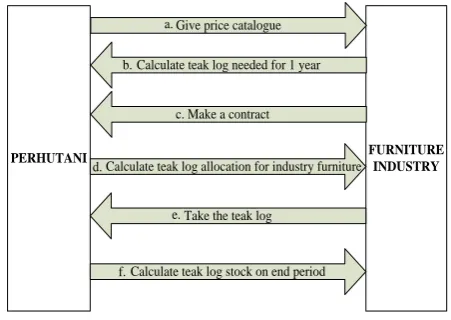
economical, ecological, and social aspects. Analyzing business process between PP and VSU will help exploring the problem. Business process between PP and VSU is shown by Fig. 1.
PERHUTANI FURNITURE
INDUSTRY Give price catalogue
Calculate teak log needed for 1 year
Make a contract
Calculate teak log allocation for industry furniture
Take the teak log
Calculate teak log stock on end period a.
b.
c.
d.
e.
f.
[image:2.595.54.280.138.298.2]
Fig. 1. The business process of PP – furniture industry relationship.
PP gives price catalogue for furniture industry (a). Next, furniture industry forecasts and calculates the demand of teak log for 1 year production (b). Furniture industry must calculate their teak log needed accurately, because if they cannot spend their teak log until end period, they must pay penalty cost in the end of period. Then furniture industry gives the teak log needed to PP and makes a contract (c). PP calculates teak log allocation for all of industry furniture (d). Furniture industry must take their order on the right schedule (e). On the end period, PP calculates the teak log stock in furniture industry to calculate the penalty cost from furniture industry (f).
In this model, we take a case study by PP as a supplier as well as VSU Company as a manufacturer. Therefore we consider economic variable, ecological variable, and social variable. So we develop six goals that can be categorized in three main objectives.
From the supplier side, we develop three goals. The first goal comes from economic variable, which does maximize PP’s profit. The second goal is about ecological variable that does maximize conserved forest. The third goal is about social variable that does maximize PP’s CSR which must be taken out by PP.
In the other hand, we also develop three goals from the manufacturer side. The fourth goal comes from economic variable that does maximize profit. The fifth goal is about ecological variable, which does maximize waste selling to minimize dispose waste. The last goal is about social variable, which does maximize PPE for the VSU’s employees. The six goals are shown by Fig. 2.
Sustainable Supply Chain
Economic Ecological Social
Goal 1 Maximization PP’s
profit
Goal 2 Maximization VSU’s
profit
Goal 3 Maximization PP’s
conserved forest
Goal 4 Maximization VSU’s
waste selling
Goal 6 Maximization PPE for
VSU’s employee Goal 5
Maximization PP’s CSR
Fig. 2. The six goals of sustainable supply chain.
Thus, in this paper will develop a relationship model between supplier (PP) and manufacturer (VSU) on teak log procurement with sustainability considerations. This model is expected give win-win solution for PP as a supplier and VSU and manufacturer.
III. MATHEMATICAL MODELLING
Based on the above description, this paper consider three aspects and its mean the model will be developed is multi objectives. Goal Programming (GP) is a suitable tool for decision maker to analyze the achievement of the desired goals considering different and sometimes conflicting multiple objectives.
A. Index and Notation
The notations in the formulation will be described and all of the cost parameters are measured in Indonesia Domestic Rupiah (IDR). The notations of parameters and decision variables below:
Parameters:
o t
C Planting cost in period t (IDR/ha)
p t
C Maintenance cost in period t (IDR/ha)
v t
C Harvesting cost in period t (IDR/ha)
tk t
C Labor cost in period t (IDR/m3
)
b t
C Overhead cost in period t (IDR/m3)
h jt
C Inventory holding cost for type j in period t (IDR/m3
)
l jt
P Selling price of teak log in period t (IDR/m3
)
v kt
P Selling price of furniture in period t (IDR/m3
)
s t
P Selling price of waste in period t (IDR/m3
)
CSRt CSR cost paid by PP in period t (IDR)
Gt PPE cost in period t (IDR)
Lt Waste sold by VSU in period t (IDR)
TPPt Total profit of PP in period t (IDR)
TPVSU t Total profit VSU in period t (IDR)
Β Percentage of CSR cost
γj Conversion value from furniture to log for type j
αj Conversion value from log to waste for type j
ni Negative deviation of function i
pi Positive deviation of function i
bi Desired value of function i
Decision variables:
At Planted forest area (ha)
Bt Conserved forest area (ha)
Ct Harvested forest area (ha)
qjt Teak log sold by PP type j in period t (m
3
)
Qjt Teak log bought by VSU type j in period t (m
3
)
Vkt Furniture sold by VSU type k in period t (m
3
[image:2.595.46.289.692.774.2]B. Objective Function
There are three aspects considered in this paper and in this paper there are two entities, PP as a supplier and VSU as manufacturer. The six objective functions will cover all aspects from two entities.
12
1
t TP
Pt =
12
1
t
3 1 j l jt P q
jt -
12 1 t o t
C At -
12 1 t p t
C At -
12 1 t v t
C Ct
- 12 1 t CSR t (1)
12 1 t TPVSUt =
2
1
k
12 1 t v t P V
kt -
12
1
t
2
1
k tk t
C Vkt -
12 1 t
3 1 j l jt P Q jt - 12 1t
3 1 j h jt C Q
jt -
12
1
t
2
1 k
b t
C V
kt +
12
1
t L
t -
12
1
t G
t (2)
12
1
t B
t =
12
1
t A
t -
12
1
t C
t (3)
12
1
t L
t =
12
1
t
3
1
j s t
P
αjQjt (4)
12
1
t CSR
t =
12
1
t β TP
Pt (5)
12
1
t Gt =
12
1 t
p t
C k
t (6)
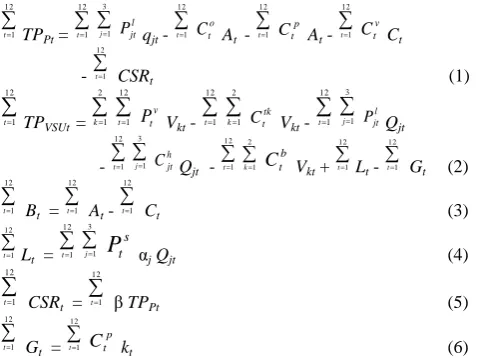
The first goal (1) is maximization of PP’s profit. The second goal (2) is maximization of furniture industry’s profit. The third goal, maximization conserved forest was expressed in (3). The fourth goal (4), maximization waste selling from furniture production. Equation (5) and (6) state social goal. Equation (5) states the fifth goal, maximization CSR from PP. The last goal (6), maximization PPE for employee safety.
C. Mathematical Formulation
The objective function is changed to soft constraint in Goal Programming (GP). The objective function is added with positive deviation, negative deviation, and desired value. The model then can be formulated as Goal Programming (GP) below:
Min ( (𝑛𝑖∈𝐼 𝑖+ 𝑝𝑖)) (7)
Subject to:
12 1 t
3 1 j l jt P qjt -
12
1
t Cto At -
12 1 t p t
C A
t -
12 1 t v t
C C
t -
12
1
t CSR
t +
n1 – p1 = b1 (8)
2 1 k
12 1 t v t P Vkt -
2
1
k
12
1
t tk t
C V
kt -
12 1 t
3 1 j l jt P Qjt -
12 1 t 3 1 j h jt C Q
jt -
2
1
k
12
1
t b t
C V
kt +
12
1
t L
t –
12
1
t G
t + n2 – p2 = b2 (9)
12
1
t A
t -
12
1
t C
t + n3 – p3 = b3 (10)
12 1 t s tP α
jQjt + n4 – p4 = b4 (11)
12
1
t β TP
Pt + n5 – p5 = b5 (12)
12 1 t p tC k
t + n6 – p6 = b6 (13)
12
1
t
3
1
j Q
j(t-1) – γjQjt + Qjt ≤ 1000 (14)
12 1 t
3 1 j Qjt - γjQjt = 0 (15)
12
1
t A
t + Bt - Ct ≤ 446790 (16)
Where niand pi are defined as preferential weight, negative deviational variable, and positive deviational of the goal, bi denote the target level for each goal respectively. In this paper the number of goals is six. Some literatures defined (7) as the achievement function, which must be minimized to ensure that the solution is closely as possible to the desired goals [13].
IV. SOLUTION METHOD,NUMERICAL EXAMPLE, AND RESULTS
In this computational study, we analyze the impact of the changes in parameters in the supplier-manufacturer relationship model between PP and VSU considering several goals that must be achieved.
A. Solution Method
The algorithm used to solve the GP formulation was simplex method. The algorithm to solve this model is given by Fig. 3.
Start
Determine initial target level for all goals
Apply Simplex to minimize deviation variable
All goals satisfied?
Stop
[image:3.595.47.286.125.304.2]Adjust the target level for goal which the biggest deviation
Fig. 3. Solution procedure for solving a mathematical model.
B. Numerical Example
In order to illustrate the capabilities of the proposed-model, a numerical example has been done. All parameter cost used for the computational study is presented in Table I. The conversion value from furniture to log and conversion value from log to waste can be seen in Table II and Table III. The furniture demand is shown in Table IV. The furniture price and teak log price can be seen in Table V and Table VI. The PPE price is shown in Table VII.
TABLE I PARAMETER COST
Parameter Quantity Units Planting cost 43,329,000.00 IDR/ha Maintanance cost 160,500.00 IDR/ha Harvesting cost 16,785,300.00 IDR/ha Labor cost 2,230,400.00 IDR/m3
Overhead cost 1,500,000.00 IDR/m3
TABLE II
CONVERSION VALUE FROM FURNITURE TO LOG
Furniture Type Log Type Conversion Value
GF AIII 5.2
GF AII 20
Indoor AIII 12.2
Indoor AII 4.95
TABLE III
CONVERSION VALUE FROM LOG TO WASTE
Furniture Type Log Type Conversion Value
GF AIII 80.8%
GF AII 95%
Indoor AIII 91.8%
Indoor AII 79.8%
TABLE IV FURNITURE DEMAND
Period GF Indoor Units
1 0 19.63 m3
2 8.74 15.44 m3
3 7.39 8.74 m3
4 0 12.30 m3
5 4.68 0 m3
6 4.52 3.22 m3
7 9.68 14.71 m3
8 8.93 22.25 m3
9 0 9.77 m3
10 0 0 m3
11 16.56 13.98 m3
12 0 7.43 m3
TABLE V FURNITURE PRICE
Type Price Units
Indoor 27,750,000.00 IDR/m3 GF 37,000,000.00 IDR/m3
TABLE VI TEAK LOG PRICE
Type Price Holding Cost Units AII 3,158,000.00 94,740.00 IDR/m3
AIII 7,144,000.00 214,320.00 IDR/m3
TABLE VII PPEPRICE
PPE Price Units Level
a) Mask 9,000.00 IDR 1 (a) b) Helmet 15,000.00 IDR 2 (a+b) c) Safety shoes 300,000.00 IDR 3 (a+b+c)
d) Gloves 8,500.00 IDR 4 (a+b+c+d) e) Earplugs 32,000.00 IDR 5 (a+b+c+d+e)
C. Results
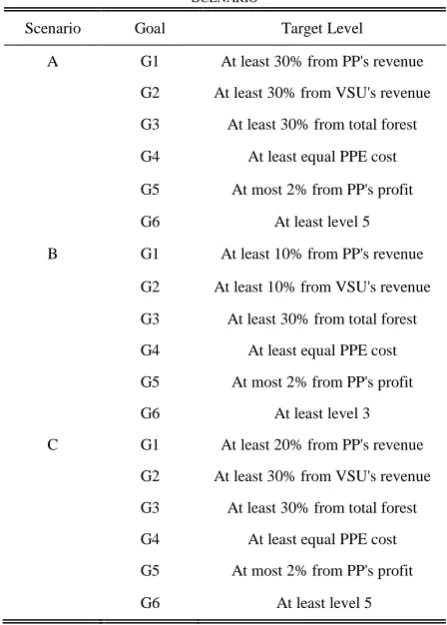
[image:4.595.314.538.461.774.2]There are 3 scenarios that can be run to get the best result. The scenarios are shown in Table VIII. We set scenario A to optimistic target level, scenario B to pessimistic target level, while scenario C to normal target level. The best scenario must satisfy all of goals. The results of scenario A, B, and C can be seen on Table IX.
TABLE VIII SCENARIO
Scenario Goal Target Level
A G1 At least 30% from PP's revenue G2 At least 30% from VSU's revenue G3 At least 30% from total forest G4 At least equal PPE cost G5 At most 2% from PP's profit G6 At least level 5 B G1 At least 10% from PP's revenue
G2 At least 10% from VSU's revenue G3 At least 30% from total forest G4 At least equal PPE cost G5 At most 2% from PP's profit G6 At least level 3 C G1 At least 20% from PP's revenue
G2 At least 30% from VSU's revenue G3 At least 30% from total forest G4 At least equal PPE cost G5 At most 2% from PP's profit
TABLE IX RESULTS FROM ALL SCENARIOS
Scenario Goal Target Level Achieved Value Satisfied A G1 945,201,862.00
945,201,900.00 Yes G2 1,732,601,140.00
1,225,865,000.00 No G3 134,037 ≥ 134,037 Yes G4 24,786,000.00
248,286,297.00 Yes G5 18,904,037.00
18,904,000.00 Yes G6 24,786,000.00
24,786,000.00 Yes B G1 315,067,287.00
315,067,300.00 Yes G2 577,533,700.00
577,533,700.00 Yes G3 134,037 ≥ 134,037 Yes G4 22,032,000.00
248,286,297.00 Yes G5 6,301,345.00
6,301,345.00 Yes G6 22,032,000.00
22,302,000.00 Yes C G1 945,201,862.00
945,201,900.00 Yes G2 1,155,067,000.00
1,155,067,000.00 Yes G3 134,037 ≥ 134,037 Yes G4 24,786,000.00
248,286,297.00 Yes G5 18,904,037.00
18,904,000.00 Yes
G6 24,786,000.00
24,786,000.00 Yes
To illustrate the capabilities of the model, we take real data from PP and furniture manufacturers in Central Java. Teak forest stand area in PP is estimated about 447,690 ha, and only 313,383 ha can be harvested. The remaining forest area is categorized as conserved forest and prohibited to be harvested i.e. its age is below 20 years. However, based on the government regulation, the minimum area of forest must cover at least 30% of area within. As a consequence, decision makers set the target level of forest area that must be harvested at most 313,383 ha.
In optimistic scenario A, all goals set by decision makers are satisfied except G2. G2 refers to VSU’s profit, it’s mean that the target level for VSU’s profit is too large. In order to do so, decision makers can adjust the target level set in scenario A.
Scenario B is one alternate solution which its target level is lower than the scenario A. It can be seen in Table VIII that all target levels are lowered, except G3, G4, and G5. G3 refers to goal set by decision makers to comply with government regulation about forest area that must be conserved by PP. G4 refers to goal set by decision makers that VSU’s revenue from waste selling is used for buying PPE. G5 refers to goal set by decision makers to comply with goverment regulation about CSR. The result from scenario B is all goals are satisfied. However, the achieved value is lower than target value so the decision makers can improve the target level until the achieved value is approaching the target value and the goal is still satisfied.
Pareto efficient solution for GP formulation can be seen in scenario C. It can be seen that all goals are satisfied. It is the best scenario because if the target levels are increased, the goals will not be satisfied. From the result, the PP’s profit is IDR 945,201,900.00 and the VSU’s profit is IDR 1,155,067,000.00. The harvested forest is less than 30% of total forest so it is not violate the goverment regulation. The VSU’s revenue from waste selling can be used for buying PPE. CSR cost that must be taken out by PP is IDR 6,301,345.00. All of PPE can be bought by VSU for improving employee safety.
V.CONCLUSION
In this paper, we develop a relationship model between supplier and manufacturer with sustainability considerations. The model can determine the value of decision variables consist of planted forest area, conserved forest area, harvested forest area, teak log sold by supplier, teak log bought by manufacturer, and furniture sold by manufacturer. The proposed model can be used to determine the six goals for securing availability of teak log in export oriented furniture industry with sustainability considerations.
Further research can be conducted in adding more criteria of each aspects of sustainability. Another research topic is supplier selection with considering aspects of sustainability.
ACKNOWLEDGMENT
Thanks to the Perum Perhutani Unit I Central Java and CV. Valasindo Sentra Usaha which have been partners in the research project.
REFERENCES
[1] A. O. T. Devi, Model for Determine Material Purchasing Quantity and inventory in CV. Valasindo Sentra Usaha (Model Penentuan Jumlah Pembelian dan Persediaan Bahan Baku di CV. Valasindo Sentra Usaha), Undergraduate Thesis in Industrial Engineering Department at Sebelas Maret University, Indonesia, 2010, in Bahasa Indonesia. [2] Antara (1991, May 10). Export Furniture Indonesia Still Decline
(Ekspor Furnitur Indonesia Masih Menurun). [Online]. Available: www.news.tentangkayu.com (Accessed on 03 Aug. 2010), in Bahasa Indonesia.
[3] Regulation Number 1 of 1970 the Republic of Indonesia concerning on Work Healthy (Undang-Undang tentang Keselamatan dan Kesehatan Kerja No. 1 Tahun 1970), in Bahasa Indonesia.
[4] M. Hisjam, A. D. Guritno, H. Simon, and S. D. Tandjung, “A Framework for The Development of Sustainable Supply Chain Management for Business Sustainability of Export-Oriented Furniture Industry in Indonesia (A Case Study of Teak Wooden Furniture in Central Java Province),” in Proc. of the 1st International Conference on Industrial Engineering and Service Science, Indonesia, September, 2011.
[5] Regulation Number 6 of 2007 the Republic of Indonesia concerning on Forest Governance, Development of Forest Management, and Utilization of Forest (Undang-Undang tentang Manajemen Pengembangan Hutan dan Fungsi Hutan No. 6 Tahun 2007), in Bahasa Indonesia.
[6] Regulation Number 19 of 2003 the Republic of Indonesia concerning on State-Owned Enterprises (Undang-Undang tentang BUMN No. 19 Tahun 2003), in Bahasa Indonesia.
[7] M. Hisjam, A. D. Guritno, H. Simon, and S. D. Tandjung, “The Development of Sustainable Supply Chain Model of The Relationship Between Wood Supplier with Furniture Industry in Indonesia: A Case Study,” in Proc. of IGSCI, Indonesia, November, 2011.
[9] K. Ginoga, Y. C. Wulan, D. Djaennudin, “Carbon and Its Role in Enhancing Economic Value of Teak Plantation in Saradan Forest Resort, East Java (Karbon dan Peranannya dalam Meningkatkan Kelayakan Usaha Hutan Tanaman Jati di KPH Saradan, Jawa Timur)”,
Social and Economic Research Journal, vol. 2, no. 2, pp. 183-302 , July. 2005, in Bahasa Indonesia.
[10] Regulation Number 9 of 2005 the Republic of Indonesia concerning on Small-Medium Enterprises (Undang-Undang tentang UKM No. 9 Tahun 2003), in Bahasa Indonesia.
[11] Z. Zhou, S. Cheng, and B. Hua, “Supply Chain Optimization of Continuous Process Industries with Sustainability Considerations”,
Computers and Chemical Engineering, vol. 24, pp. 1151–11158, 2000. [12] B. Centikaya, R. Cuthbertson, G. Ewer, T. Klass-Wissing, W.
Piotrowicz, and C. Tyssen, Sustainable Supply Chain Management : Practical Ideas for Moving Towards Best Practice, Springer. 2011. [13] D. Jonez and M. Tamiz, “Practical Goal Programming”, International