Proceedings of the Fourth Conference on Machine Translation (WMT), Volume 1: Research Papers, pages 1–12 1
Saliency-driven Word Alignment Interpretation for
Neural Machine Translation
Shuoyang Ding Hainan Xu Philipp Koehn Center for Language and Speech Processing
Johns Hopkins University
{dings, hxu31, phi}@jhu.edu
Abstract
Despite their original goal to jointly learn to align and translate, Neural Machine Transla-tion (NMT) models, especially Transformer, are often perceived as not learning inter-pretable word alignments. In this paper, we show that NMT models do learn interpretable word alignments, which could only be re-vealed with proper interpretation methods. We propose a series of such methods that are model-agnostic, are able to be applied either offline or online, and do not require parame-ter update or architectural change. We show that under the force decoding setup, the align-ments induced by our interpretation method are of better quality than fast-align for some systems, and when performing free decoding, they agree well with the alignments induced by automatic alignment tools.
1 Introduction
Neural Machine Translation (NMT) has made lots of advancements since its inception. One of the key innovations that led to the largest improve-ments is the introduction of the attention
mecha-nism (Bahdanau et al.,2014;Luong et al.,2015),
which jointly learns word alignment and
transla-tion. Since then, the attention mechanism has
gradually become a general technique in various
NLP tasks, including summarization (Rush et al.,
2015; See et al., 2017), natural language
infer-ence (Parikh et al., 2016) and speech recognition
(Chorowski et al.,2015;Chan et al.,2016). Although word alignment is no longer a integral step like the case for Statistical Machine
Transla-tion (SMT) systems (Brown et al., 1993;Koehn
et al., 2003), there is a resurgence of interest in the community to study word alignment for NMT models. Even for NMT, word alignments are use-ful for error analysis, inserting external vocabular-ies, and providing guidance for human translators
wir glauben nicht , daß wir nur rosinen herauspicken sollten .
we do not belie ve
that we should cherr y-pic
k
.
wir glauben nicht , daß wir nur rosinen herauspicken sollten .
we do not belie ve
that we should cherr y-pic
k
.
(a) reference (b) attention
wir glauben nicht , daß wir nur rosinen herauspicken sollten .
we do not belie ve
that we should cherr y-pic
k
.
wir glauben nicht , daß wir nur rosinen herauspicken sollten .
we do not belie ve
that we should cherr y-pic
k
.
(c) word saliency (d) word saliency with SmoothGrad
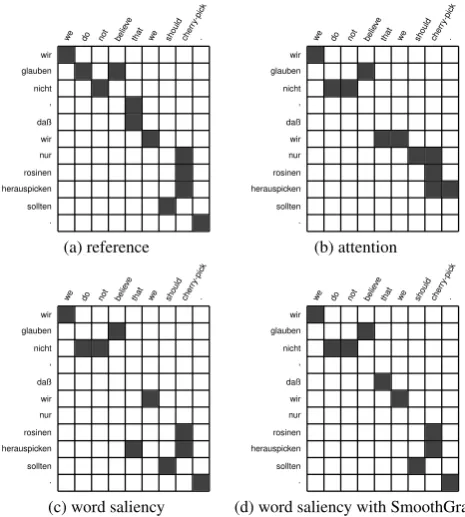
Figure 1: Comparison of our saliency-based word alignment interpretation of convolutional NMT model with reference and attention interpretation.
in computer-aided translation. When aiming for the most accurate alignments, the state-of-the-art
tools include GIZA++ (Brown et al., 1993; Och
and Ney,2003) and fast-align (Dyer et al.,2013), which are all external models invented in SMT era and need to be run as a separate post-processing step after the full sentence translation is complete. As a direct result, they are not suitable for analyz-ing the internal decision processes of the neural machine translation models. Besides, these mod-els are hard to apply in the online fashion, i.e. in the middle of left-to-right translation process, such as the scenario in certain constrained decoding
al-gorithms (Hasler et al., 2018) and in
computer-aided translation (Bouma and Parmentier, 2014;
[image:1.595.294.527.221.480.2]For these cases, the current common practice is to simply generate word alignments from attention weights between the encoder and decoder.
How-ever, there are problems with this practice.Koehn
and Knowles (2017) showed that attention-based word alignment interpretation may be subject to
“off-by-one” errors. Zenkel et al. (2019); Tang
et al. (2018b); Raganato and Tiedemann (2018) pointed out that the attention-induced alignment is particularly noisy with Transformer models.
Be-cause of this, some studies, such asNguyen and
Chiang (2018); Zenkel et al. (2019) proposed ei-ther to add extra modules to generate higher qual-ity word alignments, or to use these modules to further improve the model performance or inter-pretability.
This paper is a step towards interpreting word alignments from NMT without relying on exter-nal models. We argue that using only attention weights is insufficient for generating clean word alignment interpretations, which we demonstrate both conceptually and empirically. We propose to
use the notion of saliency to obtain word
align-ment interpretation of NMT predictions.
Dif-ferent from previous alignment models, our
pro-posal is a pure interpretation method and does
not require any parameter update or architecture change. Nevertheless, we are able to reduce Align-ment Error Rate (AER) by 10-20 points over the attention weight baseline under two evaluation
set-tings we adopt (see Figure1for an example), and
beat fast-align (Dyer et al., 2013) by as much as
8.7 points. Not only have we proposed a superior model interpretation method, but our empirical re-sults also uncover that, contrary to common be-liefs, architectures such as convolutional
sequence-to-sequence models (Gehring et al.,2017) have
al-ready implicitly learned highly interpretable word alignments, which sheds light on how future im-provement should be made on these architectures.
2 Related Work
We start with work that combines word alignments with NMT. Research in this area generally falls into one of three themes: (1) employing the no-tion of word alignments to interpret the predicno-tion of NMT; (2) making use of word alignments to im-prove NMT performance; (3) making use of NMT to improve word alignments. We mainly focus on related work in the first theme as this is the problem we are addressing in this work. Then we
briefly introduce work in the other themes that is relevant to our study. We conclude by briefly sum-marizing related work to our proposed interpreta-tion method.
For the attention in RNN-based sequence-to-sequence model, the first comprehensive analysis
is conducted byGhader and Monz(2017). They
argued that the attention in such systems agree with word alignment to a certain extent by show-ing that the RNN-based system achieves compara-ble alignment error rate comparacompara-ble to that of bi-directional GIZA++ with symmetrization. How-ever, they also point out that they are not exactly the same, as training the attention with alignments would occasionally cause the model to forget
im-portant information. Lee et al. (2017) presented
a toolkit that facilitates study for the attention in RNN-based models.
There is also a number of other studies that
an-alyze the attention in Transformer models. Tang
et al. (2018a,b) conducted targeted evaluation of neural machine translation models in two different evaluation tasks, namely subject-verb agreement and word sense disambiguation. During the anal-ysis, they noted that the pattern in Transformer
model (what they refer to as advanced attention
mechanism) is very different from that of the at-tention in RNN-based architecture, in that a lot of the probability mass is focused on the last input to-ken. They did not dive deeper in this phenomenon
in their analysis. Raganato and Tiedemann(2018)
performed a brief but more refined analysis on each attention head and each layer, where they no-ticed several different patterns inside the modules, and concluded that Transformer tends to focus on local dependencies in lower layers but finds long dependencies on higher ones.
Beyond interpretation, in order to improve the
translation of rare words, Nguyen and Chiang
(2018) introduced LexNet, a feed-forward
neu-ral network that directly predicts the target word from a weighted sum of the source embeddings, on top of an RNN-based Seq2Seq models. Their goal was to improve translation output and hence they did not empirically show AER improvements on manually-aligned corpora. There are also a few other studies that inject alignment
supervi-sion during NMT training (Mi et al., 2016; Liu
et al., 2016). In terms of improvements in word
alignment quality, Legrand et al. (2016); Wang
neu-ral word alignment modules decoupled from NMT
systems, whileZenkel et al. (2019) introduced a
separate module to extract alignment from NMT decoder states, with which they achieved compara-ble AER with fast-align with Transformer models. The saliency method we propose in this work draws its inspiration from visual saliency proposed by Simonyan et al. (2013); Springenberg et al.
(2014);Smilkov et al.(2017). It should be noted that these methods were mostly applied to com-puter vision tasks. To the best of our knowledge,
Li et al. (2016) presented the only work that di-rectly employs saliency methods to interpret NLP
models. Most similar to our work in spirit, Ding
et al. (2017) used Layer-wise Relevance
Propa-gation (LRP; Bach et al. 2015), an interpretation
method resembling saliency, to interpret the in-ternal working mechanisms of RNN-based neural machine translation systems. Although conceptu-ally LRP is also a good fit for word alignment inter-pretation, we have some concerns with the mathe-matical soundness of LRP when applied to atten-tion models. Our proposed method is also consid-erably more flexible and easier to implement than LRP.
3 The Interpretation Problem
Formally, by interpreting model prediction, we
are referring to the following problem: given
a trained MT model and input tokens S =
{s0, s1, . . . , sI−1}, at a certain time step j when
the models predicts tj, we want to know which
source word inS “contributed” most to this
pre-diction. Note that the prediction tj might not be
arg maxtjp(tj | t1:j−1), as the locally optimal
option may be pruned during beam search and not end up in the final translation.
Under this framework, we can see an impor-tant conceptual problem regarding interpreting at-tention weights as word alignment. Suppose for the same source sentence, there are two alternative
translations that diverge at target time stepj,
gen-eratingtjandt′j which respectively correspond to
different source words. Presumably, the source
word that is aligned to tj andt′j should changed
correspondingly. However, this is not possible
with the attention weight interpretation, because
the attention weight is computedbeforeprediction
oftj ort′j. With that, we argue that an ideal
inter-pretation algorithm should be able to adapt the in-terpretation with the specified output label,
regard-less of whether it is the most likely label predicted by the model.
As a final note, the term “attention weights” here refers to the weights of the attention between encoder and decoder (the “encoder-decoder
atten-tion” inVaswani et al.(2017)). Specifically, they
do not refer to the weight of self-attention
mod-ules that only exist in the Transformer architec-ture, which do not establish alignment between the source and target words.
4 Method
Our proposal is based on the notion of visual
saliency (Simonyan et al., 2013) in computer
vi-sion. In brief, the saliency of an input feature is defined by the partial gradient of the output score with regard to the input. We propose to extend this idea to NMT by drawing analogy between input pixels and the embedding look-up operation.
4.1 Visual Saliency
Suppose we have an image classification example
(x0, y0), withy0 being a specific image class and
x0 being an |X |-dimensional vector. Each entry
ofx0 is an input feature (i.e., a pixel) to the
clas-sifier. Given the inputx0, a trained classifier can
generate a prediction score for class y0, denoted
asp(y0 | x0). Consider the first-order Taylor
ex-pansion of a perturbed version of this score at the
neighborhood of inputx0:
p(y0|x)≈p(y0 |x0) +
∂p(y0 |x)
∂x
x0
·(x−x0)
(1)
This is essentially re-formulating the perturbed
prediction score p(y0 | x) as an affine
approxi-mation of the input features, while the “contribu-tion” of each feature to the final prediction being the partial derivative of the prediction score with regard to the feature. Assuming a feature that is deemed as salient for the local perturbation of the prediction score would also be globally salient, the saliency of an input feature is defined as follows:
Definition 1 Denoted asΨ(x, y), the saliency of feature vectorx with regard to output class y is
defined as ∂p(y|x)
∂x .
Note that Ψ(x, y) is also a vector, with each
en-try corresponding to the saliency of a single input
feature inx. Such formulation has following nice
• The saliency of an input feature is related to the
choice of output classy, as model scores of
dif-ferent output classes correspond to a difdif-ferent set of parameters, and hence resulting in differ-ent partial gradidiffer-ents for the input features. This makes up for the aforementioned deficiency of attention weights in addressing the interpreta-tion problem.
• The partial gradient could be computed by back-propagation, which is efficiently imple-mented in most deep learning frameworks.
• The formulation is agnostic to the model that
generates p(y | x), so it could be applied to
any deep learning architecture.
4.2 Word Saliency
In computer vision, the input feature is a 3D Ten-sor corresponding to the level in each channel. The key question to apply such method to NMT is what
constitutes the input feature to a NMT system. Li
et al. (2016) proposed to use the embedding of of the input words as the input feature to formu-late saliency score, which results in the saliency of an input word being a vector of the same di-mension as embedding vectors. To obtain a scalar saliency value, they computed the mean of the ab-solute value of the embedding gradients. We argue that there is a more mathematically principled way to approach this.
To start, we treat the word embedding look-up operation as a dot product between the embedding
weight matrix W and an one-hot vector z. The
size ofzis the same as the source vocabulary size.
Similarly, the input sentence could be formulated
as a matrix Zwith only 0 and 1 entries. Notice
thatzhas certain resemblance to the pixels of an
image, with each cell representing the pixel-wise activation level of the words in the vocabulary. For
the output wordtjat time stepj, we can similarly
define the saliency of the one-hot vectorzas:
Ψ(z, tj) = ∂p(tj |Z)
∂z (2)
wherep(tj |Z)is the probability of wordtj
gener-ated by the NMT model given source sentenceZ.
Ψ(z, tj)is a vector of the same size asz.
However, note that there is a key difference
be-tweenzand pixels. If the pixel level is 0, it means
that the pixel is black, while a 0-entry inzmeans
that the input word is not the word denoted by the corresponding cell. While the black region of
an input image may still carry important informa-tion, we are not interested in the saliency of the
0-entries inz.1 Hence, we only take the 1-entries
of matrixZas the input to the NMT model. For a
source wordsi in the source sentence, this means
we only care about the saliency of the 1-entries,
i.e., the entry corresponding to source wordsi:
ψ(si, tj) =
[
∂p(tj |Z) ∂z
]
si
=
[
∂p(tj |Z)
∂Wsi
·∂Wsi ∂z
]
si
=
[
∂p(tj |Z)
∂Wsi ·W
]
si
= ∂p(tj |Z)
∂Wsi
·Wsi (3)
where[·]idenotes thei-th row of a matrix or thei
-th element of a vector. In o-ther words, -the saliency
ψ(si, tj) is a weighted sum of the word
embed-ding of input wordsi, with the partial gradient of
each cell as the weight. By comparison, the word
saliency2inLi et al.(2016) is defined as:
ψ′(si, tj) =mean(∂p(tj |Z)
∂Wsi
) (4)
There are two implementation details that we would like to call for the reader’s attention:
• When the same word occurs multiple times in the source sentence, multiple copies of embed-ding for such word need to be made to ensure that the gradients flowing to different instances of the same word are not merged;
• Note thatψ(si, tj)is not a probability
distribu-tion, which does not affect word alignment
re-sults because we are takingarg max. For
visu-alizations presented herein, we normalized the
distribution by p(si |tj) ∝ max(0, ψ(si, tj)).
One may also use softmax function for appli-cations that need more well-formed probability distribution.
1
Although we introducezto facilitate presentation, note that word embedding look-up is never implemented as a ma-trix multiplication. Instead, it is implemented as a table look-up, so for each input word, only one row of the word em-bedding is fed into the subsequent computation. As a con-sequence, during training, since the other rows are not part of the computation graph, only parameters in the rows cor-responding to the 1-entries will be updated. This is another reason why we choose to discard the saliency of 0-entries.
4.3 SmoothGrad
There are two scenarios where the naïve gradient-based saliency may make mistakes:
• For highly non-linear models, the saliency ob-tained from local perturbation may not be a good representation of the global saliency. • If the model fits the distribution nearly
per-fectly, some data points or input features may
becomesaturated, i.e. having a partial gradient
of 0. This does not necessarily mean they are not salient with regard to the prediction.
We alleviate these problems with SmoothGrad,
a method proposed bySmilkov et al.(2017). The
idea is to augment the input to the network inton
samples by adding random noise generated by
nor-mal distributionN(0, σ2). The saliency scores of
each augmented sample are then averaged to can-cel out the noise in the gradients.
We made one small modification to this method in our experiments: rather than adding noise to the word inputs that are represented as one-hot vec-tors, we instead add noise to the queried embed-ding vectors. This allows us to introduce more randomness for each word input.
5 Experiments
5.1 Evaluation Method
The best evaluation method would compare pre-dicted word alignments against manually labeled word alignments between source sentences and NMT output sentences, but this is too costly for our study. Instead, we conduct two automatic eval-uations for our proposed method using resources available:
• force decoding: take a human-annotated cor-pus, run NMT models to force-generate the target side of the corpus and measure AER against the human alignment;
• free decoding: take the NMT prediction, ob-tain reasonably clean reference alignments be-tween the prediction and the source and
mea-sure AER against this reference.3
Notice that both automatic evaluation methods have their respective limitation: the force decod-ing method may force the model to predict some-thing it deems unlikely, and thus generating noisy
3Our reference alignment construction process is as
fol-lows: we first run automatic alignment on both sides, and take the intersection of the two outputs as “sure” alignments and the rest as “possible” alignments.
alignment; whereas the free decoding method lacks authentic references.
5.2 Setup
We follow Zenkel et al. (2019) in data setup
and use the accompanied scripts of that paper4
for preprocessing. Their training data consists
of 1.9M, 1.1M and 0.4M sentence pairs for German-English (de-en), English-French (en-fr) and Romanian-English (ro-en) language pairs, re-spectively, whereas the manually-aligned test data contains 508, 447 and 248 sentence pairs for each language pair. There is no development data pro-vided in their setup, and it is not clear what they used for NMT system training, so we set aside the last 1,000 sentences of the training data for each language as the development set.
For our NMT systems, we use fairseq5 to
train attention-based RNN systems (LSTM) (
Bah-danau et al.,2014), convolution systems (FConv) (Gehring et al., 2017), and Transformer systems (Transformer) (Vaswani et al., 2017). We use the pre-configured model architectures for IWSLT
German-English experiments6 to build all NMT
systems. Our experiments cover the following in-terpretation methods:
• Attention: directly take the attention weights as soft alignment scores. For transformer, we fol-low the implementation in fairseq and used the attention weights from the final layer averaged across all heads;
• Smoothed Attention: obtain multiple version of attention weights with the same data augmen-tation procedure as SmoothGrad and average them. This is to prove that smoothing itself does not improve the interpretation quality, and has to be used together with effective interpre-tation method;
• (Li et al., 2016): applied with normal
back-propagation (Grad) andSmoothGrad;
• Ours: applied with normal back-propagation
(Grad) andSmoothGrad.
For all the methods above, we follow the same
pro-cedure in (Zenkel et al.,2019) to convert soft
align-ment scores to hard alignalign-ment.
4
https://github.com/lilt/alignment-scripts 5
https://github.com/pytorch/fairseq 6The exact model options we used are
de<>en fr<>en ro<>en de-en en-de bidir en-fr fr-en bidir ro-en en-ro bidir
FConv
Attention 38.5 40.1 37.5 23.8 27.4 22.0 40.9 38.6 39.1
Smoothed Attention 40.2 43.9 41.2 24.1 27.4 22.5 41.5 39.6 40.4 (Li et al.,2016) Grad 39.0 39.6 35.3 26.8 29.2 21.1 41.9 42.1 38.6 (Li et al.,2016) SmoothGrad 40.7 44.5 39.3 27.3 28.1 21.6 43.5 43.5 40.0
Ours Grad 33.1 40.5 26.8 25.2 22.7 11.9 37.1 39.4 29.8
Ours SmoothGrad 27.3 33.0 22.3 21.2 18.1 8.5 32.4 34.2 27.2 LSTM
Attention 42.8 47.5 36.9 33.7 38.0 25.8 47.1 47.0 40.9
Smoothed Attention 47.3 50.7 40.0 35.4 40.2 27.5 50.7 50.2 43.5 (Li et al.,2016) Grad 41.0 43.9 33.5 32.9 37.1 23.5 44.5 44.9 37.5 (Li et al.,2016) SmoothGrad 39.4 43.1 31.5 32.2 36.2 22.0 45.7 46.8 37.7
Ours Grad 47.5 50.2 38.6 41.1 41.6 30.4 54.2 55.8 42.8
Ours SmoothGrad 31.4 36.8 23.7 27.2 25.0 13.8 40.4 39.9 32.0 Transformer
Attention 53.4 58.6 42.3 48.1 48.7 33.8 51.6 51.1 43.3
Smoothed Attention 55.8 56.1 48.6 42.5 47.5 32.9 57.5 57.6 51.5 (Li et al.,2016) Grad 51.1 56.2 43.7 43.6 47.9 39.9 46.7 48.4 35.5 (Li et al.,2016) SmoothGrad 36.4 45.8 30.3 27.0 25.5 15.6 41.3 39.9 33.7
Ours Grad 77.7 78.2 77.4 69.1 72.5 74.5 74.6 75.2 71.0
Ours SmoothGrad *36.4 43.0 *29.0 29.7 25.9 15.3 41.2 41.4 32.7
fast-align Offline 28.4 32.0 27.0 16.4 15.9 10.5 33.8 35.5 32.1 fast-align Online 30.8 34.4 30.0 18.8 16.8 13.6 37.1 41.1 35.9 (Zenkel et al.,2019) 26.6 30.4 21.2 23.8 20.5 10.0 32.3 34.8 27.6
[image:6.595.107.493.65.386.2]GIZA++ 21.0 23.1 21.4 8.0 9.8 5.9 28.7 32.2 27.9
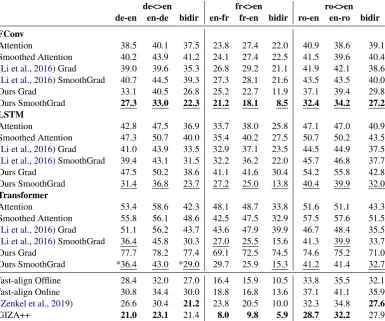
Table 1: Alignment Error Rate (AER) with different saliency methods, underforce decodingsetting. GIZA++ and fast-align Offline results are quoted fromZenkel et al.(2019), whereas fast-align Online stands for our online alignment result (c.f. Section5.2).bidirrefers to the symmetrized alignment results. Best results for each architec-ture are marked with underlines, and best interpretation/alignment results are respectively marked with boldface. Numbers affected by hyper-parameter tuning are marked with *.
For force decoding experiments, we
gener-ate symmetrized alignment results with
grow-diag-final. We also include AER results7 of
fast-align (Dyer et al., 2013), GIZA++8 and the
best model (Add+SGD) fromZenkel et al.(2019)
on the same dataset for comparison. However,
the readers should be aware that there are certain caveats in this comparison:
• All of these models are specifically designed and optimized to generate high-quality
align-ments, while our method is an interpretation
method and is not making any architecture modifications or parameter updates;
• fast-align and GIZA++ usually need to update model with full sentence to generate optimal
alignments, while our system andZenkel et al.
(2019) can do so on-the-fly.
7
We reproduced the fast-align results as a sanity check and we were able to perfectly replicate their numbers with their released scripts.
8https://github.com/moses-smt/giza-pp
Realizing the second caveat, we also run
fast-align under theonlinealignment scenario, where
we first train a fast-align model and decode on the test set. This is a real-world scenario in
applica-tions such as computer-aided translation (Bouma
and Parmentier, 2014;Arcan et al., 2014), where we cannot practically update alignment models on-the-fly. On the other hand, we believe this is a slightly better comparison for methods with online
alignment capabilities such asZenkel et al.(2019)
and this work.
The data used in Zenkel et al. (2019) did not
provide a manually-aligned development set, so we tune the SmoothGrad hyperparameters (noise
standard deviation σ and sample sizen) on a
30-sentence subset of the German-English test data with the Transformer model. We ended up using
the recommendedσ = 0.15in the original paper
and a slightly smaller sample size n = 30 for
com-parison with previous work, we do not exclude these sentences from the reported results, we in-stead mark the numbers affected to raise caution.
5.3 Force Decoding Results
Table1shows the AER results under theforce
de-codingsetting. First, note that after applying our saliency method with normal back-propagation, AER is only reduced for FConv model but instead increases for LSTM and Transformer. The largest increase is observed for Transformer, where the AER increases by about 20 points on average. However, after applying SmoothGrad on top of that, we observe a sharp drop in AER, which ends up with 10-20 points lower than the atten-tion weight baseline. We can also see that this is not just an effect introduced by input noise, as the same smoothing procedure for attention increases the AER most of the times. To summarize, at
least under force decoding settings, our saliency
method with SmoothGrad obtains word alignment interpretations of much higher quality than the at-tention weight baseline.
As forLi et al.(2016), for FConv and LSTM
ar-chitectures, it is not only consistently worse than our method, but at times also worse than atten-tion. Besides, the effect of SmoothGrad is also not as consistent on their saliency formulation as ours. Although with the Transformer model, the
Li et al.(2016) method obtained better AER than our method under several settings, it is still pretty clear overall that the superior mathematical sound-ness of our method is translated into better inter-pretation quality.
While the GIZA++ model obtains the best
align-ment result in Table 19, most of our word
align-ment interpretation of FConv model with Smooth-Grad surpasses the alignment quality of fast-align (either Online or Offline), sometimes by as much as 8.7 points (symmetrized ro<>en result). Our
best models are also largely on-par with (Zenkel
et al., 2019). These are notable results as our method is an interpretation method and no ex-tra parameter is updated to optimize the quality
of alignment. On the other hand, this also
in-dicates that it is possible to induce high-quality
9
WhileGhader and Monz(2017) showed that the AER obtained by LSTM model is close to that of GIZA++, our experiments yield a much larger difference. We think this is largely due to the fact that we choose to train our model with BPE, whileGhader and Monz(2017) explicitly avoided doing so.
alignments from NMT model without modifying its parameters, showing that it has acquired such
information in an implicit way. Most
interest-ingly, although NMT is often deemed as perform-ing poorly under low-resource settperform-ing, our inter-pretation seems to work relatively well on ro<>en language pair, which happens to be the language pair that we have least training data for. We think this is a phenomenon that merits further explo-ration.
Besides, it can be seen that for all reported meth-ods, the overall order for the number of alignment errors is FConv < LSTM < Transformer. To our best knowledge, this is also a novel insight, as no one has analyzed attention weights of FConv with other architectures before. We can also observe that while our method is not strong enough to fully bridge the gap of the attention noise level between different model architecture, it does manage to nar-row the difference in some cases.
5.4 Free Decoding Results
Table 2 shows the result underfree decoding
set-ting. The trend in this group of experiment is
sim-ilar to Table1, except that Transformer
occasion-ally outperforms LSTM. We think this is mainly due to the fact that Transformer generates higher quality translations, but could also be partially at-tributed to the noise in fast-align reference. Also, notice that the AER numbers are also generally
lower compared to Table1under this setting. One
reason is that our model is aligning output with which it is most confident, so less noise should be expected in the model behavior. On the other hand, by qualitatively comparing the reference transla-tion in the test set and the NMT output, we find that it is generally easier to align the translation as it is often a more literal translation.
6 Analysis
6.1 Comparison with Li et al. (2016)
The main reason why the word saliency
formula-tion in Li et al.(2016) does not work as well for
word alignment is the lack of polarity in the for-mulation. In other words, it only quantifies how much the input influences the output, but does not
specifyin what waydoes the input influence. This
de-en en-de en-fr fr-en ro-en en-ro
FConv
Attention 27.4 24.2 20.7 23.6 32.5 25.6
Smoothed Attention 29.4 29.0 21.1 23.6 33.7 26.7 (Li et al.,2016) Grad 29.3 23.5 25.0 23.7 33.9 27.9 (Li et al.,2016) SmoothGrad 31.2 30.4 24.1 24.0 35.6 30.1
Ours Grad 18.2 20.0 20.2 14.3 24.9 22.8
Ours SmoothGrad 13.7 14.2 17.0 10.6 21.4 17.4 LSTM
Attention 33.6 34.6 32.5 32.3 36.5 31.7
Smoothed Attention 38.2 39.5 34.3 35.2 41.2 36.3 (Li et al.,2016) Grad 34.1 32.5 33.6 33.7 36.6 32.1 (Li et al.,2016) SmoothGrad 30.8 29.4 31.8 32.1 38.9 34.8
Ours Grad 35.9 36.7 40.2 36.3 44.1 43.1
Ours SmoothGrad 20.5 21.9 26.0 19.1 32.6 27.5 Transformer
Attention 50.2 53.0 50.4 48.5 44.9 41.9
Smoothed Attention 51.4 49.0 44.5 47.3 49.9 48.9 (Li et al.,2016) Grad 49.9 51.2 49.4 51.5 42.9 40.8 (Li et al.,2016) SmoothGrad 27.8 35.3 28.3 22.3 30.5 26.5
Ours Grad 76.7 76.6 77.1 78.9 71.9 74.0
[image:8.595.149.450.67.327.2]Ours SmoothGrad *26.6 31.0 30.0 21.4 30.0 28.2
Table 2: Alignment Error Rate (AER) with different saliency models, underfree decodingsetting. See the caption of Table1for notations.
wir glauben nicht , daß wir nur ro s inen her au sp ick en sollten .
we do not belie ve
thatwe should ch er ry - p ick .
wir glauben nicht , daß wir nur ro s inen her au sp ick en sollten .
we do not belie ve
that we should ch er ry - p ick .
(a) Li et al. (b) Ours
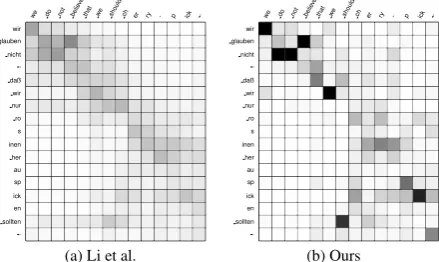
Figure 2: Saliency interpretation of FConv de-en model with the method in Li et al. (2016) and this paper. SmoothGrad (σ = 0.15,n = 30) is applied for both interpretations.
Figure 2 shows a case where this problem
oc-curs in our German-English experiments. Note
that in Subfigure (a), the source word nur has
high saliency on several target words, e.g. should,
but the word nur is actually not translated in
the reference. On the other hand, as shown in Subfigure (b), our method correctly assigns neg-ative (shown as white) or small positive values at all time steps for this source word. Specifically,
the saliency value of nur for should is negative
with large magnitude, indicating significant nega-tive contributions to the prediction of that target word. Hence, a good word alignment
interpreta-tion should strongly avoid aligning them.
6.2 SmoothGrad
Tables 1 and 2 show that SmoothGrad is a
cru-cial factor to reduce AER, especru-cially for
Trans-former. Figure 3 shows the interpretation of the
same German-English sentence pair by our pro-posed method, but with Transformer and differ-ent SmoothGrad noise levels. Specifically, Sub-figures (a) and (c) corresponds to our Grad and
SmoothGrad experiments in Table1. By
compar-ing Subfigures (a) and (c), we notice that (1) with-out SmoothGrad, the word saliency obtained from the Transformer model is extremely noisy, and (2) the output of SmoothGrad is not only a smoother version of the naïve gradient output, but also gains new information by performing extra forward and backward evaluations with the noisy input. For example, compare the alignment point between
source word wir and target word we: in
Subfig-ure (a), this word pair has very low saliency, but in (c), they become the most likely alignment pair for that target word.
Referring back to our motivation for using
SmoothGrad in Section4.3, we think the
[image:8.595.74.294.376.507.2]wir glauben nicht , daß wir nur ro s inen her au sp ick en sollten .
we do not belie ve
thatwe should ch er ry - p ick .
wir glauben nicht , daß wir nur ro s inen her au sp ick en sollten .
we do not belie ve
that we should ch er ry - p ick .
wir glauben nicht , daß wir nur ro s inen her au sp ick en sollten .
we do not belie ve
thatwe should ch er ry - p ick .
wir glauben nicht , daß wir nur ro s inen her au sp ick en sollten .
we do not belie ve
thatwe should ch er ry - p ick .
[image:9.595.75.529.63.198.2](a)σ= 0 (b)σ= 0.05 (c)σ= 0.15 (d)σ= 0.3
Figure 3: Saliency interpretation of Transformer de-en model with different SmoothGrad noise valuesσ(n= 30).
att σ= 0 σ= 0.05 σ= 0.15 σ= 0.3
FConv
force 2.09 1.36 1.48 1.89 2.59
free 2.00 1.34 1.43 1.79 2.54
LSTM
force 1.75 1.63 2.02 2.54 2.89
free 1.65 1.57 1.91 2.46 2.88
Transformer
force 1.73 1.91 2.63 2.76 2.85
free 1.69 1.89 2.62 2.74 2.84
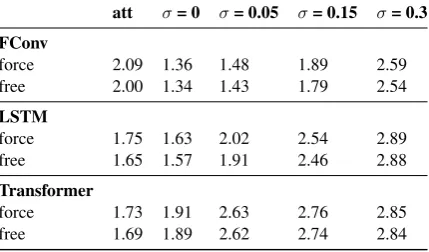
Table 3: Alignment distribution entropy for selected de-en models.attstands for attention in Table1.
poor representation of the global saliency almost all the time. On the other hand, this is also why the Transformer especially relies on SmoothGrad to work well, as the perturbation will give a better estimation of the global saliency.
It could also be observed from Subfigures (b) and (d) that when the noise is too moderate, the evaluation does not deviate enough from the orig-inal spot to gain non-local information, and at (d) it deviates too much and hence the resulting align-ment is almost random. Intuitively, the noise
pa-rameterσ should be sensitive to the model
archi-tecture or even specific input feature values, but interestingly we end up finding that a single choice from the computer vision literature works well with all of our systems. We encourage future work to conduct more comprehensive analysis of the ef-fect of SmoothGrad on more complicated architec-tures beyond convolutional neural nets.
6.3 Alignment Dispersion
We run German-English alignments under several
different SmoothGrad noise deviation σ and
re-port their dispersion as measured by entropy of the (soft) alignment distribution averaged by number of target words. Results are summarized in
Ta-ble3, where lower entropy indicates more peaky
alignments. First, we observe that dispersion of
word saliency gets higher as we increaseσ, which
aligns with the observations in Figure3. It should
also be noted that the alignment dispersion is
con-sistently lower forfree decodingthanforce
decod-ing. This verifies our conjecture that theforce
de-codingsetting might introduce more noise in the model behavior, but judging from this result, that gap seems to be minimal. Comparing different architectures, the dispersion of attention weights does not correlate well with the dispersion of word saliency. We also notice that, while the Trans-former attention interpretation consistently results in higher AER, its dispersion is lower than the other architectures, indicating that with attention, a lot of the probability mass might be concentrated in the wrong place more often. This corroborates
the finding inRaganato and Tiedemann(2018).
7 Discussion And Future Work
There are several extensions to this work that we
would like to discuss in this section. First, in
this paper we only explored two saliency
meth-ods among many others available (Montavon et al.,
2018). In our preliminary study, we also
ex-perimented with guided back-propagation (
[image:9.595.75.290.240.366.2]limitation of interpretation method on recovering interpretable word alignments, and the ambigu-ity in word alignments itself. Although we have shown that high quality alignment could be recov-ered from NMT systems (thus pushing our under-standing on the limitation of NMT models), we are not yet able to separate these sources of errors in this work. While exploration on this direction will help us better understand both NMT models and the capability of saliency methods in NLP, re-searchers may want to avoid using word alignment as a benchmark for saliency methods because of its ambiguity. For such purpose, simpler tasks with clear ground truth, such as subject-verb agreement, might be a better choice.
Finally, as mentioned before, we are only con-ducting approximate evaluation to measure the ability of our interpretation method. An imme-diate future work would be evaluating this on human-annotated translation outputs generated by the NMT system.
8 Conclusion
We propose to use word saliency and SmoothGrad to interpret word alignments from NMT predic-tions. Our proposal is model-agnostic, is able to be applied either offline or online, and does not require any parameter updates or architectural
change. Both force decoding and free decoding
evaluations show that our method is capable of generating word alignment interpretations of much higher quality compared to its
attention-based counterpart. Our empirical results also
probe into the NMT black-box and reveal that even without any special architecture or training algorithm, some NMT models have already implicitly learned interpretable word alignments of comparable quality to fast-align. The model and code for our experiments are available at
https://github.com/shuoyangd/meerkat.
Acknowledgements
The authors would like to thank Matt Post for help-ful feedback on an earlier draft of this work, and
the authors of Zenkel et al. (2019) for efforts in
making their results easily reproducible. This ma-terial is based upon work supported in part by the DARPA LORELEI and IARPA MATERIAL pro-grams.
References
Tamer Alkhouli, Gabriel Bretschner, and Hermann Ney. 2018. On the alignment problem in multi-head attention-based neural machine translation. In Pro-ceedings of the Third Conference on Machine Trans-lation: Research Papers, WMT 2018, Belgium, Brus-sels, October 31 - November 1, 2018, pages 177– 185.
Mihael Arcan, Marco Turchi, Sara Tonelli, and Paul Buitelaar. 2014. Enhancing statistical machine trans-lation with bilingual terminology in a cat environ-ment. InProceedings of the 11th Biennial Confer-ence of the Association for Machine Translation in the Americas (AMTA 2014), pages 54–68.
Sebastian Bach, Alexander Binder, Grégoire Mon-tavon, Frederick Klauschen, Klaus-Robert Müller, and Wojciech Samek. 2015. On pixel-wise explana-tions for non-linear classifier decisions by layer-wise relevance propagation. PloS one, 10(7):e0130140.
Dzmitry Bahdanau, Kyunghyun Cho, and Yoshua Bengio. 2014. Neural machine translation by
jointly learning to align and translate. CoRR,
abs/1409.0473.
Gosse Bouma and Yannick Parmentier, editors. 2014. Proceedings of the 14th Conference of the European Chapter of the Association for Computational Lin-guistics, EACL 2014, April 26-30, 2014, Gothen-burg, Sweden. The Association for Computer Lin-guistics.
Peter F. Brown, Stephen Della Pietra, Vincent J. Della Pietra, and Robert L. Mercer. 1993. The mathemat-ics of statistical machine translation: Parameter esti-mation. Computational Linguistics, 19(2):263–311.
William Chan, Navdeep Jaitly, Quoc V. Le, and Oriol Vinyals. 2016. Listen, attend and spell: A neural network for large vocabulary conversational speech
recognition. In 2016 IEEE International
Confer-ence on Acoustics, Speech and Signal Processing, ICASSP 2016, Shanghai, China, March 20-25, 2016, pages 4960–4964.
Jan Chorowski, Dzmitry Bahdanau, Dmitriy Serdyuk, Kyunghyun Cho, and Yoshua Bengio. 2015.
Attention-based models for speech recognition. In
Advances in Neural Information Processing Systems 28: Annual Conference on Neural Information Pro-cessing Systems 2015, December 7-12, 2015, Mon-treal, Quebec, Canada, pages 577–585.
Yanzhuo Ding, Yang Liu, Huanbo Luan, and Maosong Sun. 2017. Visualizing and understanding neural machine translation. InProceedings of the 55th An-nual Meeting of the Association for Computational Linguistics, ACL 2017, Vancouver, Canada, July 30 -August 4, Volume 1: Long Papers, pages 1150–1159.
Chris Dyer, Victor Chahuneau, and Noah A. Smith. 2013. A simple, fast, and effective
reparameteriza-tion of IBM model 2. InHuman Language
the Association of Computational Linguistics, Pro-ceedings, June 9-14, 2013, Westin Peachtree Plaza Hotel, Atlanta, Georgia, USA, pages 644–648.
Jonas Gehring, Michael Auli, David Grangier, De-nis Yarats, and Yann N. Dauphin. 2017.
Convolu-tional sequence to sequence learning. In
Proceed-ings of the 34th International Conference on Ma-chine Learning, ICML 2017, Sydney, NSW, Australia, 6-11 August 2017, pages 1243–1252.
Hamidreza Ghader and Christof Monz. 2017. What does attention in neural machine translation pay
at-tention to? In Proceedings of the Eighth
Interna-tional Joint Conference on Natural Language Pro-cessing, IJCNLP 2017, Taipei, Taiwan, November 27 - December 1, 2017 - Volume 1: Long Papers, pages 30–39.
Eva Hasler, Adrià de Gispert, Gonzalo Iglesias, and Bill Byrne. 2018. Neural machine translation decod-ing with terminology constraints. InProceedings of the 2018 Conference of the North American Chap-ter of the Association for Computational Linguistics: Human Language Technologies, NAACL-HLT, New Orleans, Louisiana, USA, June 1-6, 2018, Volume 2 (Short Papers), pages 506–512.
Philipp Koehn and Rebecca Knowles. 2017. Six chal-lenges for neural machine translation. In Proceed-ings of the First Workshop on Neural Machine Trans-lation, NMT@ACL 2017, Vancouver, Canada, Au-gust 4, 2017, pages 28–39.
Philipp Koehn, Franz Josef Och, and Daniel Marcu. 2003. Statistical phrase-based translation. In Hu-man Language Technology Conference of the North American Chapter of the Association for Compu-tational Linguistics, HLT-NAACL 2003, Edmonton, Canada, May 27 - June 1, 2003.
Jaesong Lee, Joong-Hwi Shin, and Jun-Seok Kim. 2017. Interactive visualization and manipulation of attention-based neural machine translation. In Pro-ceedings of the 2017 Conference on Empirical Meth-ods in Natural Language Processing, EMNLP 2017, Copenhagen, Denmark, September 9-11, 2017 - Sys-tem Demonstrations, pages 121–126.
Joël Legrand, Michael Auli, and Ronan Collobert. 2016. Neural network-based word alignment
through score aggregation. InProceedings of the
First Conference on Machine Translation, WMT 2016, colocated with ACL 2016, August 11-12, Berlin, Germany, pages 66–73.
Jiwei Li, Xinlei Chen, Eduard H. Hovy, and Dan Ju-rafsky. 2016. Visualizing and understanding neural
models in NLP. In NAACL HLT 2016, The 2016
Conference of the North American Chapter of the Association for Computational Linguistics: Human Language Technologies, San Diego California, USA, June 12-17, 2016, pages 681–691.
Lemao Liu, Masao Utiyama, Andrew M. Finch, and Eiichiro Sumita. 2016. Neural machine translation
with supervised attention. InCOLING 2016, 26th
International Conference on Computational Linguis-tics, Proceedings of the Conference: Technical Pa-pers, December 11-16, 2016, Osaka, Japan, pages 3093–3102.
Thang Luong, Hieu Pham, and Christopher D. Man-ning. 2015. Effective approaches to attention-based
neural machine translation. InProceedings of the
2015 Conference on Empirical Methods in Natural Language Processing, EMNLP 2015, Lisbon, Portu-gal, September 17-21, 2015, pages 1412–1421.
Haitao Mi, Zhiguo Wang, and Abe Ittycheriah. 2016.
Supervised attentions for neural machine transla-tion. In Proceedings of the 2016 Conference on Empirical Methods in Natural Language Processing, EMNLP 2016, Austin, Texas, USA, November 1-4, 2016, pages 2283–2288.
Grégoire Montavon, Wojciech Samek, and Klaus-Robert Müller. 2018. Methods for interpreting and understanding deep neural networks. Digital Signal Processing, 73:1–15.
Toan Q. Nguyen and David Chiang. 2018. Improv-ing lexical choice in neural machine translation. In Proceedings of the 2018 Conference of the North American Chapter of the Association for Computa-tional Linguistics: Human Language Technologies, NAACL-HLT 2018, New Orleans, Louisiana, USA, June 1-6, 2018, Volume 1 (Long Papers), pages 334– 343.
Franz Josef Och and Hermann Ney. 2003. A systematic comparison of various statistical alignment models. Computational Linguistics, 29(1):19–51.
Ankur P. Parikh, Oscar Täckström, Dipanjan Das, and Jakob Uszkoreit. 2016. A decomposable attention
model for natural language inference. In
Proceed-ings of the 2016 Conference on Empirical Meth-ods in Natural Language Processing, EMNLP 2016, Austin, Texas, USA, November 1-4, 2016, pages 2249–2255.
Alessandro Raganato and Jörg Tiedemann. 2018. An analysis of encoder representations in
transformer-based machine translation. In Proceedings of the
Workshop: Analyzing and Interpreting Neural Net-works for NLP, BlackboxNLP@EMNLP 2018, Brus-sels, Belgium, November 1, 2018, pages 287–297.
Alexander M. Rush, Sumit Chopra, and Jason Weston. 2015. A neural attention model for abstractive
sen-tence summarization. In Proceedings of the 2015
Conference on Empirical Methods in Natural Lan-guage Processing, EMNLP 2015, Lisbon, Portugal, September 17-21, 2015, pages 379–389.
Linguistics, ACL 2017, Vancouver, Canada, July 30 -August 4, Volume 1: Long Papers, pages 1073–1083.
Karen Simonyan, Andrea Vedaldi, and Andrew Zisser-man. 2013.Deep inside convolutional networks: Vi-sualising image classification models and saliency maps.CoRR, abs/1312.6034.
Daniel Smilkov, Nikhil Thorat, Been Kim, Fernanda B. Viégas, and Martin Wattenberg. 2017.
Smooth-grad: removing noise by adding noise. CoRR,
abs/1706.03825.
Jost Tobias Springenberg, Alexey Dosovitskiy, Thomas Brox, and Martin A. Riedmiller. 2014. Striving
for simplicity: The all convolutional net. CoRR,
abs/1412.6806.
Gongbo Tang, Mathias Müller, Annette Rios, and Rico Sennrich. 2018a. Why self-attention? A targeted evaluation of neural machine translation
architec-tures. In Proceedings of the 2018 Conference on
Empirical Methods in Natural Language Processing, Brussels, Belgium, October 31 - November 4, 2018, pages 4263–4272.
Gongbo Tang, Rico Sennrich, and Joakim Nivre. 2018b.
An analysis of attention mechanisms: The case of word sense disambiguation in neural machine
trans-lation. In Proceedings of the Third Conference on
Machine Translation: Research Papers, WMT 2018, Belgium, Brussels, October 31 - November 1, 2018, pages 26–35.
Ashish Vaswani, Noam Shazeer, Niki Parmar, Jakob Uszkoreit, Llion Jones, Aidan N. Gomez, Lukasz Kaiser, and Illia Polosukhin. 2017. Attention is all
you need. InAdvances in Neural Information
Pro-cessing Systems 30: Annual Conference on Neural Information Processing Systems 2017, 4-9 Decem-ber 2017, Long Beach, CA, USA, pages 6000–6010.
Weiyue Wang, Derui Zhu, Tamer Alkhouli, Zixuan Gan, and Hermann Ney. 2018. Neural hidden
markov model for machine translation. In
Pro-ceedings of the 56th Annual Meeting of the Asso-ciation for Computational Linguistics, ACL 2018, Melbourne, Australia, July 15-20, 2018, Volume 2: Short Papers, pages 377–382.
Thomas Zenkel, Joern Wuebker, and John DeNero. 2019.Adding interpretable attention to neural
trans-lation models improves word alignment. CoRR,