87
Ultra-Fine Entity Typing
Eunsol Choi† Omer Levy† Yejin Choi†] Luke Zettlemoyer†
†Paul G. Allen School of Computer Science & Engineering, University of Washington
]Allen Institute for Artificial Intelligence, Seattle WA
{eunsol,omerlevy,yejin,lsz}@cs.washington.edu
Abstract
We introduce a new entity typing task: given a sentence with an entity mention, the goal is to predict a set of free-form phrases (e.g. skyscraper, songwriter, or criminal) that describe appropriate types for the target entity. This formulation al-lows us to use a new type of distant super-vision at large scale: head words, which indicate the type of the noun phrases they appear in. We show that these ultra-fine types can be crowd-sourced, and intro-duce new evaluation sets that are much more diverse and fine-grained than exist-ing benchmarks. We present a model that can predict open types, and is trained using a multitask objective that pools our new head-word supervision with prior supervi-sion from entity linking. Experimental re-sults demonstrate that our model is effec-tive in predicting entity types at varying granularity; it achieves state of the art per-formance on an existing fine-grained en-tity typing benchmark, and sets baselines
for our newly-introduced datasets.1
1 Introduction
Entities can often be described by very fine grained types. Consider the sentences “Bill robbed John. He was arrested.” The noun phrases “John,” “Bill,” and “he” have very specific types that can be inferred from the text. This includes the facts that “Bill” and “he” are both likely “crimi-nal” due to the “robbing” and “arresting,” while “John” is more likely a “victim” because he was “robbed.” Such fine-grained types (victim, crimi-nal) are important for context-sensitive tasks such
1Our data and model can be downloaded from:
http://nlp.cs.washington.edu/entity_type
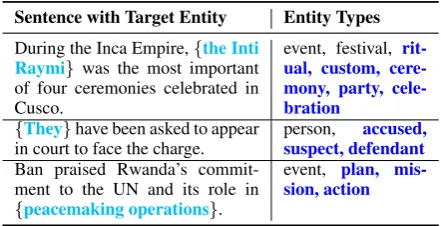
Sentence with Target Entity Entity Types
During the Inca Empire,{the Inti
Raymi} was the most important of four ceremonies celebrated in Cusco.
event, festival,
rit-ual, custom, cere-mony, party, cele-bration
{They}have been asked to appear
in court to face the charge.
person, accused,
suspect, defendant
Ban praised Rwanda’s commit-ment to the UN and its role in
{peacemaking operations}.
event, plan,
[image:1.595.306.527.223.336.2]mis-sion, action
Table 1: Examples of entity mentions and their an-notated types, as anan-notated in our dataset. The en-tity mentions are bold faced and in the curly brack-ets. The bold blue types do not appear in existing fine-grained type ontologies.
as coreference resolution and question answering (e.g. “Who was the victim?”). Inferring such types for each mention (John, he) is not possible given current typing models that only predict relatively coarse types and only consider named entities.
To address this challenge, we present a new task: given a sentence with a target entity men-tion, predict free-form noun phrases that describe appropriate types for the role the target entity plays
in the sentence. Table1shows three examples that
exhibit a rich variety of types at different granular-ities. Our task effectively subsumes existing fine-grained named entity typing formulations due to the use of a very large type vocabulary and the fact that we predict types for all noun phrases, includ-ing named entities, nominals, and pronouns.
Incorporating fine-grained entity types has im-proved entity-focused downstream tasks, such as
relation extraction (Yaghoobzadeh et al., 2017a),
question answering (Yavuz et al., 2016), query
analysis (Balog and Neumayer,2012), and
coref-erence resolution (Durrett and Klein,2014). These
pos-12/14/2017 https://homes.cs.washington.edu/~eunsol/finetype_visualization/onto_index.html https://homes.cs.washington.edu/~eunsol/finetype_visualization/onto_index.html 1/1 person litical_figu legal artist autho title organization company governmen other news perso location country city structure other anizat ograp ernm ans other legal product currency event person art writing ng_th food ealt and_ atm adc car
a) Our Dataset b) OntoNotes c) FIGER
[image:2.595.82.517.75.247.2]Other 12/15/2017 https://homes.cs.washington.edu/~eunsol/finetype_visualization/ours_index.html https://homes.cs.washington.edu/~eunsol/finetype_visualization/ours_index.html 1/1 person organization event object leader group adult place male location politician administration area time government concept company athlete country region nation team idea man official state institution authority business ocial_grou professiona pokesperso city position player female agency performe period orporatio ontestan enterprise activity presiden pokesma woman nsequen firm worker action rganism writer unicipal mmunica expert date resenta space actor musicia nesspe citizen speake crimina unit ministra sociati rvicem party artist inessm report point angem ownshi calizati tructur tertain day appeni contes eporte ocume mploye elebrit show ormati directo year mmitt blicati conflic cientis sport coach uildin tuatio military game ball_p soldie friend music office reato chola law aceme song army roduc atherin money mpetit force anima meetin ateme ecord dividu risone squad nalys victim licem uratio battle essag avele plan singe aract title dar_m name reem voca ndida club child semb nditio bstan movie land docto ry_se ceho tuden istric ateri raine maste evic fenda ogra urnal vesto atien policy writin ontra rrito ystem llplay sast choo rtain match erati act oble attac opos food war amily ache rule mpaig agen astro hang aim plom eekd ruler film ndma oubl part mmu us_l olitic wspa gisla ubjec ctres album data oces vers mou hoic rrori elativ plan demi fund ppor dy_p umb own nam marke awye ecut ecisio ress belie e_e visio lam achi rren uca upa tesm olleg home cuss esu aren inist book work vern slat uipm tatu islat nanc eath g_th agu etwo fere easu onte orma car eatio body cce inne mmo pos gme band er_p lica two job rive pous play rugg nes gotia dea ufac owe spe new case ligio easo emb peec head uni ecta r_ve hing stitu udg of_e elin nom ucat rticl figh gine ehic _of_ ome matte cash wife crip tem ounc oduc urre ove toc llag res sea ders cide oss king mpa lop girl ilwa ctio ect vote quid fes pinio ssu spu mic_ nio nctiopic row site dus sour emi pita stig rum bill risi mba war ian apit eat kpl ecti oth s_p ady anc gua ace ocie tem sto star ketp serv roo liat ugh our oad oun ontr ow ion ouri tru tne dic nce onv adc _tra dm cus gat soci mina torm ubl men fug mpu _ag arri stiv ours nda lan utho wm ont dvis por oje ncip alu ent atm nn zen prize ono olic erv tor spo den ngd tain vem boa ula fact olla rrat ial_ ppo pro dic sw ea olfe apo ess no goa iva ven ers erie olit icip stom ailur ace role il_lpio bird proa rlin mst sum ctio of_ twa path ud emdrug ffic hea wne gov ghte vilia eci al_ an oar ave rga ffo mpo abit erc clu age pla po me ord ecia m_s osi stig for e_n eke on_ ship tion c_g ssi tary staf rga rim pas era phic ons ain ric hiev spl boy sum mp cos an rofi pe clo hurc al_s og cin cili ma ficu art nc otia atis ver tifa an ese nci dca auc min ced up com lec gd gym ort riti per athe _se elo ale oo pta uti ma mo ndin ourc adm od las eit are nce res oup atio n_c em ha fall uild dish cor gd adiu ex rm ini ak ric na ate har oda pula orm ent n_ gs_ ndin ack eac lid urn er mp ac ran gre otio nce erm vin alit nem um rai unt gaz or side mis aso ote rm de ect co as hav ffa exc eat thi aid pai ate xt_ cto _p visi fer ou na an erw rtn ce rat ec cip b_s du oun ltu ar mb etr _sc erta ho ote titu cto nt ec ruc es ut wgi ma cul em de grid od re urg rie cov ive oph gre rcr act son ab ve tfo bra ent on ric nsi ws erv fire er ape ally eal an crip int al_ mig nec ual tra bby an olu ine dre ya _m roo ho ua isk os rts ran eta tor on ea sba ud mea xhi pre otb seb ea se wo tu oy ativ ym ou sca ot end stm alk len nn ov nis ous oxe wor era plis ha ap los ide ille m lita p_a duc ou ree ctio ne dic on usa er nk ie rg ess ra artm let ass sta win tro al an ron ma oya pe mu med ad oth no es blin urn giti ter gw ay ers pa se ctu ish sw ns hw rde ria sh es ist ag sen ea mm sh ch gr ng tis pa ere tin ve re up ar_ ve_ et tdo tra ens co ou uis ar wo dit _in ad ell em arn ilo fe jet ctu sp rea et si en ui eig rde lua ta mm ge pro se an nd ge rn ca aw 12/15/2017 https://homes.cs.washington.edu/~eunsol/finetype_visualization/onto_index.html https://homes.cs.washington.edu/~eunsol/finetype_visualization/onto_index.html 1/1 /other /person /organization /location /company /legal /city /country 12/15/2017 https://homes.cs.washington.edu/~eunsol/finetype_visualization/figer_index.html https://homes.cs.washington.edu/~eunsol/finetype_visualization/figer_index.html 1/1 /person /organization /location /time /company ational_ins /event /building /art itten_wo /country nment_a Person Other Person
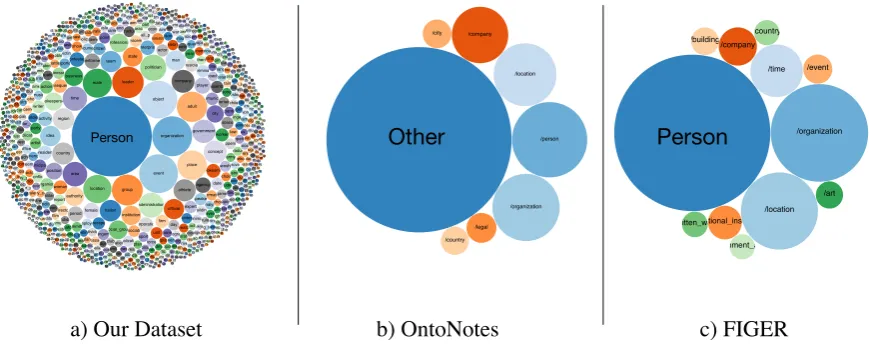
Figure 1: A visualization of all the labels that cover 90% of the data, where a bubble’s size is proportional to the label’s frequency. Our dataset is much more diverse and fine grained when compared to existing datasets (OntoNotes and FIGER), in which the top 5 types cover 70-80% of the data.
sible concepts even within a limited domain. This can be seen empirically in existing datasets, where the label distribution of fine-grained entity typing datasets is heavily skewed toward coarse-grained types. For instance, annotators of the OntoNotes
dataset (Gillick et al.,2014) marked about half of
the mentions as “other,” because they could not
find a suitable type in their ontology (see Figure1
for a visualization and Section2.2for details).
Our more open, ultra-fine vocabulary, where types are free-form noun phrases, alleviates the need for hand-crafted ontologies, thereby greatly increasing overall type coverage. To better un-derstand entity types in an unrestricted setting, we crowdsource a new dataset of 6,000 examples. Compared to previous fine-grained entity typing datasets, the label distribution in our data is
sub-stantially morediverseandfine-grained.
Annota-tors easily generate a wide range of types and can determine with 85% agreement if a type generated by another annotator is appropriate. Our evalu-ation data has over 2,500 unique types, posing a challenging learning problem.
While our types are harder to predict, they also allow for a new form of contextual distant super-vision. We observe that text often contains cues that explicitly match a mention to its type, in the form of the mention’s head word. For example, “the incumbent chairman of the African Union”
is a type of “chairman.” This signal
comple-ments the supervision derived from linking entities to knowledge bases, which is context-oblivious. For example, “Clint Eastwood” can be described
with dozens of types, but context-sensitive typing would prefer “director” instead of “mayor” for the sentence “Clint Eastwood won ‘Best Director’ for Million Dollar Baby.”
We combine head-word supervision, which pro-vides ultra-fine type labels, with traditional sig-nals from entity linking. Although the problem is more challenging at finer granularity, we find that mixing fine and coarse-grained supervision helps significantly, and that our proposed model with a multitask objective exceeds the performance of existing entity typing models. Lastly, we show that head-word supervision can be used for previ-ous formulations of entity typing, setting the new state-of-the-art performance on an existing fine-grained NER benchmark.
2 Task and Data
Given a sentence and an entity mentionewithin
it, the task is to predict a set of natural-language
phrasesT that describe the type ofe. The
selec-tion ofT is context sensitive; for example, in “Bill
Gates has donated billions to eradicate malaria,” Bill Gates should be typed as “philanthropist” and not “inventor.” This distinction is important for context-sensitive tasks such as coreference resolu-tion and quesresolu-tion answering (e.g. “Which philan-thropist is trying to prevent malaria?”).
We annotate a dataset of about 6,000 mentions
via crowdsourcing (Section2.1), and demonstrate
that using an large type vocabulary substantially increases annotation coverage and diversity over
2.1 Crowdsourcing Entity Types
To capture multiple domains, we sample sentences
from Gigaword (Parker et al., 2011), OntoNotes
(Hovy et al.,2006), and web articles (Singh et al.,
2012). We select entity mentions by taking
max-imal noun phrases from a constituency parser
(Manning et al.,2014) and mentions from a
coref-erence resolution system (Lee et al.,2017).
We provide the sentence and the target entity mention to five crowd workers on Mechanical Turk, and ask them to annotate the entity’s type. To encourage annotators to generate fine-grained types, we require at least one general type (e.g. person, organization, location) and two specific types (e.g. doctor, fish, religious institute), from a type vocabulary of about 10K frequent noun
phrases. We use WordNet (Miller, 1995) to
ex-pand these types automatically by generating all their synonyms and hypernyms based on the most common sense, and ask five different annotators to validate the generated types. Each pair of annota-tors agreed on 85% of the binary validation deci-sions (i.e. whether a type is suitable or not) and
0.47 in Fleiss’sκ. To further improve consistency,
the final type set contained only types selected by at least 3/5 annotators. Further crowdsourcing de-tails are available in the supplementary material.
Our collection process focuses on precision. Thus, the final set is diverse but not
comprehen-sive, making evaluation non-trivial (see Section5).
2.2 Data Analysis
We collected about 6,000 examples. For analysis, we classified each type into three disjoint bins:
• 9generaltypes: person, location, object, orga-nization, place, entity, object, time, event
• 121fine-grainedtypes, mapped to fine-grained
entity labels from prior work (Ling and Weld,
2012;Gillick et al.,2014) (e.g. film, athlete)
• 10,201 ultra-fine types, encompassing every
other label in the type space (e.g. detective, law-suit, temple, weapon, composer)
On average, each example has 5 labels: 0.9 gen-eral, 0.6 fine-grained, and 3.9 ultra-fine types. Among the 10,000 ultra-fine types, 2,300 unique types were actually found in the 6,000 crowd-sourced examples. Nevertheless, our distant
su-pervision data (Section3) provides positive
train-ing examples for every type in the entire
vocabu-lary, and our model (Section4) can and does
[image:3.595.309.533.59.222.2]pre-dict from a 10K type vocabulary. For example,
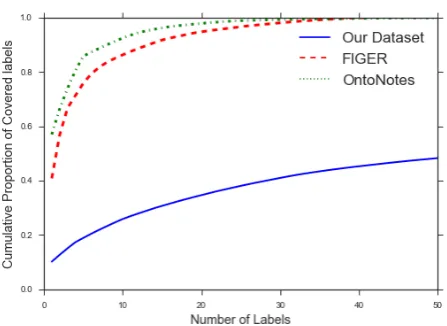
Figure 2: The label distribution across different evaluation datasets. In existing datasets, the top 4 or 7 labels cover over 80% of the labels. In ours, the top 50 labels cover less than 50% of the data.
the model correctly predicts “television network” and “archipelago” for some mentions, even though that type never appears in the 6,000 crowdsourced examples.
Improving Type Coverage We observe that
prior fine-grained entity typing datasets are
heav-ily focused on coarse-grained types. To
quan-tify our observation, we calculate the
distribu-tion of types in FIGER (Ling and Weld, 2012),
OntoNotes (Gillick et al., 2014), and our data.
For examples with multiple types (|T| > 1), we
counted each type1/|T|times.
Figure2shows the percentage of labels covered
by the topN labels in each dataset. In previous
enitity typing datasets, the distribution of labels is highly skewed towards the top few labels. To cover 80% of the examples, FIGER requires only the top 7 types, while OntoNotes needs only 4; our dataset requires 429 different types.
Figure1takes a deeper look by visualizing the
types that cover 90% of the data, demonstrating the diversity of our dataset. It is also striking that more than half of the examples in OntoNotes are classified as “other,” perhaps because of the limi-tation of its predefined ontology.
Improving Mention Coverage Existing
datasets focus mostly on named entity mentions, with the exception of OntoNotes, which contained
nominal expressions. This has implications on
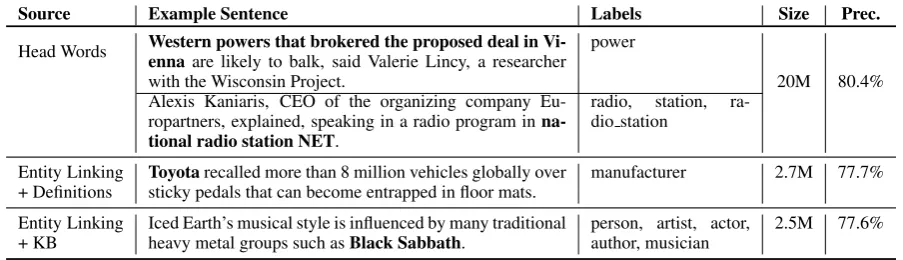
Source Example Sentence Labels Size Prec.
Head Words Western powers that brokered the proposed deal in
Vi-ennaare likely to balk, said Valerie Lincy, a researcher
with the Wisconsin Project.
power
20M 80.4%
Alexis Kaniaris, CEO of the organizing company
Eu-ropartners, explained, speaking in a radio program in
na-tional radio station NET.
radio, station,
ra-dio station
Entity Linking + Definitions
Toyotarecalled more than 8 million vehicles globally over sticky pedals that can become entrapped in floor mats.
manufacturer 2.7M 77.7%
Entity Linking + KB
Iced Earth’s musical style is influenced by many traditional
heavy metal groups such asBlack Sabbath.
person, artist, actor, author, musician
2.5M 77.6%
Table 2: Distant supervision examples and statistics. We extracted the headword and Wikipedia def-inition supervision from Gigaword and Wikilink corpora. KB-based supervision is mapped from prior work, which used Wikipedia and news corpora.
mentions). Our new dataset provides a
well-rounded benchmark with roughly 40% pronouns, 38% nominal expressions, and 22% named entity mentions. The case of pronouns is particularly interesting, since the mention itself provides little information.
3 Distant Supervision
Training data for fine-grained NER systems is typically obtained by linking entity mentions and drawing their types from knowledge bases (KBs). This approach has two limitations: recall can
suf-fer due to KB incompleteness (West et al.,2014),
and precision can suffer when the selected types
do not fit the context (Ritter et al., 2011). We
al-leviate the recall problem by mining entity men-tions that were linked to Wikipedia in HTML, and extract relevant types from their
encyclope-dic definitions (Section 3.1). To address the
pre-cision issue (context-insensitive labeling), we pro-pose a new source of distant supervision: auto-matically extracted nominal head words from raw
text (Section 3.2). Using head words as a form
of distant supervision provides fine-grained infor-mation about named entities and nominal men-tions. While a KB may link “the 44th president of the United States” to many types such as author, lawyer, and professor, head words provide only the type “president”, which is relevant in the context.
We experiment with the new distant supervi-sion sources as well as the traditional KB
super-vision. Table2shows examples and statistics for
each source of supervision. We annotate 100 ex-amples from each source to estimate the noise and usefulness in each signal (precision in Table 2).
3.1 Entity Linking
For KB supervision, we leveraged training data
from prior work (Ling and Weld, 2012; Gillick
et al.,2014) by manually mapping their ontology
to our 10,000 noun type vocabulary, which
cov-ers 130 of our labels (general and fine-grained).2
Section 6 defines this mapping in more detail.
To improve both entity and type coverage of KB supervision, we use definitions from Wikipedia. We follow Shnarch et al. () who observed that the first sentence of a Wikipedia article often states the entity’s type via an “is a” relation; for exam-ple, “Roger Federer is a Swiss professional tennis player.” Since we are using a large type
vocabu-lary, we can now mine this typing information.3
We extracted descriptions for 3.1M entities which contain 4,600 unique type labels such as “compe-tition,” “movement,” and “village.”
We bypass the challenge of automatically link-ing entities to Wikipedia by exploitlink-ing existlink-ing
hy-perlinks in web pages (Singh et al., 2012),
fol-lowing prior work (Ling and Weld, 2012; Yosef
et al., 2012). Since our heuristic extraction of
types from the definition sentence is somewhat noisy, we use a more conservative entity linking
policy4that yields a signal with similar overall
ac-curacy to KB-linked data.
2
Data from: https://github.com/
shimaokasonse/NFGEC
3We extract types by applying a dependency parser (
Man-ning et al.,2014) to the definition sentence, and taking nouns that are dependents of a copular edge or connected to nouns linked to copulars via appositive or conjunctive edges.
4Only link if the mention contains the Wikipedia entity’s
[image:4.595.73.525.64.194.2]3.2 Contextualized Supervision
Many nominal entity mentions include detailed type information within the mention itself. For example, when describing Titan V as “the newly-released graphics card”, the head words and phrases of this mention (“graphics card” and “card”) provide a somewhat noisy, but very easy to gather, context-sensitive type signal.
We extract nominal head words with a
depen-dency parser (Manning et al.,2014) from the
Gi-gaword corpus as well as the Wikilink dataset. To support multiword expressions, we included nouns that appear next to the head if they form a phrase in our type vocabulary. Finally, we lower-case all words and convert plural to singular.
Our analysis reveals that this signal has a com-parable accuracy to the types extracted from en-tity linking (around 80%). Many errors are from the parser, and some errors stem from idioms and transparent heads (e.g. “parts of capital” labeled as “part”). While the headword is given as an input to the model, with heavy regularization and multi-tasking with other supervision sources, this super-vision helps encode the context.
4 Model
We design a model for predicting sets of types
given a mention in context. The
architec-ture resembles the recent neural AttentiveNER
model (Shimaoka et al., 2017), while improving
the sentence and mention representations, and in-troducing a new multitask objective to handle mul-tiple sources of supervision. The hyperparameter settings are listed in the supplementary material.
Context Representation Given a sentence
x1, . . . , xn, we represent each token xi using a
pre-trained word embedding wi. We
concate-nate an additional location embedding li which
indicates whether xi is before, inside, or after
the mention. We then use[xi;li]as an input to a
bidirectional LSTM, producing a contextualized
representationhi for each token; this is different
from the architecture of Shimaoka et al. 2017,
who used two separate bidirectional LSTMs on each side of the mention. Finally, we represent the
contextcas a weighted sum of the contextualized
token representations using MLP-based attention:
ai=SoftMaxi(va·relu(Wahi))
WhereWaandvaare the parameters of the
atten-tion mechanism’s MLP, which allows interacatten-tion
between the forward and backward directions of the LSTM before computing the weight factors.
Mention Representation We represent the
mention m as the concatenation of two items:
(a) a character-based representation produced by a CNN on the entire mention span, and (b) a weighted sum of the pre-trained word embeddings in the mention span computed by attention, similar to the mention representation in a recent
coreference resolution model (Lee et al., 2017).
The final representation is the concatenation of the
context and mention representations:r= [c;m].
Label Prediction We learn a type label
embed-ding matrixWt∈Rn×dwherenis the number of
labels in the prediction space anddis the
dimen-sion ofr. This matrix can be seen as a combination
of three sub matrices, Wgeneral, Wf ine, Wultra,
each of which contains the representations of the general, fine, and ultra-fine types respectively. We predict each type’s probability via the sigmoid of
its inner product withr:y =σ(Wtr). We predict
every typetfor whichyt >0.5, orarg maxytif
there is no such type.
Multitask Objective The distant supervision sources provide partial supervision for ultra-fine types; KBs often provide more general types, while head words usually provide only ultra-fine
types, without their generalizations. In other
words, the absence of a type at a different level of abstraction does not imply a negative signal; e.g. when the head word is “inventor”, the model should not be discouraged to predict “person”.
Prior work used a customized hinge loss (
Ab-hishek et al.,2017) or max margin loss (Ren et al.,
2016a) to improve robustness to noisy or
incom-plete supervision. We propose a multitask objec-tive that reflects the characteristic of our training dataset. Instead of updating all labels for each ex-ample, we divide labels into three bins (general, fine, and ultra-fine), and update labels only in bin containing at least one positive label. Specifically,
the training objective is to minimizeJ wheretis
the target vector at each granularity:
Jall =Jgeneral·1general(t)
+Jfine·1fine(t)
+Jultra·1ultra(t)
Where 1category(t) is an indicator function that
Model Dev Test
MRR P R F1 MRR P R F1
AttentiveNER 0.221 53.7 15.0 23.5 0.223 54.2 15.2 23.7
[image:6.595.151.448.64.114.2]Our Model 0.229 48.1 23.2 31.3 0.234 47.1 24.2 32.0
Table 3: Performance of our model and AttentiveNER (Shimaoka et al.,2017) on the new entity typing
benchmark, using same training data. We show results for both development and test sets.
Train Data Total General(1918) Fine(1289) Ultra-Fine(7594)
MRR P R F1 P R F1 P R F1 P R F1
All 0.229 48.1 23.2 31.3 60.3 61.6 61.0 40.4 38.4 39.4 42.8 8.8 14.6
– Crowd 0.173 40.1 14.8 21.6 53.7 45.6 49.3 20.8 18.5 19.6 54.4 4.6 8.4
– Head 0.220 50.3 19.6 28.2 58.8 62.8 60.7 44.4 29.8 35.6 46.2 4.7 8.5
– EL 0.225 48.4 22.3 30.6 62.2 60.1 61.2 40.3 26.1 31.7 41.4 9.9 16.0
Table 4: Results on the development set for different type granularity and for different supervision data with our model. In each row, we remove a single source of supervision. Entity linking (EL) includes supervision from both KB and Wikipedia definitions. The numbers in the first row are example counts for each type granularity.
Jcategoryis the category-specific logistic regression
objective:
J =−X i
ti·log(yi) + (1−ti)·log(1−yi)
5 Evaluation
Experiment Setup The crowdsourced dataset
(Section2.1) was randomly split into train,
devel-opment, and test sets, each with about 2,000 ex-amples. We use this relatively small
manually-annotated training set (Crowd in Table4)
along-side the two distant supervision sources: entity linking (KB and Wikipedia definitions) and head words. To combine supervision sources of differ-ent magnitudes (2K crowdsourced data, 4.7M en-tity linking data, and 20M head words), we sample a batch of equal size from each source at each it-eration. We reimplement the recent AttentiveNER
model (Shimaoka et al.,2017) for reference.5
We report macro-averaged precision, recall, and F1, and the average mean reciprocal rank (MRR).
Results Table 3 shows the performance of
our model and our reimplementation of Atten-tiveNER. Our model, which uses a multitask ob-jective to learn finer types without punishing more general types, shows recall gains at the cost of drop in precision. The MRR score shows that our
5We use the AttentiveNER model with no engineered
fea-tures or hierarchical label encoding (as a hierarchy is not clear in our label setting) and let it predict from the same label space, training with the same supervision data.
model is slightly better than the baseline at ranking correct types above incorrect ones.
Table 4shows the performance breakdown for
different type granularity and different supervi-sion. Overall, as seen in previous work on
fine-grained NER literature (Gillick et al., 2014;Ren
et al.,2016a), finer labels were more challenging
to predict than coarse grained labels, and this is-sue is exacerbated when dealing with ultra-fine types. All sources of supervision appear to be useful, with crowdsourced examples making the
biggest impact. Head word supervision is
par-ticularly helpful for predicting ultra-fine labels, while entity linking improves fine label prediction. The low general type performance is partially be-cause of nominal/pronoun mentions (e.g. “it”), and because of the large type inventory (some-times “location” and “place” are annotated inter-changeably).
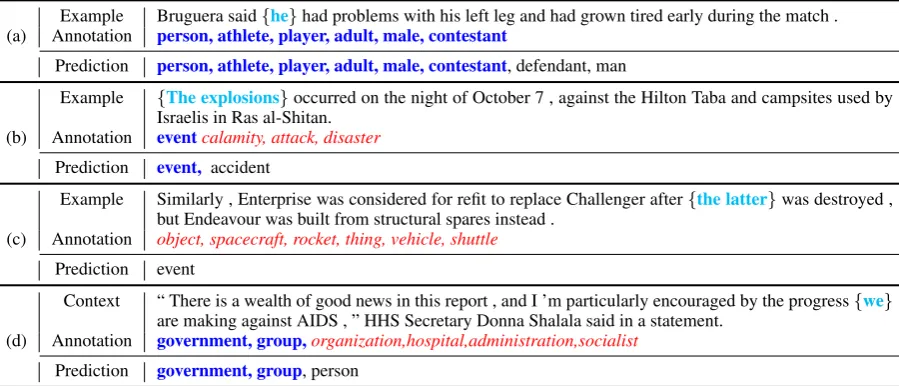
Analysis We manually analyzed 50 examples from the development set, four of which we
present in Table5. Overall, the model was able to
generate accurate general types and a diverse set of type labels. Despite our efforts to annotate a com-prehensive type set, the gold labels still miss many potentially correct labels (example (a): “man” is reasonable but counted as incorrect). This makes the precision estimates lower than the actual pformance level, with about half the precision
er-rors belonging to this category. Real precision
Example Bruguera said{he}had problems with his left leg and had grown tired early during the match .
(a) Annotation person, athlete, player, adult, male, contestant
Prediction person, athlete, player, adult, male, contestant, defendant, man
Example {The explosions}occurred on the night of October 7 , against the Hilton Taba and campsites used by
Israelis in Ras al-Shitan.
(b) Annotation eventcalamity, attack, disaster
Prediction event, accident
Example Similarly , Enterprise was considered for refit to replace Challenger after{the latter}was destroyed ,
but Endeavour was built from structural spares instead .
(c) Annotation object, spacecraft, rocket, thing, vehicle, shuttle
Prediction event
Context “ There is a wealth of good news in this report , and I ’m particularly encouraged by the progress{we}
are making against AIDS , ” HHS Secretary Donna Shalala said in a statement.
(d) Annotation government, group,organization,hospital,administration,socialist
[image:7.595.75.525.64.257.2]Prediction government, group, person
Table 5: Example and predictions from our best model on the development set. Entity mentions are marked with curly brackets, the correct predictions are boldfaced, and the missing labels are italicized and written in red.
may be true, but are not supported by the context. We found that the model often abstained from predicting any fine-grained types. Especially in challenging cases as in example (c), the model predicts only general types, explaining the low re-call numbers (28% of examples belong to this cat-egory). Even when the model generated correct fine-grained types as in example (d), the recall was often fairly low since it did not generate a com-plete set of related fine-grained labels.
Estimating the performance of a model in an in-complete label setting and expanding label cover-age are interesting areas for future work. Our task also poses a potential modeling challenge; some-times, the model predicts two incongruous types (e.g. “location” and “person”), which points to-wards modeling the task as a joint set prediction task, rather than predicting labels individually. We provide sample outputs on the project website.
6 Improving Existing Fine-Grained NER with Better Distant Supervision
We show that our model and distant supervision can improve performance on an existing
fine-grained NER task. We chose the widely-used
OntoNotes (Gillick et al.,2014) dataset which
in-cludes nominal and named entity mentions.6
6
While we were inspired by FIGER (Ling and Weld,
2012), the dataset presents technical difficulties. The test set
has only 600 examples, and the development set was labeled with distant supervision, not manual annotation. We there-fore focus our evaluation on OntoNotes.
Augmenting the Training Data The original
OntoNotes training set (ONTO in Tables6and7)
is extracted by linking entities to a KB. We supple-ment this dataset with our two new sources of dis-tant supervision: Wikipedia definition sentences
(WIKI) and head word supervision (HEAD) (see
Section3). To convert the label space, we
manu-ally map a single noun from our natural-language vocabulary to each formal-language type in the OntoNotes ontology. 77% of OntoNote’s types directly correspond to suitable noun labels (e.g. “doctor” to “/person/doctor”), whereas the other cases were mapped with minimal manual effort (e.g. “musician” to “person/artist/music”, “politi-cian” to “/person/political figure”). We then ex-pand these labels according to the ontology to in-clude their hypernyms (“/person/political figure” will also generate “/person”). Lastly, we create negative examples by assigning the “/other” label to examples that are not mapped to the ontology. The augmented dataset contains 2.5M/0.6M new positive/negative examples, of which 0.9M/0.1M are from Wikipedia definition sentences and 1.6M/0.5M from head words.
Experiment Setup We compare performance to other published results and to our
reimplemen-tation of AttentiveNER (Shimaoka et al., 2017).
We also compare models trained with different sources of supervision. For this dataset, we did not
use our multitask objective (Section 4), since
as-Acc. Ma-F1 Mi-F1
AttentiveNER++ 51.7 70.9 64.9
AFET (Ren et al.,2016a) 55.1 71.1 64.7
LNR (Ren et al.,2016b) 57.2 71.5 66.1
[image:8.595.73.290.64.130.2]Ours (ONTO+WIKI+HEAD) 59.5 76.8 71.8
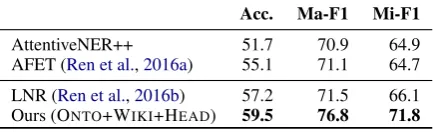
Table 6: Results on the OntoNotes fine-grained entity typing test set. The first two models (At-tentiveNER++ and AFET) use only KB-based su-pervision. LNR uses a filtered version of the KB-based training set. Our model uses all our distant supervision sources.
Model Training Data Performance
ONTO WIKI HEAD Acc. MaF1 MiF1
Attn. 3 46.5 63.3 58.3
NER 3 3 3 53.7 72.8 68.0
3 41.7 64.2 59.5
3 3 48.5 67.6 63.6
Ours 3 3 57.9 73.0 66.9
3 3 60.1 75.0 68.7
3 3 3 61.6 77.3 71.8
Table 7: Ablation study on the OntoNotes fine-grained entity typing development. The second row isolates dataset improvements, while the third row isolates the model.
sumption. Following prior work, we report macro-and micro-averaged F1 score, as well as accuracy (exact set match).
Results Table 6 shows the overall performance on the test set. Our combination of model and training data shows a clear improvement from
prior work, setting a new state-of-the art result.7
In Table7, we show an ablation study. Our new
supervision sources improve the performance of both the AttentiveNER model and our own. We observe that every supervision source improves
performance in its own right. Particularly, the
naturally-occurring head-word supervision seems to be the prime source of improvement, increasing performance by about 10% across all metrics.
Predicting Miscellaneous Types While analyz-ing the data, we observed that over half of the men-tions in OntoNotes’ development set were anno-tated only with the miscellaneous type (“/other”). For both models in our evaluation, detecting the miscellaneous category is substantially easier than
7We did not compare to a system from (Yogatama et al.,
2015), which reports slightly higher test number (72.98 micro
F1) as they used a different, unreleased test set.
producing real types (94% F1 vs. 58% F1 with our best model). We provide further details of this analysis in the supplementary material.
7 Related Work
Fine-grained NER has received growing
atten-tion, and is used in many applications (Gupta
et al.,2017;Ren et al.,2017;Yaghoobzadeh et al.,
2017b;Raiman and Raiman, 2018). Researchers
studied typing in varied contexts, including
men-tions in specific sentences (as we consider) (Ling
and Weld, 2012; Gillick et al., 2014; Yogatama
et al., 2015; Dong et al., 2015; Schutze et al.,
2017), corpus-level prediction (Yaghoobzadeh and
Sch¨utze, 2016), and lexicon level (given only a
noun phrase with no context) (Yao et al.,2013).
Recent work introduced fine-grained type
on-tologies (Rabinovich and Klein, 2017; Murty
et al., 2017; Corro et al., 2015), defined using
Wikipedia categories (100), Freebase types (1K) and WordNet senses (16K). However, they focus on named entities, and data has been challeng-ing to gather, often approximatchalleng-ing gold annota-tions with distant supervision. In contrast, (1) our ontology contains any frequent noun phrases that depicts a type, (2) our task goes beyond named entities, covering every noun phrase (even pro-nouns), and (3) we provide crowdsourced annota-tions which provide context-sensitive, fine grained type labels.
Contextualized fine-grained entity typing is
re-lated to selectional preference (Resnik,1996;
Pan-tel et al., 2007; Zapirain et al., 2013; de Cruys,
2014), where the goal is to induce semantic
gen-eralizations on the type of arguments a predicate prefers. Rather than focusing on predicates, we condition on the entire sentence to deduce the ar-guments’ types, which allows us to capture more nuanced types. For example, not every type that
fits “He played the violin in his room” is also
suitable for “Heplayed the violin in the Carnegie
Hall”. Entity typing here can be connected to ar-gument finding in semantic role labeling.
To deal with noisy distant supervision for KB population and entity typing, researchers
used multi-instance multi-label learning (
Sur-deanu et al.,2012;Yaghoobzadeh et al.,2017b) or
custom losses (Abhishek et al., 2017; Ren et al.,
2016a). Our multitask objective handles noisy
8 Conclusion
Using virtually unrestricted types allows us to ex-pand the standard KB-based training methodol-ogy with typing information from Wikipedia defi-nitions and naturally-occurring head-word super-vision. These new forms of distant supervision boost performance on our new dataset as well as on an existing fine-grained entity typing bench-mark. These results set the first performance lev-els for our evaluation dataset, and suggest that the data will support significant future work.
Acknowledgement
The research was supported in part the ARO (W911NF-16-1-0121) the NSF (1252835, IIS-1562364), and an Allen Distinguished Investigator Award. We would like to thank the reviewers for constructive feedback. Also thanks to Yotam Es-hel and Noam Cohen for providing the Wikilink dataset. Special thanks to the members of UW NLP for helpful discussions and feedback.
References
Abhishek, Ashish Anand, and Amit Awekar. 2017. Fine-grained entity type classification by jointly learning representations and label embeddings. In Proceedings of European Chapter of Association for Computational Linguistics.
Krisztian Balog and Robert Neumayer. 2012. Hier-archical target type identification for entity-oriented queries. InProceedings of the Conference on Infor-mation and Knowledge Management.
Luciano Del Corro, Abdalghani Abujabal, Rainer Gemulla, and Gerhard Weikum. 2015. Finet: Context-aware fine-grained named entity typing. In Proceedings of the conference on Empirical Meth-ods in Natural Language Processing.
Tim Van de Cruys. 2014. A neural network approach to selectional preference acquisition. In Proceedings of Empirical Methods in Natural Language Process-ing.
Li Dong, Furu Wei, Hong Sun, Ming Zhou, and Ke Xu. 2015. A hybrid neural model for type classification of entity mentions. InProceedings of International Joint Conference on Artificial Intelligence.
Greg Durrett and Dan Klein. 2014. A joint model for entity analysis: Coreference, typing, and linking. In Transactions of the Association for Computational Linguistics.
Daniel Gillick, Nevena Lazic, Kuzman Ganchev, Jesse Kirchner, and David Huynh. 2014. Context-dependent fine-grained entity type tagging. CoRR, abs/1412.1820.
Nitish Gupta, Sameer Singh, and Dan Roth. 2017. En-tity linking via joint encoding of types, descriptions, and context. In Proceedings of the Conference on Empirical Methods in Natural Language Process-ing, pages 2671–2680.
Eduard Hovy, Mitchell Marcus, Martha Palmer, Lance Ramshaw, and Ralph Weischedel. 2006. Ontonotes: the 90% solution. InProceedings of the human lan-guage technology conference of the North American Chapter of the Association for Computational Lin-guistics, Companion Volume: Short Papers, pages 57–60. Association for Computational Linguistics.
Kenton Lee, Luheng He, Mike Lewis, and Luke Zettle-moyer. 2017. End-to-end neural coreference resolu-tion. InProceedings of the Conference on Empirical Methods in Natural Language Processing.
Xiao Ling and Daniel S Weld. 2012. Fine-grained en-tity recognition. In Proceedings of Association for the Advancement of Artificial Intelligence. Citeseer.
Christopher D. Manning, Mihai Surdeanu, John Bauer, Jenny Finkel, Steven J. Bethard, and David Mc-Closky. 2014. The Stanford CoreNLP natural lan-guage processing toolkit. InAssociation for Compu-tational Linguistics (ACL) System Demonstrations, pages 55–60.
George A Miller. 1995. Wordnet: a lexical database for english. Communications of the ACM, 38(11):39– 41.
Shikhar Murty, Patrick Verga, Luke Vilnis, and Andrew McCallum. 2017. Finer grained entity typing with typenet. InAKBC Workshop.
Patrick Pantel, Rahul Bhagat, Bonaventura Coppola, Timothy Chklovski, and Eduard H. Hovy. 2007. Isp: Learning inferential selectional preferences. In Pro-ceedings of North American Chapter of the Associ-ation for ComputAssoci-ational Linguistics.
Robert Parker, David Graff, David Kong, Ke Chen, and Kazuaki Maeda. 2011. English gigaword fifth edi-tion (ldc2011t07). InLinguistic Data Consortium.
Maxim Rabinovich and Dan Klein. 2017. Fine-grained entity typing with high-multiplicity assignments. In Proceedings of Association for Computational Lin-guistics (ACL).
Jonathan Raiman and Olivier Raiman. 2018. Deep-type: Multilingual entity linking by neural type sys-tem evolution. InAssociation for the Advancement of Artificial Intelligence.
embedding. In Proceedings Empirical Methods in Natural Language Processing.
Xiang Ren, Wenqi He, Meng Qu, Clare R. Voss, Heng Ji, and Jiawei Han. 2016b. Label noise reduction in entity typing by heterogeneous partial-label embed-ding. In Proceedings of Knowledge Discovery and Data Mining.
Xiang Ren, Zeqiu Wu, Wenqi He, Meng Qu, Clare R. Voss, Heng Ji, Tarek F. Abdelzaher, and Jiawei Han. 2017. Cotype: Joint extraction of typed entities and relations with knowledge bases. InProceedings of World Wide Web Conference.
Philip Resnik. 1996. Selectional constraints: an information-theoretic model and its computational realization. Cognition, 61 1-2:127–59.
Alan Ritter, Sam Clark, Oren Etzioni, et al. 2011. Named entity recognition in tweets: an experimental study. InProceedings of the Conference on Empiri-cal Methods in Natural Language Processing, pages 1524–1534. Association for Computational Linguis-tics.
Hinrich Schutze, Ulli Waltinger, and Sanjeev Karn. 2017. End-to-end trainable attentive decoder for hi-erarchical entity classification. In Proceedings of European Chapter of Association for Computational Linguistics.
Sonse Shimaoka, Pontus Stenetorp, Kentaro Inui, and Sebastian Riedel. 2017. An attentive neural archi-tecture for fine-grained entity type classification. In Proceedings of the European Chapter of Association for Computational Linguistics (ACL).
Eyal Shnarch, Libby Barak, and Ido Dagan. Extract-ing lexical reference rules from wikipedia. In Pro-ceedings of the Joint Conference of the 47th Annual Meeting of the ACL and the 4th International Joint Conference on Natural Language Processing of the AFNLP.
Sameer Singh, Amarnag Subramanya, Fernando Pereira, and Andrew McCallum. 2012. Wik-ilinks: A large-scale cross-document coreference corpus labeled via links to Wikipedia. Techni-cal Report UM-CS-2012-015, University of Mas-sachusetts, Amherst.
Mihai Surdeanu, Julie Tibshirani, Ramesh Nallap-ati, and Christopher D. Manning. 2012. Multi-instance multi-label learning for relation extraction. InEMNLP-CoNLL.
Robert West, Evgeniy Gabrilovich, Kevin Murphy, Shaohua Sun, Rahul Gupta, and Dekang Lin. 2014.
Knowledge base completion via search-based ques-tion answering. InProceedings of World Wide Web Conference.
Yadollah Yaghoobzadeh, Heike Adel, and Hinrich Sch¨utze. 2017a. Noise mitigation for neural entity typing and relation extraction. In Proceedings of the
Conference of the European Chapter of the Associa-tion for ComputaAssocia-tional Linguistics, abs/1612.07495.
Yadollah Yaghoobzadeh, Heike Adel, and Hinrich Sch¨utze. 2017b. Noise mitigation for neural entity typing and relation extraction. In Proceedings of European Chapter of Association for Computational Linguistics.
Yadollah Yaghoobzadeh and Hinrich Sch¨utze. 2016. Corpus-level fine-grained entity typing using con-textual information. Proceedings of the Conference on Empirical Methods in Natural Language Pro-cessing.
Limin Yao, Sebastian Riedel, and Andrew McCallum. 2013. Universal schema for entity type prediction. In Automatic KnowledgeBase Construction Work-shop at the Conference on Information and Knowl-edge Management.
Semih Yavuz, Izzeddin Gur, Yu Su, Mudhakar Srivatsa, and Xifeng Yan. 2016. Improving semantic parsing via answer type inference. InProceedings of Empir-ical Methods in Natural Language Processing.
Dani Yogatama, Daniel Gillick, and Nevena Lazic. 2015. Embedding methods for fine grained entity type classification. In Proceedings of Association for Computational Linguistics (ACL).
M Amir Yosef, Sandro Bauer, Johannes Hoffart, Marc Spaniol, and Gerhard Weikum. 2012. Hyena: Hier-archical type classification for entity names. In Pro-ceedings of the International Conference on Compu-tational Linguistics.