328
Universal Language Model Fine-tuning for Text Classification
Jeremy Howard∗ fast.ai
University of San Francisco
Sebastian Ruder∗ Insight Centre, NUI Galway
Aylien Ltd., Dublin
Abstract
Inductive transfer learning has greatly im-pacted computer vision, but existing ap-proaches in NLP still require task-specific modifications and training from scratch. We propose Universal Language Model Fine-tuning (ULMFiT), an effective trans-fer learning method that can be applied to any task in NLP, and introduce techniques that are key for fine-tuning a language model. Our method significantly outper-forms the state-of-the-art on six text clas-sification tasks, reducing the error by 18-24% on the majority of datasets. Further-more, with only100labeled examples, it matches the performance of training from scratch on 100× more data. We open-source our pretrained models and code1.
1 Introduction
Inductive transfer learning has had a large impact on computer vision (CV). Applied CV models (in-cluding object detection, classification, and seg-mentation) are rarely trained from scratch, but in-stead are fine-tuned from models that have been pretrained on ImageNet, MS-COCO, and other datasets (Sharif Razavian et al.,2014;Long et al.,
2015a;He et al.,2016;Huang et al.,2017). Text classification is a category of Natural Lan-guage Processing (NLP) tasks with real-world ap-plications such as spam, fraud, and bot detection (Jindal and Liu,2007;Ngai et al.,2011;Chu et al.,
2012), emergency response (Caragea et al.,2011), and commercial document classification, such as for legal discovery (Roitblat et al.,2010).
1
http://nlp.fast.ai/ulmfit.
?Equal contribution. Jeremy focused on the algorithm
de-velopment and implementation, Sebastian focused on the ex-periments and writing.
While Deep Learning models have achieved state-of-the-art on many NLP tasks, these models are trained from scratch, requiring large datasets, and days to converge. Research in NLP focused mostly on transductive transfer (Blitzer et al.,
2007). For inductive transfer, fine-tuning
pre-trained word embeddings (Mikolov et al., 2013), a simple transfer technique that only targets a model’s first layer, has had a large impact in prac-tice and is used in most state-of-the-art models. Recent approaches that concatenate embeddings derived from other tasks with the input at different layers (Peters et al., 2017; McCann et al., 2017;
Peters et al.,2018) still train the main task model from scratch and treat pretrained embeddings as fixed parameters, limiting their usefulness.
In light of the benefits of pretraining (Erhan et al.,2010), we should be able to do better than
randomly initializingthe remaining parameters of
our models. However, inductive transfer via fine-tuning has been unsuccessful for NLP (Mou et al.,
2016). Dai and Le (2015) first proposed fine-tuning a language model (LM) but require millions of in-domain documents to achieve good perfor-mance, which severely limits its applicability.
trans-fer learning approaches on six widely studied text classification tasks. On IMDb, with 100labeled examples, ULMFiT matches the performance of training from scratch with 10× and—given 50k unlabeled examples—with100×more data.
Contributions Our contributions are the follow-ing: 1) We propose Universal Language Model Fine-tuning (ULMFiT), a method that can be used to achieve CV-like transfer learning for any task for NLP. 2) We proposediscriminative fine-tuning,
slanted triangular learning rates, and gradual
unfreezing, novel techniques to retain previous
knowledge and avoid catastrophic forgetting dur-ing fine-tundur-ing. 3) We significantly outperform the state-of-the-art on six representative text classifi-cation datasets, with an error reduction of 18-24% on the majority of datasets. 4) We show that our method enables extremely sample-efficient trans-fer learning and perform an extensive ablation analysis. 5) We make the pretrained models and our code available to enable wider adoption.
2 Related work
Transfer learning in CV Features in deep neu-ral networks in CV have been observed to tran-sition from task-specific togeneralfrom the first to the last layer (Yosinski et al., 2014). For this reason, most work in CV focuses on transferring the last layers of the model (Long et al., 2015b).
Sharif Razavian et al.(2014) achieve state-of-the-art results using features of an ImageNet model as input to a simple classifier. In recent years, this approach has been superseded by fine-tuning ei-ther the last (Donahue et al., 2014) or several of the last layers of a pretrained model and leaving the remaining layers frozen (Long et al.,2015a).
Hypercolumns In NLP, only recently have methods been proposed that go beyond transfer-ring word embeddings. The prevailing approach is to pretrain embeddings that capture additional context via other tasks. Embeddings at different levels are then used as features, concatenated ei-ther with the word embeddings or with the in-puts at intermediate layers. This method is known as hypercolumns (Hariharan et al.,2015) in CV2 and is used by Peters et al. (2017), Peters et al.
(2018), Wieting and Gimpel (2017), Conneau
2A hypercolumn at a pixel in CV is the vector of
activa-tions of all CNN units above that pixel. In analogy, a hyper-column for a word or sentence in NLP is the concatenation of embeddings at different layers in a pretrained model.
et al. (2017), and McCann et al. (2017) who use language modeling, paraphrasing, entailment, and Machine Translation (MT) respectively for pre-training. Specifically,Peters et al.(2018) require engineered custom architectures, while we show state-of-the-art performance with the same basic architecture across a range of tasks. In CV, hyper-columns have been nearly entirely superseded by end-to-end fine-tuning (Long et al.,2015a).
Multi-task learning A related direction is multi-task learning (MTL) (Caruana,1993). This is the approach taken byRei(2017) andLiu et al.
(2018) who add a language modeling objective to the model that is trained jointly with the main task model. MTL requires the tasks to be trained from scratch every time, which makes it inefficient and often requires careful weighting of the task-specific objective functions (Chen et al.,2017).
Fine-tuning Fine-tuning has been used success-fully to transfer between similar tasks, e.g. in QA (Min et al., 2017), for distantly supervised senti-ment analysis (Severyn and Moschitti, 2015), or MT domains (Sennrich et al., 2015) but has been shown to fail between unrelated ones (Mou et al.,
2016). Dai and Le (2015) also fine-tune a lan-guage model, but overfit with 10k labeled exam-ples and require millions of in-domain documents for good performance. In contrast, ULMFiT lever-ages general-domain pretraining and novel fine-tuning techniques to prevent overfitting even with only100labeled examples and achieves state-of-the-art results also on small datasets.
3 Universal Language Model Fine-tuning
We are interested in the most general inductive
transfer learning setting for NLP (Pan and Yang,
2010): Given a static source taskTS andany
tar-get taskTT withTS 6= TT, we would like to im-prove performance on TT. Language modeling
13/02/2018 ulmfit_pretraining.html
1/1
dollar
The gold or
Embedding
layer
Layer 1 Layer 2 Layer 3 Softmax layer
gold
(a) LM pre-training
13/02/2018 ulmfit_lm_fine-tuning.html
1/1
scene
The best ever
Embedding
layer
Layer 1 Layer 2 Layer 3 Softmax layer
(b) LM fine-tuning
13/02/2018 ulmfit_clas_fine-tuning.html
1/1 scene
The best ever
Embedding
layer
Layer 1 Layer 2 Layer 3 Softmax layer
[image:3.595.76.531.61.238.2](c) Classifier fine-tuning
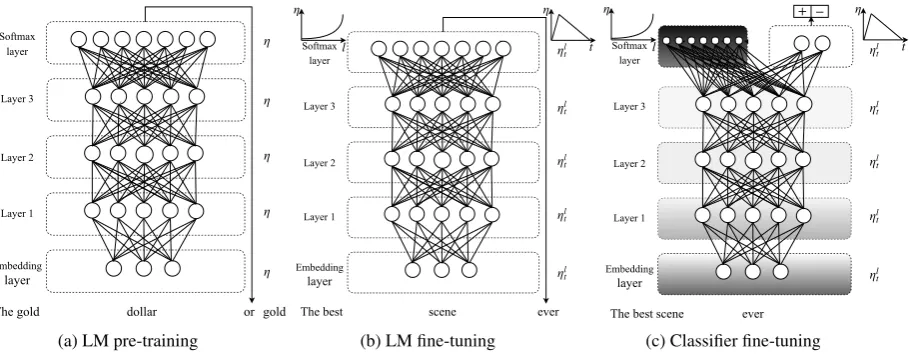
Figure 1: ULMFiT consists of three stages: a) The LM is trained on a general-domain corpus to capture general features of the language in different layers. b) The full LM is fine-tuned on target task data using discriminative fine-tuning (‘Discr’) and slanted triangular learning rates (STLR) to learn task-specific features. c) The classifier is fine-tuned on the target task using gradual unfreezing, ‘Discr’, and STLR to preserve low-level representations and adapt high-level ones (shaded: unfreezing stages; black: frozen).
task, which we show significantly improves per-formance (see Section 5). Moreover, language modeling already is a key component of existing tasks such as MT and dialogue modeling. For-mally, language modeling induces a hypothesis spaceHthat should be useful for many other NLP tasks (Vapnik and Kotz,1982;Baxter,2000).
We propose Universal Language Model Fine-tuning (ULMFiT), which pretrains a language model (LM) on a large general-domain corpus and fine-tunes it on the target task using novel tech-niques. The method isuniversalin the sense that it meets these practical criteria: 1) It works across tasks varying in document size, number, and label type; 2) it uses a single architecture and training process; 3) it requires no custom feature engineer-ing or preprocessengineer-ing; and 4) it does not require ad-ditional in-domain documents or labels.
In our experiments, we use the state-of-the-art language model AWD-LSTM (Merity et al.,
2017a), a regular LSTM (with no attention, short-cut connections, or other sophisticated ad-ditions) with various tuned dropout hyperparame-ters. Analogous to CV, we expect that downstream performance can be improved by using higher-performance language models in the future.
ULMFiT consists of the following steps, which we show in Figure 1: a) General-domain LM pretraining (§3.1); b) target task LM fine-tuning (§3.2); and c) target task classifier fine-tuning (§3.3). We discuss these in the following sections.
3.1 General-domain LM pretraining
An ImageNet-like corpus for language should be large and capture general properties of language. We pretrain the language model on Wikitext-103 (Merity et al.,2017b) consisting of 28,595 prepro-cessed Wikipedia articles and 103 million words. Pretraining is most beneficial for tasks with small datasets and enables generalization even with100
labeled examples. We leave the exploration of more diverse pretraining corpora to future work, but expect that they would boost performance. While this stage is the most expensive, it only needs to be performed once and improves perfor-mance and convergence of downstream models.
3.2 Target task LM fine-tuning
No matter how diverse the general-domain data used for pretraining is, the data of the target task will likely come from a different distribution. We thus fine-tune the LM on data of the target task. Given a pretrained general-domain LM, this stage converges faster as it only needs to adapt to the id-iosyncrasies of the target data, and it allows us to train a robust LM even for small datasets. We
pro-posediscriminative fine-tuning andslanted
trian-gular learning ratesfor fine-tuning the LM, which
we introduce in the following.
Discriminative fine-tuning As different layers capture different types of information (Yosinski et al., 2014), they should be fine-tuned to
fine-tuning method,discriminative fine-tuning3. Instead of using the same learning rate for all
layers of the model, discriminative fine-tuning al-lows us to tuneeachlayer with different learning rates. For context, the regular stochastic gradient descent (SGD) update of a model’s parametersθat time steptlooks like the following (Ruder,2016):
θt=θt−1−η· ∇θJ(θ) (1)
whereηis the learning rate and∇θJ(θ)is the gra-dient with regard to the model’s objective func-tion. For discriminative fine-tuning, we split the parametersθinto{θ1, . . . , θL}whereθl contains the parameters of the model at the l-th layer and
Lis the number of layers of the model. Similarly, we obtain {η1, . . . , ηL} where ηl is the learning rate of thel-th layer.
The SGD update with discriminative fine-tuning is then the following:
θtl=θtl−1−ηl· ∇θlJ(θ) (2)
We empirically found it to work well to first choose the learning rate ηL of the last layer by fine-tuning only the last layer and using ηl−1 = ηl/2.6as the learning rate for lower layers.
Slanted triangular learning rates For adapting its parameters to task-specific features, we would like the model to quickly converge to a suitable region of the parameter space in the beginning of training and then refine its parameters. Using the same learning rate (LR) or an annealed learn-ing rate throughout trainlearn-ing is not the best way to achieve this behaviour. Instead, we propose
slanted triangular learning rates (STLR), which
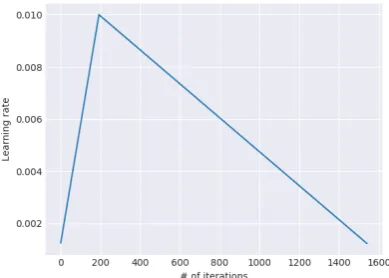
first linearly increases the learning rate and then linearly decays it according to the following up-date schedule, which can be seen in Figure2:
cut=bT·cut f racc
p=
(
t/cut, ift < cut
1− t−cut
cut·(ratio−1), otherwise
ηt=ηmax·
1 +p·(ratio−1) ratio
(3)
where T is the number of training iterations4,
cut f racis the fraction of iterations we increase
3
An unrelated method of the same name exists for deep Boltzmann machines (Salakhutdinov and Hinton,2009).
4In other words, the number of epochs times the number
of updates per epoch.
the LR,cutis the iteration when we switch from increasing to decreasing the LR,pis the fraction of the number of iterations we have increased or will decrease the LR respectively,ratiospecifies how much smaller the lowest LR is from the maximum LRηmax, andηtis the learning rate at iterationt.
We generally usecut f rac= 0.1,ratio= 32and
ηmax= 0.01.
STLR modifies triangular learning rates (Smith,
2017) with a short increase and a long decay pe-riod, which we found key for good performance.5 In Section5, we compare against aggressive co-sine annealing, a similar schedule that has recently been used to achieve state-of-the-art performance in CV (Loshchilov and Hutter,2017).6
Figure 2: The slanted triangular learning rate schedule used for ULMFiT as a function of the number of training iterations.
3.3 Target task classifier fine-tuning
Finally, for fine-tuning the classifier, we augment the pretrained language model with two additional linear blocks. Following standard practice for CV classifiers, each block uses batch normaliza-tion (Ioffe and Szegedy, 2015) and dropout, with ReLU activations for the intermediate layer and a softmax activation that outputs a probability dis-tribution over target classes at the last layer. Note that the parameters in these task-specific classi-fier layers are the only ones that are learned from scratch. The first linear layer takes as the input the pooled last hidden layer states.
Concat pooling The signal in text classification tasks is often contained in a few words, which may
5
We also credit personal communication with the author.
6WhileLoshchilov and Hutter(2017) use multiple
[image:4.595.312.507.295.434.2]occur anywhere in the document. As input docu-ments can consist of hundreds of words, informa-tion may get lost if we only consider the last hid-den state of the model. For this reason, we con-catenate the hidden state at the last time stephT
of the document with both the max-pooled and the mean-pooled representation of the hidden states over as many time steps as fit in GPU memory
H={h1, . . . ,hT}:
hc= [hT,maxpool(H),meanpool(H)] (4)
where[]is concatenation.
Fine-tuning the target classifier is the most crit-ical part of the transfer learning method. Overly aggressive fine-tuning will cause catastrophic for-getting, eliminating the benefit of the information captured through language modeling; too cautious fine-tuning will lead to slow convergence (and re-sultant overfitting). Besides discriminative fine-tuning and triangular learning rates, we propose
gradual unfreezingfor fine-tuning the classifier.
Gradual unfreezing Rather than fine-tuning all layers at once, which risks catastrophic forgetting, we propose to gradually unfreeze the model start-ing from the last layer as this contains the least
general knowledge (Yosinski et al., 2014): We
first unfreeze the last layer and fine-tune all un-frozen layers for one epoch. We then unfreeze the next lower frozen layer and repeat, until we fine-tune all layers until convergence at the last itera-tion. This is similar to ‘chain-thaw’ (Felbo et al.,
2017), except that we add a layer at a time to the set of ‘thawed’ layers, rather than only training a single layer at a time.
While discriminative fine-tuning, slanted trian-gular learning rates, and gradual unfreezing all are beneficial on their own, we show in Section
5that they complement each other and enable our method to perform well across diverse datasets.
BPTT for Text Classification (BPT3C) Lan-guage models are trained with backpropagation through time (BPTT) to enable gradient propa-gation for large input sequences. In order to make fine-tuning a classifier for large documents feasible, we propose BPTT for Text Classifica-tion (BPT3C): We divide the document into fixed-length batches of sizeb. At the beginning of each batch, the model is initialized with the final state of the previous batch; we keep track of the hid-den states for mean and max-pooling; gradients
Dataset Type # classes # examples
TREC-6 Question 6 5.5k
IMDb Sentiment 2 25k
Yelp-bi Sentiment 2 560k
Yelp-full Sentiment 5 650k
AG Topic 4 120k
DBpedia Topic 14 560k
Table 1: Text classification datasets and tasks with number of classes and training examples.
are back-propagated to the batches whose hidden states contributed to the final prediction. In prac-tice, we use variable length backpropagation se-quences (Merity et al.,2017a).
Bidirectional language model Similar to exist-ing work (Peters et al., 2017, 2018), we are not limited to fine-tuning a unidirectional language model. For all our experiments, we pretrain both a forward and a backward LM. We fine-tune a clas-sifier for each LM independently using BPT3C and average the classifier predictions.
4 Experiments
While our approach is equally applicable to se-quence labeling tasks, we focus on text classifica-tion tasks in this work due to their important real-world applications.
4.1 Experimental setup
Datasets and tasks We evaluate our method on six widely-studied datasets, with varying numbers of documents and varying document length, used by state-of-the-art text classification and transfer learning approaches (Johnson and Zhang, 2017;
McCann et al., 2017) as instances of three com-mon text classification tasks: sentiment analy-sis, question classification, and topic classifica-tion. We show the statistics for each dataset and task in Table1.
Sentiment Analysis For sentiment analysis, we evaluate our approach on the binary movie review IMDb dataset (Maas et al.,2011) and on the binary and five-class version of the Yelp review dataset compiled byZhang et al.(2015).
Model Test Model Test
IMDb
CoVe (McCann et al.,2017) 8.2
TREC-6
CoVe (McCann et al.,2017) 4.2 oh-LSTM (Johnson and Zhang,2016) 5.9 TBCNN (Mou et al.,2015) 4.0 Virtual (Miyato et al.,2016) 5.9 LSTM-CNN (Zhou et al.,2016) 3.9
[image:6.595.104.499.65.141.2]ULMFiT (ours) 4.6 ULMFiT (ours) 3.6
Table 2: Test error rates (%) on two text classification datasets used byMcCann et al.(2017).
AG DBpedia Yelp-bi Yelp-full
Char-level CNN (Zhang et al.,2015) 9.51 1.55 4.88 37.95 CNN (Johnson and Zhang,2016) 6.57 0.84 2.90 32.39 DPCNN (Johnson and Zhang,2017) 6.87 0.88 2.64 30.58
ULMFiT (ours) 5.01 0.80 2.16 29.98
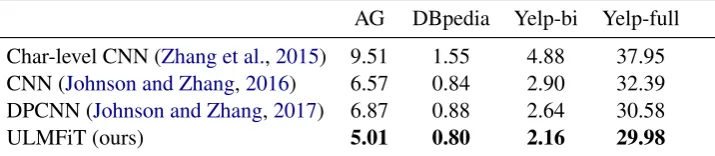
Table 3: Test error rates (%) on text classification datasets used byJohnson and Zhang(2017).
Topic classification For topic classification, we evaluate on the large-scale AG news and DBpedia ontology datasets created byZhang et al.(2015).
Pre-processing We use the same pre-processing as in earlier work (Johnson and Zhang,2017; Mc-Cann et al., 2017). In addition, to allow the lan-guage model to capture aspects that might be rel-evant for classification, we add special tokens for upper-case words, elongation, and repetition.
Hyperparameters We are interested in a model that performs robustly across a diverse set of tasks. To this end, if not mentioned otherwise, we use the same set of hyperparameters across tasks, which we tune on the IMDb validation set. We use the AWD-LSTM language model (Merity et al.,
2017a) with an embedding size of 400, 3 layers,
1150 hidden activations per layer, and a BPTT batch size of 70. We apply dropout of 0.4 to layers, 0.3 to RNN layers, 0.4 to input embed-ding layers,0.05to embedding layers, and weight dropout of0.5to the RNN hidden-to-hidden ma-trix. The classifier has a hidden layer of size50. We use Adam with β1 = 0.7 instead of the
de-faultβ1 = 0.9 andβ2 = 0.99, similar to (Dozat
and Manning, 2017). We use a batch size of 64, a base learning rate of 0.004 and 0.01 for fine-tuning the LM and the classifier respectively, and tune the number of epochs on the validation set of each task7. We otherwise use the same practices
7On small datasets such as TREC-6, we fine-tune the LM
only for15epochs without overfitting, while we can fine-tune
longer on larger datasets. We found50epochs to be a good
default for fine-tuning the classifier.
used in (Merity et al.,2017a).
Baselines and comparison models For each task, we compare against the current state-of-the-art. For the IMDb and TREC-6 datasets, we com-pare against CoVe (McCann et al.,2017), a state-of-the-art transfer learning method for NLP. For the AG, Yelp, and DBpedia datasets, we com-pare against the state-of-the-art text categorization method byJohnson and Zhang(2017).
4.2 Results
For consistency, we report all results as error rates (lower is better). We show the test error rates on the IMDb and TREC-6 datasets used by Mc-Cann et al.(2017) in Table2. Our method outper-forms both CoVe, a state-of-the-art transfer learn-ing method based on hypercolumns, as well as the state-of-the-art on both datasets. On IMDb, we reduce the error dramatically by 43.9% and 22% with regard to CoVe and the state-of-the-art re-spectively. This is promising as the existing state-of-the-art requires complex architectures (Peters et al.,2018), multiple forms of attention (McCann et al.,2017) and sophisticated embedding schemes (Johnson and Zhang,2016), while our method em-ploys a regular LSTM with dropout. We note that the language model fine-tuning approach of
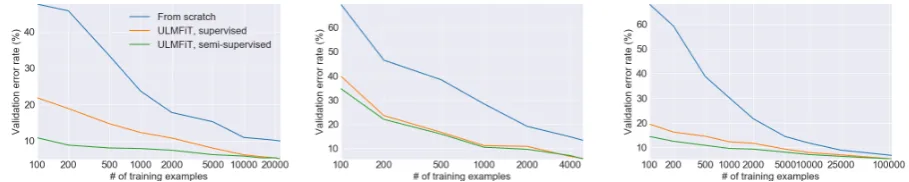
[image:6.595.121.479.179.257.2]Figure 3: Validation error rates for supervised and semi-supervised ULMFiT vs. training from scratch with different numbers of training examples on IMDb, TREC-6, and AG (from left to right).
paragraphs long—similar to emails (e.g for legal discovery) and online comments (e.g for commu-nity management); and sentiment analysis is simi-lar to many commercial applications, e.g. product response tracking and support email routing.
On TREC-6, our improvement—similar as the improvements of state-of-the-art approaches—is not statistically significant, due to the small size of the 500-examples test set. Nevertheless, the com-petitive performance on TREC-6 demonstrates that our model performs well across different dataset sizes and can deal with examples that range from single sentences—in the case of TREC-6— to several paragraphs for IMDb. Note that despite pretraining on more than two orders of magnitude less data than the 7 million sentence pairs used by
McCann et al.(2017), we consistently outperform their approach on both datasets.
We show the test error rates on the larger AG, DBpedia, Yelp-bi, and Yelp-full datasets in Table
3. Our method again outperforms the state-of-the-art significantly. On AG, we observe a simi-larly dramatic error reduction by 23.7% compared to the state-of-the-art. On DBpedia, Yelp-bi, and Yelp-full, we reduce the error by 4.8%, 18.2%, 2.0% respectively.
5 Analysis
In order to assess the impact of each contribution, we perform a series of analyses and ablations. We run experiments on three corpora, IMDb, TREC-6, and AG that are representative of different tasks, genres, and sizes. For all experiments, we split off
10% of the training set and report error rates on this validation set with unidirectional LMs. We fine-tune the classifier for 50epochs and train all methods but ULMFiT with early stopping.
Low-shot learning One of the main benefits of transfer learning is being able to train a model for
Pretraining IMDb TREC-6 AG
Without pretraining 5.63 10.67 5.52
With pretraining 5.00 5.69 5.38
Table 4: Validation error rates for ULMFiT with and without pretraining.
a task with a small number of labels. We evalu-ate ULMFiT on different numbers of labeled ex-amples in two settings: only labeled exex-amples are used for LM fine-tuning (‘supervised’); and all task data is available and can be used to fine-tune the LM (‘semi-supervised’). We compare ULM-FiT to training from scratch—which is necessary for hypercolumn-based approaches. We split off balanced fractions of the training data, keep the validation set fixed, and use the same hyperparam-eters as before. We show the results in Figure3.
On IMDb and AG, supervised ULMFiT with only 100 labeled examples matches the perfor-mance of training from scratch with10×and20×
more data respectively, clearly demonstrating the benefit of general-domain LM pretraining. If we allow ULMFiT to also utilize unlabeled exam-ples (50k for IMDb,100k for AG), at100labeled examples, we match the performance of training from scratch with50×and100×more data on AG and IMDb respectively. On TREC-6, ULMFiT significantly improves upon training from scratch; as examples are shorter and fewer, supervised and semi-supervised ULMFiT achieve similar results.
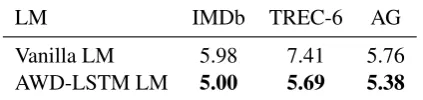
LM IMDb TREC-6 AG
Vanilla LM 5.98 7.41 5.76
AWD-LSTM LM 5.00 5.69 5.38
Table 5: Validation error rates for ULMFiT with a vanilla LM and the AWD-LSTM LM.
LM fine-tuning IMDb TREC-6 AG
No LM fine-tuning 6.99 6.38 6.09
Full 5.86 6.54 5.61
Full + discr 5.55 6.36 5.47
Full + discr + stlr 5.00 5.69 5.38
Table 6: Validation error rates for ULMFiT with different variations of LM fine-tuning.
Impact of LM quality In order to gauge the im-portance of choosing an appropriate LM, we com-pare a vanilla LM with the same hyperparame-ters without any dropout8 with the AWD-LSTM LM with tuned dropout parameters in Table 5. Using our fine-tuning techniques, even a regular LM reaches surprisingly good performance on the larger datasets. On the smaller TREC-6, a vanilla LM without dropout runs the risk of overfitting, which decreases performance.
Impact of LM fine-tuning We compare no fine-tuning against fine-fine-tuning the full model (Erhan et al., 2010) (‘Full’), the most commonly used fine-tuning method, with and without discrimi-native fine-tuning (‘Discr’) and slanted triangular learning rates (‘Stlr’) in Table6. Fine-tuning the LM is most beneficial for larger datasets. ‘Discr’ and ‘Stlr’ improve performance across all three datasets and are necessary on the smaller TREC-6, where regular fine-tuning is not beneficial.
Impact of classifier fine-tuning We compare training from scratch, fine-tuning the full model (‘Full’), only fine-tuning the last layer (‘Last’) (Donahue et al.,2014), ‘Chain-thaw’ (Felbo et al.,
2017), and gradual unfreezing (‘Freez’). We fur-thermore assess the importance of discriminative fine-tuning (‘Discr’) and slanted triangular learn-ing rates (‘Stlr’). We compare the latter to an alternative, aggressive cosine annealing schedule (‘Cos’) (Loshchilov and Hutter,2017). We use a learning rateηL= 0.01for ‘Discr’, learning rates
8To avoid overfitting, we only train the vanilla LM
classi-fier for5epochs and keep dropout of0.4in the classifier.
Classifier fine-tuning IMDb TREC-6 AG
From scratch 9.93 13.36 6.81
Full 6.87 6.86 5.81
Full + discr 4.57 6.21 5.62
Last 6.49 16.09 8.38
Chain-thaw 5.39 6.71 5.90
Freez 6.37 6.86 5.81
Freez + discr 5.39 5.86 6.04
Freez + stlr 5.04 6.02 5.35
Freez + cos 5.70 6.38 5.29
[image:8.595.76.288.64.114.2]Freez + discr + stlr 5.00 5.69 5.38
Table 7: Validation error rates for ULMFiT with different methods to fine-tune the classifier.
of0.001and0.0001for the last and all other layers respectively for ‘Chain-thaw’ as in (Felbo et al.,
2017), and a learning rate of0.001otherwise. We show the results in Table7.
Fine-tuning the classifier significantly improves over training from scratch, particularly on the small TREC-6. ‘Last’, the standard fine-tuning method in CV, severely underfits and is never able to lower the training error to 0. ‘ Chain-thaw’ achieves competitive performance on the smaller datasets, but is outperformed significantly on the large AG. ‘Freez’ provides similar per-formance as ‘Full’. ‘Discr’ consistently boosts the performance of ‘Full’ and ‘Freez’, except for the large AG. Cosine annealing is competi-tive with slanted triangular learning rates on large data, but under-performs on smaller datasets. Fi-nally, full ULMFiT classifier fine-tuning (bottom row) achieves the best performance on IMDB and TREC-6 and competitive performance on AG. Im-portantly, ULMFiT is the only method that shows excellent performance across the board—and is therefore the onlyuniversalmethod.
Classifier fine-tuning behavior While our re-sults demonstrate that howwe fine-tune the clas-sifier makes a significant difference, fine-tuning for inductive transfer is currently under-explored in NLP as it mostly has been thought to be un-helpful (Mou et al.,2016). To better understand the fine-tuning behavior of our model, we compare the validation error of the classifier fine-tuned with ULMFiT and ‘Full’ during training in Figure4.
Figure 4: Validation error rate curves for fine-tuning the classifier with ULMFiT and ‘Full’ on IMDb, TREC-6, and AG (top to bottom).
The error then increases as the model starts to overfit and knowledge captured through pretrain-ing is lost. In contrast, ULMFiT is more sta-ble and suffers from no such catastrophic forget-ting; performance remains similar or improves un-til late epochs, which shows the positive effect of the learning rate schedule.
Impact of bidirectionality At the cost of train-ing a second model, ensembltrain-ing the predictions of a forward and backwards LM-classifier brings a performance boost of around 0.5–0.7. On IMDb we lower the test error from5.30of a single model to4.58for the bidirectional model.
6 Discussion and future directions
While we have shown that ULMFiT can achieve state-of-the-art performance on widely used text classification tasks, we believe that language model fine-tuning will be particularly useful in the following settings compared to existing transfer learning approaches (Conneau et al., 2017; Mc-Cann et al.,2017;Peters et al.,2018): a) NLP for non-English languages, where training data for su-pervised pretraining tasks is scarce; b) new NLP tasks where no state-of-the-art architecture exists; and c) tasks with limited amounts of labeled data (and some amounts of unlabeled data).
Given that transfer learning and particularly fine-tuning for NLP is under-explored, many fu-ture directions are possible. One possible direc-tion is to improve language model pretraining and fine-tuning and make them more scalable: for ImageNet, predicting far fewer classes only in-curs a small performance drop (Huh et al.,2016), while recent work shows that an alignment be-tween source and target task label sets is impor-tant (Mahajan et al.,2018)—focusing on predict-ing a subset of words such as the most frequent ones might retain most of the performance while speeding up training. Language modeling can also be augmented with additional tasks in a multi-task learning fashion (Caruana,1993) or enriched with additional supervision, e.g. syntax-sensitive de-pendencies (Linzen et al.,2016) to create a model that is more general or better suited for certain downstream tasks, ideally in a weakly-supervised manner to retain its universal properties.
Another direction is to apply the method to novel tasks and models. While an extension to sequence labeling is straightforward, other tasks with more complex interactions such as entailment or question answering may require novel ways to pretrain and fine-tune. Finally, while we have provided a series of analyses and ablations, more studies are required to better understand what knowledge a pretrained language model captures, how this changes during fine-tuning, and what in-formation different tasks require.
7 Conclusion
We have proposed ULMFiT, an effective and ex-tremely sample-efficient transfer learning method that can be applied to any NLP task. We have also proposed several novel fine-tuning techniques that in conjunction prevent catastrophic forgetting and enable robust learning across a diverse range of tasks. Our method significantly outperformed ex-isting transfer learning techniques and the state-of-the-art on six representative text classification tasks. We hope that our results will catalyze new developments in transfer learning for NLP.
Acknowledgments
References
Jonathan Baxter. 2000. A Model of Inductive Bias Learning. Journal of Artificial Intelligence Research
12:149–198.
John Blitzer, Mark Dredze, and Fernando Pereira. 2007. Biographies, bollywood, boom-boxes and blenders: Domain adaptation for sentiment classification. Annual Meeting-Association
for Computational Linguistics 45(1):440.
https://doi.org/10.1109/IRPS.2011.5784441.
Cornelia Caragea, Nathan McNeese, Anuj Jaiswal, Greg Traylor, Hyun-Woo Kim, Prasenjit Mitra, Dinghao Wu, Andrea H Tapia, Lee Giles, Bernard J Jansen, et al. 2011. Classifying text messages for the haiti earthquake. InProceedings of the 8th interna-tional conference on information systems for crisis
response and management (ISCRAM2011). Citeseer.
Rich Caruana. 1993. Multitask learning: A knowledge-based source of inductive bias. In Pro-ceedings of the Tenth International Conference on
Machine Learning.
Zhao Chen, Vijay Badrinarayanan, Chen-Yu Lee, and Andrew Rabinovich. 2017. GradNorm: Gradient Normalization for Adaptive Loss Balancing in Deep Multitask Networks pages 1–10.
Zi Chu, Steven Gianvecchio, Haining Wang, and Sushil Jajodia. 2012. Detecting automation of twitter ac-counts: Are you a human, bot, or cyborg? IEEE Transactions on Dependable and Secure Computing
9(6):811–824.
Alexis Conneau, Douwe Kiela, Holger Schwenk, Lo¨ıc Barrault, and Antoine Bordes. 2017. Supervised Learning of Universal Sentence Representations from Natural Language Inference Data. In Proceed-ings of the 2017 Conference on Empirical Methods in Natural Language Processing.
Andrew M. Dai and Quoc V. Le. 2015. Semi-supervised Sequence Learning. Advances in Neu-ral Information Processing Systems (NIPS ’15) http://arxiv.org/abs/1511.01432.
Jeff Donahue, Yangqing Jia, Oriol Vinyals, Judy Hoff-man, Ning Zhang, Eric Tzeng, and Trevor Darrell. 2014. Decaf: A deep convolutional activation fea-ture for generic visual recognition. InInternational
conference on machine learning. pages 647–655.
Timothy Dozat and Christopher D. Manning. 2017. Deep Biaffine Attention for Neural Dependency Parsing. InProceedings of ICLR 2017.
Dumitru Erhan, Yoshua Bengio, Aaron Courville, Pierre-Antoine Manzagol, Pascal Vincent, and Samy Bengio. 2010. Why does unsupervised pre-training help deep learning? Journal of Machine Learning
Research11(Feb):625–660.
Bjarke Felbo, Alan Mislove, Anders Søgaard, Iyad Rahwan, and Sune Lehmann. 2017. Using millions of emoji occurrences to learn any-domain represen-tations for detecting sentiment, emotion and sar-casm. In Proceedings of the 2017 Conference on Empirical Methods in Natural Language Process-ing.
Kristina Gulordava, Piotr Bojanowski, Edouard Grave, Tal Linzen, and Marco Baroni. 2018. Colorless green recurrent networks dream hierarchically. In
Proceedings of NAACL-HLT 2018.
Bharath Hariharan, Pablo Arbel´aez, Ross Girshick, and Jitendra Malik. 2015. Hypercolumns for object seg-mentation and fine-grained localization. In Proceed-ings of the IEEE Conference on Computer Vision and Pattern Recognition. pages 447–456.
Kaiming He, Xiangyu Zhang, Shaoqing Ren, and Jian Sun. 2016. Deep Residual Learning for Image Recognition. InProceedings of the IEEE
Confer-ence on Computer Vision and Pattern Recognition.
Gao Huang, Zhuang Liu, Kilian Q. Weinberger, and Laurens van der Maaten. 2017. Densely Connected Convolutional Networks. InProceedings of CVPR 2017.
Minyoung Huh, Pulkit Agrawal, and Alexei A Efros. 2016. What makes ImageNet good for transfer learning? arXiv preprint arXiv:1608.08614.
Sergey Ioffe and Christian Szegedy. 2015. Batch nor-malization: Accelerating deep network training by reducing internal covariate shift. In International
Conference on Machine Learning. pages 448–456.
Nitin Jindal and Bing Liu. 2007. Review spam de-tection. In Proceedings of the 16th international
conference on World Wide Web. ACM, pages 1189–
1190.
Rie Johnson and Tong Zhang. 2016. Supervised and semi-supervised text categorization using lstm for region embeddings. InInternational Conference on
Machine Learning. pages 526–534.
Rie Johnson and Tong Zhang. 2017. Deep pyramid convolutional neural networks for text categoriza-tion. InProceedings of the 55th Annual Meeting of the Association for Computational Linguistics
(Vol-ume 1: Long Papers). volume 1, pages 562–570.
Tal Linzen, Emmanuel Dupoux, and Yoav Gold-berg. 2016. Assessing the ability of lstms to learn syntax-sensitive dependencies. arXiv preprint
arXiv:1611.01368.
Jonathan Long, Evan Shelhamer, and Trevor Darrell. 2015a. Fully convolutional networks for semantic segmentation. In Proceedings of the IEEE
Confer-ence on Computer Vision and Pattern Recognition.
pages 3431–3440.
Mingsheng Long, Yue Cao, Jianmin Wang, and Michael I. Jordan. 2015b. Learning Transferable Features with Deep Adaptation Networks. In Pro-ceedings of the 32nd International Conference on
Machine learning (ICML ’15). volume 37.
Ilya Loshchilov and Frank Hutter. 2017. SGDR: Stochastic Gradient Descent with Warm Restarts. In
Proceedings of the Internal Conference on Learning Representations 2017.
Andrew L Maas, Raymond E Daly, Peter T Pham, Dan Huang, Andrew Y Ng, and Christopher Potts. 2011. Learning word vectors for sentiment analysis. In
Proceedings of the 49th Annual Meeting of the Asso-ciation for Computational Linguistics: Human
Lan-guage Technologies-Volume 1. Association for
Com-putational Linguistics, pages 142–150.
Dhruv Mahajan, Ross Girshick, Vignesh Ramanathan, Kaiming He, Manohar Paluri, Yixuan Li, Ashwin Bharambe, and Laurens van der Maaten. 2018. Ex-ploring the Limits of Weakly Supervised Pretraining .
Bryan McCann, James Bradbury, Caiming Xiong, and Richard Socher. 2017. Learned in Translation: Con-textualized Word Vectors. In Advances in Neural Information Processing Systems.
Stephen Merity, Nitish Shirish Keskar, and Richard Socher. 2017a. Regularizing and Optimiz-ing LSTM Language Models. arXiv preprint
arXiv:1708.02182.
Stephen Merity, Caiming Xiong, James Bradbury, and Richard Socher. 2017b. Pointer Sentinel Mixture Models. InProceedings of the International Con-ference on Learning Representations 2017.
Tomas Mikolov, Kai Chen, Greg Corrado, and Jeffrey Dean. 2013. Distributed Representations of Words and Phrases and their Compositionality. In Ad-vances in Neural Information Processing Systems.
Sewon Min, Minjoon Seo, and Hannaneh Hajishirzi. 2017. Question Answering through Transfer Learn-ing from Large Fine-grained Supervision Data. In
Proceedings of the 55th Annual Meeting of the As-sociation for Computational Linguistics (Short Pa-pers).
Takeru Miyato, Andrew M Dai, and Ian Good-fellow. 2016. Adversarial training methods for semi-supervised text classification. arXiv preprint
arXiv:1605.07725.
Lili Mou, Zhao Meng, Rui Yan, Ge Li, Yan Xu, Lu Zhang, and Zhi Jin. 2016. How Transferable are
Neural Networks in NLP Applications? Proceed-ings of 2016 Conference on Empirical Methods in
Natural Language Processing.
Lili Mou, Hao Peng, Ge Li, Yan Xu, Lu Zhang, and Zhi Jin. 2015. Discriminative neural sentence mod-eling by tree-based convolution. InProceedings of the 2015 Conference on Empirical Methods in Nat-ural Language Processing.
EWT Ngai, Yong Hu, YH Wong, Yijun Chen, and Xin Sun. 2011. The application of data mining tech-niques in financial fraud detection: A classifica-tion framework and an academic review of literature.
Decision Support Systems50(3):559–569.
Sinno Jialin Pan and Qiang Yang. 2010. A survey on transfer learning. IEEE Transactions on Knowledge
and Data Engineering22(10):1345–1359.
Matthew E Peters, Waleed Ammar, Chandra Bhagavat-ula, and Russell Power. 2017. Semi-supervised se-quence tagging with bidirectional language models. InProceedings of ACL 2017.
Matthew E Peters, Mark Neumann, Mohit Iyyer, Matt Gardner, Christopher Clark, Kenton Lee, and Luke Zettlemoyer. 2018. Deep contextualized word rep-resentations. InProceedings of NAACL 2018.
Alec Radford, Rafal Jozefowicz, and Ilya Sutskever. 2017. Learning to generate reviews and discovering sentiment. arXiv preprint arXiv:1704.01444.
Marek Rei. 2017. Semi-supervised multitask learning for sequence labeling. InProceedings of ACL 2017.
Herbert L Roitblat, Anne Kershaw, and Patrick Oot. 2010. Document categorization in legal electronic discovery: computer classification vs. manual re-view. Journal of the Association for Information
Science and Technology61(1):70–80.
Sebastian Ruder. 2016. An overview of gradient descent optimization algorithms. arXiv preprint
arXiv:1609.04747.
Ruslan Salakhutdinov and Geoffrey Hinton. 2009. Deep boltzmann machines. InArtificial Intelligence and Statistics. pages 448–455.
Rico Sennrich, Barry Haddow, and Alexandra Birch. 2015. Improving neural machine translation models with monolingual data. arXiv preprint
arXiv:1511.06709.
Aliaksei Severyn and Alessandro Moschitti. 2015. UNITN: Training Deep Convolutional Neural Net-work for Twitter Sentiment Classification. Proceed-ings of the 9th International Workshop on Semantic
Evaluation (SemEval 2015)pages 464–469.
Ali Sharif Razavian, Hossein Azizpour, Josephine Sul-livan, and Stefan Carlsson. 2014. Cnn features off-the-shelf: an astounding baseline for recognition. In
Leslie N Smith. 2017. Cyclical learning rates for train-ing neural networks. In Applications of Computer
Vision (WACV), 2017 IEEE Winter Conference on.
IEEE, pages 464–472.
Vladimir Naumovich Vapnik and Samuel Kotz. 1982.
Estimation of dependences based on empirical data, volume 40. Springer-Verlag New York.
Ellen M Voorhees and Dawn M Tice. 1999. The trec-8 question answering track evaluation. InTREC. vol-ume 1999, page 82.
John Wieting and Kevin Gimpel. 2017. Revisiting Re-current Networks for Paraphrastic Sentence Embed-dings. InProceedings of the 55th Annual Meeting of the Association for Computational Linguistics (ACL 2017).
Jason Yosinski, Jeff Clune, Yoshua Bengio, and Hod Lipson. 2014. How transferable are features in deep neural networks? InAdvances in neural information
processing systems. pages 3320–3328.
Xiang Zhang, Junbo Zhao, and Yann LeCun. 2015. Character-level convolutional networks for text clas-sification. In Advances in neural information pro-cessing systems. pages 649–657.
Peng Zhou, Zhenyu Qi, Suncong Zheng, Jiaming Xu, Hongyun Bao, and Bo Xu. 2016. Text classification improved by integrating bidirectional lstm with two-dimensional max pooling. InProceedings of