ISSN Online: 2327-5227 ISSN Print: 2327-5219
DOI: 10.4236/jcc.2017.512009 Oct. 31, 2017 80 Journal of Computer and Communications
A Quick Survey on Cloud Computing and
Associated Security, Mobility and IoT Issues
Michael Perez, Sanjeev Kumar
Department of Electrical and Computer Engineering, University of Texas-RGV, Edinburg, TX, USA
Abstract
This survey paper provides a general overview on Cloud Computing. The topics that are discussed include characteristics, deployment and service mod-els as well drawbacks. Major aspects of Cloud Computing are explained to give the reader a clearer understanding on the complexity of the platform. Following this, several security issues and countermeasures are also discussed to show the major issues and obstacles that Cloud Computing faces as it is being implemented further. The major part of countermeasures focuses on Intrusion Detection Systems. Moving towards Mobile Cloud Computing and Internet of Things, this survey paper gives a general explanation on the appli-cations and potential that comes with the integration of Cloud Computing with any device that has Internet connectivity as well as the challenges that are before it.
Keywords
Cloud Computing, Cloud Service Models, Platform, Security, Mobility, Internet of Things (IoT)
1. Introduction
Cloud computing is a model that is completely based on the Internet and remote servers to utilize large amounts of data, software, and applications. It is a prom-ising new platform for services to be provided on the Internet. These include storage, applications, and hardware services that clients can utilize as an on-de- mand basis. The listed services are provided without the clients having to own the particular service or application. As for hardware services, clients do not have to have them installed locally. They are usually paid for by clients “per use” basis, which results in overall cost reductions. Along with reduced costs, major companies such as Google and Amazon utilize the features and benefits of cloud
How to cite this paper: Perez, M. and Kumar, S. (2017) A Quick Survey on Cloud Computing and Associated Security, Mo-bility and IoT Issues. Journal of Computer and Communications, 5, 80-95.
https://doi.org/10.4236/jcc.2017.512009
Received: June 22, 2017 Accepted: October 28, 2017 Published: October 31, 2017
Copyright © 2017 by authors and Scientific Research Publishing Inc. This work is licensed under the Creative Commons Attribution International License (CC BY 4.0).
http://creativecommons.org/licenses/by/4.0/
DOI: 10.4236/jcc.2017.512009 81 Journal of Computer and Communications
computing such as low investment cost, easy to manage, and flexibility to pro-vide their services [1]. The purpose of this survey paper is to give the reader a much clearer understanding of the fundamentals of cloud computing ranging from a general overview of cloud computing to the security issues and vulnera-bilities that are involved with the platform.
The topics presented in this paper can be divided into four major categories. This includes a general Cloud Computing overview, Cloud Computing security, Mobile Cloud Computing, and Internet of Things. For the cloud computing overview, the reader will find detailed explanations for each individual aspect of cloud computing to get a clearer understanding on the platform ranging from its architecture to each service model. The cloud computing security section will provide an overview of a variety of different security threats and vulnera-bilities that cloud computing faces. Mobile Cloud Computing and Internet of Things both act as extensions to the general overview of Cloud Computing with subtopics including Cloud Computing limitations, new applications, and the future outlook, as Cloud Computing is further integrated with mobile de-vices.
2. Cloud Computing General Overview
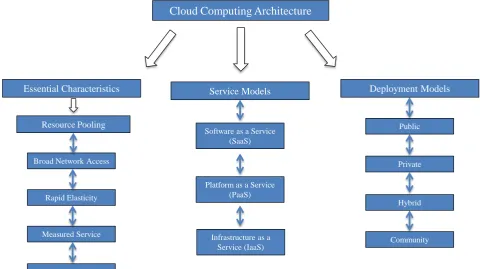
There are various levels of Cloud Computing that need to be taken into consid-eration when trying to understand the platform. Like most forms of technology it has it’s own set of benefits and drawbacks, which will be discussed shortly, but also has defining characteristics that set it apart from other forms of technology. Other levels of cloud computing include the various service and deployment models. Each of these models allows for versatility in order to satisfy a specific set of needs for different customer bases. On a higher level the cloud architecture can be used to describe each component of cloud computing ranging from the physical servers and networks, the middleware, and even to individual applica-tion funcapplica-tion that are more commonly associated by clients for cloud compu-ting. Figure 1 shows a general overview of each architectural layer of cloud computing.
2.1. Cloud Computing Architecture
DOI: 10.4236/jcc.2017.512009 82 Journal of Computer and Communications
Figure 1. Cloud computing architecture and general overview.
components. The physical layer is the hardware and resources that the two layers above utilize to perform their required tasks. Hardware includes individual servers, switchers, and routers. The facilities that house the hardware is also a part of this layer along with the power systems related to maintaining proper operation of the physical components in house. This includes heating, ventila-tion, air conditioning, and emergency power [2].
2.2. Cloud Computing Benefits
The adoption of cloud computing has allowed for many companies to expe-rience several benefits from it’s implementation. Reduction of costs from differ-ent paymdiffer-ent schemes such as a onetime paymdiffer-ent or pay-as-you-use instead of an extensive purchase of a large number of computers and related hardware has been a major benefit. Also the combination of needs from a customer base re-duces the overall cost and with the higher computer utilization from cloud computing services, this makes it an enticing option for major companies. Another benefit offered is the reduced deployment times. With cloud compu-ting, whole systems can become fully functional in a fraction of the time tradi-tional methods would have. Examples include virtual web servers that can be brought online in the cloud and the launching of products or services [1] [3]. Different aspects of services also benefit from cloud computing including intro-ducing new services, scalability, and easy access. The cloud allows information to be easily accessible anywhere with proper access. For scalability, the cloud can scale services and provide new ones easily with the demands of customers. Along
Cloud Computing Architecture
Essential Characteristics Service Models Deployment Models
Public
Private
Hybrid
Community Software as a Service
(SaaS)
Platform as a Service (PaaS)
Infrastructure as a Service (IaaS) Resource Pooling
Broad Network Access
Rapid Elasticity
Measured Service
DOI: 10.4236/jcc.2017.512009 83 Journal of Computer and Communications
with this, backup and recovery is another key benefit of cloud computing, which allows easier storage than physical media [1].
2.3. Cloud Computing Drawbacks
Like all other forms of technology with all the benefits that cloud computing of-fers there are some drawbacks. Security issues are the main drawback to cloud computing as sensitive data is usually handed over to third party cloud servers, which could lead to trust issues within organizations of who they work with. The amount of data used in cloud computing also makes it vulnerable to attacks, which requires constant monitoring. Also technical issues such as server down-times and even data losses can hinder job completions from organizations. Ap-plication inflexibility can also be considered a drawback to cloud computing be-cause of the lack of support for different formats [1].
2.4. Cloud Computing Characteristics
With Cloud Computing being so complex there are several basic characteristics that define the technology that is universally understood as the foundation for the platform. These characteristics allow the services of Cloud Computing to be provided which include elasticity, on demand self-service, multi-tenancy, and shared resource pooling to name a few [1] [3] [4].
Elasticity allows cloud computing to scale either up or down quickly in order to make a user think that there are unlimited resources available at all times. Multi-tenancy allows the same infrastructure to be shared by different business-es. Each one would have its own responsibilities of its own respective layer while sharing the same infrastructure provider and same data center. Shared resource pooling allows the provider to combine computing resources to serve different customers, and assign and reassign physical and virtual resources as customer demand changes. This allows more flexibility to the infrastructure providers for resource management and costs. Broad network access is another key characte-ristic of cloud computing. Since the platform is Internet based, the only thing required for any Internet ready device to access cloud mechanisms, services, and resources is an Internet connection [1] [3] [4].
2.5. Cloud Computing Deployment Models
The type of model cloud computing can be classified as depends on location and organization. Public clouds are considered the standard cloud model. Multiple users access the cloud resources and services on the same public infrastructure. Each user is charged by the amount of time accessing the resources that they need. Drawbacks to this model include the fact that it is prone to attacks and have various security issues that will be discussed in later sections.
inter-DOI: 10.4236/jcc.2017.512009 84 Journal of Computer and Communications
nally. Benefits include security and easy maintenance however; the privatization of this cloud can result in high costs. A community cloud is implemented as an access between several organizations and belongs to the same community. Pri-vacy requirements, policies, and security concerns are all shared. Infrastructure locations can vary such as the same company hosted by a third-party. Hybrid clouds combined private and public clouds or multiple clouds of the same type under a standard protocol. Companies can utilize aspects of which types of clouds are present in the hybrid cloud to allocate where to perform certain tasks that can improve productivity [1] [5].
2.6. Cloud Computing Service Models
There are three service models used to describe cloud services. These include Software as a Service, Platform as a Service, and Infrastructure as a Service. Software as a Service (SaaS) allows clients to access cloud applications without having to install the application on their own computer. The service provider maintains the cloud-computing infrastructure, and control from a user’s stand-point is only at the application settings [6]. The advantages of this model include reduction of software licensing costs, security, and it allows multiple clients to use the same application at the same time [7]. Platform as a Service (PaaS) is somewhat opposite of the previous model where now clients can create and deploy their own applications to the cloud. These applications are developed by programming and configuration tools and are mainly used by developers, testers or administrators [6]. This platform allows individuals to develop applications without the need to have the proper environment installed locally. Control over the application’s configuration is in the client’s hands while the actual cloud in-frastructure is not since they are renting the virtual servers for development and testing. Advantages of Platform as a Service include increased flexibility for de-velopers allowing them to create new platforms on demand to meet newer re-quirements along with security benefits of the service for data, which include backup and recovery [7]. Infrastructure as a Service (IaaS) the client now has access to the actual infrastructure of the cloud service provider. They can use the virtual hardware to use development tools to build applications on the given in-frastructure. Clients include higher level IT personnel including system admin-istrators and developers [6]. Advantages of Infrastructure as a Service include fluctuation of the infrastructure on demand and reduction of costs from hard-ware and human resources as well as from the ability to have many users use single hardware [7].
3. Cloud Computing Security
DOI: 10.4236/jcc.2017.512009 85 Journal of Computer and Communications
will be discussed in further detail. Looking at various security threat examples and countermeasures pertaining to topic discussed previously such as Cloud Computing service models and characteristics can give a good overview on the obstacles that Cloud Computing faces as it is further implemented and more widely used.
3.1. Cloud Computing CIA Triad
The CIA Triad model stands for Confidentiality, Integrity and Availability for securing systems and plays a key role in maintaining proper security for cloud computing. With the amount of data being exchanged on the platform each part of the triad must be kept in check. Confidentiality prevents the access of data by unauthorized party and in essence main role is to keep data private. There are several parts of cloud computing that are related to this part of the CIA Triad. Encryption, covert channel, and traffic analysis are just a few examples of what is associated with confidentiality in cloud computing. Integrity maintains consis-tent and unaltered information being used on the cloud. This means that there is no unauthorized modification of data present. Availability in cloud computing means that the resources and data are reliable and can be accessed at any time as user needs [8] [9].
3.2. CIA Triad General Security Threat Examples
General security threats also apply to cloud computing such as eavesdropping, fraud, theft, and external attacks. Each of these affect the CIA Triad for cloud computing. Eavesdropping allows the unauthorized gathering of information, fraud can be either data manipulation or falsification, and external attacks can result in lack of availability for cloud computing services. There are several tech-niques used to compromise the CIA Triad for cloud computing. Reconnaissance can involve various methods of collection methods and social engineering to gather information to be granted unauthorized cloud access. These can include physical break-ins to get to specific machines to access information, dumpster diving to retrieve discarded information which can sometimes still be valid, and social engineering to manipulate individuals into giving out secret information such as passwords. Denial of Service is the main culprit for affecting the availa-bility of cloud computing in the CIA Triad. Resources such as CPU, Network, and Memory are the main targets to bring down access to cloud related services. General methods implemented can be buffer overflows and packet flooding. Other general methods used to violate the CIA Triad include account cracking and malicious software. Account cracking from brute force password attacks can lead to unauthorized access to accounts and thus can result in data manipulation and data being stolen. Malicious software such as viruses, spyware, and worms can all in their own way affect each part of the CIA Triad [9].
3.3. Cloud Computing Threats and Countermeasures
compu-DOI: 10.4236/jcc.2017.512009 86 Journal of Computer and Communications
ting there are various aspects of the technology where specific security issues can take place. Security threats in the cloud computing environment have their own exploits for taking advantage of different vulnerabilities. In virtualization, with the amount of operating systems running on single hardware, it is possible to loose track of all the machines present. This can result in a new machine run-ning malicious code to either gain control of the entire system or bring the sys-tem down. Rootkits can be installed to infect machines to hide key components from being identified by different security tools and programs. Countermeasures for this type of attack revolve around authenticity checks for messages from the client machines. A comparison of an original image file to upcoming service re-quest via hash values is one specific method.
The software interfaces that clients use for cloud computing also have their own set of risks. The control over several virtual machines and systems in com-bination with potential insecure interfaces and application program interfaces can lead to unauthorized access, reusable passwords, and limited logging to name a few. Countermeasures can include strong authentication methods and encrypted transmissions. The storage of data by third party data center can re-sult in data breaches that leak information and cause data corruption. In partic-ular, by renting a server from other service providers for reduction of costs and flexibility, cloud providers run the risk for malicious insiders to steal the valua-ble data on the service provider servers. There are multiple security threats that can result in data breaches such as identify theft, malware, SQL injection, and phishing. Data breach aftermaths can result in cloud service providers to close because of the financial and legal issues that arise with customer data loss and corruption. Countermeasures include filter techniques for user in-puts, active content filtering for SQL attacks, and web application vulnera-bility detection.
DOI: 10.4236/jcc.2017.512009 87 Journal of Computer and Communications
3.4. Security Threats to Cloud Computing Characteristics
Looking at the characteristics of cloud computing that were discussed in a pre-vious section, here we can find and describe security risks to the cloud service environment. The elasticity nature of cloud computing makes security breaches possible even though safety measures are in place such as data encryption. For multi-tenancy, the service placement engine, which overlooks the lists of availa-ble resources for the cloud resource pool, must have several security require-ments. These are needed to avoid the placement of multiple cloud services on the same hardware resource, which can create data vulnerabilities. With shared resource pooling comes a certain distribution and multi-user environment. Here risks are always present because of the lack of control users have in this type of environment. Referring back to the previous section on specific CIA threats with the issues of control over data and applications, since customers have to trust the service provider with sensitive data without knowing exactly where the services or applications are located in general, the data itself is vulnerable in each area of the CIA triad. Adding on to characteristics, there is also a lack of standard at each cloud tier. High flexibility in a cloud computing environment can make us-ers become dependent on only one service provider which can make them even more vulnerable from the lack of diversity [11].
3.5. Security Threats to Cloud Computing Service Models
Each service model has its own set of unique vulnerabilities based on its struc-ture. This comes from the differences in what is managed by users and the cloud service providers for each service model. Software-as-a-Service (SaaS) specific vulnerabilities include identity management, lack of standards, service secrecy, anywhere access, and general infrastructure security. For identity management the use of third parties creates differences in how they approach restricting sys-tem access to authorized users increases vulnerabilities. Also with lack of stan-dards and service secrecy, the fact that the information on where data is stored and the lack of disclosers on how it is secured creates vulnerabilities for users. With this lack of information the service providers do not guarantee the safety of data other than just general formalities saying that the data is secured. With this service model, since access can occur anywhere, individual users and endpoints cannot be guaranteed to be secure. This can create openings for threats to this cloud service model. Now as stated before, there will be issues with data security when running an application on the cloud as the infrastructure security is totally dependent on the service provider.
down-DOI: 10.4236/jcc.2017.512009 88 Journal of Computer and Communications
time because of this. Overall changes though can lead to compromised data and applications. With this service model providing the development environment tools to customers, the customers do not have a guarantee that they are secure.
Infrastructure-as-a-Service (IaaS) model vulnerabilities include enforcement of Service Level Agreement, virtualization, and security of virtual machines. The enforcement of service level agreements has to be done by both the cloud service provider and customers when necessary. The lack of enforcement and monitor-ing of quality of services can create security issues. For virtualization, changes to virtual machines in general can create security threats and the lack of a control-ling system to monitor virtual machines and the communications that take place also creates a high-risk environment. The security of virtual machines in partic-ular the communication and mobility must be secure to prevent cloud servers from being susceptible to DDoS related attacks. Overall, for the three service models they each share vulnerabilities that relate to the CIA triad such as each one can be susceptible to DDoS attacks, which affect availability, or the assur-ance of information, which affects confidentiality, and maintaining data integri-ty in general [11].
3.6. Intrusion Detection Systems
The previously mentioned cloud computing threats can be categorized into two areas, they are insider attacks which include cloud users doing unauthorized tasks, and outsider attacks such as DDoS. Preventing these attacks is a challenge for Intrusion Detection Systems (IDS) [12]. “The definition for Intrusion Detec-tion Systems is the process of monitoring events occurring in a computer system or network and analyzing them to look for intrusions” [12]. The system itself can be both hardware and software. However there are some limitations to ex-isting IDS that make it a challenge to work within the cloud-computing envi-ronment. They do not have autonomic self-adaptation, lack scalability, and are not deterministic. Thus new cloud based IDS are needed [12].
DOI: 10.4236/jcc.2017.512009 89 Journal of Computer and Communications
are considered. This gives the IDS time to identify habits within a network over a certain period of time such as CPU usage, file access times, and incorrect logins. The benefit that this type of detection has over signature-based is that it can detect unknown attacks by comparing current network and system activities to the profiles that it has created to determine that an attack is taking place. Hybrid detection is the combination of signature-based and anomaly-based detection using both methods as one IDS [12].
3.7. Cloud Computing Intrusion Detection Systems
The types of cloud-computing IDS are Network based, Host based, Distributed, and Hypervisor-based. Network based IDS can use both signature and anomaly based techniques to identify potential malicious activities. After it scans the traf-fic for a network, it uses the IP and transport layer headers of each packet in its detection. This type of system however, cannot analyze encrypted traffic and in-trusions in a virtual network by a virtual machine monitor which creates and runs virtual machines.
Host based IDS instead of collecting information from the entire network it collects and analyzes information from a specific host machine to detect any possible intrusions. Information that is used includes network events, system calls, and file usage to name few. Any modification in the host kernel, host file system, or overall behavior of the program that seems to be unusual is reported as an attack. In cloud computing, Host based IDS can be deployed on the hyper-visor (creates and runs virtual machines) or host. Here it can use system logs, user logins, and policies to detect any potential threat within the cloud. Benefits over Network based IDS include the ability to now analyze encrypted traffic, but this type of detection system is vulnerable to DDoS attacks.
Distributed IDS combines many Network based and Host based IDS, which are deployed on a large network. Each individual IDS communicate with a cen-tralized server.
Hypervisor-based IDS is used for virtual machines as it is set up at the hyper-visor layer. This system monitors communication at different levels such as communication between virtual machine and hypervisor to detect any type of anomalies [12].
4. Mobile Cloud Computing
DOI: 10.4236/jcc.2017.512009 90 Journal of Computer and Communications
Cloud Computing can allow for a better understanding of the platform and the differences between itself and regular Cloud Computing.
4.1. Mobile Cloud Computing Architecture
Mobile cloud computing services have some differences than the cloud services as regular cloud computing with Software as a Service (SaaS), Platform as a Ser-vice (PaaS), and Infrastructure as a SerSer-vice (IaaS). This is due to these classifica-tions being based on virtualization [14]. With the increasing number of mobile clients in cloud computing using mobile applications that are linked to servers operating in the cloud, breaking down mobile cloud computing architecture into its components can help with understanding how mobile devices and clients work with cloud computing. These components are mobile clients, middleware, and cloud services. Each mobile client connects to the cloud, which is managed by service providers’ thorough middleware. The middleware component pushes updates to services via hypertext transfer protocol [15].
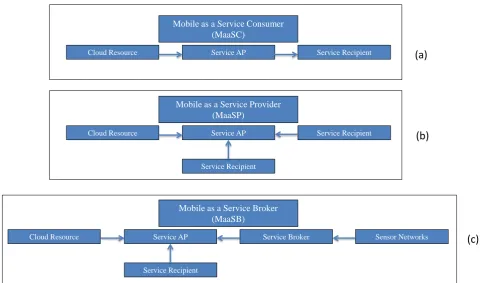
For mobile cloud service models, they are classified based on the roles of computational entities within a service framework. Specific models are titled Mobile as a Service Consumer (MaaSC), Mobile as a Service Provider (MaaSP), and Mobile as a Service Broker (MaaSB). The most popular model for mobile cloud computing is MaaSC. Mobile devices using this model can achieve higher performance and have a broader range of application capabilities by outsourcing computation and storage to the cloud. MaaSP is the opposite of MaaSC where now each client has the capability of the service provider. Services provided here are based on sensing and processing capabilities of the connecting mobile devic-es with application data ranging from GPS, camera, and other device related da-ta. Other local devices receive this data in order to improve performance and accuracy of various applications. MaaSB is used when mobile devices are limited in their capabilities. This model allows an extension to sensor networks where a mobile device can be used as a gateway to provide network services via Blu-etooth, WiFi, and cell phone provider network in order to communicate and send data to cloud resources. Mobile devices can also act as a security layer to sensor networks under this service model [14]. Figure 2 shows an overview of each mobile cloud service model.
4.2. Mobile Cloud Challenges
DOI: 10.4236/jcc.2017.512009 91 Journal of Computer and Communications
Figure 2. Mobile cloud computing service models: (a) Mobile as a service consumer model; (b) Mobile as a service provider; (c)
Mobile as a service broker.
similar to traditional devices that connect to the Internet as mobile devices are at risk for malicious attacks as well as the general cloud security [13], which was discussed earlier in the paper.
4.3. Mobile Cloud Applications
Current applications that are being used as a result of the increased popularity of mobile devices are email, banking, healthcare, and gaming to name a few. Email acts as the main application of the Mobile Cloud as emails are stored on a re-mote server and are accessed and updated regularly by mobile devices. Banking and commerce in general, is utilizing the Mobile Cloud for performing different transactions such as Mobile Banking and shopping. For healthcare the Mobile Cloud is used to provide better overall service and treatment for patients such as ease of access of patient health records. On the entertainment side, Mobile Gaming has taken advantage of using the Mobile Cloud for computing resources to allow users to play advanced type of games on their mobile devices [13].
The list of mobile cloud applications described in [14] includes computation, storage, security and privacy, and context awareness. One obstacle faced by mo-bile cloud computation is that dividing tasks between a local momo-bile device and the cloud can be inefficient leading to high energy consumption, CPU usage, and network delays. Various services mitigate these inefficiencies by offering runtime environments to make mobile applications run seamlessly between local devices and the cloud servers. Other services use code to maximize energy consumption
Mobile as a Service Consumer (MaaSC)
Cloud Resource Service AP Service Recipient
Mobile as a Service Provider (MaaSP)
Cloud Resource Service AP Service Recipient
Service Recipient
Mobile as a Service Broker (MaaSB)
Cloud Resource Service Broker Sensor Networks
Service Recipient Service AP
(a)
(b)
DOI: 10.4236/jcc.2017.512009 92 Journal of Computer and Communications
as well as offloading tasks to the cloud is made efficient by having this process to be automatic. For mobile cloud storage, automatic synchronization is a preferred feature to send data to storage services. Examples of storage services include Dropbox and Google Drive. Each mobile device has a limited amount of storage capacity and sensitive data used in automatic synchronization such as history, contacts, and preferences has to be kept in a secure and reliable space [14].
5. Internet of Things (IoT)
With the concept of Internet of Things (IoT) now a reality, the amount of devic-es connected to the Internet has grown exponentially. The combination of cloud computing, sensors, and actuators creates a network never seen before. These smart devices can range from practically anything including wearables, security solutions, healthcare, smart electric meters, smart appliances, and power grids to name a few [16]. The incorporation of these devices with cloud computing has increased performance potential and they also have many challenges.
5.1. Internet of Things and Cloud Computing
Cloud IoT is the name given for the combination of Internet of Things and Cloud Computing. Cloud Computing has most of the issues that Internet of Things has solved with nearly unlimited capabilities in processing power and storage. Now Internet of Things can also benefit Cloud Computing by extending its scope and bring new types of services. Looking at specifics, Internet of Things produces a large amount of data from the information it gathers and Cloud Computing is the most cost effective and convenient way to handle the amount of data produced by Internet of Things. For processing power, each Internet of Things device has limited processing power and resources. Usually data is trans-ferred to more powerful capable devices for processing. Cloud Computing can offset this drawback of Internet of Things and create higher levels of complexity with these devices. Looking at connectivity, each device that is part of Internet of Things has to be IP-enabled and the costs for support can be rather high. Cloud Computing offers a much more cost-effective solution and these devices can be managed and monitored in real-time from applications on the cloud. Overall the addition of Cloud Computing to Internet of Things can solve the issues of scala-bility, reliascala-bility, and security [17].
5.2. Cloud IoT Applications
DOI: 10.4236/jcc.2017.512009 93 Journal of Computer and Communications
Smart Home applications can range from managing energy consumption, lighting, and air conditioning. Each relies on a sensor network, which can pro-duce a large amount of data. The rise of home automation and Internet-enabled devices in a household create an opportunity for an integration of a cloud to manage these devices. The cloud must provide internal network connections, intelligent remote control, and automation. Another home related application is video surveillance. Using the cloud can mitigate any potential storage con-straints that may arise with the amount of data gathered in surveillance. Cloud based solutions can be used to store and mange content from surveillance feeds and deliver it to authorized user devices via the Internet [17].
Smart Energy can utilize Cloud IoT to provide intelligent management of energy systems such as energy distribution and energy consumption. For distri-bution, electricity can be better managed by providing services after analyzing data collected from nodes that have sensing, processing power, and network ca-pabilities. Each node along with the cloud can distribute tasks and the deci-sion-making can be made on the cloud [17].
The automotive industry also can have many benefits with the integration of Cloud Computing and Internet of Things with transportation technologies. These IoT-based vehicular data clouds benefits can include increased road safe-ty, reduced traffic, and vehicle maintenance [17]. “Vehicular Clouds are de-signed to expand the conventional Clouds in order to increase on-demand the whole Cloud computing, processing, and storage capabilities, by using under- utilized facilities of vehicles” [17]. Issues with vehicular clouds include scalability due to the amount of vehicles and number changes. Along with this the various speeds and locations where vehicles travel can cause interruption in communi-cations, which reduce performance, reliability, and quality of service. Security is also an issue due to the lack of an established infrastructure preventing any ef-fective authentication [17].
6. Conclusion
DOI: 10.4236/jcc.2017.512009 94 Journal of Computer and Communications
Acknowledgements
This work was supported in part by the US National Science Foundation, under Grant# 0421585 and Houston Endowment Chair in Science, Math and Tech-nology Fellowship.
References
[1] Kamboj, S. and Ghumman, N.S. (2016) A Survey on Cloud Computing and Its Types. 2016 3rd International Conference on Computing for Sustainable Global Development (INDIACom), New Delhi, 2971-2974.
[2] Colman-Meixner, C., Develder, C., Tornatore, M. and Mukherjee, B. (2016) A Sur-vey on Resiliency Techniques in Cloud Computing Infrastructures and Applica-tions. IEEE Communications Surveys & Tutorials, 18, 2244-2281.
https://doi.org/10.1109/COMST.2016.2531104
[3] Arinze, B. and Anandarajan, M. (2013) Adapting Cloud Computing Service Models to Subscriber Requirements. 2013 16th International Symposium on Wireless Per-sonal Multimedia Communications (WPMC), Atlantic City, 1-5.
[4] Savu, L. (2011) Cloud Computing: Deployment Models, Delivery Models, Risks and Research Challenges. 2011 International Conference on Computer and Manage-ment (CAMAN), Wuhan, 1-4. https://doi.org/10.1109/CAMAN.2011.5778816 [5] Mirobi, G.J. and Arockiam, L. (2015) Service Level Agreement in Cloud
Compu-ting: An Overview. 2015 International Conference on Control, Instrumentation,
Communication and Computational Technologies (ICCICCT), Kumaracoil, 753-758. https://doi.org/10.1109/ICCICCT.2015.7475380
[6] Polash, F., Abuhussein, A. and Shiva, S. (2014) A Survey of Cloud Computing Tax-onomies: Rationale and Overview. The 9th International Conference for Internet Technology and Secured Transactions (ICITST-2014), London, 459-465.
https://doi.org/10.1109/ICITST.2014.7038856
[7] Bokhari, M.U., Shallal, Q.M. and Tamandani, Y.K. (2016) Cloud Computing Service Models: A Comparative Study. 2016 3rd International Conference on Computing for Sustainable Global Development (INDIACom), New Delhi, 890-895.
[8] Kanday, R. (2012) A Survey on Cloud Computing Security. 2012 International Conference on Computing Sciences, Phagwara, 302-311.
https://doi.org/10.1109/ICCS.2012.6
[9] Patil Madhubala, R. (2015) Survey on Security Concerns in Cloud Computing. 2015
International Conference on Green Computing and Internet of Things (ICGCIoT), Noida, 1458-1462. https://doi.org/10.1109/ICGCIoT.2015.7380697
[10] Jouini, M. and Rabai, L.B.A. (2014) Surveying and Analyzing Security Problems in Cloud Computing Environments. 2014 Tenth International Conference on Com-putational Intelligence and Security, Kunming, 689-693.
https://doi.org/10.1109/CIS.2014.169
[11] Girma, A., Garuba, M. and Li, J. (2015) Analysis of Security Vulnerabilities of Cloud Computing Environment Service Models and Its Main Characteristics. 12th Inter-national Conference on Information Technology New Generations, Las Vegas, 206-211.https://doi.org/10.1109/ITNG.2015.39
[12] Chiba, Z., Abghour, N., Moussaid, K., El Omri, A. and Rida, M. (2016) A Survey of Intrusion Detection Systems for Cloud Computing Environment. International Conference on Engineering & MIS, Agadir, 1-13.
DOI: 10.4236/jcc.2017.512009 95 Journal of Computer and Communications
[13] Mallya, K.R. and Dhas, C.S.G. (2016) Secure Learning in the Mobile Cloud. IEEE International Conference on Advances in Computer Applications, Coimbatore, 125-130.https://doi.org/10.1109/ICACA.2016.7887936
[14] Huang, D., Xing, T. and Wu, H. (2013) Mobile Cloud Computing Service Models: A User-Centric Approach. IEEE Network, 27, 6-11.
https://doi.org/10.1109/MNET.2013.6616109
[15] Tuli, A., Hasteer, N., Sharma, M. and Bansal, A. (2013) Exploring Challenges in Mobile Cloud Computing: An Overview. Confluence 2013: The Next Generation Information Technology Summit, Noida, 496-501.
https://doi.org/10.1049/cp.2013.2364
[16] Saha, H.N., Mandal, A. and Sinha, A. (2017) Recent Trends in the Internet of Things. 7th Annual Computing and Communication Workshop and Conference, Las Vegas, 1-4.https://doi.org/10.1109/CCWC.2017.7868439
[17] Botta, A., de Donato, W., Persico, V. and Pescapé, A. (2014) On the Integration of Cloud Computing and Internet of Things. International Conference on Future In-ternet of Things and Cloud, Barcelona, 23-30.