Proceedings of the 57th Annual Meeting of the Association for Computational Linguistics, pages 117–128 117
The (Non-)Utility of Structural Features in BiLSTM-based
Dependency Parsers
Agnieszka Falenska and Jonas Kuhn Institut f¨ur Maschinelle Sprachverarbeitung
University of Stuttgart
Abstract
Classical non-neural dependency parsers put considerable effort on the design of feature functions. Especially, they benefit from infor-mation coming from structural features, such as features drawn from neighboring tokens in the dependency tree. In contrast, their BiLSTM-based successors achieve state-of-the-art performance without explicit informa-tion about the structural context. In this pa-per we aim to answer the question: How much structural context are the BiLSTM representa-tions able to capture implicitly? We show that features drawn from partial subtrees become redundant when the BiLSTMs are used. We provide a deep insight into information flow in transition- and graph-based neural architec-tures to demonstrate where the implicit infor-mation comes from when the parsers make their decisions. Finally, with model ablations we demonstrate that the structural context is not only present in the models, but it signifi-cantly influences their performance.
1 Introduction
When designing a conventional non-neural parser substantial effort is required to design a power-ful feature extraction function. Such a function (McDonald et al., 2005;Zhang and Nivre, 2011, among others) is constructed so that it captures as muchstructural context as possible. The con-text allows the parser to make well-informed deci-sions.1 It is encoded in features built from partial subtrees andexplicitlyused by the models.
Recently, Kiperwasser and Goldberg (2016, K&G) showed that the conventional feature ex-traction functions can be replaced by modeling the left- and right-context of each word with BiLSTMs (Hochreiter and Schmidhuber, 1997;
1See Figure1for the concept of structural context, details
of the architectures will be described in Section2.
Graves and Schmidhuber, 2005). Although the proposed models do not use any conventional structural features they achieve state-of-the-art performance. The authors suggested that it is be-cause the BiLSTM encoding is able to estimate the missing information from the given features and did not explore this issue further.
Since the introduction of the K&G architecture BiLSTM-based parsers have become standard in the field.2 Yet, it is an open question how much conventional structural context the BiLSTMs rep-resentations actually are able to captureimplicitly. Small architectures that ignore the structural con-text are attractive since they come with lower time complexity. But to build such architectures it is important to investigate to what extent the explicit structural information is redundant. For example, K&G also proposed an extended feature set de-rived from structural context, which has subse-quently been re-implemented and used by others without questioning its utility.
Inspired by recent work (Gaddy et al., 2018) on constituency parsing we aim at understanding what type of information is captured by the inter-nal representations of BiLSTM-based dependency parsers and how it translates into their impres-sive accuracy. As our starting point we take the K&G architecture and extend it with a second-order decoder.3 We perform systematic analy-ses on nine languages using two different archi-tectures (transition-based and graph-based) across two dimensions: with and without BiLSTM rep-resentations, and with and without features drawn from structural context.
2See results from the recent CoNLL 2018 shared task on
dependency parsing (Zeman et al.,2018) for a comparison of various high-performing dependency parsers.
3To the best of our knowledge, this is the first
s1 s0L s0 s0R b0
x1 x2 ... xi ... xj xn
x1
x2 ...
xi ...
xj
xn scores: LAlbl RAlbl SHIFT
[3] MLP
[2] BiLSTM
[1] word repr.
structural context
(a) Transition-based parser; scoring transitions for the configuration
hΣ, B, Ai=hx1. . . xi, xn,{xi→x2, xi→xj, . . .}i
head (h) sibling (s) dependent (d)
x1 x2 ... xi ... xj xn
x1
x2 ...
xi ...
xj
xn arc score
[image:2.595.86.522.60.177.2](b) Graph-based parser; scoring an arcx1→xj
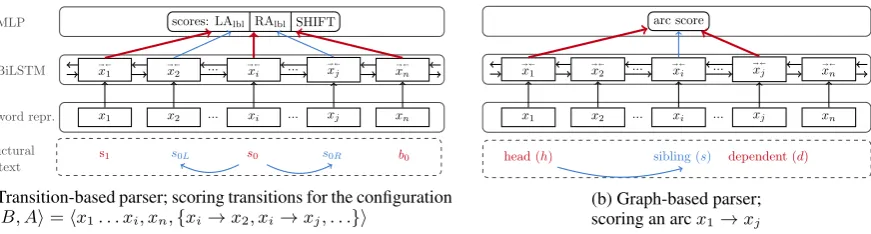
Figure 1: Schematic illustration of the K&G architecture of BiLSTM-based neural dependency parsers. Red arrows mark the basic feature sets and blue show how to extend them with features drawn from structural context.
We demonstrate that structural features are use-ful for neural dependency parsers but they become redundant when BiLSTMs are used (Section 4). It is because the BiLSTM representations trained together with dependency parsers capture a signif-icant amount of complex syntactic relations (Sec-tion 5.1). We then carry out an extensive inves-tigation of information flow in the parsing archi-tectures and find that the implicit structural con-text is not only present in the BiLSTM-based pars-ing models, but also more diverse than when en-coded in explicit structural features (Section5.2). Finally, we present results on ablated models to demonstrate the influence of structural informa-tion implicitly encoded in BiLSTM representa-tions on the final parsing accuracy (Section5.3).
2 Parsing Model Architecture
Our graph- and transition-based parsers are based on the K&G architecture (see Figure 1). The architecture has subsequently been extended by, e.g., character-based embeddings (de Lhoneux et al., 2017) or attention (Dozat and Manning, 2016). To keep the experimental setup clean and simple while focusing on the information flow in the architecture, we abstain from these extensions. We use the basic K&G architecture as our starting point with a few minor changes outlined below. For further details we refer the reader to Kiper-wasser and Goldberg(2016).
2.1 Word Representations
In both transition- and graph-based architectures input tokens are represented in the same way (see level [1] in Figure 1). For a given sentence with words[w1, . . . wn]and part-of-speech (POS) tags
[t1, . . . , tn] each word representation xi is built from concatenating the embeddings of the word
and its POS tag:
xi =e(wi)◦e(ti)
The embeddings are initialized randomly at train-ing time and trained together with the model.
The representations xi encode words in isola-tion and do not contain informaisola-tion about their context. For that reason they are passed to the Bi-LSTM feature extractors (level [2] in Figure1) and represented by a BiLSTM representation
xi:
xi =BiLSTM(x1:n, i)
2.2 Transition-Based Parser
Transition-based parsers gradually build a tree by applying a sequence of transitions. During train-ing they learn a scortrain-ing function for transitions. While decoding they search for the best action given the current state and the parsing history.
Figure 1a illustrates the architecture of the transition-based K&G parser. For every config-uration c consisting of a stack, buffer, and a set of arcs introduced so far, the parser selects a few core items from the stack and buffer (red arrows in the figure) as features. Next, it concatenates their BiLSTM vectors and passes them to a multi-layer perceptron (MLP) which assigns scores to all pos-sible transitions. The highest scoring transition is used to proceed to the next configuration.
Our implementation (denoted TBPARS) uses the arc-standard decoding algorithm (Nivre,2004) extended with a SWAP transition (ASWAP, Nivre (2009)) to handle non-projective trees. The sys-tem applies arc transitions between the two top-most items of the stack (denoted s0 ands1). We use the lazy SWAP oracle by Nivre et al. (2009)
TBMIN: is the simple architecture which does not use structural features. SinceShi et al.(2017) showed that the feature set {
s0,
s1,
b0} is min-imal for the arc-standard system (i.e., it suffers almost no loss in performance in comparison to larger feature sets but significantly out-performs a feature set built from only two vectors) we apply the same feature set to ASWAP. Later we analyze if the set could be further reduced.
TBEXT: is the extended architecture. We use the original extended feature set from K&G:{
s0,
s1,
s2,
b0,
s0L,
s0R,
s1L,
s1R,
s2L,
s2R,
b0L}, where.Land.Rdenote left- and right-most child.
2.3 Graph-Based Parser
The K&G graph-based parser follows the struc-tured prediction paradigm: while training it learns a scoring function which scores the correct tree higher than all the other possible ones. While decoding it searches for the highest scoring tree for a given sentence. The parser employs an arc-factored approach (McDonald et al.,2005), i.e., it decomposes the score of a tree to the sum of the scores of its arcs.
Figure 1b shows the K&G graph-based archi-tecture. At parsing time, every pair of words hxi, xjiyields a BiLSTM representation{
xi,
xj} (red arrows in the figure) which is passed to MLP to compute the score for an arcxi → xj. To find the highest scoring tree we applyEisner(1996)’s algorithm. We denote this architecture GBMIN. We note in passing that, although this decoding algorithm is restricted to projective trees, it has the advantage that it can be extended to incorpo-rate non-local features while still maintaining ex-act search in polynomial time.4
The above-mentioned simple architecture uses a feature set of two vectors {
h ,d}. We ex-tend it and add information about structural con-text. Specifically, we incorporate information about siblings
s (blue arrows in the figure). The model follows the second-order model from Mc-Donald and Pereira (2006) and decomposes the score of the tree into the sum of adjacent edge pair scores. We use the implementation of the second-order decoder fromZhang and Zhao(2015). We denote this architectureGBSIBL.
4
ReplacingEisner(1996)’s algorithm with the Chu-Liu-Edmonds’s decoder (Chu and Liu, 1965;Edmonds, 1967) which can predict non-projective arcs causes significant im-provements only for the Ancient Greek treebank (1.02 LAS on test set).
3 Experimental Setup
Data sets and preprocessing. We perform
ex-periments on a selection of nine treebanks from Universal Dependencies (Nivre et al., 2016) (v2.0): Ancient Greek PROIEL (grc), Arabic (ar), Chinese (zh), English (en), Finnish (fi), Hebrew (he), Korean (ko), Russian (ru) and Swedish (sv). This selection was proposed bySmith et al.(2018) as a sample of languages varying in language fam-ily, morphological complexity, and frequencies of non-projectivity (we refer to Smith et al. (2018) for treebank statistics). To these 9, we add the En-glish Penn Treebank (en-ptb) converted to Stan-ford Dependencies.5 We use sections 2-21 for training, 24 as development set and 23 as test set.
We use automatically predicted universal POS tags in all the experiments. The tags are assigned using a CRF tagger (Mueller et al.,2013). We an-notate the training sets via 5-fold jackknifing.
Evaluation. We evaluate the experiments using
Labeled Attachment Score (LAS).6We train mod-els for 30 epochs and select the best model based on development LAS. We follow recommenda-tions fromReimers and Gurevych(2018) and re-port averages and standard deviations from six models trained with different random seeds. We test for significance using the Wilcoxon rank-sum test with p-value<0.05.
Analysis is carried out on the development sets in order not to compromise the test sets. We present the results on the concatenation of all the development sets (one model per lan-guage). While the absolute numbers vary across languages, the general trends are consistent with the concatenation.
Implementation details. All the described
parsers were implemented with the DyNet library (Neubig et al.,2017).7 We use the same hyperpa-rameters asKiperwasser and Goldberg(2016) and summarize them in Table2in AppendixA.
5
We use version 3.4.1 of the Stanford Parser from
http://nlp.stanford.edu/software/ lex-parser.shtml
6The ratio of tokens with a correct head and label to the
total number of tokens in the test data.
avg. en-ptb ar en fi grc he ko ru sv zh TBMIN 76.43 90.25 76.22 81.85† 72.51† 71.92† 79.41† 64.39 74.35† 80.11† 73.28† TBEXT 75.56 90.25 75.77 80.50 71.47 70.32 78.62 63.88 73.82 78.80 72.17 GBMIN 77.74 91.40 77.25 82.53 74.37 73.48 80.83 65.47 76.43 81.22 74.47 GBSIBL 77.89 91.59 77.21 82.65 74.44 73.20 81.03 65.61 76.79† 81.42 74.95†
Table 1: Average (from six runs) parsing results (LAS) on test sets.†marks statistical significance (p-value<0.05). Corresponding standard deviations are provided in Table3in AppendixA.
4 Structural Features and BiLSTMs
4.1 Simple vs. Extended Architectures
We start by evaluating the performance of our four models. The purpose is to verify that the simple architectures will compensate for the lack of addi-tional structural features and achieve comparable accuracy to the extended ones.
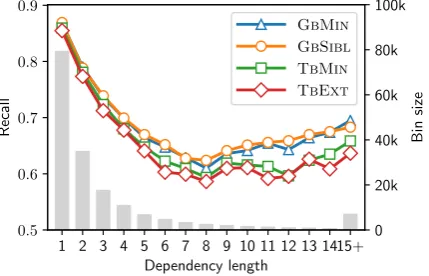
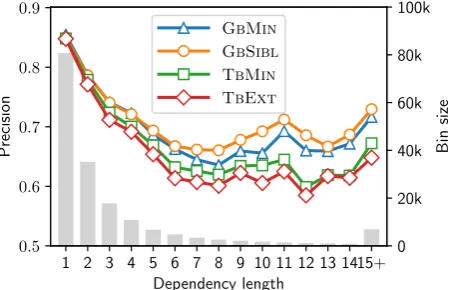
Table 1 shows the accuracy of all the parsers. Comparing the simple and extended architectures we see that dropping the structural features does not hurt the performance, neither for transition-based nor graph-transition-based parsers. Figure 2 dis-plays the accuracy relative to dependency length in terms of recall.8 It shows that the differences between models are not restricted to arcs of par-ticular lengths.
In the case of graph-based models (GBMINvs. GBSIBL) adding the second-order features to a
BiLSTM-based parser improves the average per-formance slightly. However, the difference be-tween those two models is significant only for two out of ten treebanks. For the transition-based parser (TBMINvs. TBEXT) a different effect can be noticed – additional features cause a significant loss in accuracy for seven out of ten treebanks. One possible explanation might be that TBEXT
suffers more from error propagation than TBMIN.
The parser is greedy and after making the first mis-take it starts drawing features from configurations which were not observed during training. Since the extended architecture uses more features than the simple one the impact of the error propagation might be stronger. This effect can be noticed in Figure2. The curves for TBMINand TBEXTare almost parallel for the short arcs but the perfor-mance of TBEXTdeteriorates for the longer ones, which are more prone to error propagation (Mc-Donald and Nivre,2007).
8Dependency recall is defined as the percentage of correct
predictions among gold standard arcs of lengthl(McDonald and Nivre,2007).
1 2 3 4 5 6 7 8 9 10 11 12 13 1415+ Dependency length
0 20k 40k 60k 80k 100k
Bin
size
0.5 0.6 0.7 0.8 0.9
Recall
GbMin GbSibl TbMin TbExt
Figure 2: Dependency recall relative to arc length on development sets. The corresponding plot for precision shows similar trends (see Figure7in AppendixA).
4.2 Influence of BiLSTMs
We now investigate whether BiLSTMs are the rea-son for models being able to compensate for lack of features drawn from partial subtrees.
Transition-based parser. We train TBPARS in
two settings: with and without BiLSTMs (when no BiLSTMs are used we pass vectorsxidirectly to the MLP layer following Chen and Manning (2014)) and with different feature sets. We start with a feature set{s0}and consecutively add more until we reach the full feature model of TBEXT.
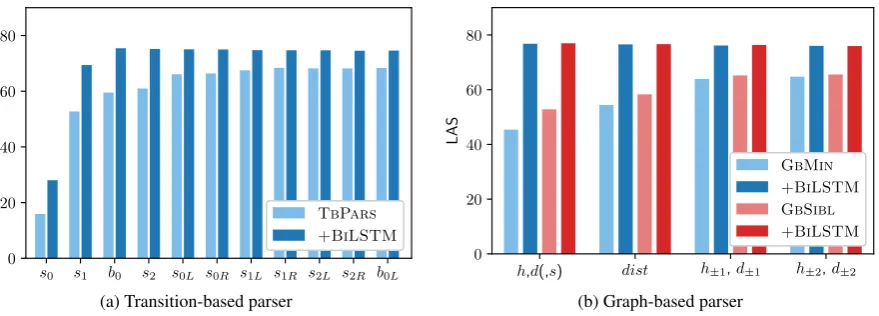
Figure3adisplays the accuracy of all the trained models. First of all, we notice that the models without BiLSTMs (light bars) benefit from struc-tural features. The biggest gains in the average performance are visible after adding vectors s0L (5.15 LAS) ands1R(1.12 LAS) . After addings1R the average improvements become modest.
Adding the BiLSTM representations changes the picture (dark bars). First of all, as in the case of arc-standard system (Shi et al.,2017), the feature
set{
s0,
s1,
s0 s1 b0 s2 s0L s0R s1L s1R s2L s2R b0L 0
20 40 60 80
LAS
TbPars +BiLSTM
(a) Transition-based parser
h,d(,s) dist h±1,d±1 h±2,d±2 0
20 40 60 80
LAS
GbMin +BiLSTM GbSibl +BiLSTM
[image:5.595.85.525.60.218.2](b) Graph-based parser
Figure 3: Parsing accuracy (average LAS over ten treebanks) with incremental extensions to the feature set.
advantage over the parsers which do not, regard-less of the feature model used.
Graph-based parser. We train two models:
GBMINand GBSIBLwith and without BiLSTMs. To ensure a fairer comparison with the models without BiLSTMs we expand the basic feature sets ({
h ,d} and {
h ,d ,
s}) with additional surface features known from classic graph-based parsers, such as distance between head and depen-dent (dist), words at distance of 1 from heads and dependents (h±1,d±1) and at distance±2. We
fol-lowWang and Chang(2016) and encode distance as randomly initialized embeddings.
Figure3bdisplays the accuracy of all the trained models with incremental extensions to their ture sets. First of all, we see that surface fea-tures (dist, h±1, d±1, h±2, d±2) are beneficial for the models without BiLSTM representations (light bars). The improvements are visible for both parsers, with the smallest gains after addingh±2, d±2 vectors: on average 0.35 LAS for GBSIBL and 0.83 LAS for GBMIN.
As expected, adding BiLSTMs changes the pic-ture. Since the representations capture surface context, they already contain a lot of informa-tion about words around heads and dependents and adding featuresh±1, d±1 andh±2, d±2 does not influence the performance. Interestingly, introduc-ingdistis also redundant which suggests that ei-ther BiLSTMs are aware of the distance between tokens or they are not able to use this information in a meaningful way. Finally, even after adding all the surface features the models which do not em-ploy BiLSTMs are considerably behind the ones which do.
Comparing GBMIN (blue) with GBSIBL (red)
we see that adding information about structural context through second-order features is benefi-cial when the BiLSTM are not used (light bars): the second-order GBSIBL has an advantage over GBMINof 0.81 LAS even when both of the mod-els use all the additional surface information (last group of bars on the plot). But this advantage drops down to insignificant 0.07 LAS when the BiLSTMs are incorporated.
We conclude that, for both transition- and graph-based parsers, BiLSTMs not only compen-sate for absence of structural features but they also encode more information than provided by the manually designed feature sets.
5 Implicit Structural Context
Now that we have established that structural fea-tures are indeed redundant for models which em-ploy BiLSTMs we examine the ways in which the simple parsing models (TBMINand GBMIN) im-plicitly encode information about partial subtrees.
5.1 Structure and BiLSTM Representations
We start by looking at the BiLSTM representa-tions. We know that the representations are capa-ble of capturing syntactic relations when they are trained on a syntactically related task, e.g, number prediction task (Linzen et al.,2016). We evaluate how complicated those relations can be when the representations are trained together with a depen-dency parser.
To do so, we followGaddy et al.(2018) and use derivatives to estimate how sensitive a particular part of the architecture is with respect to changes in input. Specifically, for every vector
represen-0 5 10 15 20 Distance
0 5 10 15 20
Average
impact
Other Head Grand Child Sibl
(a) Transition-based parser (TBMIN)
0 5 10 15 20
Distance
0 5 10 15 20
Average
impact
Other Head Grand Child Sibl
[image:6.595.79.524.62.217.2](b) Graph-based parser (GBMIN)
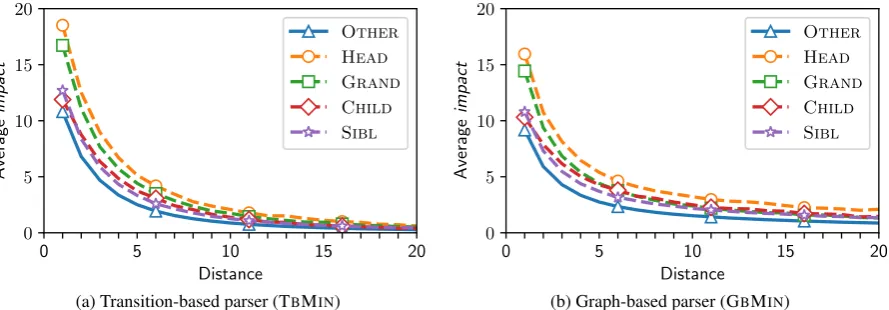
Figure 4: The average impact of tokens on BiLSTM vectors trained with dependency parser with respect to the surface distance and the structural (gold-standard) relation between them.
tationxifrom the sentence. If the derivative of
x with respect toxi is high then the word xi has a high influence on the vector. We compute thel2 -norm of the gradient of
x with respect toxi and normalize it by the sum of norms of all the words from the sentence calling this measureimpact:
impact(
x , i) = 100× ||
∂
x
∂xi||
P
j||∂
x
∂xj||
For every sentence from the development set and every vector
xi we calculate the impact of every representationxj from the sentence on the vector
xi. We bucket those impact values accord-ing to the distance between the representation and the word. We then use the gold-standard trees to divide every bucket into five groups: correct heads ofxi, children (i.e., dependents) ofxi, grandpar-ents (i.e., heads of heads), siblings, and other.
Figure 4 shows the average impact of tokens at particular positions. Similarly as shown by Gaddy et al.(2018) even words 15 and more posi-tions away have a non-zero effect on the BiLSTM vector. Interestingly, the impact of words which we know to be structurally close to xi is higher. For example, for the transition-based parser (Fig-ure4a) at positions±5an average impact is lower than 2.5%, children and siblings of xi have a slightly higher impact, and the heads and grand-parents around 5%. For the graph-based parser (Figure4b) the picture is similar with two notice-able differences. The impact of heads is much stronger for words 10 and more positions apart. But it is smaller than in the case of transition-based parser when the heads are next toxi.
We conclude that the BiLSTMs are indeed in-fluenced by the distance, but when trained with a dependency parser they also capture a significant amount of non-trivial syntactic relations.
5.2 Structure and Information Flow
Now that we know that the representations encode structural information we ask how this information influences the decisions of the parser.
First, we investigate how much structural infor-mation flows into the final layer of the network. When we look back at the architecture in Fig-ure1we see that when the final MLP scores pos-sible transitions or arcs it uses only feature
vec-tors{
s0,
s1,
b0} or{
h ,
d}. But thanks to the BiLSTMs the vectors encode information about other words from the sentence. We examine from which words the signal is the strongest when the parser makes the final decision.
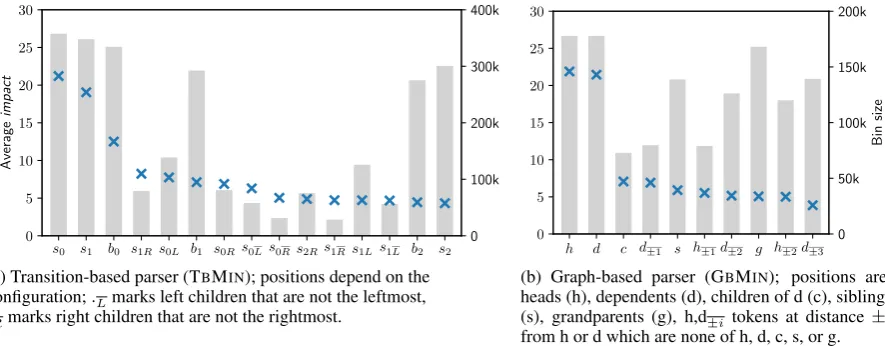
We extend the definition of impact to capture how a specific word representation xi influences the final MLP scoresc(we calculate the derivative ofscwith respect toxi). We parse every develop-ment sentence. For every predicted transition/arc we calculate how much its scorescwas affected by every word from the sentence. We group im-pacts of words depending on their positions.
Transition-based parser. For the
transition-based parser we group tokens according to their positions in the configuration. For example, for the decision in Figure1aimpact(sc,1)would be grouped ass1andimpact(sc, j)ass0R.
s0 s1 b0 s1Rs0L b1 s0Rs0Ls0Rs2Rs1Rs1Ls1L b2 s2
0 100k 200k 300k 400k
0 5 10 15 20 25 30
Average
impact
(a) Transition-based parser (TBMIN); positions depend on the configuration;.Lmarks left children that are not the leftmost,
.Rmarks right children that are not the rightmost.
h d c d±1 s h±1d±2 g h±2d±3
0 50k 100k 150k 200k
Bin
size
0 5 10 15 20 25 30
(b) Graph-based parser (GBMIN); positions are: heads (h), dependents (d), children of d (c), siblings (s), grandparents (g), h,d±i tokens at distance ±i
[image:7.595.79.522.61.234.2]from h or d which are none of h, d, c, s, or g.
Figure 5: Positions with the highest impact on the MLP scores (blue crosses) and their frequency (gray bars).
b0have the highest influence on the decision of the parser. The next two positions are s1R and s0L. Interestingly, those are the same positions which used as features caused the biggest gains in perfor-mance for the models whichdid notuse BiLSTMs (see Figure3a). They are much less frequent than b1but when they are present the model is strongly influenced by them. Afterb1 we can notice posi-tions which are not part of the manually designed extended feature set of TBEXT, such ass0L (left children ofs0that are not the leftmost).
Graph-based parser. For the graph-based
parser we group tokens according to their position in the full predicted tree. We then bucket the impacts into: heads (h), dependents (d), children (i.e., dependents of dependents) (c), siblings (s), and grandparents (i.e., heads of heads) (g). Words which do not fall into any of those categories are grouped according to their surface distance from heads and dependents. For example, h±2 are tokens two positions away from the head which do not act as dependent, child, sibling, or grandparent.
Figure 5b presents 10 positions with the high-est impact and the number of arcs for which they are present (gray bars). As expected, heads and dependents have the highest impact on the scores of arcs, much higher than any of the other tokens. Interestingly, among the next three bins with the highest impact are children and siblings. Children are less frequent than structurally unrelated tokens at distance 1 (h±1,d±1), and much less frequent thanh±2ord±2but they influence the final scores more. The interesting case is siblings – they not only have a strong average impact but they are also
very frequent, suggesting that they are very impor-tant for the parsing accuracy.
The results above show that the implicit struc-tural context is not only present in the models, but also more diverse than when incorporated through conventional explicit structural features.
5.3 Structure and Performance
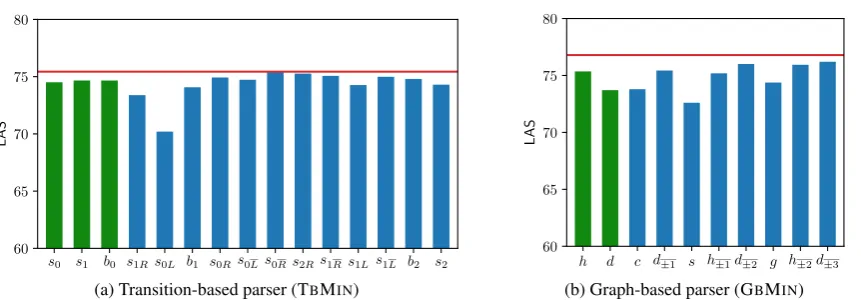
Finally, we investigate if the implicit structural context is important for the performance of the parsers. To do so, we take tokens at structural po-sitions with the highest impact and train new ab-lated models in which the information about those tokens is dropped from the BiLSTM layer. For example, while training an ablated model without s0L, for every configuration we re-calculate all the BiLSTM vectors as ifs0Lwas not in the sentence. When there is more than one token at a specific position, for examples0Lorc(i.e., children of the dependent), we pick a random one to drop. That way every ablated model looses information about at most one word.
We note that several factors can be responsi-ble for drops in performance of the ablated mod-els. For example, the proposed augmentation dis-torts distance between tokens which might have an adverse impact on the trained representations. Therefore, in the following comparative analysis we interpret the obtained drops as an approxima-tion of how much particular tokens influence the performance of the models.
ab-s0 s1 b0 s1Rs0L b1 s0Rs0Ls0Rs2Rs1Rs1Ls1L b2 s2 60
65 70 75 80
LAS
(a) Transition-based parser (TBMIN)
h d c d±1 s h±1d±2 g h±2d±3 60
65 70 75 80
LAS
[image:8.595.81.512.56.206.2](b) Graph-based parser (GBMIN)
Figure 6: The performance drops when tokens at particular positions are removed from the BiLSTM encoding. The red line marks average LAS of uninterrupted model. Feature sets of both models are highlighted in green.
lated models.9 First of all, removing the vectors {
s0,
s1,
b0} (marked in green on the plot) only from the BiLSTM layer (although they are still used as features) causes visible drops in perfor-mance. One explanation might be that when the vector
s0 is recalculated without knowledge ofs1 the model loses information about the distance be-tween them. Secondly, we can notice that other drops depend on both the impact and frequency of positions. The biggest declines are visible af-ter removing s0L and s1R – precisely the posi-tions which we found to have the highest impact on the parsing decisions. Interestingly, the posi-tions which were not a part of the TBEXTfeature set, such ass0L ors1R, although not frequent are important for the performance.
Graph-based parser. Corresponding results for
the graph-based parser are presented in Figure6b (we use gold-standard trees as the source of infor-mation about structural relations between tokens). The biggest drop can be observed for ablated mod-els without siblings. Clearly, information coming from those tokens implicitly into MLP is very im-portant for the final parsing accuracy. The next two biggest drops are caused by lack of children and grandparents. As we showed in Figure 5b children, although less frequent, have a stronger impact on the decision of the parser. But dropping grandparents also significantly harms the models.
We conclude that information about partial sub-trees is not only present when the parser makes
9
It is worth noting that not all of the models suffer from the ablation. For example, dropping vectorss2R causes
al-most no harm. This suggests that re-calculating the represen-tations multiple times does not have a strong negative effect on training.
final decisions but also strongly influences those decisions. Additionally, the deteriorated accuracy of the ablated models shows that the implicit struc-tural context can not be easily compensated for.
6 Related Work
Feature extraction. Kiperwasser and Goldberg
(2016) andCross and Huang (2016) first applied BiLSTMs to extract features for transition-based dependency parsers. The authors demonstrated that an architecture using only a few positional features (four for the arc-hybrid system and three for arc-standard) is sufficient to achieve state-of-the-art performance.Shi et al.(2017) showed that this number can be further reduced to two fea-tures for arc-hybrid and arc-eager systems. De-creasing the size of the feature set not only al-lows for construction of lighter and faster neu-ral networks (Wang and Chang, 2016; Vilares and G´omez-Rodr´ıguez,2018) but also enables the use of exact search algorithms for several projec-tive (Shi et al.,2017) and non-projective (G´omez-Rodr´ıguez et al.,2018) transition systems. A sim-ilar trend can be observed for graph-based de-pendency parsers. State-of-the-art models (Kiper-wasser and Goldberg,2016;Dozat and Manning, 2016) typically use only two features of heads and dependents, possibly also incorporating their distance (Wang and Chang, 2016). Moreover, Wang and Chang (2016) show that arc-factored BiLSTM-based parsers can compete with conven-tional higher-order models in terms of accuracy.
perspec-tive than ours – composition. They showed that composing the structural context with recursive networks as in Dyer et al. (2015) is redundant for the K&G transition-based architecture. The authors analyze components of the BiLSTMs to show which of them (forward v. backward LSTM) is responsible for capturing subtree information.
RNNs and syntax. Recurrent neural networks,
which BiLSTMs are a variant of, have been re-peatedly analyzed to understand whether they can learn syntactic relations. Such analyses differ in terms of: (1) methodology they employ to probe what type of knowledge the representa-tions learned and (2) tasks on which the rep-resentations are trained on. Shi et al. (2016) demonstrated that sequence-to-sequence machine-translation systems capture source-language syn-tactic relations. Linzen et al. (2016) showed that when trained on the task of number agree-ment prediction the representations capture a non-trivial amount of grammatical structure (although recursive neural networks are better at this task than sequential LSTMs (Kuncoro et al., 2018)). Blevins et al.(2018) found that RNN representa-tions trained on a variety of NLP tasks (includ-ing dependency pars(includ-ing) are able to induce syn-tactic features (e.g., constituency labels of par-ent or grandparpar-ent) even without explicit supervi-sion. Finally,Conneau et al.(2018) designed a set of tasks probing linguistic knowledge of sentence embedding methods.
Our work contributes to this line of research in two ways: (1) from the angle of methodology, we show how to employ derivatives to pinpoint what syntactic relations the representations learn; (2) from the perspective of tasks, we demonstrate how BiLSTM-based dependency parsers take ad-vantage of structural information encoded in the representations. In the case of constituency pars-ingGaddy et al.(2018) offer such an analysis. The authors show that their BiLSTM-based models im-plicitly learn the same information which was con-ventionally provided to non-neural parsers, such as grammars and lexicons.
7 Discussion and Conclusion
We examined how the application of BiLSTMs in-fluences the modern transition- and graph-based parsing architectures. The BiLSTM-based parsers can compensate for the lack of traditional struc-tural features. Specifically, the features drawn
from partial subtrees become redundant because the parsing models encode them implicitly.
The main advantage of BiLSTMs comes with their ability to capture not only surface but also syntactic relations. When the represen-tations are trained together with a parser they encode structurally-advanced relations such as heads, children, or even siblings and grandparents. This structural information is then passed directly (through feature vectors) and indirectly (through BiLSTMs encoding) to MLP and is used for scor-ing transitions and arcs. Finally, the implicit struc-tural information is important for the final parsing decisions: dropping it in ablated models causes their performance to deteriorate.
The introduction of BiLSTMs into dependency parsers has an additional interesting consequence. The classical transition- and graph-based depen-dency parsers have their strengths and limitations due to the trade-off between the richness of fea-ture functions and the inference algorithm (Mc-Donald and Nivre, 2007). Our transition- and graph-based architectures use the same word rep-resentations. We showed that those representa-tions trained together with the parsers capture syn-tactic relations in a similar way. Moreover, the transition-based parser does not incorporate struc-tural features through the feature set. And the graph-based parser makes use of far away surface tokens but also structurally related words. Evi-dently, the employment of BiLSTM feature ex-tractors blurs the difference between the two ar-chitectures. The one clear advantage of the graph-based parser is that it performs global inference (but exact search algorithms are already being ap-plied to projective (Shi et al., 2017) and non-projective (G´omez-Rodr´ıguez et al.,2018) transi-tion systems). Therefore, an interesting questransi-tion is if integrating those two architectures can still be beneficial for the parsing accuracy as inNivre and McDonald(2008). We leave this question for fu-ture work.
Acknowledgments
References
Terra Blevins, Omer Levy, and Luke Zettlemoyer. 2018. Deep RNNs Encode Soft Hierarchical Syn-tax. InProceedings of the 56th Annual Meeting of the Association for Computational Linguistics (Vol-ume 2: Short Papers), pages 14–19, Melbourne, Australia. Association for Computational Linguis-tics.
Danqi Chen and Christopher Manning. 2014. A Fast and Accurate Dependency Parser using Neural
Net-works. InProceedings of the 2014 Conference on
Empirical Methods in Natural Language Processing (EMNLP), pages 740–750. Association for Compu-tational Linguistics.
Yoeng-Jin Chu and Tseng-Hong Liu. 1965. On shortest arborescence of a directed graph. Scientia Sinica, 14(10):1396–1400.
Alexis Conneau, Germ´an Kruszewski, Guillaume Lample, Lo¨ıc Barrault, and Marco Baroni. 2018.
What you can cram into a single $&!#* vector: Probing sentence embeddings for linguistic proper-ties. InProceedings of the 56th Annual Meeting of the Association for Computational Linguistics (Vol-ume 1: Long Papers), pages 2126–2136, Melbourne, Australia. Association for Computational Linguis-tics.
James Cross and Liang Huang. 2016. Incremental Parsing with Minimal Features Using Bi-Directional LSTM. In Proceedings of the 54th Annual Meet-ing of the Association for Computational LMeet-inguistics (Volume 2: Short Papers), pages 32–37. Association for Computational Linguistics.
Timothy Dozat and Christopher D. Manning. 2016.
Deep Biaffine Attention for Neural Dependency
Parsing.CoRR, abs/1611.01734.
Chris Dyer, Miguel Ballesteros, Wang Ling, Austin Matthews, and Noah A. Smith. 2015. Transition-Based Dependency Parsing with Stack Long
Short-Term Memory. InProceedings of the 53rd Annual
Meeting of the Association for Computational Lin-guistics and the 7th International Joint Conference on Natural Language Processing (Volume 1: Long Papers), pages 334–343. Association for Computa-tional Linguistics.
Jack Edmonds. 1967. Optimum branchings. Journal of Research of the National Bureau of Standards B, 71(4):233–240.
Jason M. Eisner. 1996. Three New Probabilistic
Mod-els for Dependency Parsing: An Exploration. In
COLING 1996 Volume 1: The 16th International Conference on Computational Linguistics.
David Gaddy, Mitchell Stern, and Dan Klein. 2018.
What’s Going On in Neural Constituency Parsers?
An Analysis. In Proceedings of the 2018
Confer-ence of the North American Chapter of the Associ-ation for ComputAssoci-ational Linguistics: Human Lan-guage Technologies, Volume 1 (Long Papers), pages
999–1010. Association for Computational Linguis-tics.
Carlos G´omez-Rodr´ıguez, Tianze Shi, and Lillian Lee. 2018. Global Transition-based Non-projective
De-pendency Parsing. In Proceedings of the 56th
An-nual Meeting of the Association for Computational Linguistics (Volume 1: Long Papers), pages 2664– 2675, Melbourne, Australia. Association for Com-putational Linguistics.
Alex Graves and J¨urgen Schmidhuber. 2005. Frame-wise Phoneme Classification with Bidirectional LSTM and Other Neural Network Architectures. Neural Networks, 18(5):602–610.
Sepp Hochreiter and J¨urgen Schmidhuber. 1997. Long short-term memory. Neural computation, 9(8):1735–1780.
Eliyahu Kiperwasser and Yoav Goldberg. 2016. Sim-ple and Accurate Dependency Parsing Using
Bidi-rectional LSTM Feature Representations.
Transac-tions of the Association for Computational Linguis-tics, 4:313–327.
Adhiguna Kuncoro, Chris Dyer, John Hale, Dani Yo-gatama, Stephen Clark, and Phil Blunsom. 2018.
LSTMs Can Learn Syntax-Sensitive Dependencies
Well, But Modeling Structure Makes Them Better.
In Proceedings of the 56th Annual Meeting of the Association for Computational Linguistics (Volume 1: Long Papers), pages 1426–1436. Association for Computational Linguistics.
Miryam de Lhoneux, Miguel Ballesteros, and Joakim Nivre. 2019. Recursive subtree composition in lstm-based dependency parsing. arXiv preprint arXiv:1902.09781.
Miryam de Lhoneux, Yan Shao, Ali Basirat, Eliyahu Kiperwasser, Sara Stymne, Yoav Goldberg, and Joakim Nivre. 2017. From raw text to universal
dependencies - look, no tags! In Proceedings of
the CoNLL 2017 Shared Task: Multilingual Pars-ing from Raw Text to Universal Dependencies, pages 207–217. Association for Computational Linguis-tics.
Tal Linzen, Emmanuel Dupoux, and Yoav Goldberg. 2016.Assessing the ability of lstms to learn
syntax-sensitive dependencies. Transactions of the
Associ-ation for ComputAssoci-ational Linguistics, 4:521–535.
Ryan McDonald, Koby Crammer, and Fernando Pereira. 2005. Online Large-Margin Training of
De-pendency Parsers. In Proceedings of the 43rd
An-nual Meeting of the Association for Computational Linguistics (ACL’05), pages 91–98. Association for Computational Linguistics.
Ryan McDonald and Joakim Nivre. 2007. Character-izing the Errors of Data-Driven Dependency
Pars-ing Models. InProceedings of the 2007 Joint
Ryan McDonald and Fernando Pereira. 2006. On-line Learning of Approximate Dependency Parsing
Algorithms. In 11th Conference of the European
Chapter of the Association for Computational Lin-guistics.
Thomas Mueller, Helmut Schmid, and Hinrich Sch¨utze. 2013. Efficient higher-order crfs for
mor-phological tagging. InProceedings of the 2013
Con-ference on Empirical Methods in Natural Language Processing, pages 322–332. Association for Com-putational Linguistics.
Graham Neubig, Chris Dyer, Yoav Goldberg, Austin Matthews, Waleed Ammar, Antonios Anastasopou-los, Miguel Ballesteros, David Chiang, Daniel Clothiaux, Trevor Cohn, Kevin Duh, Manaal Faruqui, Cynthia Gan, Dan Garrette, Yangfeng Ji, Lingpeng Kong, Adhiguna Kuncoro, Gaurav Ku-mar, Chaitanya Malaviya, Paul Michel, Yusuke Oda, Matthew Richardson, Naomi Saphra, Swabha Swayamdipta, and Pengcheng Yin. 2017. DyNet:
The Dynamic Neural Network Toolkit. CoRR,
abs/1701.03980.
Joakim Nivre. 2004. Incrementality in deterministic
dependency parsing. In Proceedings of the
Work-shop on Incremental Parsing: Bringing Engineering and Cognition Together, pages 50–57, Barcelona, Spain.
Joakim Nivre. 2009. Non-Projective Dependency
Pars-ing in Expected Linear Time. InProceedings of the
Joint Conference of the 47th Annual Meeting of the ACL and the 4th International Joint Conference on Natural Language Processing of the AFNLP, pages 351–359. Association for Computational Linguis-tics.
Joakim Nivre, Marco Kuhlmann, and Johan Hall. 2009.
An Improved Oracle for Dependency Parsing with
Online Reordering. In Proceedings of the 11th
International Conference on Parsing Technologies (IWPT’09), pages 73–76. Association for Computa-tional Linguistics.
Joakim Nivre, Marie-Catherine de Marneffe, Filip Gin-ter, Yoav Goldberg, Jan Hajic, Christopher D. Man-ning, Ryan McDonald, Slav Petrov, Sampo Pyysalo, Natalia Silveira, Reut Tsarfaty, and Daniel Zeman. 2016. Universal Dependencies v1: A Multilingual
Treebank Collection. InProceedings of the Tenth
In-ternational Conference on Language Resources and Evaluation (LREC 2016), Paris, France. European Language Resources Association (ELRA).
Joakim Nivre and Ryan McDonald. 2008. Integrat-ing Graph-Based and Transition-Based Dependency
Parsers. In Proceedings of ACL-08: HLT, pages
950–958, Columbus, Ohio. Association for Compu-tational Linguistics.
Emily Pitler. 2014. A Crossing-Sensitive Third-Order
Factorization for Dependency Parsing.Transactions
of the Association for Computational Linguistics, 2:41–54.
Nils Reimers and Iryna Gurevych. 2018. Why com-paring single performance scores does not allow to draw conclusions about machine learning ap-proaches. arXiv preprint arXiv:1803.09578.
Tianze Shi, Liang Huang, and Lillian Lee. 2017.
Fast(er) Exact Decoding and Global Training for Transition-Based Dependency Parsing via a
Mini-mal Feature Set. InProceedings of the 2017
Con-ference on Empirical Methods in Natural Language Processing, pages 12–23. Association for Computa-tional Linguistics.
Xing Shi, Inkit Padhi, and Kevin Knight. 2016. Does
String-Based Neural MT Learn Source Syntax? In
Proceedings of the 2016 Conference on Empirical Methods in Natural Language Processing, pages 1526–1534. Association for Computational Linguis-tics.
Aaron Smith, Miryam de Lhoneux, Sara Stymne, and Joakim Nivre. 2018. An Investigation of the In-teractions Between Pre-Trained Word Embeddings, Character Models and POS Tags in Dependency
Parsing. In Proceedings of the 2018 Conference
on Empirical Methods in Natural Language Pro-cessing, pages 2711–2720. Association for Compu-tational Linguistics.
David Vilares and Carlos G´omez-Rodr´ıguez. 2018.
Transition-based Parsing with Lighter Feed-Forward
Networks. InProceedings of the Second Workshop
on Universal Dependencies (UDW 2018), pages 162–172. Association for Computational Linguis-tics.
Wenhui Wang and Baobao Chang. 2016. Graph-based
Dependency Parsing with Bidirectional LSTM. In
Proceedings of the 54th Annual Meeting of the As-sociation for Computational Linguistics (Volume 1: Long Papers), pages 2306–2315, Berlin, Germany. Association for Computational Linguistics.
Daniel Zeman, Jan Hajiˇc, Martin Popel, Martin Pot-thast, Milan Straka, Filip Ginter, Joakim Nivre, and Slav Petrov. 2018. CoNLL 2018 Shared Task: Mul-tilingual Parsing from Raw Text to Universal
Depen-dencies. InProceedings of the CoNLL 2018 Shared
Task: Multilingual Parsing from Raw Text to Univer-sal Dependencies, pages 1–21, Brussels, Belgium. Association for Computational Linguistics.
Yue Zhang and Joakim Nivre. 2011. Transition-based
Dependency Parsing with Rich Non-local Features.
In Proceedings of the 49th Annual Meeting of the Association for Computational Linguistics: Human Language Technologies, pages 188–193. Associa-tion for ComputaAssocia-tional Linguistics.
Zhisong Zhang and Hai Zhao. 2015. High-order
Graph-based Neural Dependency Parsing. In
A Appendix
Word embedding dimension 100 POS tag embedding dimension 20 Hidden units in MLP 100 BiLSTM layers 2 BiLSTM dimensions 125
αfor word dropout 0.25
Trainer Adam
[image:12.595.219.378.94.182.2]Non-lin function tanh
Table 2: Hyperparameters for the parsers.
[image:12.595.118.481.229.296.2]en-ptb ar en fi grc he ko ru sv zh TBMIN 0.237 0.323 0.207 0.163 0.382 0.391 0.740 0.282 0.295 0.398 TBEXT 0.211 0.191 0.176 0.323 0.472 0.454 0.456 0.408 0.257 0.267 GBMIN 0.146 0.179 0.212 0.157 0.340 0.269 0.300 0.228 0.379 0.408 GBSIBL 0.103 0.186 0.149 0.219 0.372 0.229 0.163 0.169 0.195 0.441
Table 3: Standard deviation for results in Table1.
1 2 3 4 5 6 7 8 9 10 11 12 13 1415+ Dependency length
0 20k 40k 60k 80k 100k
Bin
size
0.5 0.6 0.7 0.8 0.9
Precision
GbMin GbSibl TbMin TbExt
[image:12.595.187.415.341.486.2]