9
Sampling Informative Training Data for RNN Language Models
Jared Fernandez and Doug Downey
Department of Electrical Engineering and Computer Science Northwestern University
Evanston, IL 60208
[email protected], [email protected]
Abstract
We propose an unsupervised importance sampling approach to selecting training data for recurrent neural network (RNN) language models. To increase the infor-mation content of the training set, our approach preferentially samples high per-plexity sentences, as determined by an eas-ily queryablen-gram language model. We experimentally evaluate the heldout per-plexity of models trained with our var-ious importance sampling distributions. We show that language models trained on data sampled using our proposed approach outperform models trained over randomly sampled subsets of both the Billion Word (Chelba et al., 2014) and Wikitext-103 benchmark corpora (Merity et al.,2016).
1 Introduction
The task of statistical language modeling seeks to learn a joint probability distribution over se-quences of natural language words. In recent work, recurrent neural network (RNN) language models (Mikolov et al.,2010) have produced state-of-the-art perplexities in sentence-level language modeling, far below those of traditional n-gram models (Melis et al., 2017). Models trained on large, diverse benchmark corpora such as the Bil-lion Word Corpus and Wikitext-103 have seen re-ported perplexities as low as 23.7 and 37.2, respec-tively (Kuchaiev and Ginsburg, 2017; Dauphin et al.,2017).
However, building models on large corpora is limited by prohibitive computational costs, as the number of training steps scales linearly with the number of tokens in the training corpus. Sentence-level language models for these large corpora can be learned by training on a set of sentences sub-sampled from the original corpus. We seek to de-termine whether it is possible to select a set of
training sentences that is significantly more infor-mative than a randomly drawn training set. We hypothesize that by training on higher informa-tion and more difficult training sentences, RNN language models can learn the language distribu-tion more accurately and produce lower perplexi-ties than models trained on similar-sized randomly sampled training sets.
We propose an unsupervised importance sam-pling technique for selecting training data for sentence-level RNN language models. We lever-age n-gram language models’ rapid training and query time, which often requires just a single pass over the training data. We determine a prelimi-nary heuristic for each sentence’s importance and information content by calculating its average per-word perplexity. Our technique uses an offlinen -gram model to score sentences and then samples higher perplexity sentences with increased proba-bility. Selected sentences are then used for training with corrective weights to remove the sampling bias. As entropy and perplexity have a monotonic relationship, selecting sentences with higher aver-agen-gram perplexity also increases the average entropy and information content.
perplexity sentences frequently contain common subsequences that are useful in modeling other sentences.
2 Related Work
Standard stochastic gradient descent (SGD) iter-atively selects random examples from the train-ing set to perform gradient updates. In con-trast, weighted SGD has been proven to acceler-ate the convergence racceler-ates of SGD by leveraging importance sampling as a means of variance re-duction (Needell et al., 2014; Zhao and Zhang, 2015). Weighted SGD selects examples from an importance sampling distribution and then trains on the selected examples with corrective weights. Weights of each training example i are set to be
1
P r(i), whereP r(i)is the probability of selecting
example i. The weighting provides an unbiased estimator of overall loss by removing the bias of the importance sampling distribution. In expecta-tion, each example’s contribution to the total loss function is the same as if the example had been drawn uniformly at random.
Alain et al. (2015) developed an importance sampling technique for training deep neural net-works by sampling examples directly accord-ing to their gradient norm. To avoid the high computational costs of gradient computations, Katharopoulos and Fleuret(2018) sample accord-ing to losses as approximated by a lightweight RNN model trained along side their larger pri-mary RNN model. Both techniques observed in-creased convergence rates and reduced errors in image classification tasks. In comparison, we use a fixed offlinen-gram model to compute our sampling distribution, which can be trained and queried much more efficiently than a neural net-work model.
In natural language processing, subsampling of large corpora has been used to speed up training for both language modeling and machine trans-lation. For domain specific language modeling, Moore and Lewis (2010) used an n-gram model trained on in-domain data to score sentences and then selected the sentences with low perplexities for training. Both Cho et al. (2014) and Koehn and Haddow(2012) used similar perplexity-based sampling to select training data for domain spe-cific machine translation systems. Importance sampling has also been used to increase rate of convergence for a class of neural network
lan-guage models which use a set of binary classifiers to determine sequence likelihood, rather than cal-culating the probabilities jointly (Xu et al.,2011). Because these subsampling techniques are used to learn domain specific distributions different from the distribution of the original corpus, they target lower perplexity sentences and have no need for corrective weighting. In contrast, we study how training sets generated using weighted im-portance sampling can be selected to maximize knowledge of the entire corpus for the standard language modeling task.
3 Methodology
First, we train an offlinen-gram model over sen-tences randomly sampled from the training corpus. Using then-gram model, we score perplexities for the remaining sentences in the training corpus.
We propose multiple importance sampling and likelihood weighting schemes for selecting train-ing sequences for an RNN language model. Our proposed sampling distributions (discussed in de-tail below) bias the training set to select higher perplexity sentences in order to increase the train-ing set’s information content. We then train an RNN language model on the sampled sentences with weights set to the reciprocal of the sentence’s selection probability.
3.1 Z-Score Sampling (Zf ull)
This sampling distribution naively selects sen-tences according to their z-score, as calculated in terms of their n-gram perplexities. The selection probability of sequencesis set as:
PKeep(s) =kpr
ppl(s)−µppl
σppl
+ 1
,
whereppl(s)is then-gram perplexity of sentence
s, µppl is the average n-gram perplexity, σppl is
the standard deviation ofn-gram perplexities, and
kpr is a normalizing constant to ensure a proper
probability distribution.
For sentences with z-scores less than−1.00 or sequences whereppl(s)was in the99thpercentile of n-gram perplexities, sequences are assigned
Pkeep(s) = kpr. This ensured all sequences had
of these high perplexity sentences provided min-imal accuracy gain in exchange for their boosted selection probability.
3.2 Limited Z-Score Sampling (Zα)
Training on low perplexity sentences can be help-ful in learning to model higher perplexity sen-tences which share common sub-sequences. How-ever, naive z-score sampling results in the selec-tion of few low perplexity sentences. Addiselec-tionally, the low perplexity sentences that are selected tend to dominate the training weight space due to their low selection probability.
To smooth the distribution in the weight space, selection probability is only determined using z-scores for sentences where their perplexities are greater than the mean. Thus, the selection proba-bility of sentencesis:
PKeep(s) =
(
kpr
αppl(s)−µppl
σppl + 1
, ifppl(s)> µppl.
kpr, else.
where α is a constant parameter that determines the weight of the z-score in calculating the se-quence’s selection probability.
3.3 Squared Z-Score Sampling (Z2)
To investigate the effects of sampling from more complex distributions, we also evaluate an impor-tance sampling scheme where sentences are sam-pled according to their squared z-score.
PKeep(s) =
kpr
αppl(s)−µppl
σppl
2
+ 1
, ifppl(s)> µppl.
kpr, else.
4 Experiments
We experimentally evaluate the effectiveness of theZf ullandZ2sampling methods, as well as the
Zαmethod for various values of parameterα.
4.1 Dataset Details
Sentence-level models were trained and evaluated on samples from Wikitext-103 and the One Bil-lion Word Benchmark corpus. To create a dataset of independent sentences, the Wikitext-103 corpus was parsed to remove headers and to create indi-vidual sentences. The training and heldout sets were combined, shuffled, and then split to cre-ate new 250k token test and validation sets. The
remaining sequences were set as a new training set of approximately 99 million tokens. In Bil-lion Word experiments, training sequences were sampled from a 500 million subset of the released training split. Billion Word models were evaluated on 250k token test and validation sets randomly sampled from the released heldout split.
Models were trained on 500 thousand, 1 mil-lion, and 2 million token training sets sampled from each training split. Rare words were replaced with <unk> tokens, resulting in vocabularies of 267K and 250K for the Wikitext and Billion Word corpora, respectively.
4.2 Model Details
To calculate the sampling distribution, ann-gram model was trained on a heldout set with the same number tokens used to train each RNN model (Hochreiter and Schmidhuber, 1997). For exam-ple, the sampling distribution used to build a 1 million token RNN training set was determined using perplexities calculated by ann-gram model also trained on 1 million tokens. N-gram mod-els were trained as 5-gram modmod-els with Kneser-Ney discounting (Kneser and Ney, 1995) using
SRILM (Stolcke, 2002). For efficient calculation of sentence perplexities, we query our models us-ingKenLM(Heafield,2011).
RNN models were built using a two-layer long short-term memory (LSTM) neural network, with 200-dimensional hidden and embedding layers. Each training set was trained on for 10 epochs us-ing the Adam gradient optimizer (Kingma and Ba, 2014) with a mini-batch size of 12.
5 Results
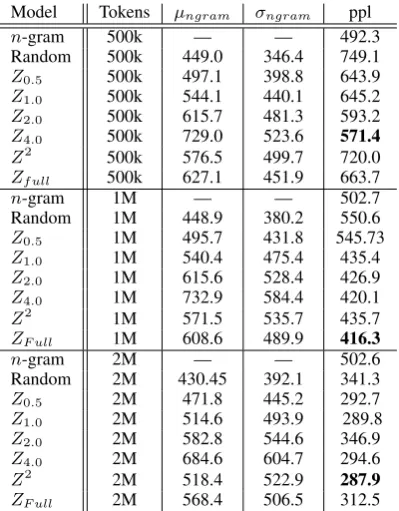
In Tables 1 and 2, we summarize the performances of models trained on samples from Wikitext-103 and the Billion Word Corpus, respectively. We re-port the Random andn-gram baseline perplexities for RNN andn-gram language models trained on randomly sampled data. We also report µngram
and σngram for each training set, which are the
mean and standard deviation in sentence perplex-ity as evaluated by the offlinen-gram model.
Model Tokens µngram σngram ppl
n-gram 500k — — 492.3
Random 500k 449.0 346.4 749.1 Z0.5 500k 497.1 398.8 643.9 Z1.0 500k 544.1 440.1 645.2 Z2.0 500k 615.7 481.3 593.2 Z4.0 500k 729.0 523.6 571.4 Z2 500k 576.5 499.7 720.0
Zf ull 500k 627.1 451.9 663.7
n-gram 1M — — 502.7
Random 1M 448.9 380.2 550.6 Z0.5 1M 495.7 431.8 545.73 Z1.0 1M 540.4 475.4 435.4 Z2.0 1M 615.6 528.4 426.9 Z4.0 1M 732.9 584.4 420.1 Z2 1M 571.5 535.7 435.7
ZF ull 1M 608.6 489.9 416.3
n-gram 2M — — 502.6
Random 2M 430.45 392.1 341.3 Z0.5 2M 471.8 445.2 292.7 Z1.0 2M 514.6 493.9 289.8 Z2.0 2M 582.8 544.6 346.9 Z4.0 2M 684.6 604.7 294.6 Z2 2M 518.4 522.9 287.9
[image:4.595.82.282.61.317.2]ZF ull 2M 568.4 506.5 312.5
Table 1: Perplexities for Wikitext models. All pro-posed models outperform the random andn-gram baselines as number of training tokens increases.
also yield significantly lower perplexities than then-gram models trained on randomly sampled training sets. As expected,µngramandσngram
in-crease substantially for training sets generated us-ing our proposed samplus-ing methods.
Overall, the Z4.0 sampling method produced
the most consistent reductions in average perplex-ity of 102.9 and 54.2 compared to the Random andn-gram baselines, respectively. ZF ull andZ2
exhibit higher variance in their heldout perplex-ity as compared to the Zα and baseline methods.
We expect that this is because these methods se-lect higher perplexity sequences with significantly higher probability than Zα methods. As a result,
low perplexity sentences, which may contain com-mon subsequences helpful in modeling other sen-tences, are ignored in training.
6 Conclusions and Future Work
We introduce a weighted importance sampling scheme for selecting RNN language model train-ing data from large corpora. We demonstrate that models trained with data generated using this ap-proach yield perplexity reductions of up to 24% when compared to models trained over randomly sampled training sets of similar size. This tech-nique leverages higher perplexity training
sen-Model Tokens µngram σngram ppl
n-gram 1M — — 432.5
Random 1M 433.2 515.4 484.0 Z0.5 1M 476.8 410.9 436.6 Z1.0 1M 543.8 529.0 421.5 Z4.0 1M 726.4 517.3 427.3
Zf ull 1M 635.19 458.69 495.75
[image:4.595.316.516.62.146.2]Z2 1M 639.2 593.7 435.3
Table 2: Perplexities for Billion Word models.Zα
andZ2 both outperform the random baseline and are comparable to then-gram baseline.
tences to learn more accurate language models, while limiting added computational cost of impor-tance calculations.
In future work, we will examine the perfor-mance of our proposed selection techniques in ad-ditional parameter settings, with various values of
α and thresholds in the limited z-score methods
Zα. We will evaluate the performance of
sam-pling distributions based on perplexities calculated using small, lightweight RNN language models rather than n-gram language models. Addition-ally, we will also be evaluating the performance of sampling distributions calculated based on a sen-tence’s subsequences and uniquen-gram content. Furthermore, we plan on adapting this importance sampling approach to use online n-gram models trained alongside the RNN language models for determining the importance sampling distribution.
Acknowledgements
This work was supported in part by NSF Grant IIS-1351029. Support for travel provided in part by the ACL Student Travel Grant (NSF Grant IIS-1827830) and the Conference Travel Grant from Northwestern University’s Office of the Provost. We thank Dave Demeter, Thanapon Noraset, Yiben Yang, and Zheng Yuan for helpful comments.
References
Guillaume Alain, Alex Lamb, Chinnadhurai Sankar, Aaron Courville, and Yoshua Bengio. 2015. Vari-ance reduction in sgd by distributed importVari-ance sam-pling. arXiv preprint arXiv:1511.06481.
Ciprian Chelba, Tomas Mikolov, Mike Schuster, Qi Ge, Thorsten Brants, Phillipp Koehn, and Tony Robin-son. 2014. One billion word benchmark for mea-suring progress in statistical language modeling. In
Kyunghyun Cho, Bart van Merrienboer, Caglar Gul-cehre, Dzmitry Bahdanau, Fethi Bougares, Holger Schwenk, and Yoshua Bengio. 2014. Learning phrase representations using rnn encoder–decoder for statistical machine translation. InProceedings of the 2014 Conference on Empirical Methods in Nat-ural Language Processing (EMNLP), pages 1724– 1734.
Yann N Dauphin, Angela Fan, Michael Auli, and David Grangier. 2017. Language modeling with gated con-volutional networks. InInternational Conference on Machine Learning, pages 933–941.
Kenneth Heafield. 2011. Kenlm: Faster and smaller language model queries. InProceedings of the Sixth Workshop on Statistical Machine Translation, pages 187–197. Association for Computational Linguis-tics.
Sepp Hochreiter and J¨urgen Schmidhuber. 1997. Long short-term memory. Neural computation, 9(8):1735–1780.
Angelos Katharopoulos and Franc¸ois Fleuret. 2018. Not all samples are created equal: Deep learn-ing with importance sampllearn-ing. arXiv preprint arXiv:1803.00942.
Diederik P Kingma and Jimmy Ba. 2014. Adam: A method for stochastic optimization. arXiv preprint arXiv:1412.6980.
Reinhard Kneser and Hermann Ney. 1995. Improved backing-off for m-gram language modeling. In
Acoustics, Speech, and Signal Processing, 1995. ICASSP-95., 1995 International Conference on, vol-ume 1, pages 181–184. IEEE.
Philipp Koehn and Barry Haddow. 2012. Towards ef-fective use of training data in statistical machine translation. InProceedings of the Seventh Workshop on Statistical Machine Translation, pages 317–321. Association for Computational Linguistics.
Oleksii Kuchaiev and Boris Ginsburg. 2017. Factor-ization tricks for lstm networks. arXiv preprint arXiv:1703.10722.
G´abor Melis, Chris Dyer, and Phil Blunsom. 2017. On the state of the art of evaluation in neural language models. arXiv preprint arXiv:1707.05589.
Stephen Merity, Caiming Xiong, James Bradbury, and Richard Socher. 2016. Pointer sentinel mixture models. arXiv preprint arXiv:1609.07843.
Tom´aˇs Mikolov, Martin Karafi´at, Luk´aˇs Burget, Jan ˇ
Cernock`y, and Sanjeev Khudanpur. 2010. Recur-rent neural network based language model. In
Eleventh Annual Conference of the International Speech Communication Association.
Robert C Moore and William Lewis. 2010. Intelligent selection of language model training data. In Pro-ceedings of the ACL 2010 conference short papers,
pages 220–224. Association for Computational Lin-guistics.
Deanna Needell, Rachel Ward, and Nati Srebro. 2014. Stochastic gradient descent, weighted sampling, and the randomized kaczmarz algorithm. In Advances in Neural Information Processing Systems, pages 1017–1025.
Andreas Stolcke. 2002. Srilm-an extensible language modeling toolkit. InSeventh International Confer-ence on Spoken Language Processing.
Puyang Xu, Asela Gunawardana, and Sanjeev Khudan-pur. 2011. Efficient subsampling for training com-plex language models. InProceedings of the Con-ference on Empirical Methods in Natural Language Processing, pages 1128–1136. Association for Com-putational Linguistics.