Semantic Clustering and Convolutional Neural Network
for Short Text Categorization
Peng Wang, Jiaming Xu, Bo Xu, Cheng-Lin Liu, Heng Zhang Fangyuan Wang, Hongwei Hao
{peng.wang, jiaming.xu, boxu}@ia.ac.cn, [email protected]
{heng.zhang, fangyuan.wang, hongwei.hao}@ia.ac.cn
Institute of Automation, Chinese Academy of Sciences, Beijing, 100190, P.R. China
Abstract
Short texts usually encounter data sparsi-ty and ambiguisparsi-ty problems in representa-tions for their lack of context. In this pa-per, we propose a novel method to mod-el short texts based on semantic clustering and convolutional neural network. Partic-ularly, we first discover semantic cliques in embedding spaces by a fast clustering algorithm. Then, multi-scale semantic u-nits are detected under the supervision of semantic cliques, which introduce useful external knowledge for short texts. These meaningful semantic units are combined and fed into convolutional layer, followed by max-pooling operation. Experimental results on two open benchmarks validate the effectiveness of the proposed method.
1 Introduction
Conventional texts mining methods based on bag-of-words (BoW) easily encounter data sparsi-ty and ambiguisparsi-ty problems in short text model-ing (Chenet al., 2011), which ignore semantic re-lations between words (Sriramet al., 2010). How to acquire effective representation for short tex-t has been an actex-tive research issue (Chen et al., 2011; Phanet al., 2008).
In order to overcome the weakness of BoW, re-searchers have proposed to expand the represen-tation of short text using latent semantics, where the words are mapped to distributional representa-tions by Latent Dirichlet Allocation (LDA) (Blei et al., 2003) and its extensions. Phan et al. (2008) presented a general framework to expand the short and sparse text by appending topic names discov-ered using LDA. Yan et al. (2013) presented a vari-ant of LDA, dubbed Biterm Topic Model (BTM), especially for short text modeling to alleviate the problem of sparsity. However, the methods dis-cussed above still view a piece of text as BoW.
Therefore, they are not effective in capturing fine-grained semantic information for short texts mod-eling.
Recently, neural network related methods have received much attention, including learning word embeddings (Bengioet al., 2003; Mikolovet al., 2013a) and performing semantic composition to obtain phrase or sentence level representation-s (Collobertet al., 2011; Le and Mikolov, 2014). For learning word embedding, the training objec-tive of continuous Skip-gram model (Mikolov et al., 2013b) is to predict its context. Thus, the co-occurrence information can be effectively used to describe a word, and each component of word em-bedding might have a semantic or grammatical in-terpretation.
In embedding spaces, semantically close word-s are likely to cluword-ster together and form word-semantic cliques (or word embedding cliques). Moreover, the embedding spaces exhibit linear structure that the word vectors can be meaningfully combined using simple additive operation (Mikolov et al., 2013b), for example:
vec(Germany) +vec(Capital)≈vec(Berlin) (1)
vec(Athlete)+vec(F ootball)≈vec(F ootball P layer) (2)
The above examples indicate that the additive composition can often produce meaningful result-s. In Equation (1), the token′Berlin′can be viewed
that it has an embedding offsetvec(Capital)to the
token ′Germany′ in embedding spaces.
Further-more, the embedding offsets represent the syntac-tical and semantic relations among words.
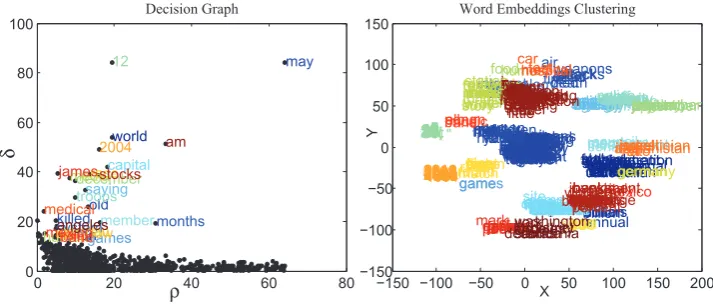
In this paper, we propose a method to mod-el short texts using semantic clustering and con-volutional neural network (CNN). Firstly, the fast clustering algorithm (Rodriguez and Laio, 2014), based on searching density peaks, is utilized to cluster word embeddings and discover semantic cliques, as shown in Figure 1. Then semantic com-position is performed overn-gram embeddings to
0 20 40 60 80 0 20 40 60 80 100 Decision Graph ρ δ world million may old killed months system games saying capital member troops 12 december human media german per race low 2004 iraqi medical band mexico jamesstocks am angeles
−150 −100 −50 0 50 100 150 200
−150 −100 −50 0 50 100 150
Word Embeddings Clustering
X
Y
governmentworld state
us u.s.internationalunitedstatescountryamerican countrieseuropeanbritish federal
america administrationnationssocietyeueuropecanadanationaustraliabritainaustralian
$ million billiondollars
annual
thein,.ofand a’sforon is wasaswith itbyanhasarefromhavewerebut this they had which theiror its one after newalsobeenmoreabout upwhen there all
out otherpeoplethan
over some time onlythem_so
before may many whilenow madelike betweenunderjust such then being down back off wellbothstilleven part those these home later another calledsamehowevermuchhereuntilway knownfullspecialwithindifferentamongwhosebasedtogethereachfeweveryothersgivenclosepointalthoughhalfawayleastlesshavingtimespastseennearlyrecentlyalmostthoughalreadyoncefartodaycamegavewenttootookagainenoughsoonbigcoursehardmaking
instead saw americans
currentlybroughtturnedeither present
he hiswho she her himoldhistorymanchildrenlife
young age himselfwomanchildlivinglives
killed air
death diedattack fireattacksdeadweapons used use system using technology internetcomputer game games said toldforeign official saying statementspokesmanagencyministryreporters
citytownnearareasouthnorthwesteastcommunitycentralcapitalsouthernregion northern western siteareas
province villagelocatedeasternborder
memberscouncil member senior independent
policearmyforcesmilitarytroopssecurityforce soldiersstaffu.n.unmission
" ():; 1 102/3 20 15 304 11 125 1862571413161789 2419 2221
marchjunejulyaprilseptemberaugustjanuarydecemberoctobernovemberfebruary human
food news press televisionmediastation story book radio published daily tvnewspaper wrote network interview written germany german
%totalper1005040
two three four five six finalseven roundmatchraceeightnine 2008 2006 2007 2010 2000 200920042005200120032002 2011199620121997199819991994
iraqisraelisraelipalestinian iraqi afghanistannato car hospitaltest medical music album bandsong mexicoitaly johngeorge david michael markpaulrobertjamesst.
percent marketpricesfinancialstockbankrose sales workers fell shares shareindex priceexchange investorsmarketsinvestmentstockstrading buybanks −
’’‘‘iwe ’−−youn’tdo
whatdid getmy?howsay says good going go best’rethink mewantnever
little know your got... better’velotreal’maskedreallythingssomethinglookever job’lldonealwayswhybelievethoughtwanted ! lovegettingcaamdoingthingletlookingperson
kind ‘
nothingfeelquestion
[image:2.595.119.476.65.217.2]york washington de districtlosangelessancaliforniatexasfloridacounty
Figure 1: Fast clustering based on density peaks of embeddings
detect candidate Semantic Units1(abbr. to SUs)
appearing in short texts. The part of candidate SUs meeting the preset threshold are chosen to constitute semantic matrices, which are used as in-put for the CNN, otherwise dropout. In this stage, semantic cliques are used as supervision informa-tion, which guarantee meaningful SUs can be ex-tracted.
The motivation of our work is to introduce extra knowledge by pre-trained word embeddings and fully exploit the contextual information of short texts to improve their representations. The main contributions include: (1) semantic cliques are discovered using fast clustering method based on searching density peaks; (2) for fine-tuning multi-scale SUs, the semantic cliques are used to super-vise the selection stage.
The remainder of this paper is organized as fol-lows. The related works are briefly reviewed in Section 2. Section 3 introduces the semantic clus-tering based on fast searching density peaks. Sec-tion 4 describes the architecture of the proposed method. Section 5 demonstrates the effectiveness of our method with experiments. Finally, conclud-ing remarks are offered in Section 6.
2 Related Works
Traditional statistics-based methods usually fail to achieve satisfactory performance for short texts classification due to their sparsity of representa-tions (Sriram et al., 2010). Based on external Wikipedia corpus, Phan et al. (2008) proposed a method to discover hidden topics using LDA and
1Semantic units are defined asn-grams which have
domi-nant meaning of text. Withnvarying, multi-scale contextual information can be exploited.
expand short texts. Chen et al. (2011) proved that leveraging topics at multiple granularity can mod-el short texts more precismod-ely.
Neural networks have been used to model lan-guages, and the word embeddings can be learned simultaneously (Mnih and Teh, 2012). Mikolov et al. (2013b) introduced the continuous Skip-gram model that is an efficient method for learning high quality word embeddings from large-scale un-structured text data. Recently, various pre-trained word embeddings are publicly available, and many composition-based methods are proposed to in-duce the semantic representation of texts. Le and Mikolov (2014) presented the Paragraph Vector al-gorithm to learn a fixed-size feature representation for documents.
Kalchbrenner et al. (2014) introduced the Dy-namic Convolutional Neural Network (DCNN) for modeling sentences. Their work is closely relat-ed to our study in thatk-max pooling is utilized to capture global feature vector and do not rely on parse tree. Kim (2014) proposed a simple im-provement to the convolutional architecture that t-wo input channels are used to allow the employ-ment of task-specific and static word embeddings simultaneously.
complex co-adaptations. To exploit more struc-ture information of text, based on CNN and direc-t embedding of small direc-texdirec-t regions, an aldirec-ternadirec-tive mechanism for effective use of word order for text categorization was proposed (Johnson and Zhang, 2014).
Although the popular methods can capture high-order information and word relations to pro-duce complex features, they cannot guarantee the classification performance for very short texts. In this paper, we design a method to exploit more contextual information for short text classification using semantic clustering and CNN.
3 Semantic Clustering
Since the neighbors of each word are semanti-cally related in embedding space (Mikolovet al., 2013b), clustering methods (Rodriguez and Laio, 2014) can be used to discover semantic cliques. For implementation, two quantities of data pointi
are computed, include: local densityρi, defined as follows,
ρi= ∑
j
χ(dij −dc) (3)
wheredij is the distance between data points, dc
is a cutoff distance. Furthermore, distanceδi from
points of higher density is measured by,
δi=
min
j:ρj>ρi(dij) , if ρi < ρmax max
j (dij) , otherwise
(4)
An example of semantic clustering is illustrat-ed in Figure 1. The decision graph shows the two quantitiesρ andδ of each word embedding. Ac-cording to the definitions above, these word em-beddings with large ρ and δ simultaneously are chosen as cluster centers, which are labeled using the corresponding words.
4 Proposed Architecture
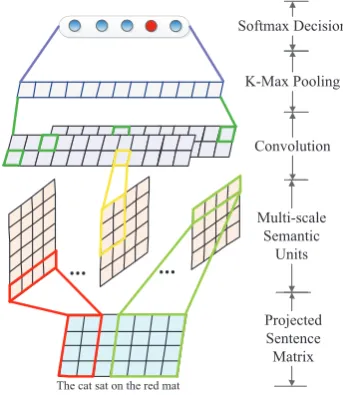
As shown in Figure 2, the proposed architecture use well pre-trained word embeddings to initialize the lookup table, and higher levels extract more complexity features.
For short text S ={w1, w2,· · ·, wN}, its
project-ed matrix PM∈ Rd×N is obtained by table
look-ing up in the first layer, wheredis the dimension
of word embedding. The second layer is used to obtain multi-scale SUs to constitute the semantic
... ...
Projected Sentence Matrix Convolution
Multi-scale Semantic
Units K-Max Pooling Softmax Decision
[image:3.595.328.500.64.262.2]The cat sat on the red mat
Figure 2: Architecture for short text modeling
matrices, which are combined and fed into convo-lutional layer, followed byk-max pooling opera-tion. Finally, a softmax function is employed as classifier.
4.1 Detection for Multi-scale SUs
Methods for modeling short text S mainly have
problem that its semantic meaning is determined by a few of key-phrases, however, these meaning-ful phrases may appear at any position ofS. Thus,
simply combining all words of S may introduce unnecessary divergence and hurt the overall se-mantic representation. Therefore, the detection for SUs are useful, which capture salient local infor-mation, as shown in Figure 2.
In particular, to obtain the representations of candidate SUs, multiple windows with variable width over word embeddings are used to perfor-m eleperfor-ment-wise additive coperfor-mposition, as follows:
[SU1,SU2,· · ·,SUN−m+1] =PM⊗Ewin (5)
where,Ewin ∈ Rd×mis a window matrix with all
weights equal to one, and
SUi=
|PMwin,i|
∑
j=1
PMwin,ij (6)
PMwin,i
j is the jth column from the sub-matrix
PMwin,i, which is windowed on projected matrix
PMby Ewin with theith times sliding. m is the
width of the window matrixEwin. Withm
The meaningful SUs are assumed that they have one close neighbor at least in embedding space. Thus, we compute Euclidean distance between candidate SUs and semantic cliques. If the dis-tance between candidate SUs and nearest word embeddings are smaller than the preset threshold, the candidate SUs are selected to constitute the se-mantic matrices, otherwise dropout.
4.2 Convolution Layer
In our network, the convolutional layer is used to extract local features. Kernel matriceskwith cer-tain width nare utilized to calculate convolution with the input matricesM, as Equation (7).
C= [c1,c2,· · ·,cd/2]T=KT⊗M (7)
where,
K= [k1,k2,· · ·,kd/2] (8)
M = [Mwin
1 ,Mwin2 ,· · ·,Mwind/2] (9)
cj
i =ki·(Mwin,ji )T (10)
The cj
i is generated from the jth n-gram in M.
Equation (7) produce the feature maps of convolu-tional layer.
4.3 K-Max Pooling
This operator is a non-linear sub-sampling func-tion that returns the sub-sequence ofKmaximum
values (LeCunet al., 1998), which is used to cap-ture the most relevant global feacap-tures with fixed-length. Then, tangent transformation over the re-sults of K-max pooling is performed, the output
of which is concatenated to used as representation for the input short texts.
4.4 Network Training
The last layer is fully connected, where a soft-max classifier is applied to predict the proba-bility distribution over categories. The network is trained with the objective that minimizes the cross-entropy of the predicted distributions and the actual distributions (Turianet al., 2010),
J(θ) =−1t ∑ti=1logp(c†|xi, θ) +α∥θ∥2 (11)
wheretis number of training examplesx, andθis the parameters set which comprises the kernels of weights used in convolutional layer and the con-nective weights from the fully connected layer.
Embedding Senna2 GloVe3 Word2Vec4
Corpus Wikipedia Wikipedia Google News
Dimension 50 50 300
[image:4.595.309.519.102.292.2]|V ocab.| 130,000 400,000 3,000,000
Table 1: Details of word embeddings
Methods SnippetsGoogle TREC
Semantic-CNN
Senna 83.6 96.4
GloVe 84.4 97.2
Word2Vec 85.1 95.6
DCNN – 93
(Kalchbrenner et al,2014)
SVMS – 95
(Silva et al., 2011)
CNN-TwoChannel – 93.6
(Kim, 2014)
LDA+MaxEnt 82.7 –
(Phan et al., 2008)
Multi-Topics+MaxEnt 84.17 –
(Chen et al., 2011)
Table 2: The classification accuracy of proposed method against other models
5 Experiments 5.1 Datasets
Experiments are conducted on two benchmarks: Google Snippets (Phanet al., 2008) and TREC (Li and Roth, 2002).
Google Snippets This dataset consists of 10,060 training snippets and 2,280 test snippets from 8 categories. On average, each snippet has 18.07 words.
TRECThe TREC questions dataset contains 6 different question types. The training dataset con-sists of 5,452 labeled questions whereas the test dataset consists of 500 questions.
5.2 Experimental Setup
Three pre-trained word embeddings for initializ-ing the lookup table are summarized in Table 1. To discover semantic cliques, we takeρmin = 16
andδmin = 1.54. Through our experiments,6
k-ernel matrices in convolutional layer, K = 3for max pooling, and mini-batch size of100are used.
5.3 Results and Discussions
5.3.1 Comparison with state-of-the-art methods
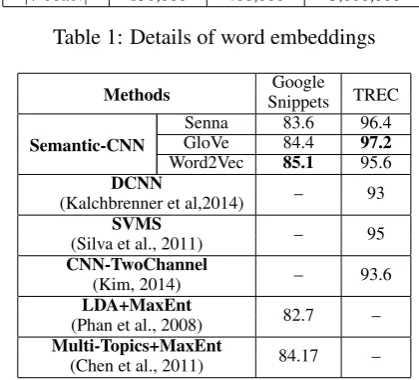
As shown in Table 2, we introduce 5 popular meth-ods as baselines, and the details are described:
0 2 4 6 0.8
0.81 0.82 0.83 0.84 0.85
Number of window matrices
A
cc
ura
cy
Google Snippets
0 2 4 6
0.93 0.94 0.95 0.96 0.97
TREC Senna
[image:5.595.145.455.63.182.2]GloVe Word2Vec
Figure 3: Number of windows for multi-scale SUs
3 4 5 6
0.82 0.825 0.83 0.835 0.84
Euclidean Distance
A
cc
ura
cy
Senna
0.5 1 1.5 2
0.82 0.83 0.84 0.85
GloVe
1 2 3 4
0.83 0.835 0.84 0.845 0.85
[image:5.595.146.457.218.324.2]Word2Vec
Figure 4: Influence of threshold in SUs detection
SVMs Parser, wh word, head word, POS, hy-pernyms, and 60 hand-coded rules were used as features to train SVMs (Silvaet al., 2011).
CNN-TwoChannelAn improved CNN that al-lows task-specific and static word embeddings are used simultaneously (Kim, 2014).
LDA+MaxEntLDA was used to discover hid-den topics for expanding short texts (Phanet al., 2008).
Multi-topics+MaxEnt Multiple granularity topics from LDA were utilized to model short texts (Chenet al., 2011).
For valid comparisons, we respectively initial-ize the lookup table with the word embeddings in Table 1, and three experiments are conducted for each benchmark. As a whole, our method achieves the best performance, especially for TREC with
97.2% when the GloVe word embedding is em-ployed. For Google snippets, our method achieves the highest result of 85.1%corresponding to the word embedding induced by Word2Vec.
5.3.2 Effect of Hyper-parameters
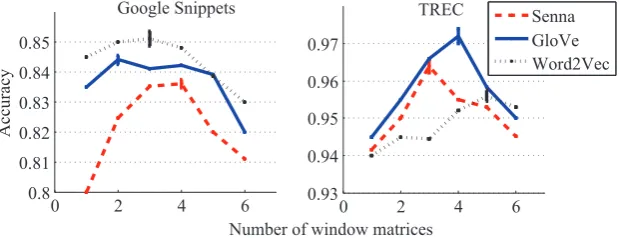
In Figure 2, for obtaining SUs with multi-scale, multiple window matrices with increasing width
mare used. With respect to the variablem, the
re-2http://ml.nec-labs.com/senna/ 3http://nlp.stanford.edu/projects/glove/ 4https://code.google.com/p/word2vec/
sults are shown in Figure 3. We find small size of window may result in loss of critical information, however, the window with large size may intro-duce noise.
Figure 4 demonstrate how preset threshold d
impact our method over benchmark Goggle snip-pets. We can draw a conclusion that whendis too small, only a few of SUs can be detected, where-as meaningless features are enrolled. The optimal thresholddcan be chosen by cross-validation.
The impacts of other hyper-parameters like the number and size of the feature detectors in convo-lutional layer, and the variablekink-max pooling layer are beyond the scope of this paper.
6 Conclusion
This paper proposes a novel semantic hierarchical model for short text classification. The model us-es pre-trained word embeddings to introduce extra knowledge, and multi-scale SUs in short texts are detected.
Acknowledgement
References
Ainur Yessenalina and Claire Cardie. Composition-al matrix-space models for sentiment anComposition-alysis. In EMNLP, pages 172–182. Association for Computa-tional Linguistics, 2011.
Alex Rodriguez and Alessandro Laio. Clustering by
fast search and find of density peaks. Science,
344(6191):1492–1496, 2014.
Andriy Mnih and Yee Whye Teh. A fast and simple algorithm for training neural probabilistic language
models. arXiv preprint arXiv:1206.6426, 2012.
Bharath Sriram, Dave Fuhry, Engin Demir, Hakan Fer-hatosmanoglu, and Murat Demirbas. Short text clas-sification in twitter to improve information filtering. InSIGIR, pages 841–842. ACM, 2010.
Daojian Zeng, Kang Liu, Siwei Lai, Guangyou Zhou, and Jun Zhao. Relation classification via
convolu-tional deep neural network. InProceedings of
COL-ING, pages 2335–2344, 2014.
David M Blei, Andrew Y Ng, and Michael I Jordan.
Latent dirichlet allocation. the Journal of machine
Learning research, 3:993–1022, 2003.
Geoffrey E Hinton, Nitish Srivastava, Alex Krizhevsky, Ilya Sutskever, and Ruslan R Salakhutdinov. Improving neural networks by preventing
co-adaptation of feature detectors. arXiv preprint
arX-iv:1207.0580, 2012.
Jeff Mitchell and Mirella Lapata. Composition in
dis-tributional models of semantics. Cognitive science,
34(8):1388–1429, 2010.
John Duchi, Elad Hazan, and Yoram Singer. Adap-tive subgradient methods for online learning and
stochastic optimization. The Journal of Machine
Learning Research, 12:2121–2159, 2011.
Joseph Turian, Lev Ratinov, and Yoshua Bengio. Word representations: a simple and general method for
semi-supervised learning. InACL, pages 384–394.
Association for Computational Linguistics, 2010. Mehran Sahami and Timothy D Heilman. A web-based
kernel function for measuring the similarity of short
text snippets. In Proceedings of the 15th
interna-tional conference on World Wide Web, pages 377– 386. AcM, 2006.
Mengen Chen, Xiaoming Jin, and Dou Shen. Short text classification improved by learning
multi-granularity topics. In IJCAI, pages 1776–1781.
Citeseer, 2011.
Nal Kalchbrenner, Edward Grefenstette, and Phil Blun-som. A convolutional neural network for modelling
sentences. arXiv preprint arXiv:1404.2188, 2014.
Quoc V Le and Tomas Mikolov. Distributed
represen-tations of sentences and documents. arXiv preprint
arXiv:1405.4053, 2014.
Richard Socher, Alex Perelygin, Jean Y Wu, Jason Chuang, Christopher D Manning, Andrew Y Ng, and Christopher Potts. Recursive deep models for semantic compositionality over a sentiment
tree-bank. InEMNLP, volume 1631, page 1642.
Cite-seer, 2013.
Ronan Collobert, Jason Weston, L´eon Bottou, Michael Karlen, Koray Kavukcuoglu, and Pavel Kuksa.
Nat-ural language processing (almost) from scratch. The
Journal of Machine Learning Research, 12:2493– 2537, 2011.
Tomas Mikolov, Kai Chen, Greg Corrado, and Jeffrey Dean. Efficient estimation of word
representation-s in vector representation-space. arXiv preprint arXiv:1301.3781,
2013.
Tomas Mikolov, Ilya Sutskever, Kai Chen, Greg S Cor-rado, and Jeff Dean. Distributed representations of words and phrases and their compositionality. In Advances in Neural Information Processing System-s, pages 3111–3119, 2013.
Tomas Mikolov, Wen-tau Yih, and Geoffrey Zweig. Linguistic regularities in continuous space word
rep-resentations. InHLT-NAACL, pages 746–751, 2013.
Xiaohui Yan, Jiafeng Guo, Yanyan Lan, and Xueqi Cheng. A biterm topic model for short texts. In WWW, pages 1445–1456. International World Wide Web Conferences Steering Committee, 2013. Xin Li and Dan Roth. Learning question classifiers.
InProceedings of the 19th international conference on Computational linguistics-Volume 1, pages 1–7. Association for Computational Linguistics, 2002. Xuan-Hieu Phan, Le-Minh Nguyen, and Susumu
Horiguchi. Learning to classify short and sparse text & web with hidden topics from large-scale data
collections. InProceedings of the 17th
internation-al conference on World Wide Web, pages 91–100. ACM, 2008.
Yann LeCun, L´eon Bottou, Yoshua Bengio, and Patrick Haffner. Gradient-based learning applied to
doc-ument recognition. Proceedings of the IEEE,
86(11):2278–2324, 1998.
Yoon Kim. Convolutional neural networks for sentence
classification. arXiv preprint arXiv:1408.5882,
2014.
Yoshua Bengio, R´ejean Ducharme, Pascal Vincent, and Christian Janvin. A neural probabilistic language
model. The Journal of Machine Learning Research,
3:1137–1155, 2003.
Joao Silva, Lu´ısa Coheur, Ana Cristina Mendes, and Andreas Wichert. From symbolic to sub-symbolic
information in question classification. Artificial
In-telligence Review, 35(2):137–154, 2011.
Rie Johnson and Tong Zhang. Effective use of word or-der for text categorization with convolutional neural