User Based Aggregation for Biterm Topic Model
Weizheng Chen, Jinpeng Wang, Yan Zhang , Hongfei Yan and Xiaoming Li School of Electronic Engineering and Computer Science, Peking University, China
{cwz.pku,wjp.pku,yhf1029}@gmail.com, [email protected], [email protected]
Abstract
Biterm Topic Model (BTM) is designed to model the generative process of the word co-occurrence patterns in short texts such as tweets. However, two aspects of BTM may restrict its performance: 1) user individualities are ignored to obtain the corpus level words co-occurrence patterns; and 2) the strong assumptions that two co-occurring words will be assigned the same topic label could not distinguish background words from topical words. In this paper, we propose Twitter-BTM model to address those issues by considering user level personalization in BTM. Firstly, we use user based biterms aggregation to learn user specific topic distribution. Secondly, each user’s preference between background words and topical words is estimated by incorporating a background topic. Experiments on a large-scale real-world Twitter dataset show that Twitter-BTM outperforms several state-of-the-art baselines.
1 Introduction
In recent years, short texts are increasingly preva-lent due to the explosive growth of online social media. For example, about 500 million tweets are published per day on Twitter1, one of the most
popular online social networking services. Proba-bilistic topic models (Blei et al., 2003) are broadly used to uncover the hidden topics of tweets, s-ince the low-dimensional semantic representation is crucial for many applications, such as prod-uct recommendation (Zhao et al., 2014), hashtag recommendation (Ma et al., 2014), user interest tracking (Sasaki et al., 2014), sentiment analysis
1See https://about.Twitter.com/company
(Si et al., 2013). However, the scarcity of context and the noisy words restrict LDA and its variations in topic modeling over short texts.
Previous works model topic distribution at three different levels for tweets: 1) document, the standard LDA assumes each document is associated with a topic distribution (Godin et al., 2013; Huang, 2012). LDA and its variations suffer from context sparsity in each tweet. 2) user, user based aggregation is utilized to alleviate the sparsity problem in short texts (Weng et al., 2010; Hong and Davison, 2010). In these models, all the tweets of the same user are aggregated together as a pseudo document based on the observation that the tweets written by the same user are more similar. 3) corpus, BTM (Yan et al., 2013) assumes that all the biterms (co-occurring word pairs) are generated by a corpus level topic distribution to benefit from the global rich word co-occurrence patterns.
As far as we know, how to incorporate user factor into BTM has not been studied yet. User based aggregation has proven effective for LDA. But unfortunately, our preliminary experiments in-dicate that simple user-based aggregation for BTM will generate incoherent topics. To distinguish be-tween commonly used words (e.g.,good, people, etc) and topical words (e.g., food, travel, etc), a background topic is often incorporated into the topic models. Zhao et al. (2011) use a back-ground topic in Twitter-LDA to distill discrimi-native words in tweets. Sasaki et al. (2014) re-duce the perplexity of Twitter-LDA by estimating the ratio between choosing background words and topical words for each user. They both make a very strong assumption that one tweet only covers one topic. Yan et al. (2015) use a background topic to distinguish between common biterms and bursty biterms, which need external data to evaluate the burstiness of each biterm as prior knowledge. Un-like those above, we incorporate a background
topic to absorb non-discriminative common words in each biterm. And we also estimate the user’s preference between common words and topical words. Our new model is named as Twitter-BTM, which combines user based aggregation and the background topic in BTM. Finally, experiments on a Twitter dataset show that Twitter-BTM not only can discover more coherent topics but also can give more accurate topic representation of tweets compared with several state-of-the-art baselines.
We organize the rest of the paper as follows. Section 2 gives a brief review for BTM. Section 3 introduces our Twitter-BTM model and its im-plementation. Section 4 describes experimental results on a large-scale Twitter dataset. Finally, Section 5 contains a conclusion and future work.
2 BTM
There are two major differences between BTM and LDA (Yan et al., 2013). For one thing, con-sidering a topic is a mixture of highly correlated words, which implies that they often occur togeth-er in the same document, BTM models the gen-erative process of the word co-occurrence patterns directly. Thus a document made up of n words will be converted toC2
nbiterms. For another, LDA and its variants suffer from the severe data sparsity in short documents. BTM uses global co-occurrence patterns to model the topic distribution over corpus level instead of document level.
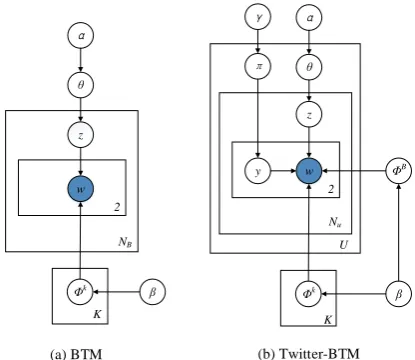
The graphical representation of BTM (Yan et al., 2013) is shown in Figure 1(a). It assumes that the whole corpus is associated with a distri-butions θ over K topics drawn from a Dirichlet priorDir(α). And each topictis associated with a multinomial distribution φt over a vocabulary of V unique words drawn from a Dirichlet pri-or Dir(β). The generative process for a corpus which consists ofNBbitermsB ={b1, ..., bNB},
wherebi = (wi1, wi2), is as follows:
1 For each topic t=1,...,T (a) Drawφt∼Dir(β) 2 For the whole tweets collection
(a) Drawθ∼Dir(α)
3 For each biterm b = 1,...,NB (a) Drawzb ∼Multi(θ)
(b) Drawwb,1, wb,2 ∼Multi(φzb)
In the above process, zb is the topic assign-ment latent variable of biterm b. To infer the parameters φ and θ, collapsed Gibbs sampling
θ
α
NB 2 w z
β
K Φk
θ
α
Nu U 2
γ
y w
z
π
β
K Φk
ΦB
[image:2.595.315.523.67.247.2](a) BTM (b) Twitter-BTM
Figure 1: Graphical representation of (a) BTM, (b) Twitter-BTM
algorithm (Griffiths and Steyvers, 2004) is used for approximate inference.
Compared with the strong assumption that a short document only covers a single topic (Diao et al., 2012; Ding et al., 2013), BTM makes a looser assumption that two words will be assigned the same topic label if they have co-occurred. Thus a short document could cover more than one topic, which is more close to the reality. But this assump-tion causes another issue, those commonly used words and those topical words are treated equally. Obviously it is inappropriate to assign same topic label to those words.
3 Twitter-BTM
In this Section, we introduce our Twitter-BTM model. Figure 1(b) shows the graphical represen-tation of Twitter-BTM. The generative process of Twitter-BTM is as follows:
1 DrawφB ∼Dir(β) 2 For each topic t=1,...,T
(a) Drawφt∼Dir(β) 3 For each user u=1,...,U
(a) Drawθu ∼Dir(α), πu ∼Beta(γ) (b) For each biterm b = 1,...,Nu
(i) Drawzu,b ∼Multi(θu) (ii) For each word n = 1,2
(A) Drawyu,b,n∼Bern(πu) (B) ifyu,b,n= 0Drawwu,b,n∼
Multi(φB)
ifyu,b,n= 1Drawwu,b,n∼
In the above process, user u’s topic interestθu is a multinomial distribution over K topics drawn from a Dirichlet prior Dir(α). The background topicB is associated with a multinomial distribu-tionφBdrawn from a Dirichlet priorDir(β). The assumption that each user has a different prefer-ence between topical words and background word-s iword-s word-shown to be effective in (Saword-saki et al., 2014). We adopt this assumption in Twitter-BTM. User
u’s preference is represented as a Bernoulli distri-bution with parameterπudrawn from a beta prior
Beta(γ). Nu is the number of biterms of useru,
zu,bis the topic assignment latent variable of user
u’s bitermb. For useruand his/her bitermb,n=1 or 2, we use a latent variableyu,b,nto indicate the word type of the wordwb,n. Whenyu,b,n= 1,wb,n is generated from topic zu,b. When yu,b,n = 0,
wb,nis generated from the background topicB. We adopt collapsed Gibbs Sampling to estimate the parameters. Because of the limitations of s-pace, we leave out the details about the sampling algorithm. Since we can’t get a document’s distri-bution over topics from the parameters estimated by Twitter-BTM directly, we utilize the following formula (Yan et al., 2013) to infer the topic distri-bution of document d. Given a documentdwhose author is useru:
P(z=t|d) =
Nb
X
i
P(z=t|bi)P(bi|d) (1)
Now the problem is converted to how to estimate
P(bi|d)andP(z =t|bi). P(bi|d)is estimated by empirical distribution in d:
P(bi|d) = NNbi
b (2)
whereNbi is the number of bitermbi occurred in
d, Nb is the total number of biterms in d. We can apply Bayes’ rule to computeP(z=t|bi)via following expression:
θu t
πuφB
wi,1+ (1−πu)φtwi,1 πuφBwi,2+ (1−πu)φtwi,2
P kθuk
πuφB
wi,1+ (1−πu)φkwi,1 πuφBwi,2+ (1−πu)φkwi,2
(3)
4 Experiments
In this Section, we describe our experiments car-ried on a Twitter dataset collected form 10th Jun, 2009 to 31st Dec, 2009. Stop words and words occur less than 5 times are removed. We also filter
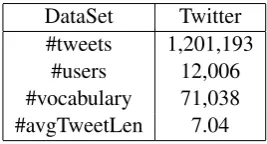
tweets which only have one or two words. All letters are converted into lower case. The dataset is divided into two parts. The first part whose statis-tics is shown in Table 1 is used for training. The second part which consists of 22,496,107 tweets is used as the external dataset in topic coherence evaluation task in Section 4.1.
We compare the performance of Twitter-BTM with five baselines:
• LDA-U, user based aggregation is applied before training LDA.
• Twitter-LDA (Zhao et al., 2011), which makes a strong assumption that a tweet only covers one topic.
• TwitterUB-LDA (Sasaki et al., 2014), an im-proved version of Twitter-LDA, which mod-els the user level preference between topical words and background words.
• BTM (Yan et al., 2013), the Biterm Topic Model.
• BTM-U, a simplified version of Twitter-BTM without background topic.
For all the above models, we use symmetric Dirichlet priors. The hyperparameters are set as follows: for all the models, we set α = 50/K,
β = 0.01; for Twitter-LDA, TwitterUB-LDA and Twitter-BTM, we set γ = 0.5. We run Gibbs sampling for 400 iterations.
DataSet Twitter
#tweets 1,201,193
#users 12,006
#vocabulary 71,038
[image:3.595.349.483.512.584.2]#avgTweetLen 7.04
Table 1: Summary of dataset
Perplexity metric is not used in our experiments since it is not a suitable evaluation metric for BTM (Cheng et al., 2014). The first reason is that BTM and LDA optimize different likelihood. The second reason is that topic models which have bet-ter perplexity may infer less semantically topics (Chang et al., 2009).
4.1 Topic Coherence
K 50 100
method Top5 Top10 Top20 Top5 Top10 Top20
LDA-U 2.83±0.07 1.93±0.06 1.40±0.04 3.11±0.09 1.89±0.09 1.15±0.04 Twitter-LDA 2.58±0.04 1.90±0.03 1.39±0.03 2.97±0.20 1.98±0.09 1.44±0.06 TwitterUB-LDA 2.57±0.05 1.87±0.07 1.45±0.04 3.07±0.11 2.05±0.05 1.45±0.05 BTM 2.88±0.14 2.01±0.09 1.44±0.08 3.25±0.14 2.13±0.06 1.49±0.06
[image:4.595.80.520.61.173.2]BTM-U 2.92±0.10 1.89±0.05 1.33±0.04 3.03±0.07 1.95±0.05 1.34±0.07 Twitter-BTM 3.04±0.10 2.05±0.08 1.47±0.05 3.27±0.12 2.15±0.08 1.48±0.05
Table 2: PMI-Score of different topic models
Equation (4) defines PMI (Pointwise Mutual In-formation) for two wordswi andwj:
P MI(wi, wj) = logPP((wwi, wj) +
i)P(wj) (4)
is an extremely small constant (Stevens et al., 2012), which is equal to10−12 in this paper. The
word probabilities and the co-occurrence proba-bilities are computed on the large-scale external dataset empirically. Here we use the second part Twitter dataset as the external dataset. Then for a topictand its topT words ranked by topic-word probabilityφt
w, the PMI-Score of topictis defined as follow:
P MI−Score(t)= 1
T(T−1)
X
1≤i<j≤T
P MI(wi, wj)
(5) The model’s PMI-Score is defined as the mean of all the topics’ PMI-Score. Table 2 shows the average results over 10 runs of different models. When K = 50, Twitter-BTM outperforms all other models significantly. WhenK = 100, The PMI-Score of BTM and Twitter-BTM are very close. BTM-U is worse than BTM, the reason may be that each user’s biterm sets provide extremely limited words co-occurring information.
Table 3 shows top 10 words of topic “food” learned by BTM, BTM-U and Twitter-BTM when
K = 50. We use italic fonts to indicate back-ground words labeled by human judgement. Com-pared with BTM and BTM-U, Twitter-BTM can rank those background words at lower level. It demonstrates that representative words learned by Twitter-BTM are more coherent and meaningful.
4.2 Document Representation
Topic models are powerful dimension reduction methods for texts. Given a tweet d, we can in-fer its probability distribution overK topics with
BTM BTM-U Twitter-BTM
food food vegan
eat vegan food
chicken eat eat
good good chicken
vegan chicken chocolate
lol #vegan cheese
cheese cream cream
chocolate cheese #vegan
love chocolate ice
[image:4.595.326.507.212.365.2]dinner ice dinner
Table 3: Top 10 words of topic food
equation (1). Thusdcan be represented as a topic probability vector:
d= [P(z= 1|d), ..., P(z=K|d)] (6)
We use document classification task (Cheng et al., 2014) and document clustering task (Duan et al., 2012) to measure the quality of the docu-ments’ topic proportions. Tweets in Twitter have no explicit label information. But some tweets are labeled by one or more hashtags (a type of label whose form is “#keyword”) manually by its author to indicate the topic the tweets involve. We follow previous works (Cheng et al., 2014; Wang et al., 2014) and use hashtags as the tweets’ labels. Table 4 lists 38 frequent (at least appears in 100 tweets ) hashtags relating to certain topic or event manually selected in our dataset.
We choose those tweets which contain only one of these hashtags appear in Table 4 from our o-riginal data in the following experiments. When we infer a tweet’s topic distribution, the hashtag is ignored. Because it doesn’t make sense to use the label information to construct the feature vector directly.
aaliyah afghanistan beatcancer birding blogtalkradio digguser dmv dontyouhate fact
giladshalit gno gov green haiku healthcare honduras india iranelection jazz jesus krp lgbt
mindsetshift nfl nn oink rhoa slaughterhouse socialmedia tech travel trueblood vegan vegas
[image:5.595.334.502.62.189.2]voss weeklyfitnesschallenge wordpress yyj
Table 4: Hashtags selected for evaluation
10 20 30 40 50 60 70 80 90 100
1XPEHURI7RSLFV
0.25 0.30 0.35 0.40 0.45 0.50 0.55 0.60 0.65 0.70
Accuracy
LDA-U Twitter-LDA TwitterUB-LDA
[image:5.595.101.264.195.315.2]BTM Twitter-BTM BTM-U
Figure 2: Performance of classification
sklearn2python module with 10-fold cross
valida-tion. Using accuracy as the evaluation metric, we report the classification performance of different topic models in Figure 2. With the increase of the topic number K, all the models’ accuracies are tending to increase. BTM is worse than all other models, which confirms the effectiveness of user based aggregation. Twitter-BTM and BTM-U always outperform LDA-BTM-U, Twitter-LDA and TwitterUB-LDA. Twitter-BTM’s accuracy is a lit-tle higher than BTM-U, which demonstrates that the background topic is helpful to capture more accurate topic representation of documents.
We adopt k-means algorithm implemented in sklearn python module as our clustering method. The number of cluster is set to 38. Consider-ing we have the knowledge of ground truth class assignments of each tweet, and Adjusted Rand Index (ARI) and Normalized Mutual Information are used as cluster validation indices in our exper-iments. As shown in Figure 3 and Figure 4, The higher ARI and NMI value indicate that Twitter-BTM outperform other models. And Twitter-BTM per-forms worse than all other models.
5 Conclusion
In this paper, we investigate the problem of topic modeling over short texts with user factor.
Us-2See http://scikit-learn.org/stable/
10 20 30 40 50 60 70 80 90 100
1XPEHURI7RSLFV
0.10 0.15 0.20 0.25 0.30 0.35 0.40 0.45 0.50
ARI
LDA-U Twitter-LDA TwitterUB-LDA
BTM Twitter-BTM BTM-U
Figure 3: Performance of clustering (ARI)
10 20 30 40 50 60 70 80 90 100
1XPEHURI7RSLFV
0.30 0.35 0.40 0.45 0.50 0.55 0.60 0.65 0.70
NMI
LDA-U Twitter-LDA TwitterUB-LDA
BTM Twitter-BTM BTM-U
Figure 4: Performance of clustering (NMI)
er individualities are sacrificed to obtain the cor-pus level words co-occurrence patterns in BTM. However, unlike LDA, simple user based aggre-gation will reduce the topic coherence for BTM. To address this problem, we propose Twitter-BTM which loosens the inappropriate assumption that two co-occurring words must have same topic la-bel made in BTM by leveraging user based ag-gregation and incorporating a background topic in BTM. The experimental results show that Twitter-BTM substantially outperforms Twitter-BTM.
In the future, we plan to study the influence of other factors such as temporal information to BTM and its variants.
Acknowledgments
[image:5.595.333.502.241.363.2]References
David M Blei, Andrew Y Ng, and Michael I Jordan. 2003. Latent dirichlet allocation. the Journal of machine Learning research, 3:993–1022.
Leo Breiman. 2001. Random forests. Machine Learning, 45(1):5–32.
Jonathan Chang, Sean Gerrish, Chong Wang, Jordan L Boyd-Graber, and David M Blei. 2009. Reading tea leaves: How humans interpret topic models. In Advances in neural information processing systems, pages 288–296.
Xueqi Cheng, Xiaohui Yan, Yanyan Lan, and Jiafeng Guo. 2014. Btm: Topic modeling over short texts. IEEE TRANSACTIONS ON KNOWLEDGE AND DATA ENGINEERING.
Qiming Diao, Jing Jiang, Feida Zhu, and Ee-Peng Lim. 2012. Finding bursty topics from microblogs. In ACL (1), pages 536–544. The Association for Computer Linguistics.
Zhuoye Ding, Xipeng Qiu, Qi Zhang, and Xuanjing Huang. 2013. Learning topical translation model for microblog hashtag suggestion. In IJCAI 2013, Proceedings of the 23rd International Joint Conference on Artificial Intelligence, Beijing, China, August 3-9, 2013.
Dongsheng Duan, Yuhua Li, Ruixuan Li, Rui Zhang, and Aiming Wen. 2012. Ranktopic: Ranking based topic modeling. InICDM, pages 211–220.
Fr´ederic Godin, Viktor Slavkovikj, Wesley De Neve, Benjamin Schrauwen, and Rik Van de Walle. 2013. Using topic models for twitter hashtag recommendation. In Proceedings of the 22nd international conference on World Wide Web com-panion, pages 593–596. International World Wide Web Conferences Steering Committee.
T. L. Griffiths and M. Steyvers. 2004. Finding scientific topics. Proceedings of the National Academy of Sciences, 101:5228–5235.
Liangjie Hong and Brian D. Davison. 2010. Empirical study of topic modeling in twitter. InProceedings of the First Workshop on Social Media Analytics, SOMA ’10, pages 80–88, New York, NY, USA. ACM.
Zhuoye Ding Qi Zhang XuanJing Huang. 2012. Automatic hashtag recommendation for microblogs using topic-specific translation model. In24th Inter-national Conference on Computational Linguistics, page 265. Citeseer.
Zongyang Ma, Aixin Sun, Quan Yuan, and Gao Cong. 2014. Tagging your tweets: A probabilistic modeling of hashtag annotation in twitter. In Proceedings of the 23rd ACM International Confer-ence on ConferConfer-ence on Information and Knowledge Management, pages 999–1008. ACM.
David Newman, Jey Han Lau, Karl Grieser, and Timothy Baldwin. 2010. Automatic evaluation of topic coherence. InHuman Language Technologies: The 2010 Annual Conference of the North American Chapter of the Association for Computational Linguistics, pages 100–108. Association for Com-putational Linguistics.
Kentaro Sasaki, Tomohiro Yoshikawa, and Takeshi Furuhashi. 2014. Online topic model for twitter considering dynamics of user interests and topic trends. InProceedings of the 2014 Conference on Empircal Methods in Natural Language Processing, pages 1977–1985.
Jianfeng Si, Arjun Mukherjee, Bing Liu, Qing Li, Huayi Li, and Xiaotie Deng. 2013. Exploiting topic based twitter sentiment for stock prediction. InACL (2), pages 24–29.
Keith Stevens, Philip Kegelmeyer, David Andrzejew-ski, and David Buttler. 2012. Exploring topic coherence over many models and many topics. In Proceedings of the 2012 Joint Conference on Empirical Methods in Natural Language Processing and Computational Natural Language Learning, pages 952–961. Association for Computational Linguistics.
Yuan Wang, Jie Liu, Jishi Qu, Yalou Huang, Jimeng Chen, and Xia Feng. 2014. Hashtag graph based topic model for tweet mining. In 2014 IEEE International Conference on Data Mining, ICDM 2014, Shenzhen, China, December 14-17, 2014, pages 1025–1030.
Jianshu Weng, Ee-Peng Lim, Jing Jiang, and Qi He. 2010. Twitterrank: finding topic-sensitive influen-tial twitterers. InWSDM, pages 261–270. ACM. Xiaohui Yan, Jiafeng Guo, Yanyan Lan, and Xueqi
Cheng. 2013. A biterm topic model for short texts. InProceedings of the 22nd international conference on World Wide Web, pages 1445–1456. International World Wide Web Conferences Steering Committee. Xiaohui Yan, Jiafeng Guo, Yanyan Lan, Jun Xu, and Xueqi Cheng. 2015. A probabilistic model for bursty topic discovery in microblogs.
Wayne Xin Zhao, Jing Jiang, Jianshu Weng, Jing He, Ee-Peng Lim, Hongfei Yan, and Xiaoming Li. 2011. Comparing twitter and traditional media using topic models. In Advances in Information Retrieval, pages 338–349. Springer.