Scholarship@Western Scholarship@Western
Electronic Thesis and Dissertation Repository
12-13-2012 12:00 AM
An Outcome-Based Approach for Ensuring Regulatory An Outcome-Based Approach for Ensuring Regulatory Compliance of Business Processes
Compliance of Business Processes
Quanjun Yin
The University of Western Ontario Supervisor
Nazim H. Madhavji
The University of Western Ontario
Graduate Program in Computer Science
A thesis submitted in partial fulfillment of the requirements for the degree in Master of Science
© Quanjun Yin 2012
Follow this and additional works at: https://ir.lib.uwo.ca/etd Part of the Software Engineering Commons
Recommended Citation Recommended Citation
Yin, Quanjun, "An Outcome-Based Approach for Ensuring Regulatory Compliance of Business Processes"
(2012). Electronic Thesis and Dissertation Repository. 1006.
https://ir.lib.uwo.ca/etd/1006
This Dissertation/Thesis is brought to you for free and open access by Scholarship@Western. It has been accepted for inclusion in Electronic Thesis and Dissertation Repository by an authorized administrator of
Scholarship@Western. For more information, please contact [email protected].
(Spine title: outcome-based approach for regulatory compliance) (Thesis format: Monograph)
by Quanjun Yin
Graduate Program in Computer Science A thesis submitted in partial fulfillment
of the requirements for the degree of Master of Science
The School of Graduate and Postdoctoral Studies The University of Western Ontario
London, Ontario, Canada
© Quanjun Yin 2012
ii
THE UNIVERSITY OF WESTERN ONTARIO School of Graduate and Postdoctoral Studies
CERTIFICATE OF EXAMINATION
Supervisor
______________________________
Dr. Nazim H. Madhavji
Examiners
______________________________
Dr. Robert Mercer
______________________________
Dr. Michael Bauer
______________________________
Dr. Margaret Ann Wilkinson
The thesis by
Quanjun Yin
entitled:
An Outcome-based Approach for Ensuring Regulatory Compliance of Business Processes
is accepted in partial fulfillment of the requirements for the degree of
Master of Science
______________________ _______________________________
Date Chair of the Thesis Examination Board
iii
Abstract
In service industries, such as healthcare, catering, tourism, etc., there exist regulations that require organisations’ service to comply with the regulations. More and more regulations in the service sector are, or are aimed to be, outcome-focused regulations. An outcome prescribed in the regulation is what users should experience or achieve when the regulated business processes are compliant. Service providers need to proactively ensure that the outcomes specified in the regulations have been achieved prior to conducting the relevant part of the business or prior to inspectors discovering noncompliance. Current approaches check system requirements or business processes, not outcomes, against regulations and thus this still leaves uncertain as to whether what the users actually experience are really achieved.
In this thesis, we propose an approach for assessing the compliance of process outcomes and improve the noncompliance. The approach is designed through the U.K’s. CQC regulations in the care home environment.
Keywords
Regulations; Requirements; Requirements engineering; Method for regulatory compliance;
Outcome-based; Checking compliance; Process improvement; Service; Health care.
iv
Acknowledgments
First I would like to thank Prof. Nazim H. Madhavji for this supervision on my research work and thesis writing. Without his huge input of time and energy, my work cannot be completed.
His passion and enthusiasm for research and education inspire me a lot and set an example for me for future career.
I would like to thank all the people in my group; especially I should thank Md. Rashed Iqbal Nekvi and Khalid Sherdil for their help and valuable suggestions on my research and thesis writing.
I would like to thank all my parents, my friends and my girlfriend who helped me in the ordinary life activities and gave me constant encouragement.
Last but not the least, I would like to thank all the staff, faculty and other colleagues in the
department of computer science for their support of my studies and research. I would like to
thank everyone in the University of Western Ontario to create an excellent environment so
that I can enjoy my student life.
v
Table of Contents
CERTIFICATE OF EXAMINATION ... ii
Abstract ... iii
Acknowledgments... iv
Table of Contents ... v
List of Tables ... viii
List of Figures ... ix
List of Appendices ... x
Glossary of Abbreviations ... xi
Glossary of Terms ... xii
Chapter 1 ... 1
1 Introduction ... 1
1.1 Context and problem description, and motivation ... 1
1.2 Background of current approaches and analysis ... 3
1.3 Why outcome-focused regulations? ... 4
1.4 Research objectives and originality ... 4
1.5 Research contribution and the significance ... 5
1.6 Thesis structure ... 5
Chapter 2 ... 6
2 Background and related work ... 6
2.1 Regulatory compliance ... 6
2.2 Properties of textual regulations ... 7
2.3 Representation and analysis of regulations ... 7
2.4 Interpretation of regulations ... 9
2.5 Eliciting regulatory requirements ... 10
vi
2.7 Checking Business processes for compliance... 12
2.8 Runtime compliance monitoring... 13
2.9 Analysis of the research gap ... 14
Chapter 3 ... 16
3 Analysis and decision making ... 16
3.1 Context overview ... 16
3.1.1 Overview of the Care Quality Commission (CQC) Regulations ... 16
3.1.2 Overview of the company ... 17
3.1.3 The problems and needs of the company ... 18
3.2 Description of analysis and decision making ... 19
3.3 Threats to validity ... 24
3.3.1 External validity ... 24
3.3.2 Construct Validity ... 25
Chapter 4 ... 26
4 Research result: the outcome-based approach ... 26
4.1 Approach overview ... 26
4.2 Steps of the approach ... 28
4.2.1 Step 1: Pre-processing the regulations ... 29
4.2.2 Step 2: Interpreting the required outcomes ... 30
4.2.3 Step 3: Searching for business processes ... 31
4.2.4 Step 4: Identifying actual outcomes ... 32
4.2.5 Step 5: Checking the actual outcomes against required outcomes for compliance ... 33
4.2.6 Step 6: Improving business processes... 34
4.3 Validation of the approach ... 35
vii
5 Implications and discussion ... 38
5.1 Implications... 38
5.1.1 Implication on the industry practice ... 38
5.1.2 Implication on the research ... 39
5.1.3 Implication on tool support ... 39
5.1.4 Implication on the regulation drafting ... 40
5.2 Discussions ... 40
5.2.1 Refining the approach ... 40
5.2.2 Interpreting regulation outcomes ... 41
5.2.3 Checking a business process for compliance (down-top) ... 41
5.2.4 Measures of the approach ... 41
5.2.5 Applicability to other domains... 42
5.2.6 Accommodating for regulation evolution ... 42
Chapter 6 ... 43
6 Conclusions and future works ... 43
6.1 Conclusions ... 43
6.2 Future works ... 43
References or Bibliography ... 45
Appendix A: An adjusted version of our approach that is applicable in CQC’s special situation where they provide causes/prompts to outcomes.. ... 49
Appendix B: in the meantime of the development of our approach, some interviews with our stakeholders. ... 50
Appendix C: a snapshot of part of our preliminary work – translating outcomes to requirements. ... 51
Curriculum Vitae ... 53
viii
List of Tables
Table 1: Example of semantics of an obligation in the regulation………8
Table 2: Example of semantics of an obligation in the regulation………..19
Table 3: The interpreted outcomes of “users will have their medicine safely”………...20
Table 4: Semantic variables of the sub-outcome I1……….21
Table 5: Actual target variables from the medicine management processes………...22
Table 6: Example of an assessment table to evaluate the non-functional outcome “users experience effective treatment”………...32
Table 7: The brief review of experts we asked to evaluate our approach………36
Table 8: A rating table showing the feedbacks of experts (multiple-selection)………..36
ix
List of Figures
Figure 1: The relationships between traditional regulations and outcome-focused
regulations...2
Figure 2: a model of elements in a normative proposition………9
Figure 3: Partial description of CQC guidance Outcome 9……….………19
Figure 4: A meta-model depicting the relationship among outcomes, addressees, regulations and business processes……….27
Figure 5: Overview of the outcome-based regulatory compliance ensuring approach……...28
Figure 6: A snapshot of the prototype of regulation management tool………...29
Figure 7: An example of outcome interpretation in the hierarchical form………..30
Figure 8: An example of a description of a business process………..32
Figure 9: The Quality Improvement Paradigm cycle………..35
x
List of Appendices
Appendix A: An adjusted version of our approach that is applicable in CQC’s special
situation where they provide causes/prompts to outcomes……….……….50
Appendix B: in the meantime of the development of our approach, some interviews with our
stakeholders………..51
Appendix C: a snapshot of part of our preliminary work – translating outcomes to
requirements……….52
xi
Glossary of Abbreviations
CQC Care Quality Commission RO Required Outcome
AO Actual Outcome
F-ROI Functional Required Outcome Interpretation NF-ROI Non-Functional Required Outcome Interpretation CRUD Create, Read, Update and Delete
GRL Goal-oriented Requirements Engineering BP Business Process
BPEL Business Process Execution Language
BPSL Business Property Specification Language
FSM Finite State Machine
xii
Glossary of Terms
Regulatory Compliance - Conforming to a rule, such as a specification, policy, standard or law.
Business Process - a collection of related, structured activities or tasks that produce a specific service or product (serve a particular goal) for a particular customer or customers.
Regulatory Body - Authority that legislates regulations.
Regulated Party - Organisations that are regulated by some regulations.
Required Outcome - Outcomes specified from the outcome-focused regulations that business process need to fulfill.
Actual Outcome - Real outcomes generated by business processes.
Compliance Requirement - Software or systems requirements that are compliant with
regulations or derived from the regulations.
Chapter 1
1 Introduction
This chapter gives the introduction of the context and the general work about our research.
Section 1.1 describes the underlying context surrounding our topic. Section 1.2 Problem Statement presents what problems currently exist in this area. Section 1.3 introduces the reason why the authority and we look at outcome-focused regulations. Research objectives and originality are presented in Section 1.4. About what we have done and how, we introduce them in Section 1.5. Lastly, in Section 1.6 and 1.7, our research contribution (a systematic compliance ensuring approach) and the structure of this thesis is displayed respectively.
1.1 Context and problem description, and motivation
Laws and regulations constrain the service industries (e.g., healthcare, catering, tourism, etc.) by giving prescriptions to guide and demand the service providers with regard to what and how to serve the targeted users. For example, in the domain of health care, the health care providers (e.g., care homes) need to demonstrate to the governmental regulatory bodies (e.g., CQC – Care Quality Commission of the U.K. [1]) that their operations always satisfy the regulations [2]. In Canada, the Long-Term Care Home Quality Inspection Program (LQIP) [63] in the province of Ontario continuously inspects LTC Homes to ensure they comply with legislation and regulations.
Business organizations in these industries need to make sure their behaviors (business processes) are compliant with related regulations. Failing to comply with regulations has numerous risks to the business, such as: damage to the business reputation [4] (e.g., noncompliant business can lose trust among the public), prosecution and penalties (e.g., non-compliance with HIPPA – a health Act in the USA – in 2009 resulted in a penalty of
$2.25 million to CVS Caremark Co. [3]), and negative emotional and physical effects on
humans [6].
Besides, an approach that uses technology to do “quick fixes” (i.e., be reactive, fix noncompliance when it happens ) to comply against the acting regulations will no longer be adequate [12]. Organizations would thus need to be self-regulatory in order to be proactive [11]. Business operators have to take actions to do self-regulations [11] at the usual running time of service activities.
In addition, recently in the service industry, outcome-focused regulations have been gaining prominence. Traditional regulations generally require an organization to ensure that its processes are compliant. For example, “Unfair Competition Prevention Act of Japan” states that “A person who intentionally or negligently infringes on the business interests of another person through unfair competition shall compensate for damages which result from there”. In this statement, the regulation focuses on the constraints (such as if infringement occurs then compensate) imposed on the market processes rather than specifying the outcome of these processes (e.g., fairness experienced by stakeholders).
Outcome-focused regulations focus on outcomes of a process rather how to achieve the outcomes [1] (see figure 1).
Business processes Generate Outcomes
Traditional regulations
Outcome- focused regulations
Foc Focus us
Figure 1: The relationships between traditional regulations and outcome-focused regulations
Because in the service industries, what the regulations emphasize is what users really
achieve in the service processes. For example, for a CQC care home or restaurant, there
are regulations that give prescriptions on the service they provide to the customers - what
should their service users achieve. E.g., the CQC says “every registered care home should ensure the service users’ dignity and privacy are respected”. These are what served users will experience. An “outcome” is (in CQC’s definition): “…. what we think people who use (care home) services should experience when providers comply with the regulation.
This is what we will focus on when we check that providers are meeting essential standards”. Thus, the stakeholders (such business managers) need to demonstrate the outcomes required by the outcome-focused regulation are actually satisfied in their business processes. The systems or business processes need to show that it satisfies these requirements (or constraints).
As mentioned above, stakeholders need to ensure their business processes are compliant with regulations in order to avoid unnecessary penalty. The emergence of outcome- focused regulations adds to the difficulty for stakeholders to check if their business processes are satisfying these outcomes. Meanwhile, current state-of-art approaches are not applicable to this issue. Therefore, it is necessary to solve this problem.
1.2 Background of current approaches and analysis
The context introduced in Section 1.1 raises the need for stakeholders to have an approach to check if their business processes are compliant or not, and if noncompliance is identified, they need to correct the noncompliant business processes. Current compliance checking approaches and practice that focus on checking system (or software) requirement [42] [43] [51] do not ensure that the business processes are compliant.
Problems such as requirements may be incomplete or missing, people may not be familiar with the requirements, and if the system is large then modeling the requirements is a non- starter. Approaches checking the runtime systems [5] [23] and business processes [53]
[54] [56] deal with traditional regulations (focusing on how to do (processes) rather than outcomes), thus, they still do not ensure that the outcomes specified in the outcome- focused regulations and are not appropriate for our use (outcome-focused regulations mention outcomes rather than processes).
In addition, These approaches use techniques such as modeling techniques [9] [37] [51],
logical reasoning [15] [36], etc., they require requirements analysts or software engineers
(a special kind of human resource), however, a service owner who does regular self- checking may not know how to use these techniques (e.g., KAOS (a Goal-oriented Requirements Engineering method)) to elicit requirements from regulations and making such a human resources arrangement may be too expensive. All above then raise the demand to have a convenient method for ordinary stakeholders such as service owners or domain experts to do self-regulation (regulatory check) and process correction with regard to outcome-focused regulations.
1.3 Why outcome-focused regulations?
As mentioned in Section 1.1, outcome-focused regulations have gained prominence recently. They focus on results rather than how to achieve them. In service industries, outcomes are more directly concerned with what users really achieve. In CQC’s guidance [1], they declare that they use outcomes because outcomes focus on people’s experience of care, the quality of the treatment, and support that they receive. People who use services tell them that this is what matters most to them, rather than the systems, policies and processes needed to deliver their care. Also, as the regulated parties can vary (in CQC’s case, it regulates hospitals, care homes, hospices, etc), it is difficult to guide each kind as to how to achieve these outcomes. Therefore, setting outcomes can be regarded as setting the criteria for them to test their service compliance. As long as the business processes meet the criteria, we can say they are compliant with the regulations. In the meantime, as mentioned in [45], since regulated parties are not being told how to achieve required outcomes, such regulations can help promote innovation and enterprises can find ways to comply while satisfying their own business objectives. As the outcome-focused regulations do not mention the business processes (see figure 1), instead, they are centered on outcomes. Therefore, in order to check the compliance, we also choose to look at the actual outcomes from business processes and assess them against the required outcomes from regulations.
1.4 Research objectives and originality
The underlying research objective for this thesis is:
To design an approach for checking the compliance with outcome-focused regulations and doing noncompliance correction.
To the best of our knowledge, there is no published work on a systematic approach for checking compliance of outcomes and noncompliance correction.
1.5 Research contribution and the significance
Our foremost contribution is the approach for ensuring compliance with outcome-focused regulations. It consists of 6 steps: (1) pre-process the regulations, (2) interpret required outcomes, (3) search for related business processes, (4) identify the actual outcomes from the business processes, (5) Assess actual outcomes against required outcomes, and lastly, (6) improve the noncompliance. The approach we developed contributes to the research in the regulatory compliance area, as well as the practice in the industry. Our approach complements current research by proposing a systematic approach for ensuring compliance of outcomes. This approach does help the business people to ensure the compliance of their business processes, and thus help promote the service quality on their clients (service users).
1.6 Thesis structure
The thesis is organized as follows: Chapter 2 describes the background knowledge
and related work, as well as the research gap analysis; Chapter 3 explains the work that
we did about regulation analysis and decision making so as to develop an approach, as
well as the validity analysis; An overview of the approach, the description of each step
and the validation are presented in Chapter 4. Discussions are presented and implications
are explored in Chapter 5. Lastly, in Chapter 6, conclusions and future works are
discussed.
Chapter 2
2 Background and related work
This chapter talks about the literature review that is related to our work to show the related research achievements others did and a foreshadowing of how our work is collaborating with them. There is a number of interesting research on regulatory compliance and they are described and summarized below. Section 2.1 introduces what is so called regulatory compliance. Section 2.2 gives the nature of textual regulations.
Section 2.3 introduces research done about representation and analysis of regulations. In section 2.4, the research about the interpretation of regulations is presented. Section 2.5 discusses the current theories for eliciting regulatory requirements. Then checking the requirements for compliance is presented in Section 2.6. Section 2.7 introduces the methods on checking business processes for compliance. Section 2.8 introduces the work on monitoring runtime regulatory compliance. Lastly, Section 2.6, the analysis of research gap is presented.
2.1 Regulatory compliance
Regulation is a legal provision that creates, limits, or constrains a right, or creates or
limits a duty [24] which is a definition given by Wikipedia. For example, the Unfair
Competition Prevention Act of Japan tells how a right of a company in the market should
be, as well as its obligation. Organizations have to conform to the related regulations
which give guidance or put constraints on their behaviors. Wikipedia also gives the
description of “regulatory compliance” as conforming to a rule, such as a specification,
policy, standard or law [25]. Regulatory compliance set the goal that organizations make
efforts to ensure their personnel know and take actions to comply with relevant
regulations [25]. Bitpipe [26] introduces Governance, Risk and Compliance as three
components of conformance within an organization. Anton et al [23] also stated in the
keynote paper of RELAW’09 that regulatory compliance means “to maintain a defensive
position in a court of law”. It means that when organizations are putting efforts to
conform to the laws, they have to think that they should be able to defend what they adopt to do compliance and the results.
2.2 Properties of textual regulations
The textual regulation itself is written in natural language so that it has some characteristics that make the regulation conforming, especially compliance requirements elicitation a difficult task. Legal texts tend to be well structured and are organized hierarchically [30]. For example, most of the regulations have the level structures such as chapter, section, subsection, etc. For part of this reason and that legal texts often need to refer to other regulations inside (e.g., exception/ precondition/ constraints) and outside (e.g., other regulations or publications), therefore building cross-references and traceability is not easy to complete [31]. Legal terms are often ambiguous and lacunae [22]. For example, what does “necessary qualifications” mean in healthcare regulations?
How many is necessary? Legal texts are often full of jargon that requirements engineers do not fully understand. In other words, they contain professional words which are rarely used in the Requirements Engineering community [31]. For example, “full nutrition” may only be understood by nutritionists. Also, organizations may have doubts about their own rights and obligations. In this case, they have to verify whether the lacuna has not been already filled in, for example, by binding judicial decisions (especially in the common law countries). Regulations evolve constantly, usually because the current versions are no longer enough to support new situations [30]. Whenever a new regulation is enacted or the current regulation is revised, organizations must take quick actions to fulfill it.
Besides, different levels of laws may refer to each other, have overlaps, and even contradict each other [32]. For example, Federal laws constrain everything inside a country, however, a municipal law may have some provisions which are not consistent.
2.3 Representation and analysis of regulations
Semantic analysis of regulation refers to a process of analyzing semantic structure of regulations. Analyzing the regulations is vital to understand what the regulation provisions mean and it can also facilitate the logic reasoning. Anton and Breaux [27]
classify regulation provisions as rights (i.e., what people are permitted to do), obligations
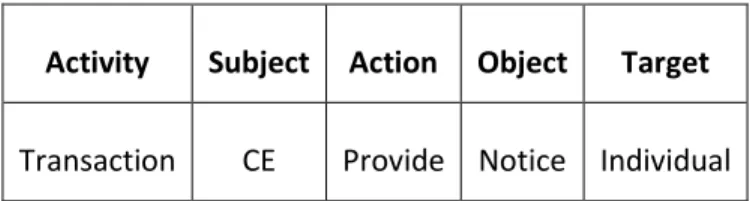
(i.e., what people are required to do) and constraints. They also give formal regulatory semantics. For example, the semantic elements of “The covered entity (CE) must provide
notice to the individual.” are shown in table 1. The same authors [14] proposed asystematic process for extracting rights, obligations and auxiliary concepts such as actors and constraints from legal text thereby generating a formal model of a law. Their method identifies and infers six types of data access constraints, handles cross-references, resolves ambiguities, etc., as part of extracting privacy and security requirements. This is a fundamental milestone to handle the complexity and syntactic ambiguity of legal texts.
Table 1: Example of semantics of an obligation in the regulation
Activity Subject Action Object Target Transaction CE Provide Notice Individual
Kerrigan and Law describe a system that models environmental regulations using first-
order predicate logic [36]. The system computes weighted relatedness scores between
sections of regulation text using ontology. Hohfeld taxonomy of regulation [33] provides
a classification of underlying legal concept (based on the notion of right, which can be
defined as “entitlement (not) to perform certain actions or be in certain states”) and which
are described in the legal documents, into eight categories. This legal taxonomy (i.e.,
privilege, claim, power, immunity, no-claim, duty, liability and disability) is a landmark
and has widely been used in various regulation sensitive domains such as law, systems
engineering, health care, financial institutions, etc. where understanding of the legal
documents and their underlying notion is extremely critical. These rights described in the
Hohfeld taxonomy also have a correlative relationship. For example, privilege and no-
claim are correlatives and it means that if someone has privilege on something, others
cannot claim for the same thing. Based on Hohfeld’s taxonomy, Siena et al [9] introducesa model to represent legal prescriptions, from regulatory documents, in terms of modeling
elements (such as: a right, duty, actor and action) and relationships (such as: holder and
counterparty with respect to the right) using ontology from the legal domain. After the
normative proposition (the most atomic element in which a legal prescription can be
subdivided) is modeled and they use the model in their Nomos modeling language.
Figure 2 shows a model of a normative proposition. Later in 2010, Siena in his PhD thesis [34] introduces the Nomos modeling language to express legal concepts. Nomos is an extension of i* which is a goal-oriented requirements engineering modeling language and Nomos is especially suitable for modeling legal elements [35].
Right Actor
PrivilegeNoclaim PowerLiability
ClaimDuty ImmunityDisability
-Holder 1
0..*
-Counterparty
1
0..*
Figure 2: a model of elements in a normative proposition
In the meantime, many logic based methods have been produced to represent and reason about regulations, such as deontic logic [37], defeasible logic [38] and first-order temporal logic [5] [15] [31].The benefits of logic representation of regulations which has ambiguity are computer readability, structured query facility, and searching and classification facilities.
2.4 Interpretation of regulations
Legal terms are ambiguous and abstract, and laws define general directions, therefore, interpretation of legal terms is needed especially in the regulatory compliant requirements elicitation phase. As interpretation strongly depends on an understanding of the law and its internal structure and relations, legal texts are often difficult to understand for the
“layman”. Under the situation where a term is not certain in its meaning, there are legal interpretation methods that can be used for an organization in interpreting legal texts.
These methods can be divided into these groups [28] [29]: lingual (based on grammatical,
morphological, and syntactical rules); logical (using formal logic rules); systematic (interpretation is made with respect to the whole legal order); historic (the meaning is clarified on the basis of circumstances under which the regulation was issued);
teleological (based on the purpose and a function of the rule). In 2009, due to the fact that others’ works are merely mapping legal concepts to software requirements without any interpretation, Ishikawa et al [15] gave a goal-oriented method to interpret regulations through previous cases and guidance. They then propose a meta-model for legal interpretations that are modeled as refinement relationships (such as and/or) between legal concepts. They manage the interpretation relationships by building them into goal trees so as to serve as criteria of further regulation refinement.
2.5 Eliciting regulatory requirements
Regulations constrain and put requirements on the system-to-be; therefore, it is important to elicit these compliant-requirements before a system starts to be implemented. Sutcliffe et al. [40] and Maiden [41] generate scenarios using use cases and object system models through a partially automated method. Meanwhile, Maiden defines object system models as patterns of requirements that include attributes for agents, actions, objects, and pre- conditions, among others and Maiden’s scenarios were generated to be used in requirements validation phase. Siena et al. [7] introduces a conceptual framework which considers both legal concepts proposed in theoretical studies in the legal domain and concepts from goal-oriented requirements engineering. In their framework description, a domain characterizes a set of activities, and with the involvement of law, the sub-set of legal activities is scoped. Also involving users’ goals, a sub-set of strategic activities is also scoped. The intersection of legal sub-set and strategic sub-set are legal-strategic activities and requirements to be elicited should be based on this intersection. Because requirements can be modeled as users’ goals at a high-level, they view the eliciting, requirements phase as transforming from a model of legal concepts to a model of users goals. Based on this conceptual framework, in [39], the same authors propose the Nomos framework that contains a detailed process of generating law-compliant requirements.
Given a model of law and a model of stakeholders’ goals, legal alternative requirements
are systematically identified and explored by analyzing the strategic goals that can realize
legal prescriptions. Giorgini et al. [46] propose Secure Tropos - a framework for security- related goal-oriented requirements modeling that, in order to ensure access control, uses strategic dependencies refined with concepts such as trust, delegation and permission, to fulfill a goal, execute a task or access a resource, as well as ownership of goals or other intentional elements. Ghanavati et al. [17] use Goal-oriented Requirements Language (GRL) to model goals and actions prescribed by laws. The models of goals and actions can be further refined to requirements. Darimont and Lemoine have used KAOS as a modeling language for representing goals extracted from regulation texts [12]. Such an approach results from the similarity between regulation documents and requirements documents. In 2010, Islam et al. describe in [8] a framework to assist in the elicitation and management of security and privacy requirements from relevant legislation.
Conceptually, this framework resembles that in Nomos[39] except that it focuses on the analysis of security and privacy requirements for risks to intrusion and refinement of requirements.
2.6 Checking requirements for compliance
Once system or software requirements are elicited from regulations or the existing requirements from legacy systems, it is necessary to validate them against the regulations.
In [27], Anton and Breaux propose semantic parameterization which expresses legal texts
as semantic models of rights and obligations with the purpose of comparing semantics to
check for compliance. In [17], a checking approach is provided by Ghanavanti et al. to
deal specifically with privacy law. They use the Goal-oriented Requirements Language
(GRL) to model goals (high-level requirements) established by laws and use a framework
to model the processes of a hospital. Then they combine both models to check the
compliance. Maxwell et al. [51] use the production rule model describing the legal
domain knowledge that can provide the functionality for requirements engineering to
query so as to identify potential areas of noncompliance in the requirements, and specify
new compliance requirements to address the compliance gaps. Breaux et al. [52] propose
the Frame-Based Requirements Analysis Method (FBRAM) to check the Cisco
accessibility requirements for compliance with the U.S. accessibility law. They compare
the compliance requirements with the existing requirements of Cisco’s by analyzing the gap and aligning both of them additionally.
Rather than systematic analysis of legal knowledge and requirements for noncompliance, another branch is to conduct an argumentation among stakeholders as long as the consensus is finally reached. Habli et al. [48] have shown how argumentation is used to assure the decomposition and traceability of requirements. Haley et al. [49] have shown how argumentation can be successfully employed to clarify how a system can satisfy its security requirements. Moreover, Ghetiu et al. [50] introduce the concept Argument- Driven Validation (ADV), structured arguments used as validity building elements.
Based on these works, Ingolfo et al. [35] give an argument framework that integrate models of the requirements (expressed in i*) and the regulations (expressed in Nomos) for capturing arguments and establishing their acceptability of the elicited requirements.
2.7 Checking Business processes for compliance
Business organizations have a number of Business Processes (BP) that fulfill business tasks. The managerial layers of the organizations need to ensure that all business processes are compliant with regulations. This issue is emphasized when the organizations are super huge or distributed. There are two kinds of BP compliance checking approaches introduced in [55]: (1) Forward compliance checking which targets the verification of business rules during design time or execution time. (2) Backward compliance checking which aims to detect that noncompliant behavior has taken place by looking at the history of BP instances’ execution, but this is unable to prevent actual noncompliant behavior.
Ghose et al. [56] propose an approach based on the patterns of compliance (i.e., pre-
defined BP models for which compliance to regulations have been proven). The main
idea is to compute the deviation of a given BP model to a certain compliance pattern. El
Kharbili et al. [53] propose a BP checking framework. The checking framework rests on
a semantic level for the compliance management. Regulations formalized as semantic
policies are modeled into BPs as sets of semantic business rules. BPs are also modeled
using languages adapted to BP execution. Then compliance checking engine consisting of
generic compliance checking algorithms is implemented by building on an inference engine. In [54] Liu et al. propose a method of model checking of business process models and legal models for compliance. They use Business Process Execution Language (BPEL) to model BPs as finite state machines and Business Property Specification Language (BPSL) to capture compliance rules as temporal linear logic. The benefit of their method is to enable the automated compliance verification of BPs. In [57], regulation definitions are integrated into BPs and rely on BP events and transactions for run-time compliance monitoring.
2.8 Runtime compliance monitoring
Regulatory compliance generally has two types: intentional compliance and actual
compliance [39]. Intentional compliance means assigning the responsibilities to actorsand the compliance is achieved if the actors fulfill their goals. Usually, intentional compliance is achieved through requirements-based methods, however it is important to stress that requirements are limited to the scope of software systems because the regulations also govern the broader scope of business operations (processes) [5]. Actual compliance means the running systems should be ensured compliant and laws prescribe actions on certain events that can only be detected at run time [23]. In [5], Breaux proposes a method to acquire finite state machines (FSMs) from stakeholder rights and obligations for compliance monitoring. In his method, the semantic models of regulations will be taken as the input sequentially into the consistency checking and FSM generation phases, and FSMs will be generated as the output. Run-time systems are then instrumented with FSMs to report events and detect violations.
Some other methods also have been proposed to have the capacity to specify and deploy
regulatory requirements monitors in real-time systems. Spanoudakis et al [42] identify the
differences between expected and runtime system behaviors by modeling the
relationships between events. Robinson [43] introduces a runtime requirements
monitoring framework which can be used to align regulatory compliance requirements
monitoring with design methodologies. In [44], the author proposes a method to query
runtime assumptions though a generalized interface. Peters and Parnas [45] address the
issues about real-time notification under discrete-time sampling and sample quantization which can be used in compliance requirements runtime monitors.
2.9 Analysis of the research gap
To the best our knowledge from the literature review, no one is investigating regulatory compliance in terms of “outcome” of a process with respect to outcome-focused regulations (regulation outcomes are ones that are what is actually checked against by CQC inspectors).
In Nomos-like approaches, it models the regulations and compliance solutions in terms of goals and system (or software) requirements. The key difference of our work from the Nomos framework [14] is that we check the “outcomes” of a business process against regulations, not system goals or requirements (as in Nomos). Methods such as frame- based requirements analysis method (FBRAM) [52] and the production rule model [51]
help to check if the requirements are compliant. However, while the compliance of requirements is established, these methods still do not ensure that either business processes comply with the regulations or process outcomes are sufficient to satisfy the required outcomes. Also, for an existing system such as a legacy system, requirements might be absent; therefore checking requirements for compliance is a non-starter.
Runtime system monitoring methods such as [42] monitor runtime systems against compliant requirements to ensure that these requirements are correctly implemented and performed. However, as requirements are limited to the scope of software (and systems), a broader range of business processes (including manual processes) are not covered by these methods.
In addition, traditional regulations focus on procedures or processes rather than outcomes.
Business process checking methods such as [53] [54] generally focus on business rules
derived from traditional regulations which means a regulation describes constraints or
changes of a business process. However these methods are not suitable to address the
issue of outcome-focused regulation compliance as the outcome-focused regulation
focuses on outcomes rather than the processes or procedures that result in the outcomes.
Therefore, the process outcomes are not necessarily ensured compliant with the outcome- focused regulations.
Our work complements their works by proposing an approach to ensuring compliance of
outcome-focused regulations. Business process outcomes will be analyzed and assessed
to see if they are sufficient to satisfy the required outcomes from the outcome-focused
regulations.
Chapter 3
3 Analysis and decision making
This chapter introduces the process of data collection, analysis and decision making that we have done so as to design a method that could be applied for regular self-inspection, compliance confirmation and noncompliance correction. We conducted it by analyzing the CQC regulations and actual business processes of a care home in Britain. Section 3.1 is to give an overview of the environment we analyzed including the company introduction, regulation introduction and the problem overview. Section 3.2 describes the procedures of data collection, analysis and decision making. The process includes regulation analysis, regulation interpretation, analyzing the business processes for actual outcomes, checking for noncompliance and correcting noncompliance.
3.1 Context overview
As mentioned in Chapter 1, our goal is to design a method that can be used to detect and improve noncompliance based on outcome-focused regulations. Based on this goal, we decided to look at concrete outcome-focused regulations (the CQC guidance) and the business processes in a care home to support the method design. We focus on two things here: regulation outcomes and business process outcomes which we examined for identifying and correcting noncompliance
3.1.1 Overview of the Care Quality Commission (CQC) Regulations
The Care Quality Commission (CQC) of the U.K. issues a guidance to help make sure
that the care people (service users) receive meet essential standards of quality and safety
and to encourage ongoing improvements by those who provide care [1]. CQC’s guidance
focuses on outcomes rather than systems and procedures and it contains outcomes which
are what users will experience or achieve. For example, in CQC’s Outcome 5, it states
that “people who use the service can express their views, so far as they are able to do
so…” rather than specifying the procedures that service providers should do to achieve
the outcome - service users “can express their views”. This is because CQC places the
views and experience of users at its center [1] as they say “results are the most important”
and that what matters most to users are their experience of care, the quality of care and support they receive rather than on how to achieve it.
CQC will frequently send assessors and inspectors to review the service of providers before any service provider can legally operate or during their operation and will use enforcement power if necessary. In the meantime, they will focus on outcomes when they check the business operations.
CQC guidance is to help service providers meet the requirements of the Health and Social Care Act 2008 and CQC regulations. Even if the guidance itself is not enforceable in its own right, however, as CQC will send their inspectors to evaluate the outcomes before service providers can start their operations (register their service) and will continuously send them to check if the operations of service providers are compliant or not in the running time, it in effect results in that this CQC guidance can have legal validity as service provider face a binary selection (being compliant or being shut down). At the same time, this guidance will also be used by courts and tribunals when stakeholders appear in the court from time to time [1].
3.1.2 Overview of the company
The company of which the business processes we plan to investigate is a care home in the
U.K. This care home has three branches: The first branch has 40 beds registered for four
types of patients (i.e., Dementia (DE), Physical Disability (PD), Mental Disability (MD)
and Old age (OP)); the second branch has 29 beds (i.e., DE, PD, MD and OP) and the
third branch has 28 registered beds (i.e., DE, PD, MD and OP). The main responsibilities
are giving sufficient care to service users and supporting them so as to have a better
recovery process. Stakeholders in this care home include the board members,
management team members, staff and service users. The ordinary processes that the care
home has are, for example: admission process of new service users, processes of giving
care and treatments, processes of medicine management, processes of medicine purchase,
processes of handing users’ complaints, etc.
3.1.3 The problems and needs of the company
The care home that we have investigated has been registered under CQC. Every registered organization has to fulfill what the governing institution requires. As the CQC guidance comes out, the care home needs to confirm that the outcomes specified in CQC guidance have to been achieved, otherwise, it can suffer from the danger of being forced to stop its business (as interviewed by us, they declared it as “suspension of the business operations which will take up to one year plus the penalty”). Some example problems in this care home are given below:
A problem scenario: Outcome 4 of CQC guidance says “People who use services experience effective, safe and appropriate care, treatment and support that meets their needs and protects their rights.” The managers of this care home are not sure if their business processes are compliant or not. For example, how do they decide if their business processes “protect users’ rights”? How do they decide if their business processes will let people experience “effective, safe and appropriate care”? How much do they need to do to ensure these non-functional requirements such as “effective”?
The care home management team does not have a relatively easy and efficient method to proactively identify where the business processes go wrong with reference to the outcomes required in the CQC guidance and they need to act upon the deviation promptly (as CQC sees it as a very positive step learnt from the interview). The inspectors from CQC will come to the care home to check their business processes every now and then (“unannounced and depending on what they find they will come back with a minimum once a year to 4 or more times a year”). The care home needs to gather the evidence of meeting the outcomes and be confident in demonstrating that they meet the regulations.
Meanwhile, also learned from the interview with them, they stated that the cost of hiring special experts (such as requirements experts and software experts for doing technical system and business modeling, etc) and time is not a luxury they have. They need to have
“practical” solutions that their staff, once trained for some degree, can perform.
3.2 Description of analysis and decision making
In this process, we analyzed the CQC guidance and the business processes of this care home so as to build a systematic approach for the care home to check and correct the noncompliance.
We started with a question and a sample outcome from the CQC guidance.
The question is: what are the targeted variables that exist in the CQC guidance?
(variables such as actors, activities, objects, conditions, constraints, etc.)
For the legal texts from the CQC guidance, we picked up a fragment that shows an outcome of the CQC guidance:
Outcome 9: What should the service users experience?
People who use services:
(1) Will have their medicines at the times they need them, and safely
(2) …
Figure 3. Partial description of CQC guidance Outcome 9
Item (1) in figure 3 above is a required outcome description. It is about what service users will experience when having their medicines. We analyzed the semantics of the sentence and identified the target variables that we are tracking for checking the compliance. The identified variables are shown in table 2.
Table 2: Example of semantics of an obligation in the regulation
Subject Activity Object Constraint/conditions Service users Have (medicine) medicines • At the time they need them;
• Safely.
We found that these variables are usually ambiguous or abstract and cannot match easily to concrete business processes for checking compliance. For example, what does “safely”
mean? How do we evaluate “service users take medicine safely”?
Therefore we need to explain the outcome, and we later found almost every outcome specified in the CQC guidance is abstract and ambiguous. We interviewed the stakeholders from the care home and we got this answer: because the CQC guidance aims for regulating different kinds of health care organizations such as hospitals, hospices, care homes, etc., the legal texts cannot be very detailed and local. The legal texts should be trying to cover all the situations with limited sentences of descriptions.
We made the decision: if the outcome is ambiguous, then we interpret them. This interpreting process is transforming the required outcomes (high-level) to concrete and domain specific (low-level) outcomes. Hence, the domain knowledge is needed by involving domain experts.
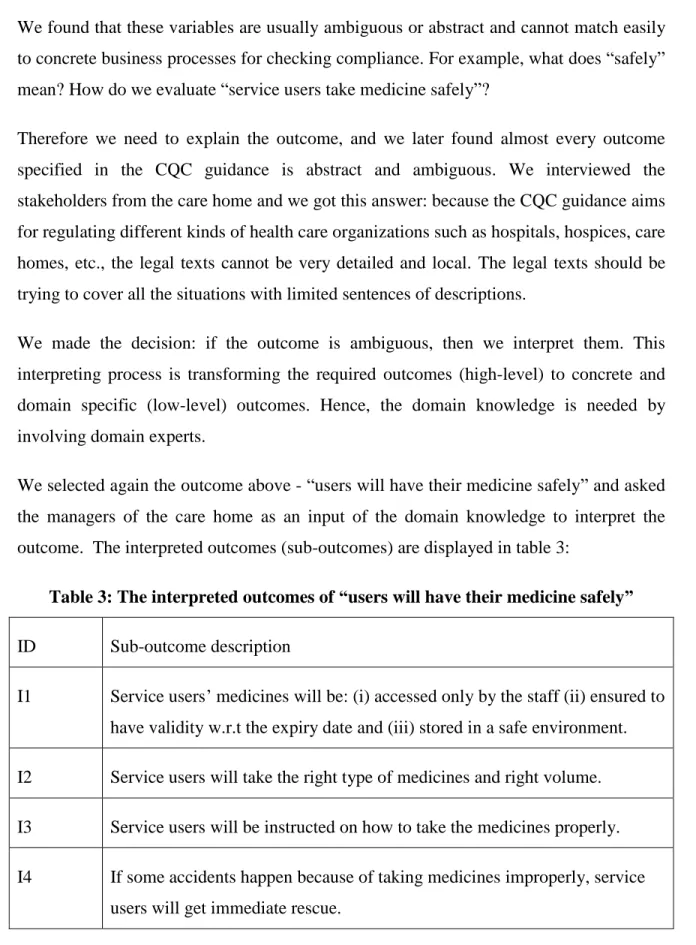
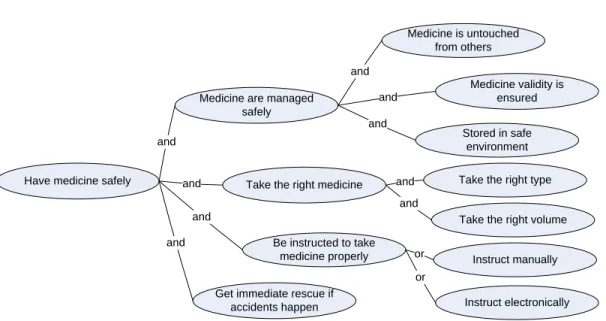
We selected again the outcome above - “users will have their medicine safely” and asked the managers of the care home as an input of the domain knowledge to interpret the outcome. The interpreted outcomes (sub-outcomes) are displayed in table 3:
Table 3: The interpreted outcomes of “users will have their medicine safely”
ID Sub-outcome description
I1 Service users’ medicines will be: (i) accessed only by the staff (ii) ensured to have validity w.r.t the expiry date and (iii) stored in a safe environment.
I2 Service users will take the right type of medicines and right volume.
I3 Service users will be instructed on how to take the medicines properly.
I4 If some accidents happen because of taking medicines improperly, service
users will get immediate rescue.
The relationship among the four sub-outcomes is “and” which means the sub-outcomes collectively represent the original outcome.
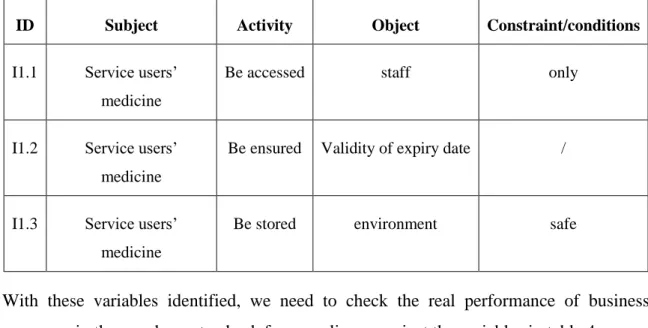
We did analyze all the sub-outcomes during our research procedure. Here, in order to avoid repeatability, we just picked sub-outcome I1 for explanation in this thesis. We again analyzed the semantic variables of it and the result is shown in table 4:
Table 4: Semantic variables of the sub-outcome I1
ID Subject Activity Object Constraint/conditions
I1.1 Service users’
medicine
Be accessed staff only
I1.2 Service users’
medicine
Be ensured Validity of expiry date /
I1.3 Service users’
medicine
Be stored environment safe
With these variables identified, we need to check the real performance of business processes in the care home to check for compliance against the variables in table 4.
For sub-outcome I1 (in table 3), there are three partial sub-outcomes (in table 4): I1.1
“service users’ medicine is accessed by staff”; I1.2 “service users’ medicine is ensured to have validity w.r.t the expiry date”; and I1.3 “service users’ medicine is saved in a clean environment”. We need to identify where these partial sub-outcomes I1.1, I1.2 and I1.3 exist. We then identified the business processes of “S1: medicine management” where the “accessing (medicines)” and “stored in a safe environment” exist and business processes of “S2: medicines purchase” where “ensured validity w.r.t the expiry date”
exists and we identify and describe related business processes as below:
S1: Medicine management.
P1: The staff adds every medicine with its owner’s (user) tag and save them in the
clean fridge which never has power outage.
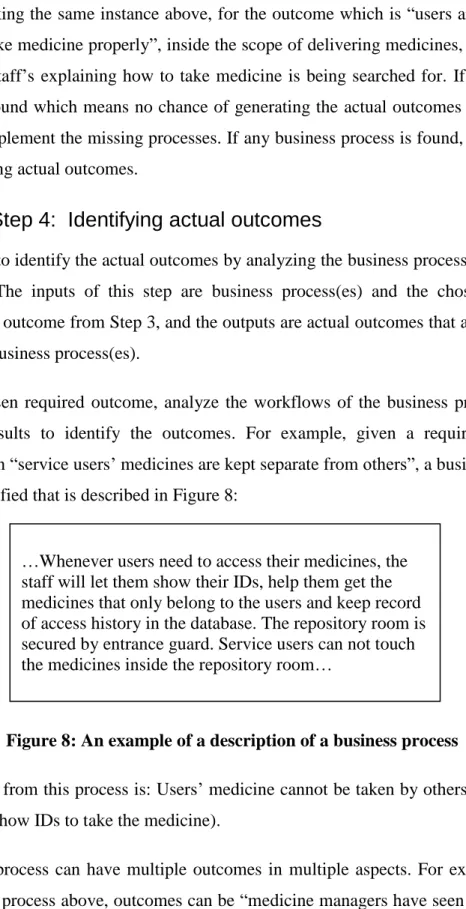
P2: Whenever users need to access their medicines, the staff will let them show their IDs, help them get the medicines that only belong to the users and keep record of access history in the database. The repository room is secured and users can not touch the medicines inside the repository room.
S4: Medicine purchase.
P3: Before the agent decides to purchase any medicine, s/he will negotiate with the user on the issues of users’ needs, price, producers, brands, etc.
P4: The agent who purchases the medicine carefully checks every medicine they purchase to ensure the validity of expiry date, authenticity of medicine, etc.
P5: The agent keeps record of every medicine in the database after the purchase.
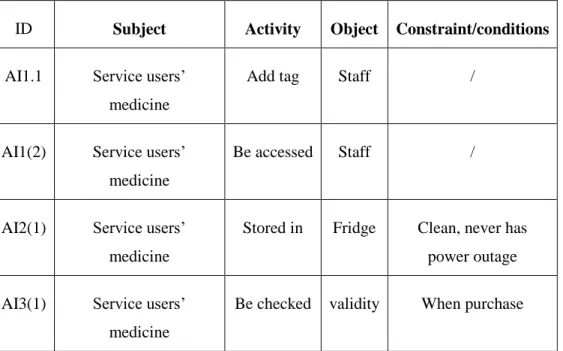
From the business processes above, we identified the actual target variables which can match target variables (in table 4) as below in table 5:
Table 5: Actual target variables from the medicine management processes
ID Subject Activity Object Constraint/conditions
AI1.1 Service users’
medicine
Add tag Staff /
AI1(2) Service users’
medicine
Be accessed Staff /
AI2(1) Service users’
medicine
Stored in Fridge Clean, never has power outage
AI3(1) Service users’
medicine
Be checked validity When purchase
Some constraints/conditions in table 5 that are not easily identified (need analysis of
business processes) are left empty (we identified them later in Analysis of business
processes). We now need to assess if the actual target variables in table 5 can match and
satisfy variables of legal texts in table 4.
Analysis of business processes: As the medicines of users are stored in the repository

![Figure 2 shows a model of a normative proposition. Later in 2010, Siena in his PhD thesis [34] introduces the Nomos modeling language to express legal concepts](https://thumb-us.123doks.com/thumbv2/123dok_us/7753869.1271520/22.918.268.657.280.549/figure-normative-proposition-introduces-modeling-language-express-concepts.webp)