Domain-Specific Paraphrase Extraction
Ellie Pavlick1 Juri Ganitkevitch2 Tsz Ping Chan3 Xuchen Yao4 Benjamin Van Durme2,5 Chris Callison-Burch1
1Computer and Information Science Department, University of Pennsylvania 2Center for Language and Speech Processing, Johns Hopkins University
3Bloomberg L.P., New York, NY 4kitt.ai∗, Seattle, WA
5Human Language Technology Center of Excellence, Johns Hopkins University
Abstract
The validity of applying paraphrase rules depends on the domain of the text that they are being applied to. We develop a novel method for extracting domain-specific paraphrases. We adapt the bilin-gual pivoting paraphrase method to bias the training data to be more like our tar-get domain of biology. Our best model results in higher precision while retaining complete recall, giving a 10% relative im-provement in AUC.
1 Introduction
Many data-driven paraphrase extraction algo-rithms have been developed in recent years (Madnani and Dorr, 2010; Androutsopoulos and Malakasiotis, 2010). These algorithms attempt to learn paraphrase rules, where one phrase can be replaced with another phrase which has equiv-alent meaning in at least some context. Deter-mining whether a paraphrase is appropriate for a specific context is a difficult problem (Bhagat and Hovy, 2013), encompassing issues of syntax (Callison-Burch, 2008), word sense (Apidianaki et al., 2014), and style (Xu et al., 2012; Pavlick and Nenkova, 2015). To date, the question of how do-main effects paraphrase has been left unexplored.
Although most paraphrase extraction algo-rithms attempt to estimate a confidence with which a paraphrase rule might apply, these scores are not differentiated by domain, and instead corre-spond to the general domain represented by the model’s training data. As illustrated by Table 1, paraphrases that are highly probable in the gen-eral domain (e.g. hot = sexy) can be extremely improbable in more specialized domains like biol-ogy. Dominant word senses change depending on
∗Incubated by the Allen Institute for Artificial
Intelli-gence.
General Biology
hot warm, sexy, exciting heated, warm, thermal treat address, handle, buy cure, fight, kill head leader, boss, mind skull, brain, cranium Table 1: Examples of domain-sensitive paraphrases. Most paraphrase extraction techniques learn paraphrases for a mix of senses that work well in general. But in specific domains, paraphrasing should be sensitive to specialized language use.
domain: the verbtreatis used in expressions like
treat you to dinnerin conversational domains ver-sustreat an infectionin biology. This domain shift changes the acceptability of its paraphrases.
We address the problem of customizing para-phrase models to specific target domains. We ex-plore the following ideas:
1. We sort sentences in the training corpus based on how well they represent the target domain, and then extract paraphrases from a subsample of the most domain-like data.
2. We improve our domain-specific paraphrases by weighting each training example based on its domain score, instead of treating each ex-ample equally.
3. We dramatically improve recall while main-taining precision by combining the subsam-pled in-domain paraphrase scores with the general-domain paraphrase scores.
2 Background
The paraphrase extraction algorithm that we cus-tomize is the bilingual pivoting method (Bannard and Callison-Burch, 2005) that was used to create PPDB, the paraphrase database (Ganitkevitch et al., 2013). To perform the subsampling, we adapt and improve the method that Moore and Lewis (2010) originally developed for domain-specific language models in machine translation.
2.1 Paraphrase extraction
Paraphrases can be extracted via bilingual pivot-ing. Intuitively, if two English phrasese1 ande2 translate to the same foreign phrasef, we can as-sume that e1 and e2 have similar meaning, and thus we can “pivot” overfand extracthe1, e2ias a paraphrase pair. Since many possible paraphrases are extracted in this way, and since they vary in quality (in PPDB, the verbtreathas 1,160 poten-tial paraphrases, including address, handle, deal with,care for,cure him,’m paying, and’s on the house), it is necessary to assign some measure of confidence to each paraphrase rule. Bannard and Callison-Burch (2005) defined a conditional para-phrase probabilityp(e2|e1)by marginalizing over all shared foreign-language translationsf:
p(e2|e1)≈
X
f
p(e2|f)p(f|e1) (1)
where p(e2|f) and p(f|e1) are translation model probabilities estimated from the bilingual data.
Equation 1 approximates the probability with whiche1can paraphrase ase2, but its estimate in-evitably reflects the domain and style of the bilin-gual training text. If e1 is a polysemous word, the highest probabilities will be assigned to para-phrases of the most frequently occurring sense of
e1, and lower probabilities to less frequent senses. This results in inaccurate probability estimates when moving to a domain with different sense dis-tributions compared to the training corpus. 2.2 Sorting by domain specificity
The crux of our method is to train a paraphrase model on data from the same domain as the one in which the paraphrases will be used. In practice, it is unrealistic that we will be able to find bilingual parallel corpora precompiled for each domain of interest. We instead subsample from a large bitext, biasing the sample towards the target domain.
We adapt and extend a method developed by Moore and Lewis (2010) (henceforth M-L), which builds a domain-specific sub-corpus from a large, general-domain corpus. The M-L method assigns a score to each sentence in the large corpus based on two language models, one trained on a sam-ple of target domain text and one trained on the general domain. We want to identify sentences which are similar to our target domain and dissim-ilar from the general domain. M-L captures this notion using the difference in the cross-entropies
according to each language model (LM). That is, for a sentencesi, we compute
σi =Htgt(si)−Hgen(si) (2)
where Htgt is the cross-entropy under the
in-domain language model and Hgen is the cross-entropy under the general domain LM. Cross-entropy is monotonically equivalent to LM per-plexity, in which lower scores imply a better fit. Lowerσisignifies greater domain-specificity.
3 Domain-Specific Paraphrases
To apply the M-L method to paraphrasing, we need a sample of in-domain monolingual text. This data is not directly used to extract para-phrases, but instead to train an n-gram LM for the target domain. We computeσifor the English side of every sentence pair in our bilingual data, using the target domain LM and the general domain LM. We sort the entire bilingual training corpus so that the closer a sentence pair is to the top of the list, the more specific it is to our target domain.
We can apply Bannard and Callison-Burch (2005)’s bilingual pivoting paraphrase extraction algorithm to this sorted bitext in several ways:
1. By choosing a threshold value forσiand
dis-carding all sentence pairs that fall outside of that threshold, we can extract paraphrases from a subsampled bitext that approximates the target domain.
2. Instead of simply extracting from a subsam-pled corpus (where each training example is equally weighted), we can weight each train-ing example proportional toσiwhen comput-ing the paraphrase scores.
3. We can combine multiple paraphrase scores: one derived from the original corpus and one from the subsample. This has the advantage of producing the full set of paraphrases that can be extracted from the entire bitext. 4 Experimental Conditions
Domain data We evaluate our domain-specific paraphrasing model in the target domain of biol-ogy. Our monolingual in-domain data is a com-bination of text from the GENIA database (Kim et al., 2003) and text from an introductory biology textbook. Our bilingual general-domain data is the
2009), a collection of French-English parallel data covering a mix of genres from legal text (Stein-berger et al., 2006) to movie subtitles (Tiedemann, 2012). We use 5-gram language models with Kneser-Ney discounting (Heafield et al., 2013). Evaluation We measure the precision and recall of paraphrase pairs produced by each of our mod-els by collecting human judgments of what para-phrases are acceptable in sentences drawn from the target domain and in sentences drawn from the general domain. We sample 15K sentences from our biology data, and 10K general-domain sen-tences from Wikipedia. We select a phrase from each sentence, and show the list of candidate para-phrases1to 5 human judges. Judges make a binary decision about whether each paraphrase is appro-priate given the domain-specific context. We con-sider a paraphrase rule to be good in the domain if it is judged to be good in least one context by the majority of judges. See Supplementary Materials for a detailed description of our methodology. Baseline We run normal paraphrase extraction over the entire 109 word parallel corpus (which has 828M words on the English side) without any attempt to bias it toward the target domain. We refer this system asGeneral.
Subsampling After sorting the109 word paral-lel corpus by Equation 2, we chose several thresh-old values for subsampling, keeping only top-rankedτ words of the bitext. We train models on for several values ofτ(1.5M, 7M, 35M, and 166M words). We refer to these model asM-L,T=τ. M-L Change Point We test a model whereτ is set at the point where σi switches from negative
[image:3.595.308.523.63.248.2]to positive. This includes all sentences which look more like the target domain than the general. This threshold is equivalent to sampling 20M words. Weighted Counts Instead of weighting each subsampled sentence equally, we test a novel ex-tension of M-L in which we weight each sentence proportional toσiwhen computingp(e2|e1). Combined Models We combine the subsam-pled models with the general model, using binary logistic regression to combine the p(e2|e1) esti-mate of the general model and that of the domain-specific model. We use 1,000 labeled pairs from 1The candidates paraphrases constitute the full set of para-phrases that can be extracted from our training corpus.
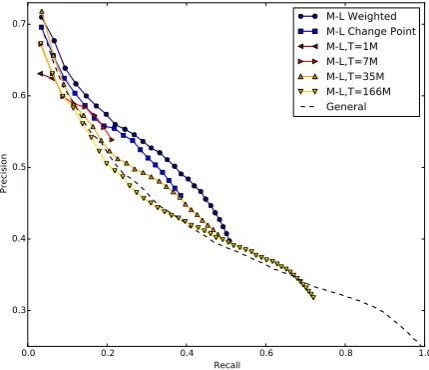
Figure 1: Precision-recall curves for paraphrase pairs ex-tracted by models trained on data from each of the described subsampling methods. These curves are generated using the 15k manually annotated sentences in the biology domain.
the target domain to set the regression weights. This tuning set is disjoint from the test set.
5 Experimental Results
What is the effect of subsampling? Figure 1 compares the precision and recall of the differ-ent subsampling methods against the baseline of training on everything, when they are evaluated on manually labeled test paraphrases from the bi-ology domain. All of subsampled models have a higher precision than the baselineGeneralmodel, except for the largest of the subsampled models (which was trained on sentence pairs with 166M words - many of which are more like the general domain than the biology domain).
The subsampled models have reduced recall since many of the paraphrases that occur in the full
109word bilingual training corpus do not occur in the subsamples. As we increaseτ we improve re-call at the expense of precision, since we are in-cluding training data that is less and less like our target domain. The highest precision model based on the vanilla M-L method isM-L Change Point, which sets the subsample size to include exactly those sentence pairs that look more like the target domain than the general domain.
Our novel extension of the M-L model (M-L Weighted) provides further improvements. Here, we weight each sentence pair in the bilingual train-ing corpus proportional to σi when computing
(a) Biology domain (b) General domain
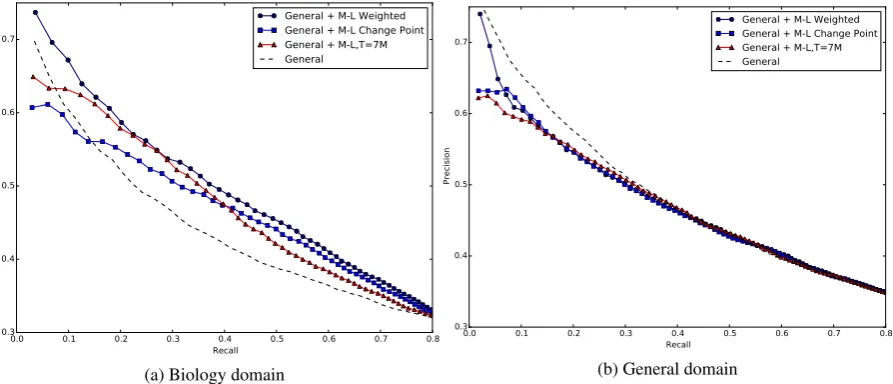
Figure 2: Performance of models build by combining small domain-specific models trained on subsampled data with general domain models trained on all the data. Performance in the general domain are shown as a control.
rather than each occurrence counting as 1, each occurrence counts as the ratio of the sentence’s cross-entropies: Hgen
Htgt. The top-ranked sentence
pairs receive an exaggerated count of 52, while the bottom ones receive a tiny factional count of 0.0068. Thus, paraphrases extracted from sen-tence pairs that are unlike the biology domain re-ceive very low scores. This allows us to achieve higher recall by incorporating more training data, while also improving the precision.
What is the benefit of combining models? We have demonstrated that extracting paraphrases from subsampled data results in higher precision domain-specific paraphrases. But these models extract only a fraction of the paraphrases that are extracted by a general model trained on the full bitext, resulting in a lower recall.
We dramatically improve the recall of our domain-specific models by combining the small subsampled models with the large general-domain model. We use binary logistic regression to com-bine the p(e2|e1) estimate of the general model with that of each domain-specific model. Figure 2(a) shows that we are able to extend the recall of our domain-specific models to match the recall of the full general-domain model. The precision scores remain higher for the domain-specific mod-els. Our novelM-L Weightedmodel performs the best. Table 3 gives the area under the curve (AUC). The best combination improves AUC by more than 4 points absolute (>10 points relative) in the biology domain. Table 2 provides examples of paraphrases extracted using our domain-specific
general / bio-spec. general / bio-spec. air aerial / atmosphere fruit result / fruiting balance pay / equilibrate heated lively / hot
breaks pauses / ruptures motion proposal / movement Table 2: Top paraphrase under the general and the best domain-specific model, General+M-L Weighted.
AUC ∆absolute ∆relative
General 39.5 – –
Gen.+M-L,T=1 40.8 +1.3 +3.3
Gen.+M-L,T=145 40.8 +1.3 +3.3 Gen.+M-L,T=29 41.2 +1.7 +4.3
Gen.+M-L CP 41.9 +2.4 +6.1
Gen.+M-L,T=6 42.3 +2.8 +7.1
Gen.+M-L Weighted 43.7 +4.2 +10.6 Table 3: AUC (×100) for each model in the biology domain from Figure 2(a).
model for biology versus the baseline model. 6 Related Work
[image:4.595.312.546.388.497.2]fractional counting, (Madnani et al., 2007) used introduced a count-centric approach to paraphrase probability estimation. Matsoukas et al. (2009) and Foster et al. (2010) explored weighted training sentences for MT, but set weights discriminatively based on sentence-level features.
7 Conclusion
We have discussed the new problem of extracting domain-specific paraphrases. We adapt a method from machine translation to the task of learn-ing domain-biased paraphrases from billearn-ingual cor-pora. We introduce two novel extensions to this method. Our best domain-specific model dramat-ically improves paraphrase quality for the target domain.
Acknowledgements This research was sup-ported by the Allen Institute for Artificial Intel-ligence (AI2), the Human Language Technology Center of Excellence (HLTCOE), and by gifts from the Alfred P. Sloan Foundation, Google, and Facebook. This material is based in part on re-search sponsored by the NSF under grant IIS-1249516 and DARPA under agreement number FA8750-13-2-0017 (the DEFT program). The U.S. Government is authorized to reproduce and distribute reprints for Governmental purposes. The views and conclusions contained in this pub-lication are those of the authors and should not be interpreted as representing official policies or en-dorsements of DARPA or the U.S. Government.
We would like to thank Luke Orland for his con-tributions to this research, and to thank the anony-mous reviewers for their thoughtful comments.
References
Ion Androutsopoulos and Prodromos Malakasiotis. 2010. A survey of paraphrasing and textual entail-ment methods. JAIR, pages 135–187.
Marianna Apidianaki, Emilia Verzeni, and Diana Mc-Carthy. 2014. Semantic clustering of pivot para-phrases. InLREC.
Amittai Axelrod, Xiaodong He, and Jianfeng Gao. 2011. Domain adaptation via pseudo in-domain data selection. InEMNLP, pages 355–362.
Colin Bannard and Chris Callison-Burch. 2005. Para-phrasing with bilingual parallel corpora. In ACL, pages 597–604.
Rahul Bhagat and Eduard Hovy. 2013. What is a para-phrase? Computational Linguistics, 39(3):463–472.
Chris Callison-Burch, Philipp Koehn, Christof Monz, and Josh Schroeder. 2009. Findings of the 2009 Workshop on Statistical Machine Translation. In
Proceedings of the Fourth Workshop on Statistical Machine Translation.
Chris Callison-Burch. 2008. Syntactic constraints on paraphrases extracted from parallel corpora. In
EMNLP, pages 196–205. Association for Computa-tional Linguistics.
George Foster and Roland Kuhn. 2007. Mixture-model adaptation for smt.
George Foster, Cyril Goutte, and Roland Kuhn. 2010. Discriminative instance weighting for domain adap-tation in statistical machine translation. InEMNLP, pages 451–459.
Juri Ganitkevitch, Benjamin Van Durme, and Chris Callison-Burch. 2013. PPDB: The paraphrase database. InNAACL-HLT, pages 758–764, Atlanta, Georgia, June.
Jianfeng Gao, Joshua Goodman, Mingjing Li, and Kai-Fu Lee. 2002. Toward a unified approach to sta-tistical language modeling for chinese. ACM Trans-actions on Asian Language Information Processing (TALIP), 1(1):3–33.
Kenneth Heafield, Ivan Pouzyrevsky, Jonathan H Clark, and Philipp Koehn. 2013. Scalable modified kneser-ney language model estimation. InACL. J-D Kim, Tomoko Ohta, Yuka Tateisi, and Junichi
Tsu-jii. 2003. Genia corpusa semantically annotated corpus for bio-textmining. Bioinformatics, 19(suppl 1):i180–i182.
Nitin Madnani and Bonnie J. Dorr. 2010. Generating phrasal and sentential paraphrases: A survey of data-driven methods.Computational Linguistics, 36. Nitin Madnani, Necip Fazil Ayan, Philip Resnik, and
Bonnie Dorr. 2007. Using paraphrases for parame-ter tuning in statistical machine translation. In Pro-ceedings of the Workshop on Machine Translation. Spyros Matsoukas, Antti-Veikko I Rosti, and Bing
Zhang. 2009. Discriminative corpus weight esti-mation for machine translation. InEMNLP, pages 708–717.
Robert C Moore and William Lewis. 2010. Intelligent selection of language model training data. InACL, pages 220–224.
Ellie Pavlick and Ani Nenkova. 2015. Inducing lexical style properties for paraphrase and genre differenti-ation. InNAACL.
J¨org Tiedemann. 2012. Parallel data, tools and inter-faces in opus. InLREC, pages 2214–2218.
Wei Xu, Alan Ritter, Bill Dolan, Ralph Grishman, and Colin Cherry. 2012. Paraphrasing for style. In
COLING, pages 2899–2914.