4227
Open-Domain Why-Question Answering with Adversarial Learning to
Encode Answer Texts
Jong-Hoon Oh§ Kazuma Kadowaki§‡ Julien Kloetzer§ Ryu Iida§¶ Kentaro Torisawa§¶
Data-driven Intelligent System Research Center (DIRECT),
National Institute of Information and Communications Technology (NICT)§
Advanced Technology Laboratory, The Japan Research Institute, Limited (JRI)‡
Graduate School of Science and Technology, NAIST¶
{rovellia, kadowaki, julien, ryu.iida, torisawa}@nict.go.jp
Abstract
In this paper, we propose a method for why-question answering (why-QA) that uses an ad-versarial learning framework. Existing why-QA methods retrieve answer passages that usually consist of several sentences. These multi-sentence passages contain not only the reason sought by a why-question and its con-nection to the why-question, but also redun-dant and/or unrelated parts. We use our proposed Adversarial networks for Generat-ing compact-answer Representation(AGR) to generate from a passage a vector representa-tion of the non-redundant reason sought by a why-question and exploit the representa-tion for judging whether the passage actu-ally answers the why-question. Through a se-ries of experiments using Japanese why-QA datasets, we show that these representations improve the performance of our why-QA neu-ral model as well as that of a BERT-based why-QA model. We show that they also im-prove a state-of-the-art distantly supervised open-domain QA (DS-QA) method on pub-licly available English datasets, even though the target task is not a why-QA.
1 Introduction
Why-question answering (why-QA) tasks retrieve from a text archive answers to such why-questions as “Why does honey last such a long time?” Previ-ous why-QA methods retrieve from a text archive
answer passages, each of which consists of sev-eral sentences, like A in Table 1 (Girju, 2003;
Higashinaka and Isozaki, 2008; Oh et al., 2012,
2013,2016,2017;dos Santos et al., 2016;Sharp
et al.,2016;Tan et al.,2016;Verberne et al.,2011), and then determine whether the passages answer the question. A proper answer passage must con-tain (1) a paraphrase of the why-question (e.g., the underlined texts in Table 1) and (2) the reasons
or the causes(e.g., the bold texts in Table 1) of
Q Why does honey last a long time?
A While excavating Egypt’s pyramids, archaeologists have found pots of honey in an ancient tomb: thou-sands of years old and still preserved. Honey can last a long timedue to three special properties.
Its average pH is 3.9, which is quite acidic. Such high level of acidity is certainly hostile and hin-ders the growth of many microbes. Though honey contains around 17–18% water,its water activity is too low to support the growth of microbes. More-overhoney contains hydrogen peroxide, which is thought to helpprevent the growth of microbes in honey. Despite these properties, honey can be con-taminated under certain circumstances.
C Because its acidity, low water activity, and hydrogen peroxide together hinder the growth of microbes. Table 1: Answer passage A to why-question Q and its compact answer C
the events described in the why-question, both of which are often written in multiple non-adjacent sentences. This multi-sentenceness implies that the answer passages often contain redundant parts that are not directly related to a why-question or its reason/cause and whose presence complicates the why-QA task. Highly accurate why-QA methods should be able to find the exact reason sought by a why-question in an answer passage without being distracted by redundancy.
In this paper, we train a neural network (NN) to generate, from an answer passage, a vector rep-resentation of the non-redundant reason asked by a why-question, and exploit the generated vec-tor representation as evidence for judging whether the passage answers the why-question. This idea was inspired by Ishida et al. (2018), who used a seq2seq model to automatically generate such
generated compact-answers to support a why-QA method in finding the exact reason of a why-question in these passages, why-QA accuracy may be improved. We actually tried this idea in a preliminary study in which we generated a com-pact answer from a given question-passage pair by using the compact-answer generation method of
Iida et al.(2019) and used the generated
compact-answer along with the given question-passage pair to find proper answer passages. However, we were disappointed by the small performance improve-ment, as shown in our experimental results.
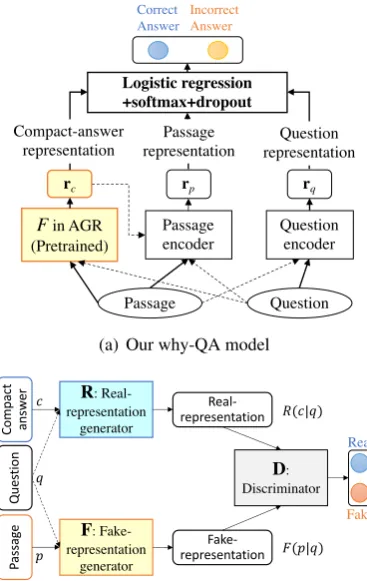
We chose an alternative approach. Instead of generating a compact answer of an answer pas-sage as word sequences, we devised a model to generate acompact-answer representation, which is a vector representation for a compact answer, from an answer passage. Inspired by the genera-tive adversarial network (GAN) approach (
Good-fellow et al., 2014), we developed an adversarial
network called theAdversarial networks for Gen-erating compact-answer Representation (AGR). Like the original GAN, an AGR is composed of a generator and a discriminator: the generator net-workis trained for generating (from answer pas-sages) fake representations to make it hard for thediscriminator networkto distinguish these fake representations from the true representations de-rived from manually created compact-answers.
We combined the generator network in the AGR with an extension of the state-of-the-art why-QA method (Oh et al.,2017). Our evaluation against a Japanese open-domain why-QA dataset, which was created using general web texts as a source of answer passages, revealed that the generator net-work significantly improved the accuracy of the top-ranked answer passages and that the combi-nation significantly outperformed several strong baselines, including a combination of a genera-tor network and a BERT model (Devlin et al.,
2019). This combination also outperformed a vanilla BERT model, suggesting that the genera-tor network in our AGR may be effective even if it is combined with many types of NN architectures. Another interesting point is that the performance improved even when we replaced, as the inputs to AGR, the word embedding vectors that represent an answer passage, with a random vector. This observation warrants further exploration in our fu-ture work.
Finally, we applied our AGR to a distantly
su-rq
Question encoder
Question
rp
Passage encoder
Passage
Logistic regression +softmax+dropout
Fin AGR (Pretrained)
rc
Correct Answer
Passage representation Compact-answer
representation representationQuestion
Incorrect Answer
(a) Our why-QA model
F: Fake-representation
generator
Qu
es
tio
n
Pa
ssa
ge
Co
m
pa
ct
an
sw
er R: Real-representation
generator
Real-representation
D: Discriminator
Fake-representation
Real
Fake
𝑞 𝑐
𝑝 𝐹(𝑝|𝑞)
𝑅(𝑐|𝑞)
[image:2.595.324.508.64.355.2](b) AGR and its three subnetworksF,R, andD
Figure 1: System architecture
pervised open-domain QA (DS-QA) task (Chen
et al.,2017), which is an extension of a
machine-reading task, to check whether it is applicable to other datasets. We combined our generator network with a state-of-the-art DS-QA method, OpenQA (Lin et al., 2018), and used a generated compact-answer representation from a given pas-sage as evidence to 1) select relevant paspas-sages from the retrieved ones and 2) find an answer from the selected passages. Although the task was not our initial target (why-QA) and the answers in the DS-QA task were considerably shorter than those in the why-QA, experiments using three pub-licly available datasets (Quasar-T (Dhingra et al.,
2017), SearchQA (Dunn et al., 2017), and Triv-iaQA (Joshi et al., 2017)) revealed that the gen-erator network improved the performance in most cases. This suggests that AGR may be applicable to many QA-like tasks.
2 Why-QA Model
using the representations of a question, an answer passage, and a compact answer. The probability (the why-QA model’s final output) is computed from these representations by our answer selec-tion module, which is a logistic regression layer with dropout and softmax output.
The representations of why-questions and an-swer passages are generated by Convolutional Neural Networks (CNNs) (Collobert et al.,2011;
LeCun et al., 1998) that (1) are augmented by
two types of attention mechanisms, similarity-attention (dos Santos et al., 2016; Tan et al.,
2016) and causality-attention (Oh et al., 2017), and (2) are given two types of word embed-dings, general word embeddings computed by
word2vec(Mikolov et al.,2013) using Wikipedia andcausal word embeddings(Sharp et al.,2016). Note that in computing a question’s representa-tion, the answer passage is given to the question encoder to guide the computation. Likewise the passage encoder is given the question and the rep-resentation of the compact answer. We repre-sent these information flows with dotted arrows in Fig.1(a).
The representations of compact answers are created by a generator network called a fake-representation generator (F in Fig.1(a)), which is pre-trained in an adversarial learning manner (Fig.1(b)). During the training of the whole why-QA model, the generator’s parameters are fixed and no further fine-tuning is conducted.
In the next section, we describe our main contri-bution: the AGR and the fake-representation gen-erator. The entire why-QA model can be seen as an extension of the state-of-the-art why-QA method (Oh et al.,2017). Its details are described in Section A of the supplementary materials.
3 Adversarial Networks for Generating Compact-answer Representation
3.1 Adversarial training
Generative adversarial networks (GANs) (
Good-fellow et al., 2014) are a framework for training
generative models based on game theory. Unlike the original GANs, which generate suchdata sam-ples as images and compact answers from noise, our AGR generates useful vector representations
frommeaningful text passages. To clarify the dif-ference, we explain our AGR with three subnet-works: two generators,FandR, and a discrimina-tor,D, as in Fig.1(b). GeneratorF takes as input
passagepdrawn from prior passage distributiondp
and outputs vector¯pas afake representationof a compact answer. We callF afake-representation generator. R, which we call areal-representation generator, is given sample c taken from manu-ally created compact-answers and provides vector ¯cas areal-representationof the sampled compact-answer. DiscriminatorDhas to distinguish fake-representation ¯p from real-representation ¯c of a compact answer. These three networks play an ad-versarial minimax game; fake-representation gen-eratorF creates a fake compact-answer represen-tation that is hard for the discriminator to distin-guish from the representations of manually created compact-answers, and discriminatorDand gener-atorRsimultaneously try to avoid being duped by generatorF. These processes should allow gener-atorF to learn how to generate a representation of a proper compact-answer from an answer passage. In addition, since passage p and compact an-swercare dependent on questionq, the generation of the compact-answer representations by F and
R is conditioned by question q, like in the con-ditional GANs (Mirza and Osindero, 2014). We trained our AGR with the following minimax ob-jective:
min
F maxD,R V(D, F, R) =Ec∼dc(c)[logD(R(c|q))]
+Ep∼dp(p)[log(1−D(F(p|q))].
3.2 Generator and discriminator
In our implementation, bothFandRare networks with identical structure called Encoder. They are defined as follows, where p, c, and q are re-spectively an answer passage, a manually created compact-answer, and a why-question:
F(p|q) =Encoder(p;θF, q) R(c|q) =Encoder(c;θR, q)
HereθF andθR represent the parameters of
net-works F and R. The details of Encoder are de-scribed below.
CNNs
Attention
Representation rt
𝐭$%%: Attention-weighted word embedding
Word embedding Word
embedding
q t
t: passage or compact-answer q: question
[image:4.595.109.255.62.217.2]Encoder
Figure 2: Architecture of generatorsF andR
3.3 Encoder
Figure 2 illustrates the architecture shared by our fake-representation generator F and real-representation generator R, namely, Encoder(t;θ, q), where θ is a set of parame-ters,qis a why-question, andtis either an answer passage or a manually created compact-answer. Encoder(t;θ, q) first represents question q and passage/compact-answer t with pre-trained word embeddings, which are supplemented with attention mechanisms. The resulting attention-weighted word embeddings are given to convolutional neural networks (CNNs) that generate a single feature vector, which is an output/value of Encoder(t;θ, q).
In the following, we give an overview of the word embeddings, the attention mechanisms, and the CNNs used in Encoder(t;θ, q). All of these techniques were proposed by previous works. Fur-ther details are given in Section B of the supple-mentary materials.
3.3.1 Word embeddings
The pre-trained word embeddings used in Encoder(t;θ, q) were obtained by concatenating two types of d-dimensional word embeddings (d= 300in this work):general word embeddings
andcausal word embeddings.
General word embeddings are widely used em-bedding vectors (300 dimensions) that were pre-trained for about 1.65 million words by applying
word2vec(Mikolov et al.,2013) to about 35 mil-lion sentences from Japanese Wikipedia (January 2015 version).
Causal word embeddings (Sharp et al., 2016) were proposed for representing the causal asso-ciationsbetween words. Sharp et al.(2016)
cre-ated a set of cause-effect word pairs by paring each content word in a cause part with each con-tent word in an effect part of the same causal-ity expression, such as “Volcanoes erupt because
magma pushes through vents and fissures.” In this work, we extracted 100 million causality expres-sions from 4-billion Japanese web pages using the causality recognizer of Oh et al. (2013). Then, following Sharp et al. (2016), we trained 300-dimensional causal word embeddings for about 1.85 million words by applying the generalized skip-gram embedding model of Levy and Gold-berg(2014) to the causality expressions.
3.3.2 Attention
We also applied two types of attention mecha-nisms to the above word embeddings. The first type of attention, similarity-attention(dos Santos et al., 2016;Tan et al., 2016), was used for esti-mating the similarities between words in question
qand those in passage/compact-answerstand fo-cusing on the attended words as those that directly indicate the connection between the question and passage/compact-answers. Basically, the mecha-nism computes the cosine similarity between the embeddings of the words in q andt, and uses it for producing attention feature vectoras
j ∈ Rfor
wordtj in passage/compact-answers.
Another attention mechanism, causality-attention (Oh et al., 2017), was proposed for focusing on passage words causally associated with question words. They used normalized point-wise mutual information to measure the strength of the causal associations with the causality expressions used for creating the causal embeddings. The scores are used for producing causality-attention feature vectoracjfor wordtj.
Finally, we form two attention feature vectors,
as = [as
1,· · · , as|t|]and ac = [ac1,· · ·, ac|t|], con-catenate them intoa= [as;ac]∈
R2×|t|, and
pro-duce attention-weighted word embedding tatt of
given textt, which is either an answer passage or a compact answer:
tatt=ReLU(Wtt+Waa)
whereWt ∈ R2d×2d andWa ∈ R2d×2 are
train-able parameters, t is the representation of textt, and ReLU represents the rectified linear units.
3.3.3 CNNs
tatt is given to CNNs to generate final
The CNNs resembles those inKim(2014). Con-volutions are performed over the word embed-dings using both multiple filters and multiple fil-ter windows (e.g., sliding over 1, 2, or 3 word windows at a time and 100 filters for each win-dow). An average pooling operation is applied to the convolution results to generate representation
rt, which is the output/value of Encoder(t;θ, q); rt = Encoder(t;θ, q). In our experiments, we set
the dimension of representationrtto 300.
4 Why-QA Experiments
4.1 Datasets
We used three datasets,W hySet,CmpAns, and
AddT r, for our why-QA experiments. W hySet
andAddT rwere used for training and evaluating the why-QA models, whileCmpAnswas used for training AGR.
The W hySet dataset, which was used in previous works for why-QA (Oh et al., 2012,
2013,2016,2017), is composed of 850 Japanese why-questions and their top-20 answer passages (17,000 question-passage pairs) obtained from 600 million Japanese web pages using the answer-retrieval method of Murata et al. (2007), where a question-passage pair is composed of a single-sentence question and a five-single-sentence passage. The label of each question-answer pair (i.e., cor-rect answer and incorcor-rect answer) was manually annotated (See Oh et al. (2013) for more de-tails). Oh et al.(2013) selected 10,000 question-passage pairs as training and test data in 10-fold cross-validation (9,000 for training and 1,000 for testing) and used the remainder (7,000 question-passage pairs) as additional training data during the 10-fold cross-validation. We followed the set-tings and, in each fold, we selected 1,000 pairs from the 9,000 pairs for training to use as develop-ment data for tuning hyperparameters. Note that there are no shared questions in the training, de-velopment, or test data.
For training the AGR, we used CmpAns, the training data set created inIshida et al.(2018) for compact-answer generation;CmpAnsconsists of 15,130 triples of a why-question, an answer pas-sage, and a manually-created compact answer. These cover 2,060 unique why-questions. Note that there was no overlap between the questions in
CmpAns and those inW hySet. CmpAns was created in the following manner: 1) human anno-tators manually came up with open-domain
why-questions, 2) retrieved the top-20 passages for each question using the open-domain why-QA module of a publicly available web-based QA system WISDOM X (Mizuno et al., 2016;
Oh et al., 2016), and 3) three annotators created
(when possible) a compact answer for each of the retrieved passages. The passages for which no annotator could create a compact answer were discarded, and were not included in the 15,130 triples mentioned previously. The average lengths of questions, passages, and compact answers in
CmpAnswere 10.5 words, 184.4 words, and 8.3 words, respectively.
Finally, we created additional training data
AddT rfor training the why-QA models. If an an-notator could write a compact answer for a ques-tion and an answer passage, she/he probably rec-ognized the passage as a proper answer passage to the question. Based on this observation, we builtAddT rfromCmpAnsby applying a major-ity vote. We only gave a correct answer label to a question and a passage if at least two of the three annotators wrote compact answers, and it received an incorrect answer label otherwise. AddT r has 10,401 pairs in total. We used AddT r as addi-tional training data for baselines that lack a mech-anism for generating compact-answer representa-tions, for a fair comparison with other methods that useCmpAnsfor such mechanisms.
We processed all the data with MeCab1, a mor-phological analyzer, to segment the words.
4.2 Training details
In our proposed methods and their variants, all the weights in the CNNs were initialized using He’s method (He et al., 2015), and the other weights in our why-QA model were initialized randomly with a uniform distribution in the range of (-0.01, 0.01). For the CNN-based components, we set the window size of the filters to “1,2,3” with 100 filters each2. We used dropout (Srivastava et al.,
2014) with probability 0.5 on the final logistic re-gression layer. All of these hyper-parameters were chosen with our development data. We optimized the learned parameters with the Adam stochastic gradient descent (Kingma and Ba, 2015). The learning rate was set to 0.001, and the batch size
1http://taku910.github.io/mecab/
for each iteration was set to 20.
4.3 Compared methods
We tried three schemes for training our AGR in our proposed method. In the first scheme, pairs of passages and compact answers inCmpAnswere given to fake-representation generatorF and real-representation generator R as their inputs. We called the fake-representation generator trained in this way FOP and referred to our proposed
method usingFOP asOurs(OP). In the second
scheme, we randomly sampled five-sentence pas-sages that contain some clue words indicating the existence of causal relations, such as “because,” from 4-billion web pages and fed them to fake-representation generatorF. We fed the same num-ber of the sampled passages as in CmpAns for fair comparison. We refer to the method trained by this scheme asOurs(RP). In the final scheme, we replaced the word embeddings for the passages given to fake-representation generatorFwith ran-dom vectors and used similarity-attention but not causality-attention. The fake-representation gen-erator trained in this way is calledFRV, and our
proposed method usingFRV is calledOurs(RV).
This scheme is more similar to the original GAN than the others because the fake-representation generator is givenrandom noises.
We implemented and evaluated the following four why-QA models in previous works as base-lines, using the same dataset as ours:
1) Oh et al. (2013): an SVM-based model that
uses bag-of-word and causality features;
2) Sharp et al. (2016): a CNN model that
rep-resents a question and its answer passage separately by using cause and effect word-embedding vectors, which were trained with our causality expressions by the same way as inSharp et al.(2016);
3) Tan et al. (2016): an LSTM model with
similarity-attention;
4) Oh et al. (2017): the state-of-the-art
neu-ral model for Japanese why-QA that uses causality-attention and causality expressions.
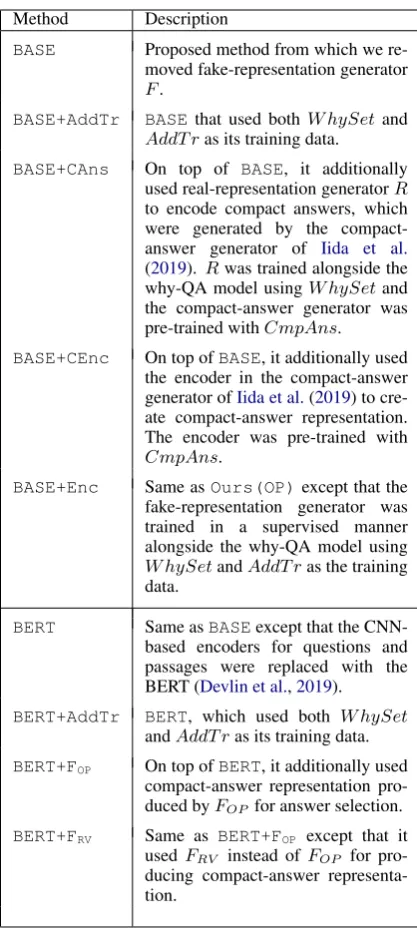
We also evaluated nine baseline neural mod-els, four of which are BERT-based models (BERT,
BERT+AddTr, BERT+FOP, and BERT+FRV), to
show the effectiveness of our why-QA model and AGR. They are listed in Table2.
Method Description
BASE Proposed method from which we re-moved fake-representation generator F.
BASE+AddTr BASE that used both W hySetand AddT ras its training data.
BASE+CAns On top of BASE, it additionally used real-representation generatorR to encode compact answers, which were generated by the compact-answer generator of Iida et al. (2019). Rwas trained alongside the why-QA model usingW hySetand the compact-answer generator was pre-trained withCmpAns.
BASE+CEnc On top ofBASE, it additionally used the encoder in the compact-answer generator ofIida et al.(2019) to cre-ate compact-answer representation. The encoder was pre-trained with CmpAns.
BASE+Enc Same asOurs(OP)except that the fake-representation generator was trained in a supervised manner alongside the why-QA model using W hySetandAddT ras the training data.
BERT Same asBASEexcept that the CNN-based encoders for questions and passages were replaced with the BERT (Devlin et al.,2019).
BERT+AddTr BERT, which used both W hySet andAddT ras its training data.
BERT+FOP On top ofBERT, it additionally used compact-answer representation pro-duced byFOP for answer selection.
BERT+FRV Same as BERT+FOP except that it usedFRV instead ofFOP for
[image:6.595.311.520.58.533.2]pro-ducing compact-answer representa-tion.
Table 2: Baseline neural models
[CLS] Token embeddings Segment embeddings Position embeddings 𝑤' 𝑤′) + + + Attention feature embeddings + + + + + +
E[CLS] E𝑤' E𝑤′)
EQ EQ EP
E0 E1 EN+M+1
E[234]567
𝑤8 + + + E𝑤8 EQ EN 𝑤′' + + + E𝑤′' EP EN+2 C T1 ... TN T’1 T’M
... ... ... ... ... ... ... ... ... ... ... [SEP] + + + E[SEP] EQ EN+1 Input + + + + + T[SEP] Question Passage
Logistic regression layer Correct Incorrect
E=567' E= > 567 E [4?@] 567 E=A B 567 E=C
' 567 +
E[234]DEF5 E= ... ... '
DEF5 E= >
DEF5 E[4?@]DEF5 E=A B DEF5 E=C
' DEF5 [SEP] + + + E[SEP] EP EN+M+2 + T[SEP]
E[4?@]567
[image:7.595.346.489.59.246.2]E[4?@]DEF5 Transformer encoder E[CLS] E1 ... EN E[SEP] E’1... ... E’M E[SEP]
Figure 3: Architecture ofBERT: E represents input em-bedding and Tirepresents contextual representation of
tokeni. [CLS] is a special symbol added in front of every input example, and [SEP] is a special separator token (e.g. for separating questions/passages).
(2019)3 except for the batch size of 50. We ran 3 epochs with the learning rate of 1e-5 for fine-tuning the BERT-based models4.
A BERT-based model,BERT, takes a question-passage pair as input and computes the input representation using token, segment, position, and attention feature embeddings (Fig. 3). For the input representation computation, the orig-inal BERT only used the token, segment, and position embeddings, while BERT additionally used the attention feature embeddings5 to ex-ploit the same similarity-attention and causality-attention features used in our proposed method. We used the attention feature embeddings during the fine-tuning and testing, but not during the pre-training of the BERT-based model. The atten-tion feature embeddings for answer passages (i.e.,
Ewsim0 1 ,
· · · , Ewsim0
M, and E
caus
w01 ,· · · , E caus
wM0 ) were
computed from the same attention feature vec-tors,asandac, as those in our proposed methods; those for the other parts (i.e., questions, [CLS], and [SEP]) were computed from a zero vector (in-dicating no attention feature). The transformer en-coder processed the input representation to
gen-3
12-layers, 768 hidden states, 12 heads and training for 1-million steps with the warmup rate of 1% using Adam op-timizer with the learning rate of 1e-4.
4We tested all the combinations of epochs{1, 2, 3, 4, 5} and learning rates of{1e-5, 2e-5, 3e-5}and chose the one that maximized the performance on the development data in W hySet.
5We also evaluated a BERT-based model that did not use the attention feature embeddings, but its P@1 (41.4) was much lower than that ofBERT(51.2).
P@1 MAP Oh et al.(2013) 41.8 41.0 Sharp et al.(2016) 33.2 32.2 Tan et al.(2016) 34.0 33.4 Oh et al.(2017) 47.6 45.0
BASE 51.4 50.4
BASE+AddTr 52.0 49.3
BASE+CAns 51.8 50.3
BASE+CEnc 52.4 51.5
BASE+Enc 52.2 50.6
BERT 51.2 50.8
BERT+AddTr 51.8 51.0
BERT+FOP 53.4 51.2
BERT+FRV 53.2 50.9
Ours(OP) 54.8 52.4
Ours(RP) 53.4 51.5
Ours(RV) 54.6 51.8
[image:7.595.81.281.60.232.2]Oracle 60.4 60.4
Table 3: Why-QA performances
erate a representation for a question-passage pair and passed the generated representation to the lo-gistic regression layer for answer selection.BERT
was trained with the training data in W hySet.
BERT+AddTris the same asBERTexcept that it additionally usedAddT ras training data. On top ofBERT,BERT+FOPandBERT+FRVadditionally
used the compact-answer representation produced by our fake-representation generator for answer selection by giving it to the final logistic regres-sion layer.
4.4 Results
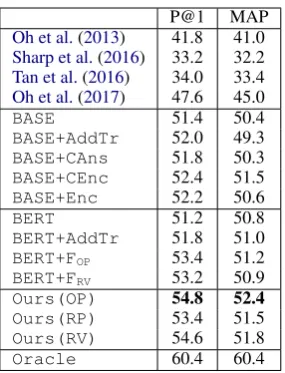
Table3shows the performances of all the methods in the Precision of the top answer (P@1) and the Mean Average Precision (MAP) (Oh et al.,2013). Note that the Oraclemethod indicates the per-formance of afictionalmethod that ranks the an-swer passages perfectly, i.e., it locates all the m
correct answers to a question in the top-m ranks, based on the gold-standard labels. This perfor-mance is the upper bound of those of all the im-plementable methods.
Our proposed method, Ours(OP), outper-formed all the other methods. Our starting point, i.e., BASE, was already superior to the methods in the previous works. Compared withBASEand
BASE+AddTr, neither of which used compact-answer representations or fake-representation gen-erator F, Ours(OP) gave 3.4% and 2.8% im-provement in P@1, respectively. It also outper-formed BASE+CAns and BASE+CEnc, which generated compact-answer representations in a way different from the proposed method, and
generator without adversarial learning. These per-formance differences were statistically significant (p < 0.01by the McNemar’s test).
Ours(OP) also outperformed all the BERT-based models but an interesting point is that fake-representation generator F boosted the perfor-mance of the BERT-based models (statistically significant withp <0.01by the McNemar’s test). These results suggest that AGR is effective in both our why-QA model and our BERT-based model.
4.5 Deeper analysis on the output ofF
Another interesting point is that Ours(RV), in which fake-representation generator FRV was
trained using random vectors, achieved almost the same performance as that ofOurs(OP). This re-sult was puzzling, so we first checked whether
FRV’s output was not just random noise (which
could prevent the why-QA model from overfitting) by replacing inOurs(RV)the output ofFRV by
random vectors. Although we sampled the ran-dom vectors from different distribution types with various ranges, we obtained at best similar perfor-mance to that ofBASE: 51.6 in P@1. This result confirms that it is not trivial to mimicFRV using
random vectors at least.
We investigated the FRV’s output to check
whether it actually focused on the compact an-swer in a given passage. We computed the fol-lowing three representation sets from a gold set of 3,608 triples of why-questions, answer passages and manually created compact-answers that do not overlap withCmpAns:
• {rorgi }:FRV’s output with the pairs of a
why-question and an answer passage in the gold set as its input;
• {rini }: FRV’s output for the same input as {rorgi }, where we replaced theword embed-dingsof all the content words in the answer passages thatalso appeared inthe associated gold compact-answers withrandom vectors;
• {routi }: FRV’s output for the same input as {rorgi }, where we replaced theword embed-dingsof all the content words in the answer passages thatdid not appear inthe associated gold compact-answers withrandom vectors6.
If FRV perfectly focuses on the gold standard
compact-answers, for each question-passage pair,
6For bothrin
i androuti , we never replaced the word
em-beddings for the words that also appeared in the question.
Train Dev Test Quasar-T 37,012 3,000 3,000 SearchQA 99,811 13,893 27,247
[image:8.595.326.509.61.113.2]TriviaQA 87,291 11,274 10,790∗ SQuAD v1.1 87,599 10,570∗ NA
Table 4: Number of questions in each dataset: datasets marked with∗were not used in this experiment
routi should be the same asrorgi andrini should sig-nificantly differ fromrorgi . Next we computed the average Euclidian distance among {rorgi }, {rini }
and{routi }. The average distance (2.67) between
{rorgi }and{routi }was much smaller than the av-erage distance (13.3) between {rorgi } and {rini }. Note that we replaced the word embeddings for much more words with random vectors in the com-putation of {routi } than those in the computation of{rini }(38.1 words vs. 5.6 words). This implies that the distance between{rorgi }and{routi }might be much larger than that between{rorgi }and{rini }
ifFRV focused equally on every answer passage
word. However, the actual results suggest that this is not the case. Although we cannot draw deci-sive conclusions due to the complex nature of neu-ral networks, we believe from the results thatFRV
does actually focus more on words that are a part of a compact answer than on other words. We also computed {rorgi }, {rini }, and {routi } with fake-representation generatorFOP in the same way and
observed the same tendency.
5 DS-QA Experiments
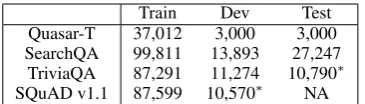
We tested our framework on another task, the dis-tantly supervised open-domain question answer-ing (DS-QA) task (Chen et al., 2017), to check its generalizability. Table 4 shows the statistics for the datasets used in this experiment. The first three, Quasar-T, SearchQA, and TriviaQA pro-vided by Lin et al. (2018), were used for train-ing and evaluattrain-ing DS-QA methods. The traintrain-ing data of SQuAD v1.1 (Rajpurkar et al.,2016) was used for training our AGR. The SQuAD dataset consisted of the triples of a question, an answer, and a paragraph that includes the answer. We as-sume that the answers areour compact answers, although the answers in the dataset are consec-utive short word sequences (2.8 words on aver-age), whose majority are noun phrases, unlike the compact answers for our why-QA experiment, i.e., sentences or phrases (8.3 words on average).
a question, an answer, and a paragraph in the training data of SQuAD-v1.1 under the same set-tings for the AGR’s hyperparameters as in our why-QA experiment except that we use neither causal word embeddings nor causality-attention. In this experiment, we used the AGR training schemes for Ours(OP) and Ours(RV). We used the 300-dimensional GloVe word embed-dings learned from 840 billion tokens in the web crawl data (Pennington et al., 2014), as gen-eral word embeddings. Then we combined the resulting fake-representation generator F in the AGR with the state-of-the-art DS-QA method, OpenQA (Lin et al.,2018)7. We also used the hy-perparameters presented inLin et al.(2018).
OpenQA is composed of two components: a
paragraph selectorto choose relevant paragraphs (or answer passages in our terms) from a set of paragraphs and aparagraph reader to extract an-swers from the selected paragraphs. For iden-tifying answer a to given question q from set of paragraphs P = {pi}, the paragraph
selec-tor and the paragraph reader respectively compute probabilitiesP r(pi|q, P)andP r(a|q, pi), and
fi-nal output P r(a|q, P) is obtained by combining the probabilities. We introduced ci, which is a
compact-answer representation generated by fake-representation generator F with question q and paragraphpias its input, to the computation of the
probabilities as follows:
P r(a|q, P, C) =X
i
P r(a|q, pi,ci)P r(pi|q, P,ci)
In the original OpenQA, the paragraph selec-tor and the reader use bidirectional stacked RNNs for encoding paragraphs, where word embeddings
pi of a paragraph is used as the input. In our implementation, we computed attention-weighted embedding ¯pi of a paragraph by using compact-answer representationci. Given word embedding pji for thej-th word in paragraphpi, its
attention-weighted embeddingp¯ji was computed by using a bilinear function (Sutskever et al.,2009):
¯
pji =softmaxj(pTiMci)pji,
where M ∈ Rd×d is a trainable matrix,
softmaxj(x)denotes the j-th element of the soft-maxedvector ofx, andd= 300. We gave[pji; ¯pji], a concatenation ofpji andp¯ji, as the word embed-ding of thej-th word in paragraphpi to the
bidi-rectional stacked RNNs.
7https://github.com/thunlp/OpenQA
Quasar-T SearchQA TriviaQA
EM F1 EM F1 EM F1
R3 35.3 41.7 49.0 55.3 47.3 53.7
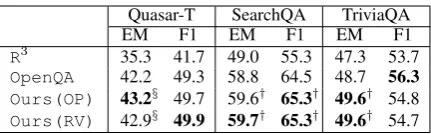
OpenQA 42.2 49.3 58.8 64.5 48.7 56.3 Ours(OP) 43.2§ 49.7 59.6† 65.3† 49.6† 54.8
Ours(RV) 42.9§ 49.9 59.7† 65.3† 49.6† 54.7 Table 5: DS-QA performances: Result of TriviaQA dataset is on its development data.§and†respectively indicate statistical significance of difference in perfor-mance betweenOurs(·)andOpenQAby the McNe-mar’s test withp <0.05andp <0.01
Table 5 shows the performances of the four DS-QA methods: R3 (Wang et al., 2018),
OpenQA (Lin et al., 2018), Ours(OP), and
Ours(RV) evaluated against the Quasar-T, SearchQA and TriviaQA datasets. All the meth-ods were evaluated with EM and F1 scores, fol-lowing Lin et al. (2018). EM measures the per-centage of predictions that exactly match one of the ground-truth answers and F1 is a metric that loosely measures the average overlap between the prediction and ground-truth answer. Note that both Ours(OP) and Ours(RV) outperformed both previous methods, R3 and OpenQA, except for the F1 score for the TriviaQA dataset. Some of the improvements over the previous state-of-the-art method,OpenQA, were statistically signif-icant. These findings suggest that our framework can be effective for tasks other than the original why-QA and the other datasets.
6 Conclusion and Future Work
We proposed a method for why-question answer-ing (why-QA) that used an adversarial learnanswer-ing framework. It employed adversarial learning to generate vector representations of reasons ortrue answers from answer passages and exploited the representations for judging whether the passages are proper answer passages to the given why-questions. Through experiments using Japanese why-QA datasets, we showed that this idea im-proved why-QA performance. We also showed that our method improved the performance in a distantly supervised open-domain QA task.
In our why-QA method, causality expressions extracted from the web were used as background knowledge for computing causality-attention/em-beddings. As a future work, we plan to introduce a wider range of background knowledge including another type of event causality (Hashimoto et al.,
[image:9.595.311.527.60.127.2]References
Danqi Chen, Adam Fisch, Jason Weston, and An-toine Bordes. 2017. Reading Wikipedia to answer open-domain questions. InProceedings of the 55th Annual Meeting of the Association for Computa-tional Linguistics (Volume 1: Long Papers), pages 1870–1879.
Ronan Collobert, Jason Weston, L´eon Bottou, Michael Karlen, Koray Kavukcuoglu, and Pavel Kuksa. 2011. Natural language processing (almost) from scratch. J. Mach. Learn. Res., 12:2493–2537.
Jacob Devlin, Ming-Wei Chang, Kenton Lee, and Kristina Toutanova. 2019. BERT: Pre-training of deep bidirectional transformers for language under-standing. InProceedings of the 2019 Conference of the North American Chapter of the Association for Computational Linguistics: Human Language Tech-nologies, Volume 1 (Long and Short Papers), pages 4171–4186.
Bhuwan Dhingra, Kathryn Mazaitis, and William W Cohen. 2017. Quasar: Datasets for question an-swering by search and reading. arXiv preprint arXiv:1707.03904.
Matthew Dunn, Levent Sagun, Mike Higgins, V. Ugur G¨uney, Volkan Cirik, and Kyunghyun Cho. 2017. SearchQA: A new Q&A dataset aug-mented with context from a search engine. CoRR, abs/1704.05179.
Roxana Girju. 2003. Automatic detection of causal re-lations for question answering. In Proceedings of the ACL 2003 workshop on Multilingual summariza-tion and quessummariza-tion answering, pages 76–83.
Ian J. Goodfellow, Jean Pouget-Abadie, Mehdi Mirza, Bing Xu, David Warde-Farley, Sherjil Ozair, Aaron Courville, and Yoshua Bengio. 2014. Generative ad-versarial nets. In Proceedings of the 27th Interna-tional Conference on Neural Information Process-ing Systems - Volume 2, NIPS’14, pages 2672–2680, Cambridge, MA, USA. MIT Press.
Chikara Hashimoto, Kentaro Torisawa, Stijn De Saeger, Jong-Hoon Oh, and Jun’ichi Kazama. 2012. Excitatory or inhibitory: A new semantic orientation extracts contradiction and causality from the web. In Proceedings of the 2012 Joint Confer-ence on Empirical Methods in Natural Language Processing and Computational Natural Language Learning, pages 619–630.
Chikara Hashimoto, Kentaro Torisawa, Julien Kloetzer, and Jong-Hoon Oh. 2015. Generating event causal-ity hypotheses through semantic relations. In Pro-ceedings of the Twenty-Ninth AAAI Conference on Artificial Intelligence, (AAAI-15), pages 2396–2403.
Chikara Hashimoto, Kentaro Torisawa, Julien Kloetzer, Motoki Sano, Istv´an Varga, Jong-Hoon Oh, and Yu-taka Kidawara. 2014. Toward future scenario gener-ation: Extracting event causality exploiting semantic
relation, context, and association features. In Pro-ceedings of the 52nd Annual Meeting of the Associa-tion for ComputaAssocia-tional Linguistics (Volume 1: Long Papers), pages 987–997.
Kaiming He, Xiangyu Zhang, Shaoqing Ren, and Jian Sun. 2015. Delving deep into rectifiers: Surpassing human-level performance on imagenet classifica-tion. InProceedings of the 2015 IEEE International Conference on Computer Vision (ICCV), ICCV ’15, pages 1026–1034, Washington, DC, USA. IEEE Computer Society.
Ryuichiro Higashinaka and Hideki Isozaki. 2008. Corpus-based question answering for why-questions. InProceedings of the Third International Joint Conference on Natural Language Processing: Volume-I, pages 418–425.
Ryu Iida, Canasai Kruengkrai, Ryo Ishida, Kentaro Torisawa, Jong-Hoon Oh, and Julien Kloetzer. 2019. Exploiting background knowledge in compact an-swer generation for why-questions. InProceedings of Thirty-Third AAAI Conference on Artificial Intel-ligence 2019 (AAAI-19).
Ryo Ishida, Kentaro Torisawa, Jong-Hoon Oh, Ryu Iida, Canasai Kruengkrai, and Julien Kloetzer. 2018. Semi-distantly supervised neural model for gener-ating compact answers to open-domain why ques-tions. In Proceedings of the Thirty-Second AAAI Conference on Artificial Intelligence, (AAAI-18), pages 5803–5811. AAAI Press.
Mandar Joshi, Eunsol Choi, Daniel Weld, and Luke Zettlemoyer. 2017. TriviaQA: A large scale dis-tantly supervised challenge dataset for reading com-prehension. In Proceedings of the 55th An-nual Meeting of the Association for Computa-tional Linguistics (Volume 1: Long Papers), pages 1601–1611.
Yoon Kim. 2014. Convolutional neural networks for sentence classification. InProceedings of the 2014 Conference on Empirical Methods in Natural Lan-guage Processing (EMNLP), pages 1746–1751.
Diederik P. Kingma and Jimmy Ba. 2015. Adam: a method for stochastic optimization. In Proceed-ings of the 3rd International Conference on Learn-ing Representations (ICLR), pages 1–13.
Canasai Kruengkrai, Kentaro Torisawa, Chikara Hashimoto, Julien Kloetzer, Jong-Hoon Oh, and Masahiro Tanaka. 2017. Improving event causal-ity recognition with multiple background knowl-edge sources using multi-column convolutional neu-ral networks. In Proceedings of the Thirty-First AAAI Conference on Artificial Intelligence, Febru-ary 4-9, 2017, San Francisco, California, USA.
Omer Levy and Yoav Goldberg. 2014. Neural word embedding as implicit matrix factorization. In Ad-vances in Neural Information Processing Systems 27, pages 2177–2185. Curran Associates, Inc.
Yankai Lin, Haozhe Ji, Zhiyuan Liu, and Maosong Sun. 2018. Denoising distantly supervised open-domain question answering. InProceedings of the 56th An-nual Meeting of the Association for Computational Linguistics, ACL 2018, pages 1736–1745.
Tomas Mikolov, Ilya Sutskever, Kai Chen, Greg S Cor-rado, and Jeff Dean. 2013. Distributed representa-tions of words and phrases and their compositional-ity. InAdvances in Neural Information Processing Systems 26, pages 3111–3119. Curran Associates, Inc.
Mehdi Mirza and Simon Osindero. 2014. Conditional generative adversarial nets. CoRR, abs/1411.1784.
Junta Mizuno, Masahiro Tanaka, Kiyonori Ohtake, Jong-Hoon Oh, Julien Kloetzer, Chikara Hashimoto, and Kentaro Torisawa. 2016. WISDOM X, DIS-AANA and D-SUMM: Large-scale NLP systems for analyzing textual big data. In Proceedings of COLING 2016, the 26th International Conference on Computational Linguistics: System Demonstra-tions, pages 263–267.
Masaki Murata, Sachiyo Tsukawaki, Toshiyuki Kana-maru, Qing Ma, and Hitoshi Isahara. 2007. A sys-tem for answering non-factoid Japanese questions by using passage retrieval weighted based on type of answer. InProceedings of NTCIR-6.
Jong-Hoon Oh, Kentaro Torisawa, Chikara Hashimoto, Ryu Iida, Masahiro Tanaka, and Julien Kloetzer. 2016. A semi-supervised learning approach to why-question answering. InProceedings of the Thirtieth AAAI Conference on Artificial Intelligence, pages 3022–3029.
Jong-Hoon Oh, Kentaro Torisawa, Chikara Hashimoto, Takuya Kawada, Stijn De Saeger, Jun’ichi Kazama, and Yiou Wang. 2012. Why question answering us-ing sentiment analysis and word classes. In Pro-ceedings of the 2012 Joint Conference on Empiri-cal Methods in Natural Language Processing and Computational Natural Language Learning, pages 368–378.
Jong-Hoon Oh, Kentaro Torisawa, Chikara Hashimoto, Motoki Sano, Stijn De Saeger, and Kiyonori Ohtake. 2013. Why-question answering using intra- and inter-sentential causal relations. In Proceedings of the 51st Annual Meeting of the Association for Com-putational Linguistics (Volume 1: Long Papers), pages 1733–1743.
Jong-Hoon Oh, Kentaro Torisawa, Canasai Kru-engkrai, Ryu Iida, and Julien Kloetzer. 2017. Multi-column convolutional neural networks with causality-attention for why-question answering. In
Proceedings of the Tenth ACM International Confer-ence on Web Search and Data Mining, WSDM ’17, pages 415–424.
Jeffrey Pennington, Richard Socher, and Christopher Manning. 2014. Glove: Global vectors for word representation. In Proceedings of the 2014 Con-ference on Empirical Methods in Natural Language Processing (EMNLP), pages 1532–1543.
Pranav Rajpurkar, Jian Zhang, Konstantin Lopyrev, and Percy Liang. 2016. SQuAD: 100,000+ questions for machine comprehension of text. InProceedings of the 2016 Conference on Empirical Methods in Nat-ural Language Processing, pages 2383–2392.
C´ıcero Nogueira dos Santos, Ming Tan, Bing Xiang, and Bowen Zhou. 2016. Attentive pooling net-works. CoRR, abs/1602.03609.
Rebecca Sharp, Mihai Surdeanu, Peter Jansen, Pe-ter Clark, and Michael Hammond. 2016. Creating causal embeddings for question answering with min-imal supervision. InProceedings of the 2016 Con-ference on Empirical Methods in Natural Language Processing, pages 138–148.
Nitish Srivastava, Geoffrey Hinton, Alex Krizhevsky, Ilya Sutskever, and Ruslan Salakhutdinov. 2014. Dropout: A simple way to prevent neural networks from overfitting. Journal of Machine Learning Re-search, 15:1929–1958.
Ilya Sutskever, Joshua B. Tenenbaum, and Ruslan R Salakhutdinov. 2009. Modelling relational data us-ing bayesian clustered tensor factorization. In Ad-vances in Neural Information Processing Systems 22, pages 1821–1828. Curran Associates, Inc.
Ming Tan, Cicero dos Santos, Bing Xiang, and Bowen Zhou. 2016. Improved representation learning for question answer matching. In Proceedings of the 54th Annual Meeting of the Association for Compu-tational Linguistics (Volume 1: Long Papers), pages 464–473, Berlin, Germany. Association for Compu-tational Linguistics.
Suzan Verberne, Hans van Halteren, Daphne Theijssen, Stephan Raaijmakers, and Lou Boves. 2011. Learn-ing to rank for why-question answerLearn-ing. Inf. Retr., 14(2):107–132.
Shuohang Wang, Mo Yu, Xiaoxiao Guo, Zhiguo Wang, Tim Klinger, Wei Zhang, Shiyu Chang, Gerry Tesauro, Bowen Zhou, and Jing Jiang. 2018. R3: