Munich Personal RePEc Archive
Why are some online courses more open
than others?
Jacqmin, Julien
10 November 2018
Online at
https://mpra.ub.uni-muenchen.de/89929/
Why are some online courses more open
than others?
Julien Jacqmin
∗November 9, 2018
Abstract
This paper studies the determinants of the intellectual property li-cense of the Massive Open Online Courses (MOOCs) provided on a French platform. While they can opt for a traditional intellectual property right license, the vast majority chooses among creative commons licenses. Con-sidering the ordering in terms of degree of openness of these licenses, we study the course-, teacher- and institution-related factors driving this de-cision. We observe that the field of study of the course and the character-istics of the institution providing the course play a role. We explain this result by the teachers’ variable awareness and preferences with regard to open practices. We also find support for the idea that those willing to raise revenues by selling goods complementary to the MOOC (e.g. a textbook, certificate of completion or bundle of courses) are less likely to choose an open license.
Keywords: Massive Open Online Courses, intellectual property rights license, creative commons, open educational resources.
JEL codes: O34, I29, L17
∗LCII and HEC Liège, University of Liège, B. 31 Place des Orateurs 3, 4000 Liège, Belgium.
1
Introduction
Massive Open Online Courses (MOOCs) first attracted media attention when two Stanford professors decided to put online their ‘Introduction to artificial intelligence course’. In the wake of its huge success with more than 160,000 students enrolled, several online platforms have sought to spur similar initia-tives, mostly from higher education institutions. To date, Coursera and edX are the most popular MOOC platforms, hosting respectively 33 and 14 million students, enrollment figures which are rarely heard in the higher education context.
Various efforts to take advantage of information technologies to provide online courses predate these initiatives. Launched in 2001, OpenCourseWare published via internet and for free the video captions of courses taught in various universities, including MIT. As of the mid-2000s, a first initiative also called MOOCs originated from the open educational resource movement. These MOOCs are now referred to as cMOOOcs in opposition to the more recently developed xMOOCS available on online platforms like Coursera or edX (Daniel [2012]). All these initiatives have in common that they use internet to pro-vide cost- and selection-free education to students. Apart from their relative confidentiality in terms of student figures, a key distinctive feature between these two previous attempts to provide online courses and the more recent xMOOCs is that the content of the courses provided is protected by open-source licenses. These licenses, such as creative commons licenses, concern the rights to share, transform and redistribute creative works. In other words, they provide an explicit legal framework to construct innovations built up on the shoulders of previous works. The objective of this paper is to understand why online courses tend to differ in terms of openness, as defined by their copyright license.
by one of the creative commons licenses. We distinguish three categories of factors that can explain this heterogeneity: course-specific, professor-related and institutional factors
We find that science and health MOOCS tend to have a more open license. This is true also of courses originating from foreign institutions. Top-ranked higher education institutions, though, prefer to choose a relatively ‘closed’ li-cense. We also observe that courses trying to raise money by selling a product complementary to the MOOC, e.g. a certificate of completion or textbook, tend to restrict the redistribution of the course content to non commercial pur-poses, which is made possible by creative commons licenses. We argue that these results can be explained by (1) the heterogeneity between academic dis-ciplines of the peer recognition concerning open practices, (2) the greater ‘taste for openness’ of teachers from foreign institutions, and (3) the higher foregone potential earnings of choosing an open license when a textbook or a certificate of completion is sold to the students enrolling freely in the MOOC.
After introducing the concept of open educational resources in Section 2, we explain what open source licenses are, especially by discussing the liter-ature that has looked at why innovators might choose a more or less open licensing scheme. Section 4 presents our data and methodology. The results of our empirical analysis are presented in Section 5. Section 6 concludes.
2
Open educational resources
According to the OECD (Hylen et al. [2012], P. 19), “Open Educational Re-sources (OER) are digital learning reRe-sources offered online (although some-times in print) freely and openly to teachers, educators, students, and inde-pendent learners in order to be used, shared, combined, adapted, and ex-panded in teaching, learning and research. They include learning content, software tools to develop, use and distribute, and implementation resources such as open licenses”. Initiatives made possible thanks to the emergence of information and communication technologies such as the MIT OpenCourse-Ware or the Khan Academy are all examples of such resources. It is the central element promoted by the open education movement, which can be seen as the equivalent to the education context of the, better known, open science move-ment.
[2017]). Recently, the U.S. Department of Education has introduced an open licensing rule for educational resources produced by the winners of some of its competitive federal grants (Lieberman [2018]). From a normative perspective, two key benefits of OER make them desirable. First, their openness reduces the costs of education for its main users, i.e. students, by making them cost-less. Second, by choosing open licenses, they facilitate the improvement and personalization of the learning material by other teachers.
The commitment to non excludability created by the decision to use an open license makes it difficult, for its initiators, to appropriate direct monetary returns from OER as it is costless for its users. This issue is conceptually simi-lar to the difficulty of privately providing public goods, especially as internet also reduces the extent of rivalry. Hence, higher education institutions as well as educators might refrain from investing in OER. These impediments have been studied in the education policy literature. Based on a survey of higher education representatives worldwide, Murphy [2013] argues that inhibitors are mainly at the institutional level and come from the lack of knowledge and committed resources. Analyzing the interviews of 30 higher education edu-cators, Kaatrakoski et al. [2017] rather argue that the lack of recognition from investing in OER projects explains the limited uptake by teachers. Both these individual and institutional explanations are also acknowledged by Castana Munoz et al. [2016], who surveyed close to 200 administrators from various European higher education institutions.
This paper also tries to understand the factors accounting for the hetero-geneous behavior of professors in open educational practices. We focus more specifically on the Massive Open Online Courses provided on a platform called FUN, which stands for France Université Numérique.1 All the courses pro-vided are free of charge for students and there is no requirement needed in order to participate. However, as opposed to the MOOCs provided on plat-forms like edX or Coursera, courses differ with respect to the license protect-ing what is explicitly allowed with the reuse, remix and redistribution of the pedagogical materials in other contexts. Apart from this different focus, our methodological approach also differs from the one used in the education pol-icy literature. First, we rely on revealed preference data rather than stated preference data, as we look at the chosen license posted on the course web-page available on the FUN platform. Second, we use a multivariate regres-sion approach rather than a bivariate analysis. Thanks to this approach, the
presence of omitted variable bias is reduced.
3
Open source licensing
The copyright legal framework grants exclusive rights to the creator of an original work concerning its usage by others. Acts of reproduction, adapta-tion and the distribuadapta-tion thereof can also be specified, but only on a case by case basis, negotiated by the two parties concerned. The goal of open source licenses is to enable innovators to explicitly specify these rights and duties for all users (Vanbrabant [2016]). Hence, they provide a legal framework to facil-itate innovations built upon others by decreasing transactions costs between the parties concerned. Creative commons licenses are the most famous exam-ple of such public copyright licenses. Initiated in the early 2000s by Lawrence Lessig, they have been widely used by Youtube, Wikipedia and numerous open-source software.
Creative commons licenses differ based on the combinations of four dis-tinct conditions enabling the innovator to manage the circulation of their inno-vation. Attribution (BY) requires to credit the author of the work. No deriva-tive (ND) gives permission to copy and distribute copies of the work in its original format but not to create derivative works and remixes based on it. Share-alike (SA) is a clause requiring copies and derivative works to circulate under a license similar to that of the original work. Non-commercial (NC) gives permission to copy, display and redistribute the work and its deriva-tives but only for non-commercial purposes. In the context of online courses, videos of the professors discussing the topic covered tend to be the backbone of the course. BY requires, when reusing this content for another purpose, to stipulate the paternity of the video. ND means that it can be re-broadcast in another context but only in the same format. For example, the video cannot be translated or adapted by introducing interactive content, such as by integrat-ing a quiz, in the video. When SA applies, it is possible to rework the video to adapt it to the context of the new usage, only if it is redistributed under the same condition as the original work. With NC, this can only be done for non commercial purposes. Hence, it is not possible to take the video as an input of an online learning program for which students would have to pay.
By mixing together (some of these) four conditions, we end up with seven different creative commons licenses.2 As pictured in Figure 1 (Creative
Figure 1: Ordinal ranking of Creative Commons licenses from least to most open (Creative Commons [2018])
mons [2018]), which comes from the official website of the creative commons licenses, these licenses can be ranked from the least to the most open ones. The license BY NC ND is the least open creative commons license, as it does not authorize the re-adaptation of the original work and the reuse for com-mercial purposes. This license is ranked right above “all rights reserved” in term of openness which only protects the work following the sole traditional intellectual property system and does not provide further guidelines about its reuse. The most open license CC0 sets the work in the public domain. In be-tween, the other possible combinations of BY, SA, ND and NC, can be ranked depending on the ability to share the work, remix it and use it for commercial purposes.
The objective of this paper is to explain why we observe heterogeneous licensing practices among the Massive Open Online Courses provided on an online platform. While all these courses are freely accessible to students, they variously condition their reuse and distribution. Hence, compared to most of the literature on open source issues, we do not focus on the incentives to contribute/produce to the project but on the specific licensing decision that takes place once the project is completed (Lerner and Tirole [2002]).
Economic theory can help us shed light on the licensing decision of MOOC teachers. Balancing the costs and benefits of the licenses available, they will choose the degree of openness that provides them the largest net benefit. The main cost incurred when choosing a more open license relates to the fore-gone potential earnings from selling close complements to the course (Lerner and Tirole [2005]). In our context, we can think of a certificate of completion, a textbook, a tutorial or a bundle of complementary online courses (Belle-flamme and Jacqmin [2016]). This way the free online course is a strategy chosen within a freemium business model where the initial goal is to attract a large user base that is then tempted to pay for a different, but related, good or service. In the case where a relatively open license is chosen, especially if it does not include the conditions NC and ND, these revenues are more diffi-cult to appropriate. Another innovator could freely enter the market by using the course content, adapt it and commercialize it. For example, as the courses are aired according to a specific timing on the MOOC platform, e.g. usually a timespan of a few months, another person could put up a website to air the course under a more flexible timing at almost no production cost and charge access to it. Hence, under this freemium business model, the course providers face potential additional competitive pressures when a more open license is chosen.
Teachers might also differ with respect to the non-monetary benefits they derive directly or indirectly from the chosen license. A pre-requirement lies in the heterogeneous awareness of the potential benefits that can be obtained from choosing an open license. The concept of openness in research practices is heterogeneously used and known across academic disciplines and institu-tions (Eger et al. [2015] and Zhu [2017]). This is likely correlated with their awareness of the opportunities created by open educational practices.
Teachers can first derive immediate intrinsic benefits from choosing an open license. They can have stronger preferences towards openness or some form of altruistic motives that impact their decision. In the context of research, as discussed in Roach and Sauermann [2010], the “taste for science”, which in-cludes the “taste for openness” is likely to differ between people working in the higher education system and in other sectors, due to the self-selection of workers with this characteristic into academia.
career concern motives do play a role as we have no example in mind of em-ployers valuing the license chosen for a MOOC for future job prospects. How-ever, social motives in the form of peer recognition are more likely to play a role. Hence, the collegiate reputation-based reward system present in research activities discussed a.o. in Dasgupta and David [1994]) can potentially ex-plain why, despite the absence of direct private appropriability, some teachers choose very open creative commons licenses to protect their course content.
This paper is closely related to the literature focusing on the empirical de-terminants of licensing choices in academia, which uses mainly faculty-level data. While many papers have focused on explaining the patenting decision of faculty members (see for example Thursby et al. [2009]), recent works have looked at why the degree of openness of the inputs and outputs of academic research tends to be heterogeneous. These works aim at understanding the movement towards more open science. Analyzing a survey of, respectively, German and UK academics, Eger et al. [2015] and Zhu [2017] look at the ex-planations behind an open access publishing decision. They find that aspects such as the discipline or the personal characteristics of the faculty members are relevant. Andreoli-Versbach and Mueller-Langer [2014] study the characteris-tics of a selected sample of empirical economists to see why some voluntarily share their data while others do not. They observe that personal character-istics, such as age, academic tenure and attitudes towards the principles of open science as well as the mandatory data-disclosure policies set by journals are relevant. However, in contrast to this literature, a key feature of this work is that it studies an intellectual property rights decision related to a teaching rather than a research activity.
One peculiarity of our work is that we look at the degree of openness of the creative commons licenses chosen by the teachers of the courses provided on a MOOC platform. This decision is made after producing the course content, when organizing the host webpage of the course on the platform.3 To our knowledge, Bazen et al. [2015] is the only other paper that has investigated the rich information available about the various dimensions of openness that lie behind creative commons licenses. For this purpose, they use data from Jamendo, a free online music platform, where artists can choose the licensing protection of their music using these licenses. After analyzing a survey of some of the artists active on the platform, one of their observations is that
3Note that there is no default option provided and that the platform refers to the website
younger artists, not deriving income from their music, tend to choose more open licensing rights.
4
Data and Methodology
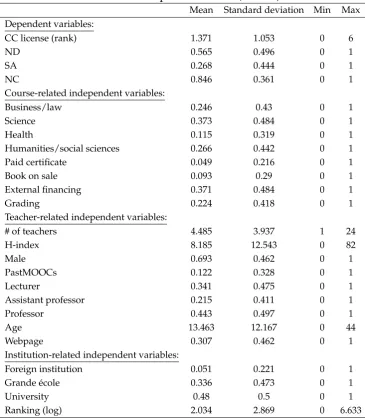
[image:10.595.114.480.302.721.2]This research draws on web scrapped data of all the 410 courses provided on the FUN platform, up to September 2018. This information is completed by additional data collected from various internet sources. Hence, one key aspect of this approach is that revealed information is used, while most works on open practices use survey data. Descriptive statistics are shown in Table 1.
Table 1: Descriptive statistics (N=410)
Mean Standard deviation Min Max Dependent variables:
CC license (rank) 1.371 1.053 0 6
ND 0.565 0.496 0 1
SA 0.268 0.444 0 1
NC 0.846 0.361 0 1
Course-related independent variables:
Business/law 0.246 0.43 0 1
Science 0.373 0.484 0 1
Health 0.115 0.319 0 1
Humanities/social sciences 0.266 0.442 0 1 Paid certificate 0.049 0.216 0 1
Book on sale 0.093 0.29 0 1
External financing 0.371 0.484 0 1
Grading 0.224 0.418 0 1
Teacher-related independent variables:
# of teachers 4.485 3.937 1 24
H-index 8.185 12.543 0 82
Male 0.693 0.462 0 1
PastMOOCs 0.122 0.328 0 1
Lecturer 0.341 0.475 0 1
Assistant professor 0.215 0.411 0 1
Professor 0.443 0.497 0 1
Age 13.463 12.167 0 44
Webpage 0.307 0.462 0 1
Institution-related independent variables:
Foreign institution 0.051 0.221 0 1
Grande école 0.336 0.473 0 1
University 0.48 0.5 0 1
Ranking (log) 2.034 2.869 0 6.633
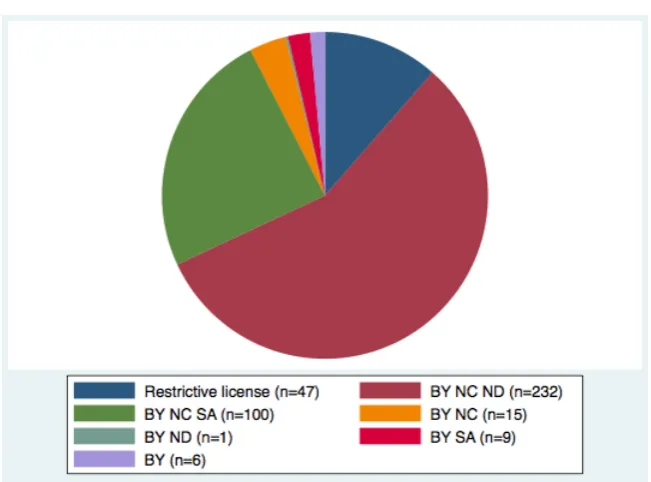
Figure 2: Course content license choice on the FUN MOOC platform
license chosen for the course content by its teacher. It is an integer between 0 and 6, which mirrors the ordinal ranking of the different licenses from the least to the most open, pictured in Figure 1. The most restrictive license “all rights reserved” receives the score 0. From 1 to 6, we have the different categories of the creative commons licenses, as no course has chosen the most open license CC0. As shown in Figure 2, about 10% of the courses have not chosen a cre-ative commons license. A majority of the courses have set the most restrictive creative commons license by choosing CC BY NC ND. The remaining third of the courses have chosen more open creative commons licenses. We further analyze separately the determinants each of the three conditions: ND,SAand
NC.
Our independent variables are grouped into 3 separate categories: Course-, teacher- and institution-related factors.4 Note that a yearly time trend is also considered in each of our regressions. The first course-related factors con-cern the discipline in which the course is taught. There are 4 categories (
busi-ness/law, science, health and humanities/social sciences, the last one being our
reference category) which are each represented by a dummy variable. Paid
certificate and book on sale are dummies whether or not complements to the
4Various other variables have been considered e.g. the number of classes taught, the
course are advertised on the course webpage. Two of them are considered: a certificate of completion of the course and a textbook related to the course being taught. This is the case for, respectively, 5% and 10% of the courses.
External financingis a dummy equal to one if it is mentioned that the initiators
of the course have received funding from external sources, such as regional governments or private enterprises. Gradingis a dummy equal to one if the course grading system is based on more than multiple choices. Using essays and problem sets (graded automatically or by fellow students) or valuing the participation to forum discussions can be seen as a proxy of the teachers’ ped-agogical investment.
As for the teacher-related variable, we first control for the number of teach-ers of the course with # of teachers. For the other teacher-related factors, we only take into account the main teacher of the course, identified as the per-son in charge of it. If not explicitly assigned, the one cited on top of the list is taken and, if this list is in alphabetical order, we take the first appearing in the trailer of the MOOC. H-indexis the h-index of the main teacher as found on Scopus. We include a dummy for male. PastMOOCs is a dummy equal to one if the teacher has already taught a MOOC on the FUN platform. We also control for the academic rank. Three categories of academic positions are considered, each represented by a dummy:lecturer(for non-tenured teachers),
associate professor(for tenured teachers with the lowest tenured rank position,
also known as maître de conférence) andfull professor (for teachers with a se-nior/full professor position, our reference group). As information about the age of the main teacher is not always available, we use, as a proxy, the age
of the first publication available on Scopus. A dummy whether or not the teacher has their ownwebpage is also included. This last variable can be seen as a proxy of the teacher’s attitude towards the openness of other academic information related to their research and other teaching activities.
Finally, we also consider institutional factors.5 First, as 5% of the MOOCs are taught by teachers affiliated to foreign institutions, we consider the dummy
foreign institution. We also take into account a dummy grande école to control
whether the course is provided by a French public higher education institu-tion allowed to select students at the entrance. If not by such an instituinstitu-tion,
5Online courses are provided by 90 different institutions. One issue relates to whether or
we control whether it is provided by an university. Finally, we control for the Shanghai ranking of the institution providing the course. We take the 2017 ranking and, to facilitate the interpretation of the sign of the parameter, we subtract the rank of the institution from 800, which corresponds to the last rank. We also take the log of ranking.
Due to the ordinal nature of the dependent variableCC license, we estimate ordered probit regressions. Note that an ordered probit model only takes the rank into consideration while the value assigned to the dependent variable is meaningless. As some teachers teach several classes, we cluster standard errors at the professor level. We also analyze the three creative commons con-ditions separately, using a probit model. We focus on the sign of the coefficient rather than on the size, as their interpretation is far from trivial with this non-linear approach.
5
Empirical analysis
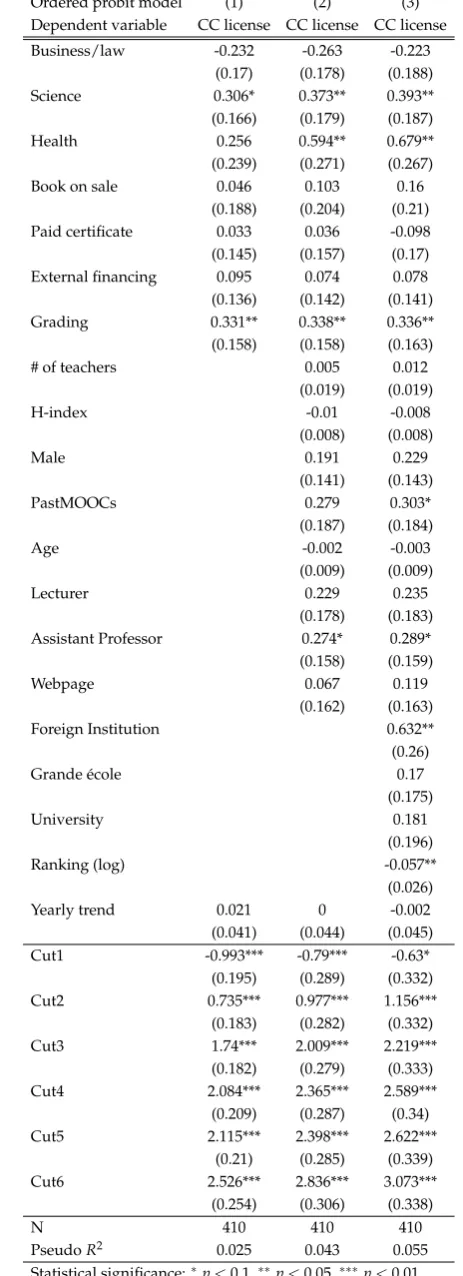
The main results are presented in Table 2, where each group of control vari-ables are introduced step-by-step. Focusing on regression (3), we first observe that the discipline in which the course is taught plays a significant role.
Sci-ence and health MOOCs tend to pick a license that is more open than those
taught inbusiness/lawandhumanities/social sciences.6 This result is reminiscent of those of Migheli and Ramello [2013], Eger et al. [2015] and Zhu [2017] in the research context. Science and health scholars also tend to be more proactive with respect to open access publishing practices, e.g. by publishing in open access journals or by using self-archives/repositories. A first theoretical expla-nation behind this result is linked to the idea that, teachers of these disciplines are more aware of and tend to prefer these open licenses for their MOOC. A second plausible explanation, bound to the first, relates to the greater peer recognition received from choosing a more open creative commons licenses in these disciplines, which suggests that open licenses there tend to be the social norm.
6Specifying ten disciplines instead of four provides similar results, with MOOCs offered
Table 2: Creative commons license of the MOOC content Ordered probit model (1) (2) (3)
Dependent variable CC license CC license CC license Business/law -0.232 -0.263 -0.223
(0.17) (0.178) (0.188) Science 0.306* 0.373** 0.393** (0.166) (0.179) (0.187) Health 0.256 0.594** 0.679** (0.239) (0.271) (0.267) Book on sale 0.046 0.103 0.16
(0.188) (0.204) (0.21) Paid certificate 0.033 0.036 -0.098 (0.145) (0.157) (0.17) External financing 0.095 0.074 0.078 (0.136) (0.142) (0.141) Grading 0.331** 0.338** 0.336** (0.158) (0.158) (0.163) # of teachers 0.005 0.012
(0.019) (0.019) H-index -0.01 -0.008 (0.008) (0.008)
Male 0.191 0.229
(0.141) (0.143) PastMOOCs 0.279 0.303* (0.187) (0.184)
Age -0.002 -0.003
(0.009) (0.009) Lecturer 0.229 0.235
(0.178) (0.183) Assistant Professor 0.274* 0.289* (0.158) (0.159) Webpage 0.067 0.119
(0.162) (0.163) Foreign Institution 0.632** (0.26)
Grande école 0.17
(0.175)
University 0.181
(0.196) Ranking (log) -0.057**
(0.026) Yearly trend 0.021 0 -0.002 (0.041) (0.044) (0.045) Cut1 -0.993*** -0.79*** -0.63* (0.195) (0.289) (0.332) Cut2 0.735*** 0.977*** 1.156***
(0.183) (0.282) (0.332) Cut3 1.74*** 2.009*** 2.219***
(0.182) (0.279) (0.333) Cut4 2.084*** 2.365*** 2.589***
(0.209) (0.287) (0.34) Cut5 2.115*** 2.398*** 2.622***
(0.21) (0.285) (0.339) Cut6 2.526*** 2.836*** 3.073***
(0.254) (0.306) (0.338)
N 410 410 410
PseudoR2 0.025 0.043 0.055
The variablegradingalso plays a positive and significant role in explaining the degree of openness of the license chosen. Using more complex mecha-nisms to evaluate the participation of students, especially using peer-graded assessments, is in line with what the first waves of MOOCs did. These so-called cMOOCs, which emerged from the early open educational resource movement fostered a student-centered pedagogical approach and the use of open licenses, such as creative commons licenses. Hence, we can expect that a teacher using a more elaborate grading system than just multiple choice ques-tions to assess students has a greater awareness/preference for more open creative commons licenses.
Foreign institutionsalso tend to choose more open licenses. One
explana-tion for this result lies in the fact that French instituexplana-tions choose to provide MOOCs on the FUN platform by default as it is an initiative of the French gov-ernment. However, foreign institutions who prefer more openness are likely to choose FUN as a partnering platform, compared to other international plat-forms which put less emphasis on openness. For example, edX, Coursera, Udacity, Iversity and Futurelearn do not allow for a creative commons license for the courses offered on their platform, as content is by default protected by an “all rights reserved” license.
A final significant variable is ranking (log). We have that better ranked higher education institutions tend to choose significantly more closed licenses. The most likely explanation for this result finds its roots in the fact that top and mostly anglophone higher education institutions, recycle some of their (for-mer) MOOCs by bundling them together to provide a fully online program. A much-talked about example is the Master in computer science program of-fered by the Georgia Institute of Technology in partnership with the MOOC platform Udacity. This program was offered both on campus and online, for a reduced fee in the latter format (Goodman et al. [2019]). Micro Masters, also known as nanodegress, bundle together a handful of courses on a specific topic and are another recent initiative from platforms like Coursera or edX. Hence, top-ranked institutions prefer to choose a closed license to limit the foregone potential earnings from selling a related complement to the course, as otherwise other institutions could rebroadcast their pedagogical content via another channel for a limited production cost.
job prospects, it is unclear why the dummyassistant professoris significant, at the 10% threshold, while those oflecturer andage are not. All the other vari-ables do not seem to significantly impact the license choice.
As a further robustness check, we next look at the determinants of each creative commons condition separately: ND, SA and NC. These results are provided in Table 3. As they cannot be chosen together among the existing creative commons licenses, we analyze side-by-side regression (4) and (5), where ND and SA are (respectively) used as dependent variables. As ND, contrary to SA, does not promote the creation of content built on the one ini-tiated by others, one can question whether choosing the ND condition can be considered an “open” practice (Mishra [2017]). Note as well that, with the li-censes BY and BY NC, it is possible to choose neither of these two conditions. The main result is that institutional factors do play a significant role. Teach-ers at foreign institutions are more likely to choose the condition Share-Alike as opposed to No Derivative. As for our main results, this preference can be explained by the self-selection into the FUN platform of foreign institutions which prefer relatively more openness. In addition, we observe that teachers at public higher education institutions, universities or “grande écoles”, also tend to opt for Share-Alike. Together, more than 80% of the MOOCs are pro-vided by higher education institutions. The other are developed by research centers, the French public administration, government bodies or a few private schools. Here also, this result can be explained by the self-selection of teach-ers with a “taste for openness” into academic institutions, as also observed by Roach and Sauermann [2010] in the research context.
Finally, assistant professors are more likely to choose SA, even though we have not heard of examples where choosing this condition was seen as a valuable signal for promotion. We also have that MOOCs in the field of
business/law are less likely to chooseSA and that lecturers are also less likely
Table 3: Determinants of each creative commons condition
Probit model (4) (5) (6) Dependent variable ND SA NC Business/law 0.202 -0.403* -0.044
(0.206) (0.224) (0.226) Science 0.209 -0.147 0.52*
(0.21) (0.211) (0.27) Health 0.042 -0.271 0.393 (0.288) (0.296) (0.339) Book on sale 0.066 0.124 0.61** (0.264) (0.266) (0.308) Paid certificate 0.512 -0.007
(0.358) (0.345)
External financing 0.085 -0.174 -0.039 (0.156) (0.17) (0.198) Grading -0.27 0.277 -0.125 (0.165) (0.17) (0.197) # of teachers -0.016 0.028 -0.012 (0.021) (0.021) (0.031) H-index -0.004 0 -0.008 (0.009) (0.009) (0.01) Male -0.046 -0.068 -0.142 (0.162) (0.171) (0.209) PastMOOCs -0.06 0.009 -0.226 (0.19) (0.206) (0.233) Age -0.013 0.011 -0.017 (0.01) (0.01) (0.011) Lecturer -0.38* 0.34 -0.271 (0.221) (0.245) (0.245) Assistant Professor -0.262 0.476** 0.041
(0.211) (0.222) (0.251) Webpage -0.168 0 -0.192 (0.176) (0.181) (0.217) Foreign Institution -0.585* 0.706** 0.21
(0.327) (0.325) (0.376) Grande école -0.943*** 0.857*** -0.118 (0.243) (0.258) (0.32) University -1.215*** 0.748*** -0.826***
(0.253) (0.278) (0.317) Ranking (log) 0.038 0.007 0.046
(0.029) (0.031) (0.035) Yearly trend 0.035 -0.052 0.082
(0.053) (0.055) (0.06) Constant 1.38*** -1.545*** 1.635***
(0.409) (0.455) (0.469)
N 410 410 410
In regression (6), we look at what explains the choice of not allowing the commercialization of the original content or its derivative. First, it is impor-tant to note thatpaid certificatehas been dropped because it perfectly predicts the choice ofNC. The twenty MOOCs offering to buy a certificate of comple-tion have all chosen the condicomple-tion Non Commercial. In addicomple-tion, as book on salehas a positive coefficient, significantly different from zero, teachers selling a textbook related to the content of the MOOC are more likely to chooseNC. These two results can be explained by the cost arising from choosing NC in the form of foregone potential earnings. Otherwise, anyone could take (part of) the MOOC, especially if allowed to remix and sell it as an online course (at a more flexible timing for instance) or in a textbook format for little addi-tional effort. This would facilitate the emergence of competitors in the seg-ment where the MOOC provider aims to raise money by taking advantage of the presence of a large number of students enrolling free of charge in the online course on the FUN platform. In addition, we have that university has a negative and significant coefficient, meaning that university scholars pro-viding MOOCs are quite favorable to others using the content they create for commercial purposes. Finally, science MOOCs are more likely to choose NC
but this is only marginally significant.
6
Conclusion
courses attract a large, partially captive, user base, which is offered to buy some complementary good, e.g. a textbook, a certificate of completion or a bundle of complementary courses. As top institutions have a higher outreach, the sale of such goods also makes for higher potential revenues. Choosing a less open creative commons license bares potential competitors from the reuse of their content. Hence, by creating this barrier of entry, they can protect their monopoly power on these complementary market segments.
References
ANDREOLI-VERSBACH, P.ANDF. MUELLER-LANGER, “Open access to data: An ideal
professed but not practised,”Research Policy43 (2014), 1621–1633.
BAZEN, S., L. BOUVARD AND J. ZIMMERMAN, “Musicians and the Creative Com-mons: A survey of artists on Jamendo,”Information Economics and Policy32 (2015), 65–76.
BELLEFLAMME, P. AND J. JACQMIN, “An economic appraisal of MOOC platforms: Business models and impacts on higher education,”CESifo Economic Studies(2016), 148–169.
CASTANA MUNOZ, J., Y. PUNIE, A. INAMORATO DOS SANTOS, M. MITIC AND
R. MORAIS, “How are higher education institutions dealing with Openness,” Tech-nical Report, JRC science for policy report, 2016.
CREATIVECOMMONS, “www.creativecommons.org, last checked: 22 October 2018,”
(2018).
DANIEL, J., “Making sense of MOOCs: Musings in a maze of myth, paradox and possibility,”Journal of interactive Media in education3 (2012).
DASGUPTA, P. ANDP. DAVID, “Toward a new economics of science,” Research Policy
23 (1994), 487–521.
EGER, T., M. SCHEUFEN AND MEIERRIEKS, “The determinants of open access
pub-lishing: survey evidence from Germany,”European Journal of law and economics39 (2015), 475–503.
EUROPEAN COMMISSION, “on a renewed EU agenda for higher education,” Com-munication from the Commission to the European Parliamant, the Council, the European Economic and Social Committee and the Committee of the Regions COM(2017) 247 final, European Commission, 2017.
GOODMAN, J., J. MELKERS ANDA. PALLAIS, “Can online delivery increase access to education?,”Journal of Labor Economics37 (2019).
HOLMSTROM, B., “Managerial incentive problems: A dynamic perspective,”Review of Economic Studies66 (1999), 169–182.
HYLEN, J., D. VANDAMME, F. MULDER ANDS. D ANTONI, “Open educational
JACQMIN, J., “Providing MOOCs: A fun way to enroll students?,” Information
Eco-nomics and Policy(2018).
KAATRAKOSKI, H., A. LITTLEJOHN AND N. HOOD, “Learning challenges in higher
education: An analysis of contradictions within Open Educational Practice,”Higher education74 (2017), 599–615.
LERNER, J.ANDJ. TIROLE, “Some simple economics of open source,”Journal of
indus-trial economics50 (2002), p. 197–234.
———, “The Scope of Open Source Licensing,”Journal of Law, Economics, & Organiza-tion21 (2005), 20–56.
LIEBERMAN, M.,Feds Come Around to OER – Slowly(Inside Higher Ed, 2018).
MIGHELI, M. AND G. B. RAMELLO, “Open access, social norms and publication choice,”European Journal of law and economics35 (2013), 149–167.
MISHRA, S., “Open educational resources: removing barriers from within,”Distance education38 (2017), 369–380.
MURPHY, A., “Open educational practices in higher education: Institutional adoption
and challenges,”Distance education34 (2013), 201–217.
ROACH, M. AND H. SAUERMANN, “A taste for science? PhD scientists academic
orientation and self-selection into research careers in industry,”Research Policy39 (2010), 422–434.
THURSBY, J., A. FULLER ANDM. THURSBY, “US faculty patenting: Inside and outside
the university,”Research Policy38 (2009), 14–25.
VANBRABANT, B.,La propriété intellectuelle - Nature juridique, volume 1 (Larcier, 2016). ZHU, Y., “Who support open access publishing? Gender, discipline, seniority and
![Figure 1: Ordinal ranking of Creative Commons licenses from least to mostopen (Creative Commons [2018])](https://thumb-us.123doks.com/thumbv2/123dok_us/176918.513214/7.595.231.366.92.352/figure-ordinal-creative-commons-licenses-mostopen-creative-commons.webp)