141
Preparing SNACS for Subjects and Objects
Adi Shalev
Hebrew University of Jerusalem [email protected]
Jena D. Hwang
IHMC [email protected]
Nathan Schneider
Georgetown University
Vivek Srikumar
University of Utah [email protected]
Omri Abend Ari Rappoport
Hebrew University of Jerusalem {oabend,arir}@cs.huji.ac.il
Abstract
Research on adpositions and possessives in multiple languages has led to a small inven-tory of general-purpose meaning classes that disambiguate tokens. Importantly, that work has argued for a principled separation of the se-mantic rolein a scene from thefunctioncoded
by morphosyntax. Here, we ask whether
this approach can be generalized beyond ad-positions and possessives to cover all scene participants—including subjects and objects— directly, without reference to a frame lexicon. We present new guidelines for English and the results of an interannotator agreement study.
1 Introduction
Studies of verbal argument structure have estab-lished some clear semantic correlations of syntactic relations like subject and object, and there are vari-ous approaches to expressing these generalizations using categorical semantic roles (Fillmore,1968,
1982;Levin,1993) or bundles of proto-properties (Dowty,1991;Reisinger et al.,2015) that gener-alize across verbs. A parallel line of work (§2) has looked at the meanings coded by grammati-cal phrase-markers such as prepositions and pos-sessives and how to disambiguate them. These inquiries necessarily overlap because many prepo-sitions mark verb arguments or modifiers. Conse-quently, insights from the study of prepositions/ case may improve the meaning representation of core syntactic arguments, or vice versa.
In this paper, we investigate whether SNACS (Schneider et al.,2018b), an approach to semantic disambiguation of adpositions and possessives, can be adapted to cover syntactically core grammatical relations (subjects and objects). We believe this may have several practical advantages for NLP.
First, many of the semantic labels in SNACS de-rive from VerbNet (Kipper et al.,2008) role labels.
However, VerbNet and other frame-semantic ap-proaches like FrameNet (Fillmore and Baker,2009) and PropBank (Palmer et al.,2005)assume a lexi-conas a prerequisite for semantic role annotation. This can be an obstacle to comprehensive corpus annotation when out-of-vocabulary predicates are encountered. But is a lexicon really necessary for role annotation? A general-purpose set of role la-bels with detailed criteria for each can potentially bypass coverage limitations of lexicon-based ap-proaches, while still supporting some degree of generalization across grammatical paraphrases.
Second, the nonreliance on a lexicon potentially
simplifies the annotation processin some respects. For example, no explicit predicate disambiguation step is necessary, and the annotator does not need to consult frame-specific role definitions.1
Third, the semantic criteria for SNACS labels are designed to belanguage-neutral, and investigations thus far suggest that they can be generalized to languages besides English (Hwang et al., 2017;
Zhu et al., 2019). While this paper focuses on English, we see the future opportunity for cross-lingual extension without the construction of new lexicons as a major advantage.
Finally, SNACS is unique in allowing two se-mantic labels per target, one reflecting a level of meaning closer to the grammatical coding, and the other at a deeper level associated with the predicate scene type (§3). We show below that the SNACS analysis, while designed for PPs, can be extended to subjects and objects, to the extent that the coarse-grained inventory distinguishes roles in the scene.
We summarize SNACS in §2, and in §3propose a strategy for adapting SNACS for English subjects
1
Circumstance Temporal Time StartTime EndTime Frequency Duration Interval Locus Source Goal Path Direction Extent Means Manner Explanation Purpose Participant Causer Agent Co-Agent Theme Co-Theme Topic Stimulus Experiencer Originator Recipient Cost Beneficiary Instrument Configuration Identity Species Gestalt Possessor Whole Org Characteristic Possession PartPortion Stuff OrgMember Accompanier InsteadOf ComparisonRef RateUnit Quantity Approximator SocialRel OrgRole
Figure 1: Modified inventory of supersenses based on the SNACS hierarchy (additions and removals in bold).
and objects. This involves minor changes to the label inventory and new annotation guidelines for a variety of challenging phenomena. We conduct a pilot interannotator agreement study on Wikipedia articles (§4) and release the annotations.2
2 Background
The SNACS3 hierarchy is a taxonomy of coarse-grained supersenses developed to mark semantic relations as expressed by adpositions (prepositions + postpositions) and possessives (Schneider et al.,
2018b). The complete SNACS hierarchy is shown in figure1with our modifications highlighted.
SNACS includes the usual thematic relations (e.g., AGENT, THEME, RECIPIENT) and adjunct
relations (e.g.,TIME,LOCUSincluding locations,
PURPOSE) used by most resources designed for
SRL annotation. SNACS diverges from the general predicate-argument labeling standards in its inclu-sion of non-standard roles such asORIGINATORin creation (creator), transfer (giver) and communica-tion (speaker) events, and labels regarding proper-ties involved in a static relationship to one another (e.g.,POSSESSIONin “ownerofthe car”).
Unlike labels used by efforts such as PropBank and FrameNet, SNACS labels are highly coarse-grained and generalize across various scenes and situations. This approach also differs from frame-alternation–based lexicons like VerbNet, which de-fines classes of verbs whose members exhibit simi-lar syntactic alternations involving the same subset
2
https://github.com/adishalev/SNACS_DMR_IAA
3
Semantic Network of Adposition and Case Supersenses
of roles. Instead, SNACS places the burden of semantics directly on a fixed set ofsupersenses, forgoing the use of frame (or class) definitions. The supersenses can be thought of as disambiguating coarse-grained adposition senses. The supersense labels effectively encapsulate—at a highly abstract/ schematic level—various basic scenarios that are important to language and grammar, such as transi-tive action, motion, unidirectional transfer/commu-nication, and psychological events, as well as sta-tive relations like possession, quantity, comparison, and identity. SNACS does not formalize a seman-tic core/non-core or argument/adjunct distinction, though roles in thePARTICIPANThierarchy are typ-ically core and roles in theCIRCUMSTANCE hier-archy are typically non-core in predicate-argument annotation schemes like PropBank and FrameNet. SNACS further adopts a device calledconstrual
(Hwang et al.,2017), explained below.
3 Applying SNACS
We adopt the SNACS labels originally developed for disambiguating adpositions and possessives as exemplified in (1) and extend their use to annotate the subject and object of a verb as seen in (2).
(1) a. The bagel was eatenbyAGENTJane. b. Jane dinedonTHEMEa bagel.
(2) [Jane]AGENTate[a bagel]THEME.
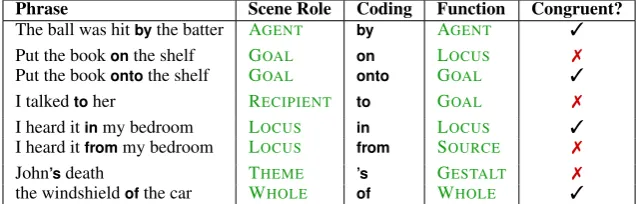
Following the construal approach, which is il-lustrated in table 1 for adpositions, we separate two semantic dimensions of an annotation target:
Scene Role: What semantic role is most closely as-sociated with the type of scene (typically indicated by the verb/predicate)?Function: What semantic role is most salient in the morphosyntactic coding of the phrase (with a grammatical relation like sub-ject or obsub-ject, or overt marking with closed-class morphology like adpositions and case)? Consider the following examples. Construal is notated by
SCENEROLE↝FUNCTION.
(3) [Jane]RECIPIENT↝AGENTbought[the book]POSSESSION↝THEME.
(4) [Bingley]SOCIALREL↝THEMEmarried
[Jane]SOCIALREL↝THEME.
The scene role indicates the participation role of the target in the scene described by the verb. Jane is the RECIPIENT in a transfer scene in (3), and
Phrase Scene Role Coding Function Congruent?
The ball was hitbythe batter AGENT by AGENT 3 Put the bookonthe shelf GOAL on LOCUS 7
Put the bookontothe shelf GOAL onto GOAL 3 I talkedtoher RECIPIENT to GOAL 7
I heard itinmy bedroom LOCUS in LOCUS 3 I heard itfrommy bedroom LOCUS from SOURCE 7
John’sdeath THEME ’s GESTALT 7
[image:3.595.139.460.63.165.2]the windshieldofthe car WHOLE of WHOLE 3
Table 1: SNACS for adpositions/possessives (Schneider et al.,2018b,a). The scene role and function annotations are labels from figure1and are often but not always congruent for a particular token. The function annotation reflects the semantics of the morphosyntactic coding (such as the choice of adposition). Note that, especially for adnominal PPs and genitives, the governor sometimes does not lexically denote an event or state; rather, a semantic relation such as possession or part-whole is indicated by the morphosyntax.
orthogonal dimsension of agency which is more closely tied to syntactic realization: Jane is the
AGENTof the buying action, while the book is the
THEMEin (3); Jane and Bingley are theTHEMEs of the marriage in (4). Further examples are shown in figure2. In many cases, the scene role will be identical to the function. These are called congru-ent construals. But in other cases, they can differ, as illustrated in table1.
In the rest of the section, we discuss a few dif-ficult cases while assessing SNACS labels for the annotation of subject and objects, and decisions made regarding these challenges including slight deviations from the latest SNACS standards.
Scene role prioritization. In some cases, multi-ple supersenses are equally applicable at the scene level. In such cases, we give highest priority to more complex and less frequent scene types such as transfer (ORIGINATOR,RECIPIENT) or employee-organization (or social) relations (ORGMEMBER,
ORG, SOCIALREL). The causal roles (AGENT,
INSTRUMENT,THEME), if appearing in the scene
position, are prioritized next. The highly frequent locative scenes (LOCUS, SOURCE, GOAL) are given the lowest priority. In example (10), the subject “I” could be considered either a metaphor-ical source location of the recommendation (i.e.,
SOURCE) or can be considered the speaker in a
communication event (i.e.,ORIGINATOR). The
lat-ter scene is prioritized, and the scene rolesORIGI
-NATOR,TOPIC(i.e., the message), andRECIPIENT
reflect the prioritized choice.
(10) [I]ORIGINATOR↝AGENTrecommended[the book]TOPIC↝TOPIC[tohim]RECIPIENT↝GOAL.
Transfer of possession often implies change of location, and being a part of something often im-plies being located in it. If both are salient, for the scene role annotation, we prioritize the more
complex scene over the locative semantics:
(11) [Jane]RECIPIENT↝AGENT took the book from me.
(12) I relinquished the book[to
Jane]RECIPIENT↝GOAL.
(13) At the play, he spotted Mary[inthe cast]ORG↝LOCUS.
In (11,12), Jane is arguably aGOALof motion by virtue of being aRECIPIENTof something physi-cal. We do not useGOALas the scene role, how-ever, ifRECIPIENTapplies. In (13), Mary can be understood as part of the cast (which is an orga-nization) or as located within the cast. We prior-itize the former. Other pairs that tend to overlap include: RECIPIENT/BENEFICIARY, closely cor-related when someone is given or told something for their benefit or harm—we prioritizeRECIPIENT
for the scene role; andSTIMULUS/TOPIC, closely correlated when a thought or message triggers an emotional reaction—we prioritizeSTIMULUSfor
the scene role.
If two equally prioritized scenes are in conflict with one another, we rely on the semantics of the predicate to disambiguate the scene. Note that in (14), CJ is likely an employee of the White House. However, CJ is not considered theORGMEMBER
as the verb “brief” does not intrinsically conven-tionalize the employee-organization relationship in its semantics. With a predicate that conven-tionally encodes employment or some other sta-ble relationship—employ,hire,workfor/at, etc.—
ORGMEMBERwould be annotated.
(14) [CJ]ORIGINATOR↝AGENTbriefs the press[forthe White House]ORG↝BENEFICIARY.
(5) a. [Rachel]AGENT↝AGENTopened[the door]THEME↝THEME[withthe remote control]INSTRUMENT↝INSTRUMENT. b. [The remote control]INSTRUMENT↝INSTRUMENTopened[the door]THEME↝THEME.
c. [I]AGENT↝AGENTused[the remote control]INSTRUMENT↝INSTRUMENT[toopen the door]PURPOSE↝PURPOSE. d. [The door]THEME↝THEMEopened.
(6) [Rachel]THEME↝THEMEsneezed.
(7) [Rachel]EXPERIENCER↝AGENTwatched[the children playing]STIMULUS↝THEME.
(8) [Rachel]EXPERIENCER↝THEMEheard[the noise]STIMULUS↝THEME.
(9) [Rachel]AGENT↝AGENTspent[$5]COST↝COST[oncoffee]POSSESSION↝THEME.
Figure 2: Annotated examples from our guidelines.
labels such asAGENTorTHEMEto appear multi-ple times in a given scene, opting for the use of a “Co-” label for the second participant sharing the same role (e.g.,CO-AGENT). In applying SNACS guidelines for subjects and objects, this became untenable, as “Co-” prefixation could apply to a good majority of thePARTICIPANTlabels, threat-ening a quick proliferation of the supersenses. E.g., (4) would require CO-SOCIALREL, (16) would re-quire CO-EXPERIENCER, and so forth. In an effort to keep the supersense inventory limited, we di-verge from the latest SNACS standards to allow role duplication in a scene. This is allowed even when targets assigned the same role are not fully symmetric or are qualitatively distinct as in (17).
(15) [A reception]THEME↝THEMEwill precede[the dinner]THEME↝THEME.
(16) [He]EXPERIENCER↝THEMEheard the news[witha stranger]EXPERIENCER↝ACCOMPANIER.
(17) Replace[the old one]THEME↝THEME[withthe new one]THEME↝ACCOMPANIER.
Thematic hierarchy. As discussed above, the function label generally reflects AGENT-THEME
relations of a proposition. More specifically, we annotate all subjects anddirectobjects with a func-tion in the following thematic hierarchy: {AGENT,
CAUSER} > {INSTRUMENT,MEANS} > {THEME,
TOPIC, COST}. In a transitive clause, the
super-sense of the subject cannot be ranked lower than the direct object (e.g., a subject construed as aTHEME
cannot have a direct object construed as anAGENT).
Indirect objects in the English double object con-struction4are treated asRECIPIENTconstruals.
(18) I sent[John]RECIPIENT↝RECIPIENTa cake.
(19) I sent a cake[toJohn]RECIPIENT↝GOAL.
(20) I baked[John]RECIPIENT↝RECIPIENTa cake.
(21) I paid[John]RECIPIENT↝RECIPIENT[$10]COST↝COST.
4If there is a single overt object, we treat it as an indirect object if what would normally be a direct object is implicit: e.g.,Johnis treated as an indirect object inI told John.(where the content of what is told is implicit).
Copular sentences. These are treated differently from non-copular sentences. The English copula relates a subject to an object in what is semantically an identificational (22a) or predicational (22b) re-lationship. To these cases we assign IDENTITY
-IDENTITYorGESTALT-CHARACTERISTICat the
scene level, respectively. Roughly speaking,IDEN
-TITY indicates the identified or identifying
cate-gory or referent, andCHARACTERISTICindicates a property being ascribed to theGESTALT:
(22) a. [John]IDENTITY↝IDENTITYis[a man]IDENTITY↝IDENTITY. b. [John]GESTALT↝THEMEis
[tall]CHARACTERISTIC↝CHARACTERISTIC.
Open issues. The unresolved problem of
causatives and caused-motion constructions is discussed in appendixA.
4 Interannotator Agreement Study
Data. We piloted our guidelines using a sample of 100 scenes from the English UCCA-annotated Wiki corpus5as detailed byAbend and Rappoport
(2013). UCCA is a scheme for annotating coarse-grained predicate-argument structure such that syntactically varied paraphrases and translations should receive similar analyses. It captures both static and dynamic scenes and their participants, but does not mark semantic roles.
Annotators. Four annotators (A, B, C, D), all authors of this paper, took part in this study. All are computational linguistics researchers.
Datasets. Prior to development of guidelines for subjects and objects, one of the annotators (Anno-tator A) sampled 106 Wiki documents (44k tokens) and tagged all 10k instances of UCCA Participants6 with a supersense based on the existing guidelines
5
http://cs.huji.ac.il/~oabend/ucca.html; the Wikipedia corpus contains 369 documents (biographies of entertainment industry figures) with 159k tokens and 36k Participant units.
6
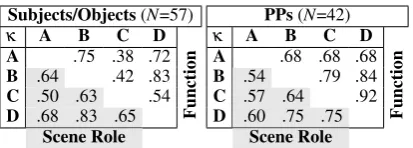
Subjects/Objects(N=57) κ A B C D A .75 .38 .72
Function
B .64 .42 .83
C .50 .63 .54
D .68 .83 .65
Scene Role
PPs(N=42) κ A B C D A .68 .68 .68
Function
B .54 .79 .84
C .57 .64 .92
D .60 .75 .75
[image:5.595.80.287.60.134.2]Scene Role
Table 2: Cohen’s Kappa scores for interannotator agree-ment for all pairings of four annotators.
for adpositions. This preliminary dataset was used to stimulate discussion for developing guidelines for subjects and objects. Once the new guidelines were written, four annotators first annotated a prac-tice dataset of 48 UCCA Participant tokens, then adjudicated disagreements through discussion and clarified certain policies before annotating a final sample of 100 tokens for measuring agreement.7 Participant units were sampled based on the pre-liminary annotation, stratified across subtypes of
PARTICIPANTandCONFIGURATIONto ensure
di-versity. In the final sample, the syntactic distribu-tion is as follows: 31 subjects (including 4 passive subjects and 6 copular subjects); 26 objects (includ-ing 1 indirect object and 2 copular complements); 42 PPs; and 1 possessive.
Coverage of the hierarchy. Under thePARTIC
-IPANT tree in the hierarchy, there are 12
super-senses, of which 11 were used as scene roles and 9 as functions. (By design,PARTICIPANTitself is never used and exists only to organize the hierar-chy.) TheCONFIGURATIONtree includes 19 super-senses, of which 14 were used as scene roles and 10 as functions. In theCIRCUMSTANCEtree—which primarily applies to syntactic adverbials—GOAL,
LOCUS, SOURCE, MANNER, MEANS, and CIR
-CUMSTANCEwere all used as functions, and all but
SOURCEalso appeared as a scene role.
Quantitative IAA results. We first compare agreement on two subsamples: the subject/object Participants, and the prepositional phrase Partici-pants. Pairwise Cohen’sκscores appear in table2.
Subjects/objects: For the scene role, all anno-tators agree on 46% of items (26/57), and at least 3 annotators on 84%. For the function, 51% have total agreement, and 86% have a majority. Average pairwiseκis 0.66 for scene and 0.61 for function.
PPs: At the scene level, 48% (20/42) have to-tal agreement, and 71% have a majority. For the function, 64% have total agreement, and 88% have a majority. Average pairwiseκ is 0.64 for scene and 0.77 for function.
7
4 tokens where annotators noticed a problem with the UCCA annotation were discarded and replaced.
Thus subjects/objects (SOs) receive higher scene role agreement than PPs—somewhat surprising given that the labels were originally designed for prepositions! This may be an artifact of the par-ticular sample, or may indicate that the scene role is more intuitive for SOs than for PPs. PPs have higher agreement than SOs with respect to function; this may be due to some difficulty deciding between
AGENTandTHEMEfor the function of SOs, plus the availability of extensive guidelines/examples for prepositional SNACS annotation.8
Disagreements involving agentivity. We found it can be difficult to choose betweenAGENTand
THEMEfor the function of a subject with borderline agentivity, e.g., in scenes ofbefriendingsomeone orforminga musical group with others. Likewise, the line betweenAGENTandTHEMEfor the func-tion can be unclear in cognifunc-tion/percepfunc-tion scenes like[She]enjoyed the fameand[She]saw the so-cial scene as tedious and superfiso-cial. We decided the annotator should consider whether the scene involves judgment or is more of a passive experi-ence;EXPERIENCER↝THEMEwould thus apply to the first example andEXPERIENCER↝AGENTto
second.9 Finally, the line betweenCAUSERandIN
-STRUMENTcan be unclear in sentences likeI was
hit[bya car]andI was quoted[bya magazine].
UCCA issues. We found a handful of UCCA an-notation errors—primarily where two verbs were analyzed as separate scenes but the first ought to be considered a light verb. A more interesting case was the relation between the two bolded ex-pressions in William S. Paley set terms that in-cluded. . .ownershipof the negative at the end of
the contract.The UCCA annotation treatsWilliam
S. Paley as a Participant of ownership (i.e., the owner). Though POSSESSOR is a natural scene role for the owner of something, we concluded that this was an indirect inference not suitable for annotating with a function.
5 Conclusion
We explored whether a system for semantic relation annotation can be extended beyond prepositions and possessives to cover English subjects and ob-jects. While initial annotation results are promising, further work is needed to substantiate the approach on a larger scale, and ideally in multiple languages.
8
Raw agreements are higher than kappa, but the same trends hold.
9
Acknowledgments
We would like to thank Jakob Prange and anony-mous reviewers for their feedback. This research was supported in part by NSF award IIS-1812778 and grant 2016375 from the United States–Israel Binational Science Foundation (BSF), Jerusalem, Israel.
References
Omri Abend and Ari Rappoport. 2013. Universal Con-ceptual Cognitive Annotation (UCCA). InProc. of ACL, pages 228–238, Sofia, Bulgaria.
David Dowty. 1991. Thematic proto-roles and argu-ment selection.Language, 67(3):547–619.
Charles J. Fillmore. 1968. The case for case. In Em-mon Bach and Robert Thomas Harms, editors, Uni-versals in Linguistic Theory, pages 1–88. Holt, Rine-hart, and Winston, New York.
Charles J. Fillmore. 1982. Frame Semantics. In Lin-guistics in the Morning Calm, pages 111–137. Han-shin PubliHan-shing Co., Seoul, South Korea.
Charles J. Fillmore and Collin Baker. 2009. A frames approach to semantic analysis. In Bernd Heine and Heiko Narrog, editors,The Oxford Handbook of Lin-guistic Analysis, pages 791–816. Oxford University Press, Oxford, UK.
Adele E. Goldberg. 2006. Constructions at work: the nature of generalization in language. Oxford Uni-versity Press, Oxford.
Jena D. Hwang, Archna Bhatia, Na-Rae Han, Tim O’Gorman, Vivek Srikumar, and Nathan Schneider.
2017. Double trouble: the problem of construal
in semantic annotation of adpositions. InProc. of *SEM, pages 178–188, Vancouver, Canada.
Karin Kipper, Anna Korhonen, Neville Ryant, and Martha Palmer. 2008. A large-scale classification of English verbs.Language Resources and Evaluation, 42(1):21–40.
Beth Levin. 1993. English verb classes and alterna-tions: a preliminary investigation. University of Chicago Press, Chicago.
Martha Palmer, Daniel Gildea, and Paul Kingsbury.
2005. The Proposition Bank: An annotated
cor-pus of semantic roles. Computational Linguistics, 31(1):71–106.
Drew Reisinger, Rachel Rudinger, Francis Ferraro, Craig Harman, Kyle Rawlins, and Benjamin Van Durme. 2015. Semantic proto-roles. Transactions of the Association for Computational Linguistics, 3:475–488.
Nathan Schneider, Jena D. Hwang, Archna Bhatia, Na-Rae Han, Vivek Srikumar, Tim O’Gorman, Sarah R. Moeller, Omri Abend, Austin Blodgett, and Jakob
Prange. 2018a. Adposition and Case Supersenses
v2: Guidelines for English. arXiv:1704.02134 [cs.CL].
Nathan Schneider, Jena D. Hwang, Vivek Srikumar, Jakob Prange, Austin Blodgett, Sarah R. Moeller, Aviram Stern, Adi Bitan, and Omri Abend. 2018b.
Comprehensive supersense disambiguation of En-glish prepositions and possessives. InProc. of ACL, pages 185–196, Melbourne, Australia.
A Open Issues
Sometimes a sentence will construe a scene as in-volving more arguments than a predicate normally licenses, as in the following causative or caused-motion examples (Goldberg,2006):
(23) [Rachel]THEME↝?sneezed(implicit: blew)[the
napkin]THEME↝THEME[off the table]PATH↝SOURCE.
(24) [Rachel]AGENT↝?(implicit: caused)jumped[the
horse]AGENT↝THEME[over the fence]PATH↝PATH.