6551
Are You Looking? Grounding to Multiple Modalities in
Vision-and-Language Navigation
Ronghang Hu1, Daniel Fried1, Anna Rohrbach1, Dan Klein1, Trevor Darrell1, Kate Saenko2
1University of California, Berkeley 2Boston University
{ronghang,dfried,anna.rohrbach,klein}@cs.berkeley.edu,
[email protected],[email protected]
Abstract
Vision-and-Language Navigation (VLN) re-quires grounding instructions, such as turn right and stop at the door, to routes in a vi-sual environment. The actual grounding can connect language to the environment through multiple modalities, e.g.stop at the doormight ground into visual objects, while turn right might rely only on the geometric structure of a route. We investigate wherethe natural lan-guage empirically grounds under two recent state-of-the-art VLN models. Surprisingly, we discover that visual features may actuallyhurt these models: models which only use route structure, ablating visual features, outperform their visual counterparts in unseen new envi-ronments on the benchmark Room-to-Room dataset. To better use all the available modal-ities, we propose to decompose the grounding procedure into a set of expert models with ac-cess to different modalities (including object detections) and ensemble them at prediction time, improving the performance of state-of-the-art models on the VLN task.
1 Introduction
The Vision-and-Language Navigation (VLN) task (Anderson et al.,2018) requires an agent to nav-igate to a particular location in a real-world en-vironment, following complex, context-dependent instructions written by humans (e.g.go down the second hallway on the left, enter the bedroom and stop by the mirror). The agent must navigate through the environment, conditioning on the in-struction as well as the visual imagery that it ob-serves along the route, to stop at the location spec-ified by the instruction (e.g.the mirror).
Recent state-of-the-art models (Wang et al.,
2018; Fried et al., 2018b;Ma et al., 2019) have demonstrated large gains in accuracy on the VLN task. However, it is unclear whichmodalitythese
go past the couch … Instruction:
Route Structure:
Non-Visual Agent:
39.7%
success
go past the couch … Instruction:
Route Structure and
Visual Appearance: Visual
Agent:
40.5%
success
Prior Work
go past the couch … Instruction:
Route Structure and
Object Detections:
Object-based Agent:
41.6%
success
couch door lamp
chair stairs
Mixture-of-Experts
[image:1.595.310.518.213.375.2]Agent: 51.9% success
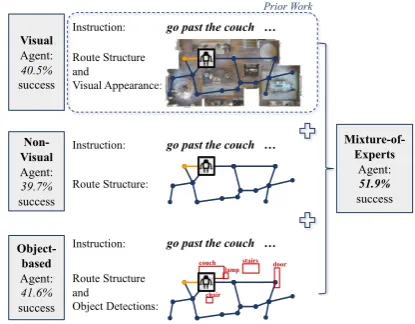
Figure 1: We factor the grounding of language instruc-tions into visual appearance, route structure, and object detections using a mixture-of-experts approach.
substantial increases in task metrics can be at-tributed to, and, in particular, whether the gains in performance are due to stronger grounding into visual context or e.g. simply into the discrete, geo-metric structure of possible routes, such as turning left or moving forward (see Fig.1, top vs. middle). First, we analyze to what extent VLN mod-els ground language into visual appearance and route structure by training versions of two state-of-the-art models without visual features, using the benchmark Room-to-Room (R2R) dataset ( Ander-son et al.,2018). We find that while grounding into route structure is useful, the models with visual features fail to learn generalizable visual ground-ing. Surprisingly, when trained without visual fea-tures, their performance on unseen environments is comparable or even better.
appearance of a specific table in a given environ-ment, detecting tables and other objects in scenes, mapping them into symbols, and grounding the text mentions into these symbols should general-ize better to unseen environments.
Finally, inspired by the complementary errors of visual and non-visual agents, we decompose the grounding process through a mixture-of-experts approach. We train separate visual and non-visual agents, encouraging each one to focus on a sepa-rate modality, and combine their predictions as an ensemble (see Fig.1). Our mixture-of-experts out-performs the individual agents, and is also better than the ensembles of multiple agents of the same modality (e.g. both visual or both non-visual).
Adding our object representation and mixture-of-experts approach to both state-of-the-art mod-els improves their success rate by over 10% (ab-solute) in novel environments, obtaining a 51.9% success rate on theval-unseensplit of the bench-mark R2R dataset (Anderson et al.,2018).
2 Related work
Vision and Language Navigation. Vision-and-Language Navigation (VLN) (Anderson et al.,
2018;Chen et al.,2019) unites two lines of work: first, of following natural language navigational instructions in an environmental context ( MacMa-hon et al.,2006;Vogel and Jurafsky,2010;Tellex et al., 2011; Chen and Mooney, 2011;Artzi and Zettlemoyer,2013;Andreas and Klein,2015;Mei et al., 2016; Fried et al., 2018a; Misra et al.,
2018), and second, of vision-based navigation tasks (Mirowski et al., 2017; Zhu et al., 2017;
Yang et al., 2019; Mirowski et al., 2018; Cirik et al., 2018) that use visually-rich real-world im-agery (Chang et al.,2017).
A number of methods for the VLN task have been recently proposed. Wang et al. (2018) use model-based and model-free reinforcement learn-ing to learn an environmental model and op-timize directly for navigation success. Fried et al.(2018b) use a separate instruction generation model to synthesize new instructions as data aug-mentation during training, and perform pragmatic inference at test time. Most recently, Ma et al.
(2019) introduce a visual and textual co-attention mechanism and a route progress predictor.
These approaches have significantly improved performance on the VLN task, when evaluated by metrics such as success rate. However, it
is unclear where the high performance comes from. In this paper, we find that agents with-out any visual input can achieve competitive per-formance, matching or even outperforming their vision-based counterparts under two state-of-the-art model models (Fried et al., 2018b;Ma et al.,
2019). We also explore two approaches to make the agents better utilize their visual inputs. The role of vision in vision-and-language tasks. In several vision-and-language tasks, high perfor-mance can be achieved without effective model-ing of the visual modality. Devlin et al. (2015) find that image captioning models can exploit reg-ularity in the captions, showing that a nearest-neighbor matching approach can achieve compet-itive performance to sophisticated language gen-eration models. Hendricks et al. (2018) and
Rohrbach et al.(2018) find that neural captioning models often ground object mentions into incor-rect objects due to correlations in the training data, and can hallucinate non-existing objects.
Recent work has also investigated single-modality performance in vision-and-language em-bodiment tasks.Anand et al.(2018) find that state-of-the-art results can be achieved on the Embod-iedQA task (Das et al.,2018) using an agent with-out visual inputs. Work concurrent to ours eval-uates the performance of single-modality mod-els for several embodied tasks including VLN (Thomason et al.,2019), finding that high perfor-mance can be achieved on the R2R dataset using a non-visual version of the baseline model ( Ander-son et al.,2018). In this paper, we show that the same trends hold for two recent state-of-the-art ar-chitectures (Ma et al., 2019; Fried et al., 2018b) for the VLN task; we also analyze to what ex-tent object-based representations and mixture-of-experts methods can address these issues.
3 State-of-the-art VLN models do not use vision effectively
in a connectivity graph determined by line-of-sight in the physical environment. See the top row of Fig.1for a top-down environment illustration.
In the VLN task, a virtual agent is placed at a particular viewpoint in an environment, and is given a natural language instruction (written by a human annotator) to follow. At each timestep, the agent receives the panoramic image for the view-point it is currently located at, and either predicts to move to one of the adjacent connected view-points, or to stop. When the agent predicts the stop action, it is evaluated on whether it has cor-rectly reached the end of the route that the human annotator was asked to describe.
In this work, we analyze two recent VLN mod-els, which typify the visual grounding approaches of VLN work: the panoramic “follower” model from the Speaker-Follower (SF) system of Fried et al.(2018b) and the Self-Monitoring (SM) model ofMa et al.(2019). These models obtained state-of-the-art results on the R2R dataset. Both mod-els are based on the encoder-decoder approach (Cho et al.,2014) and map an instruction to a se-quence of actions in context by encoding the in-struction with an LSTM, and outputting actions using an LSTM decoder that conditions on the en-coded instruction and visual features summarizing the agent’s environmental context. Compared to the SF model, the SM model introduces an im-proved visual-textual co-attention mechanism and a progress monitor component. We refer to the original papers for details on the two models.
To analyze the models’ visual grounding ability, we focus on their core encoder-decoder compo-nents. In our experiments, we use models trained without data augmentation, and during inference predict actions with greedy search (i.e. without beam search, pragmatic, or progress monitor-based inference). For SF, we use the publicly re-leased code. For SM, we use a reimplementation without the progress monitor, which was shown to be most important for search in inference (Ma et al.,2019).
We investigate how well these models ground instructions into visual features of the environ-ment, by training and evaluating them without ac-cess to the visual context: setting their visual fea-ture vectors to zeroes during training and testing. We compare performance on the validation sets of the R2R dataset: theval-seensplit, consisting of the same environments as in training, and the
val-model train. vis. SR on SR on
# arch. appr. feat. val-seen val-unseen
1
SF stud.-forc.
no vis. 29.7 31.7
2 RN 53.3 29.0
3 teach.-forc. no vis. 34.1 35.2
4 RN 40.4 29.0
5
SM stud.-forc.
no vis. 36.1 39.7
6 RN 62.8 40.5
7 teach.-forc. no vis. 34.3 32.2
8 RN 44.0 32.8
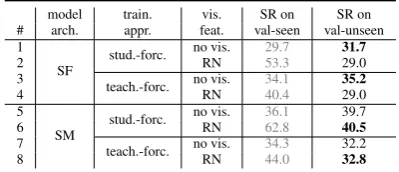
Table 1: Success rate (SR) of the vision-based full agent (“RN”, using ResNet) and the non-visual agent (“no vis.”, setting all visual features to zero) on the R2R dataset under different model architectures (Speaker-Follower (SF) (Fried et al.,2018b) and Self-Monitoring (SM) (Ma et al.,2019)) and training schemes.
unseensplit of novel environments. Since we aim to evaluate how well the agentsgeneralizeto the unseen environments, we focus on the val-unseen split. For both the SF and SM models, we train two versions of the agents, using either the student-forcing or teacher-student-forcing approaches ofAnderson et al.(2018)1, and select the best training snapshot
on the val-seen split.2 The results are shown in
Table 1. In each block, the two rows show the agent’s performance (under the specific model ar-chitecture and training approach) with or without access to the visual features (“RN”: ResNet-152 network (He et al.,2016), “no vis.”: non-visual).
While visual features improve performance on environments seen during training, we see that for the SF architecture the non-visual agent (lines 1 and 3) outperforms the visual agent (lines 2 and 4) on unseen environments under both student-forcing and teacher-student-forcing training. For SM, the non-visual agent (lines 5 and 7) has a success rate very close to the visual agent (lines 6 and 8). This indicates that these models do not learn generaliz-able visual perception, so that the visual features may actuallyhurtthem in unseen environments.
4 Object representation for better grounding and generalization
In both the SF and SM architectures, the agents use visual features from a pretrained ResNet-152 CNN (He et al., 2016). As the training data for the R2R dataset contains only 61 distinct environ-ments, the agents may overfit to the appearance of the training environments and thus struggle to
gen-1During training, the agent either follows the ground-truth
actions (teacher-forcing) or samples actions from its own pre-diction (student-forcing). See supplemental for more details.
2Following previous work, we use success rate (SR) as
[image:3.595.316.516.63.149.2]eralize. For example, for the instructiongo down the staircase, a model may learn to ground stair-caseinto a specific staircase in a given training en-vironment, and fail to generalize to staircases with different appearances or in different contexts in unseen environments. We thus propose an object-based representation, where object detection re-sults from a pretrained large-scale object detector are used as the environment representation. The object-based representation is intended to prevent overfitting to training scenes and to transfer to new environments better than CNN features.
Both the SF and SM models represent the sual appearance at each location with a set of vi-sual features{ximg,i}, whereximg,iis a vector
ex-tracted from an image patch at a particular orienta-tioniusing a CNN. Both models also use a visual attention mechanism to extract an attended visual feature ximg,att from {ximg,i}. For our
object-based representation, we use a Faster R-CNN (Ren et al.,2015) object detector trained on the Visual Genome dataset (Krishna et al., 2017). We con-struct a set of vectors {xobj,j} representing
de-tected objects and their attributes. Each vector xobj,j (j-th detected object in the scene) is a
con-catenation of summed GloVe vectors ( Penning-ton et al.,2014) for the detected object label (e.g. door) and attribute labels (e.g. white) and a loca-tion vector from the object’s bounding box coor-dinates. We then use the same visual attention mechanism as inFried et al.(2018b) andMa et al.
(2019) to obtain an attended object representation xobj,attover these{xobj,j}vectors. We either
sub-stitute the ResNet CNN featuresximg,att (“RN”)
with our object representation xobj,att (“Obj”),
or concatenateximg,att andxobj,att (“RN+Obj”).
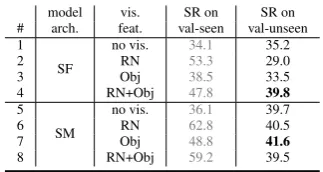
Then we train the SF model or the SM model us-ing this object representation, with results shown in Table2.3
For SF (lines 1–4), object representations sub-stantially improve generalization ability: using ei-ther the object representation (“Obj”) or the com-bined representation (“RN+Obj”) obtains higher success rate on unseen environments than us-ing only the ResNet features (“RN”), and the combined representation (“RN+Obj”) obtains the highest overall performance. For SM (lines 5–8),
3For each model and setting, we use the best training
mechanism as found in Table1, where student-forcing is used in all experiments except line 1 (where teacher-forcing is used to obtain the best performance for the non-visual agent under the SF architecture). See supplemental for more details.
model vis. SR on SR on
# arch. feat. val-seen val-unseen
1 SF
no vis. 34.1 35.2
2 RN 53.3 29.0
3 Obj 38.5 33.5
4 RN+Obj 47.8 39.8
5 SM
no vis. 36.1 39.7
6 RN 62.8 40.5
7 Obj 48.8 41.6
[image:4.595.335.497.64.150.2]8 RN+Obj 59.2 39.5
Table 2: Success rate (SR) of agents with different vi-sual inputs on the R2R dataset (“RN”: ResNet CNN, “Obj”: objects, “no vis.”: no visual representation). Models: Speaker-Follower (SF) (Fried et al., 2018b) and Self-Monitoring (SM) (Ma et al.,2019).
the model that uses only the object representation achieves the best performance (line 7). Here the success rates across the four settings are closer, and the improvement from object representation is smaller than for SF. However, in Sec.5we find that object representation can be combined with other inputs to further improve the performance.
5 Mixture-of-experts makes better use of all available information
While the agent with CNN visual features does not outperform its non-visual counterpart (Sec.3) on average, it often succeeds on individual instruc-tions where the non-visual model fails, indicat-ing the visual and non-visual modalities are com-plementary. To encourage grounding into both modalities, we ensemble visual and non-visual models in a mixture-of-experts approach.
5.1 Separate Training
We first ensemble the models from Sec. 3 and Sec.4at test time (after training them separately) by combining their predictions at each timestep.4
Lines 9–22 of Table 3 show ensembles of two models. Compared to single-model performance (line 1–8 in Table 2), an ensemble of a visual and a non-visual agent outperforms the individ-ual agents for both the SF and the SM models. The best performing setting is the combination of “RN” and “no vis.” (non-visual) in line 20 un-der the SM model. While it is unsurprising that the mixture-of-experts can boost performance, it is interesting to see that the best mixture in line 20 outperforms mixtures of two agents of the same type (two non-visual agents in line 16, two visual agents in line 17, trained from distinct random pa-rameter initializations), confirming that two agents 4We combine model predictions at each timestep by
model mix.-of-exp. SR on
# arch. comb. val-unseen
9
SF
(no vis., no vis.) 35.1
10 (RN, RN) 32.1
11
(mixture (Obj, Obj) 35.4
12
of 2 models) (RN+Obj, RN+Obj) 43.3
13 (RN, no vis.) 39.5
14 (Obj, no vis.) 38.4
15 (RN+Obj, no vis.) 43.1
16
SM
(no vis., no vis.) 41.0
17 (RN, RN) 43.5
18
(mixture (Obj, Obj) 45.2
19
of 2 models) (RN+Obj, RN+Obj) 42.2
20 (RN, no vis.) 46.9
21 (Obj, no vis.) 43.4
22 (RN+Obj, no vis.) 46.4
23 SM (3-way mix.) (RN, Obj, no vis.) 49.5
24 SM (RN, no vis.) 48.3
25 (joint training) (RN, Obj, no vis.) 51.9
Table 3: Success rate (SR) of different mixture-of-experts ensembles. Models: Speaker-Follower (SF) (Fried et al., 2018b) and Self-Monitoring (SM) (Ma et al.,2019); “RN”: ResNet CNN, “Obj”: objects, “no vis.”: no visual representation.
with access to different modalities can comple-ment each other, especially in the SM model.
We also experiment with a 3-way mixture in the SM model, combining a visual agent with ResNet CNN features, a visual agent with object features, and a non-visual agent (line 23). This mixture out-performs all the 2-way mixtures by a noticeable margin, showing that the CNN and object-based visual representations are also complementary.
5.2 Joint Training
Finally, given the success of this simple test-time ensemble, we also explore jointly training these models by building a single agent which uses a single instruction encoder shared between mul-tiple (visual and non-visual) jointly-trained de-coders. During joint training, each decoder is su-pervised to predict the true actions, applying the same loss function as in separate training. During testing, actions are predicted by averaging logits from the separate decoders as in Sec.5.1. We ex-periment with jointly training the agents in each of the two best-performing combinations (RN, no vis.) and (RN, Obj, no vis.) under the SM archi-tecture (line 24 and 25 of Table3). From line 24 vs. 20 and line 25 vs. 23, joint training gives higher performance than training each model separately and combining them only at test time. Overall, we obtain 51.9% final success rate on the val-unseen split (line 25), which is over 10% (absolute) higher than the SF or SM baselines using a single decoder with CNN features (line 2 and 6 in Table2).5
5On the val-seen split, we maintain performance
compa-rable to the original SM model.
6 Discussion
The success of non-visual versions of two recent state-of-the-art VLN models, often outperform-ing their vision-based counterparts in unseen en-vironments on the benchmark R2R dataset, shows that these models do not use the visual inputs in a generalizable way. Our intuition is that, while language has rich, high-level symbolic meaning, which can be easily matched to the modality of the route structures, pixel-based visual representa-tions, even those extracted via CNNs, are a lower-level modality which require more data to learn, and so a model trained on both modalities may learn to mostly rely on the route structure. This is also supported by the results in Table3(line 23 vs. line 20), where adding higher-level object rep-resentations improves the success rate by 2.6%.
Notably, an agent in the R2R environment is only able to move to a discrete set of locations in the environment, and at each point in time it only has a small number of actions available, de-termined by the environment’s connectivity graph (i.e., moving to the adjacent locations). These con-straints on possible routes help explain our find-ings that language in the VLN instructions often grounds into geometric route structure in addition to visual context along the route. For example, if an instruction saysturn left at the couch, and the route structure only allows the agent to turn left at a single location, it may not need to perceive the couch. Other instructions, such asgo straight for 5 meters and stopmay also be carried out without access to visual perception.
The improvement of our mixture-of-experts ap-proach over single models suggests that it is chal-lenging to learn to ground language into multiple modalities in one model. The “RN+Obj” model (Table 2, line 8) has access tothe same informa-tion as our best result in Table3, line 25, but ob-tains much lower success rate (39.5% vs. 51.9%). Thus, splitting the prediction task across several models, where each has access to a different input modality, is an effective way to inject an inductive bias that encourages the model to ground into each of the modalities.
[image:5.595.84.278.63.220.2]References
Ankesh Anand, Eugene Belilovsky, Kyle Kastnerand, Hugo Larochelle, and Aaron Courville. 2018. Blindfold baselines for embodied qa. arXiv preprint arXiv:1811.05013.
Peter Anderson, Qi Wu, Damien Teney, Jake Bruce, Mark Johnson, Niko S¨underhauf, Ian Reid, Stephen Gould, and Anton van den Hengel. 2018. Vision-and-language navigation: Interpreting visually-grounded navigation instructions in real environ-ments. In Proceedings of the IEEE Conference on Computer Vision and Pattern Recognition (CVPR). Jacob Andreas and Dan Klein. 2015.
Alignment-based compositional semantics for instruction fol-lowing. InProceedings of the Conference on Em-pirical Methods in Natural Language Processing (EMNLP).
Yoav Artzi and Luke Zettlemoyer. 2013. Weakly su-pervised learning of semantic parsers for mapping instructions to actions. Transactions of the Associa-tion for ComputaAssocia-tional Linguistics, 1(1):49–62. Dzmitry Bahdanau, Kyunghyun Cho, and Yoshua
Ben-gio. 2015. Neural machine translation by jointly learning to align and translate. In Proceedings of the International Conference on Learning Represen-tations (ICLR).
Angel Chang, Angela Dai, Thomas Funkhouser, Ma-ciej Halber, Matthias Niebner, Manolis Savva, Shu-ran Song, Andy Zeng, and Yinda Zhang. 2017. Mat-terport3d: Learning from rgb-d data in indoor envi-ronments. In2017 International Conference on 3D Vision (3DV), pages 667–676. IEEE.
David L. Chen and Raymond J. Mooney. 2011. Learn-ing to interpret natural language navigation instruc-tions from observainstruc-tions. InProceedings of the Con-ference on Artificial Intelligence (AAAI).
Howard Chen, Alane Shur, Dipendra Misra, Noah Snavely, and Yoav Artzi. 2019. Touchdown: Natural language navigation and spatial reasoning in visual street environments. In Proceedings of the IEEE Conference on Computer Vision and Pattern Recog-nition (CVPR).
Kyunghyun Cho, Bart Van Merri¨enboer, Dzmitry Bah-danau, and Yoshua Bengio. 2014. On the properties of neural machine translation: Encoder-decoder ap-proaches. arXiv preprint arXiv:1409.1259.
Volkan Cirik, Yuan Zhang, and Jason Baldridge. 2018. Following formulaic map instructions in a street simulation environment. In Visually Grounded Interaction and Language (ViGIL) Work-shop, NeurIPS.
Abhishek Das, Samyak Datta, Georgia Gkioxari, Ste-fan Lee, Devi Parikh, and Dhruv Batra. 2018. Em-bodied question answering. In Proceedings of the IEEE Conference on Computer Vision and Pattern Recognition (CVPR).
Jacob Devlin, Hao Cheng, Hao Fang, Saurabh Gupta, Li Deng, Xiaodong He, Geoffrey Zweig, and Mar-garet Mitchell. 2015. Language models for image captioning: The quirks and what works. In Proceed-ings of the 53rd Annual Meeting of the Association for Computational Linguistics and the 7th Interna-tional Joint Conference on Natural Language Pro-cessing of the Asian Federation of Natural Language Processing, ACL 2015, July 26-31, 2015, Beijing, China, Volume 2: Short Papers.
Daniel Fried, Jacob Andreas, and Dan Klein. 2018a. Unified pragmatic models for generating and follow-ing instructions. InProceedings of the Conference of the North American Chapter of the Association for Computational Linguistics (NAACL).
Daniel Fried, Ronghang Hu, Volkan Cirik, Anna Rohrbach, Jacob Andreas, Louis-Philippe Morency, Taylor Berg-Kirkpatrick, Kate Saenko, Dan Klein, and Trevor Darrell. 2018b. Speaker-follower mod-els for vision-and-language navigation. InAdvances in Neural Information Processing Systems (NIPS). Kaiming He, Xiangyu Zhang, Shaoqing Ren, and Jian
Sun. 2016. Deep residual learning for image recog-nition. InProceedings of the IEEE Conference on Computer Vision and Pattern Recognition (CVPR), pages 770–778.
Lisa Anne Hendricks, Kaylee Burns, Kate Saenko, Trevor Darrell, and Anna Rohrbach. 2018. Women also snowboard: Overcoming bias in captioning models. InEuropean Conference on Computer Vi-sion, pages 793–811. Springer.
Sepp Hochreiter and J¨urgen Schmidhuber. 1997. Long short-term memory. Neural computation, 9(8):1735–1780.
Ranjay Krishna, Yuke Zhu, Oliver Groth, Justin John-son, Kenji Hata, Joshua Kravitz, Stephanie Chen, Yannis Kalantidis, Li-Jia Li, David A Shamma, et al. 2017. Visual genome: Connecting language and vision using crowdsourced dense image anno-tations. International Journal of Computer Vision, 123(1):32–73.
Chih-Yao Ma, Jiasen Lu, Zuxuan Wu, Ghassan Al-Regib, Zsolt Kira, Richard Socher, and Caiming Xiong. 2019. Self-monitoring navigation agent via auxiliary progress estimation. InProceedings of the International Conference on Learning Representa-tions (ICLR).
Matt MacMahon, Brian Stankiewicz, and Benjamin Kuipers. 2006. Walk the talk: Connecting language, knowledge, and action in route instructions. In Pro-ceedings of the Conference on Artificial Intelligence (AAAI).
Piotr Mirowski, Matt Grimes, Mateusz Malinowski, Karl Moritz Hermann, Keith Anderson, Denis Teplyashin, Karen Simonyan, Andrew Zisserman, Raia Hadsell, et al. 2018. Learning to navigate in cities without a map. InAdvances in Neural Infor-mation Processing Systems (NIPS).
Piotr Mirowski, Razvan Pascanu, Fabio Viola, Hu-bert Soyer, Andrew J Ballard, Andrea Banino, Misha Denil, Ross Goroshin, Laurent Sifre, Koray Kavukcuoglu, et al. 2017. Learning to navigate in complex environments. InProceedings of the Inter-national Conference on Learning Representations (ICLR).
Dipendra Misra, Andrew Bennett, Valts Blukis, Eyvind Niklasson, Max Shatkhin, and Yoav Artzi. 2018. Mapping instructions to actions in 3d environments with visual goal prediction. In Proceedings of the 2018 Conference on Empirical Methods in Natural Language Processing, pages 2667–2678.
Jeffrey Pennington, Richard Socher, and Christopher Manning. 2014. Glove: Global vectors for word representation. InProceedings of the 2014 confer-ence on empirical methods in natural language pro-cessing (EMNLP), pages 1532–1543.
Shaoqing Ren, Kaiming He, Ross Girshick, and Jian Sun. 2015. Faster r-cnn: Towards real-time ob-ject detection with region proposal networks. In Advances in neural information processing systems, pages 91–99.
Anna Rohrbach, Lisa Anne Hendricks, Kaylee Burns, Trevor Darrell, and Kate Saenko. 2018. Object hal-lucination in image captioning. In Proceedings of the Conference on Empirical Methods in Natural Language Processing (EMNLP).
Stefanie Tellex, Thomas Kollar, Steven Dickerson, Matthew R Walter, Ashis Gopal Banerjee, Seth J Teller, and Nicholas Roy. 2011. Understanding nat-ural language commands for robotic navigation and mobile manipulation. InAAAI, volume 1, page 2.
Jesse Thomason, Daniel Gordon, and Yonatan Bisk. 2019. Shifting the baseline: Single modality perfor-mance on visual navigation & qa. InConference of the North American Chapter of the Association for Computational Linguistics (NAACL).
Adam Vogel and Dan Jurafsky. 2010. Learning to fol-low navigational directions. In Proceedings of the 48th Annual Meeting of the Association for Compu-tational Linguistics, pages 806–814. Association for Computational Linguistics.
Xin Wang, Wenhan Xiong, Hongmin Wang, and William Yang Wang. 2018. Look before you leap: Bridging model-free and model-based rein-forcement learning for planned-ahead vision-and-language navigation. In Proceedings of the Eu-ropean Conference on Computer Vision (ECCV), pages 37–53.
Wei Yang, Xiaolong Wang, Ali Farhadi, Abhinav Gupta, and Roozbeh Mottaghi. 2019. Visual seman-tic navigation using scene priors. InProceedings of the International Conference on Learning Represen-tations (ICLR).