20
Multimodal Relational Tensor Network for Sentiment and Emotion
Classification
Saurav Sahay Shachi H Kumar Rui Xia Jonathan Huang Lama Nachman
Anticipatory Computing Lab Intel Labs
{saurav.sahay, shachi.h.kumar, rui.xia, Jonathan.Huang, lama.nachman} @intel.com
Abstract
Understanding Affect from video seg-ments has brought researchers from the language, audio and video domains to-gether. Most of the current multimodal re-search in this area deals with various tech-niques to fuse the modalities, and mostly treat the segments of a video indepen-dently. Motivated by the work of (Zadeh et al., 2017) and (Poria et al., 2017), we present Relational Tensor Network archi-tecture where we use the inter-modal in-teractions within a segment and also con-sider the sequence of segments in a video to model the inter-segment inter-modal in-teractions. We also generate rich repre-sentations of text and audio modalities by leveraging richer audio and linguistic con-text alongwith fusing fine-grained knowl-edge based polarity scores from text. We present the results of our model on CMU-MOSEI dataset and show that our model outperforms many baselines and state of the art methods for sentiment classifica-tion and emoclassifica-tion recogniclassifica-tion.
1 Introduction
Sentiment Analysis is broadly defined as the com-putational study of subjective elements such as opinions, attitudes, and emotions towards other objects or persons. Sentiments attach to modali-ties such as text, audio and video at different lev-els of granularity and are useful in deriving so-cial insights about various entities such as movies, products, persons or organizations. Emotion Un-derstanding is another closely related field that commonly deals with analysis of audio, video, and other sensory signals for getting psychologi-cal and behavioral insights about an individual’s mental state. Emotions are defined as brief organ-ically synchronized evaluations of major events
whereas sentiments on the other hand are consid-ered as more enduring beliefs and dispositions to-wards objects or persons (Scherer, 1984). The field of Emotion Understanding has rich litera-ture with many interesting models of understand-ing (Plutchik,2001) (Ekman,2009) (Posner et al., 2005).
In this work, we explore methods that com-bine various unimodal techniques for classifi-cation alongwith multimodal techniques for fu-sion of cross modal interactions to perform sen-timent analysis and emotion understanding. We develop and test our approaches on the CMU-MOSEI dataset (Zadeh et al., 2018d) as part of the ACL Multimodal Emotion Recognition grand challenge. CMU Multimodal Opinion Sentiment and Emotion Intensity (CMU-MOSEI) dataset is a newly released large dataset of multimodal sentiment analysis and emotion recognition on YouTube video segments. The dataset contains more than 23,500 sentence utterance videos from more than 1000 online YouTube speakers. The dataset has several interesting properties such as being gender balanced, containing various topics and monologue videos from people with different personality traits. The videos are manually tran-scribed and properly punctuated. Since the dataset comprises of natural audio-visual opinionated ex-pressions of the speakers, it provides an excellent testbed for research in emotion and sentiment un-derstanding. The videos are cut into continuous segments and the segments are annotated with 7 point scale sentiment labels and 4 point scale emo-tion categories corresponding to the Eckman’a 6 basic emotion classes (EKMAN,2002). The opin-ionated expressions in the segments contain visual cues, audio variations in signal as well textual ex-pressions showing various subtle and non-obvious interactions across the modalities for both senti-ment and emotion classification.
lit-erature is (i) application of a novel cross modal fu-sion technique across the temporal segments of the multimodal channel (ii) use of rich shallow seman-tic domain knowledge that include a large num-ber of psycholinguistic features and resources for sentiment and emotion classification and (iii) ex-traction of emotion aware acoustic phoneme level features using a novel method and architecture.
Our unimodal research focus in this paper is an exploration of speech sentiment and emotion recognition using various text dependent and text independent techniques. On the text modality experiments, we’ve explored (i) fusion of Lexi-cons as additional input features (ii) fusion of po-larity discriminating lexico-syntactic fine-grained scores as additional input features (iii) fusion of rich contextualized embeddings as additional in-put features to the classification pipeline. On au-dio modality, we’ve used a novel pipeline to gen-erate the iVectors and Phoneme level utterance features. For fusion of multimodal information, we have explored techniques that leverage intra-modal and inter-intra-modal dynamics and fused them together in a novel Relational Tensor Network ar-chitecture.
2 Related Work
Sentiment Analysis has received a lot of prior at-tention in Movie reviews and Product reviews do-main and is an established field of research in NLP (Liu,2010) (Pang and Lee,2008). However, this hasn’t been widely researched in conversa-tional multimodal audio-visual and textual context for continuous recognition of sentiments and emo-tions. (Kaushik et al.,2013) perform sentiment ex-traction on natural audio streams using ASR on Youtube videos. They use a maximum entropy classifier and do not use any lexicon features or do any domain adaptation. Multimodal Affect recog-nition has lately gained a lot of popularity with re-lease of multiple datasets and approaches (Zadeh et al.,2018c) (Zadeh et al.,2018b). (Zadeh et al., 2017) present a tensor fusion technique to gener-ate a fused representation of the individual modal-ities. Most of these techniques treat the segments of a video independently and ignore the temporal relations and interactions between the segments of a video. (Poria et al., 2017) present an LSTM based network architecture that leverages the con-text or the temporal interactions between neigh-boring segments of a video by concatenation of
cross modal features across the segments. For acoustic emotion recognition, one of the most suc-cessful system is based on the super-segmental acoustic features which is extracted by applying multiple functions on frame-level features. These features have been adopted as the baseline system in many acoustic emotion challenges (Schuller et al., 2016) (Valstar et al., 2016) (Dhall et al., 2013). Deep learning techniques have also been used in acoustic emotion recognition system in re-cent years. In (Neumann and Vu, 2017), convo-lutional neural network (CNN) is applied on the frame-level feature. In (Tao and Liu,2017), recur-rent neural network (RNN) is used to model the temporal information for emotion recognition sys-tem.
3 Model Description
This work brings together techniques for various modality specific feature extraction methods and fusion of information from different modalities for Sentiment and Emotion Classification. The grand challenge dataset comes with modality spe-cific features for text, audio and images as a part of the CMU Multimodal Data SDK (Zadeh et al., 2018a). The text features are based on Glove em-beddings (Pennington et al.,2014), audio features are based on COVAREP (Degottex et al.,2014)and the visual features based on FACET (Baltruaitis et al.,2016) visual feature extraction libraries. We extracted various additional features for text and audio modalities as described in the following sec-tions.
3.1 Text
Several traditional methods have been developed in Sentiment Analysis technology for decades be-fore the recent advances in deep learning that pri-marily rely on methods for word vector represen-tation and automated feature discovery from snip-pets. We look at modeling some of the tradi-tional methods and features in the deep pipeline and study the impact of these on the classifiers. Below, we describe a couple of traditional knowl-edge based resources alongwith some recent deep representations that we have fused together in our pipeline.
3.1.1 Lexico-syntactic Rule based features
Figure 1: Sentiment Analyzer
with world knowledge to extract meaningful in-ferences such as sentiments and emotions. We have explored the use of VADER rules (Hutto and Gilbert, 2014) for sentiment and emotion in-duction. VADER is a simple and fast rule-based model for general sentiment analysis. It utilizes a human-validated general sentiment lexicon and general rules related to grammar and syntax. The goal of this work is to capture generalizable rules and heuristics associated with grammatical and syntactical cues people use to assess sentiment in-tensity in text. We can clearly see from Figure1 how this system can differentiate emphasis, inten-sity and non-linguistic cues from utterances. Deep learning based systems today fail to capture such systematic nuances deterministically.
3.1.2 Sentiment Lexicons
Lexicons consists of maps of key-value pairs, where the key is a word and the value is a list of sentiment scores for that word (e.g., probabil-ities of the word in positive, neutral, and nega-tive contexts). The scores have different ranges for showing very negative to very positive senti-ments. Lexicon embeddings are sparse signals de-rived by taking the normalized scores from mul-tiple sources of lexicon datasets. The simplest method of blending a lexicon embedding into its corresponding word embedding is to append it to the end of the word embedding. The General Inquirer(GI) (Stone et al., 1966) is a text analy-sis application with one of the oldest manually constructed lexicons still in widespread use. It contains 11000 words in 183 different psycho-linguistic categories. We have used the lexi-con based General Inquirer classes that are vided into groups such as valence, semantic di-mensions, cognitive orientation, institutional con-text, motivation related words, classes of Power, Respect, Affection, Wealth, Well-being, Enlight-enment, Skill, etc.. (Shin et al.,2017) who orig-inally explored this work in depth show that lex-icon embeddings allow building high-performing
models with much smaller word embeddings.
3.1.3 Contextualized Language Embeddings
In contrast to the above two features, we have also looked at recent developments in contextu-alized deep word vector representations and how they can help with sentiment and emotion classifi-cation. These word vectors are learned functions of the internal states of a deep bidirectional lan-guage model, which is pretrained on a large text corpus. The additional language modeling views to vector generation process results in high quality representations (Peters et al., 2018). These word vector representations try to model the complex characteristics of word use along with how these uses vary across linguistic contexts (i.e., to model polysemy). We have used ELMo that learns a linear combination of the vectors stacked above each input word for each end task, which im-proves performance over just using the top LSTM layer (McCann et al.,2017) . Unlike most widely used word embeddings (Pennington et al.,2014), ELMo word representations are functions of the entire input sentence
3.2 Audio Features
For this task, three different kinds of features were applied. The first one is the feature set extracted by using COVAREP which is provided by the chal-lenge. It includes multiple kinds of frame level acoustic features, such as Mel-frequency Cepstral Coefficients (MFCCs), energy and etc. More de-tails are described in (Gusfield,1997). Along with COVAREP features, we proposed two additional feature-sets, i-vector features and phoneme level features. Following two sections will discuss de-tails about proposed feature-sets.
3.2.1 I-vector Features
The previous studies (Xia and Liu, 2016) (Tao et al.,2018) have shown that i-vector feature can benefit acoustic emotion recognition system. I-vector modeling is a technique to map the high dimensional Gaussian Mixture Model (GMM) su-pervector space (generated by concatenating the mean of the mixtures from GMM) to low dimen-sional space called total variability spaceT.
Give an utterance u, xut which represents t-th frame of utteranceu. Audio framexu
t is generated
by the following distribution:
xut ∼X
c
wherep(c|xut) is the posterior probability ofc-th Gaussian in Universal Background Model (UBM),
mcandΣcrepresent the means and covariance of
c-th Gaussian andwu is the latent i-vector for ut-teranceu. EM algorithm introduced in is applied to iteratively trainT. Note that UBM is a GMM which trained with a large corpus.
In (Lei et al., 2014), the phonetically-aware DNN is used to replace the traditional UBM in the framework of i-vector training which showed significant improvements on the speaker identifi-cation task. The phonetically-aware DNN is the network for the acoustic model of the Automatic Speech Recognition (ASR) system. It is trained for recognizing the tri-phone state. Compared to the traditional trained UBM, the DNN from ASR represents the feature space constrained on pre-defined tri-phone states. The posterior probabil-ity as the output of this DNN is directly used as thep(c|xu
t)in Equation1. In this work, ASR and
i-vector extractor are pre-trained on Librispeech dataset (Panayotov et al.,2015) with Kaldi (Povey et al.,2011). We used 960 hours speech data from Librispeech to train DNN-HMM ASR and 460 clean data for i-vector extractor. To avoid over-fitting, the dimensionality of i-vector is set as 100. We also tried larger vector dimensions but the i-vector with larger dimensions show similar perfor-mance compared to the i-vector system with size 100 dimensionality.
3.2.2 Phoneme Level Features
The phoneme related information have also been applied in emotion recognition system. Phoneme-dependent hidden Markov model (HMM) was pro-posed for emotion recognition system in (Lee et al., 2004). (Bitouk et al., 2010) proposed to extract class-level spectral features on three types of phoneme. Unlike most other work that need accurate alignment, we propose to use the statis-tics of posterior probability of phoneme on utter-ance level. The following steps are used to extract phoneme level features:
• Step One: Each frame xut in utterance u is been feed into DNN pre-trained for ASR. The output is a numeric vector consisting ofp(si|xut, DN N), which corresponding to
posterior probability of triphone statesi. The
number of triphone state is dependent on the decision tree algorithm in the ASR system.
• Step Two: Mapping the tri-phone state si
into monophone. The number of the triphone state is huge. For emotion recognition sys-tem, it is not necessary to know information in such fine-grained unit. Instead, we map the triphone state into monophone level by disregarding left and right phone in the tri-phone structure. The mapping function is:
Fmap(si) = mj where si is the tri-phone
state andmjrepresents corresponding
mono-phone. For example,Fmap(r−ae−n) =ae.
• Step Three: Calculating the statistics of pos-terior probability of phoneme on utterance level. Givenxut, for each clustermj, we sum
up the posterior probabilityp(si|xut, DN N)
oncesibelongs to clustermj.
Pmj(x
u t) =
X
Fmap(si)=mj
p(si|xut, DN N)
(2)
It generates a vector in the length of number of monophone for each frame in utteranceu. In order to obtain a fixed dimensional feature for each utterance with variable length, statis-tics functionals, mean and standard deviation are applied onPM(X).
For each utterance, the generated feature set is a fixed dimensional vector. Based on the trained DNN-HMM ASR system, the number of tri-phone states and monophone ends up in 5672 and 58 re-spectively. After mapping and feature extraction, the dimensionality of the phoneme level features is 106.
4 Network Architectures
The models described here are based on a recur-rent architecture and use differecur-rent fusion strategies such as concatenation or tensor fusion across all modalities as well as across all segments of the video. We have integrated ideas from the two dis-tinct approaches to jointly leverage multimodal fu-sion across modalities and across temporal seg-ments and developed our Multimodal Relational Tensor Network.
4.1 Tensor Fusion Network
is a algebraic Merge operation where the operators are generally a linear concatenation of features or a sum. TFN, on the other hand, tries to disen-tangle unimodal, bimodal and trimodal dynamics by modeling each of them explicitly. Tensor Fu-sion is defined as the three-fold Cartesian product amongst the modalities with an extra constant ‘1’ added to the dimension. The extra constant dimen-sion with value ‘1’ analytically generates all the multimodal dynamics followed with vector dot op-erations. This definition is mathematically equiv-alent to a differentiable outer product between the modalities. This operation results is a very large number of dimensions in the merged layer and therefore can realistically be applied to problems where the interaction space is not too large.
4.2 Contextual LSTM
Utterances in a video maintain a continuous se-quence and work like state machines following a certain path before changing courses. Statistical Sequence classification techniques are applied in the classification of each member of the sequence by modeling the dependence on the other members of the sequence. Human reactions are also gener-ally continuous and maintain a certain state in the sequence before jumping to another state. In par-ticular, it has been seen that, when classifying one utterance, other utterances can provide important contextual information. This natural phenomenon directly maps to methods such as recurrent net-work approaches and sequence models to capture the dependencies between the segments. We re-use this idea to capture this flow of informational triggers across utterances using an LSTM-based recurrent neural network (RNN).
4.3 Relational Tensor Network
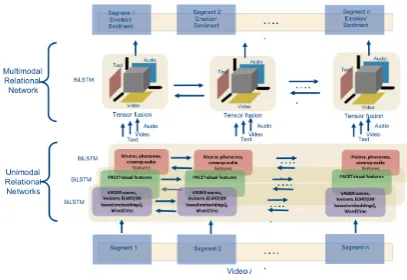
[image:5.595.309.513.61.201.2]While TFN has been used to model the modal-ity interactions within a video segment, we extend that approach to apply it to the contextual stream of segments. There are two ways we can apply a tensor fusion (by tensor fusion, we specifically refer to the cartesian product operation between the modalities with an extra ‘1’ input to model the inter-modal interaction) across modalities across the streams. The first approach is to apply a tensor fusion across all modality features of all segments for all the modalities. This approach ideally cap-tures all possible cross-dynamics (unimodal, bi-modal, trimodal) amongst all possible features of all the video segments. The main issue with this
Figure 2: Relational Tensor Network
approach is that we run into an exponential growth in the feature space with every modality added in the interaction. The cartesian product further cre-ates multiple outer products for bimodal and tri-modal interactions. Even with a small number of features for this approach, our network had about 10s of billions of parameters and this would not be a feasible approach unless deployed on a massive infrastructure. This approach does not require the use of LSTMs as used in the Contextual LSTM work to capture the sequence information in the segments.
The other more feasible approach is to apply ten-sor fusion across modality features of each seg-ment and then model the sequential interactions between the segments of the video using an LSTM Network. We depict our network in Figure2.
Binary 7-class Regression
Baseline Acc F1 Acc F1 MAE
SV M multimodal 60.4 0.61 23.5 0.27 1.38 LST M uni audio 58 0.52 41 0.37 0.73
LST M uni video 57.9 0.51 45.9 0.40 0.68 LST M uni text 64.2 0.60 45.8 0.43 0.618 LST M earlyf usion 65.2 0.62 46.6 0.44 0.60
T F N 66 0.62 47.9 0.43 0.58 RT N 66.8 0.63 49.17 0.45 0.58
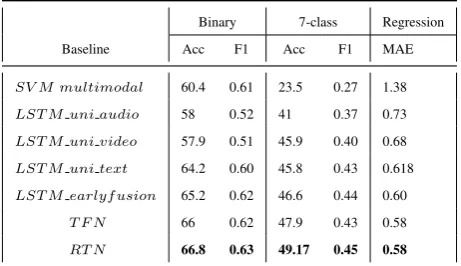
Table 1: Sentiment Analysis Model Results
5 Experiments
We present multiple sets of experiments in order to evaluate the different models, impact of tex-tual and audio features on sentiment and emotion prediction. Our training data consists of CMU-MOSEI training set where we do a 90/10 split for validation and early stopping experiments. All our results in this paper are reported on the CMU-MOSEI validation set1.
5.1 Architecture comparisons
Table1and Table2show the performance of the various models on sentiment and emotion classifi-cation. We have used three LSTM based unimodal baselines, each for audio, video and text modali-ties. From the table, we see that unimodal-text net-work outperforms both audio and video modalities for sentiment. Unimodal-text also outperforms SVM multimodal for sentiment analysis, which is an SVM model trained on concatenated features from all the three modalities. The early fusion net-work is an LSTM based netnet-work(an extension of the unimodal networks),that takes in concatenated features from the three modalities. This LSTM model outperforms the SVM multimodal baseline by almost 5% binary class accuracy scores for sen-timent analysis. All of these LSTM based net-works outperform SVM by a huge margin in the 7-class 7-classification scores and MAE for sentiment analysis. TheT F N network with rich set of tex-tual features slightly outperforms the simple con-catenation technique(early fusion model) for sen-timent and emotion recognition. The model with the best performance is the Relational Tensor Net-work model for both sentiment and emotion recog-nition that considers the neighboring tensor fusion networks for a given segment.
1The test set was not released at the time of writing.
5.2 Ablation study
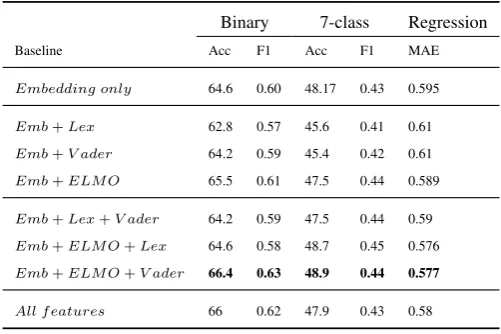
Table 3 shows the detailed ablation study of the various text features that we have used in our mod-els. We added word based features using lexi-cons and language model based ELMo embed-dings and utterance level sentiment scores using VADER scores. As the table shows, adding lexi-cons result in a slight drop in performance of the scores. The lexicons we’ve used are extremely sparse compared to the vocabulary space of Word Vectors. Also we’ve simplistically concatenated the binary scores for Positive and and Negative category words to the same embeddings space as for the word vectors. Majority of these values re-main 0 after the operation. We are exploring other ways to leverage the lexicon embeddings to allow a larger contribution of these signals to the classifi-cation process. Addition of the ELMo embeddings improves the performance as compared to using word embeddings alone. Addition of ELMo em-beddings and segment level sentiment scores us-ing Vader gives the best performance for binary, 7-class and MAE scores, as compared to adding individual features, or a combination of features. As described in ELMo work, adding the layers at different positions of the network helps to ab-stract various naturally occurring syntactic and se-mantic information about the words. For the au-dio modality, we presented two additional feature-sets in the previous section, i-vector features and phoneme level features alongwith COVAREP fea-tures. Based on our experiments, we observed that the performance of the Emotion recognition RTN model with all these features were similar but im-proved slightly for ‘Happy’ emotion compared to the RTN model without the additional audio fea-tures.
6 Conclusion
[image:6.595.71.302.63.196.2]Anger Disgust F ear Happy Sad Surprise
SV M multimodal 0.358 0.19 0.21 1.167 0.33 0.171
LST M uni audio 0.17 0.079 0.09 0.475 0.20 0.073 LST M uni text 0.16 0.08 0.086 0.485 0.195 0.068 LST M uni video 0.148 0.08 0.10 0.42 0.208 0.076
[image:7.595.148.450.66.181.2]LST M earlyf usion 0.148 0.078 0.09 0.428 0.19 0.073 T F N 0.147 0.07 0.089 0.466 0.1766 0.074 RT N 0.137 0.065 0.072 0.422 0.176 0.059
Table 2: Emotion Recognition Model Results - MAE scores
Binary 7-class Regression
Baseline Acc F1 Acc F1 MAE
Embedding only 64.6 0.60 48.17 0.43 0.595
Emb+Lex 62.8 0.57 45.6 0.41 0.61 Emb+V ader 64.2 0.59 45.4 0.42 0.61
Emb+ELM O 65.5 0.61 47.5 0.44 0.589
Emb+Lex+V ader 64.2 0.59 47.5 0.44 0.59
Emb+ELM O+Lex 64.6 0.58 48.7 0.45 0.576 Emb+ELM O+V ader 66.4 0.63 48.9 0.44 0.577
All f eatures 66 0.62 47.9 0.43 0.58
Table 3: Text Ablation Study
References
T. Baltruaitis, P. Robinson, and L. P. Morency. 2016. Openface: An open source facial behavior analysis toolkit. In2016 IEEE Winter Conference on
Appli-cations of Computer Vision (WACV), pages 1–10.
Dmitri Bitouk, Ragini Verma, and Ani Nenkova. 2010. Class-level spectral features for emotion recogni-tion. Speech communication, 52(7-8):613–625.
G. Degottex, J. Kane, T. Drugman, T. Raitio, and S. Scherer. 2014. Covarep x2014; a collaborative voice analysis repository for speech technologies.
In 2014 IEEE International Conference on
Acous-tics, Speech and Signal Processing (ICASSP), pages 960–964.
Abhinav Dhall, Roland Goecke, Jyoti Joshi, Michael Wagner, and Tom Gedeon. 2013. Emotion recogni-tion in the wild challenge 2013. InProceedings of the 15th ACM on International conference on
multi-modal interaction, pages 509–516. ACM.
P. EKMAN. 2002. Facial action coding system (facs).
A Human Face.
Paul Ekman. 2009. Telling Lies: Clues to Deceit in the Marketplace, Politics, and Marriage (Revised Edi-tion). WW Norton & Company.
Dan Gusfield. 1997. Algorithms on Strings, Trees
and Sequences. Cambridge University Press,
Cam-bridge, UK.
Clayton J. Hutto and Eric Gilbert. 2014.Vader: A par-simonious rule-based model for sentiment analysis of social media text. InICWSM. The AAAI Press.
Lakshmish Kaushik, Abhijeet Sangwan, and John HL Hansen. 2013. Sentiment extraction from natural audio streams. InAcoustics, Speech and Signal Pro-cessing (ICASSP), 2013 IEEE International
Confer-ence on, pages 8485–8489. IEEE.
Chul Min Lee, Serdar Yildirim, Murtaza Bulut, Abe Kazemzadeh, Carlos Busso, Zhigang Deng, Sung-bok Lee, and Shrikanth Narayanan. 2004. Emotion recognition based on phoneme classes. In Eighth International Conference on Spoken Language Pro-cessing.
Yun Lei, Nicolas Scheffer, Luciana Ferrer, and Mitchell McLaren. 2014. A novel scheme for speaker recog-nition using a phonetically-aware deep neural net-work. InAcoustics, Speech and Signal Processing
(ICASSP), 2014 IEEE International Conference on,
pages 1695–1699. IEEE.
Bing Liu. 2010. Sentiment analysis and subjectivity.
Handbook of natural language processing, 2:627–
[image:7.595.173.424.214.381.2]Bryan McCann, James Bradbury, Caiming Xiong, and Richard Socher. 2017. Learned in translation: Con-textualized word vectors.
Michael Neumann and Ngoc Thang Vu. 2017. At-tentive convolutional neural network based speech emotion recognition: A study on the impact of in-put features, signal length, and acted speech. arXiv preprint arXiv:1706.00612.
Vassil Panayotov, Guoguo Chen, Daniel Povey, and Sanjeev Khudanpur. 2015. Librispeech: an asr cor-pus based on public domain audio books. In Acous-tics, Speech and Signal Processing (ICASSP), 2015
IEEE International Conference on, pages 5206–
5210. IEEE.
Bo Pang and Lillian Lee. 2008. Opinion mining and sentiment analysis. Foundations and trends in infor-mation retrieval, 2(1-2):1–135.
Jeffrey Pennington, Richard Socher, and Christo-pher D. Manning. 2014. Glove: Global vectors for word representation. InEmpirical Methods in
Nat-ural Language Processing (EMNLP), pages 1532–
1543.
Matthew E. Peters, Mark Neumann, Mohit Iyyer, Matthew Gardner, Christopher Clark, Kenton Lee, and Luke S. Zettlemoyer. 2018. Deep contextual-ized word representations. CoRR, abs/1802.05365.
Robert Plutchik. 2001. The nature of emotions human emotions have deep evolutionary roots, a fact that may explain their complexity and provide tools for clinical practice. American Scientist.
Soujanya Poria, Erik Cambria, Devamanyu Hazarika, Navonil Majumder, Amir Zadeh, and Louis-Philippe Morency. 2017. Context-dependent sentiment anal-ysis in user-generated videos. InACL.
Jonathan Posner, James A Russell, and Bradley S Pe-terson. 2005. The circumplex model of affect: An integrative approach to affective neuroscience, cog-nitive development, and psychopathology.
Develop-ment and psychopathology, 17(03):715–734.
Daniel Povey, Arnab Ghoshal, Gilles Boulianne, Lukas Burget, Ondrej Glembek, Nagendra Goel, Mirko Hannemann, Petr Motlicek, Yanmin Qian, Petr Schwarz, et al. 2011. The kaldi speech recog-nition toolkit. In IEEE 2011 workshop on
auto-matic speech recognition and understanding,
EPFL-CONF-192584. IEEE Signal Processing Society.
Klaus R Scherer. 1984. Emotion as a multicomponent process: A model and some cross-cultural data. Re-view of Personality & Social Psychology.
Bj¨orn W Schuller, Stefan Steidl, Anton Batliner, Julia Hirschberg, Judee K Burgoon, Alice Baird, Aaron C Elkins, Yue Zhang, Eduardo Coutinho, and Kee-lan Evanini. 2016. The interspeech 2016 computa-tional paralinguistics challenge: Deception, sincer-ity & native language. InInterspeech, pages 2001– 2005.
Bonggun Shin, Timothy Lee, and Jinho D. Choi. 2017. Lexicon integrated cnn models with attention for sentiment analysis. InWASSA@EMNLP.
Philip J Stone, Dexter C Dunphy, and Marshall S Smith. 1966. The general inquirer: A computer ap-proach to content analysis.
Fei Tao and Gang Liu. 2017. Advanced lstm: A study about better time dependency modeling in emotion recognition.arXiv preprint arXiv:1710.10197.
Fei Tao, Gang Liu, and Qingen Zhao. 2018. An ensem-ble framework of voice-based emotion recognition system for films and tv programs. arXiv preprint
arXiv:1803.01122.
Michel Valstar, Jonathan Gratch, Bj¨orn Schuller, Fa-bien Ringeval, Denis Lalanne, Mercedes Torres Tor-res, Stefan Scherer, Giota Stratou, Roddy Cowie, and Maja Pantic. 2016. Avec 2016: Depression, mood, and emotion recognition workshop and chal-lenge. InProceedings of the 6th International
Work-shop on Audio/Visual Emotion Challenge, pages 3–
10. ACM.
Rui Xia and Yang Liu. 2016. Dbn-ivector frame-work for acoustic emotion recognition. In
INTER-SPEECH, pages 480–484.
A Zadeh, PP Liang, S Poria, P Vij, E Cambria, and LP Morency. 2018a. Multi-attention recurrent net-work for human communication comprehension. In
AAAI.
Amir Zadeh, Minghai Chen, Soujanya Poria, Erik Cambria, and Louis-Philippe Morency. 2017. Ten-sor fusion network for multimodal sentiment analy-sis.CoRR, abs/1707.07250.
Amir Zadeh, Paul Pu Liang, Navonil Mazumder, Soujanya Poria, Erik Cambria, and Louis-Philippe Morency. 2018b. Memory fusion network for multi-view sequential learning. arXiv preprint
arXiv:1802.00927.
Amir Zadeh, Paul Pu Liang, Soujanya Poria, Erik Cam-bria, and Louis-Philippe Morency. 2018c. Human multimodal language in the wild: A novel dataset and interpretable dynamic fusion model. Associa-tion for ComputaAssocia-tional Linguistics.
Amir Zadeh, Paul Pu Liang, Jon Vanbriesen, Soujanya Poria, Erik Cambria, Minghai Chen, and Louis-Philippe Morency. 2018d. Multimodal language analysis in the wild: Cmu-mosei dataset and inter-pretable dynamic fusion graph. In Association for