Idiosyncratic Shocks, Child Labor and
School Attendance in Indonesia
Kharisma, Bayu
Department of Economics, Universitas Padjadjaran
25 January 2017
International Journal of Evaluation and Research in Education (IJERE) Vol.6, No.2, June 2017
ISSN: 2252-8822
Journal homepage: http://iaesjournal.com/online/index.php/IJERE
Idiosyncratic Shocks, Child Labor and School Attendance
in Indonesia
Bayu Kharisma
Department of Economics, Faculty of Economics and Business, Universitas Padjadjaran, Indonesia
Article Info ABSTRACT
Article history:
Received January 25, 2017 Revised April 06, 2017 Accepted June 10, 2017
This paper investigates the effect of various idiosyncratic shocks against child labor, child labor hour and school attendance. Also, the role of the assets held by households as one of the coping strategies to mitigate the effects of shocks. The results show that various idiosyncratic shocks that encourage child labor is generally caused by crop loss, a disease suffered by the head or member of the household, a decrease in household income due to lower prices and the quantity produced and the death of the head or a family member. This indicates that households are not sheltered from the idiosyncratic shocks and restricted access to formal and informal institutions. Other findings show a variety of idiosyncratic shocks do not affect child labor hour and the school attendance. Additionally, household assets play an important role in reducing the number of child labor and increase school attendance but do not affect the child labor hour during a variety of idiosyncratic shocks.
Keyword:
Idiosyncratic Shocks Child Labor
Child Labor Hour School Attendance
Copyright © 2017 Institute of Advanced Engineering and Science. All rights reserved.
Corresponding Author: Bayu Kharisma
Departement of Economics Padjadjaran University,
Jl. Dipati Ukur No. 35 Bandung, 40132, Indonesia West Java - Indonesia
Email : [email protected]
1. INTRODUCTION
The high risk of income caused by idiosyncratic shocks is an unseparated condition from life in many developing countries. This situation is among other things characterized by the severe income fluctuations, volatile financial markets and thin or lacking formal insurance markets [29]. In addition to the low levels of income, some developing countries often suffer from the high-risk characteristics and the low probability of doing risk diversification [15]. That is because the weakness of formal insurance markets in developing countries so that many households are forced to rely on informal insurance mechanisms, such as drawing personal savings, and credit transfer to ensure consumption due to the impact of such shocks.
The use of child labor as a buffer stock as one strategy or mechanism is common, particularly in the agricultural households in developing countries to have consumption smoothing [5]. [26] stated that the existence of child labor is strongly associated with households' low ability to protect themselves from various shocks through formal and informal institutions. Thus, if households have limited access to the protection of formal and informal, then it will encourage parents to involve their children in some activities to earn income. [15] showed that the missing functionality of the labor market is believed to be one of the factors which caused the number of child labor in domestic work and agricultural activities.
IJERE Vol.6, No.2, June 2017
magnitude of over 13%. This is a sharp turnaround from the high economic growth averaging around 7% annually over the previous three decades [25]. As Indonesian households were forced to adjust to the substantial fall in real income, it was feared that parents would be forced to withdraw their children from schools and send them to work to supplement family income.
Various studies related to shocks against child labor and attendance have been a source of debate for policymakers, both from the perspective of microeconomics and macroeconomics. [19] showed that the decrease in school attendance rates and an increase in the labor market caused by both aggregate and idiosyncratic shocks. Households actively utilized child labor in performing consumption smoothing when faced with idiosyncratic shocks in Tanzania [5]. [11] showed that households tend to use child labor in reducing the variability of aggregate income.
Several empirical results indicated that the presence of the shocks tends to increase the use of child labor along with the decline of attendance rates. However, there is some evidence to contradict these findings. [4] showed that in eight of the largest metropolitan areas in Brazil, the level of child labor was higher for low poverty levels and high economic growth. Child labor was greater, and school attendance decreased when exposed to high levels of wages [14]. Similar results were obtained in Brazil and Nicaragua where data showed that children tend to work as long as economic conditions continued to improve as their coffee production boom [21].
Many empirical studies emphasize the importance of the credit markets and other safeguards to anticipate the impact of shocks. Nevertheless, it is undeniable that the use of self-insurance mechanism has been widely used as a tool to perform household consumption smoothing through household assets [12]. The role of household assets against child labor has an ambiguous effect [6]. In this case, the ownership of assets can reduce child labor, but on the other hand, it only may be able to provide relatively small protection because the price of the asset can be decreased when many households sell assets during shocks.
Since the findings are contradictory and there is an emergence of the issue of using child labor as a buffer to dampen the shocks, this study aims to investigate the effect of various idiosyncratic shocks against child labor, child labor hour and school attendance. Also, the role of household’s assets as one of the coping strategies to mitigate the effects of such shocks. This study gives empirical contribution because similar studies conducted in Indonesia is relatively limited, especially one that looks at the influence of various idiosyncratic shocks against child labor, working hours and school attendance.
Research on the influence of idiosyncratic shocks on child labor was mostly done by involving the empirical results and different approaches. An important contribution of this research is to use a variety of idiosyncratic shocks that are comprehensive including crop loss, disease suffered by head or household members who require hospitalization or continuous need of medical care, acceptable losses the business sector (due to fires, earthquakes and disasters others), the head of the household is not working or failure of a business, the decline in household income due to lower price or quantity of goods produced.
Our contributions in this study are. First, this study adds a variety of statistical tests before estimating random effect probit among others are a test of serial correlation to ensure there is no correlation in the error and the likelihood ratio test (LR), wald test and Lagrange multiplier (LM) to ensure the influence of random effects. The test is important in order to estimate produced consistently and efficiently [2],[17]. Second, adding the province dummy variables to control or capture the effect of differences in wages, labor demand conditions and prices between provinces caused by aggregate shocks, such as the economic crisis in Indonesia [6], [22]. Third, the data used in this study differs from previous study in estimating child labor in Indonesia [25]. Lastly, the advantages of this study with other studies in Indonesia [9] related to the estimated hours of work is the use of panel data in analysis, whereas previous studies using cross section data so that the possibility is still there is a problem concerning matters that are not observed that can affect outcomes.
2. RESEARCH METHOD
2.1. First Model
The first model is used to estimate many idiosyncratic shocks on the probability of children working and school attendance through random effects probit [13] with some modifications.
L
iht C*=
b
X
iht
+
lq
iht+
f
t+
ma
iht+
c
h+
e
iht (1) where LC*iht is child labor or school attendance i in a household h in year t,X
iht is household and individualIJERE ISSN: 2252-8822
Idiosyncratik Shocks, Child Labor and School Attendance in Indonesia (Bayu Kharisma)
3
dummy variables. Meanwhile,
a
ihtis household asset ownership ande
iht is the error term. In addition, this study uses dummies province variables to capture any effects of inter province differences in wages and prices. The estimation technique used in the first model is a random effects probit. The purpose of using the estimation technique is to control for household unobservable, such as parental preferences that have large effects on children’s schooling and work decisions. Households fixed effect estimation technique would not be able to control effect of other household characteristics such as household asset or parental education which potentially varies among children may influence children’s time allocation pattern to work or to study [13].2.2.Second Model
The second model is used to estimate a variety of idiosyncratic shocks to the child labor hour through fixed effect techniques at the household level [3], [5]. The model used is as follows.
l
iht=
r
h+
b
X
iht+
lq
iht+
f
t+
ma
iht+
u
iht (2) wherer
h is a fixed effects term on the household level,l
iht is time allowed for work for the child i in a household h in year t,f
t is the year dummy variables andu
ihtis an error term. In this model, parents’ level of education is used as a proxy for parental income to avoid the possible simultaneity between child labor and parental income [3]. The reason of this is because parents’ education is highly unlikely to be simultaneously determined with child labor.Before performing an estimate of each model, the step that must be done is ensuring that idiosyncratic shocks are unpredictable and transitory [3], [5]. Therefore, to test this issue, it was estimated using probit at any shocks. In this case, the shock in 2000 was estimated to child labor and ownership of assets in 1997 as well as the characteristics of the household and children through the following equation:
Pr(
shock
iht=
1)
=
f
(child labor
iht-1,
X
iht)
(3) furthermore, to show that the shocks are transitory it is necessary to analyze it. Therefore, this can be investigated by examining the following equation:
Pr(
shock
iht=
1)
=
f
(
shock
iht-1,
X
iht)
(4) lastly, [17] identified that to estimate the random effects probit there should be a variety of statistical tests including a likelihood ratio test (LR), Wald test and Lagrange multiplier (LM) to find out where the influence of random effects. Besides, the serial correlation test can also be important to ensure there is no correlation in error.The data used in this paper is Indonesia Family Life Survey (IFLS), particularly those from 1997 and 2000, and it is used to capture the occurrence of several events in Indonesia which has a risk associated with the shocks of child labor, child labor hour and the participation of school children. Child labor variables in this study were children who worked while going to school. Meanwhile, the definition of child labor hour in this study using the definition given by [18] that children who are active in economic activity aged 5 up to 14 years to find wages over the last week or the last week of work. The measurement of idiosyncratic shocks in this study is a variety of shocks over the past year or 12 months, among others, the death of the head or member of the household, the disease suffered by the head and members of the household, crop loss, loss of business sector due to natural disasters such as fires, earthquakes and other disasters, household unemployed or failure of business, and a decline in household income due to lower prices and the quantity produced.
The households asset ownership used in this study includes the house occupied, houses or other buildings, livestock or poultry, vehicles (cars, bikes, bicycles, boats and motorcycles), household appliances (radios, tape recorders, refrigerators, sewing tools, washing machine and others), savings accounts or certificates or deposits or shares, receivables, jewelry, furniture and appliances as well as other assets. Ownership of household assets in the form of land is not taken into account because it could be positively related to child labor demand so that they can make estimates biased [5].
IJERE Vol.6, No.2, June 2017
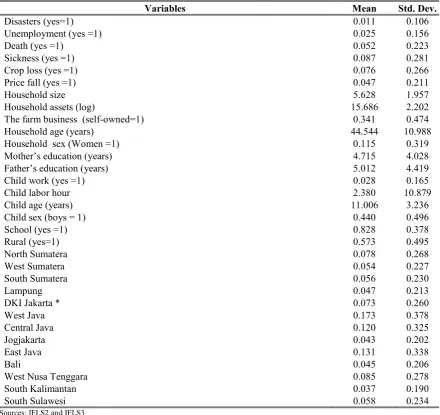
[image:5.595.86.527.126.541.2]2,380 hours per week. This indicates that the number of children aged 5-14 years who attend school was quite high, although they spent some of their time for working purpose, they still did their school activities.
Table 1 Summary Statistics of Key Variables
Variables Mean Std. Dev.
Disasters (yes=1) 0.011 0.106
Unemployment (yes =1) 0.025 0.156
Death (yes =1) 0.052 0.223
Sickness (yes =1) 0.087 0.281
Crop loss (yes =1) 0.076 0.266
Price fall (yes =1) 0.047 0.211
Household size 5.628 1.957
Household assets (log) 15.686 2.202
The farm business (self-owned=1) 0.341 0.474
Household age (years) 44.544 10.988
Household sex (Women =1) 0.115 0.319
Mother’s education (years) 4.715 4.028
Father’s education (years) 5.012 4.419
Child work (yes =1) 0.028 0.165
Child labor hour 2.380 10.879
Child age (years) 11.006 3.236
Child sex (boys = 1) 0.440 0.496
School (yes =1) 0.828 0.378
Rural (yes=1) 0.573 0.495
North Sumatera 0.078 0.268
West Sumatera 0.054 0.227
South Sumatera 0.056 0.230
Lampung 0.047 0.213
DKI Jakarta * 0.073 0.260
West Java 0.173 0.378
Central Java 0.120 0.325
Jogjakarta 0.043 0.202
East Java 0.131 0.338
Bali 0.045 0.206
West Nusa Tenggara 0.085 0.278
South Kalimantan 0.037 0.190
South Sulawesi 0.058 0.234
Sources: IFLS2 and IFLS3 * Categorical reference
3. RESULTS AND ANALYSIS
3.1. Estimation Results of Idiosyncratic Shocks
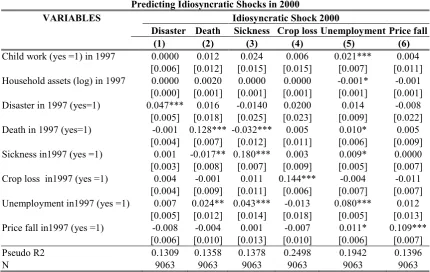
The first stage in this research is to ensure that idiosyncratic shocks cannot be predicted by child labor and ownership of household assets. In Table 2 shows that working children aged 5-14 years and ownership of household assets in 1997 can predict shocks when the head or members of the household are unemployed or experienced a business failure in 2000. This is demonstrated by the statistically significant effect on child labor, and household assets 1997 with head or member of the household who are unemployed or failure of business in 2000 amounted to 1 and 10 percent. Thus, it can be concluded if the head or members of the household are unemployed or experiencing business failure then households will likely involve a child to work and use of household assets as a coping strategy to dampen such shocks.
IJERE ISSN: 2252-8822
Idiosyncratik Shocks, Child Labor and School Attendance in Indonesia (Bayu Kharisma)
5
with the use of fixed effect estimation techniques at the household level to control the time invariant unobserved heterogeneity and did robustness check is expected to address potential biases [3], [5].
[image:6.595.89.520.175.447.2]Lastly, the testing results of child labor and school attendance models through the likelihood-ratio test, Wald test and LM test indicated the presence of random effects. Thus, it can be concluded that the model is appropriate and efficient for child labor and school attendance is a probit random effects rather than probit. Meanwhile, the value of Prob> F did not show statistically significant. This indicates no correlation in error.
Table 2
Predicting Idiosyncratic Shocks in 2000
VARIABLES Idiosyncratic Shock 2000
Disaster Death Sickness Crop loss Unemployment Price fall
(1) (2) (3) (4) (5) (6)
Child work (yes =1) in 1997 0.0000 0.012 0.024 0.006 0.021*** 0.004 [0.006] [0.012] [0.015] [0.015] [0.007] [0.011] Household assets (log) in 1997 0.0000 0.0020 0.0000 0.0000 -0.001* -0.001
[0.000] [0.001] [0.001] [0.001] [0.001] [0.001] Disaster in 1997 (yes=1) 0.047*** 0.016 -0.0140 0.0200 0.014 -0.008
[0.005] [0.018] [0.025] [0.023] [0.009] [0.022] Death in 1997 (yes=1) -0.001 0.128*** -0.032*** 0.005 0.010* 0.005
[0.004] [0.007] [0.012] [0.011] [0.006] [0.009] Sickness in1997 (yes =1) 0.001 -0.017** 0.180*** 0.003 0.009* 0.0000
[0.003] [0.008] [0.007] [0.009] [0.005] [0.007] Crop loss in1997 (yes =1) 0.004 -0.001 0.011 0.144*** -0.004 -0.011
[0.004] [0.009] [0.011] [0.006] [0.007] [0.007] Unemployment in1997 (yes =1) 0.007 0.024** 0.043*** -0.013 0.080*** 0.012
[0.005] [0.012] [0.014] [0.018] [0.005] [0.013] Price fall in1997 (yes =1) -0.008 -0.004 0.001 -0.007 0.011* 0.109*** [0.006] [0.010] [0.013] [0.010] [0.006] [0.007]
Pseudo R2 0.1309 0.1358 0.1378 0.2498 0.1942 0.1396
N 9063 9063 9063 9063 9063 9063
Marginal effects; robust standard errors in brackets
Additional controls: Household head sex (women =1), Household age (years), Rural (yes=1), Child sex (boys = 1), Child age (years) and the farm business (self-owned=1), Household size, Mother’s education (years), Father’s education (years) are included but not reported. * p<0.1, ** p<0.05, *** p<0.01
3.2. Effects of Idiosyncratic Shocks to Child Labor
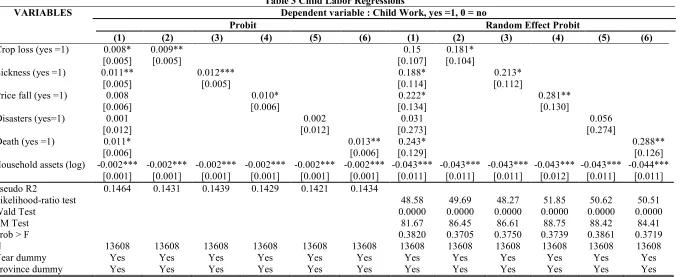
The estimation results in Table 3 show that idiosyncratic shocks over the last year have positive and statistically significant against child labor. These shocks are crop loss, a disease suffered by the head or member of the household, a decrease in household income due to lower prices and the quantity produced and the death of the head or household members. This indicates that the emergence of child labor occurs because of the limited ability of the household to protect from the idiosyncratic shocks and restricted access to formal and informal institutions. This may indirectly force the parents to involve their children to work as a buffer to mitigate the shocks are in ensuring the level of household consumption smoothing.
IJERE Vol.6, No.2, June 2017
conducted by the ILO in mid-1996 that child labor contributes to the family income averaged 20 percent of total household income [19].
The illness suffered by the head or member of the household over the last year had a positive effect on child labor and statistically significant at the 10 percent level. This indicates that the health condition of the primary breadwinner in a household has an essential role to decide whether the child should work or not. If the breadwinner suffers from an illness, this situation will have consequences for the loss of jobs and declining household income. Therefore, children are forced to work, although they do not have the provision of adequate education and skills to earn income for the survival of the family. In this case, the children are just substitute for the main breadwinner in a household at the time of adult labor supply decreases because the head of the household is sick and requires hospitalization or constant medical care. The findings are consistent with research in Mali North Africa that stated a sick adult women in the household increases the probability that a child will be withdrawn from school [13]. Similar results occurred in Tanzania that when a parent is ill, the household may need cheap labor to substitute for the parent’s missed work at the farm, and they do agriculture work at a young age [1]. Similar findings occurred in Bangladesh, when the father suffered from the constant pain it will encourage children to participate in the labor market.
Furthermore, the decline in household income due to price and quantity produced over the last year positive effect on child labor and statistically significant at 5 and 10 percent. These results indicate that the worsening weather conditions or climate variability can lead to a decrease in household income due to price and production received decreased. Thus, to offset the decline in revenue and reduce the cost of production of the household needs additional income by increasing labor provided by members of his family, especially his son. The findings are consistent with studies in Tanzania that when there are fluctuations in the income of households actively using child labor in response to the variability of these incomes [3], [11].
Lastly, idiosyncratic shocks that contribute to the existence of child labor is the death of the head of household or household members. The death of the head of household or household members over the last year had a positive effect on child labor and was statistically significant at 5 and 10 percent. This finding indicates that if the head of household died then this will have an impact on the heavy burden of households to survive and it encourages children to work to find additional incomes for the survival of the family. These findings are consistent with studies in Mozambique that the death of the head of household encourages the use of child labor [23].
7 ISSN: 2252-8822 IJERE
[image:8.842.87.774.91.368.2]Journal homepage: http://iaesjournal.com/online/index.php/IJERE
Table 3 Child Labor Regressions
VARIABLES Dependent variable : Child Work, yes =1, 0 = no
Probit Random Effect Probit
(1) (2) (3) (4) (5) (6) (1) (2) (3) (4) (5) (6)
Crop loss (yes =1) 0.008* 0.009** 0.15 0.181*
[0.005] [0.005] [0.107] [0.104]
Sickness (yes =1) 0.011** 0.012*** 0.188* 0.213*
[0.005] [0.005] [0.114] [0.112]
Price fall (yes =1) 0.008 0.010* 0.222* 0.281**
[0.006] [0.006] [0.134] [0.130]
Disasters (yes=1) 0.001 0.002 0.031 0.056
[0.012] [0.012] [0.273] [0.274]
Death (yes =1) 0.011* 0.013** 0.243* 0.288**
[0.006] [0.006] [0.129] [0.126]
Household assets (log) -0.002*** -0.002*** -0.002*** -0.002*** -0.002*** -0.002*** -0.043*** -0.043*** -0.043*** -0.043*** -0.043*** -0.044*** [0.001] [0.001] [0.001] [0.001] [0.001] [0.001] [0.011] [0.011] [0.011] [0.012] [0.011] [0.011] Pseudo R2 0.1464 0.1431 0.1439 0.1429 0.1421 0.1434
Likelihood-ratio test 48.58 49.69 48.27 51.85 50.62 50.51
Wald Test 0.0000 0.0000 0.0000 0.0000 0.0000 0.0000
LM Test 81.67 86.45 86.61 88.75 88.42 84.41
Prob > F 0.3820 0.3705 0.3750 0.3739 0.3861 0.3719
N 13608 13608 13608 13608 13608 13608 13608 13608 13608 13608 13608 13608
Year dummy Yes Yes Yes Yes Yes Yes Yes Yes Yes Yes Yes Yes
Province dummy Yes Yes Yes Yes Yes Yes Yes Yes Yes Yes Yes Yes
Marginal effects; Robust Standard errors in brackets.
Additional controls: Household head sex (women =1), Household age (years), Rural (yes=1), Child sex (boys = 1), Child age (years) and the farm business (self-owned=1), Household size, Mother’s education (years), Father’s education (years) are included but not reported.
Journal homepage: http://iaesjournal.com/online/index.php/IJERE
3.3. Effects of Idiosyncratic Shocks to Child Labor Hour
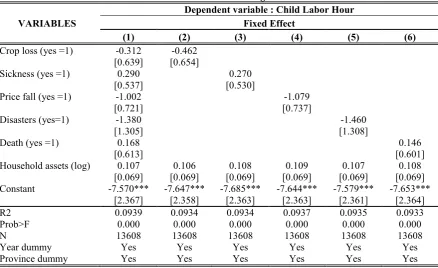
[image:9.595.88.527.219.487.2]The fixed effect estimation results in Table 4 show that a variety of idiosyncratic shocks over the last year did not affect children aged 5-14 hours of work. This indicates that in the event of idiosyncratic shocks, households do not use a coping strategy by increasing the duration of child labor hour to dampen the shocks. Household coping strategy is generally performed by reducing expenses for girls' education to absorb shocks [7], [8]. In addition, the more common coping strategy is reducing investment in young children education to protect the education of older children [27]. These findings are consistent with previous studies that idiosyncratic shocks, especially crop loss did not affect the increase in the number of working hours, especially individuals aged under 18 years who is usually involved as child labor [9]. Another study showed that household coping strategies in Indonesia, especially in rural areas generally rely on informal mechanisms of social networks, for example, family or friends help rather than adding children's extra work hours [15].
Table 4 Child Labor Hour Regressions
VARIABLES Dependent variable : Child Labor Hour Fixed Effect
(1) (2) (3) (4) (5) (6)
Crop loss (yes =1) -0.312 -0.462 [0.639] [0.654]
Sickness (yes =1) 0.290 0.270
[0.537] [0.530]
Price fall (yes =1) -1.002 -1.079
[0.721] [0.737]
Disasters (yes=1) -1.380 -1.460
[1.305] [1.308]
Death (yes =1) 0.168 0.146
[0.613] [0.601]
Household assets (log) 0.107 0.106 0.108 0.109 0.107 0.108 [0.069] [0.069] [0.069] [0.069] [0.069] [0.069] Constant -7.570*** -7.647*** -7.685*** -7.644*** -7.579*** -7.653***
[2.367] [2.358] [2.363] [2.363] [2.361] [2.364]
R2 0.0939 0.0934 0.0934 0.0937 0.0935 0.0933
Prob>F 0.000 0.000 0.000 0.000 0.000 0.000
N 13608 13608 13608 13608 13608 13608
Year dummy Yes Yes Yes Yes Yes Yes
Province dummy Yes Yes Yes Yes Yes Yes
Robust standard errors in brackets
Additional controls: Household head sex (women =1), Household age (years), Rural (yes=1), Child sex (boys = 1), Child age (years) and the farm business (self-owned=1), Household size, Mother’s education (years), Father’s education (years) are included but not reported. * p<0.1, ** p<0.05, *** p<0.01
Household asset in any models has a positive effect on the number of hours children work, but it is not statistically significant. This indicates that assets as one of the coping mechanisms of households to cope with shocks are ineffective or instrumental to reduce the number of child labor hour aged 5-14 years. The findings are consistent with studies in Indonesia on the fact that the assets owned by households are generally illiquid, although there are some assets that are relatively liquid as cash and stock, but those are not able to mitigate the effects of shocks because the value has decreased quite dramatically in line by the economic crisis in Indonesia [27]. In addition, the limitations of the assets owned by households, particularly in rural and distance constraints to trade assets, for example, the households will be relatively difficult to sell assets because of the distance between households with trade location is quite far.
Another study in Indonesia showed that the coping mechanisms through migration and remittances can reduce the supply of child labor, including the number of working hours significantly compared with household assets. The existence of migration reduces the number of hours of work done by all the number of family members, including children, at 26 hours per week [24]. Thus, the role of migration is much greater influence than household assets in reducing children's working hours
3.4. Effects of Idiosyncratic Shocks to School Attendance
IJERE ISSN: 2252-8822
Idiosyncratik Shocks, Child Labor and School Attendance in Indonesia (Bayu Kharisma)
9
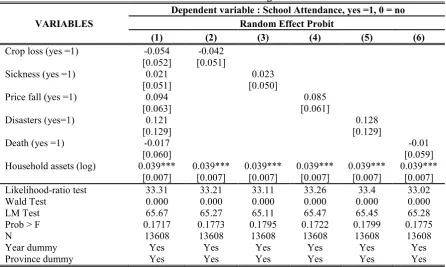
Indonesia that although children must work to help their parents in the event of shocks, it did not mean lowering the chance of children in school, particularly concerning children aged 5-14 years [25]. These findings in line with previous research in Indonesia that idiosyncratic shocks had no effect on children's education [15]. [30] showed that children aged 6-14 years still received the education, both formal and informal during a financial crisis in Asian countries, including Indonesia. [16] identified that the uncertainty of household income expectations caused by shocks did not affect the attendance of children at primary school level in Indonesia.
Household asset positively affects children's school attendance and statistically significant at the 1 percent level. This indicates that the larger the household asset ownership, the tendency to send their children to school will be higher. This finding is consistent with studies conducted in Tanzania [5] and Mali [13] that the ownership of assets of the household can increase the probability of children school attendance
[image:10.595.82.529.229.496.2]significantly.
Table 5 School Attendance Regressions
VARIABLES Dependent variable : School Attendance, yes =1, 0 = no Random Effect Probit
(1) (2) (3) (4) (5) (6)
Crop loss (yes =1) -0.054 -0.042 [0.052] [0.051]
Sickness (yes =1) 0.021 0.023
[0.051] [0.050]
Price fall (yes =1) 0.094 0.085
[0.063] [0.061]
Disasters (yes=1) 0.121 0.128
[0.129] [0.129]
Death (yes =1) -0.017 -0.01
[0.060] [0.059]
Household assets (log) 0.039*** 0.039*** 0.039*** 0.039*** 0.039*** 0.039***
[0.007] [0.007] [0.007] [0.007] [0.007] [0.007]
Likelihood-ratio test 33.31 33.21 33.11 33.26 33.4 33.02
Wald Test 0.000 0.000 0.000 0.000 0.000 0.000
LM Test 65.67 65.27 65.11 65.47 65.45 65.28
Prob > F 0.1717 0.1773 0.1795 0.1722 0.1799 0.1775
N 13608 13608 13608 13608 13608 13608
Year dummy Yes Yes Yes Yes Yes Yes
Province dummy Yes Yes Yes Yes Yes Yes
Robust standard errors in brackets
Additional controls: Household head sex (women =1), Household age (years), Rural (yes=1), Child sex (boys = 1), Child age (years) and the farm business (self-owned=1), Household size, Mother’s education (years), Father’s education (years) are included but not reported. * p<0.1, ** p<0.05, *** p<0.01
4. CONCLUSION
Various idiosyncratic shocks that encourage child labor is generally caused by crop loss, a disease suffered by the head or member of the household, a decrease in household income due to lower prices and the quantity produced and the death of the head or a family member. This indicates that households are not sheltered from the idiosyncratic shocks so that will involve the children work as a buffer in making consumption smoothing. Other findings show a variety of idiosyncratic shocks do not affect the working hours and the level of school attendance. This indicates that in the event of various household idiosyncratic shocks tend not add working hours and lay off their children attending school to dampen or offset such shocks.
IJERE Vol.6, No.2, June 2017
anticipate the shocks without involving children to work. In addition, there should be special policies that aim to promote gender equality and empower women, especially in access to education. Low education of girls is very influential on access to production resources, where girls are more concentrated in the informal and domestic work tend to have lower wages. This happens because there is still a thought that boys are not obliged to engage in domestic work. Therefore, the average wage of women workers tend to be relatively lower than that of male workers.
Critics of this study are not considering the impact of aggregate shocks. It is important to remember these shocks may have a different effect on participation in education and child labor. Thus, further studies are expected to take into account the impact of idiosyncratic and aggregate shocks as well as the role of remittances on child labor and school attendance. Another limitation is the data used in this study, the IFLS 1997 and 2000. This is because the data IFLS in 2007 has experienced a change in describing various economic shocks faced by households
ACKNOWLEDGMENTS
This research was partially supported by Doctoral Research Grant from Direktorat Jenderal Pendidikan Tinggi (Dikti). We thank our colleagues from Doctoral Program of Economics, Gadjah Mada University who provided insight and expertise that greatly assisted the research and we thank to “anonymous” reviewers for their so-called insights.
REFERENCES
[1] Alam, S.A. (2012). “Parental Health Shocks, Child Labor and Educational Outcomes: Evidence from Tanzania”. Essay in University of Washington – Seattle
[2] Arulampalam, W (1998). “A Note on Estimated Coefficients in Random Effects Probit Models”. Department of Economics, University of Warwick, Coventry, CV4 7AL, U.K.
[3] Bandara, A., Dehejia, R., & Rouse, S.L. (2014). “The Impact of Income and Non-Income Shocks on Child Labor: Evidence from a Panel Survey of Tanzania”. World Development Vol. 67, pp. 218–237, 2015. 0305-750X/_ 2014 Elsevier Ltd. All rights reserved
[4] Barros, R., Mendonça, R & Velazco, T. (1994). “Is Poverty The Main Cause of Child Work in Urban Brazil?”. Rio de Janeiro, Texto para Discussão No. 351, Instituto de Pesquisa Econômica Aplicada [5] Beegle, K., Dehejia, R.H & Gatti, R. (2006). “Child Labor and Agricultural Shocks”. Journal of
Development Economics 81:80–96
[6] Bhalotra, S. & Heady, C. (2003). “Child Farm Labor: The Wealth Paradox”. The World Bank Economic Review, 17, 197-227
[7] Cameron, L (2001). “The Impact Of The Indonesian Financial Crisis On Children: An Analysis Using the 100 Villages Data” Bulletin of Indonesian Economic Studies, Vol. 37, No. 1, 2001: 43–64
[8] Cameron, L & Worswick, C (2001). “Education Expenditure Responses to Crop Loss in Indonesia: A Gender Bias. University of Chicago.
[9] Cameron, L & Worswick, C (2003). “The Labour Market as a Smoothing Device: Labour Supply Responses to Crop Loss.” Review of Development Economics 7, no. 2: 327-341.
[10] Deaton, A (1991) “Saving and Liquidity Constraints” Econometrica, Vol. 59, No. 5 (September, 1991), 1221-1248
[11] Dehejia,R & Gatti, R (2002). ”Child Labor: The Role of Income Variability and Access to Credit Across Countries”. NBER Working Paper No. 9018
[12] Dercon, S (2005). “Insurance against Poverty (UNU-WIDER Studies in Development Economics). Oxford University Press
[13] Dillon, A (2008). “Child Labor and Agricultural Production in Northern Mali”. A Dissertation. Faculty of the Graduate School of Cornell University
[14] Duryea, S., & Kuenning, M.A. (2001). “School Attendance, Child Labor and Local Labor Market Fluctuations in Urban Brasil.” Prepared for presentation at the conference “Crises and Disasters: Measurement and Mitigation of their Human Costs” organized by the IDB and IFPRI
[15] Fitzsimons, E., (2007.) “The Effects of Risk on Education in Indonesia”. Institute for Fiscal Studies. Journal of Economic Development and Cultural Change. Volume, issue, pages: Vol. 56, No. 1, pp. 1-25 [16] Gilbert, C.L., & Modena, F. (2009). “The Effects of Risk and Shocks on School Progression in Rural
IJERE ISSN: 2252-8822
Idiosyncratik Shocks, Child Labor and School Attendance in Indonesia (Bayu Kharisma)
11
[17] Greene, W., & McKenzie, C. (2012) “An LM Test Based On Generalized Residuals for Random Effects in A Nonlinear Model”. Economics Letters. Volume 127, February 2015, Pages 47–50
[18] International Labour Organization, (2008). “Panduan tentang Pelaksanaan Pemantauan dan Pelaporan Penerima Manfaat Langsung”. Jakarta
[19] International Labour Organization. (1996). “Child Labor: What’s To Be Done?.
Document for discussion at the Informal Tripartite Meeting at the Ministerial Level (June)”. Geneva, Switzerland.
[20] Jacoby, H., & Skoufias, E., (1997). “Risk, Financial Markets, and Human Capital in a Developing Country”. Review of Economic Studies LXIV, 311 – 335
[21] Kruger, D. I. (2004). “Coffee Production Effects on Child Labor and Schooling in Rural Brazil.”Journal of Development Economics 82(2):448–63.
[22] Levinsohn, J.A., Berry, S.T., & Friedman, J. (2003). “Impacts of the Indonesian Economic Crisis.Price Changes. National Bureau of Economic Research
[23] Mather, D et al. (2004). “Household Responses to Prime Age Adult Mortality in Rural Mozambique: Implications for HIV/AIDS Mitigation Efforts and Rural Economic Development Policies”. Reprint of paper prepared for the Center for the Study of African Economies Conference, March 2004, St. Catherine’s College
[24] Nguyen, T., & Purnamasari, R. (2011).”Impacts of International Migration and Remittances on Child Outcomes and Labor Supply in Indonesia: How Does Gender Matter? Policy Working Paper 5591. The World Bank East Asia and Pacific Region Poverty Reduction and Economic Management Unit
[25] Priyambada, A., Sumarto, S., & Suryahadi, A. (2005). “What Happened to Child Labor in Indonesia during the Economic Crisis? The Trade-off between School and Work”. SMERU Working Paper [26] Skoufias, E., & Parker, S.W. (2002). “Labor market shocks and their impacts on work and schooling:
Evidence from urban Mexico. Food Consumption and Nutrition Division”. Discussion Paper 129. Washington, D.C.: International Food Policy Research Institute
[27] Thomas, D., & Frankenberg, E. (2004). “Household Responses to the Financial Crisis in Indonesia: Longitudinal Evidence on Poverty, Resources, and Well-Being”. University of Chicago Press
[28] Thomas, D et al. (2004). “Education in a Crisis”. Journal of Development Economics 74(1): 53–85
[29] Townsend, R., (1994). “Risk and Insurance in Village India”. Econometrica LXII, 539– 591.
[30] Wu, T (2011). “Constraints to Human Capital Investment in Developing Countries: Using the Asian Financial Crisis in Indonesia as a Natural Experiment”. Dissertation. Maastricht University