A Data-Driven, Factorization Parser for CCG Dependency Structures
Yantao Du, Weiwei Sun∗and Xiaojun Wan
Institute of Computer Science and Technology, Peking University The MOE Key Laboratory of Computational Linguistics, Peking University
{ws,duyantao,wanxiaojun}@pku.edu.cn
Abstract
This paper is concerned with building CCG-grounded, semantics-oriented deep dependency structures with a data-driven, factorization model. Three types of fac-torization together with different higher-order features are designed to capture different syntacto-semantic properties of functor-argument dependencies. Integrat-ing heterogeneous factorizations results in intractability in decoding. We pro-pose a principled method to obtain opti-mal graphs based on dual decomposition. Our parser obtains an unlabeled f-score of 93.23 on the CCGBank data, resulting in an error reduction of 6.5% over the best published result. which yields a signifi-cant improvement over the best published result in the literature. Our implementa-tion is available athttp://www.icst. pku.edu.cn/lcwm/grass.
1 Introduction
Combinatory Categorial Grammar (CCG; Steed-man, 2000) is a linguistically expressive gram-mar formalism which has a transparent yet el-egant interface between syntax and semantics. By assigning each lexical category a dependency interpretation, we can derive typed dependency structures from CCG derivations (Clark et al., 2002), providing a useful approximation to the underlying meaning representations. To date, CCGparsers are among the most competitive sys-tems for generating such deep bi-lexical depen-dencies that appropriately encode a wide range of local and non-local syntacto-semantic infor-mation (Clark and Curran, 2007a; Bender et al., 2011). Such semantic-oriented dependency struc-tures have been shown very helpful for NLP
ap-∗
Email correspondence.
plications e.g. Question Answering (Reddy et al., 2014).
Traditionally, CCG graphs are generated as a by-product by grammar-guided parsers (Clark and Curran,2007b;Fowler and Penn,2010). The main challenge is that a deep-grammar-guided model usually can only produce limited coverage and corresponding parsing algorithms is of relatively high complexity. Robustness and efficiency, thus, are two major problems for handling practical tasks. To increase the applicability of such parsers, lexical or syntactic pruning has been shown nec-essary (Clark and Curran,2004;Matsuzaki et al., 2007;Sagae et al.,2007;Zhang and Clark,2011). In the past decade, the techniques for data-driven dependency parsing has made a great progress (McDonald et al., 2005a,b;Nivre et al., 2004; Torres Martins et al., 2009; Koo et al., 2010). The major advantage of the data-driven architecture is complementary to the grammar-driven one. On one hand, data-grammar-driven approaches make essential uses of machine learning from lin-guistic annotations and are flexible to produce analysis for arbitrary sentences. On the other hand, without hard constraints, parsing algorithms for spanning specific types of graphs, e.g. projec-tive (Eisner, 1996) and 1-endpoint-crossing trees (Pitler et al.,2013), can be of low complexity.
trees, which have many good computational erties. Simultaneously modeling the three prop-erties yields intrinsically heterogeneous factoriza-tions over the same graph, and hence results in in-tractability in decoding. Inspired by (Koo et al., 2010;Rush et al.,2010), we employ dual decom-position to perform principled decoding. Though not always, we can obtain the optimal solution most of time. The time complexity of our parser isO(n3)when various 1st- and 2nd-order features are incorporated.
We conduct experiments on English CCGBank (Hockenmaier and Steedman, 2007). Though our parser does not use any grammar informa-tion, including both lexical categories and syntac-tic derivations, it produces very accurateCCG de-pendency graphs with respect to both token and complete matching. Our parser obtains an unla-beled f-score of 93.23, resulting in, perhaps sur-prisingly, an error reduction of up to 6.5% over the best published performance reported in (Auli and Lopez,2011). Our work indicates that high-quality data-driven parsers can be built for produc-ing more general dependency graphs, rather than trees. Nevertheless, empirical evaluation indicates that explicitly or implicitly using tree-structured information plays an essential role. The result also suggests that a wider range of complicated linguis-tic phenomena beyond surface syntax can be well modeled even without explicitly using grammars. Our algorithm is also applicable to other graph-structured representations, e.g. HPSG predicate-argument analysis (Miyao et al.,2004).
2 Related Work
Hockenmaier and Steedman(2007) developed lin-guistic resources, namely CCGBank, from the Penn Treebank (PTB; Marcus et al., 1993). In CCGBank, PTB phrase-structure trees have been transformed into normal-form CCG derivations, and deep bi-lexical dependency graphs that encode functor-argument strcutures have been extracted from these derivations using coindexation infor-mation. The typed dependency analysis provides a useful approximation to the underlying meaning representations, and has been shown very help-ful for NLP applications e.g. Question Answering (Reddy et al.,2014).
Traditionally, CCG graphs are generated as a by-product by deep parsers with a core gram-mar (Clark et al.,2002;Clark and Curran,2007b;
Fowler and Penn,2010). On the other hand, mod-eling these dependencies within aCCGparser has been shown very effective to improve the pars-ing accuracy (Clark and Curran,2007b;Xu et al., 2014). Besides CCG, similar deep dependency structures can be also extracted from parsers under other deep grammar formalisms, e.g. LFG (King et al.,2003) andHPSG(Miyao et al.,2004).
In recent years, data-driven dependency pars-ing has been well studied and widely applied to many NLP tasks. Research on data-driven ap-proach to producing dependency graphs that are not limited to tree or forest structures has also been initialized. Sagae and Tsujii (2008) introduced a transition-based parser that is able to handle projective directed dependency graphs for HPSG-style predicate-argument analysis. McDonald and Pereira(2006) presented a graph-based parser that can generate graphs in which a word may depend on multiple heads, and evaluated it on the Danish Treebank. Encouraged by their work, we study factorization models as well as principled decod-ing forCCG-grounded, graph-structured represen-tations.
Dual decomposition, and more generally La-grangian relaxation, is a classical method for solv-ing combinatorial optimization problems. It has been successfully applied to several NLP tasks, including parsing (Koo et al., 2010;Rush et al., 2010) and machine translation (Rush and Collins, 2011). To provide principled decoding for our fac-torization parser, we employ the dual decomposi-tion technique. Our work directly follows (Koo et al., 2010). The two basic factorizations are similar to the model introduced in (Martins and Almeida, 2014). Llu´ıs et al. (2013) introduced a dual decomposition based joint model for joint syntactic and semantic parsing. They are con-cerned with shallow semantic representation, i.e. Semantic Role Labeling, whose graphs are sparse. Different from their concern on integrating syntac-tic parsing and semansyntac-tic role labeling under 1st-order factorization, we are interested in designing higher-order factorization models for more dense and general linguistic graphs.
3 Graph Factorization
3.1 Background Notations
Consider a sentences=hw,piwith wordsw =
w1w2· · ·wnand POS-tagsp =p1p2· · ·pn. First
changes would exempt ...executives from
(S\NP)/(S\NP) ((S\NP)/PP)NP
arg1 arg2
arg1
[image:3.595.80.300.66.118.2]arg3 arg2
Figure 1: Examples to illustrate the predicate-centric view.
with POS-tagp0 = #Proot#which is
convention-ally considered as the root node of trees or graphs on the sentence. Then we denote the index set of all possible dependencies as I = {(i, j)|i ∈ {0,· · ·, n}, j ∈ {1,· · · , n}, i 6= j}. A depen-dency parse then can be represented as a vector
y={y(i, j) : (i, j)∈ I},
wherey(i, j) = 1if a dependency with predicatei
and argumentjis in the graph,0otherwise. Note thatyis not a matrix but a long vector though we use two indexes to index it. In this paper, we only consider the unlabeled parsing task. Nevertheless, it is quite straightforward to extend our models to labeled parsing. LetY denote the set of all possi-bley. Given a functionf : Y → Rthat assigns scores to parse graphs, the optimal parse is
y∗ = arg max
y∈Y
f(y).
Following recent advances in discriminative de-pendency parsing, we build disambiguation mod-els based on global linear modmod-els, as in ( McDon-ald et al.,2005a). In this framework, we score a dependency graph using a linear model:
fθ(y) =θ>Φ(s,y),
where Φ(s,y) produces a d-dimensional vector representation of the event that aCCG graphyis assigned to sentence s. In order to perform the decoding efficiently, we assume that the depen-dency graphs can befactoredinto smaller pieces. The main goal of this paper is to design ap-propriate factorization models, namely different types offθ’s, to reflect essential properties of the
semantics-orientedCCGdependency graphs.
3.2 Predicate-Centric Factorization
The very fundamental view of the CCG de-pendency graphs is based on their lexicalized, predicate-centric nature. Every word is assigned
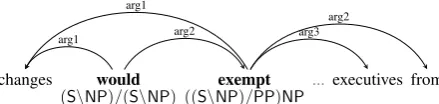
a lexical category, which directly encodes its sub-categorization information. Due to the type-transparency nature of the formalism, this lexi-cal category provides sufficient information for not only syntactic derivation but also semantic composition. It is important to capture functor-argument relations by putting all functor-arguments of one particular predicate together. Figure1 gives an example. The predicate “exempt” is of type “((S\NP)/PP)/NP,” indicating that it takes three semantic dependents. This part of information is very similar to Semantic Role Labeling (SRL), whose goal is to find semantic roles for ver-bal predicates as well as their normalization. However, functor-argument analysis grounded in CCG is approximation of underlying logic forms and thus provides bi-lexical relations for almost all words. For instance, the second word in focus— “would”—captures structural information to orga-nize other predicates yet entities.
In order to perform maximization efficiently in this view, we treat each predicate separately. Given a vectoryp, we define
yip
y={y(i, j) :j∈ {1,· · · , n}, j 6=i}
and assume thatf(yp)takes the form
fp(yp) =
n
X
i=0
fip(yip
y)
To capture the relationships of all arguments to one particular predicate as a whole, we employ a Markov model. Leta1,· · ·, ambe the sequence of
the arguments of the wordwiunderypiy. To keep
the arguments in order, we constrain1 ≤ aj1 < aj2 ≤ nif j1 < j2. In a k-th order
predicate-centric model, we define
fip(ypi
y) = m+k−1
X
j=1
θ>pΦp(aj−(k−1), ..., aj, i,w,p)
where aj (j ≤ 0 orj ≥ m + 1) are treated as
specific initial or end state.
In an Oct. 19 review of...
(S/S)/N NP/N N/N N/N N (NP\NP)/NP arg2
arg1 arg1
[image:4.595.94.272.63.114.2]arg1 arg1
Figure 2: An example to illustrate the argument-centric view.
3.3 Argument-Centric Factorization
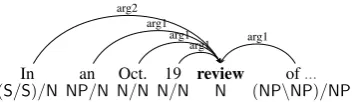
The syntactic principle for tree annotation treats the dependency relations between two words as syntactic projection. In another word, the head de-termines the syntactic category of the whole struc-ture. The (type-logical) semantic principle deter-mines a dependency according the types of the two words. The two kinds of dependency are coherent but not necessarily the same. In particular, an ad-junct is a syntactic dependent but usually a seman-tic predicate of its syntacseman-tic head. Figure2 gives an example to illustrate the idea. The argument in focus is “review” that is the complement of the preposition “in.” The direction of this semantic de-pendency is the same to its corresponding syntac-tic dependency. Other predicates that semansyntac-tically govern “review” are actually its modifiers, so the direction of these semantic dependencies are the opposite of their syntactic counterparts. It is im-portant to capture head-complement-adjunct rela-tions by putting all predicates of one particular ar-gument together.
Similar to the predicate-centric model, we treat the graph fragment involved by each argument as independent, and capture the relationships among all predicates that governs the same argument us-ing a Markov model. In the definition of predicate-centric model, if we exchange predicates and ar-guments, then we get ourargument-centric model. Formally, we define
yyja ={y(i, j) :i∈ {0,· · ·, n}, j6=i}.
Letp1,· · · , pm be the sequence of the predicates
(in linear word order) that semantically governs the word j under yayj. A k-th order argument-centric modelscores the dependency graph as
fa(y) =
n
X
j=1
fja(yayj)
=
n
X
j=1
m+k−1
X
i=1
θa>Φa(pi−(k−1), ..., pi, j,w,p)
Similarly, we define the initial and end states for
pi(i <0ori≥m+ 1).
3.4 Tree Approximation Model
Tree structures exhibit many computationally-good properties, and have been widely applied to model linguistic, especially syntactic, structures. Tree-structured representation is an essential pre-requisite for both the parsing algorithms and the machine learning methods in state-of-the-art syn-tactic dependency parsers. The CCGdependency graphs are not but look very much like trees. We thus argue that a tree-centric model can on one hand capture some topologically essential charac-teristics and on the other hand benefit from mature tree parsing techniques.
To this end, we propose tree approximation to obtainCCGsub-graphs under the factorization us-ing tree parsus-ing algorithms. In particular, we introduce an algorithm to associate every graph with a projective dependency tree, which we call weighted conversion. The tree reflects partial in-formation about the corresponding graph. In this algorithm, we assign heuristic weights to all pos-sible edges, and then find the tree with maxi-mum weights. The key idea behind is to find a tree frame of a given graph. Given an arbitrary CCGgraph, the conversion is perhaps imperfect in the sense that information about a small portion of edges is “lost.” As a result, our tree approximation model can only generate partial graphs. Neverthe-less, we will show (in Section 3.5 and 4.2) that such a model can be combined with predicate- and argument-centric factorization models in an ele-gant way.
3.4.1 Weighted Conversion
We assign weights to all the possible edges, i.e. all pairs of words, and then determine which edges to be kept by finding the maximum spanning tree. More formally, given a graphy ={y(i, j)}, each possible edge(i, j)is assigned a heuristic weight
ω(i, j). The maximum spanning treet={t(i, j)}
contains the maximum sum of values of edges:
tmax= arg max
t
X
(i,j)
t(i, j)ω(i, j)
• A(i, j) = a·max{y(i, j), y(j, i)}: ais the weight for the existing edges on graph ignor-ing direction.
• B(i, j) = b·y(i, j): bis the weight for the forward edges on the graph.
• C(i, j) =n− |i−j|: This term estimates the importance of an edge wherenis the length of the given sentence. For dependency pars-ing, we consider edges with short distance to be more important because those edges can be predicted more accurately in future pars-ing process.
• ab nora > bn > n2: The converted tree should contain arcs in original graph as many as possible, and the direction of the arcs should not be changed if possible. The rela-tionship ofa,b, andcguarantees this. After all edges are weighted, we can use max-imum spanning tree (MST) algorithms to get the converted tree. To get the projective tree, we choose Eisner’s algorithm. However, the obtained tree must be labeled in order to encode the origi-nal graph. Here we introduce a label vectorl =
{l(i, j)}. For each(i, j) ∈ I, we assign a label
l(i, j)to edge(i, j)as follows.
Casey(i, j) = 1: label “X”;
Casey(i, j) = 0∧y(j, i) = 1: label “X∼R”;
Casey(i, j) = 0∧y(j, i) = 0: label “None”. We can convert thelabeledtree back to graph and obtainyt. Tough some edges are lost during the conversion, a lot more are kept. In fact, according to our evaluation,92.74%of edges in the training set are retained after conversion.
3.4.2 Factorizing Trees
We use the tree parsing model proposed in (Bohnet,2010) to score the converted trees. The model factorizes a tree into 1st-order and 2nd-order factors. When decoding, the model searches for a tree with the best score. The score defined for graphs as well as trees is
ft(yt) = gt(t,l) =θt>Φt(s,t,l)
= θ1>t Φ1t(s,t,l) +θ2>t Φ2t(s,t,l)
= X
(i,j)∈I
t(i, j)θ1>t Φ1t(l(i, j),w,p)
+θt2>Φ2t(s,t,l),
where Φ1t is the 1st-order features and Φ2t is the 2nd-order features.
3.5 Parsing as Optimization
Motivated by linguistic properties of the semantics-oriented CCG dependencies, we have designed three single factorization models from heterogeneous views. Our single models exhibit different predictive strengths considering that they are designed to capture different prop-erties separately. Integrating them can generate better graphs, but is provably hard. To this end, we formulate the parsing problem as the following constrained optimization problem.
maximize fp(yp) +fa(ya) +ft(yt)
subject to yp(i, j) =ya(i, j), yp(i, j)≥yt(i, j),
ya(i, j)≥yt(i, j)for all(i, j)
The equality constraint says that the graph given by the predicate- and the argument-centric model must be identical, while the inequality constraints say that the frame of graph given by the tree ap-proximation model must be a subgraph of what is given by the first two models.
4 Decoding
4.1 Easiness and Hardness of Decoding
The three factorization models are all solvable in polynomial time. The predicate-centric model and the argument-centric model can be decoded us-ing dynamic programmus-ing. We provide the de-tailed description of such an algorithm in our sup-plementary note. The decoding method for k-th (k≥2) order model costs time ofO(nk+1)where
nis the length of the sentence. The tree approxi-mation model can re-use existing dependency tree parsing algorithms.
Unfortunately, the exact joint decoding of 2nd-order predicate- and argument-centric models is already NP-hard, not to mention other model com-binations. The following gives a brief proof for the problem of combining the 2nd-order predicate-and argument-centric models.
that for all1≤i1 ≤i2 ≤n,
θ>aΦa(0, i1, j,w,p) = 0
θ>aΦa(i1, n+ 1, j,w,p) = 0
θ>aΦa(i1, i2, j,w,p) =−∞
θ>aΦa(0, n+ 1, j,w,p) =−∞
where nis the length of the sentence. Note that those 4 equations make the nodes except the root node in the optimal graph each have exactly one incoming edge. So the problem of finding a tree
t maximizing fp(t) is reduced to this problem. Moreover, the NP-hard problem 3DM can be re-duced to the problem of finding a tree t maxi-mizingfp(t)(seeMcDonald and Pereira(2006)), leading to the NP-hardness of both of the prob-lems.
4.2 Decoding via Dual Decomposition
To solve the joint decoding problem, optimization techniques based on decomposition with coupling variables are applicable. In this paper, we propose to solve it via dual decomposition. The experiment results show that though not always, we can obtain the optimal solution most of time. To simplify the description, we only consider the 2nd-order case for all three models.
4.2.1 Lagrangian Relaxation
Notice thatyp(i, j)≥yt(i, j)can be written as
yp(i, j) =
1, ifyt(i, j) = 1;
arbitrary, ifyt(i, j) = 0.
So the constraint can be written asApyp+Aaya+
Atyt= 0, where
Ap =
I Dyt
0
Aa=
−I
0
Dyt
At=
0
−Dyt −Dyt
I is the identity matrix andDyt is a diagonal
ma-trix whose main diagonal is the vectoryt. The Lagrangian of the optimization problem is
L(yp,ya,yt;u) = fp(yp) +fa(ya) +ft(yt)
+u>(Apyp+Aaya+Atyt),
whereuis the Lagrangian multiplier.
Omitting the constraints, the dual objective is
L(u) = max
yp,ya,ytL(y
p,ya,yt;u)
= max
yp (f
p(yp) +u>
Apyp)
+ max
ya (f
a(ya) +u>
Aaya)
+ max
yt (f
t(yt) +u>
Atyt)
LetL∗be the maximized value ofL(yp,ya,yt;u)
subjected to the constraints, then L∗ = minuL(u), according to the duality principle.
4.2.2 Decoding Algorithm
There are two challenges in solving the dual prob-lem. One challenge is to find the minimum value of the dual objective. For this, we can use subgra-dient method, as is demonstrated in Algorithm1. The other is the evaluation ofL(u). For this, we decompose the dual objective into three optimiza-tion problems. Let Bp = u>Ap, Ba = u>Aa,
Bt=u>At, and
Clt(i, j) =
Bt(i, j), ifl(i, j) =X;
Bt(j, i), ifl(i, j) =X∼R;
we can just redefine
fip(yiy) = m+1
X
j=1
θp>Φp(aj−1, aj, i,w,p)
+Bp(i, j)
fja(yyj) = m+1
X
i=1
θa>Φa(pi−1, pi, j,w,p)
+Ba(i, j)
ft(y) = X (i,j)∈I
t(i, j) θt1>Φ1t(l(i, j),w,p)
+Clt(i, j)
+θ2>t Φ2t(s,t,l),
and decode according to the new scores. In fact, this equals to attach some new weights to 1st-order factors, without changing the decoding algorithms for the subproblems. This nice property also al-lows using higher-order models for subproblems.
Algorithm 1:Joint decoding algorithm
Initialization: setu(0)to 0
fork= 1toKdo
y(pk)←arg maxyfp(y) +u(k)Apy
ya
(k)←arg maxyfa(y) +u(k)Aay
y(tk)←arg maxyft(y) +u(k)Aty
ifApyp(k)+Aay(ak)+Aty(tk)= 0then
returnya
u(k)←u(k−1)
−αk(Apyp(k)+Aaya(k)+Atyt(k))
the three subproblems. If they’s satisfies the con-straints, then we’ve find the optimal solution for the original problem. If not, we update the La-grangian multiplier u, towards the negative sub-gradient. We initialized u to be a zero vector, and useαkto be the step length of each iteration. When we decode the subproblems, theDyc inAp
andAais derived from theycobtained in the cur-rent iteration.
We can also assign weights to different factor-ization models. If we choose to do so, the La-grangian becomes
L(yp,ya,yc;u) =wpfp(yp) +wafa(ya)
+wcft(yt) +u>(Apyp+Aaya+Atyt).
And the decoding of subproblems in our algorithm becomes
y(pk) ← arg max
y
fp(y) + 1
wpu(k)A py;
y(ak) ← arg max
y
fa(y) + 1
wau(k)A ay;
y(tk) ← arg max
y
ft(y) + 1
wcu(k)A ty.
The algorithm we give here is the joint decod-ing for all the three models. We can also decode using any two of them, and it is trivial to adapt the algorithm to the decoding.
4.3 Pruning
In order to improve the efficiency of the algorithm, we also do some pruning. One idea is that, in predicate-centric model, different type of predi-cates has different number of arguments. For ex-ample, the predicates POS-tagged “DT” each has only one argument in most cases. Therefore, we assign each POS-tag a max number of arguments. When decoding, we search at most those number of arguments instead of all the words in the sen-tence. This pruning method can also be applied to the argument-centric model. The other idea is that, some pairs of types never form a predicate-argument relation. So we can skip extracting fea-ture of those POS-tag pairs, just take −∞ to be their scores.
5 Evaluation and Analysis
5.1 Experimental Setup
CCGbank is a translation of the Penn Treebank into a corpus of CCG derivations (Hockenmaier
Devel. Test
HMM Tagger 96.74% 97.23%
Transition-based Parser 93.48% 93.09%
[image:7.595.326.507.61.112.2]Graph-based Parser 93.47% 93.19%
Table 1: The accuracy of the POS tagger and the UAS of the syntax tree parsers.
and Steedman, 2007). CCGbank pairs syntac-tic derivations with sets of word-word dependen-cies which approximate the underlying functor-argument structure. Our experiments were per-formed using CCGBank which was split into three subsets for training (Sections 02-21), development testing (Section 00) and the final test (Section 23). We also use the syntactic dependency trees pro-vided by the CCGBank to obtain necessary in-formation for graph parsing. However, different from experiments in theCCGparsing literature, we use no grammar information. Neither lexical cate-gories norCCGderivations are utilized.
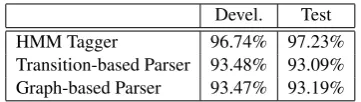
All experiments were performed using automat-ically assigned POS-tags that are generated by a symbol-refined generative HMM tagger1 (Huang et al.,2010), and automatically parsed dependency trees that are generated by our in-house implemen-tation of the transition-based model presented in (Zhang and Nivre, 2011) as well as a 2nd-order graph-based parser2 (Bohnet, 2010). The accu-racy of these preprocessors is shown in Table 1. We ran 5-fold jack-knifing on the gold-standard training data to obtain imperfect dependency trees, splitting off 4 of 5 sentences for training and the other 1/5 for testing, 5 times. For each split, we re-trained the tree parsers on the training portion and applied the resulting model to the test portion. Previous research on dependency parsing shows that structured perceptron (Collins,2002) is one of the strongest discriminative learning algorithms. To estimateθ’s of different models, we utilize the averaged perceptron algorithm. We implement our own the predicate- and argument-centric models. To perform tree parsing, we re-use the open-source implementation provided by the mate-tool. See the source code attached for details. We set it-eration 5 to train predicate- and argument-centric models and 10 for the tree approximation model. To perform dual decomposition, we set the maxi-mum iteration 200.
1
www.code.google.com/p/ umd-featured-parser/
Tree Model UP UR UF UEM
No
PC 91.85 87.26 89.50 18.77
AC 91.94 87.06 89.43 16.47
TA 92.85 86.39 89.51 14.48
PC+AC 93.84 88.18 90.93 23.05
PC+TA 91.80 91.69 91.74 27.29
AC+TA 90.19 92.88 91.52 25.51
PC+AC+TA 93.01 92.08 92.54 32.83
Gr
PC 94.01 90.76 92.36 30.16
AC 94.14 90.44 92.25 27.71
TA 93.07 86.59 89.71 15.16
PC+AC 94.66 91.09 92.84 33.19
PC+TA 92.98 92.68 92.83 35.02
AC+TA 92.47 93.13 92.80 33.93
PC+AC+TA 93.66 92.73 93.19 37.64
Tr
PC 93.93 90.85 92.37 30.21
AC 93.94 90.66 92.27 28.23
TA 93.19 86.68 89.82 14.79
PC+AC 94.58 91.14 92.83 31.94
PC+TA 92.93 92.71 92.82 35.34
AC+TA 92.33 93.16 92.74 33.61
[image:8.595.78.289.59.324.2]PC+AC+TA 93.50 92.73 93.11 37.69
Table 2: Parsing performance on the development data. The column “Tree” denotes the parsers that give dependency tree of development set: no tree (No), transition-based (Tr) or graph-based (Gr). “PC,” “AC” and “TA” in the second column de-notes the predicate-centric, the argument-centric and the tree approximation models, respectively.
5.2 Effectiveness of Data-driven Models
Table 2 summarizes parsing performance on de-velopment set with different configurations. We report unlabeled precision (UP), recall (UR), f-score (UF) as well as complete match (UEM). It can be clearly seen that the data-driven models obtains high-quality graphs with respect to token match. Even without any syntactic information (see the top block associated with “No Tree”), our parser with all three factorization models obtains an f-score of 92.5. when assisted by a syntac-tic parser, this figure goes up to over 93.1. If the predicate- or argument-centric model is applied by itself, either one can achieve a competitive accu-racy, especially when syntactic features are uti-lized.
5.3 Effectiveness of Multiple Factorization
We use dual decomposition to perform joint de-coding. First we combine the predicate-centric model and the argument-centric model. Compared to each single model, an error reduction of about 7%on f-score (UF) on average is achieved.
Fur-0 20 40 60 80 100 120 140 160 180 200 0.2
0.3 0.4 0.5 0.6 0.7 0.8 0.9 1
Iteration
Percentage of exact decoding
[image:8.595.318.509.68.217.2]PC+AC PC+AC+TA
Figure 3: The exact decoding rate.
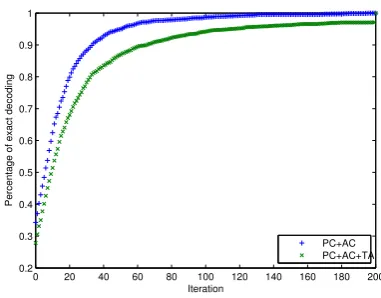
thermore, we ensemble all the three models. If no syntactic features are extracted, the “TA” model brings in a remarkable further absolute gain of 1.02 with respect to token match. If syntactic features are used, the “PC” and “AC” models al-ready achieves relatively good performance, and the “TA” model does not contribute much consid-ering token match. The join of the tree approxi-mation model lowers the precision, it increases the recall further, resulting in a modest improvement of the f-score. Nonetheless, the “TA” model still significantly improve the complete match metric. It is noticeable that in all setting, the “TA” model result in very significant boost in complete match. The dual decomposition does not guarantee to find an exact solution (in a limited number of it-erations) in theory but usually works very well in practice. We calculate the percentage of finding exact decoding belowkiterations, and the result is show in Figure3. The transition-based tree parser is utilized here. We can see that for most sen-tences, dual decomposition practically gives the exact solutions.
5.4 Importance of Tree Structures
graph-Tree Model UP UR UF UEM
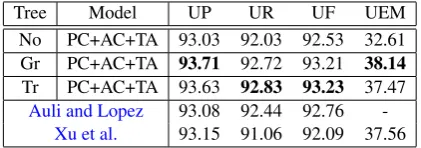
No PC+AC+TA 93.03 92.03 92.53 32.61
Gr PC+AC+TA 93.71 92.72 93.21 38.14
Tr PC+AC+TA 93.63 92.83 93.23 37.47
Auli and Lopez 93.08 92.44 92.76
[image:9.595.76.287.62.136.2]-Xu et al. 93.15 91.06 92.09 37.56
Table 3: Comparing the state-of-art with our mod-els on test set.
based. The architecture of the syntactic tree parser does not affect the results much. The two tree parsers give identical attachment scores, and lead to similar graph parsing accuracy. This result is somehow non-obvious given that the combination of a graph-based and transition-based parser usu-ally gives significantly better parsing performance (Nivre and McDonald,2008;Torres Martins et al., 2008).
Although the target representation of our parser is general graphs rather trees, implicitly or explic-itly using tree-structured information plays an es-sential role. Syntactic features are able to im-prove the f-score achieved by the “PC+AC” model from 90.9 to 92.8, while the “TA” model can bring in an absolute gain of 1.6. Note that the “TA” model does not utilize any syntactic tree infor-mation. The converted trees are automatically in-duced from theCCGgraphs. Even when syntactic trees are available, the automatically induced trees can still significantly improve the complete match with respect to the whole sentence.
5.5 Comparison to the State-of-the-art
We compare our results with the best published CCGparsing performance obtained by the models presented in (Auli and Lopez,2011) and (Xu et al., 2014)3. Auli and Lopez(2011) reported best nu-meric performance. The performance is evaluated on sentences that can be parsed by their model. Xu et al.(2014) reported the best published results for sentences with full coverage. All results on the test set is shown in Table3. Even without any syn-tactic features, our parser achieves accuracies that are superior toXu et al.’s parser and comparable toAuli and Lopez’s system. When unlabeled syn-tactic trees are provided, our parser outperform the state-of-the-art.
3The unlabeled parsing results are not reported in the
orig-inal paper. The figures presented in are provided by Wenduan Xu.
6 Conclusion
In this paper, we have presented a factoriza-tion parser for building CCG-grounded depen-dency graphs. It achieves substantial improvement over the state-of-the-art. Perhaps surprisingly, our data-driven, grammar-free parser yields a supe-rior accuracy to allCCG parsers in the literature. Our work indicates that high-quality data-driven parsers can be built for producing more general dependency graphs, rather than trees. Our method is also applicable to other deep dependency struc-tures, e.g. HPSG predicate-argument analysis (Miyao et al., 2004), as well as other graph-structured semantic representations, e.g. Abstract Meaning Representations (Banarescu et al.,2013). Acknowledgement
The work was supported by NSFC (61300064), National High-Tech R&D Pro-gram (2015AA015403), NSFC (61331011) and NSFC (61170166).
References
Michael Auli and Adam Lopez. 2011. Train-ing a log-linear parser with loss functions via softmax-margin. In Proceedings of EMNLP, pages 333–343. Association for Computational Linguistics, Edinburgh, Scotland, UK.
Laura Banarescu, Claire Bonial, Shu Cai, Madalina Georgescu, Kira Griffitt, Ulf Herm-jakob, Kevin Knight, Philipp Koehn, Martha Palmer, and Nathan Schneider. 2013. Abstract meaning representation for sembanking. In Pro-ceedings of the 7th Linguistic Annotation Work-shop and Interoperability with Discourse, pages 178–186. Association for Computational Lin-guistics, Sofia, Bulgaria.
Emily M. Bender, Dan Flickinger, Stephan Oepen, and Yi Zhang. 2011. Parser evaluation over lo-cal and non-lolo-cal deep dependencies in a large corpus. InProceedings of EMNLP, pages 397– 408. Association for Computational Linguis-tics, Edinburgh, Scotland, UK.
Stephen Clark and James Curran. 2007a. Formalism-independent parser evaluation with ccg and depbank. In Proceedings of the 45th Annual Meeting of the Association of Computa-tional Linguistics, pages 248–255. Association for Computational Linguistics, Prague, Czech Republic.
Stephen Clark and James R. Curran. 2004. The importance of supertagging for wide-coverage CCG parsing. InProceedings of Coling 2004, pages 282–288. COLING, Geneva, Switzer-land.
Stephen Clark and James R. Curran. 2007b. Wide-coverage efficient statistical parsing with CCG and log-linear models. Comput. Linguist., 33(4):493–552.
Stephen Clark, Julia Hockenmaier, and Mark Steedman. 2002. Building deep dependency structures using a wide-coverage CCG parser. In Proceedings of the 40th Annual Meeting of the Association for Computational Linguistics, July 6-12, 2002, Philadelphia, PA, USA., pages 327–334.
Michael Collins. 2002. Discriminative training methods for hidden markov models: Theory and experiments with perceptron algorithms. In Proceedings of EMNLP, pages 1–8. Association for Computational Linguistics.
Jason M. Eisner. 1996. Three new probabilis-tic models for dependency parsing: an explo-ration. In Proceedings of the 16th conference on Computational linguistics - Volume 1, pages 340–345. Association for Computational Lin-guistics, Stroudsburg, PA, USA.
Timothy A. D. Fowler and Gerald Penn. 2010. Accurate context-free parsing with combinatory categorial grammar. In Proceedings of ACL, pages 335–344. Association for Computational Linguistics, Uppsala, Sweden.
Julia Hockenmaier and Mark Steedman. 2007. CCGbank: A corpus of CCG derivations and dependency structures extracted from the penn treebank. Computational Linguistics, 33(3):355–396.
Zhongqiang Huang, Mary Harper, and Slav Petrov. 2010. Self-training with products of latent variable grammars. In Proceedings of EMNLP, pages 12–22. Association for Compu-tational Linguistics, Cambridge, MA.
Tracy Holloway King, Richard Crouch, Stefan Riezler, Mary Dalrymple, and Ronald M. Ka-plan. 2003. The PARC 700 dependency bank. In In Proceedings of the 4th International Workshop on Linguistically Interpreted Cor-pora (LINC-03), pages 1–8.
Terry Koo and Michael Collins. 2010. Efficient third-order dependency parsers. InProceedings of ACL, pages 1–11. Association for Computa-tional Linguistics, Uppsala, Sweden.
Terry Koo, Alexander M. Rush, Michael Collins, Tommi Jaakkola, and David Sontag. 2010. Dual decomposition for parsing with non-projective head automata. In Proceedings of EMNLP, pages 1288–1298. Association for Computa-tional Linguistics, Cambridge, MA.
Xavier Llu´ıs, Xavier Carreras, and Llu´ıs M`arquez. 2013. Joint arc-factored parsing of syntactic and semantic dependencies. TACL, 1:219–230. Xuezhe Ma and Hai Zhao. 2012. Fourth-order
de-pendency parsing. InProceedings of COLING 2012: Posters, pages 785–796. The COLING 2012 Organizing Committee, Mumbai, India. Mitchell P. Marcus, Mary Ann Marcinkiewicz,
and Beatrice Santorini. 1993. Building a large annotated corpus of english: the penn treebank. Comput. Linguist., 19(2):313–330.
Andr´e F. T. Martins and Mariana S. C. Almeida. 2014. Priberam: A turbo semantic parser with second order features. In Proceedings of Se-mEval 2014, pages 471–476.
Takuya Matsuzaki, Yusuke Miyao, and Jun’ichi Tsujii. 2007. Efficient hpsg parsing with su-pertagging and cfg-filtering. InProceedings of the 20th international joint conference on Ar-tifical intelligence, pages 1671–1676. Morgan Kaufmann publishers Inc., San Francisco, CA, USA.
Ryan McDonald, Koby Crammer, and Fernando Pereira. 2005a. Online large-margin training of dependency parsers. InProceedings of the 43rd Annual Meeting of the Association for Compu-tational Linguistics (ACL’05), pages 91–98. As-sociation for Computational Linguistics, Ann Arbor, Michigan.
Asso-ciation for Computational Linguistics (EACL-2006)), volume 6, pages 81–88.
Ryan McDonald, Fernando Pereira, Kiril Ribarov, and Jan Hajic. 2005b. Non-projective depen-dency parsing using spanning tree algorithms. InProceedings of EMNLP, pages 523–530. As-sociation for Computational Linguistics, Van-couver, British Columbia, Canada.
Yusuke Miyao, Takashi Ninomiya, and Jun ichi Tsujii. 2004. Corpus-oriented grammar de-velopment for acquiring a head-driven phrase structure grammar from the penn treebank. In IJCNLP, pages 684–693.
Joakim Nivre, Johan Hall, and Jens Nilsson. 2004. Memory-based dependency parsing. In Hwee Tou Ng and Ellen Riloff, editors, HLT-NAACL 2004 Workshop: Eighth Conference on Computational Natural Language Learn-ing (CoNLL-2004), pages 49–56. Association for Computational Linguistics, Boston, Mas-sachusetts, USA.
Joakim Nivre and Ryan McDonald. 2008. In-tegrating graph-based and transition-based de-pendency parsers. In Proceedings of ACL-08: HLT, pages 950–958. Association for Compu-tational Linguistics, Columbus, Ohio.
Emily Pitler, Sampath Kannan, and Mitchell Mar-cus. 2013. Finding optimal 1-endpoint-crossing trees. TACL, 1:13–24.
Siva Reddy, Mirella Lapata, and Mark Steed-man. 2014. Large-scale semantic parsing with-out question-answer pairs. Transactions of the Association for Computational Linguistics (TACL).
Alexander M. Rush and Michael Collins. 2011. Exact decoding of syntactic translation mod-els through lagrangian relaxation. InThe 49th Annual Meeting of the Association for Compu-tational Linguistics: Human Language Tech-nologies, Proceedings of the Conference, 19-24 June, 2011, Portland, Oregon, USA, pages 72– 82.
Alexander M Rush, David Sontag, Michael Collins, and Tommi Jaakkola. 2010. On dual decomposition and linear programming relax-ations for natural language processing. In Proceedings of EMNLP, pages 1–11. Associa-tion for ComputaAssocia-tional Linguistics, Cambridge, MA.
Kenji Sagae, Yusuke Miyao, and Jun’ichi Tsu-jii. 2007. Hpsg parsing with shallow depen-dency constraints. In Proceedings of the 45th Annual Meeting of the Association of Computa-tional Linguistics, pages 624–631. Association for Computational Linguistics, Prague, Czech Republic.
Kenji Sagae and Jun’ichi Tsujii. 2008. Shift-reduce dependency DAG parsing. In Pro-ceedings of the 22nd International Conference on Computational Linguistics, pages 753–760. Coling 2008 Organizing Committee, Manch-ester, UK.
Mark Steedman. 2000.The syntactic process. MIT Press, Cambridge, MA, USA.
Andre Torres Martins, Noah Smith, and Eric Xing. 2009. Concise integer linear programming for-mulations for dependency parsing. In Proceed-ings of the Joint Conference of the 47th An-nual Meeting of the ACL and the 4th Interna-tional Joint Conference on Natural Language Processing of the AFNLP, pages 342–350. As-sociation for Computational Linguistics, Sun-tec, Singapore.
Andr´e Filipe Torres Martins, Dipanjan Das, Noah A. Smith, and Eric P. Xing. 2008. Stack-ing dependency parsers. In Proceedings of EMNLP, pages 157–166. Association for Com-putational Linguistics, Honolulu, Hawaii. Wenduan Xu, Stephen Clark, and Yue Zhang.
2014. Shift-reduce ccg parsing with a depen-dency model. In Proceedings of the 52nd An-nual Meeting of the Association for Compu-tational Linguistics (Volume 1: Long Papers), pages 218–227. Association for Computational Linguistics, Baltimore, Maryland.
Yue Zhang and Stephen Clark. 2011. Shift-reduce CCG parsing. In Proceedings of the 49th An-nual Meeting of the Association for Computa-tional Linguistics: Human Language Technolo-gies, pages 683–692. Association for Computa-tional Linguistics, Portland, Oregon, USA. Yue Zhang and Joakim Nivre. 2011.