How Well Do Computers Solve Math Word Problems?
Large-Scale Dataset Construction and Evaluation
Danqing Huang1∗, Shuming Shi2, Chin-Yew Lin2, Jian Yin1and Wei-Ying Ma2 1Sun Yat-sen University
{huangdq2@mail2,issjyin@mail}.sysu.edu.cn
2 Microsoft Research
{shumings,cyl,wyma}@microsoft.com
Abstract
Recently a few systems for automatically solving math word problems have reported promising results. However, the datasets used for evaluation have limitations in both scale and diversity. In this paper, we build a large-scale dataset which is more than 9 times the size of previous ones, and contains many more problem types. Problems in the dataset are semi-automatically obtained from community question-answering (CQA) web pages. A ranking SVM model is trained to auto-matically extract problem answers from the answer text provided by CQA users, which significantly reduces human anno-tation cost. Experiments conducted on the new dataset lead to interesting and surpris-ing results.
1 Introduction
Designing computer systems for automatically solving math word problems is a challenging re-search topic that dates back to the 1960s (Bobrow, 1964a; Briars and Larkin, 1984; Fletcher, 1985). As early proposals seldom report empirical evalu-ation results, it is unclear how well they perform. Recently, promising results have been reported on both statistical learning approaches (Kushman et al., 2014; Hosseini et al., 2014; Koncel-Kedziorski et al., 2015; Zhou et al., 2015; Roy and Roth, 2015) and semantic parsing methods (Shi et al., 2015). However, we observe two limitations on the datasets used by these previous works. First, the datasets are small. The most frequently used dataset (referred to as Alg514 hereafter) only con-tains 514 algebra problems. The Dolphin1878
∗
Work done while this author was an intern at Microsoft Research.
dataset (Shi et al., 2015), the largest collection among them, contains 1878 problems. Second, the diversity of problems in the datasets is low. The Alg514 collection contains linear algebra prob-lems of 28 types (determined by 28 unique equa-tion systems), with each problem type correspond-ing to at least 6 problems. Although the Dol-phin1878 collection has over 1,000 problem types, only number word problems (i.e., math word prob-lems about the operations and relationship of num-bers) are contained in the collection.
Due to the above two limitations, observations and conclusions based on existing datasets may not be representative. Therefore it is hard to give a convincing answer to the following question: How well do state-of-the-art computer algorithms per-form in solving math word problems?
To answer this question, we need to re-evaluate state-of-the-art approaches on a larger and more diverse data set. It is not hard to collect a large set of problems from the web. The real challenge comes from attaching annotations to the problems. Important annotation types include equation sys-tems (required by most statistical learning meth-ods for model training) and gold answers (for testing algorithm performance). Manually adding equation systems and gold answers is extremely time-consuming1.
In this paper, we build a large-scale and diverse dataset called Dolphin18K2, which contains over 18,000 annotated math word problems. It is con-structed by semi-automatically extracting prob-lems, equation systems and answers from commu-nity question-answering (CQA) web pages. The source data we leverage are the (question, answer text) pairs in the math category of Yahoo!
An-1According to our experience, the speed is about 10-15 problems per hour for a person with good math skills.
2Available from http://research.microsoft.com/en-us/projects/dolphin/.
swers3. Please note that the answer text provided by CQA users cannot be used directly in evalua-tion as gold answers, because answer numbers and other numbers are often mixed together in answer text (refer to Figure 1 of Section 3). We train a ranking SVM model to identify (structured) prob-lem answers from unstructured answer text.
We then conduct experiments to test the perfor-mance of some recent math problem solving sys-tems on the dataset. We make the following main observations,
1. All systems evaluated on the Dolphin18K dataset perform much worse than on their original small and less diverse datasets. 2. On the large dataset, a simple
similarity-based method performs as well as more so-phisticated statistical learning approaches. 3. System performance improves sub-linearly
as more training data is used. This suggests that we need to develop algorithms which can utilize data more effectively.
Our experiments indicate that the problem of automatic math word problem solving is still far from being solved. Good results obtained on small datasets may not be good indicators of high perfor-mance on larger and diverse datasets. For current methods, simply adding more training data is not an effective way to improve performance. New methodologies are required for this topic.
2 Related Work
2.1 Math Word Problem Solving
Previous work on automatic math word prob-lem solving falls into two categories: symbolic approaches and statistical learning methods. In symbolic approaches (Bobrow, 1964a; Bobrow, 1964b; Charniak, 1968; Charniak, 1969; Bakman, 2007; Liguda and Pfeiffer, 2012; Shi et al., 2015), math problem sentences are transformed to certain structures (usually trees) by pattern matching, verb categorization, or semantic parsing. Math equa-tions are then derived from the structured repre-sentation. Addition/subtraction problems are stud-ied most in early research (Briars and Larkin, 1984; Fletcher, 1985; Dellarosa, 1986; Bakman, 2007; Yuhui et al., 2010). Please refer to Mukher-jee and Garain (2008) for a review of symbolic ap-proaches before 2008.
3https://answers.yahoo.com/
Statistical machine learning methods have been proposed to solve math word problems since 2014. Hosseini et al. (2014) solve single step or multi-step homogeneous addition and subtraction prob-lems by learning verb categories from the train-ing data. Kushman et al. (2014) and Zhou et al. (2015) solve a wide range of algebra word prob-lems, given that systems of linear equations are at-tached to problems in the training set. Seo et al. (2015) focuses on SAT geometry questions with text and diagram provided. Koncel-Kedziorski et al. (2015) and Roy and Roth (2015) target math problems that can be solved by one single linear equation.
No empirical evaluation results are reported in most early publications on this topic. Although promising empirical results are reported in recent work, the datasets employed in their evaluation are small and lack diversity. For example, the Alg514 dataset used in Kushman et al. (2014) and Zhou et al. (2015) only contains 514 problems of 28 types. Please refer to Section 3.4 for more details about the datasets.
Recently, a framework was presented in Koncel-Kedziorsk et al. (2016) for building an online repository of math word problems. The framework is initialized by including previous public available datasets. The largest dataset among them contains 1,155 problems.
2.2 Answer Extraction in CQA
Our work on automatic answer and equation ex-traction is related to the recent CQA exex-traction work (Agichtein et al., 2008; Cong et al., 2008; Ding et al., 2008). Most of them aim to dis-cover high-quality (question, answer text) pairs from CQA posts. We are different because we ex-tract structured data (i.e., numbers and equation systems)insidethe pieces of answer text.
3 Dataset Construction
Please note that posts cannot be used directly as our dataset entries. For example, for train-ing statistical models, we have to extract equa-tion systems from the unstructured text of user an-swers. We also need to extract numbers (56,000 and 21,000 in Figure 1) from the raw answer text as gold answers. We perform the following actions to the posts,
• Removing the posts that do not contain a math problem of our scope (Section 3.1) • Cleaning problem text (Section 3.1) • Extracting gold answers (Section 3.2) • Extracting equation systems (Section 3.3) In Section 3.4, we report some statistics of our dataset and compare them with previous ones. 3.1 Preprocessing
We crawl over one million posts from the mathe-matics categories of Yahoo! Answers. They are part of the posts submitted and answered by users since year 2008. By examining some examples, we soon find that many of them do not contain math problems of our scope. We discard or ignore the posts with the following types:
1. Containing a general math-related question but not a typical math problem. For exam-ple, “Can anyone teach me how to set up two equations for one problem, and then how to solve it after?”.
2. College-level math
3. Containing multiple math problems in a sin-gle post. They are discarded for simplifying our answer and equation system extraction process.
As the size of a set of one million problems is large for human annotation and many of them be-long to the above three types, we need a way to automatically filter out undesired problems. We manually annotate 6,000 posts with the speed of about 150 posts per hour per person. Then a lo-gistic regression classifier of posts is trained with a precision of 80% and a recall of 70%. The post collection after classification is reduced to 120,000 posts.
Then we randomly sample 46,000 posts from the reduced post collection to perform two ac-tions manually: post classification and problem
Question part:
Son’s 6th grade math? The number of cans produced in one day by two companies A and B were in ratio 8:3 and their difference was 35,000. How many cans did each company produce that day?
Answer part:
Answer 1: Let can produced by 1 company be 8x and the other 3x. so 8x - 3x = 35000. 5x = 35000. x = 7000. So the first company produced 8 x 7000 = 56,000 cans, and the other produced 3 x 7000 = 21,000 cans. Answer 2: From the ratio: 3A=8B or A=(8/3)B. From the difference: A-B=35000. By substituting for A, we get (8/3)B-B=35000 and further to B = 21000. From the difference: A = 21000+35000=56000. Answer 3: It’s 56000 and 21000.
Answer 4: what the hell thats not 6th grade math!!!
Figure 1: An example post from Yahoo! answers
text cleaning. Please note that, since the precision of the automatic classifier is only 80%, we rely on manual classification to remove the remaining 20% undesired posts. Problem text cleaning is for removing sentences like “please help” and “Son’s 6th grade math” (refer to Figure 1). The problem text after cleaning is just like that appearing in a formal math test in an elementary or secondary school.
Eight annotators participated in the manual post classification and problem text cleaning, at an av-erage speed of about 80 posts per hour per person.
3.2 Automatic Answer Extraction
Compared to post classification and problem text cleaning, it is much more time consuming to man-ually assign gold answers and equation systems to a problem (10-15 problems per hour per person vs. 80 posts per hour per person). In addition, the latter has higher requirements of the math skills of annotators. Since manually annotating all prob-lems exceeds our budget, we choose to train a high precision model to automatically extract numbers as gold answers from the answer part of a post.
count of numbers required in the gold answer. For example, the gold answer to the problem in Figure 1 is{56000, 21000}, with dimension 2.
Extracting gold answers from the answer part of a post is nontrivial. We tried an intuitive approach called last-number-majority-voting, where the last number in each answer of the post is chosen as a candidate and then majority voting is performed among all the candidates. We got a low accuracy of 47% on our annotated data. Thus, we turn to a machine learning model for better utilizing more features in the posts.
Notations: Let χ denote the set of training problems. For each problem xi in χ, Nij =
{n1
ij, n2ij, . . . , nmij} denote the set of all unique
numbers given thejth answer, wheremrepresents the size ofNij. For eachNij, we generate
possi-ble subsets of numbers as candidate answers to the problems. Please pay attention that the gold an-swer to a problem may contain multiple numbers (in the case that the answer dimension is larger than 1). We useYito denote all the candidate an-swers in problemxi.
Model: We define the conditional probability ofyik∈Yi givenxi:
p(yik|xi;ν) = P exp(ν·f(xi, yik)) y0
ik∈Yiexp(ν·f(xi, y0ik))
where ν is a parameter vector of the model and
f(xi, yik) is the feature vector. We apply the
Ranking SVM (Herbrich et al., 2000) to maximize the margin between the correct instances and the negative ones. Constructing the SVM model is equivalent to solving the following Quadratic Op-timization problem:
min
ν M(ν) =
1
2kνk2+C
X
i ξi
s.t.ξi ≥0, ν· hf(xi, yik)+−f(xi, yil)−i ≥1−ξi
where subscript “+” indicates the correct instance and “-” indicates the false ones.
Features: Features are extracted from the an-swer part of each post for model training. We design features based on the following observa-tions. In Yahoo! answers, users tend to write down correct answers at the beginning of the an-swer text, or at the end after providing the solv-ing procedure. Surroundsolv-ing words also give hints for finding correct solutions. For example, num-bers that are close to the word“answer”are more
likely to be in the gold answer. Given a post, num-bers appearing in the answer text of more users are more likely to be the correct solution. Some words in the question sentence help determine an-swer dimension. For example, “How far does Tom run?”requires a one-dimension answer while
“How much do they each earn?”indicates multi-ple dimensions. Main features are listed in table 1.
Table 1: Features for automatic answer extraction Local context features
Relative position in the procedure On right side of the symbol “=”? On left side of the symbol “=”?
Close to “ans”, “answer”, “result”, or “therefore”
Global features
Is in the text of the first answer (the first an-swer is often marked as the best anan-swer in Ya-hoo! answers)?
Is in problem text?
Frequency in the text of all answers for this problem
Frequency in the first position of all answers Frequency in the last position of all answers Number value features
Is positive? Is an integer?
Its value is between 0 to 1?
Equals to the predicted solution in automatic equation extraction?
Number set features
Are numbers at same line of answer text? Are numbers at consecutive lines of answer text?
Frequency of the numbers at same line in all answers
Frequency of the numbers at consecutive lines in all answers
Dimension features
Has singular verb in question? Has plural noun in question?
Has special words (e.g.,and, both, each, all) in question?
answer is,
arg max
yik∈Yiν·f(xi, yik)
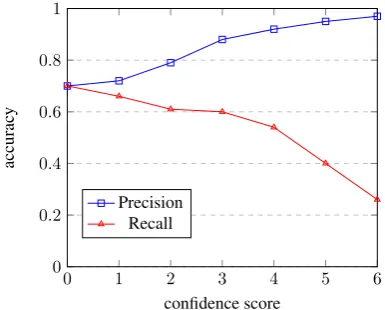
About 3,000 problems are manually annotated with answers and equations by the human annota-tors we hire. Then we train and evaluate our model using 5-fold cross validation. The extractor’s per-formance is shown in Figure 2. To preserve an accuracy rate of 90%, we use score = 3 as the threshold and only keep problems with predicted confidence score>=3.
Please note that precision is more important than recall in our scenario. We need to guaran-tee that most extracted answers are correct. Lower recall can be tackled by processing more posts.
0 1 2 3 4 5 6
0 0.2 0.4 0.6 0.8 1
confidence score
accurac
y
[image:5.595.72.265.292.447.2]Precision Recall
Figure 2: Accuracy of answer extraction
3.3 Automatic Equation Annotation
Now we illustrate how to extract equation systems automatically from the unstructured answer text of a post. The input is the answer text ofnanswers:
T ={T1, T2, . . . , Tn}
For example in Figure 1, there are four answers, each corresponding to a piece of answer textTi.
The task is not easy, because variables and equations may not be in standard formats in an-swer text. In addition, equations may be duplicate (like those in Answer 1 of Figure 1). Our algo-rithm is a two-phase procedure:
Candidate extraction: We extract an equation system from each piece of answer textTi. In pro-cessing Ti, we first extract a list of equations by
regular expression matching. Then the equations are added to the equation system by the order of their occurrences in the text. Before adding an
equation, we check whether it can be induced by the already-added equations. If so, we skip it. Duplicate equations are effectively reduced in this way.
Voting by solution: We solve each equation system obtained from the first phase and build a (equation system, solution) bipartite graph. We then choose the equation system that has the max-imum degree as our output. For example, if three equation systems return the solution{24}and the fourth returns{-1}, we will choose one from the first three equation systems. To improve precision, we do not return any equation system if the maxi-mal degree is less than 2.
We evaluate our equation extractor on 3,000 manually annotated problems 4. For an equation system extracted for a problem, we say it is cor-rect if the annotated gold answer is a subset of the solutions to the equation system. For example, if the gold answer is{16, 34}and the solution to the equation system is{16, 34, 100}, then the equa-tion system is considered correct. Evaluaequa-tion re-sults show a precision of 91.4% and a recall of 64.7%.
3.4 Datasets Summary
Below are a list of previous benchmark datasets for math word problem solving.
Alg514is introduced in Kushman et al. (2014) and also used in Zhou et al. (2015) for evaluation. It consists of 514 algebra word problems from al-gebra.com5, with each problem annotated with lin-ear equations. The template (explained later) of each problem has to appear at least six times in the whole set.
Verb395(Hosseini et al., 2014): A collection of addition/subtraction problems.
Dolphin1878: A collection built by Shi et al. (2015), containing 1,878 number word problems obtained from algebra.com and Yahoo! answers.
DRAW (Upadhyay and Chang, 2015): Con-taining 1,000 algebra word problems from alge-bra.com, each annotated with linear equations.
SingleEQ: By Koncel-Kedziorski et al. (2015), containing 508 problems, each of which corre-sponds to one single equation.
Before comparing the datasets, let’s first intro-duce the concept of equation system templates, which are first introduced in Kushman et al. (2014)
4the same set of problems as we used in training and eval-uating answer extraction
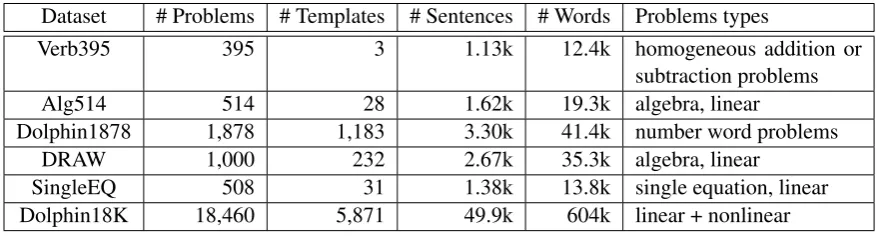
Table 2: Comparison of different datasets
Dataset # Problems # Templates # Sentences # Words Problems types
Verb395 395 3 1.13k 12.4k homogeneous addition or
subtraction problems
Alg514 514 28 1.62k 19.3k algebra, linear
Dolphin1878 1,878 1,183 3.30k 41.4k number word problems
DRAW 1,000 232 2.67k 35.3k algebra, linear
SingleEQ 508 31 1.38k 13.8k single equation, linear
Dolphin18K 18,460 5,871 49.9k 604k linear + nonlinear
for math word problem solving. A template is a unique form of equation system. For example, the following is a template of two equations:
n1·x1+x2 =n2
x1+n3·x2 =n4
The following equation system corresponds to the above template,
3·x1+x2 = 5
x1+ 7·x2 = 15
Table 2 shows some statistical information of our dataset and previous ones. It can be seen that our dataset has a much larger scale (about 10 times the size of the Dolphin1878 collection and more than 17 times larger than the others) and higher diversity (in terms of both problem types and the number of templates contained).
We split our dataset into a development set and an evaluation set. The development set is used for algorithm design and debugging, while the evalu-ation set is for training and testing. Any problem in the evaluation set should be invisible to the peo-ple who design an automatic math problem solv-ing system. Statistics on our dataset are shown in Table 3, wheredevandevalrepresent the develop-ment set and the evaluation set respectively. Most problems are assigned with both equation systems and gold answers. Some of them are annotated with answers only, either because annotators feel it is hard to do so, or because our equation extrac-tion algorithm returns empty results.
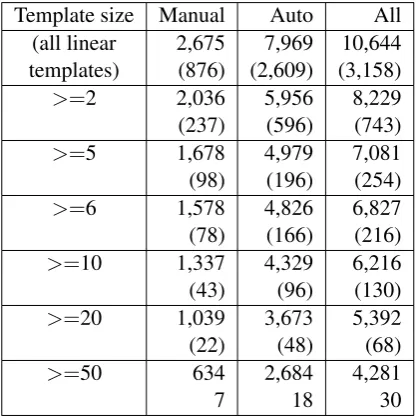
[image:6.595.306.526.262.376.2]As most previous systems only handle linear equation systems, we summarize, in Table 4, the distribution of linear problems in the evaluation set by template size. In the table, the size of a template is defined as the number of problems correspond-ing to this template. Between the two numbers in each cell, the first one is the number of problems,
Table 3: Annotation statistics for our dataset
Equations Answer Sum
+ answer only
Manual 909 67 976
dev Auto 2,245 507 2,752
All 3,154 574 3,728
Manual 3,605 321 3,926
eval Auto 8,754 2,052 10,806
All 12,359 2,373 14,732
and the second number (or the one in parentheses) is the number of templates in this category. For ex-ample, in the automatically annotated evaluation set, 166 templates have size 6 or larger. They cor-respond to 4,826 problems.
4 Experiments
4.1 Systems for evaluation
We report the performance of several state-of-the-art systems on our new dataset.
KAZB: A template-based statistical learning method introduced in Kushman et al. (2014). It maps a problem to one equation template defined in the training set by reasoning across problem sentences. KAZB reports an accuracy of 68.7% on the Alg514 dataset.
ZDC: Proposed in Zhou et al. (2015) as an im-proved version of KAZB. It reduces the search space by not modeling alignment between noun phrases and variables. It achieves an accuracy of 79.7% on Alg514.
ap-Table 4: Problem distribution by template size (for linear problems only)
Template size Manual Auto All
(all linear 2,675 7,969 10,644
templates) (876) (2,609) (3,158)
>=2 2,036 5,956 8,229
(237) (596) (743)
>=5 1,678 4,979 7,081
(98) (196) (254)
>=6 1,578 4,826 6,827
(78) (166) (216)
>=10 1,337 4,329 6,216
(43) (96) (130)
>=20 1,039 3,673 5,392
(22) (48) (68)
>=50 634 2,684 4,281
7 18 30
plied to the new problem. In a little more details, a test problem PT is solved in two steps:
tem-plate selection, and temtem-plate slot filling. In the first step, each problem is modeled as a vector of word TF-IDF scores. The similarity between two prob-lems is calculated by the weighted Jaccard sim-ilarity between their corresponding vectors. We choose, from the training data, problem P1 that
has the maximal similarity with PT and use the
equation templateTofP1as the template of
prob-lemPT. In the second step, the numbers appearing
in problemPT are mapped to the number slots of
templateT (which has been identified in the first step). The mapping is implemented by selecting one problemP2from all the training problems
cor-responding to templateT so that it has the min-imum word-level edit-distance to PT. Then the number mapping ofP2 is borrowed as the number
mapping of PT. For example, for the following
test problem,
An overnight mail service charges $3.60 for the first six ounces and$0.45 for each additional ounce or fraction of an ounce. Find the number of ounces in a package that cost$7.65 to deliver.
Assuming that a problemP1has maximum
Jac-card similarity with the above problem and its cor-responding equation template is as follows, this template will be identified in the first step,
n1+n2∗(x−n3) =n4
Assume thatP2 has the minimum edit-distance
toPT among all the training problems
correspond-ing to templateT. Suppose the numbers inP2are
(by their order in the problem text),
3.5,5,0.5,6.5
Also supposeP2is annotated with the following
equation system,
3.5 + 0.5∗(x−5) = 6.5
Then we will chooseP2 and borrow its number
mapping. So the mapping from numbers in the above test problem to template slots will be,
3.60/n1; 6/n3; 0.45/n2; 7.65/n4
In implementing SIM, we do not use any POS tagging or syntactic parsing features for similar-ity calculation. This method gets an accuracy of 71.2% on Alg514 and 49.0% on SingleEQ.
Systems not included for evaluation: Al-though the system of Shi et al. (2015) achieves very high performance on number word problems, we do not include it in our evaluation because it is unknown how to extend it to other problem types. The system of Hosseini et al. (2014) is not in-cluded in our evaluation because it only handles homogeneous addition/subtraction problems. The systems of Koncel-Kedziorski et al. (2015) and Roy and Roth (2015) are also not included because so far they only supports problems with one single linear equation.
4.2 Overall Evaluation Results
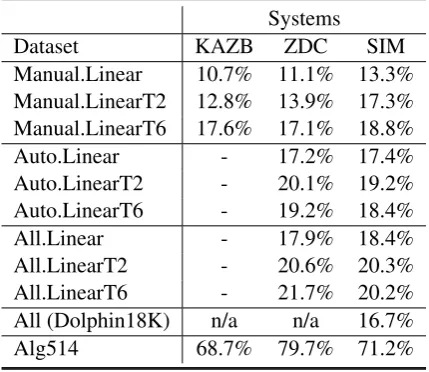
Table 5 shows the accuracy of various systems on different subsets of our dataset. In the ta-ble, Manual.Linear contains all the manually an-notated problems with linear equation systems. It contains 2,675 problems and 876 templates (as shown in Table 4). Auto.LinearT6 (containing 4,826 problems) is the set of all the automatically annotated problems with a template size larger than or equal to 6. Similarly, LinearT2 means the subset of problems with template size ≥ 2. For each system on each subset, experiments are conducted using 5-fold cross-validation with 80% problems randomly selected as training data and the remaining 20% for test.
[image:7.595.77.287.101.310.2]Systems
Dataset KAZB ZDC SIM
Manual.Linear 10.7% 11.1% 13.3%
Manual.LinearT2 12.8% 13.9% 17.3%
Manual.LinearT6 17.6% 17.1% 18.8%
Auto.Linear - 17.2% 17.4%
Auto.LinearT2 - 20.1% 19.2%
Auto.LinearT6 - 19.2% 18.4%
All.Linear - 17.9% 18.4%
All.LinearT2 - 20.6% 20.3%
All.LinearT6 - 21.7% 20.2%
All (Dolphin18K) n/a n/a 16.7%
[image:8.595.74.289.64.250.2]Alg514 68.7% 79.7% 71.2%
Table 5: Overall evaluation results
containing nonlinear problems. An “n/a” is filled in the corresponding cell in this case.
The results show that all three systems (KAZB, ZDC, and SIM) have extremely low performance on our new datasets. Surprisingly, no system achieves an accuracy rate of over 25%. Such re-sults indicate that automatic math word problem solving is still a very challenging task.
Another surprising observation is that KAZB and ZDC do not perform better than SIM, a simple similarity-based method which runs much faster than the two statistical learning systems.
By comparing the results obtained from the manual version of the datasets with their cor-responding auto version (for example, Manu-all.Linear vs. Auto.Linear), we can see larger ac-curacy scores on the auto versions6. This demon-strates the usefulness of the automatically anno-tated data. Considering the huge cost of manually assigning equation systems and gold answers, au-tomatic annotation has good potential in construct-ing larger datasets.
4.3 Why Different from Previous Results The last line of Table 5 displays the results on Alg514. All three systems perform well on Alg514 but poorly on Dolphin18K. To study the reason of such a large gap, we derive two small datasets from All.Linear by referring to the equa-tion templates in Alg514.
Small.01: The set of all problems in All.Linear that correspond to one of the 28 templates in Alg514. The dataset contains 2,021 problems.
6Please note that the auto versions are more than 2 times larger.
Small.02: A subset of Small.01, constructed by randomly removing problems from Small.01 so that each template contains similar number of problems as in Alg514. In other words, Small.02 and Alg514 have similar problem distribution among templates.
Small.01 Small.02
KAZB 29.9% 50.0%
ZDC 30.1% 52.7%
SIM 33.7% 43.0%
Table 6: The case of fewer number of templates
We still use 5-fold cross validation to test and compare system performance on the two small datasets. Evaluation results are displayed in Table 6. We now obtain higher accuracy scores for each system, but there is a big difference between the results on Small.01 and Small.02. As mentioned in (Upadhyay and Chang, 2015), Alg514 has a skewed problem distribution, with a few templates covering almost 50% problems. This may be the main reason why all three systems achieve high accuracy on this dataset and on Small.02. From all of the above results, we see at least two factors which affect system performance: number of tem-plates in the dataset, and the distribution of prob-lems among the templates. For a small dataset, the distribution of problems among templates have a huge impact on evaluation results.
4.4 Effect of Training Data Size
Now we investigate the performance change of various systems when the size of training data changes. The goal is to check whether the ac-curacy increases quickly when more training data are added. This is important: If it is the case, we can tackle this task by simply adding more training data, either manually or automatically. Otherwise, we have to discover new approaches.
We conduct experiments in two settings: fixed-test-set, and increasing-test-set. In the first setting, we randomly choose 1/2 of the problems from the Manual.Linear subset to form a fixed test-set (with size 1330). Then the other problems in All.Linear forms a candidate training collection (containing 9314 elements). We construct training sets of dif-ferent scales by doing random sampling from the candidate training collection.
[image:8.595.343.490.156.216.2]Training data source All.LinearT6 All.Linear
Training data size 138 434 1024 2940 5771 500 1000 2000 5000 9000
Test set size 1330 1330 1330 1330 1330 1330 1330 1330 1330 1330
KAZB accuracy (%) 6.7 7.2 - - - 7.1 8.3 - -
-ZDC accuracy (%) 6.1 7.5 8.6 11.4 12.6 5.5 9.2 10.5 12.5 13.1
[image:9.595.79.522.64.151.2]SIM accuracy (%) 5.5 8.7 11.0 13.7 15.9 6.5 10.8 12.2 14.9 18.4
Table 7: System performance with different training data size (setting: fixed-test-set)
Training data size 400 800 1600 4000 8516
Test set size 100 200 400 1000 2128
KAZB 5.4% 6.7% 11.7% -
-ZDC 5.8% 7.6% 12.9% 17.0% 17.9%
SIM 7.4% 10.0% 13.3% 16.9% 18.4%
Table 8: System performance with different training data size (setting: increasing-test-set)
different scales by doing random sampling from All.Linear, and then conduct 5-fold cross valida-tion on each dataset. In each fold, 80% problems are chosen at random for training, and the other 20% for testing.
The results in the two settings are reported in Tables 7 and 8 respectively. Both tables show that the accuracy of all the three systems improves steadily but slowly along with the increasing of training data size. So it is not very effective to improve accuracy by simply adding more training data.
4.5 Results Summary
In summary, the following observations are made from the experiments on our new dataset. First, all systems evaluated on the Dolphin18K dataset perform much worse than on the small and less di-verse datasets. Second, the two statistical learn-ing methods do not perform better than a sim-ple similarity-based method. Third, it seems not promising for the current methods to achieve much better results by simply adding more train-ing data. Automatic math word problem solvtrain-ing is still a very challenging task so far.
5 Conclusion
We have constructed Dolphin18K, a large dataset for training and evaluating automatic math word problem solving systems. The new dataset is al-most one order of magnitude larger than al-most of previous ones, and has a much higher level of di-versity in term of problem types. We reduce
hu-man annotation cost by automatically extracting gold answers and equation systems from the un-structured answer text of CQA posts.
We have also conducted experiments on our dataset to evaluate state-of-the-art systems. Inter-esting and surprising observations are made from the experimental results.
Acknowledgments
We would like to thank the annotators for their efforts in annotating the math problems in our dataset. Thanks to the anonymous reviewers for their helpful comments and suggestions.
References
Eugene Agichtein, Carlos Castillo, Debora Donato, Aristides Gionis, and Gilad Mishne. 2008. Finding high-quality content in social media. InFirst ACM International Conference on Web Search and Data Mining (WSDM’08).
Yefim Bakman. 2007. Robust understanding
of word problems with extraneous information. http://arxiv.org/abs/math/0701393.
Daniel G. Bobrow. 1964a. Natural language input for a computer problem solving system. Technical report, Cambridge, MA, USA.
Daniel G. Bobrow. 1964b. Natural language input for a computer problem solving system. Ph.D. Thesis. Diane J. Briars and Jill H. Larkin. 1984. An integrated
model of skill in solving elementary word problems.
Cognition and Instruction, 1(3):245–296.
Eugene Charniak. 1969. Computer solution of calcu-lus word problems. InProceedings of the 1st Inter-national Joint Conference on Artificial Intelligence, pages 303–316.
Gao Cong, Long Wang, Chin-Yew Lin, Young-In Song, and Yueheng Sun. 2008. Finding question-answer pairs from online forums. InProceedings of 31st International ACM-SIGIR Conference on Re-search and Development in Information Retrieval (SIGIR’08), pages 467–474.
Denise Dellarosa. 1986. A computer simulation of children’s arithmetic word-problem solving. Behav-ior Research Methods, Instruments, & Computers, 18(2):147–154.
Shilin Ding, Gao Cong, Chin-Yew Lin, and Xiaoyan Zhu. 2008. Using conditional random fields to ex-tract context and answers of questions from online forums. InProceedings of the 46th Annual Meet-ing of the ACL: HLT (ACL 2008), pages 710–718, Columbus, USA.
Charles R. Fletcher. 1985. Understanding and solving arithmetic word problems: A computer simulation.
Behavior Research Methods, Instruments, & Com-puters, 17(5):565–571.
Ralf Herbrich, Thore Graepel, and Klaus Obermayer, 2000. Large Margin Rank Boundaries for Ordinal Regression, chapter 7, pages 115–132.
Mohammad Javad Hosseini, Hannaneh Hajishirzi, Oren Etzioni, and Nate Kushman. 2014. Learning to solve arithmetic word problems with verb catego-rization. InProceedings of the 2014 Conference on Empirical Methods in Natural Language Processing (EMNLP), October.
Rik Koncel-Kedziorsk, Subhro Roy, Aida Amini, Nate Kushman, and Hannaneh Hajishirzi. 2016. Mawps: A math word problem repository. InProceedings of the 2016 Conference of the North American Chap-ter of the Association for Computational Linguistics: Human Language Technologies.
Rik Koncel-Kedziorski, Hannaneh Hajishirzi, Ashish Sabharwal, Oren Etzioni, and Siena Dumas Ang. 2015. Parsing algebraic word problems into equa-tions. Transactions of the Association for Computa-tional Linguistics, 3:585–597.
Nate Kushman, Yoav Artzi, Luke Zettlemoyer, and Regina Barzilay. 2014. Learning to automatically solve algebra word problems. InProceedings of the 52nd Annual Meeting of the Association for Compu-tational Linguistics.
Christian Liguda and Thies Pfeiffer. 2012. Modeling math word problems with augmented semantic net-works. InNatural Language Processing and Infor-mation Systems. International Conference on Appli-cations of Natural Language to Information Systems (NLDB-2012), pages 247–252.
Anirban Mukherjee and Utpal Garain. 2008. A review of methods for automatic understanding of natural language mathematical problems. Artificial Intelli-gence Review, 29(2):93–122.
Subhro Roy and Dan Roth. 2015. Solving general arithmetic word problems. In Proceedings of the 2015 Conference on Empirical Methods in Natural Language Processing, pages 1743–1752. The Asso-ciation for Computational Linguistics.
Minjoon Seo, Hannaneh Hajishirzi, Ali Farhadi, Oren Etzioni, and Clint Malcolm. 2015. Solving geome-try problems: Combining text and diagram interpre-tation. In Proceedings of the 2015 Conference on Empirical Methods in Natural Language Process-ing.
Shuming Shi, Yuehui Wang, Chin-Yew Lin, Xiaojiang Liu, and Yong Rui. 2015. Automatically solving number word problems by semantic parsing and rea-soning. InProceedings of the 2015 Conference on Empirical Methods in Natural Language Process-ing.
Shyam Upadhyay and Ming-Wei Chang. 2015. Draw: A challenging and diverse algebra word problem set. Number MSR-TR-2015-78, October.
Ma Yuhui, Zhou Ying, Cui Guangzuo, Ren Yun, and Huang Ronghuai. 2010. Frame-based calculus of solving arithmetic multistep addition and
subtrac-tion word problems. Education Technology and
Computer Science, International Workshop, 2:476– 479.