A Continuous Space Rule Selection Model
for Syntax-based Statistical Machine Translation
Jingyi Zhang1,2, Masao Utiyama1, Eiichro Sumita1
Graham Neubig2, Satoshi Nakamura2
1National Institute of Information and Communications Technology,
3-5Hikaridai, Keihanna Science City, Kyoto 619-0289, Japan
2Graduate School of Information Science, Nara Institute of Science and Technology,
Takayama, Ikoma, Nara 630-0192, Japan
jingyizhang/mutiyama/[email protected] neubig/[email protected]
Abstract
One of the major challenges for statisti-cal machine translation (SMT) is to choose the appropriate translation rules based on the sentence context. This paper pro-poses a continuous space rule selection (CSRS) model for syntax-based SMT to perform this context-dependent rule selec-tion. In contrast to existing maximum en-tropy based rule selection (MERS) mod-els, which use discrete representations of words as features, the CSRS model is learned by a feed-forward neural network and uses real-valued vector representa-tions of words, allowing for better gen-eralization. In addition, we propose a method to train the rule selection models only on minimal rules, which are more fre-quent and have richer training data com-pared to non-minimal rules. We tested our model on different translation tasks and the CSRS model outperformed a base-line without rule selection and the previ-ous MERS model by up to 2.2 and 1.1 points of BLEU score respectively. 1 Introduction
In syntax-based statistical machine translation (SMT), especially tree-to-string (Liu et al., 2006; Graehl and Knight, 2004) and forest-to-string (Mi et al., 2008) SMT, a source tree or forest is used as input and translated by a series of tree-based trans-lation rules into a target sentence. A tree-based translation rule can perform reordering and trans-lation jointly by projecting a source subtree into a target string, which can contain both terminals and nonterminals.
One of the difficulties in applying this model is the ambiguity existing in translation rules: a
S
NP
a thief caught
PRP VBD DT NN NP
VP
I
了 一个 抓
我 贼
S
NP
a cold caught
PRP VBD DT NN NP
VP
I
了 感冒 得
我
S
NP
caught VBD NP
VP
x0
了 x1
抓
x0
x1
S
NP
caught VBD NP
VP
x0
了 x1
得
x0
x1
[image:1.595.331.497.223.422.2]Rule Extraction
Figure 1: An ambiguous source subtree with dif-ferent translations (English-to-Chinese).
source subtree can have different target transla-tions extracted from the parallel corpus as shown in Figure 1. Selecting correct rules during decod-ing is a major challenge for SMT in general, and syntax-based models are no exception.
There have been several methods proposed to resolve this ambiguity. The most simple method, used in the first models of tree-to-string transla-tion (Liu et al., 2006), estimated the probability of a translation rule by relative frequencies. For ex-ample, in Figure 1, the rule that occurs more times in the training data will have a higher score. Later, Liu et al. (2008) proposed a maximum entropy based rule selection (MERS, Section 2) model for syntax-based SMT, which used contextual infor-mation for rule selection, such as words surround-ing a rule and words covered by nonterminals in a rule. For example, to choose the correct rule from the two rules in Figure 1 for decoding a par-ticular input sentence, if the source phrase cov-ered by “x1” is “a thief” and this child phrase
has been seen in the training data, then the MERS model can use this information to determine that the first rule should be applied. However, if the source phrase covered by “x1” is a slightly differ-ent phrase, such as “a gunman”, it will be hard for the MERS model to select the correct rule, because it treats “thief” and “gunman” as two different and unrelated words.
In this paper, we propose a continuous space rule selection (CSRS, Section 3) model, which is learned by a feed-forward neural network and re-places the discrete representations of words used in the MERS model with real-valued vector repre-sentations of words for better generalization. For example, the CSRS model can use the similarity of word representations for “gunman” and “thief” to infer that “a gunman” is more similar with “a thief” than “a cold”.
In addition, we propose a new method, ap-plicable to both the MERS and CSRS models, to train rule selection models only on minimal rules. These minimal rules are more frequent and have richer training data compared to non-minimal rules, making it possible to further relieve the data sparsity problem.
In experiments (Section 4), we validate the proposed CSRS model and the minimal rule training method on to-German, French, Chinese and English-to-Japanese translation tasks.
2 Tree-to-String SMT and MERS
2.1 Tree-to-String SMT
In tree-to-string SMT (Liu et al., 2006), a parse tree for the source sentenceF is transformed into a target sentenceEusing translation rulesR. Each tree-based translation rule r ∈ R translates a source subtree ˜tinto a target string ˜e, which can contain both terminals and nonterminals. During decoding, the translation system examines differ-ent derivations for each source sdiffer-entence and out-puts the one with the highest probability,
ˆ
E= arg max
E,R Pr (E, R|F). (1)
For a translation E of a source sentence F with derivationR, the translation probability is
calcu-lated as follows,
Pr (E, R|F)≈
exp
PK
k=1λkhk(E, R, F)
P
E0,R0exp
PK
k=1λkhk(E 0, R0, F)
.
(2)
Here,hkare features used in the translation system
andλk are feature weights. Features used in Liu
et al. (2006)’s model contain a language model and simple features based on relative frequencies, which do not consider context information.
One of the most important features used in this model is based on the log conditional probability of the target string given the input source subtree log Pr ˜e|˜t. This allows the model to determine which target strings are more likely to be used in translation. However, as the correct translation of the rules may depend on context that is not di-rectly included in the rule, this simple context-independent estimate is inherently inaccurate.
2.2 Maximum Entropy Based Rule Selection
To perform context-dependent rule selection, Liu et al. (2008) proposed the MERS model for syntax-based SMT. They built a maximum en-tropy classifier for each ambiguous source subtree ˜
t, which introduced contextual informationCand estimated the conditional probability using a log-linear model as shown below,
Pr ˜e|t, C˜ = exp
PK
k=1λkhk(˜e, C)
P
˜ e0exp
PK
k=1
λkhk(˜e0, C)
. (3)
The target strings˜eare treated as different classes for the classifier.
Supposing that,
• rcovers source span[fϕ, fϑ]and target span
[eγ, eσ],
• ˜t contains K nonterminals
{Xk|0≤k≤K−1},
• Xk covers source span [fϕk, fϑk]and target span[eγk, eσk],
the MERS model used 5 kinds of source-side fea-tures as follows,
1. Lexical features: words around a rule (e.g. fϕ−1) and words covered by nonterminals in
2. Part-of-speech features: part-of-speech (POS) of context words that are used as lexical features.
3. Span features: span lengths of source phrases covered by nonterminals inr.
4. Parent features: the parent node of ˜t in the parse tree of the source sentence.
5. Sibling features: the siblings of the root of˜t.
Note that the MERS model does not use fea-tures of the source subtree ˜t, because the source subtreet˜is fixed for each classifier.
The MERS model was integrated into the trans-lation system as two additional features in Equa-tion 2. Supposing that the derivaEqua-tion R contains M rules r1, ..., rM with ambiguous source
sub-trees, then these two MERS features are as fol-lows,
h1(E, R, F) = M
P
m=1
log Pr ˜em|˜tm, Cm
h2(E, R, F) =M,
(4)
where ˜tm ande˜m are the source subtree and the
target string contained inrm, andCm is the
con-text of rm. h1 is the MERS probability feature,
and, h2 is a penalty feature counting the number
of predictions made by the MERS model.
3 Our CSRS Approach
3.1 Modeling
The proposed CSRS model differs from the MERS model in three ways.
1. Instead of learning a single classifier for each source subtree ˜t, it learns a single classifier for all rules.
2. Instead of hand-crafted features, it uses a feed-forward neural network to induce fea-tures from context words.
3. Instead of one-hot representations, it uses distributed representations to exploit similar-ities between words.
First, with regard to training, our CSRS model fol-lows Zhang et al. (2015) in approximating the pos-terior probability by a binary classifier as follows,
Pr ˜e|˜t, C≈Pr v= 1|˜e,t, C˜ , (5)
where v ∈ {0,1} is an indicator of whether˜tis translated intoe˜. This is in contrast to the MERS model, which treated the rule selection problem as a multi-class classification task. If instead we attempted to estimate output probabilities for all different ˜e, the cost of estimating the normaliza-tion coefficient would be prohibitive, as the num-ber of unique output-side word strings ˜eis large. There are a number of remedies to this, includ-ing noise contrastive estimation (Vaswani et al., 2013), but the binary approximation method has been reported to have better performance (Zhang et al., 2015).
To learn this model, we use a feed-forward neu-ral network with structure similar to neuneu-ral net-work language models (Vaswani et al., 2013). The input of the neural rule selection model is a vector representation for˜t, another vector representation for˜e, and a set ofξvector representations for both source-side and target-side context words ofr:
C(r) =w1, ..., wξ (6) In our model, C(r) is calculated differently depending on the number of nonterminals in-cluded in the rule. Specifically, Equation 7 de-fines Cout(r, n) to be context words (n-grams)
aroundrandCin(r, n, Xk)to be boundary words
(n-grams) covered by nonterminalXkinr.1
Cout(r, n)
=fϕ−nϕ−1, fθ+1θ+n, eγ−1γ−n, eσ+nσ+1 Cin(r, n, Xk)
=fϕk+n−1 ϕk , f
θk
θk−(n−1), eγγkk+n−1, e σk σk−(n−1)
(7) The context words used for a translation ruler withKnonterminals are shown as below.
K C(r) = 0 Cout(r,6)
= 1 Cout(r,4), Cin(r,2, X0)
>1 Cout(r,2), Cin(r,2, X0), Cin(r,2, X1)
We can see that rules with different numbers of nonterminals K use different context words.2
1Note that when extractingC
out, we use “hsi” and “h/si” for context words that exceed the length of the sentence; When extractingCin, we use “hnoni” for context words that exceed the length of the nonterminal. Words that occur less than twice in the training data are replaced by “hunki”.
S
The blue rug on the floor of your apartment is really cute DT JJ NN IN DT NN IN PRP NN VBZ RB JJ
NP NP NP ADJP
VP PP
NP PP NP
你 公寓 地板
铺 在 上 的 蓝色 毛毯 很 可爱
PP IN NP on x0
在 x0 上 r:
: area covered by r
[image:4.595.103.494.61.244.2]: area covered by x0 in r
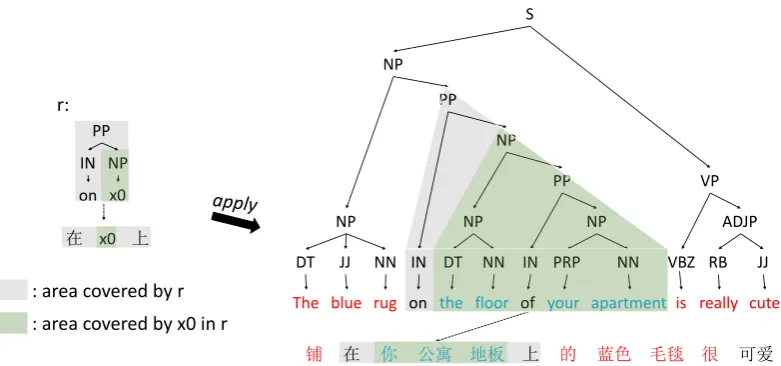
Figure 2: Context word examples. The red words are contained in Cout(r,4)and the blue words are
contained inCin(r,2, X0).
For example, if r does not contain nonterminals, thenCin is not used. Besides, we use more
con-text words surrounding the rule (Cout(r,6)) for
rules with K = 0 than rules that contain non-terminals (Cout(r,4) for K = 1and Cout(r,2)
for K > 1). This is based on the intuition that rules withK = 0can only use the context words surrounding the rule as information for rule selec-tion, hence this information is more important than for other rules. Figure 2 gives an example of con-text words when applying the rulerto the example sentence.
Note that we use target-side context because source-side context is not enough for selecting correct rules. Since it is not uncommon for one source sentence to have different correct transla-tions, a translation rule used in one correct deriva-tion may be incorrect for other derivaderiva-tions. In these cases, target-side context is useful for select-ing appropriate translation rules.3
The vector representations fort˜,˜eandCare ob-tained by using a projection matrix to project each one-hot input into a real-valued embedding vector. This projection is another key advantage over the MERS model. Because the CSRS model learns one unified model for all rules and can share all training data to learn better vector representations of words and rules, and the similarities between vectors can be used to generalize in cases such as the “thief/gunman” example in the introduction.
3It is also possible to consider target-side context in a framework like the MERS model, but we show in experi-ments that a linear model using the same features as the CSRS model did not improve accuracy.
After calculating the projections, two hidden layers are used to combine all inputs. Finally, the neural network has two outputsPr v = 1|˜e,t, C˜ andPr v= 0|˜e,˜t, C.
To train the CSRS model, we need both posi-tive and negaposi-tive training examples. Posiposi-tive ex-amples,e,˜ ˜t, C,1, can be extracted directly from the parallel corpus. For each positive example, we generate one negative example,˜e0,˜t, C,0. Here,
˜
e0is randomly generated according to the
transla-tion distributransla-tion (Zhang et al., 2015),
Pr ˜e|˜t= Count ˜e,˜t
P
˜
e0Count ˜e0,t˜
, (8)
where,Count e,˜ ˜tis how many timest˜is trans-lated intoe˜in the parallel corpus.
During translating, following the MERS model, the CSRS model only calculates probabilities for rules with ambiguous source subtrees. These pre-dictions are converted into two CSRS features for the translation system similar to the two MERS features in Equation 4: one is the product of prob-abilities calculated by the CSRS model and the other one is a penalty feature that stands for how many rules with ambiguous source subtrees are contained in one translation.
3.2 Usage of Minimal Rules
Source tree Target string
PP
IN DT NP
on the NN table NN
table 桌子
DT NP
the 桌子
NN table
DT NP
the x0
NN x0
在 桌子 上 PP
IN NP
on x0 在 x0 上
PP
IN DT NP
on the NN
x0 在 x0 上
Rule1
Rule2
Rule3
Rule4
Rule5
Rule6
PP
IN DT NN
NP
on the table
在 桌子 上
extract
Figure 3: Rules.
and many may only appear a few times in the cor-pus. To reduce these problems of sparsity, we pro-pose another improvement to the model, specifi-cally through the use of minimal rules.
Minimal rules (Galley et al., 2004) are trans-lation rules that cannot be split into two smaller rules. For example, in Figure 3, Rule2 is not a minimal rule, since Rule2 can be split into Rule1 and Rule3. In the same way, Rule4 and Rule6 are not minimal while Rule1, Rule3 and Rule5 are minimal.
Minimal rules are more frequent than non-minimal rules and have richer training data. Hence, we can expect that a rule selection model trained on minimal rules will suffer less from data sparsity problems. Besides, without non-minimal rules, the rule selection model will need less
mem-ory and can be trained faster.
To take advantage of this fact, we train another version of the CSRS model (CSRS-MINI) over only minimal rules. The probability of a non-minimal rule is then calculated using the prod-uct of the probability of minimal rules contained therein.
Note that for both the standard CSRS and CSRS-MINI models, we use the same baseline translation system which can use non-minimal translation rules. The CSRS-MINI model will break translation rules used in translations down into minimal rules and multiply all probabilities to calculate the necessary features.
4 Experiments
4.1 Setting
We evaluated the proposed approach for English-to-German (ED), English-to-French (EF), English-to-Chinese (EC) and English-to-Japanese (EJ) translation tasks. For the ED and EF tasks, the translation systems are trained on Europarl v7 parallel corpus and tested on the WMT 2015 translation task.4 The test sets for the WMT 2014
translation task were used as development sets in our experiments. For the EC and EJ tasks, we used datasets provided for the patent machine translation task at NTCIR-9 (Goto et al., 2011).5
The detailed statistics for training, development and test sets are given in Table 1. The word segmentation was done by BaseSeg (Zhao et al., 2006) for Chinese and Mecab6for Japanese.
For each translation task, we used Travatar (Neubig, 2013) to train a forest-to-string transla-tion system. GIZA++ (Och and Ney, 2003) was used for word alignment. A 5-gram language model was trained on the target side of the train-ing corpus ustrain-ing the IRST-LM Toolkit7with
mod-ified Kneser-Ney smoothing. Rule extraction was
4The WMT tasks provided other training corpora. We used only the Europarl corpus, because training a large-scale system on the whole data set requires large amounts of time and computational resources.
5Note that NTCIR-9 only contained a Chinese-to-English translation task. Because we want to test the proposed ap-proach with a similarly accurate parsing model across our tasks, we used English as the source language in our experi-ments. In NTCIR-9, the development and test sets were both provided for the CE task while only the test set was provided for the EJ task. Therefore, we used the sentences from the NTCIR-8 EJ and JE test sets as the development set in our experiments.
SOURCE TARGET
ED
TRAIN #Sents 1.90M
#Words 52.2M 49.7M #Vocab 113K 376K
DEV #Sents 3,003
#Words 67.6K 63.0K
TEST #Sents 2,169
#Words 46.8K 44.0K
EF
TRAIN #Sents 1.99M
#Words 54.4M 60.4M #Vocab 114K 137K
DEV #Sents 3,003
#Words 71.1K 81.1K
TEST #Sents 1.5K
#Words 27.1K 29.8K
EC
TRAIN #Sents 954K
#Words 40.4M 37.2M #Vocab 504K 288K
DEV #Sents 2K
#Words 77.5K 75.4K
TEST #Sents 2K
#Words 58.1K 55.5K
EJ
TRAIN #Sents 3.14M
#Words 104M 118M
#Vocab 273K 150K
DEV #Sents 2K
#Words 66.5K 74.6K
TEST #Sents 2K
[image:6.595.72.273.59.361.2]#Words 70.6K 78.5K
Table 1: Data sets.
performed using the GHKM algorithm (Galley et al., 2006) and the maximum numbers of nontermi-nals and terminontermi-nals contained in one rule were set to 2 and 10 respectively. Note that when extracting minimal rules, we release this limit. The decoding algorithm is the bottom-up forest-to-string decod-ing algorithm of Mi et al. (2008). For English parsing, we used Egret8, which is able to output
packed forests for decoding.
We trained the CSRS models (CSRS and CSRS-MINI) on translation rules extracted from the training set. Translation rules extracted from the development set were used as validation data for model training to avoid over-fitting. For different training epochs, we resample negative examples for each positive example to make use of differ-ent negative examples. The embedding dimension was set to be 50 and the number of hidden nodes was 100. The initial learning rate was set to be0.1. The learning rate was halved each time the valida-tion likelihood decreased. The number of epoches was set to be20. A model was saved after each epoch and the model with highest validation like-lihood was used in the translation system.
We implemented Liu et al. (2008)’s MERS model to compare with our approach. The
train-8https://code.google.com/archive/p/egret-parser
ED EF EC EJ
[image:6.595.318.512.61.123.2]Base 15.00 26.76 29.42 37.10 MERS 15.62 27.33 29.75 37.76 CSRS 16.15 28.05 30.12 37.83 MERS-MINI 15.77 28.13 30.53 38.14 CSRS-MINI 16.49 28.30 31.63 38.32
Table 2: Translation results. The bold numbers stand for the best systems.
ED EF EC EJ
CSRS vs. MERS >> >> > − CSRS-MINI vs. MERS-MINI >> − >> − MERS-MINI vs. MERS − >> >> >>
CSRS-MINI vs. CSRS > − >> >>
Table 3: Significance test results. The symbol>> (>) represents a significant difference at the p < 0.01(p < 0.05) level and the symbol - represents no significant difference at thep <0.05level.
ing instances for their model were extracted from the training set. Following their work, the iteration number was set to be 100 and the Gaussian prior was set to be 1. We also compared the original MERS model and the MERS model trained only on minimal rules (MERS-MINI) to test the benefit of using minimal rules for model training.
The MERS and CSRS models were both used to calculate features used to rerank unique 1,000-best outputs of the baseline system. Tuning is per-formed to maximize BLEU score using minimum error rate training (Och, 2003).
4.2 Results
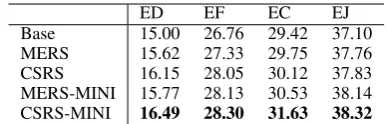
Table 2 shows the translation results and Table 3 shows significance test results using bootstrap re-sampling (Koehn, 2004): “Base” stands for the baseline system without any; “MERS”, “CSRS”, “MERS-MINI” and “CSRS-MINI” means the out-puts of the baseline system were reranked using features from the MERS, CSRS, MERS-MINI and CSRS-MINI models respectively. Generally, the CSRS model outperformed the MERS model and the CSRS-MINI model outperformed the MERS-MINI model on different translation tasks. In ad-dition, using minimal rules for model training ben-efitted both the MERS and CSRS models.
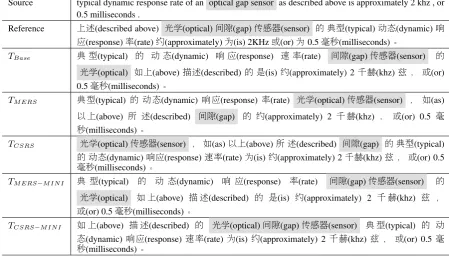
Table 4 shows translation examples in the EC task to demonstrate the reason why our ap-proach improved accuracy. Among all transla-tions, TCSRS−MINI is basically the same as the
con-Source typical dynamic response rate of an optical gap sensor as described above is approximately 2 khz , or 0.5 milliseconds .
Reference 上述(described above) 光学(optical)间隙(gap)传感器(sensor) 的典型(typical)动态(dynamic)响 应(response)率(rate)约(approximately)为(is) 2KHz或(or)为0.5毫秒(milliseconds)。
TBase 典型(typical) 的 动态(dynamic) 响应(response) 速率(rate) 间隙(gap)传感器(sensor) 的 光学(optical) 如上(above)描述(described)的是(is)约(approximately) 2千赫(khz)兹,或(or) 0.5毫秒(milliseconds)。
TMERS 典型(typical)的 动态(dynamic) 响应(response) 率(rate) 光学(optical)传感器(sensor) , 如(as)
以 上(above) 所 述(described) 间隙(gap) 的 约(approximately) 2 千赫(khz) , 或(or) 0.5 毫 秒(milliseconds)。
TCSRS 光学(optical)传感器(sensor) ,如(as)以上(above)所述(described) 间隙(gap) 的典型(typical) 的动态(dynamic)响应(response)速率(rate)为(is)约(approximately) 2千赫(khz)兹,或(or) 0.5 毫秒(milliseconds)。
TMERS−MINI 典 型(typical) 的 动 态(dynamic) 响 应(response) 率(rate) 间隙(gap)传感器(sensor) 的 光学(optical) 如上(above) 描述(described) 的 是(is) 约(approximately) 2 千赫(khz) 兹 , 或(or) 0.5毫秒(milliseconds)。
[image:7.595.72.522.67.338.2]TCSRS−MINI 如上(above) 描述(described) 的 光学(optical)间隙(gap)传感器(sensor) 典型(typical) 的 动 态(dynamic)响应(response) 速率(rate)为(is)约(approximately) 2千赫(khz)兹 , 或(or) 0.5 毫 秒(milliseconds)。
Table 4: Translation examples.
R1:TMERS&TCSRS PP ( IN ( “of” ) NP ( NP ( DT ( “an” ) NP’ ( JJ ( “optical” ) x0:NN ) ) x1:NP’ ) ) →“光学(optical)” x1 x0 “的”
R2:TMERS−MINI PP ( IN ( “of” ) NP ( NP ( DT ( “an” ) NP’ ( JJ ( “optical” ) x0:NP’ ) ) x1:SBAR ) ) →x0 “的” “光学(optical)” x1 “的”
R3:TCSRS−MINI NP’ ( JJ ( “optical” ) x0:NP’ )→“光学(optical)” x0
Table 5: Rules used to translate the source word “optical” in different translations. Shadows (R3) stand
for ambiguous rules.
trast, TBase,TMERS,TCSRS andTMERS−MINI
all contain apparent mistakes. For example, the source phrase “optical gap sensor” (covered by gray shadows in Table 4) is wrongly translated in TBase,TMERS,TCSRSandTMERS−MINIdue to
incorrect reorderings.
Table 5 shows rules used to translate the source word “optical” in different translations: R1 is
used in TMERS and TCSRS; R2 is used in
TMERS−MINI;R3 is used inTCSRS−MINI.
Al-though the source word “optical” is translated to the correct translation “光学(optical)” in all
trans-lations,R1,R2andR3cause different reorderings
for the source phrase “optical gap sensor”. R3
re-orders this source phrase correctly while R1 and
R2cause wrong reorderings for this source phrase.
We can see that R1 is umambiguous, so the
MERS and CSRS models will give probability 1 to R1, which could make the MERS and CSRS
models preferTMERS andTCSRS. This is a
typ-ical translation error caused by sparse rules since
the source subtree inR1does not have other
trans-lations in the training corpus.
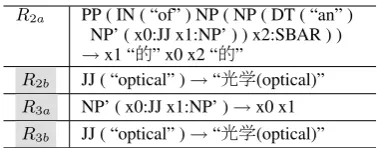
To compare the MERS-MINI and CSRS-MINI models, Table 6 shows minimal rules (R2a, R2b,
R3a and R3b) contained in R2 andR3. Table 7
shows probabilities of these minimal rules calcu-lated by the MERS-MINI and CSRS-MINI mod-els respectively. We can see that the CSRS-MINI model gave higher scores for the correct translation rules R3a and R3b than the
MERS-MINI model, while the MERS-MERS-MINI model gave a higher score to the incorrect rule R2b than the
CSRS-MINI model.
Note that R2b and R3b are the same rule,
but the target-side context in TMERS−MINI and
TCSRS−MINI is different. The CSRS-MINI
model will give R2b andR3b different scores
be-cause the CSRS-MINI model used target-side con-text. However, the MERS-MINI model only used source-side features and gave R2b and R3b the
R2a PP ( IN ( “of” ) NP ( NP ( DT ( “an” ) NP’ ( x0:JJ x1:NP’ ) ) x2:SBAR ) ) →x1 “的” x0 x2 “的”
R2b JJ ( “optical” )→“光学(optical)”
R3a NP’ ( x0:JJ x1:NP’ )→x0 x1
[image:8.595.86.275.60.134.2]R3b JJ ( “optical” )→“光学(optical)”
Table 6: Minimal rules contained inR2 andR3.
Shadows (R2b,R3aandR3b) stand for ambiguous
rules.
MERS-MINI CSRS-MINI
R2a 1 1
R2b 0.5441 0.09632
R3a 0.9943 0.9987
R3b 0.5441 0.7317
Table 7: Scores of minimal rules.
gave a higher score for R3b than R2b means that
the CSRS-MINI model predicted the target string in R2b andR3b is a good translation in the
con-text ofTCSRS−MINI but not so good in the
con-text of TMERS−MINI. As we can see, the
tar-get phrase “如上(above) 描述(described) 的(of)
光学(optical) 间隙(gap) 传感器(sensor)” around
“光学(optical)” in TCSRS−MINI is a reasonable
Chinese phrase while the target phrase “间隙(gap) 传感器(sensor)的(of)光学(optical)如上(above)
描述(described) 的(of)” around “光学(optical)”
inTMERS−MINI does not make sense. Namely,
the CSRS model trained with target-side context can perform rule selection considering target sen-tence fluency, which is the reason why target-side context can help in the rule selection task.
4.3 Analysis
To analyze the influence of different features, we trained the MERS model using source-side and target-side n-gram lexical features similar to the CSRS model. When using this feature set, the performance of the MERS model dropped signifi-cantly. This indicates that the syntactic, POS and span features used in the original MERS model are important for their model, since these fea-tures can generalize better. Purely lexical feafea-tures are less effective due to sparsity problems when training one maximum entropy based classifier for each ambiguous source subtree and training data for each classifier is quite limited. In contrast, the CSRS model is trained in a continuous space and does not split training data, which relieves the sparsity problem of lexical features. As a result, the CSRS model achieved better performance
us-ing only lexical features compared to the MERS model. We also tried to use pre-trained word em-bedding features for the MERS model, but it did not improve the performance of the MERS model, which indicates that the log-linear model is not able to benefit from distributed representations as well as the neural network model.
We also tried reranking with both the CSRS and MERS models added as features, but it did not achieve further improvement compared to only us-ing the CSRS model. This indicates that although these two models use different type of features, the information contained in these features are similar. For example, the POS features used in the MERS model and the distributed representations used in the CSRS model are both used for better general-ization.
In addition, using both the CSRS and CSRS-MINI models did not improve over using only the CSRS-MINI model in our experiments. There are two main differences between the CSRS and CSRS-MINI models. First, minimal rules are more frequent and have more training data than non-minimal rules, which is why the CSRS-MINI model is more robust than the CSRS model. Sec-ond, non-minimal rules contain more informa-tion than minimal rules. For example, in Fig-ure 3, Rule4 contains more information than Rule1, which could be an advantage for rule selec-tion. However, the information contained in Rule4 will be considered as context features for Rule1. Therefore, this is no longer an advantage for the CSRS model as long as we use rich enough con-text features, which could be the reason why using both the CSRS and CSRS-MINI models cannot further improve the translation quality compared to using only the CSRS-MINI model.
5 Related Work
problem compared to the CSRS model.
There are also existing works that exploited neural networks to learn translation probabili-ties for translation rules used in the phrase-based translation model. Namely, these methods esti-mated translation probabilities for phrase pairs ex-tracted from the parallel corpus. Schwenk (2012) proposed a continuous space translation model, which calculated the translation probability for each word in the target phrase and then multi-plied the probabilities together as the translation probability of the phrase pair. Gao et al. (2014) and Zhang et al. (2014) proposed methods to learn continuous space phrase representations and use the similarity between the source and tar-get phrases as translation probabilities for phrase pairs. All these three methods can only be used for the phrase-based translation model, not for syntax-based translation models.
There are also works that used minimal rules for modeling. Vaswani et al. (2011) proposed a rule Markov model using minimal rules for both train-ing and decodtrain-ing to achieve a slimmer model, a faster decoder and comparable performance with using non-minimal rules. Durrani et al. (2013) proposed a method to model with minimal trans-lation units and decode with phrases for phrase-based SMT to improve translation performances. Both of these two methods do not use distributed representations as used in our model for better generalization.
In addition, neural machine translation (NMT) has shown promising results recently (Sutskever et al., 2014; Bahdanau et al., 2014; Luong et al., 2015a; Jean et al., 2015; Luong et al., 2015b). NMT uses a recurrent neural network to encode the whole source sentence and then produce the target words one by one. These models can be trained on parallel corpora and do not need word alignments to be learned in advance. There are also neural translation models that are trained on word-aligned parallel corpus (Devlin et al., 2014; Meng et al., 2015; Zhang et al., 2015; Setiawan et al., 2015), which use the alignment information to decide which parts of the source sentence are more important for predicting one particular target word. All these models are trained on plain source and target sentences without considering any syn-tactic information while our neural model learns rule selection for tree-based translation rules and makes use of the tree structure of natural language
for better translation. There is also a new syn-tactic NMT model (Eriguchi et al., 2016), which extends the original sequence-to-sequence NMT model with the source-side phrase structure. Al-though this model takes source-side syntax into consideration, it still produces target words one by one as a sequence. In contrast, the tree-based translation rules used in our model can take advan-tage of the hierarchical structures of both source and target languages.
6 Conclusion
In this paper, we propose a CSRS model for syntax-based SMT, which is learned by a feed-forward neural network on a continuous space. Compared with the previous MERS model that used discrete representations of words as features, the CSRS model uses real-valued vector represen-tations of words and can exploit similarity infor-mation between words for better generalization. In addition, we propose to use only minimal rules for rule selection to further relieve the data spar-sity problem, since minimal rules are more fre-quent and have richer training data. In our exper-iments, the CSRS model outperformed the previ-ous MERS model and the usage of minimal rules benefitted both CSRS and MERS models on dif-ferent translation tasks.
For future work, we will explore more sophis-ticated features for the CSRS model, such as syn-tactic dependency relationships and head words, since only simple lexical features are used in the current incarnation.
References
Dzmitry Bahdanau, Kyunghyun Cho, and Yoshua Ben-gio. 2014. Neural machine translation by jointly learning to align and translate. arXiv preprint arXiv:1409.0473.
Lei Cui, Dongdong Zhang, Mu Li, Ming Zhou, and Tiejun Zhao. 2010. A joint rule selection model for hierarchical phrase-based translation. InProc. ACL, pages 6–11.
Jacob Devlin, Rabih Zbib, Zhongqiang Huang, Thomas Lamar, Richard Schwartz, and John Makhoul. 2014. Fast and robust neural network joint models for sta-tistical machine translation. In Proc. ACL, pages 1370–1380.
Akiko Eriguchi, Kazuma Hashimoto, and Yoshi-masa Tsuruoka. 2016. Tree-to-sequence atten-tional neural machine translation. arXiv preprint arXiv:1603.06075.
Michel Galley, Mark Hopkins, Kevin Knight, and Daniel Marcu. 2004. What’s in a translation rule? InProc. HLT-NAACL, pages 273–280.
Michel Galley, Jonathan Graehl, Kevin Knight, Daniel Marcu, Steve DeNeefe, Wei Wang, and Ignacio Thayer. 2006. Scalable inference and training of context-rich syntactic translation models. InProc. COLING-ACL, pages 961–968.
Jianfeng Gao, Xiaodong He, Wen-tau Yih, and Li Deng. 2014. Learning continuous phrase rep-resentations for translation modeling. InProc. ACL, pages 699–709.
Isao Goto, Bin Lu, Ka Po Chow, Eiichiro Sumita, and Benjamin K Tsou. 2011. Overview of the patent machine translation task at the NTCIR-9 workshop. InProc. NTCIR-9, pages 559–578.
Jonathan Graehl and Kevin Knight. 2004. Training tree transducers. InProc. HLT-NAACL, pages 105– 112.
Zhongjun He, Qun Liu, and Shouxun Lin. 2008. Im-proving statistical machine translation using lexical-ized rule selection. InProc. Coling, pages 321–328. S´ebastien Jean, Kyunghyun Cho, Roland Memisevic, and Yoshua Bengio. 2015. On using very large tar-get vocabulary for neural machine translation. In
Proc. ACL-IJCNLP, pages 1–10.
Philipp Koehn. 2004. Statistical significance tests for machine translation evaluation. In Proc. EMNLP, pages 388–395.
Yang Liu, Qun Liu, and Shouxun Lin. 2006. Tree-to-string alignment template for statistical machine translation. InProc. COLING-ACL, pages 609–616. Qun Liu, Zhongjun He, Yang Liu, and Shouxun Lin. 2008. Maximum entropy based rule selection model for syntax-based statistical machine translation. In
Proc. EMNLP, pages 89–97.
Thang Luong, Hieu Pham, and Christopher D. Man-ning. 2015a. Effective approaches to attention-based neural machine translation. InProc. EMNLP, pages 1412–1421.
Thang Luong, Ilya Sutskever, Quoc Le, Oriol Vinyals, and Wojciech Zaremba. 2015b. Addressing the rare word problem in neural machine translation. In
Proc. ACL-IJCNLP, pages 11–19.
Fandong Meng, Zhengdong Lu, Mingxuan Wang, Hang Li, Wenbin Jiang, and Qun Liu. 2015. En-coding source language with convolutional neural network for machine translation. In Proc. ACL-IJCNLP, pages 20–30.
Haitao Mi, Liang Huang, and Qun Liu. 2008. Forest-based translation. In Proc. HLT-ACL, pages 192– 199.
Graham Neubig. 2013. Travatar: A forest-to-string machine translation engine based on tree transduc-ers. InProc. ACL, pages 91–96.
Franz Josef Och and Hermann Ney. 2003. A sys-tematic comparison of various statistical alignment models. Computational linguistics, 29(1):19–51. Franz Josef Och. 2003. Minimum error rate training in
statistical machine translation. InProc. ACL, pages 160–167.
Holger Schwenk. 2012. Continuous space translation models for phrase-based statistical machine transla-tion. InProc. COLING, pages 1071–1080.
Hendra Setiawan, Zhongqiang Huang, Jacob Devlin, Thomas Lamar, Rabih Zbib, Richard Schwartz, and John Makhoul. 2015. Statistical machine trans-lation features with multitask tensor networks. In
Proc. ACL-IJCNLP, pages 31–41.
Ilya Sutskever, Oriol Vinyals, and Quoc V Le. 2014. Sequence to sequence learning with neural net-works. InAdvances in neural information process-ing systems, pages 3104–3112.
Ashish Vaswani, Haitao Mi, Liang Huang, and David Chiang. 2011. Rule markov models for fast tree-to-string translation. InProc. HLT-ACL, pages 856– 864.
Ashish Vaswani, Yinggong Zhao, Victoria Fossum, and David Chiang. 2013. Decoding with large-scale neural language models improves translation. In
Proc. EMNLP, pages 1387–1392.
Jiajun Zhang, Shujie Liu, Mu Li, Ming Zhou, and Chengqing Zong. 2014. Bilingually-constrained phrase embeddings for machine translation. InProc. ACL, pages 111–121.
Jingyi Zhang, Masao Utiyama, Eiichiro Sumita, Gra-ham Neubig, and Satoshi Nakamura. 2015. A bina-rized neural network joint model for machine trans-lation. InProc. EMNLP, pages 2094–2099.