209
Assessing incrementality in sequence-to-sequence models
Dennis Ulmer University of Amsterdam [email protected]
Dieuwke Hupkes University of Amsterdam
Elia Bruni
Universitat Pompeu Fabra [email protected]
Abstract
Since their inception, encoder-decoder models have successfully been applied to a wide array of problems in computational linguistics. The most recent successes are predominantly due to the use of different variations of attention mechanisms, but their cognitive plausibility is questionable. In particular, because past repre-sentations can be revisited at any point in time, attention-centric methods seem to lack an in-centive to build up incrementally more infor-mative representations of incoming sentences. This way of processing stands in stark contrast with the way in which humans are believed to process language: continuously and rapidly in-tegrating new information as it is encountered. In this work, we propose three novel metrics to assess the behavior of RNNs with and without an attention mechanism and identify key dif-ferences in the way the different model types process sentences.
1 Introduction
Incrementality – that is, building up representa-tions “as rapidly as possible as the input is encoun-tered” (Christiansen and Chater, 2016) – is con-sidered one of the key ingredients for humans to process language efficiently and effectively.
Christiansen and Chater(2016) conjecture how this trait is realized in human cognition by iden-tifying several components which either make up or are implications of their hypothesized Now-or-Never bottleneck, a set of fundamental con-straints on human language processing, which in-clude a limited amount of available memory and time pressure. First of all, one of the implications of the now-or-never bottleneck is anticipation, im-plemented by a mechanism calledpredictive pro-cessing. As humans have to process sequences of inputs fast, they already try to anticipate the next element before it is being uttered. This is hypoth-esized to be the reason why people struggle with
so-called garden path sentences like “The horse race past the barn fell”, where the last word en-countered, “fell”, goes against the representation of the sentence built up until this point. Secondly, another strategy being employed by humans in processing language seems to be eager process-ing: the cognitive system encodes new input into “rich” representations as fast as possible. These are build up in chunks and then processed into more and more abstract representations, an oper-ationChristiansen and Chater(2016) call Chunk-and-pass processing.
In this paper, we aim to gain a better insight into the inner workings of recurrent models with respect to incrementality while taking inspiration from and drawing parallels to this psycholinguis-tic perspective. To ensure a successful processing of language, the human brain seems to be forced to employ an encoding scheme that seems highly reminiscent of the encoder in today’s encoder-decoder architectures. Here, we look at differ-ences between a recurrent-based encoder-decoder model with and without attention. We analyze the two model variants when tasked with a navigation instruction dataset designed to assess the compo-sitional abilities of sequence-to-sequence models (Lake and Baroni,2018).
The key contributions of this work can be sum-marized as follows:
• We introduce three new metrics for incre-mentality that help to understand the way that recurrent-based encoder-decoder models en-code information;
• We conduct an depth analysis of how in-crementally recurrent-based encoder-decoder models with and without attention encode se-quential information;
attention-based recurrent models but also highlight some new aspects that explain their superiority over most attention-less recurrent models.
2 Related Work
Sequence-to-Sequence models that rely partly or fully on attention have gained much popularity in recent years (Bahdanau et al. (2015),Vaswani et al. (2017)). Although this concept can be re-lated to the prioritisation of information in the hu-man visual cortex (Hassabis et al.,2017), it seems contrary to the incremental processing of informa-tion in a language context, as for instance recently shown empirically for the understanding of con-junctive generic sentences (Tessler et al.,2019).
In machine learning, the idea of incremental-ity has already played a role in several problem statements, such as inferring the tree structure of a sentence (Jacob et al.,2018), parsing (K¨ohn and Menzel,2014), or in other problems that are nat-urally equipped with time constraints like real-time neural machine translation (Neubig et al., 2017; Dalvi et al., 2018a), and speech recogni-tion (Baumann et al., 2009; Jaitly et al., 2016; Graves,2012). Other approaches try to encourage incremental behavior implictly by modifying the model architecture or the training objective:Guan et al. (2018) introduce an encoder with an incre-mental self-attention scheme for story generation. Wang(2019) try to encourage a more incremental attention behaviour through masking for text-to-speech, while Hupkes et al.(2018a) guide atten-tion by penalizing deviaatten-tion from a target pattern. The significance of the encoding process in sequence-to-sequence models has also been stud-ied extensively by Conneau et al. (2018). Pro-posals exploring how to improve the resulting approaches include adding additional loss terms (Serdyuk et al.,2018) or a second decoder (Jiang and Bansal,2018;Korrel et al.,2019).
3 Metrics
In this section, we present three novel met-rics called Diagnostic Classifier Accuracy (Sec-tion3.1),Integration Ratio(Section3.2) and Rep-resentational Similarity(Section3.3) to assess the ability of models to process information incremen-tally. These metrics are later evaluated themselves in Section5.2and differ from traditional ones used to assess the incrementality of models, e.g. as the
ones summarized byK¨ohn and Menzel(2014), as they focus on the role of the encoder in sequence-to-sequence models. It further should be noted that the “optimal” score of these measures with re-spect to downstream applications cannot defined explicity; they rather serve as a mean to uncover insights about the ways that attention changes a model’s behavior, which might aid the develop-ment of new architectures.
3.1 Diagnostic Classifier Accuracy
Several works have utilized linear classifiers to predict the existence of certain features in the hid-den activations1of deep neural networks (Hupkes et al.,2018b;Dalvi et al.,2018b;Conneau et al., 2018). Here we follow the nomenclature of Hup-kes et al.(2018b) and call these modelsDiagnostic Classifiers(DCs).
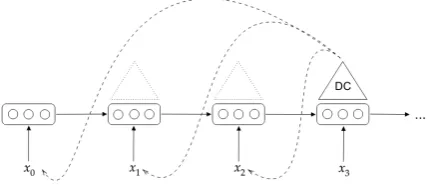
We hypothesize that the hidden activations of an incremental model contain more information about previous tokens inside the sequence. This is based on the assumption that attention-based models have no incentive to encode inputs re-currently, as previous representations can always be revisited. To test this assumption, we train a DC on every time step t > 1 in a sequence t ∈[1, . . . T]to predict thekmost frequently oc-curing input tokens for all time stepst0 < t(see Figure1). For a sentence of length T, this results inPT
t=2
Pt
t0=t−1k trained DCs. To then
gener-ate the corresponding training set for one of these classifiers, all activations from the network on a test set are extracted and the corresponding tokens recorded. Next, all activations from time step t are used as the training samples and all tokens to generate binary labels based on whether the target tokenxk occured on target time stept0. As these data sets are highly unbalanced, class weights are also computed and used during training.
Applying this metric to a model, the accuracies of all classifiers after training are averaged on a given test set, which we call Diagnostic Classi-fier Accuracy (DC Accuracy). We can test this way how much information about specific inputs is lost and whether that even matters for success-ful model performance, should it employ an en-coding procedure of increasing abstraction like in
Chunk-and-pass processing. On the other hand, one might assume that a more powerful model
1In this work, the terms
Figure 1: For the Diagnostic Classifier Accuracy, DCs are trained on the hidden activations to predict previ-ously occuring tokens. The accuracies are averaged and potentially weighed by the distance between the hidden activations used for training the occurrence of the token to predict.
Figure 2: Illustration of a thought experiment about two types of extreme recurrent models. (Left) The model completely ignores the current token and bases its new hidden state entirely on the previous one. (Right) The model forgets the whole history and just encodes the current input.
might require to retain information about an input even if the same occured several time steps ago. To account for this fact, we introduce a modified version of this metric called Weighed Diagnos-tic Classifier Accuracy (Weighed DC Accuracy), where we weigh the accuracy of a classifier based on the distancet−t0.
3.2 Integration Ratio
Imagine an extreme attention-based model that does not encode information recurrently but whose hidden statehtis solely based on the current token xt(see right half of Figure2). If we formalize an LSTM as a recurrent functionfθ :Rn,Rm 7→Rm
parameterized by weights θ that maps two con-tinuous vector representations, in our case then -dimensional representation of the current token
xt ∈ Rn and them-dimensional previous hidden
state representation ht−1 ∈ Rm to a new hidden
state ht ∈ Rm, we can formalize the mentioned
scenario as a recurrent function that completely ig-nores the pevious hidden state, which we can de-note using a zero-vector~0∈Rm:h
t=fθ(xt, ~0).
In a more realistic setting, we can exploit this thought experiment to quantify the amount of new information that is integrated into the current hid-den representation by subtracting this hypothetical value from the actual value at timestept:
∆xt=||ht−fθ(xt, ~0)||2, (1)
where ||. . .||2 denotes the l
2-norm. Conversely,
we can quantify the amount of information that was lost from previous hidden states with:
∆ht=||ht−fθ(~0,ht−1)||2. (2)
In the case of the extreme attention-based model, we would expect∆xt= 0, as no information from ht−1has been used in the transformation ofxtby fθ. Likewise, the “ignorant” model would produce a value of∆ht = 0, as any new hidden represen-tation completely originates from a transformation of the previous one.
Using these two quanitities, we can formulate a metric expressing the average ratio between them throughout a sequence which we call Integration Ratio:
φint= 1 T−1
T X
t=2
∆xt ∆ht
(3)
This metric provides an intuitive insight into the (average) model behavior during the encoding process: Forφint < 1 it holds that∆xt < ∆ht, signifying that the model prefers to integrate new information into the hidden state. Vice versa, φint>1and therefore∆xt>∆htimplies a pref-erence to maintain a representation of preceding inputs, possibly at the cost of encoding the current tokenxtin an incomplete manner.
To account for the fact that integrating new in-formation is more important at the beginning of a sequence – as no inputs have been processed yet – and maintaining a representation of the tence is more plausile towards the end of a sen-tence, we introduce two linear weighing terms with α∆xt = TT−t andα∆ht = Tt for ∆xt and ∆ht, respectively, which simplify to a single term αt:
φint= 1 Z
T X
t=2
αt ∆xt ∆ht
= 1 Z
T X
t=2
T−t t
∆xt ∆ht
, (4)
whereZ corresponds to a new normalizing factor such thatZ = PT
t=2 T
−t
the ideal score for this metric is unknown. The motivation for this score merely lies in gaining in-side into a model’s behaviour, showing us whether it engages in a similar kind of eager processing
while having to handle memory constraints (in this case realized in the constant dimensionality of hid-den representations) like in human cognition.
3.3 Representational Similarity
The sentences “I saw a cat” and “I saw a feline” only differ in terms of word choice, but essen-tially encode the same information. An incremen-tal model, based on the Chunk-and-Pass process-ing described byChristiansen and Chater (2016), should arrive at the same or at least a similar, ab-stract encoding of these phrases.2 While the exact wording might be lost in the process, the infor-mation encoded should still describe an encounter with a feline creature. We therefore hypothesize that an incremental model should map the hid-den activations of similar sequences of tokens into similar regions of the hidden activation space. To test this assumption, we compare the representa-tions produced by a model after encoding the same sequence of tokens - orhistory- using their aver-age pairwise distance based on a distance measure like thel2 norm or cosine similarity. We call the
length of the history theorder of the Representa-tional Similarity.
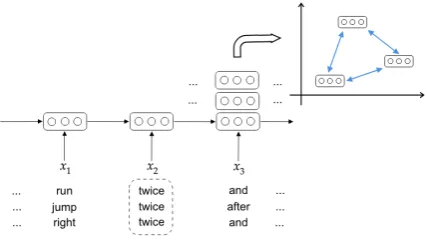
To avoid models to score high on this model metric by substituting most or all of a hidden rep-resentation with an encoding of the current token,3 we only gather the hidden states for comparison after encoding another, arbitrary token (see Fig-ure3). We can therefore interpret the score as the ability to “remember” the same sequence of tokens in the past through the encoding.
The procedure is repeated for thenmost com-mon histories of a specified order occuring in the test corpus over all time steps and, to obtain the final score, results are averaged.
4 Setup
We test our metric on two different architectures, trained on the SCAN dataset proposed by Lake and Baroni(2018). We explain both below.
2In fact, given that humans built up sentence representa-tions in a compositional manner, the same should hold for sentence pairs like “I saw a cat” and ”A feline was observed by me”, which is beyond the limits of the metric proposed here.
3∆x
[image:4.595.311.525.64.185.2]t = 0in the framework introduced in the previous Section3.2.
Figure 3:Representational Similaritymeasures the av-erage pair-wise distance of hidden representations after encoding the same subsquence of tokens (in this case the history is only of first order, i.e. x2) as well as one
arbitrary tokenx3.
4.1 Data
We use the SCAN data set proposed by Lake and Baroni (2018): It is a simplified ver-sion of the CommAI Navigation task, where the objective is to translate an order in natu-ral language into a sequence of machine-readable commands, e.g. “jump thrice and look” into
I_JUMP I_JUMP I_JUMP I_LOOK. We
fo-cus on the add_prim_jump_split (Loula et al., 2018), where the model has to learn to generalize from seeing a command like jump
only in primitive forms (i.e. by itself) to see-ing it in composite forms dursee-ing test time (e.g.
jump twice), where the remainder of the com-posite forms has been encountered in the context of other primitive commands during training.
The SCAN dataset has been proposed to assess thecompositionalabilities of a model, which we believe to be deeply related with the concept of
incrementality, which is the target of our research.
4.2 Models
any encoder hidden statehtusing some function a(·)
eit=a(si−1,ht) (5)
We then normalize the energies using the softmax function and use the normalised attention weights αitto create the context vectorct:
ci= T X
t=1
αitht (6)
In this work, we use a simple attention function, namely a dot productadot:
adot(si−1,ht) =sTi−1ht, (7)
matching the setup originally introduced by Bah-danau et al.(2015).
4.3 Training
For both architectures, we train 15 single-layer uni-directional models, with an embedding and hidden layer size of 128. We use the same hyper-parameters for both architectures, to ensure com-patibility. More specifically, both models were trained for 50 epochs using the Adam optimizer (Kingma and Ba, 2015) with the AMSgrad cor-rection (Reddi et al.,2018) and a learning rate of 0.001and a batch size of128.
5 Results
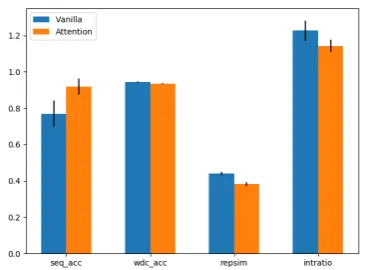
We compute metric values for all 30 models (15 per architecture) that resulted from the training procedure described above.4 We plot the metric values, averaged over all runs for both models, in Figure4. For the representational similarity score, we use all instances of then= 5most frequently occuring histories of length2at all available time steps. The unweighted DC accuracies are not de-picted, as they do not differ substantially from their weighted counter part, for which we also try to detect the k = 5most frequently occuring in-puts at every time step.
5.1 Metric scores
As expected, the standard attention model signif-icantly outperforms the vanilla model in terms of
[image:5.595.324.507.64.199.2]4The code used in this work is available online un-der https://github.com/i-machine-think/ incremental_encoding.
Figure 4: Results on SCAN add prim left with n = 15. Abbreviations stand for sequence accuracy, weighed diagnostic classifier accuracy, integration ratio and representational similarity, respectively. All differ-ences are statistically significant (using a Student’s t-test withp= 0.05).
sequence accuracy. Surprisingly, both models per-form very similarly in terms of weighed DC accu-racy. While one possible conclusion is that both models display a similar ability to store informa-tion about past tokens, we instead hypothesize that this can be explained by the fact that all sequences in our test set are fairly short (6.8tokens on aver-age). Therefore, it is easy for both models to store information about tokens over the entire length of the input even under the constrained capacity of the hidden representations. Bigger differences might be observed on corpora that contain longer sequences.
From the integration ratio scores (last column in Figure4), it seems that, while both models pre-fer to maintain a history of previous tokens, the attention-based model contains a certain bias to add new information about the current input to-ken. This supports our suspicion that this model is less incentivized to build up expressive repre-sentations over entire sequences, as the encoder representation can always be revisited later via the attention mechanism. Counterintuitively and perhaps surprisingly, it appears that the attention model produces representations that are more sim-ilar than the vanilla model, judging from the rep-resentational similarity score. To decode success-fully, the vanilla model has to include information about the entire input sequence in the last encoder hidden state, making the encodings of similar sub-sequences more distinct because of their different prefixes.5In contrast, the representations of the
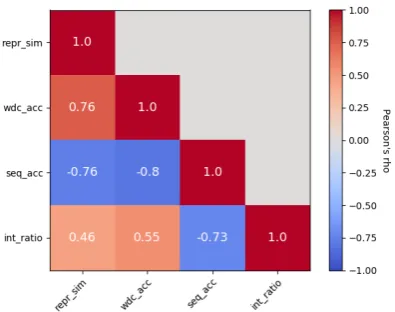
Figure 5: Correlations between metrics as heatmap of Pearson’s rho values.1indicates a strong positive cor-relation,−1a negative one. Abbreviations correspond to the same metrics as in Figure4. Best viewed in color.
tention model is able to only contain information about the most recent tokens, exclusively encoding the current input at a given time step in the extreme case, as the attention mechanism can select the re-quired representations on demand. These results will be revisited in more detail in section5.3.
5.2 Metrics Comparison
To further understand the salience of our new met-rics, we use Pearson’s correlation coefficient to show their correlation with each other and with se-quence accuracy. A heat map showing Pearson’s ρ values between all metric pairs is given in Fig-ure5.
We can observe that representational similar-ity and weighed DC accuracy display a substan-tial negative correlation with sequence accuracy. In the first case, this implies that the more simi-lar representations of the same subsequences pro-duced by the model’s encoder are, the better the model itself performs later.6 Surprisingly, we can infer from the latter case that storing more infor-mation about the previous inputs does not lead to better performance. At this point we should dis-entangle correlation from causation, as it is to be assumed that our hypothesis about the attention mechanism applies here as well: The attention is always able to revisit the encodings later during the decoding process, thus a hidden representation does not need to contain information about all
pre-6The representational similarity score actually expresses a degree of dissimilarity, i.e. a lower score results from more similar representations, therefore we identify a negative cor-relation here.
vious tokens and the weighed DC accuracy suf-fers. Therefore, as the attention model performs better in terms of sequence accuracy, a negative correlation score is observed. The same trend can be observed for the sequence accuracy - integra-tion ratio pair, where the better performance of the attention model creates a significant negative cor-relation.
The last noteworthy observation can be found looking at the high positive correlation between the weighed DC accuracy and representational similarity, which follows from the line of thought in Section5.1: As the vanilla model has to squeeze information about the whole history into the hid-den representation at every time step, encodings for a shorter subsequence become more distinct, while the attention model only encodes the few most recent inputs and are therefore able to pro-duce more homogenous representations.
5.3 Qualitative Analysis
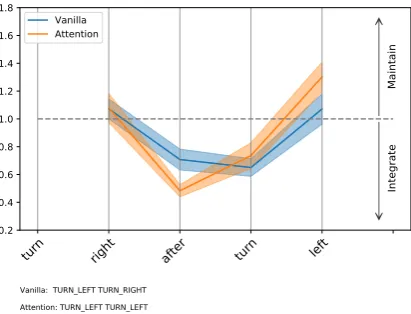
We scrutinize the models’ behavior when process-ing the same sequence by recordprocess-ing the integration ratio per time step and contrasting them in plots, which are shown in Figure 6. Figure 6a and 6b are thereby indicative of a trend which further reinforces our hypothesis about the behavior of attention-based models: As the orange curve lies below the vanilla model’s blue curve in the major-ity of cases, we can even infer on a case by case ba-sis that these models tend to integrate more infor-mation at every time step than a vanilla LSTM. In-terestingly, these distinct behaviors when process-ing information do not always lead to the models finding different solutions. In Figure 6 however, we present three error cases in which the models’ results do diverge.
(a) The vanilla model adds a redundantTURN-LEFTin the beginning.
(b) The vanilla model confuses left and right when decoding opposite.
[image:7.595.78.284.470.627.2](c) The attention model fails on a trivial sequence.
Figure 6: Qualitative analysis about the models’ en-coding behavior. Bounds show the standard deviation of integration ratio scores per time step. Decoded sen-tences are produced by having each model decode the sequence individually and then consolidating the solu-tion via a majority vote. Resulting sequences have been slightly simplified for readability. Best viewed in color.
to a duplicate in the output sequence. The atten-tion model seems to be able to avoid this issue by erasing a lot of its prior encoded information when processing “after”, as signified by the drop in the graph. Afterwards, only very little informa-tion seems to be integrated by the model.
The vanilla model commits a slightly different error in Figure6b: After both models decode three
TURN-LEFTcorrectly, it choses to decode “oppo-site” asTURN-LEFT TURN-RIGHTin contrast to the corectTURN-RIGHT TURN-RIGHTsupplied by the attention model. It is to be assumed here that the last half of the input, “turn left thrice” had the vanilla model overwrite some critical informa-tion about the initial command. Again, the atten-tion model is able to evade this problem by eras-ing a lot of its representation when encoderas-ing “af-ter” and can achieve a correct decoding this critical part by attending to the representation produced at “right” later. “turn left thrice” can followingly be encoded without having to loose any past informa-tion.
Lastly, we want to shed some light on one of the rare failure cases of the attention model, as given in Figure6c. Both models display very sim-ilar behavior when encoding this trivial sequence, yet only the vanilla model is able to decode it cor-rectly. A possible reason for this could be found in the model’s energy function: When deciding which encoded input to attend to for the next de-coding step, the model scores potential candidates based on the last decoder hidden state (see eq. 7), which was decoded as TURN-LEFT. Therefore the most similar inputs token might appear to be
TURN-LEFTas well. Notwithstanding this expla-nation, it falls short of giving a conclusive reason why the model does not err in similar ways in other examples.
6 Conclusion
In this work, we introduced three novel metrics that try to shine a light on the incremental abilities of the encoder in a sequence-to-sequence model and tested them on a LSTM-RNN with and with-out an attention mechanism. We showed how these metrics relate to each other and how they can be employed to better understand the encod-ing behavior of models and how these difference lead to performance improvements in the case of the attention-based model.
We confirm the general intuition that using an attention mechanism, due to its ability to oper-ate on the whole encoded input sequence, prefers to integrate new information about the current to-ken and is less pressured to maintain a represen-tation for the whole input sequence, which seems to lead to some corruptions of the encoded infor-mation in case of the vanilla model. Moreover, our qualitative analysis suggests that the encoder of the attention model learns to chunk parts of the input sequence into salient blocks, a behavior that is reminiscent of the Chunk-and-Pass processing described by Christiansen and Chater(2016) and one component that is hypothesized to enable in-cremental processing in humans. In this way, the attention model most surprisingly seems to dis-play a more incremental way of processing than the vanilla model.
These results open up several lines of future re-search: Although we tried to assess incremental-ity in sequence-to-sequence models in a quantita-tive manner, the notion of incremental processing lacks a formal definition within this framework. Thus, such definition could help to confirm our findings and aid in developing more incremental architectures. It furthermore appears consequen-tial to extend this methodology to deeper models and other RNN-variants as well as other data sets in order to confirm this work’s findings.
Although we were possibly able to identify one of the components that build the foundation of human language processing (as defined by Chris-tiansen and Chater, 2016) in attention models, more work needs to be done to understand how these dynamics play out in models that solely rely on attention like the Transformer (Vaswani et al., 2017) and how the remaining components could be realized in future models.
Based on these reflections, future work should attack this problem from a solid foundation: A
formalization of incrementality in the context of sequence-to-sequence modelling could help to de-velop more expressive metrics. These metrics in turn could then be used to assess possible incre-mental models in a more unbiased way. Further thought should also be given to a fairer compari-son of candidate models to existing baselines: The attention mechanism by Bahdanau et al. (2015) and models like the Transformer operate without the temporal and memory pressure that is claimed to fundamentally shape human cognition Chris-tiansen and Chater (2016). Controlling for this factor, it can be better judged whether incremental processing has a positive impact on the model’s performance. We hope that these steps will lead to encoders that create richer representations that can followingly be used back in regular sequence-to-sequence modelling tasks.
Acknowledgements
DH is funded by the Netherlands Organization for Scientific Research (NWO), through a Gravi-tation Grant 024.001.006 to the Language in In-teraction Consortium. EB is funded by the Euro-pean Union’s Horizon 2020 research and innova-tion program under the Marie Sklodowska-Curie grant agreement No 790369 (MAGIC).
References
Dzmitry Bahdanau, Kyunghyun Cho, and Yoshua Ben-gio. 2015. Neural machine translation by jointly learning to align and translate. In 3rd Inter-national Conference on Learning Representations, ICLR 2015, San Diego, CA, USA, May 7-9, 2015, Conference Track Proceedings.
Timo Baumann, Michaela Atterer, and David Schlangen. 2009. Assessing and improving the performance of speech recognition for incremental systems. In Proceedings of Human Language Technologies: The 2009 Annual Conference of the North American Chapter of the Association for Computational Linguistics, pages 380–388. Association for Computational Linguistics.
Morten H Christiansen and Nick Chater. 2016. The now-or-never bottleneck: A fundamental constraint on language. Behavioral and Brain Sciences, 39.
Alexis Conneau, Germ´an Kruszewski, Guillaume Lample, Lo¨ıc Barrault, and Marco Baroni. 2018.
2018, Melbourne, Australia, July 15-20, 2018, Vol-ume 1: Long Papers, pages 2126–2136.
Fahim Dalvi, Nadir Durrani, Hassan Sajjad, and Stephan Vogel. 2018a. Incremental decoding and training methods for simultaneous translation in neural machine translation. InProceedings of the 2018 Conference of the North American Chapter of the Association for Computational Linguistics: Hu-man Language Technologies, NAACL-HLT, New Or-leans, Louisiana, USA, June 1-6, 2018, Volume 2 (Short Papers), pages 493–499.
Fahim Dalvi, Nadir Durrani, Hassan Sajjad, and Stephan Vogel. 2018b. Incremental decoding and training methods for simultaneous translation in neural machine translation. InProceedings of the 2018 Conference of the North American Chapter of the Association for Computational Linguistics: Hu-man Language Technologies, NAACL-HLT, New Or-leans, Louisiana, USA, June 1-6, 2018, Volume 2 (Short Papers), pages 493–499.
Alex Graves. 2012. Sequence transduction with recur-rent neural networks.CoRR, abs/1211.3711.
Jian Guan, Yansen Wang, and Minlie Huang. 2018.
Story ending generation with incremental en-coding and commonsense knowledge. CoRR, abs/1808.10113.
Demis Hassabis, Dharshan Kumaran, Christopher Summerfield, and Matthew Botvinick. 2017. Neuroscience-inspired artificial intelligence. Neu-ron, 95(2):245–258.
Sepp Hochreiter and J¨urgen Schmidhuber. 1997. Long short-term memory. Neural computation, 9(8):1735–1780.
Dieuwke Hupkes, Anand Singh, Kris Korrel, Germ´an Kruszewski, and Elia Bruni. 2018a. Learning com-positionally through attentive guidance. CoRR, abs/1805.09657.
Dieuwke Hupkes, Sara Veldhoen, and Willem Zuidema. 2018b. Visualisation and’diagnostic clas-sifiers’ reveal how recurrent and recursive neural networks process hierarchical structure. Journal of Artificial Intelligence Research, 61:907–926.
Athul Paul Jacob, Zhouhan Lin, Alessandro Sordoni, and Yoshua Bengio. 2018. Learning hierarchi-cal structures on-the-fly with a recurrent-recursive model for sequences. InProceedings of The Third Workshop on Representation Learning for NLP, pages 154–158.
Navdeep Jaitly, Quoc V Le, Oriol Vinyals, Ilya Sutskever, David Sussillo, and Samy Bengio. 2016. An online sequence-to-sequence model using partial conditioning. In Advances in Neural Information Processing Systems, pages 5067–5075.
Yichen Jiang and Mohit Bansal. 2018. Closed-book training to improve summarization encoder mem-ory. InProceedings of the 2018 Conference on Em-pirical Methods in Natural Language Processing, Brussels, Belgium, October 31 - November 4, 2018, pages 4067–4077.
Diederik P. Kingma and Jimmy Ba. 2015. Adam: A method for stochastic optimization. In 3rd Inter-national Conference on Learning Representations, ICLR 2015, San Diego, CA, USA, May 7-9, 2015, Conference Track Proceedings.
Arne K¨ohn and Wolfgang Menzel. 2014. Incremen-tal predictive parsing with turboparser. In Proceed-ings of the 52nd Annual Meeting of the Association for Computational Linguistics (Volume 2: Short Pa-pers), volume 2, pages 803–808.
Kris Korrel, Dieuwke Hupkes, Verna Dankers, and Elia Bruni. 2019. Transcoding compositionally: us-ing attention to find more generalizable solutions.
BlackboxNLP 2019, ACL.
Brenden Lake and Marco Baroni. 2018. Generalization without systematicity: On the compositional skills of sequence-to-sequence recurrent networks. In In-ternational Conference on Machine Learning, pages 2879–2888.
Jo˜ao Loula, Marco Baroni, and Brenden M Lake. 2018. Rearranging the familiar: Testing composi-tional generalization in recurrent networks. arXiv preprint arXiv:1807.07545.
Graham Neubig, Kyunghyun Cho, Jiatao Gu, and Vic-tor O. K. Li. 2017. Learning to translate in real-time with neural machine translation. In Proceed-ings of the 15th Conference of the European Chap-ter of the Association for Computational Linguistics, EACL 2017, Valencia, Spain, April 3-7, 2017, Vol-ume 1: Long Papers, pages 1053–1062.
Sashank J Reddi, Satyen Kale, and Sanjiv Kumar. 2018. On the convergence of adam and beyond.
Dmitriy Serdyuk, Nan Rosemary Ke, Alessandro Sor-doni, Adam Trischler, Chris Pal, and Yoshua Ben-gio. 2018. Twin networks: Matching the future for sequence generation. In6th International Confer-ence on Learning Representations, ICLR 2018, Van-couver, BC, Canada, April 30 - May 3, 2018, Con-ference Track Proceedings.
Michael Henry Tessler, Karen Gu, and Roger Philip Levy. 2019. Incremental understanding of conjunc-tive generic sentences.
Ashish Vaswani, Noam Shazeer, Niki Parmar, Jakob Uszkoreit, Llion Jones, Aidan N Gomez, Łukasz Kaiser, and Illia Polosukhin. 2017. Attention is all you need. InAdvances in Neural Information Pro-cessing Systems, pages 5998–6008.