285
Team JUST at the MADAR Shared Task
on Arabic Fine-Grained Dialect Identification
Bashar Talafha Jordan University of Science
and Technology, Jordan [email protected]
Ali Fadel
Jordan University of Science and Technology, Jordan [email protected]
Mahmoud Al-Ayyoub Jordan University of Science
and Technology, Jordan [email protected]
Yaser Jararweh Duquesne University, USA
Mohammad AL-Smadi Jordan University of Science
and Technology, Jordan [email protected]
Patrick Juola Duquesne University, USA [email protected]
Abstract
In this paper, we describe our team’s effort on the MADAR Shared Task on Arabic Fine-Grained Dialect Identification. The task requires building a system capable of differentiating between 25 different Ara-bic dialects in addition to MSA. Our ap-proach is simple. After preprocessing the data, we use Data Augmentation (DA) to enlarge the training data six times. We then build a language model and extract n-gram word-level and character-level TF-IDF features and feed them into an MNB classifier. Despite its simplicity, the resul-ting model performs really well producing the 4th highest F-measure and region-level accuracy and the 5th highest precision, re-call, city-level accuracy and country-level accuracy among the participating teams.
1 Introduction
Give a piece of text, the Dialect Identification (DI) is concerned with automatically determining the dialect in which it is written. This is a very im-portant problem in many languages including Ara-bic. Unlike previous works on Arabic DI (ADI), which take a coarse-grained approach by consi-dering regional-level (Zaidan and Callison-Burch,
2014; Elfardy and Diab, 2013; Zampieri et al.,
2018) or country-level (Sadat et al.,2014) dialects, a new task has been proposed for the fine-grained ADI focusing on a large number of city-/country-level dialects (Bouamor et al.,2019).
This task is quite challenging as it covers 25 different dialects in addition to Modern Standard Arabic (MSA). Some of these dialects are very close to each other as we observe in our analy-sis of the training data (see Section2). Also, due
to the relatively small size of the dataset, cutting-edge techniques for document/sentence classifica-tion, which are based on word embeddings and de-ep learning models, perform poorly on it. In fact, according to (Bouamor et al.,2019), the top per-forming systems for this task as well as the pre-viously published baseline (Salameh et al.,2018) all use traditional (non-neural) machine learning approaches. This is very surprising if one takes in-to account that the use of Deep Learning in Arabic NLP is still at its early stages (Al-Ayyoub et al.,
2018).
In this paper, we describe our team’s effort to tackle this task. After preprocessing the data, we use Data Augmentation (DA) to enlarge the trai-ning data six times. We then build a language mo-del and extract n-gram word-level and character-level TF-IDF features and feed them into a Mul-tinomial Naive Bayes (MNB) classifier. Despi-te its simplicity, the resulting model performs really well producing the 4th highest Macro-F1 measure (66.33%) and Region-level Accura-cy (84.54%) and the 5th highest Macro-Precision (66.56%), Macro-Recall (66.42%), City-level Ac-curacy (66.42%) and Country-level AcAc-curacy (74.71%) among the participating teams. Unfortu-nately, due to a problem with our submission file, the official results for our system were extremely poor, which placed our team at the bottom of the official ranking.
2 MADAR Task, Dataset and Metrics
The shared task at hand comprises of two subtasks. The first one is the Travel Domain ADI, whose da-ta are da-taken from Multi-Arabic Dialect Applicati-ons and Resources (MADAR) project (Bouamor et al.,2018). Our team only focused on this sub-task. The second subtask is the Twitter User ADI and it is outside the scope of this work.
For the subtask at hand, the organizers pro-vide three sets: train (stored in a file called
MADAR-Corpus-26-trainand we refer to it as Corpus-26), development (dev) and test. The train, dev and test sets consist of 41,600, 5,200 and 5,200 parallel sentences, respectively, writ-ten in MSA as well as the local dialect of 25 ci-ties: Rabat (RAB), Fes (FES), Algiers (ALG), Tu-nis (TUN), Sfax (SFX), Tripoli (TRI), Benghazi (BEN), Cairo (CAI), Alexandria (ALX), Aswan (ASW), Khartoum (KHA), Jerusalem (JER), Am-man (AMM), Salt (SAL), Beirut (BEI), Damas-cus (DAM), Aleppo (ALE), Mosul (MOS), Bagh-dad (BAG), Basra (BAS), Doha (DOH), Muscat (MUS), Riyadh (RIY), Jeddah (JED) and Sana’a (SAN).
To aid in the training and model building processes, the organizers also provide additional train & dev data sets consisting of 54,000 and 6,000 parallel sentences covering only six dia-lects: BEI, CAI, DOH, MSA, RAB and TUN. The additional train set is stored in a file called
MADAR-Corpus-6-trainand we refer to it as Corpus-6.
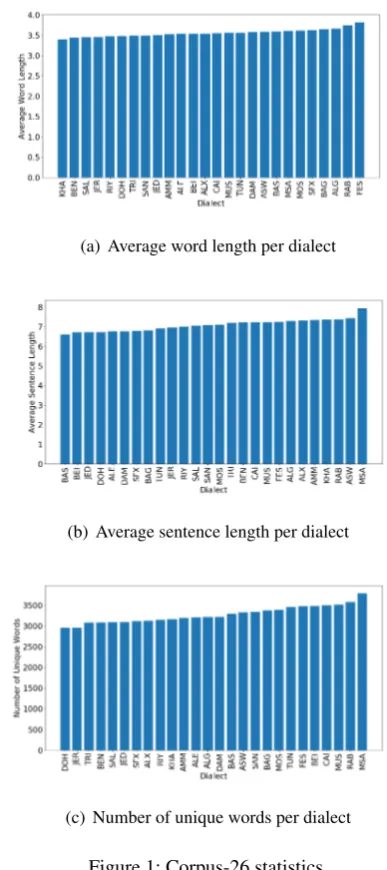
Before we go into the details of our system, we present a simple analysis of the provided data. Fi-gure1shows that the sentences of the dialects do not differ much in terms of average word/sentence lengths per dialect (Figures 1(a) and1(b)) or the number of unique words per dialect (Figures1(c)). Our analysis shows that while there are 27,501 unique words in all dialects, there is a small number of words (specifically, 84 words) com-mon in all dialects. Examples of such words in-clude:
, ñº
@Q
¯ , AJËñk. , ÐQj.ÖÏ@ , ¨PA Ë@ ,
éJ KAK.AJË@
YJªK. , hAJ ®Ó ,YKQ.Ë@ , éËñk. ,QîD
.Now, the most interesting part in our analy-sis is the varying similarity between the diffe-rent dialects pairs under consideration. Overall, there are 7,280 common sentences between dia-lects pairs and the average number of common sentences between dialects pairs, on average
the-(a) Average word length per dialect
(b) Average sentence length per dialect
[image:2.595.312.506.67.503.2](c) Number of unique words per dialect
Figure 1: Corpus-26 statistics.
1. Maghreb (18.29): Morroco: RAB & FES (50); Algeria: ALG; Tunisia: TUN & SFX (52); Libya: TRI & BEN (66).
2. Nile Basin (42.67): Egypt: CAI, ALX & ASW (67); Sudan: KHA.
3. Levant (88.4): Palestine: JER; Jordan: AMM & SAL (101); Lebanon: BEI; Syria: DAM & ALE (129).
4. Gulf (42.52): Iraq: MOS, BAG & BAS (54.33); Qatar: DOH; Oman: MUS; Saudi: RIY & JED (72.0);
5. Gulf of Aden: Yemen: SAN.
6. MSA.
This list shows that Levant dialects are the most si-milar while the Maghrib ones are the least sisi-milar. Finally, to evaluate the participating systems, the subtask organizers use Accuracy (on the city, country and region levels denoted here by Acccty, Acccntr and Accrgn, respectively) in addition to Macro-averaged Precision, Recall and F1 measure (denoted here by Pre, Rec and F1, respectively).
3 System
In this section. we describe the system that pro-duces the highest accuracy on the dev set starting from the preprocessing stage all the way up to the final classification stage.
Preprocessing and Data Augmentation (DA).
Our system starts with a couple of preproces-sing steps. The first one is a very simple one in which quotation marks, Arabic quotation marks, commas, Arabic commas, question marks, Arabic question marks and emoticons are replaced with spaces.
Another preprocessing step the system performs is DA. While DA has been shown to be very effec-tive for image processing tasks (Chatfield et al.,
2014; He et al., 2016; Chollet, 2016; Ebrahim et al.,2018), it use in text processing tasks is still limited (Fadaee et al., 2017; Kafle et al., 2017). Since the training data is small, a data augmenta-tion step is performed on Corpus-26 by applying random shuffling on Corpus. In Corpus-26, the-re athe-re 1,600 sentences for each dialect, while, in Corpus-6, there are 9,000 sentences for each of the six dialects in this corpus: BEI, CAI, DOH, MSA, RAB and TUN. The system takes 8,000 sentences
(instead of 9,000) for each dialects in order to balance them with the other dialects (shuffled). Therefore, overall, we have 8,000 sentences (from Corpus-6) + 1,600 sentences (from Corpus-26) = 9,600 sentences for each of these six dialects. For the remaining dialects, and since the order of words is not necessary to identify the dialect, we apply a random shuffling to generate five new sen-tences from each sentence by using different ran-dom seed for each generated sentence. So, for each of these 20 dialects, we have1,600×6 = 9,600 sentences. To sum up, the training data has a total of 249,600 sentences; 9,600 sentences for each of the 26 dialects under consideration.
Features Extraction.For each dialect, a language model is extracted using Kenlm1 with its default parameters using the training data (Corpus-26). For each sentence, we extract a vector of si-ze 26 that represents a language model proba-bility for each dialect. We also extract a word-level Term Frequency-Inverse Document Frequen-cy (TF-IDF) features ranging from unigram to 6-gram in addition to character-level n-6-grams TF-IDF features where n ranges from 1-gram to 5-grams.
Classifier.An MNB classifier withα = 0.5is ap-plied using the One-vs-the-rest strategy. It is worth mentioning that we experiment with several de-ep learning-based classifiers such as Convolutio-nal Neural Networks (CNN) (Kim,2014), Recur-rent Neural Networks (RNN) with Long Short-Term Memory (LSTM) cells,2 Separable Con-volutional Network (sepCNN) (Chollet, 2017), Doc2Vec-FFNN,3 Transformer (Vaswani et al.,
2017) and Bidirectional Encoder Representations from Transformers (BERT) (Devlin et al.,2018). However, none of them performed well on the va-lidation set. So, we did not submit their results.
4 Results and Discussion
In this section, we present and analyze the results and performance of our best model. Nothing is mentioned about the other models with which we experimented. The results of the model on the test set are presented in Table1. The table shows that,
1
https://github.com/kpu/kenlm
2https://bit.ly/2K3lNFM
Ours Top System
Base-line
Overall Comparison F1 66.33 67.32 67.89 4th highest
[image:4.595.74.291.61.179.2]Pre 66.56 67.73 68.41 5th highest (tied) Rec 66.42 67.33 67.75 5th highest Acccty 66.42 67.33 67.75 5th highest Acccntr 74.71 75.69 76.44 5th highest Accrgn 84.54 85.13 85.96 4th highest
Table 1: The results of our model on the test set com-pared with the other models.
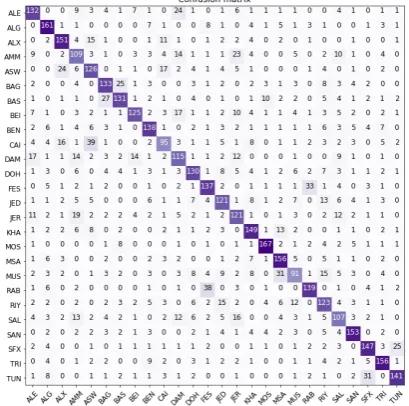
Figure 2: Our model’s confusion matrix for the test set.
despite our models’ simplicity, its results (which range between 4th highest and 5th highest num-bers) are surprisingly good. It differs only by a small number from the top system.
To understand the strengths and weaknesses of our model, we analyze the confusion matrix for the test set (shown in Figure2). The figure shows that the model suffers while trying to differentia-te between similar dialects. For example, 39 differentia-test samples from CAI are labeled as ASW and 38 from RAB are labeled as FES. Moreover, among the hardest to classify is CAI, perhaps, due to its high similarity with many dialects. After all, CAI is among the most well-known Arabic and Egyp-tian dialects due to the cultural influence of Cairo and Egypt on the Arab world, which means that other dialects (especially Egyptian ones) might ha-ve been influenced by it. On the other hand, ALG and MOS are among the easiest to classify due to their low similarity with the dialects under consi-deration.
[image:4.595.312.518.61.108.2]F1 Pre Rec Acccty w/ DA 67.51 69.28 67.29 67.29 w/o DA 66.83 68.69 66.6 66.6
Table 2: Effect of DA
In order to show the effect of DA, we perform an ablation study using the dev set. Table2shows the results of this experiment. The results show that DA had a slight effect on improving the perfor-mance of the proposed model. Perhaps, this is due to the generative nature of the MNB classifier and its assumption of independence between the featu-res. In the future, we plan on focusing more on DA techniques and their application with neural mo-dels, where the intuition is that such models make better use of any additional data in order to learn new things.
5 Conclusion
In this paper, we presented a simple model for the fine-grained ADI subtask. The model’s per-formance was good producing results competiti-ve with the top system for the task. In the future, we plan on exploring approaches based on better DA techniques in addition to the concepts of trans-fer learning and semi-supervised learning (Talafha and Al-Ayyoub,2019) in order to obtained better results.
Acknowledgment
We gratefully acknowledge the support of NVI-DIA Corporation with the donation of the Titan Xp GPU used for this research.
References
Mahmoud Al-Ayyoub, Aya Nuseir, Kholoud Alsmea-rat, Yaser Jararweh, and Brij Gupta. 2018. Deep learning for arabic nlp: A survey. Journal of com-putational science, 26:522–531.
Houda Bouamor, Nizar Habash, Mohammad Salameh, Wajdi Zaghouani, Owen Rambow, Dana Abdulra-him, Ossama Obeid, Salam Khalifa, Fadhl Eryani, Alexander Erdmann, et al. 2018. The madar arabic dialect corpus and lexicon. In Proceedings of the Eleventh International Conference on Language Re-sources and Evaluation (LREC-2018).
[image:4.595.77.282.232.435.2]Ken Chatfield, Karen Simonyan, Andrea Vedaldi, and Andrew Zisserman. 2014. Return of the devil in the details: Delving deep into convolutional nets. arXiv preprint arXiv:1405.3531.
Francois Chollet. 2016. Building powerful image clas-sification models using very little data. The Keras Blog. Https://blog.keras.io/building-powerful- image-classification-models-using-very-little-data.html.
Franc¸ois Chollet. 2017. Xception: Deep learning with depthwise separable convolutions. InProceedings of the IEEE conference on computer vision and pat-tern recognition, pages 1251–1258.
Jacob Devlin, Ming-Wei Chang, Kenton Lee, and Kris-tina Toutanova. 2018. Bert: Pre-training of deep bi-directional transformers for language understanding. arXiv preprint arXiv:1810.04805.
Maad Ebrahim, Mohammad Alsmirat, and Mahmoud Al-Ayyoub. 2018. Performance study of augmen-tation techniques for hep2 cnn classification. In 2018 9th International Conference on Information and Communication Systems (ICICS), pages 163– 168. IEEE.
Heba Elfardy and Mona Diab. 2013. Sentence level dialect identification in arabic. InProceedings of the 51st Annual Meeting of the Association for Compu-tational Linguistics (Volume 2: Short Papers), volu-me 2, pages 456–461.
Marzieh Fadaee, Arianna Bisazza, and Christof Monz. 2017. Data augmentation for low-resource neural machine translation. arXiv preprint ar-Xiv:1705.00440.
Kaiming He, Xiangyu Zhang, Shaoqing Ren, and Jian Sun. 2016. Deep residual learning for image reco-gnition. InProceedings of the IEEE conference on computer vision and pattern recognition, pages 770– 778.
Kushal Kafle, Mohammed Yousefhussien, and Christo-pher Kanan. 2017. Data augmentation for visual question answering. InProceedings of the 10th In-ternational Conference on Natural Language Gene-ration, pages 198–202.
Yoon Kim. 2014. Convolutional neural networks for sentence classification. arXiv preprint ar-Xiv:1408.5882.
Quoc Le and Tomas Mikolov. 2014. Distributed repre-sentations of sentences and documents. In Interna-tional conference on machine learning, pages 1188– 1196.
Fatiha Sadat, Farnazeh Kazemi, and Atefeh Farzindar. 2014. Automatic identification of arabic dialects in social media. InProceedings of the first internatio-nal workshop on Social media retrieval and ainternatio-naly- analy-sis, pages 35–40. ACM.
Mohammad Salameh, Houda Bouamor, and Nizar Ha-bash. 2018. Fine-grained Arabic dialect identifica-tion. In Proceedings of the International Confe-rence on Computational Linguistics (COLING), pa-ges 1332–1344, Santa Fe, New Mexico, USA.
Bashar Talafha and Mahmoud Al-Ayyoub. 2019. Ioh-rcnn: Pursue the ingredients of happiness using re-current convolutional neural networks. In Procee-dings of the 2nd Workshop on Affective Content Analysis (AffCon 2019) co-located with Thirty-Third AAAI Conference on Artificial Intelligence (AAAI 2019), Honolulu, USA, January 27, 2019., pages 191–197.
Ashish Vaswani, Noam Shazeer, Niki Parmar, Jakob Uszkoreit, Llion Jones, Aidan N Gomez, Łukasz Kaiser, and Illia Polosukhin. 2017. Attention is all you need. InAdvances in neural information pro-cessing systems, pages 5998–6008.
Omar F. Zaidan and Chris Callison-Burch. 2014. Ara-bic dialect identification. Computational Lingui-stics, 40(1):171–202.