2420
Multi-Task Semantic Dependency Parsing with Policy Gradient for
Learning Easy-First Strategies
Shuhei Kurita
Center for Advanced Intelligence Project RIKEN
Tokyo, Japan
Anders Søgaard
Department of Computer Science University of Copenhagen
Copenhagen, Denmark [email protected]
Abstract
In Semantic Dependency Parsing (SDP), se-mantic relations form directed acyclic graphs, rather than trees. We propose a new iterative predicate selection (IPS) algorithm for SDP. Our IPS algorithm combines the graph-based and transition-based parsing approaches in or-der to handle multiple semantic head words. We train the IPS model using a combination of multi-task learning and task-specific pol-icy gradient training. Trained this way, IPS achieves a new state of the art on the SemEval 2015 Task 18 datasets. Furthermore, we ob-serve that policy gradient training learns an easy-first strategy.
1 Introduction
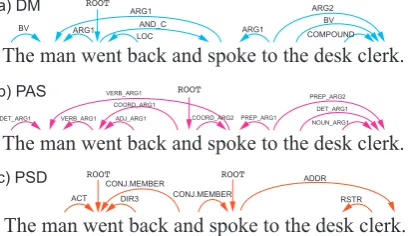
Dependency parsers assign syntactic structures to sentences in the form of trees. Semantic depen-dency parsing (SDP), first introduced in the Se-mEval 2014 shared task (Oepen et al., 2014), in contrast, is the task of assigning semantic struc-tures in the form of directed acyclic graphs to sen-tences. SDP graphs consist of binary semantic re-lations, connecting semantic predicates and their arguments. A notable feature of SDP is that words can be the semantic arguments of multiple predi-cates. For example, in the English sentence: “The man went back and spoke to the desk clerk” – the word “man” is the subject of the two predicates “went back” and “spoke”. SDP formalisms typi-cally express this by two directed arcs, from the two predicates to the argument. This yields a di-rected acyclic graph that expresses various rela-tions among words. However, the fact that SDP structures are directed acyclic graphs means that we cannot apply standard dependency parsing al-gorithms to SDP.
Standard dependency parsing algorithms are of-ten said to come in two flavors: transition-based
The man went back and spoke to the desk clerk. a) DM
The man went back and spoke to the desk clerk. b) PAS
The man went back and spoke to the desk clerk.
c) PSD ROOT ROOT
ROOT ROOT
BV ARG1
ARG1 AND_C
LOC ARG1
ARG2 BV COMPOUND
DET_ARG1 VERB_ARG1 VERB_ARG1
ADJ_ARG1 COORD_ARG1
COORD_ARG2 PREP_ARG1
PREP_ARG2 DET_ARG1 NOUN_ARG1
ACT DIR3 CONJ.MEMBER
[image:1.595.314.519.229.347.2]RSTR ADDR CONJ.MEMBER
Figure 1: Semantic dependency parsing arcs of DM, PAS and PSD formalisms.
parsers score transitions between states, and grad-ually build up dependency graphs on the side. Graph-based parsers, in contrast, score all candi-date edges directly and apply tree decoding algo-rithms for the resulting score table. The two types of parsing algorithms have different advantages (McDonald and Nivre, 2007), with transition-based parsers often having more problems with er-ror propagation and, as a result, with long-distance dependencies. This paper presents a compromise between transition-based and graph-based parsing, callediterative predicate selection(IPS) – inspired by head selection algorithms for dependency pars-ing (Zhang et al., 2017) – and show that error propagation, for this algorithm, can be reduced by a combination of multi-task and reinforcement learning.
other formalisms. Prague Semantic Dependencies (PSD) are extracted from the Czech-English De-pendency Treebank (Hajiˇc et al., 2012). There are several overlaps between these linguistic for-malisms, and we show below that parsers, us-ing multi-task learnus-ing strategies, can take advan-tage of these overlaps or synergies during train-ing. Specifically, we followPeng et al.(2017) in using multi-task learning to learn representations of parser states that generalize better, but we go beyond their work, using a new parsing algorithm and showing that we can subsequently use rein-forcement learning to prevent error propagation and tailor these representations to specific linguis-tic formalisms.
Contributions In this paper, (i) we propose a new parsing algorithm for semantic dependency parsing (SDP) that combines transition-based and graph-based approaches; (ii) we show that multi-task learning of state representations for this pars-ing algorithm is superior to spars-ingle-task trainpars-ing; (iii) we improve this model by task-specific policy gradient fine-tuning; (iv) we achieve a new state of the art result across three linguistic formalisms; fi-nally, (v) we show that policy gradient fine-tuning learns an easy-first strategy, which reduces error propagation.
2 Related Work
There are generally two kinds of dependency pars-ing algorithms, namely transition-based parspars-ing algorithms (McDonald and Nivre, 2007; Kiper-wasser and Goldberg, 2016; Ballesteros et al., 2015) and graph-based ones (McDonald and Pereira,2006;Zhang and Clark,2008;Galley and Manning, 2009; Zhang et al., 2017). In graph-based parsing, a model is trained to score all pos-sible dependency arcs between words, and decod-ing algorithms are subsequently applied to find the most likely dependency graph. The Eisner algo-rithm (Eisner,1996) and the Chu-Liu-Edmonds al-gorithm are often used for finding the most likely dependency trees, whereas the AD3 algorithm
(Martins et al., 2011) is used for finding SDP graphs that form DAGs inPeng et al.(2017) and Peng et al. (2018). During training, the loss is computed after decoding, leading the models to reflect a structured loss. The advantage of graph-based algorithms is that there is no real error prop-agation to the extent the decoding algorithms are global inference algorithm, but this also means
that reinforcement learning is not obviously appli-cable to graph-based parsing. In transition-based parsing, the model is typically taught to follow a gold transition path to obtain a perfect dependency graph during training. This training paradigm has the limitation that the model only ever gets to see states that are on gold transition paths, and error propagation is therefore likely to happen when the parser predicts wrong transitions leading to unseen states (McDonald and Nivre,2007;Goldberg and Nivre,2013).
There have been several attempts to train transition-based parsers with reinforcement learn-ing: Zhang and Chan (2009) applied SARSA (Baird III, 1999) to an Arc-Standard model, us-ing SARSA updates to fine-tune a model that was pre-trained using a feed-forward neural network. Fried and Klein (2018), more recently, presented experiments with applying policy gradient train-ing to several constituency parsers, includtrain-ing the RNNG transition-based parser (Dyer et al.,2016). In their experiments, however, the models trained with policy gradient did not always perform better than the models trained with supervised learning. We hypothesize this is due to credit assignment be-ing difficult in transition-based parsbe-ing. Iterative refinement approaches have been proposed in the context of sentence generation (Lee et al.,2018). Our proposed model explores multiple transition paths at once and avoids making risky decisions in the initial transitions, in part inspired by such iter-ative refinement techniques. We also pre-train our model with supervised learning to avoid sampling from irrelevant states at the early stages of policy gradient training.
Several models have been presented for DAG parsing (Sagae and Tsujii, 2008; Ribeyre et al., 2014; Tokg¨oz and G¨ulsen, 2015; Hershcovich et al., 2017). Wang et al. (2018) proposed a similar transition-based parsing model for SDP; they modified the possible transitions of the Arc-Eager algorithm (Nivre and Scholz,2004b) to cre-ate multi-headed graphs. We are, to the best of our knowledge, first to explore reinforcement learning for DAG parsing.
3 Model
3.1 Iterative Predicate Selection
The man went back and spoke to the desk clerk. The man went back and spoke to the desk clerk. The man went back and spoke to the desk clerk.
The man went back and spoke to the desk clerk.
The man went back and spoke to the desk clerk.
The man went back and spoke to the desk clerk.
transitions Initial state
Final state
t0
w1,· · ·, t
0
wn
t1
w1,· · ·, t
1
wn
t2
w1,· · ·, t
2
wn
transitions
transitions
τ= 0
τ= 1
τ= 2
[image:3.595.73.518.74.192.2]τ= 3
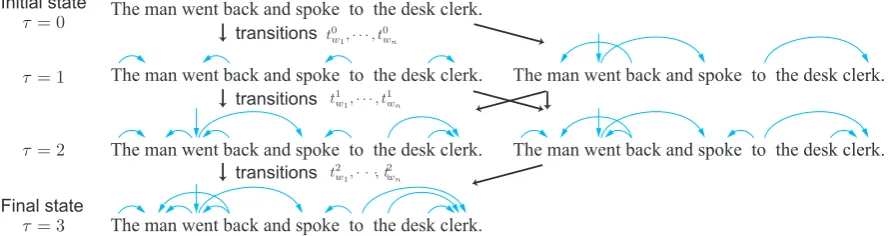
Figure 2: Construction of semantic dependency arcs (DM) in the IPS parsing algorithm. Parsing begins from the initial state and proceeds to the final state following one of several paths. In the left path, the model resolves adjacent arcs first. In contrast, in the right path, distant arcs that rely on the global structure are resolved first.
2017). Head selection iterates over sentences, fix-ing the head of a word w in each iteration, ig-noring w in future iterations. This is possible for dependency parsing because each word has a unique head word, including the root of the sen-tence, which is attached to an artificial root sym-bol. However, in SDP, words may attach to mul-tiple head-words orsemantic predicates whereas other words may not attach to any semantic pred-icates. Thus, we propose an iterative predicate se-lection (IPS) parsing algorithm, as a generaliza-tion of head-selecgeneraliza-tion in SDP.
The proposed algorithm is formalized as fol-lows. First, we define transition operations for all words in a sentence. For thei-th wordwiin a sen-tence, the model selects one transitiontτ
i from the set of possible transitions Tτ
i for each transition time stepτ. Generally, the possible transitionsTi for thei-th word are expressed as follows:
{NULL,ARCi,ROOT,ARCi,1,· · ·,ARCi,n}
whereARCi,j is a transition to create an arc from thej-th word to thei-th word, encoding that the semantic predicatewj takeswi as an semantic ar-gument. NULL is a special transition that does not create an arc. The set of possible transitions
Tτ
i for thei-th word at time stepτ is a subset of possible transitionsTithat satisfy two constraints: (i) no arcs can be reflexive, i.e., wi cannot be an argument of itself, and (ii) the new arc must not be a member of the set of arcsAτ comprising the partial parse graphyτ constructed at time stepτ. Therefore, we obtain: Tτ
i = Ti/(ARCi,i∪Aτ). The model then creates semantic dependency arcs by iterating over the sentence as follows:1
1This algorithm can introduce circles. However, circles
1 For each wordwi, select a head arc fromTiτ.
2 Update the partial semantic dependency graph.
3 If all words selectNULL, the parser halts. Oth-erwise, go to1.
Fig.2shows the transitions of the IPS algorithm during the DM parsing of the sentence “The man went back and spoke to the desk clerk.” In this case, there are several paths from the initial state to the final parsing state, depending on the orders of creating the arcs. This is known as the non-deterministic oracle problem (Goldberg and Nivre, 2013). In IPS parsing, some arcs are easy to pre-dict; others are very hard to predict. Long-distance arcs are generally difficult to predict, but they are very important for down-stream applications, including reordering for machine translation (Xu et al.,2009). Since long-distance arcs are harder to predict, and transition-based parsers are prone to error propagation, several easy-first strategies have been introduced, both in supervised (Goldberg and Elhadad,2010;Ma et al.,2013) and unsupervised dependency parsing (Spitkovsky et al., 2011), to prefer some paths over others in the face of the non-deterministic oracle problem. Easy-first prin-ciples have also proven effective with sequence taggers (Tsuruoka and Tsujii, 2005;Martins and Kreutzer,2017). In this paper, we take an arguably more principled approach,learninga strategy for choosing transition paths over others using rein-forcement learning. We observe, however, that the learned strategies exhibit a clear easy-first prefer-ence.
LSTM LSTM LSTM LSTM
MLP MLP MLP
The U.S. contends that the rules ... The U.S. contends that
ROOT The U.S. contends that the ...
pi(tj)
LSTM LSTM LSTM
hi hj
gijfij
hi hj+3
NULL ROOT
MLP . . .
NULL U.S. The U.S. contends
softmax
. . .
U.S. that U.S. ROOT
Transition probability
a) Encoder and MLP b) Encoder of Semantic Dependency
ROOT The U.S. contends that the rules ... LSTM
LSTM
LSTM ...
The U.S. contends that
(the)
wi i
wNONE wNONE wROOT wNONE wNONE (contentds) w 2
wNONE wNONE gij
+
gi,j+2
gi+1,j−1
LSTM LSTM LSTM LSTM LSTM LSTM . . .
for i-th word
...
sij sij+3
si0
. . .
sij+2
. . . .
wNONE
wNONE
wNONE
wNONE
wNONE
wNONE wNONE
wNONE
wNONE
wNONE
wNONE
wNONE
wNONE
wNONE
[image:4.595.74.524.62.205.2]wNONE
Figure 3: Our network architecture: (a) The encoder of the sentence into the hidden representationshiandhj, and
the MLP for the transition probabilities. (b) The encoder of the semantic dependency matrix for the representation ofhd
ij. The MLP also takes the arc flag representationfij(see text for explanation).
3.2 Neural Model
Fig. 3 shows the overall neural network. It con-sists of an encoder for input sentences and par-tial SDP graphs, as well as a multi-layered per-ceptron (MLP) for the semantic head-selection of each word.
Sentence encoder We employ bidirectional long short-term memory (BiLSTM) layers for en-coding words in sentences. A BiLSTM con-sists of two LSTMs that reads the sentence for-ward and backfor-ward, and concatenates their out-put before passing it on. For a sequence of to-kens[w1,· · · , wn], the inputs for the encoder are words, POS tags and lemmas.2 They are mapped to the same p-dimensional embedding vectors in a look-up table. Then they are concatenated to form 3p-dimensional vectors and used as the in-put of BiLSTMs. We denote the mapping function of tokens into 3p-dimensional vectors as u(w∗)
for later usages. Finally, we obtain the hidden representations of all words [h(w1),· · ·, h(wn)] from the three-layer BiLSTMs. We use three-layer stacked BiLSTMs. We also use special embed-dingshNULL for theNULLtransition andhROOT
for theROOTof the sentence.
Encoder of partial SDP graphs The model up-dates the partial SDP graph at each time step of the parsing procedure. The SDP graphyτ at time step τ is stored in a semantic dependency matrix
Gτ ∈ {0,1}n×(n+1) for a sentence ofn words.3 The rows of the matrixGrepresent arguments and
2In the analysis of our experiments, we include an
abla-tion test, where we leave out lemma informaabla-tion for a more direct comparison with one of our baselines.
3In this subsection, we omit the time step subscriptionτ
of the partial SDP graph from some equations for simplicity.
the columns represent head-candidates, including theROOTof the sentence, which is represented by the first column of the matrix. For each transition for a word, the model fills in one cell in a row, if the transition is notNULL. In the initial state, all cells in G are 0. A cell G[i, j] is updated to 1, when the model predicts that the(i−1)-th word is an argument of the j-th word or ROOT when
j= 0.
We convert the semantic dependency matrix
G into a rank three tensor G0 ∈
Rn×(n+1)×p,
by replacing elements with embeddings of tokens
u(w∗)by
g0ij = (
u(wj−1) (gij = 1)
u(wNONE) (gij = 0)
(1)
where gij ∈ G and g0ij ∈ G0. g0i∗ contains the
representations of the semantic predicates for the
i-th word in the partial SDP graph. We use a sin-gle layer Bi-LSTM to encode the semantic predi-catesg0
i∗ of each word; see Fig. 3(b). Finally, we
concatenate the hidden representation of theNULL
transition and obtain the partial SDP graph repre-sentationGτ of the time stepτ:
Gτ = [gNULLτ , gτ∗,1,· · · , gτ∗,n+1] (2)
We also employ dependency flags that directly encode the semantic dependency matrix and indi-cate whether the corresponding arcs are already created or not. Flag representations F0 are also three-rank tensors, consisting of two hidden rep-resentations: fARC forgi,j = 1andfNOARC for
gi,j = 0 depending onG. fARC andfNOARC is
obtain the flag representationFτ:
Fτ = [fτ
NULL, f∗τ,1,· · · , f∗τ,n+1] (3)
. We do not use BiLSTMs to encode these flags. These flags also reflect the current state of the se-mantic dependency matrix.
Predicate selection model The semantic predi-cate selection model comprises an MLP with in-puts from the encoder of the sentence and the par-tial semantic dependency graph: the sentence rep-resentationH, the SDP representationGτ, and the dependency flagFτ. They are rank three tensors and concatenated at the third axis. Formally, the scoresij of thei-th word and thej-th transition is expressed as follows.
sτ
ij = MLP([hi, hj, gijτ, fijτ]) (4) For the MLP, we use a concatenation of outputs from three different networks: a three-layer MLP, a two-layer MLP and a matrix multiplication with bias terms as follows.
MLP(x) =W33a W23a(W13x+b31) +b32 +W2
2a(W12x+b22) +W11x+b11
W∗
∗0 are matrices or vectors used in this MLP and W∗∗0are bias terms. Here, we use this MLP for
pre-dicting a scalar scoresij; therefore,W33, W22, W11
are vectors. The model computes the probability of the transition tj for each word i by applying a softmax function over the candidates of the se-mantic head wordswj.
pi(tτj) = softmaxj(sτij) (5)
These transition probabilitiespi(tj)of selecting a semantic head wordwj, are defined for each word
wiin a sentence.
For supervised learning, we employ a cross en-tropy loss
Lτ(θ) =−X i,j
lilogpi(tτj|Gτ) (6)
for the partial SDP graph Gτ at time step τ. Hereliis a gold transition label for thei-th word and θ represents all trainable parameters. Note that this supervised training regime, as mentioned above, does not have a principled answer to the non-deterministic oracle problem (Goldberg and Nivre, 2013), and samples transition paths ran-domly from those consistent with the gold anntoa-tions to create transition labels.
Algorithm 1Policy gradient learning for IPS Algorithm
Input: Sentencexwith an empty parsing treey0
. Let a time stepτ = 0and finish flagsf∗= 0.
for 0≤τ <the number of maximum iterations do
Computeπτand argmax transitionstˆ
i= arg maxπiτ.
if∀i;ˆtτ
i = NULLthen
break end if
for i-th word in a sentence do ifcheck a finish flagfi= 1then
continue end if
ifall arcs to wordiare correctly created inyτ and
ˆ
ti= NULLthen Let a flagf= 1
continue end if
Sampletτ
i fromπτi. Update the parsing treeyτ
toyτ+1
. Compute a new rewardrτ
i fromyτ,yτ+1andyg.
end for
Store a tuple of the state, transitions and rewards for words{yτ, tτ
∗, rτ∗}.
end for
Shuffle tuples of{yτ, tτ
∗, r∗τ}for a time stepτ.
fora tuple{yτ0, tτ
∗, rτ
0
∗ }of time stepτ0 do
Compute gradient and update parameters.
end for
Labeling model We also develop a semantic de-pendency labeling neural network. This neural network consists of three-layer stacked BiLSTMs and a MLP for predicting a semantic dependency label between words and their predicates. We use a MLP that is a sum of the outputs from a three-layer MLP, a two-three-layer MLP and a matrix multi-plication. Note that the output dimension of this MLP is the number of semantic dependency la-bels. The input of this MLP is the hidden repre-sentations of a wordiand its predicatesj:[hi, hj] extracted from the stacked BiLSTMs. The score
s0ij(l)of the labellfor the arc from predicatej to wordiis predicted as follows.
s0ij(l) = MLP0([hi, hj]) (7)
We minimize the softmax cross entropy loss using supervised learning.
3.3 Reinforcement Learning
by comparing the predicted parse graph to the gold parse graphyg.
We adapt a variation of the policy gradient method (Williams,1992) for IPS parsing. Our ob-jective function is to maximize the rewards
J(θ) =Eπ[rτi] (8)
and the transition policy for thei-th word is given by the probability of the transitionsπ ∼pi(tτj|yτ). The gradient of Eq.8is given as follows:
∇J(θ) =Eπ
riτ∇logpi(tτj|yτ)
(9)
When we compute this gradient, given a policyπ, we approximate the expectationEπ for any transi-tion sequence with a single transitransi-tion pathtthat is sampled from policyπ:
∇J(θ)≈X tτ
j∈t
[riτ∇logpi(tτj|y
τ)] (10)
We summarize our policy gradient learning al-gorithm for SDP in Alal-gorithm 1. For time step
τ, the model samples one transition tτ
j selecting the j-th word as a semantic head word of thei -th word, from -the set of possible transitions Ti, following the transition probability of π. After samplingtτ
j, the model updates the SDP graph to
yτ+1 and computes the reward rτ
i. When NULL becomes the most likely transition for all words, or the time step exceeds the maximum number of time steps allowed, we stop.4 For each time step, we then update the parameters of our model with the gradients computed from the sampled transi-tions and their rewards.5
Note how the cross entropy loss and the policy gradient loss are similar, if we do not sample from the policyπ, and rewards are non-negative. How-ever, these are the important differences between supervised learning and reinforcement learning: (1) Reinforcement learning uses sampling of tran-sitions. This allows our model to explore transi-tion paths that supervised models would never fol-low. (2) In supervised learning, decisions are in-dependent of the current time stepτ, while in re-inforcement learning, decisions depend onτ. This means that theθparameters are updatedafterthe parser finishes parsing the input sentence. (3) Loss
4
We limit the number of transitions during training, but not at test time.
5We update the parameters for each time step to reduce
memory requirements.
Reward Transitions
rτ
i = 1 (1) The model creates a new correct arc from a semantic predicate to thei-th word. (2) The first time the model chooses theNULL
transition after all gold arcs to thei-th word have been created, and no wrong arcs to thei words have not been created.
rτ
i =−1 (3) The model creates a wrong arc from a semantic predicate candidate to thei-th word. rτ
[image:6.595.307.532.66.176.2]i = 0 (4) All other transitions.
Table 1: Rewards in SDP policy gradient.
must be non-negative in supervised learning, while rewards can be negative in reinforcement learning. In general, the cross entropy loss is able to opti-mize for choosing good transitions given a parser configuration, while the policy gradient objective function is able to optimize the entire sequence of transitions drawn according to the current policy. We demonstrate the usefulness of reinforcement learning in our experiments below.
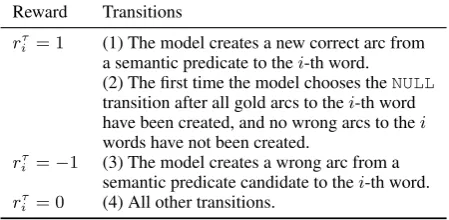
Rewards for SDP We also introduce intermedi-ate rewards, given during parsing, at different time steps. The reward rτ
i of the i-th word is deter-mined as shown in Table1. The model gets a pos-itive reward for creating a new correct arc to the
i-th word, or if the model for the first time chooses aNULLtransition after all arcs to thei-th word are correctly created. The model gets a negative re-ward when the model creates wrong arcs. When our model chooses NULL transitions for the i-th word before all gold arcs are created, the reward
rτ
i becomes 0.
3.4 Implementation Details
This section includes details of our implementa-tion.6 We use 100-dimensional, pre-trained Glove (Pennington et al., 2014) word vectors. Words or lemmas in the training corpora that do not ap-pear in pre-trained embeddings are associated with randomly initialized vector representations. Em-beddings of POS tags and other special symbol are also randomly initialized. We apply Adam as our optimizer. Preliminary experiments show that mini-batching led to a degradation in performance. When we apply policy gradient, we pre-train our model using supervised learning. We then use policy gradient for task-specific fine-tuning of our model. We find that updating parameters of BiL-STM and word embeddings during policy gradient
6The code is available at https://github.com/
Name Value
Encoder BiLSTM hidden layer size 600 Dependency LSTM hidden layer size 200 The dimensions of embeddingsp,q 100, 128 MLPs hidden layer size 4000
Dropout rate in MLPs 0.5
[image:7.595.73.294.65.145.2]Max transitions during reinforcement learning 10
Table 2: Hyper-parameters in our experiments.
Model DM PAS PSD Avg.
Peng+ 17 Freda3 90.4 92.7 78.5 88.0 Wang+ 18 Ens. 90.3 91.7 78.6 86.9 Peng+ 18 91.6 - 78.9
-IPS 91.1 92.4 78.6 88.2 IPS +ML 91.2 92.5 78.8 88.3 IPS +RL 91.6‡ 92.8‡ 79.2‡ 88.7‡ IPS +ML +RL 92.0‡ 92.8‡ 79.3‡ 88.8‡
Table 3: Labeled parsing performance on in-domain test data. Avg. is the micro-averaged score of three for-malisms.‡of the +RLmodels represents that the scores are statistically significant atp <10−3with their
non-RLcounterparts.
makes training quite unstable. Therefore we fix the BiLSTM parameters during policy gradient. In our multi-task learning set-up, we apply multi-task learning of the shared stacked BiLSTMs (Søgaard and Goldberg, 2016; Hashimoto et al., 2017) in supervised learning. We use task-specific MLPs for the three different linguistic formalisms: DM, PAS and PSD. We train the shared BiLSTM using multi-task learning beforehand, and then we fine-tune the task-specific MLPs with policy gradient. We summarize the rest of our hyper-parameters in Table2.
4 Experiments
We use the SemEval 2015 Task18 (Oepen et al., 2015) SDP dataset for evaluating our model. The training corpus contains 33,964 sentences from the WSJ corpus; the development and in-domain test were taken from the same corpus and consist of 1,692 and 1,410 sentences, respectively. The out-of-domain test set of 1,849 sentences is drawn from Brown corpus. All sentences are annotated with three semantic formalisms: DM, PAS and PSD. We use the standard splits of the datasets (Almeida and Martins,2015;Du et al.,2015). Fol-lowing standard evaluation practice in semantic dependency parsing, all scores aremicro-averaged
F-measures (Peng et al.,2017;Wang et al.,2018) with labeled attachment scores (LAS).
Model DM PAS PSD Avg.
Peng+ 17 Freda3 85.3 89.0 76.4 84.4 Peng+ 18 86.7 - 77.1
-IPS +ML 86.0 88.2 77.2 84.6 IPS +ML +RL 87.2‡ 88.8‡ 77.7‡ 85.3‡
Table 4: Labeled parsing performance on out-of-domain test data. Avg. is the micro-averaged score of three formalisms. ‡of the +RLmodels represents that the scores are statistically significant atp <10−3with
their non-RLcounterparts.
The system we propose is the IPS parser trained with a multi-task objective and fine-tuned using reinforcement learning. This is referred to as
IPS+ML+RLin the results tables. To highlight the contributions of the various components of our ar-chitecture, we also report ablation scores for the IPS parser without multi-task training nor rein-forcement learning (IPS), with multi-task train-ing (IPS+ML) and with reinforcement learning (IPS+RL). At inference time, we apply heuris-tics to avoid predicting circles during decoding (Camerini et al., 1980); see Supplementary Ma-terial, §A.1. This improves scores by 0.1 % or less, since predicted circles are extremely rare. We compare our proposed system with three state-of-the-art SDP parsers: Freda3 ofPeng et al. (2017), the ensemble model in Wang et al. (2018) and Peng et al. (2018). In Peng et al. (2018), they use syntactic dependency trees, while we do not use them in our models.7
The results of our experiments on in-domain dataset are also shown in Table3. We observe that our basic IPSmodel achieves competitive scores in DM and PAS parsing. Multi-task learning of the shared BiLSTM (IPS+ML) leads to small im-provements across the board, which is consistent with the results ofPeng et al. (2017). The model trained with reinforcement learning (IPS+RL) per-forms better than the model trained by supervised learning (IPS). These differences are significant (p <10−3). Most importantly, the combination of
multi-task learning and policy gradient-based re-inforcement learning (IPS+ML+RL) achieves the best results among all IPS models and the previ-ous state of the art models, by some margin. We also obtain similar results for the out-of-domain
7Dozat and Manning (2018) report
macro-averaged
[image:7.595.81.282.177.276.2]1st 2nd 3rd 4th Transitions
Arc Length
Dist.
a) Supervised
b) Reinforcement
[image:8.595.89.497.67.189.2]Dist.
Figure 4: Arc length distributions: (a) Supervised learning (IPS+ML). (b) Reinforcement learning (IPS+ML+RL). The four lines correspond to the first to fourth transitions in the derivations.
the position of chief financial officer , who will be hired from within the agency.
Within weeks the unfolding Iran-Contra scandal took away Mr. Noriega’s insurance policy.
Morgan will help evaluate DFC’s position and help determine alternatives.
The U.S. Commerce Department reported a $ 10.77 billion deficit in August compared with ...
1 2
3 4
1 2
3 4
1 2 3 4
1
2 3
4
1 2 3
4
1
2 4 3
1
2 3 4
a)
b)
c)
d) 3 1 2 4
SL
RL
SL
RL SL
RL SL
RL
lead the industry with a strong sales performance in the human and animal health-products segment. e)
1
2 4
3
1 5
3 2
5 4
SL
[image:8.595.94.499.231.373.2]RL
Figure 5: Examples of clauses parsed with DM formalism. The underlined words are the semantic predicates of the argument words in rectangles in the annotation. The superscript numbers (SL) are the orders of creating arcs byIPS+MLand the subscript numbers (RL) are the orders byIPS+ML+RL. In the clause (a), we show a partial SDP graph to visualize the SDP arcs.
Model DM PAS PSD Avg.
Peng+ 17 Freda3 90.4 92.5 78.5 88.0
IPS +ML -Lemma 90.7 92.3 78.3 88.0 IPS +ML +RL -Lemma 91.2‡ 92.9‡ 78.8‡ 88.5‡
Table 5: Evaluation of our parser when not using lemma embeddings (for a more direct comparison with Freda3), on in-domain test datasets. ‡of +RLmodels represents that the scores are statistically significant at
p <10−3with their non-RLcounterparts.
datasets, as shown in Table4. All improvements with reinforcement learning are also statistically significant (p <10−3).
Evaluating Our Parser without Lemma Since our baseline (Peng et al., 2017) does not rely on neither lemma or any syntactic information, we also make a comparison of IPS+ML and
IPS+ML+RLtrained with word and POS embed-dings, but without lemma embeddings. The results are given in Table5. We see that our model is still better on average and achieves better performance on all three formalisms. We also notice that the
lemma information does not improve the perfor-mance in the PAS formalism.
Effect of Reinforcement Learning Fig. 4 shows the distributions of the length of the created arcs in the first, second, third and fourth transi-tions for all words, in the various IPS models in the development corpus. These distributions show the length of the arcs the models tend to create in the first and later transitions. Since long arcs are harder to predict, an easy-first strategy would typ-ically amount to creating short arcs first.
that unlike easy-first algorithms in syntactic pars-ing (Goldberg and Nivre,2013), we do not hard-wire an easy-first strategy into our parser; but rather, we learn it from the data, because it op-timizes our long-term rewards. We present fur-ther analyses and analyses on WSJ syntactic de-pendency trees in AppendixA.2.
Fig. 5 shows four sentence excerpts from the development corpus, and the order in which arcs are created. We again compare the model trained with supervised learning (IPS+ML notated asSL
here) to the model with reinforcement learning (IPS+ML+RL notated as RLhere). In examples (a) and (b), theRLmodel creates arcs inside noun phrases first and then creates arcs to the verb. The
SLmodel, in contrast, creates arcs with inconsis-tent orders. There are lots of similar examples in the development data. In clause (c), for example, it seems that theRLmodel follows a grammatical or-dering, while theSLmodel does not. In the clause (d), it seems that theRLmodel first resolves arcs from modifiers, in “chief financial officer”, then creates an arc from the adjective phrase “, who will be hired”, and finally creates an arc from the ex-ternal phrase “the position of”. Note that both the
SLandRLmodels make an arc from “of” in stead of the annotated label of the word “position” in the phrase “the position of”. In the clause (e), the
RLmodel resolve the arcs in the noun phrase “a strong sales performance” and then resolve arcs from the following prepositional phrase. Finally, theRLmodel resolve the arc from the word “with” that is the headword in the syntactic dependency tree. In the example (d) and (e), the RL model elaborately follows the syntactic order that are not given in any stages of training and parsing.
5 Conclusion
We propose a novel iterative predicate selection (IPS) parsing model for semantic dependency parsing. We apply multi-task learning to learn general representations of parser configurations, and use reinforcement learning for task-specific fine-tuning. In our experiments, our multi-task re-inforcement IPS model achieves a new state of the art for three SDP formalisms. Moreover, we show that fine-tuning with reinforcement learning learns an easy-first strategy and some syntactic features.
Acknowledgements
This work was done when Shuhei Kurita visited the University of Copenhagen. Shuhei Kurita was supported by JST ACT-I Grant Number JP-MJPR17U8, Japan and partly supported by JST CREST Grant Number JPMJCR1301, Japan. An-ders Søgaard was supported by a Google Focused Research Award.
References
M. Almeida and A. Martins. 2015. Lisbon: Evaluating turbosemanticparser on multiple languages and out-of-domain data.
Leemon C. Baird III. 1999. Reinforcement learning through gradient descent. School of Computer Sci-ence Carnegie Mellon University.
Miguel Ballesteros, Chris Dyer, and Noah A. Smith. 2015. Improved transition-based parsing by model-ing characters instead of words with lstms. In Pro-ceedings of the EMNLP, pages 349–359.
P. M. Camerini, L. Fratta, and F. Maffioli. 1980. The
k best spanning arborescences of a network. Net-works, 10:91–110.
Ann Copestake, Dan Flickinger, Ivan A. Sag, and Carl Pollard. 2005. Minimal recursion semantics: An in-troduction. InResearch on Language & Computa-tion, pages 3(4):281–332.
Timothy Dozat and Christopher D. Manning. 2018. Simpler but more accurate semantic dependency parsing. InProceedings of the ACL (Short Papers), pages 484–490.
Yantao Du, Fan Zhang, Xun Zhang, Weiwei Sun, and XiaojunWan. 2015. Peking: Building semantic de-pendency graphs with a hybrid parser.
Chris Dyer, Adhiguna Kuncoro, Miguel Ballesteros, and Noah A. Smith. 2016. Recurrent neural net-work grammars. InProceedings of the 2016 Con-ference of the NAACL: HLT, pages 199–209, San Diego, California.
J. Eisner. 1996. Three new probabilistic models for dependency parsing: An exploration. InCOLING.
Daniel Flickinger, Yi Zhang, and Valia Kordoni. 2012. Deepbank: Adynamically annotated treebank of the wall street journal. InIn Proc. of TLT.
Daniel Fried and Dan Klein. 2018. Policy gradient as a proxy for dynamic oracles in constituency parsing. InProceedings of the ACL, pages 469–476.
4th International Joint Conference on Natural Lan-guage Processing of the AFNLP, pages 773–781. Association for Computational Linguistics.
Yoav Goldberg and Michael Elhadad. 2010. An effi-cient algorithm for easy-first non-directional depen-dency parsing. InHuman Language Technologies: NAACL, pages 742–750, Los Angeles, California.
Yoav Goldberg and Joakim Nivre. 2013. Training de-terministic parsers with non-dede-terministic oracles. pages 403–414.
Jan Hajiˇc, Eva Hajiˇcov´a, Jarmila Panevov´a, Petr Sgall, Ondˇrej Bojar, Silvie Cinkov´a, Eva Fuˇc´ıkov´a, Marie Mikulov´a, Petr Pajas, Jan Popelka, Jiˇr´ı Se-meck´y, Jana ˇSindlerov´a, Jan ˇStˇep´anek, Josef Toman, Zdeˇnka Ureˇsov´a, and Zdenˇek ˇZabokrtsk´y. 2012. Announcing prague czech-english dependency tree-bank 2.0. InProceedings of the Eighth International Conference on Language Resources and Evaluation (LREC-2012), pages 3153–3160.
Kazuma Hashimoto, Caiming Xiong, Yoshimasa Tsu-ruoka, and Richard Socher. 2017. A joint many-task model: Growing a neural network for multiple nlp tasks. InProceedings of the EMNLP, pages 1923– 1933.
Daniel Hershcovich, Omri Abend, and Ari Rappoport. 2017. A transition-based directed acyclic graph parser for ucca. In Proceedings of the 55th An-nual Meeting of the Association for Computational Linguistics (Volume 1: Long Papers), pages 1127– 1138. Association for Computational Linguistics.
Eliyahu Kiperwasser and Yoav Goldberg. 2016. Sim-ple and accurate dependency parsing using bidirec-tional lstm feature representations. TACL, 4:313– 327.
Jason Lee, Elman Mansimov, and Kyunghyun Cho. 2018. Deterministic non-autoregressive neural se-quence modeling by iterative refinement. In Pro-ceedings of the 2018 Conference on Empirical Meth-ods in Natural Language Processing, pages 1173– 1182. Association for Computational Linguistics.
Ji Ma, Jingbo Zhu, Tong Xiao, and Nan Yang. 2013.
Easy-first POS tagging and dependency parsing with beam search. In Proceedings of the 51st Annual Meeting of the Association for Computational Lin-guistics (Volume 2: Short Papers), pages 110–114, Sofia, Bulgaria. Association for Computational Lin-guistics.
Andre Martins, Noah Smith, Mario Figueiredo, and Pe-dro Aguiar. 2011. Dual decomposition with many overlapping components. In Proceedings of the 2011 Conference on EMNLP, pages 238–249, Ed-inburgh, Scotland, UK.
Andr´e F. T. Martins and Julia Kreutzer. 2017.Learning what’s easy: Fully differentiable neural easy-first taggers. InProceedings of the 2017 Conference on
Empirical Methods in Natural Language Process-ing, pages 349–362, Copenhagen, Denmark. Asso-ciation for Computational Linguistics.
Ryan McDonald and Joakim Nivre. 2007. Character-izing the errors of data-driven dependency parsing models. InProceedings of the 2007 Joint Confer-ence on EMNLP-CoNLL, pages 122–131.
Ryan McDonald and Fernando Pereira. 2006. Online learning of approximate dependency parsing algo-rithms. In11th Conference of the European Chapter of the Association for Computational Linguistics.
Yusuke Miyao, Takashi Ninomiya, and Jun’ichi. Tsu-jii. 2004. Corpus-oriented grammar development for acquiring a head-driven phrase structure gram-mar from the penn treebank. InIn Proceedings of IJCNLP-04.
Joakim Nivre and Mario Scholz. 2004b. Deterministic dependency parsing of english text. InProceedings of Coling 2004, pages 64–70. COLING.
Stephan Oepen, Marco Kuhlmann, Yusuke Miyao, Daniel Zeman, Silvie Cinkova, Dan Flickinger, Jan Hajic, and Zdenka Uresova. 2015. Semeval 2015 task 18: Broad-coverage semantic dependency pars-ing. InProceedings of the 9th International Work-shop on Semantic Evaluation (SemEval 2015), pages 915–926, Denver, Colorado. Association for Com-putational Linguistics.
Stephan Oepen, Marco Kuhlmann, Yusuke Miyao, Daniel Zeman, Dan Flickinger, Jan Hajic, Angelina Ivanova, and Yi Zhang. 2014. Semeval 2014 task 8: Broad-coverage semantic dependency parsing. In Proceedings of the 8th International Workshop on Semantic Evaluation (SemEval 2014), pages 63–72, Dublin, Ireland.
Hao Peng, Sam Thomson, and Noah A. Smith. 2017. Deep multitask learning for semantic dependency parsing. In Proceedings of the ACL, pages 2037– 2048, Vancouver, Canada.
Hao Peng, Sam Thomson, and Noah A. Smith. 2018a. Backpropagating through structured argmax using a spigot. InProceedings of the 56th Annual Meeting of the ACL, pages 1863–1873.
Hao Peng, Sam Thomson, Swabha Swayamdipta, and Noah A. Smith. 2018b. Learning joint semantic parsers from disjoint data. In Proceedings of the 2018 Conference of the North American Chapter of the Association for Computational Linguistics: Hu-man Language Technologies, Volume 1 (Long Pa-pers), pages 1492–1502, New Orleans, Louisiana. Association for Computational Linguistics.
Corentin Ribeyre, Eric Villemonte de la Clergerie, and Djam´e Seddah. 2014. Alpage: Transition-based se-mantic graph parsing with syntactic features. In Proceedings of the 8th International Workshop on Semantic Evaluation (SemEval 2014), pages 97– 103, Dublin, Ireland. Association for Computational Linguistics and Dublin City University.
Kenji Sagae and Jun’ichi Tsujii. 2008. Shift-reduce dependency DAG parsing. In Proceedings of the 22nd International Conference on Computational Linguistics (Coling 2008), pages 753–760. Coling 2008 Organizing Committee.
Anders Søgaard and Yoav Goldberg. 2016. Deep multi-task learning with low level tasks supervised at lower layers. InProceedings of the ACL (Short Papers), pages 231–235.
Valentin I. Spitkovsky, Hiyan Alshawi, Angel X. Chang, and Daniel Jurafsky. 2011. Unsupervised dependency parsing without gold part-of-speech tags. In Proceedings of the 2011 Conference on EMNLP, pages 1281–1290.
Alper Tokg¨oz and Eryigit G¨ulsen. 2015. Transition-based dependency dag parsing using dynamic ora-cles. In Proceedings of the ACL Student Research Workshop., pages 22–27.
Yoshimasa Tsuruoka and Jun’ichi Tsujii. 2005. Bidi-rectional inference with the easiest-first strategy for tagging sequence data. In Proceedings of Hu-man Language Technology Conference and Confer-ence on Empirical Methods in Natural Language Processing, pages 467–474, Vancouver, British Columbia, Canada. Association for Computational Linguistics.
Yuxuan Wang, Wanxiang Che, Jiang Guo, and Ting Liu. 2018. A neural transition-based approach for semantic dependency graph parsing. InProceedings of the Thirty-Second AAAI Conference on Artificial Intelligence.
Ronald J Williams. 1992. Simple statistical gradient-following algorithms for connectionist reinforce-ment learning. pages 5–32. Springer.
Peng Xu, Jaeho Kang, Michael Ringgaard, and Franz Och. 2009. Using a dependency parser to improve smt for subject-object-verb languages. In Proceed-ings of HLT:NAACL, pages 245–253, Boulder, Col-orado.
Lidan Zhang and Kwok Ping Chan. 2009.Dependency parsing with energy-based reinforcement learning. InProceedings of the IWPT, pages 234–237, Paris, France.
Xingxing Zhang, Jianpeng Cheng, and Mirella Lapata. 2017. Dependency parsing as head selection. In Proceedings of the ACL, pages 665–676, Valencia, Spain.