Proceedings of the 57th Annual Meeting of the Association for Computational Linguistics, pages 3050–3056 3050
A Simple and Effective Approach to Automatic Post-Editing
with Transfer Learning
Gonc¸alo M. Correia Instituto de Telecomunicac¸˜oes
Lisbon, Portugal
Andr´e F. T. Martins
Instituto de Telecomunicac¸˜oes & Unbabel Lisbon, Portugal
Abstract
Automatic post-editing (APE) seeks to auto-matically refine the output of a black-box ma-chine translation (MT) system through human post-edits. APE systems are usually trained by complementing human post-edited data with large, artificial data generated through back-translations, a time-consuming process often no easier than training a MT system from scratch. In this paper, we propose an alter-native where we fine-tune pre-trained BERT models on both the encoder and decoder of an APE system, exploring several parameter shar-ing strategies. By only trainshar-ing on a dataset of 23K sentences for 3 hours on a single GPU we obtain results that are competitive with sys-tems that were trained on 5M artificial sen-tences. When we add this artificial data, our method obtains state-of-the-art results.
1 Introduction
The goal ofautomatic post-editing(APE;Simard et al.,2007) is to automatically correct the mistakes produced by a black-box machine translation (MT) system. APE is particularly appealing for rapidly customizing MT, avoiding to train new systems from scratch. Interfaces where human translators can post-edit and improve the quality of MT sen-tences (Alabau et al.,2014;Federico et al.,2014; Denkowski,2015;Hokamp,2018) are a common data source for APE models, since they provide
tripletsofsourcesentences (src),machine trans-lationoutputs (mt), andhuman post-edits(pe).
Unfortunately, human post-edits are typically scarce. Existing APE systems circumvent this by generating artificial triplets (Junczys-Dowmunt and Grundkiewicz,2016;Negri et al.,2018). How-ever, this requires access to a high quality MT sys-tem, similar to (or better than) the one used in the black-box MT itself. This spoils the motivation of APE as an alternative to large-scale MT training
in the first place: the time to train MT systems in order to extract these artificial triplets, combined with the time to train an APE system on the result-ing large dataset, may well exceed the time to train a MT system from scratch.
Meanwhile, there have been many successes of transfer learning for NLP: models such as CoVe (McCann et al.,2017), ELMo (Peters et al., 2018), OpenAI GPT (Radford et al.,2018), ULM-FiT (Howard and Ruder,2018), and BERT (Devlin et al., 2019) obtain powerful representations by training large-scale language models and use them to improve performance in many sentence-level and word-level tasks. However, a language generation task such as APE presents additional challenges.
In this paper, we build upon the successes above and show that transfer learning is an effective and time-efficient strategy for APE, using a pre-trained BERT model. This is an appealing strategy in practice: while large language models like BERT are expensive to train, this step is only done once and covers many languages, reducing engineering efforts substantially. This is in contrast with the computational and time resources that creating arti-ficial triplets for APE needs—these triplets need to be created separately for every language pair that one wishes to train an APE system for.
Current APE systems struggle to overcome the MT baseline without additional data. This baseline corresponds to leaving the MT uncorrected (“do-nothing” baseline).1 With only the small shared task dataset (23K triplets), our proposed strategy outperforms this baseline by−4.9 TER and+7.4 BLEU in the English-German WMT 2018 APE shared task, with 3 hours of training on a single GPU. Adding the artificial eSCAPE dataset (Negri et al.,2018) leads to a performance of 17.15 TER, a new state of the art.
1If an APE system has worse performance than this
Our main contributions are the following:
• We combine the ability of BERT to handle sen-tence pair inputstogether with its pre-trained multilingual model, to use both thesrcandmt in across-lingual encoder, that takes a multilin-gual sentence pair as input.
• We show how pre-trained BERT models can also be used and fine-tuned as thedecoderin a lan-guage generation task.
• We make a thorough empirical evaluation of dif-ferent ways of coupling BERT models in an APE system, comparing different options of parame-ter sharing, initialization, and fine-tuning.
2 Automatic Post-Editing with BERT
2.1 Automatic Post-Editing
APE (Simard et al.,2007) is inspired by human post-editing, in which a translator corrects mistakes made by an MT system. APE systems are trained from triplets (src, mt, pe), containing respec-tively the source sentence, the machine-translated sentence, and its post-edited version.
Artificial triplets. Since there is little data avail-able (e.g WMT 2018 APE shared task has 23K triplets), most research has focused on creating ar-tificial triplets to achieve the scale that is needed for powerful sequence-to-sequence models to out-perform the MT baseline, either from “round-trip” translations (Junczys-Dowmunt and Grundkiewicz, 2016) or starting from parallel data, as in the eS-CAPE corpus ofNegri et al.(2018), which contains 8M synthetic triplets.
Dual-Source Transformer. The current state of the art in APE uses a Transformer (Vaswani et al., 2017) with two encoders, for the src and mt, andone decoder, forpe(Junczys-Dowmunt and Grundkiewicz, 2018; Tebbifakhr et al., 2018). When concatenating human post-edited data and artificial triplets, these systems greatly improve the MT baseline. However, little successes are known using the shared task training data only.
By contrast, with transfer learning, our work out-performs this baseline considerably, even without any auxiliary synthetic dataset; and, as shown in
§3, it achieves state-of-the-art results by combining it with the aforementioned artificial datasets.
Context Attention
(Multi-Head Att.)
Input Embedding
Output Probabilities
Add & Norm
Linear Softmax
Add & Norm Add & Norm
Add & Norm
Add & Norm
Feed Forward
Feed Forward
N×
N×
Self-Attention
(Multi-Head Att.) Self-Attention(Multi-Head Att.)
Output Embedding
Segments Positions
Tokens src1, …, srcN mt1, …, mtK pe1, …, peM B, …, B B, …, B
A, …, A
0, …, M-1 0, …, K-1
[image:2.595.310.528.62.350.2]0, …, N-1
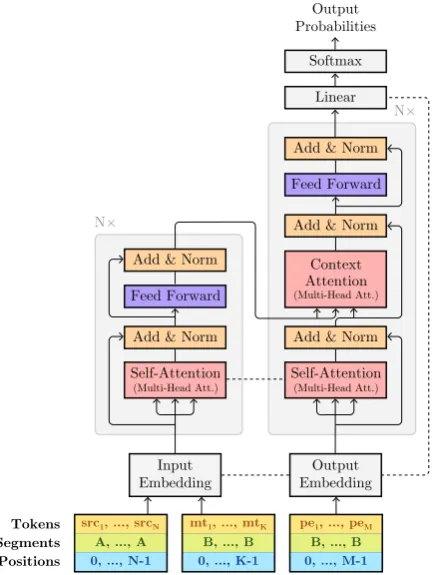
Figure 1: Dual-Source BERT. Dashed lines show shared parameters in our best configuration.
2.2 BERT as a Cross-Lingual Encoder
Our transfer learning approach is based on the Bidi-rectional Encoder Representations from Transform-ers (BERT;Devlin et al.,2019). This model ob-tains deep bidirectional representations by training a Transformer (Vaswani et al.,2017) with a large-scale dataset in a masked language modeling task where the objective is to predict missing words in a sentence. We use the BERTBASEmodel, which is
composed ofL= 12self-attention layers, hidden sizeH = 768,A= 12attention heads, and feed-forward inner layer sizeF = 3072. In addition to the word and learned position embeddings, BERT also hassegment embeddingsto differentiate be-tween a segment A and a segment B—this is useful for tasks such as natural language inference, which involve two sentences. In the case of APE, there is also a pair of input sentences (src,mt) which are in different languages. Since one of the released BERT models was jointly pre-trained on 104 lan-guages,2we use this multilingual BERT pre-trained model to encode the bilingual input pair of APE.
Therefore, the whole encoder of our APE model is the multilingual BERT: we encode bothsrcand
2 https://github.com/google-research/
mtin the same encoder and use the segment embed-dings to differentiate between languages (Figure1). We reset positional embeddings when themtstarts, since it is not a continuation ofsrc.
2.3 BERT as a Decoder
Prior work has incorporated pre-trained models inencoders, but not asdecodersof sequence-to-sequence models. Doing so requires a strategy for generating fluently from the pre-trained model. Note that the bidirectionality of BERT is lost, since the model cannot look at words that have not been generated yet, and it is an open question how to learn decoder-specific blocks (e.g. context atten-tion), which are absent in the pre-trained model.
One of our key contributions is to use BERT in the decoder by experimenting different strategies for initializing and sharing the self and context at-tention layers and the positionwise feed-forward layers. We tie together the encoder and decoder embeddings weights (word, position, and segment) along with the decoder output layer (transpose of the word embedding layer). We use the same seg-ment embedding for the target sentence (pe) and the second sentence in the encoder (mt) since they are in the same language. The full architecture is shown in Figure1. We experiment with the fol-lowing strategies for coupling BERT pre-trained models in the decoder:
• Transformer. A Transformer decoder as de-scribed in Vaswani et al. (2017) without any shared parameters, with the BERTBASE
dimen-sions and randomly initialized weights.
• Pre-trained BERT.This initializes the decoder with the pre-trained BERT model. The only com-ponent initialized randomly is the context atten-tion (CA) layer, which is absent in BERT. Un-like in the original BERT model—which only encodes sentences—a mask in the self-attention is required to prevent the model from looking to subsequent tokens in the target sentence.
• BERT initialized context attention.Instead of a random initialization, we initialize the context attention layers with the weights of the corre-sponding BERT self-attention layers.
• Shared self-attention. Instead of just having the same initialization, the self-attentions (SA) in the encoder and decoder are tied during training.
• Context attention shared with self-attention.
We take a step further andtiethe context
atten-tion and self attenatten-tion weights—making all the attention transformation matrices (self and con-text) in the encoder and decoder tied.
• Shared feed-forward.We tie the feed-forward weights (FF) between the encoder and decoder.
3 Experiments
We now describe our experimental results. Our models were implemented on a fork of OpenNMT-py (Klein et al.,2017) using a Pytorch (Paszke et al., 2017) re-implementation of BERT.3Our model’s implementation is publicly available.4
Datasets. We use the data from the WMT 2018 APE shared task (Chatterjee et al.,2018) (English-German SMT), which consists of 23,000 triplets for training, 1,000 for validation, and 2,000 for testing. In some of our experiments, we also use the eSCAPE corpus (Negri et al., 2018), which comprises about 8M sentences; when doing so, we oversample 35x the shared task data to cover10%
of the final training data. We segment words with WordPiece (Wu et al.,2016), with the same vocab-ulary used in the Multilingual BERT. At training time, we discard triplets with 200+ tokens in the combination ofsrcandmtor 100+ tokens inpe. For evaluation, we use TER (Snover et al.,2006) and tokenized BLEU (Papineni et al.,2002).
TER↓ BLEU↑
Transformer decoder 20.33 69.31 Pre-trained BERT 20.83 69.11
withCA←SA 18.91 71.81
andSA↔Encoder SA 18.44 72.25
andCA↔SA 18.75 71.83
and FF↔Encoder FF 19.04 71.53
Table 1: Ablation study of decoder configurations, by gradually having more shared parameters between the encoder and decoder (trained without synthetic data). ↔denotes parameter tying and←an initialization.
Training Details. We use Adam (Kingma and Ba, 2014) with a triangular learning rate sched-ule that increases linearly during the first 5,000 steps until5×10−5 and has a linear decay after-wards. When using BERT components, we use a
3
https://github.com/huggingface/ pytorch-pretrained-BERT
4https://github.com/deep-spin/
test 2016 test 2017 test 2018
Model Train Size TER↓ BLEU↑ TER↓ BLEU↑ TER↓ BLEU↑
MT baseline (Uncorrected) 24.76 62.11 24.48 62.49 24.24 62.99
B´erard et al.(2017) 23K 22.89 — 23.08 65.57 — —
Junczys-Dowmunt and Grundkiewicz(2018)
5M 18.92 70.86 19.49 69.72 — —
Junczys-Dowmunt and Grundkiewicz(2018)×4 18.86 71.04 19.03 70.46 — —
Tebbifakhr et al.(2018)
8M
— — — — 18.62 71.04
Junczys-Dowmunt and Grundkiewicz(2018) 17.81 72.79 18.10 71.72 — —
Junczys-Dowmunt and Grundkiewicz(2018)×4 17.34 73.43 17.47 72.84 18.00 72.52
Dual-Source Transformer†
23K
27.80 60.76 27.73 59.78 28.00 59.98 BERT Enc. + Transformer Dec. (Ours) 20.23 68.98 21.02 67.47 20.93 67.60 BERT Enc. + BERT Dec. (Ours) 18.88 71.61 19.03 70.66 19.34 70.41 BERT Enc. + BERT Dec.×4(Ours) 18.05 72.39 18.07 71.90 18.91 70.94
BERT Enc. + BERT Dec. (Ours)
[image:4.595.70.530.64.290.2]8M 16.91 74.29 17.26 73.42 17.71 72.74 BERT Enc. + BERT Dec.×4(Ours) 16.49 74.98 16.83 73.94 17.15 73.60
Table 2: Results on the WMT 2016–18 APE shared task datasets. Our single models trained on the 23K dataset took only 3h20m to converge on a single Nvidia GeForce GTX 1080 GPU, while results for models trained on 8M triplets take approximately 2 days on the same GPU. Models marked with “×4” are ensembles of 4 models. Dual-Source Transformer†is a comparable re-implementation ofJunczys-Dowmunt and Grundkiewicz(2018).
`2weight decay of0.01. We apply dropout (
Srivas-tava et al.,2014) withpdrop = 0.1to all layers and
use label smoothing with = 0.1(Pereyra et al., 2017). For the small data experiments, we use a batch size of 1024 tokens and save checkpoints ev-ery 1,000 steps; when using the eSCAPE corpus, we increase this to 2048 tokens and 10,000 steps. The checkpoints are created with the exponential moving average strategy ofJunczys-Dowmunt et al. (2018) with a decay of10−4. At test time, we select the model with best TER on the development set, and apply beam search with a beam size of 8 and average length penalty.
Initialization and Parameter Sharing. Table1 compares the different decoder strategies described in§2.3on the WMT 2018 validation set. The best results were achieved by sharing the self-attention between encoder and decoder, and by initializing (but not sharing) the context attention with the same weights as the attention. Regarding the self-attention sharing, we hypothesize that its benefits are due to both encoder and decoder sharing a com-mon language in their input (in themtandpe sen-tence, respectively). Future work will investigate if this is still beneficial when the source and target lan-guages are less similar. On the other hand, the ini-tialization of the context attention with BERT’s self-attention weights is essential to reap the benefits
of BERT representations in the decoder—without it, using BERT decreases performance when com-pared to a regular transformer decoder. This might be due to the fact that context attention and self-attention share the same neural block architecture (multi-head attention) and thus the context atten-tion benefits from the pre-trained BERT’s better weight initialization. No benefit was observed from sharing the feed-forward weights.
Final Results. Finally, Table 2 shows our re-sults on the WMT 2016–18 test sets. The model named BERT Enc. + BERT Dec. corresponds to the best setting found in Table 1, while BERT Enc. + Transformer Dec. only uses BERT in the encoder. We show results for single models and ensembles of 4 independent models.
[image:4.595.71.524.68.290.2]train. With 4×ensembling, we get competitive results with systems trained on 8M triplets.
When adding the eSCAPE corpus (8M triplets), performance surpasses the state of the art in all test sets. By ensembling, we improve even further, achieving a final 17.15 TER score in test 2018 (−0.85 TER than the previous state of the art).
4 Related Work
In their Dual-Source Transformer model, Junczys-Dowmunt and Grundkiewicz (2018) also found gains by tying together encoder parameters, and the embeddings of both encoders and decoder. Our work confirms this but shows further gains by using segment embeddings and more careful sharing and initialization strategies.Sachan and Neubig(2018) explore parameter sharing between Transformer layers. However, they focus on sharing decoder parameters in aone-to-manymultilingual MT sys-tem. In our work, we share parameters between the encoder and the decoder.
As stated in§3,B´erard et al.(2017) also showed improved results over the MT baseline, using exclu-sively the shared task data. Their system outputs edit operations that decide whether to insert, keep or delete tokens from the machine translated sen-tence. Instead of relying on edit operations, our approach mitigates the small amount of data with transfer learning through BERT.
Our work makes use of the recent advances in transfer learning for NLP (Peters et al., 2018; Howard and Ruder,2018;Radford et al.,2018; De-vlin et al.,2019). Pre-training these large language models has largely improved the state of the art of the GLUE benchmark (Wang et al.,2018). Particu-larly, our work uses the BERT pre-trained model and makes use of the representations obtained not only in the encoder but also on the decoder in a language generation task.
More closely related to our work, Lample and Conneau(2019) pre-trained a BERT-like language model using parallel data, which they used to ini-tialize the encoder and decoder for supervised and unsupervised MT systems. They also used seg-ment embeddings (along with word and position embeddings) to differentiate between a pair of sen-tences in different languages. However, this is only used in one of the pre-training phases of the lan-guage model (translation lanlan-guage modelling) and not in the downstream task. In our work, we use segment embeddings during the downstream task
itself, which is a perfect fit to the APE task. Lopes et al.(2019) used our model on the harder English-German NMT subtask to obtain better TER performance than previous state of the art. To obtain this result, the transfer learning capabilities of BERT were not enough and further engineering effort was required. Particularly, a conservative-ness factor was added during beam decoding to constrain the changes the APE system can make to themtoutput. Furthermore, the authors used a data weighting method to augment the importance of data samples that have lower TER. By doing this, data samples that required less post-editing ef-fort are assigned higher weights during the training loop. Since the NMT system does very few errors on this domain this data weighting is important for the APE model to learn to do fewer corrections to themtoutput. However, their approach required the creation of an artificial dataset to obtain a per-formance that improved the MT baseline. We leave it for future work to investigate better methods to obtain results that improve the baseline using only real post-edited data in these smaller APE datasets.
5 Conclusion and Future Work
We proposed a transfer learning approach to APE using BERT pre-trained models and careful param-eter sharing. We explored various ways for cou-pling BERT in the decoder for language generation. We found it beneficial to initialize the context atten-tion of the decoder with BERT’s self-attenatten-tion and to tie together the parameters of the self-attention layers between the encoder and decoder. Using a small dataset, our results are competitive with systems trained on a large amount of artificial data, with much faster training. By adding artificial data, we obtain a new state of the art in APE.
In future work, we would like to do an extensive analysis on the capabilities of BERT and transfer learning in general for different domains and lan-guage pairs in APE.
Acknowledgments
References
Vicent Alabau, Christian Buck, Michael Carl, Fran-cisco Casacuberta, Mercedes Garc´ıa-Mart´ınez, Ul-rich Germann, Jes´us Gonz´alez-Rubio, Robin Hill, Philipp Koehn, Luis Leiva, et al. 2014. CAS-MACAT: A Computer-assisted Translation Work-bench. In Proceedings of the Demonstrations at EACL.
Alexandre B´erard, Laurent Besacier, and Olivier Pietquin. 2017. LIG-CRIStAL Submission for the WMT 2017 Automatic Post-Editing Task. In Pro-ceedings of WMT17.
Rajen Chatterjee, Matteo Negri, Raphael Rubino, and Marco Turchi. 2018. Findings of the WMT 2018 Shared Task on Automatic Post-Editing. In Proceed-ings of WMT18.
Michael Denkowski. 2015. Machine Translation for Human Translators. Ph.D. thesis, Carnegie Mellon University.
Jacob Devlin, Ming-Wei Chang, Kenton Lee, and Kristina Toutanova. 2019. BERT: Pre-training of Deep Bidirectional Transformers for Language Un-derstanding. InProceedings of NAACL.
Marcello Federico, Nicola Bertoldi, Mauro Cettolo, Matteo Negri, Marco Turchi, Marco Trombetti, Alessandro Cattelan, Antonio Farina, Domenico Lupinetti, Andrea Martines, et al. 2014. The Mate-Cat Tool. In Proceedings of COLING, System Demonstrations.
Christopher M Hokamp. 2018. Deep Interactive Text Prediction and Quality Estimation in Translation In-terfaces. Ph.D. thesis, Dublin City University.
Jeremy Howard and Sebastian Ruder. 2018. Universal Language Model Fine-tuning for Text Classification. InProceedings of ACL.
Marcin Junczys-Dowmunt and Roman Grundkiewicz. 2016.Log-linear Combinations of Monolingual and Bilingual Neural Machine Translation Models for Automatic Post-Editing. InProceedings of WMT16.
Marcin Junczys-Dowmunt and Roman Grundkiewicz. 2018. MS-UEdin Submission to the WMT2018 APE Shared Task: Dual-Source Transformer for Au-tomatic Post-Editing. InProceedings of WMT18.
Marcin Junczys-Dowmunt, Roman Grundkiewicz, Tomasz Dwojak, Hieu Hoang, Kenneth Heafield, Tom Neckermann, Frank Seide, Ulrich Germann, Al-ham Fikri Aji, Nikolay Bogoychev, et al. 2018. Mar-ian: Fast Neural Machine Translation in C++. In
Proceedings of ACL, System Demonstrations.
Diederik P Kingma and Jimmy Ba. 2014. Adam: A Method for Stochastic Optimization. preprint arXiv:1412.6980.
Guillaume Klein, Yoon Kim, Yuntian Deng, Jean Senel-lart, and Alexander Rush. 2017. OpenNMT: Open-Source Toolkit for Neural Machine Translation. In
Proceedings of ACL 2017, System Demonstrations.
Guillaume Lample and Alexis Conneau. 2019. Cross-lingual Language Model Pretraining. preprint arXiv:1901.07291.
Ant´onio V. Lopes, M. Amin Farajian, Gonc¸alo M. Correia, Jonay Trenous, and Andr´e F. T. Martins. 2019.Unbabel’s Submission to the WMT2019 APE Shared Task: BERT-based Encoder-Decoder for Au-tomatic Post-Editing. InProceedings of WMT19.
Bryan McCann, James Bradbury, Caiming Xiong, and Richard Socher. 2017. Learned in Translation: Contextualized Word Vectors. In Proceedings of NeurIPS.
Matteo Negri, Marco Turchi, Rajen Chatterjee, and Nicola Bertoldi. 2018. eSCAPE: a Large-scale Syn-thetic Corpus for Automatic Post-Editing. In Pro-ceedings of LREC.
Kishore Papineni, Salim Roukos, Todd Ward, and Wei-Jing Zhu. 2002. BLEU: a Method for Automatic Evaluation of Machine Translation. InProceedings of ACL.
Adam Paszke, Sam Gross, Soumith Chintala, Gregory Chanan, Edward Yang, Zachary DeVito, Zeming Lin, Alban Desmaison, Luca Antiga, and Adam Lerer. 2017. Automatic differentiation in PyTorch.
Proceedings of NeurIPS Autodiff Workshop.
Gabriel Pereyra, George Tucker, Jan Chorowski, Łukasz Kaiser, and Geoffrey Hinton. 2017. Regu-larizing Neural Networks by Penalizing Confident Output Distributions.preprint arXiv:1701.06548.
Matthew Peters, Mark Neumann, Mohit Iyyer, Matt Gardner, Christopher Clark, Kenton Lee, and Luke Zettlemoyer. 2018. Deep Contextualized Word Rep-resentations. InProceedings of NAACL.
Alec Radford, Karthik Narasimhan, Tim Salimans, and Ilya Sutskever. 2018. Improving Language Under-standing by Generative Pre-Training.preprint.
Devendra Sachan and Graham Neubig. 2018. Pa-rameter Sharing Methods for Multilingual Self-Attentional Translation Models. InProceedings of WMT18.
Michel Simard, Nicola Ueffing, Pierre Isabelle, and Roland Kuhn. 2007. Rule-Based Translation with Statistical Phrase-Based Post-Editing. In Proceed-ings of WMT07.
Nitish Srivastava, Geoffrey Hinton, Alex Krizhevsky, Ilya Sutskever, and Ruslan Salakhutdinov. 2014.
Dropout: a simple way to prevent neural networks from overfitting. The Journal of Machine Learning Research, 15(1):1929–1958.
Amirhossein Tebbifakhr, Ruchit Agrawal, Matteo Ne-gri, and Marco Turchi. 2018. Multi-source Trans-former with Combined Losses for Automatic Post-Editing. InProceedings of WMT18.
Ashish Vaswani, Noam Shazeer, Niki Parmar, Jakob Uszkoreit, Llion Jones, Aidan N Gomez, Łukasz Kaiser, and Illia Polosukhin. 2017. Attention Is All You Need. InProceedings of NeurIPS.
Alex Wang, Amanpreet Singh, Julian Michael, Fe-lix Hill, Omer Levy, and Samuel Bowman. 2018.
GLUE: A Multi-Task Benchmark and Analysis Plat-form for Natural Language Understanding. In Pro-ceedings of EMNLP Workshop BlackboxNLP.