Proceedings of the 57th Annual Meeting of the Association for Computational Linguistics, pages 1560–1568
1560
Soft Representation Learning for Sparse Transfer
Haeju Park1 Jinyoung Yeo2 Gengyu Wang1 Seung-won Hwang1
Department of Computer Science, Yonsei University, Seoul, Korea1 T-Brain, AI Center, SK Telecom, Seoul, Korea2
{phj0225, posuer, seungwonh}@yonsei.ac.kr
Abstract
Transfer learning is effective for improving the performance of tasks that are related, and Multi-task learning (MTL) and Cross-lingual learning (CLL) are important instances. This paper argues that hard-parameter sharing, of hard-coding layers shared across different tasks or languages, cannot generalize well, when sharing with a loosely related task. Such case, which we callsparse transfer, might ac-tually hurt performance, a phenomenon known as negative transfer. Our contribution is us-ing adversarial trainus-ing across tasks, to “soft-code” shared and private spaces, to avoid the shared space gets too sparse. In CLL, our pro-posed architecture considers another challenge of dealing with low-quality input.
1 Introduction
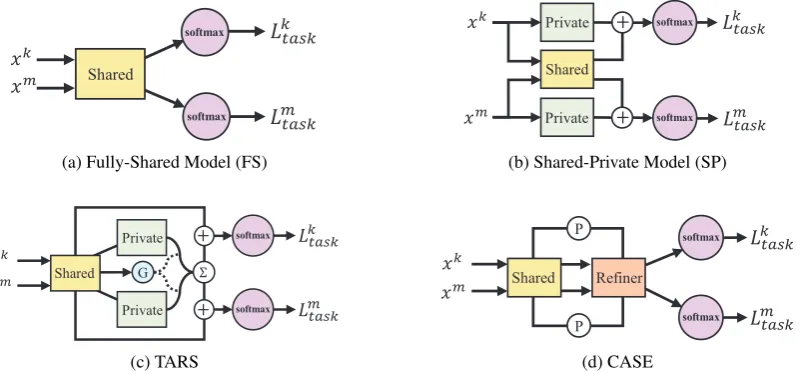
Transfer learning in neural networks has been ap-plied in recent years to improving the performance of related tasks, for example, 1) multi-task learn-ing (MTL) with different tasks (labeled data avail-able all tasks) and 2) cross-lingual learning (CLL) with different language (but the same task) though labeled data available only in source language. For both settings, one of their most common strate-gies is hard-parameter sharing, as shown in Fig-ure 1a, which shares the hidden layers across tasks, which we will call shared layer. This ap-proach works well when tasks are closely related, when most features are invariant across tasks. Oth-erwise, which we call sparse transfer, transfer-ring between loosely related tasks often hurt per-formance, known as negative transfer. We elabo-rate this problem in MTL and CLL scenarios.
First, for MTL, the shared space is reported to be sparse, in an architecture with one shared en-coder (Sachan and Neubig,2018), when shared by K(e.g.,K >2tasks) loosely-related tasks. To ad-dress this problem, as shown in Figure1b, recent
models (Liu et al.,2017;Lin et al.,2018) divide the features of different tasks into task-invariant and task-dependent latent spaces, which we will call shared and private spaces from this point on. However, since such approach still hard-codes shared and private features, deciding which sub-sets of tasks should share encoders in many-task settings, among all possible combinations of tasks, is a non-trivial design problem (Ruder et al.,2019;
Sanh et al.,2019).
Second, for CLL, the given task in source lan-guage (with rich resources) transfers to that for target languages without training resources. For the latter, machine-translated resources are fed in-stead, to the shared encoder (Schwenk and Douze,
2017;Conneau et al., 2018). When translation is perfect, the shared space would be dense: For ex-ample, English training pair withentailment rela-tionship, “Because it looked so formidable” and “It really did look wonderful” can be translated to Chinese sentences of the same meaning, to pre-serve labels. Meanwhile, its translation into “因为 它看起来那么可怕” (Because it looks so scary)
and “它真的看起来很棒” (It really looks great), fails to preserve the entailment relationship, and makes the shared space sparse.
As a unified solution for both problems, we pro-posesoft-codingapproaches that can adapt in the following novel ways.
ݔ ݔ
ܮ௧௦
ܮ௧௦
Shared
softmax
softmax
(a) Fully-Shared Model (FS)
ݔ
ݔ
ܮ௧௦
ܮ௧௦
Private
Shared
Private
softmax
softmax
(b) Shared-Private Model (SP)
ݔ ݔ
ܮ௧௦
ܮ௧௦
G Private
Private Shared ȭ
softmax
softmax
(c) TARS
ݔ ݔ
ܮ௧௦
ܮ௧௦ Shared
softmax
softmax P
P
Refiner
[image:2.595.103.504.64.251.2](d) CASE
Figure 1: Illustration of transfer learning architectures. Yellow and green boxes represent shared and private LSTM layers.GandPindicates a gating network and a policy network respectively.
a gating network G in Figure 1c, decides on output weights for each task. Based on this basic architecture, TARS softly-shares features balanced by twoconflicting auxiliary losses: one is used to eliminate private features from the shared space, which decreases the generalization across task, while the other is used to keep shared space “dense” with soft-private features, which is a form of adversarial training. Such balancing efforts prevent the shared space from being too sparse to be generalized for every task, even when K >2.
Second, for CLL, we propose a Cross-lingual AdverSarial Example, namely CASE. Compared to Figure1c, task-specific private layers no longer exist in Figure1d, because CLL deals with a sin-gle task for multiple languages. Instead, for an additional challenge of refining low-quality input, we addRefiner. Specifically, once the source lan-guage is translated into the target lanlan-guage, CASE moves the noisy representation on the target side towards a direction of space on the source side back in a form of adversarial example, and uses this as an additional training data to task classi-fier. However, this refinement may have adverse effects (Yeo et al., 2018), for which a policy net-workP in Figure1ddecides whether to refine or not.
To demonstrate the effectiveness and flexibility of our soft-coding approaches, we evaluate TARS on five different datasets covering diverse scenar-ios and CASE on cross-lingual natural language inference (XNLI) datasets with 15 languages (in-cluding low-resource language such as Swahili
and Urdu), and show that TARS and CASE out-perform existing hard-coding approaches.
2 Preliminaries
2.1 Problem Statement
Formally, we assume the existence ofK datasets {Dk}K
k=1, where eachD
kcontains|Dk|data
sam-ples for classification taskk. Specifically,
Dk={(xki, yki)}|Di=1k| (1)
wherexki andyik denote a sentence (or pair) and its corresponding label for taskk. In CLL, Dkis given only for one language, for which we create a new datasetD˜k={(˜xki, yik)}, wherex˜ki is trans-lated, using neural machine translation (NMT), for training task k (for another language). Transfer learning aims to improve classification by learn-ing theseK tasks in parallel. Thus, our objective is to learn a sentence (or pair) representationxkper taskk, but take into account the correlation among related tasks.
Specifically, given an input sequence xk =
distribu-tions on all the tasks as follows:
Ltask= K X
k=1
L(ˆyk, yk) (2)
where L(ˆyk, yk) denote a typical cross-entropy loss for each taskk.
2.2 Baseline: Hard-code Approach
As overviewed in Section1, the success of transfer learning depends on the sharing scheme in latent feature space. Existing architectures differ in how to group the shared features to maximize sharing, as illustrated in Figure1. We overview the existing approaches into the following two categories.
Base I: Fully-Shared Model (FS) As shown in Figure1a, the Fully-Shared (FS) model adopts a single shared encoderS-Encoderto extract fea-tures generalized for all the tasks. For example, given two taskskandm, all featuressk of taskk are expected to be shared by taskmand vice versa,
i.e., sk = S-Encoder({w1k, w2k, ..., wTk};θs), whereθs represents the parameters of the shared encoder. In FS model, sk is equivalent toxk fed into classifiers.
Base II: Shared-Private Model (SP) As Fig-ure1bshows, the Shared-Private (SP) model con-sists of two modules: (1) the underlying shared encoderS-Encoderresponsible to capture task-invariant features, and (2) the private encoder
P-Encoder to extract task-dependent features,
i.e., pk = P-Encoder({wk1, wk2, ..., wkT};θkp), where θpk represents the parameters of each pri-vate encoder. Then, both shared representationsk
and private representation pk are concatenated to construct the final sentence representation: xk = sk⊕pk.
These hard-code approaches greatly reduce the risk of overfitting to capture all of the tasks si-multaneously, but have the caveat that the ability of shared space to model task-invariant features can be significantly reduced (Sachan and Neubig,
2018). We empirically show our observations are consistent in Section5.2.
3 Soft-code Approach for MTL: TARS
Inspired by the limitation of hard-coding ap-proaches, our proposed model, TARS, begins with FS model but progressively adapts to task charac-teristics, as shown in Figure1c.
Soft-Private ModuleTARS first models the mul-tiple tasks as MoE, where each task has an individ-ual expert network, and weighs the experts for dif-ferent task examples. To be specific, TARS feeds the shared featuresskinto individualP-Encoder
for each task, to encode task-dependent features as follows:
pk =P-Encoder(sk;θkp) (3)
Simultaneously, a gating network decides on output weights for each expert (i.e., individual
P-Encoder). Specifically, the gating networkG, parameterized byθg, is used to map the shared rep-resentation of current task into the correct expert, and each expert is thus learning task-dependent features for that task, estimating task label of sk:
G(sk;θg) =softmax(Wgsk+bg) (4)
whereWg andbgis a trainable weight matrix and a bias, respectively. Based on above, the final soft-private representationp(sk)is a mixture of all ex-pert outputs with respect toskas the following:
p(sk) =
K X
k=1
G(sk;θg)·pk (5)
Soft-Shared Module In order to learn task-invariant features, inspired by (Liu et al., 2017), TARS adopts an adversarial network, which con-tains a feature extractor and a task discriminator D. The basic idea is to learn features that can-not be distinguished byD. Specifically,Daims to discriminate which task the feature comes from, while the feature extractor (e.g., S-Encoder) tries to foolD so that it cannot identify the task of the feature and is hence task-invariant. More formally,
Ladv = min θs λmaxθd
K X
k=1 |Dk| X
i=1
dkilog[D(sk;θd)]
Specifically, the objective of the density con-straint Ldense is to push the soft-private features from the private embeddings closer to the shared ones, such that the shared space is encouraged to being dense rather than being too sparse, resolving the sparseness of the shared space. Therefore, the soft-shared features might be more informative in this case. Formally,
Ldense= K X
k=1
||p(sk)−sk||2 (7)
where|| · ||2is the mean squared L-2 norm.
Training and Inference Lastly, the soft-private and soft-shared representations p(sk) and sk are concatenated,i.e.,xk=sk⊕p(sk), to feed the all networks in TARS with the following loss:
LT ARS =Ltask+Ladv +Ldense (8)
TARS is trained with backpropagation, and adopts a gradient reversal layer (Ganin and Lempitsky,
2015) to address minimax optimization problem. Note that, unlike hard-code approaches, zero-shot learning is also possible since TARS can adapt to a new target task (e.g., cross-domain or -lingual), by aligning it with the trained expert gate deciding what combination of the expert to use in Eq. (4) and Eq. (5) on inference.
4 Soft-code Approach for CLL: CASE
This section revisesLdensein Eq. (7) for CLL sce-nario. Note that, in CLL, sparse space corresponds to mistranslated low-resource language, which we callpseudo-sentence. The goal ofLdenseis thus replaced by, softly correcting the representation to align betterLalign, while preserving the semantics Lsem. For that purpose, we propose aRefiner re-placingLdensewith these two new losses.
Refinement by Perturbation We first discuss how to refine pseudo-sentences by perturbation∆
for higher learning effectiveness. Related ideas are ensuring the robustness of a model, by finding
∆that changes a prediction, or, f(x) = y while f(x+ ∆)6=y(Goodfellow et al.,2015). Inspired, CASE explores if incorrect translations that may cause wrong predictions in the target language can be moved back to change predictions.
For which, based on the basic architecture of variational auto-encoder (VAE) (Kingma and Welling, 2013), CASE models a neural refiner to refine low-quality representations. Specifically, as
shown in Figure 1d, CASE first encodes pseudo-parallel sentences into shared space, e.g., (x,˜x). Then, the refiner which consists of two encod-ing feed-forward networkµ(x)andσ(x)converts the representations into two distribution variables µ(˜x) and σ(˜x), the mean and standard devia-tion for pseudo representadevia-tions. Unlike tradidevia-tional VAE minimizing the latent loss that measures how closely the latent variables match a unit Gaus-sian, i.e., KL(N(µ(x), σ(x)),N(0,1)), CASE
enhances the latent loss with the pseudo-parallel representation, to generate pseudo-adversarial ex-ample ˜z that roughly follows a representation x
from resource-rich space as follows:
Lalign =KL(N(µ(˜x), σ(˜x)),N(µ(x), σ(x)))
(9) In order to optimize the KL divergence, CASE applies a simple reparameterization trick (Kingma and Welling, 2013). Using this trick, pseudo-adversarial example˜zis generated from the mean and standard deviation vectors, i.e.,˜z = µ(˜x) +
σ(˜x)·, where ∈ N(0,1). This constraint not only allows us to generate an informative repre-sentation, but also improves the generalization of our network, towardsx(e.g., English) with higher confidence. Then, CASE aims at preserving its original semantics in the latent space, for which CASE includes the reconstruction loss, which is a mean squared error, to measure how accurately the pseudo-adversarial example˜z preserves its origi-nal semantics. i.e., Lsim = Σ|D|˜||˜z−˜x||2. As a result, ˜z is fed into the classifier, and the overall loss of CASE is defined as follows:
LCASE =Ltask+Ladv
+Lalign+Lsim
(10)
Selective RefinementLastly, CASE aims to refine only when the perturbation can refine the transla-tion. In other words, if the translation is already good, CASE avoids a refinement, by parameter-izing refinement withα set to be near zero. Not applying a refinement for correct translation is im-portant, since more than half of translations is cor-rectly translated, as reported by (Yeo et al.,2018), such that refinement may lower the quality.
as follows:
α=KL(P(˜x)||P(x)) =
X
x∈D,˜x∈D˜
P(˜x) logP(˜x)
P(x)
(11) in which P(x) outputs a domain distribution of
x, and CASE estimates α as the difference be-tween two distributions (i.e., KL divergence), and the final loss function is defined factoring in α: LCASE =Ltask+Ladv+α(Lalign+Lsim).
5 Experiments
5.1 Experimental Settings
To show the effectiveness of our proposed ap-proaches, we conduct experiments on both multi-task and cross-lingual settings.
Multi-task Dataset For Multi-task learning, we use five different datasets on Natural Lan-guage Inference (NLI) and Paraphrase Identifi-cation (PI) tasks: SNLI (Bowman et al., 2015), MNLI (Williams et al., 2018), and CNLI1, for single-domain-English, multi-domain-English, and Chinese NLI respectively; QQP (Csernai et al., 2017) and LCQMC (Liu et al., 2018) for English and Chinese PI.
Cross-lingual Dataset We use the cross-lingual natural language inference (XNLI) dataset ( Con-neau et al.,2018)2from 15 different languages for Cross-lingual learning. The dataset is a version of MNLI (Williams et al.,2018) where 2,500 dev and 5,000 test sets have been translated (by hu-mans) into 14 languages. For training datasets, the English training data is translated into each target language by NMT.
Implementation Details For all encoder, we adopt BiLSTM-max (Conneau et al.,2017) model and the pre-trained word embeddings we use are 300-dimensional fastText word embeddings ( Bo-janowski et al.,2017). Following (Conneau et al.,
2018), the BiLSTM hidden states is set to 256 and Adam optimizer with a learning rate of 0.001 was applied. The learning rate was decreased by a factor of 0.85 when the target dev accuracy does not improve. As in (Conneau et al., 2018), for text classification networks, we use a feed-forward neural network with one hidden layer of 128 hidden units with a dropout rate of 0.1, to
1
https://github.com/blcunlp/CNLI
2
https://www.nyu.edu/projects/bowman/xnli/XNLI-1.0.zip
Source Model SNLI MNLI QQP (Single Task) BiLSTM-max 81.95 65.98 85.89
SNLI+MNLI
AFS 82.06 66.51 -(+0.11) (+0.53)
ASP 82.28 67.39 -(+0.33) (+1.41)
TARS 82.67 67.79 -(+0.70) (+1.81)
SNLI+QQP
AFS 82.03 - 85.08 (+0.08) (-0.81)
ASP 82.20 - 86.22 (+0.25) (+0.33)
TARS 82.54 - 86.51 (+0.59) (+0.62)
MNLI+QQP
AFS - 66.62 85.59 (+0.64) (-0.30)
ASP - 66.92 86.12 (+0.94) (+0.23)
[image:5.595.307.527.63.249.2]TARS - 67.37 86.47 (+1.39) (+0.58)
Table 1: Accuracy over MTL with two-source tasks
measure the relatedness of a given premise and hy-pothesis. The hyperparameterλis empirically set to 0.005. All our implementation is available at github.com/haejupark/soft.
5.2 Experimental Result I: MTL
Using (Liu et al.,2017) as hard-code baselines, we apply Adversarial training (and so-called orthogo-nality constraints) to FS and SP models, namely AFS and ASP. Such techniques enhance the dis-tinct nature of shared and private features.
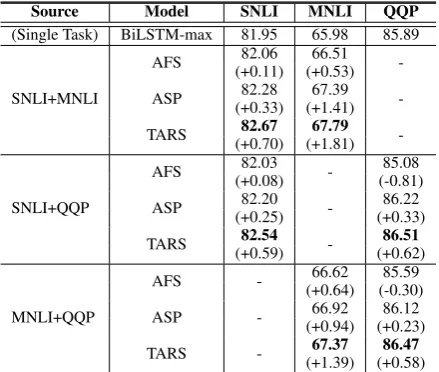
Two-source MTL Table 1 shows the perfor-mance on three text classification tasks. The first row shows the results of “single task”, and other rows show the results of “multiple tasks” by corresponding MTL models trained with two source tasks. More concretely, (SNLI+MNLI) and (*NLI+QQP) are for cross-domain and cross-task classification respectively. In this table, we can see that TARS achieves higher accuracy than all sharing scheme baselines in all scenarios, surpass-ing multi-task learnsurpass-ing (i.e., ASP) as well as sin-gle task learning. These results show that our soft-code approach also works well in typical MTL set-tings with two source tasks, though they are not our targeted sparse scenario.
Model SNLI MNLI QQP CNLI LCQMC BiLSTM-max 81.95 65.98 85.89 64.42 79.69
AFS 81.70 66.78 85.41 39.70 61.29 (-0.25) (+0.80) (-0.48) (-24.72) (-18.40)
ASP 82.23 66.92 86.04 - -(+0.28) (+0.94) (+0.15)
MoE 81.55 66.72 85.23 39.45 63.02 (-0.40) (+0.74) (-0.66) (-24.97) (-16.67)
MMoE 81.46 67.01 85.29 - -(-0.49) (+1.03) (-0.60)
[image:6.595.73.290.64.167.2]TARS 83.12 68.24 86.15 40.52 63.45 (+1.17) (+2.26) (+0.26) (-23.90) (-16.24)
Table 2: Accuracy of MTL with three-source tasks
MMoE (Ma et al., 2018), which explicitly learns to model task relationship by modeling an expert for each task (which is not desirable for a new task). This suggests that the synergetic effect of soft-private and -shared modules in TARS is criti-cal to outperform other baselines.
Specifically, AFS and ASP show a “nega-tive transfer”, which is an inherent challenge of MTL. For example, ASP with three-source tasks achieves 82.23% and 66.92% accuracy, respec-tively, in SNLI and MNLI, which are lower than
82.28% and 67.39% accuracy with its best per-formance with two-source tasks. In contrast, TARS overcomes such challenges, for example,
83.12% > 82.67% and 68.24% > 67.79% in SNLI and MNLI, except for QQP, which can be further improved by asymmetric MTL tech-niques (Lee et al.,2016).
To investigate how TARS helps transfer knowl-edge across tasks, Figure 2a and 2b contrast the feature representation of shared space in ASP and TARS, in two- and three-source settings respec-tively. First, for two-sources, ASP and TARS are comparable, capturing the distribution of two tasks that are nearly identical, which is desirable for transfer learning. Second, for three sources, the shared space of ASP shows two quite distinct distributions (task-dependent), while TARS keeps two distributions comparable (and task-invariant).
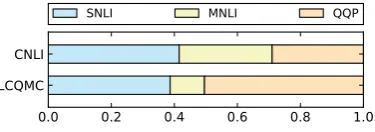
Zero-shot Learning Lastly, in Table 2, we test zero-shot learning with two target tasks, CNLI and LCQMC, excluding their own training data (ex-cept for the first row single task). As ASP requires target task labels to train its private encoders, we compare TARS only with AFS and MoE, where TARS shows the best performance in MTL. As shown in Figure 3, we observe that when TARS covers sentences in CNLI and LCQMC, using its gating network that identifies that the unknown target tasks are the most similar to SNLI and QQP,
respectively: Specifically, highest weights are as-signed to these two, but other source tasks also contribute, with non-zero weights.
(a) Shared space for two-source
[image:6.595.309.520.115.292.2](b) Shared space for three-source
Figure 2: PCA visualization. Blue and red indicate the shared features of SNLI and QQP, respectively, using ASP (left) and TARS (right).
0.0 0.2 0.4 0.6 0.8 1.0 LCQMC
CNLI
[image:6.595.316.504.374.440.2]SNLI MNLI QQP
Figure 3: Gating weights in zero-shot learning.
5.3 Experimental Result II: CLL
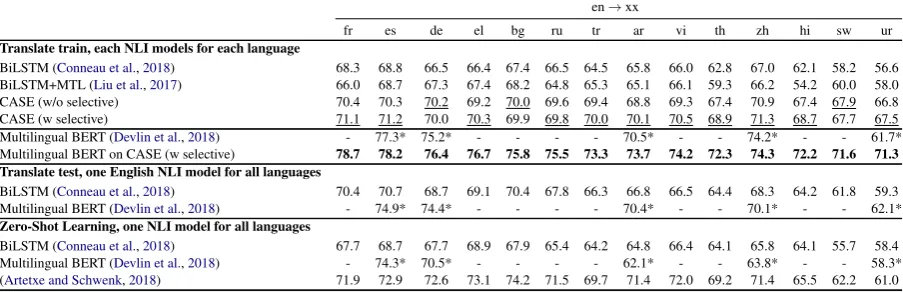
Table3shows our results on 14 XNLI languages. Following (Conneau et al., 2018), we divide the models into following three categories: 1) Trans-late train, where the English NLI training set is translated into each XNLI language and train a language-specific NLI classifier for each lan-guage; 2) Translate test, where all dev and test set of XNLI is translated to English and apply English NLI classifier; and 3) Zero-shot Learn-ing, where English classifier is directly applied to the target language without any translation. We also report the results of XNLI baselines ( Con-neau et al.,2018), a supervised cross-lingual MTL model that combines theLadv loss using pseudo-parallel data (Liu et al., 2017), the multilingual BERT (Devlin et al., 2018), and the recent work of (Artetxe and Schwenk,2018).
en→xx
fr es de el bg ru tr ar vi th zh hi sw ur Translate train, each NLI models for each language
BiLSTM (Conneau et al.,2018) 68.3 68.8 66.5 66.4 67.4 66.5 64.5 65.8 66.0 62.8 67.0 62.1 58.2 56.6 BiLSTM+MTL (Liu et al.,2017) 66.0 68.7 67.3 67.4 68.2 64.8 65.3 65.1 66.1 59.3 66.2 54.2 60.0 58.0 CASE (w/o selective) 70.4 70.3 70.2 69.2 70.0 69.6 69.4 68.8 69.3 67.4 70.9 67.4 67.9 66.8 CASE (w selective) 71.1 71.2 70.0 70.3 69.9 69.8 70.0 70.1 70.5 68.9 71.3 68.7 67.7 67.5 Multilingual BERT (Devlin et al.,2018) - 77.3* 75.2* - - - - 70.5* - - 74.2* - - 61.7* Multilingual BERT on CASE (w selective) 78.7 78.2 76.4 76.7 75.8 75.5 73.3 73.7 74.2 72.3 74.3 72.2 71.6 71.3 Translate test, one English NLI model for all languages
BiLSTM (Conneau et al.,2018) 70.4 70.7 68.7 69.1 70.4 67.8 66.3 66.8 66.5 64.4 68.3 64.2 61.8 59.3 Multilingual BERT (Devlin et al.,2018) - 74.9* 74.4* - - - - 70.4* - - 70.1* - - 62.1* Zero-Shot Learning, one NLI model for all languages
[image:7.595.74.526.64.210.2]BiLSTM (Conneau et al.,2018) 67.7 68.7 67.7 68.9 67.9 65.4 64.2 64.8 66.4 64.1 65.8 64.1 55.7 58.4 Multilingual BERT (Devlin et al.,2018) - 74.3* 70.5* - - - - 62.1* - - 63.8* - - 58.3* (Artetxe and Schwenk,2018) 71.9 72.9 72.6 73.1 74.2 71.5 69.7 71.4 72.0 69.2 71.4 65.5 62.2 61.0
Table 3: Accuracy over 14 XNLI languages (test set accuracy). We report results for translation baselines, multi-task learning baselines and zero-shot baselines. Overall best results are in bold, and the best in each group is un-derlined. All results * from its Github projecthttps://github.com/google-research/bert/blob/ master/multilingual.md.
to perform consistently better thanTranslate train
for all languages, which means a single English model works better than training each target model with translated data. In contrast, Multilingual BERT (Devlin et al., 2018) achieves best results onTranslate train, outperforming most languages, suggesting the generalization of BERT across lan-guages significantly better than BiLSTM model.
Meanwhile, CASE, significantly outperforms the BiLSTM and BiLSTM+MTL models in Trans-late trainfor all languages, and even outperforms BiLSTM in Translate test. Compared to the best performing MTL baseline, CASE achieves an improvement of 1.7% and 9.5% in Bulgarian (bg) and Urdu (ur) languages respectively. From these results, we observe that: 1) the improve-ments on low-resource language (e.g., Swahili and Urdu) are more substantial than those on other lan-guages; 2) the selective refinement strategy con-sistently contributes to the performance improve-ment. These results show that CASE, by incor-porating pseudo-adversarial example as an addi-tional resource, contributes to the robustness and the generalization of the model.
Lastly, we show that CASE with multilingual BERT model achieves the state-of-the-art, and even significantly outperforms the supervised ap-proach of (Artetxe and Schwenk, 2018) enjoying an unfair advantage of extremely large amounts of parallel sentences. These results show that CASE, with the help of strong baselines, gets a significant boost in performance, particularly for Swahili and Urdu that are low-resource languages, achieving the improvement of 9.4% and 10.3% respectively.
Robustness Analysis In order to verify whether CASE is robust, inspired by (Goodfellow et al.,
2015), we test if models keep its prediction, even after changes to the sentence, as long as the mean-ing remains unchanged. For example, the given sentence can be paraphrased by changing some words with their synonyms, and the models should give the same answer to the paraphrase.
Meanwhile, existing models, especially those overfitted to surface forms, are sensitive to such “semantic-preserving” perturbations. As human annotation for such perturbations is expensive, an automated approach (Alzantot et al., 2018) was studied for English, to generate semantic-preserving adversaries that fool well-trained sen-timent analysis and NLI models with success rates of 97% and 70%, respectively. In our problem set-ting of XNLI, we need such a generator (or gener-ated resources) for each language. For which, we identify three research questions:
• (RQ1)How hard is it to build a generator for a new language?
• (RQ2)Are the observations consistent?
• (RQ3)Does our model improve robustness?
Specifically, in this paper we focus on Chinese, as we could hire native speaking volunteers to val-idate whether automatically generated perturba-tions indeed preserve semantics.
Original Text Prediction:Contradiction(Confidence = 97%)
Premise:能帮助我的女孩在小镇的另一边。
Hypothesis:没没没有有有人能帮助我。
Adversarial Text Prediction:Entailment(Confidence = 59%)
Premise:能帮助我的女孩在小镇的另一边。
[image:8.595.113.252.640.695.2]Hypothesis:并并并没没没有有有人能帮助我。
Table 4: Example of generated adversarial example for chinese natural language inference task.
(Alzantot et al.,2018)3 to automatically generate Chinese perturbations for NLI task. Following the convention of (Alzantot et al.,2018), for NLI problem, we only add perturbation to the hypoth-esis, excluding premise, and aim to divert the pre-diction result from entailmentto contradiction, and vice versa. Table4is an example of generated adversarial example.
For RQ2, we validate the automatically gener-ated perturbations by native speaking volunteers. We show volunteers 500 samples to label whether it is contradiction, neutral or entailment. 84 per-cent of the responses matched the original ground truth. Second, we sample 500 samples, with each sample including the original sentence and the cor-responding adversarial example. Volunteers were asked to judge the similarity of each pair on a scale from 1 (very different) to 4 (very similar). The av-erage rating is 2.12, which shows the performance of our implementation for Chinese perturbation is also competitive.
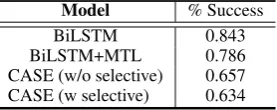
Lastly, for RQ3, we show the attack success rates over generated adversarial example in Ta-ble5. For comparison, we include the single task and MTL baselines. As shown in the Table 5, CASEs are able to achieve higher defense rate (or lower success rate) in performance of 36.6%, while baselines obtained 15.7% and 21.4% respec-tively, which demonstrates incorporating pseudo-adversarial example is indeed helpful to the ro-bustness of the model.
Model % Success
BiLSTM 0.843
BiLSTM+MTL 0.786 CASE (w/o selective) 0.657 CASE (w selective) 0.634
Table 5: Attack success rates over Chinese adversarial example for the text classification task.
3https://github.com/nesl/nlp adversarial examples
6 Related Work
Transfer Learning:Transfer learning enables ef-fective knowledge transfer from the source to the target task. Early works mainly focused on the shared representation methods (Liu et al., 2017;
Tong et al.,2018;Lin et al.,2018), using a single shared encoder between all tasks while keeping several task-dependent output layers. However, the sparseness of the shared space, when shared by K tasks, was observed (Sachan and Neubig,
2018). In this paper, we study a soft-coding ap-proach to overcome sparsity, leading to perfor-mance gains in MTL and CLL tasks. Closely re-lated work is MMoE (Ma et al.,2018), which ex-plicitly learns the task relationship by modeling a gating network for each task. Such work does not consider which combination of networks to use for a new task, while we differentiate by deciding such combination for a new task based on its similarity to the source tasks.
Adversarial Example: Despite the success of deep neural networks, neural models are still brit-tle to adversarial examples (Goodfellow et al.,
2015). Recently, adversarial examples are widely incorporated into training to improve the gen-eralization and robustness of the model using back-translated paraphrases (Iyyer et al., 2018), machine-generated rules (Ribeiro et al., 2018), black-box (Alzantot et al., 2018) and white-box (Ebrahimi et al., 2018). Inspired, we study pseudo-adversarial example in latent space to im-prove the robustness of the model. To the best of our knowledge, we are the first proposing pseudo-adversarial training in latent space for transfer learning.
7 Conclusion
In this paper, we study the limitations of hard-parameter sharing in sparse transfer learning. We propose soft-code approaches to avoid the sparse-ness observed in MTL and CLL. We have demon-strated the effectiveness and flexibility of our soft-code approaches in extensive evaluations over MTL and CLL scenarios.
Acknowledgments
References
Moustafa Alzantot, Yash Sharma, Ahmed Elgohary, Bo-Jhang Ho, Mani Srivastava, and Kai-Wei Chang. 2018. Generating natural language adversarial ex-amples. InEMNLP.
Mikel Artetxe and Holger Schwenk. 2018. Mas-sively multilingual sentence embeddings for zero-shot cross-lingual transfer and beyond. In arXiv preprint arXiv:1812.10464.
Piotr Bojanowski, Edouard Grave, Armand Joulin, and Tomas Mikolov. 2017. Enriching word vectors with subword information.TACL.
Samuel R. Bowman, Gabor Angeli, Christopher Potts, and Christopher D. Manning. 2015. A large anno-tated corpus for learning natural language inference. InEMNLP.
Alexis Conneau, Douwe Kiela, Holger Schwenk, Loic Barrault, and Antoine Bordes. 2017. Supervised learning of universal sentence representations from natural language inference data. InEMNLP.
Alexis Conneau, Guillaume Lample, Ruty Rinott, Ad-ina Williams, Samuel R Bowman, Holger Schwenk, and Veselin Stoyanov. 2018. Xnli: Evaluating cross-lingual sentence representations. InEMNLP.
Korn´el Csernai, Shankar Iyer, and Nikhil Dandekar. 2017.Quora question pairs.
Jacob Devlin, Ming-Wei Chang, Kenton Lee, and Kristina Toutanova. 2018. Bert: Pre-training of deep bidirectional transformers for language understand-ing. arXiv preprint.
Javid Ebrahimi, Anyi Rao, Daniel Lowd, and Dejing Dou. 2018. Hotflip: White-box adversarial exam-ples for text classification. InACL.
Yaroslav Ganin and Victor Lempitsky. 2015. Unsu-pervised domain adaptation by backpropagation. In
ICML.
Ian Goodfellow, Jonathon Shlens, and Christian Szegedy. 2015. Explaining and harnessing adver-sarial examples. InICLR.
Jiang Guo, Darsh Shah, and Regina Barzilay. 2018.
Multi-source domain adaptation with mixture of ex-perts. InEMNLP.
Mohit Iyyer, John Wieting, Kevin Gimpel, and Luke Zettlemoyer. 2018. Adversarial example generation with syntactically controlled paraphrase networks. InNAACL-HLT.
Diederik P Kingma and Max Welling. 2013. Auto-encoding variational bayes. arXiv preprint arXiv:1312.6114.
Giwoong Lee, Eunho Yang, and Sung Hwang. 2016.
Asymmetric multi-task learning based on task relat-edness and loss. InICML.
Ying Lin, Shengqi Yang, Veselin Stoyanov, and Heng Ji. 2018. A multi-lingual multi-task architecture for low-resource sequence labeling. InACL.
Pengfei Liu, Xipeng Qiu, and Xuanjing Huang. 2017.
Adversarial multi-task learning for text classifica-tion. InACL.
Xin Liu, Qingcai Chen, Chong Deng, Jing Chen, Dong-fang Li, and Huajun Zeng. 2018. LCQMC:A Large-scale Chinese Question Matching Corpus. In COL-ING.
Jiaqi Ma, Zhe Zhao, Xinyang Yi, Jilin Chen, Lichan Hong, and Ed H. Chi. 2018. Modeling task re-lationships in multi-task learning with multi-gate mixture-of-experts. InProceedings of the 24th ACM SIGKDD International Conference on Knowledge Discovery & Data Mining, KDD ’18.
Nikola Mrkˇsi´c, Diarmuid ´O S´eaghdha, Blaise Thom-son, Milica Gaˇsi´c, Lina Rojas-Barahona, Pei-Hao Su, David Vandyke, Tsung-Hsien Wen, and Steve Young. 2016. Counter-fitting word vectors to lin-guistic constraints. InNAACL-HLT.
Marco Tulio Ribeiro, Sameer Singh, and Carlos Guestrin. 2018. Semantically equivalent adversarial rules for debugging nlp models. InACL.
Sebastian Ruder, Joachim Bingel, Isabelle Augenstein, and Anders Søgaard. 2019. Latent multi-task archi-tecture learning. InAAAI.
Devendra Singh Sachan and Graham Neubig. 2018.
Parameter sharing methods for multilingual self-attentional translation models. InWMT.
Victor Sanh, Thomas Wolf, and Sebastian Ruder. 2019.
A hierarchical multi-task approach for learning em-beddings from semantic tasks. InAAAI.
Holger Schwenk and Matthijs Douze. 2017. Learn-ing joint multilLearn-ingual sentence representations with neural machine translation. arXiv preprint arXiv:1704.04154.
Noam Shazeer, Azalia Mirhoseini, Krzysztof Maziarz, Andy Davis, Quoc Le, Geoffrey Hinton, and Jeff Dean. 2017. Outrageously large neural networks: The sparsely-gated mixture-of-experts layer. arXiv preprint.
Xiaowei Tong, Zhenxin Fu, Mingyue Shang, Dongyan Zhao, and Rui Yan. 2018. One “ruler” for all lan-guages: Multi-lingual dialogue evaluation with ad-versarial multi-task learning. InIJCAI.
Adina Williams, Nikita Nangia, and Samuel R. Bow-man. 2018. A broad-coverage challenge corpus for sentence understanding through inference. In
NAACL-HLT.