J. Range Manage.
56:185-192 March 2003
Vegetation
dynamics from annually burning tallgrass prairie
indifferent seasons
E. GENE TOWNE AND KEN E. KEMP
Authors are Research Associate, Division of Biology ([email protected]), and Professor, Department of Statistics, Kansas State University, Manhattan, Kans. 66506-4901
Abstract
Traditional perception of how tallgrass prairie responds to fire at times other than late spring is either anecdotal or extrapolated from studies that lack spatial or temporal variability. Therefore, we evaluated patterns of change in vegetation cover, species rich- ness, diversity, and aboveground biomass production on 2 differ- ent topographic positions from ungrazed watersheds that were burned annually for 8 years in either autumn (November), win- ter (February), or spring (April). Topoedaphic factors influenced the response patterns of some species to seasonal fire, although differences were primarily in the rate of change. Annual burning in autumn and winter produced similar trends through time for most species. Big bluestem (Andropogon gerardii Vitman) cover
increased with all burn regimes, whereas indiangrass
[Sorghastrum nutans (L.) Nash] increased only with spring burn- ing. Repeated autumn and winter burning eventually increased perennial forb cover, with the largest increases occurring in heath aster [Symphyotrichum ericoides (L.) Nesom], aromatic aster [S. oblognifolium (Nutt.) Nesom], tall goldenrod (Solidago canadensis L.), and legumes. Species richness increased (P <
0.001) through time with spring and winter burning, but was similar among all burn treatments after 8 years of annual fire.
Average grass and forb biomass did not differ among burn sea- sons on either topographic position, although interannual bio- mass production fluctuated inconsistently with time of burn. Our findings contrast with many of the conventional views of how tallgrass prairie vegetation responds to seasonal fire and chal- lenges traditional recommendations that burning should only occur in late spring.
Key Words: burn season, fire ecology, grassland vegetation
Fire is an integral component of prairie development (Axelrod 1985), and for more than 7,000 years vegetation patterns have been influenced by anthropogenic burning practices (Sauer 1944, Stewart 1951, Woodcock and Wells 1994, Kimmerer and Lake 2001). Although presettlement prairie fires potentially could
Earlier drafts of this manuscript were improved by comments from David Hartnett and John Blair. We also thank Amanda Kuhl and the LTER clipping crew for the biomass collections. Konza Prairie Biological Station is a preserve of The Nature Conservancy managed by the Division of Biology at Kansas State University. The National Science Foundation Long-Term Ecological Research Program and the Kansas Agricultural Experiment Station provided support for this project. This paper is contribution No. 02-263-J from the Kansas Agricultural Experiment Station.
Manuscript accepted 2 Jul. 02.
Resumen
La percepcion tradicional de como la pradera de zacates altos responde al fuego en tiempos distintos a fines de primavera es anecdotica o extrapolada de estudios que carecen de variabilidad espacial y temporal. Por to tanto, nosotros evaluamos los patrones de cambio en la cobertura vegetal, riqueza de especies, diversidad y produccion de biomasa en 2 posiciones topograficas diferentes de cuencas hidrologicas sin apacentamiento que fueron quemadas anualmente por 8 anos tanto en otono (Noviembre), invierno (Febrero) o primavera (Abril). Los fac- tores topoedaficos influenciaron los patrones de respuesta de algunas especies al fuego estacional, aunque las diferencias fueron principalmente en la tasa de cambio. La quema anual en otono a invierno produjo tendencias similares a traves del tiempo para la mayoria de las especies. La cobertura de "Big bluestem"
(Andropogon gerardii Vitman) se incremento con todos los regimenes de quema mientras que la del "Indiangrass"
[Sorghastrum nutans (L.) Nash] se incremento solo con la quema de primavera.. Las quemas repetidas en otono a invierno even- tualmente aumentaron la cobertura de hierbas perennes y el mayor aumento ocurrio en "Heath aster" [Symphyotrichum eri- coides (L.) Nesom], "Aromatic aster" [S. oblognifolium (Nutt.) Nesom], "Tall goldenrod" (Solidago canadensis L.) y legumi- nosas. La riqueza de especies se incremento (P < 0.001) a traves del tiempo con las quemas de primavera a invierno, pero despues de 8 anos de quemas anuales fue similar en todos los tratamien- tos de quema. La biomasa promedio de zacates y hierbas no difirio entre las epocas de quema en cualquiera de las posiciones topograficas, aunque la produccion interanual de biomasa fluc- tuo inconsistentemente con el tiempo de quema. Nuestros hallaz- gos contrastan con muchos de los puntos de vista convencionales de como la vegetacion de las praderas de zacates altos responde al fuego estacional y reta a las recomendaciones tradicionales de que la quema debe ocurrir solo a fines de primavera.
occur at any time of the year (Bragg 1982), intentional burning in autumn and late winter was a frequent ritual of most native American tribes (Catlin 1973, Pyne 1982, McClain and Elzinga 1994). Prairie fires were suppressed during European settlement, and accidental or lightning-caused wildfires were the primary source of burning (Hoy 1989, McClain and Elzinga 1994). After the influx of transient cattle to the Kansas Flint Hills in the late 1800's, however, the incentive for prairie burning renewed and pastures were ignited annually in February or March to improve livestock gains (Kollmorgen and Simonett 1965, Isern 1985).
Traditional burn season shifted gradually to mid- or late-April,
JOURNAL OF RANGE MANAGEMENT 56(2) March 2003 185
because fire at that time favored the warm- season perennial grasses that are the main- stay of livestock grazing (McMurphy and Anderson 1965, Anderson et al. 1970). In addition, burning Kansas tallgrass prairie at times other than late spring has been staunchly discouraged because of reputed adverse effects on vegetation composition and productivity (Hanks and Anderson 1957, Anderson 1961, 1965, McMurphy and Anderson 1963, 1965, Owensby and Anderson 1967, Anderson et al. 1970).
The impetus of fire research in tallgrass prairie has focused on the vegetation responses imposed by fire frequency, with the bums occurring in April (Abrams and Hulbert 1987, Gibson and Hulbert 1987, Gibson 1988, Collins 1992). Perceptions of how tallgrass prairie responds to autumn or winter fires are derived either from small plots (Aldous 1934, McMurphy and Anderson 1963, 1965, Bragg 1982, Lovell et al. 1982, Towne and Owensby 1984), or from single burn events (Penfound and Kelting 1950, Kelting 1957, Adams and Anderson 1978, Adams et al. 1982). Topographic position, soil texture, and climatic factors, however, can affect how plants respond to fire (Abrams and Hulbert 1987, Gibson and Hulbert 1987), and documentation of spa- tial and temporal trends from repeated sea- sonal burning is lacking. Additionally, diversity indices and the response of most subdominant species to seasonal fire are anecdotal or speculative. Understanding the effects of seasonal burning on the dynamics of tallgrass prairie plants is important in formulating rational manage- ment, and conventional generalizations of how most species respond to season of fire may be misleading (Engle and Bidwell 2001). Thus, our objectives were to assess vegetation trends from an ongoing long- term study of annual burning in different seasons. Specific questions considered were: (1) What species are differentially affected by repeated autumn, winter, and spring fire, and does their response vary between topoeraphic sites? (2) How does species richness and diversity change in response to annual burning in different sea- sons? and (3) Are the purported adverse effects on biomass production from autumn and winter burning consistent across time and topographic positions?
Materials and Methods
Study Area
The study was conducted on Konza Prairie Biological Station, a 3,487-ha tall-
grass prairie located in the Flint Hills of northeastern Kansas (39°05' N, 96°35' W).
This site is the largest tract of taligrass prairie in the United States that is specifi- cally managed for ecological research. To study how fire affects the structure and function of grassland vegetation, Konza Prairie is parceled into 52 watersheds that provide large replicated experimental units
subjected to different fire regimes.
Vegetation is typical of native tallgrass prairie and is dominated by warm-season perennial grasses, primarily big bluestem (Andropogon gerardii Vitman), indian- grass [Sorghastrum nutans (L.) Nash], and little bluestem [Schizachyrium scoparium (Michx.) Nash]. Forb species are wide- spread and constitute more than 75% of the species richness (Towne 2002).
The climate for the area is characterized by hot summers, cold winters, and moder- ately strong surface winds. Annual precip- itation averages 859 mm, with 75% of this occurring in the April to September grow- ing season. Between 1994 and 2001, annu- al precipitation exceeded the long term average on 4 occasions, although rainfall during the growing season was above average in only 3 years (Fig. 1). The aver- age frost-free season lasts 180 days.
Six watersheds that have not been grazed by cattle for more than 30 years were selected for a long-term seasonal burning study. The watersheds ranged in size from 11 to 39 ha and had been burned previously every 3 or 4 years in the spring
0
1994 1995 1996 1997 1998 1999 2000 2001
Year
Fig. 1. Total annual precipitation and grow- ing season (Apr-Sep) precipitation (lower hatched bar) for the years 1994-2001 at Konza Prairie. The solid horizontal line represents the 30 year annual precipita- tion mean. The dashed horizontal line rep- resents the 30 year growing season precip- itation mean.
since 1972. Topographically, the water- sheds are comprised of upland plateaus, rocky hillsides, and fertile lowlands. The upland topographic positions are relatively shallow, silty clay loams overlying lime- stone and shale layers (Udic Argiustolls, Florence series), whereas the lowland positions are deeper colluvial and alluvial deposits (Pachic Argiustolls, Tully series).
Seasonal burning began in November 1993, when 2 watersheds were burned for the autumn treatment. Subsequent fire treatments included 2 watersheds that were burned in February 1994 and 2 in April 1994 for the winter and spring treat- ments, respectively. The same 2 water- sheds were burned in the same season throughout the study. Average burn dates for the 8-year period were 26 November, 17 February, and 24 April. All burns were conducted under conditions of moderate wind speed and humidity, producing rela- tively intense head fires.
Data Collection
Species composition sampling began in 1994 after four, 50-m long transects, each with 5 permanent plots, were established on both upland and lowland topographic positions in all watersheds (n = 20 plots for each topographic position). The canopy cover of every species in a 10-m2 circular area around each plot was estimat- ed and assigned to a percentage category
(Bailey and Poulton 1968). Cover of indi- vidual species was determined by averag- ing the midpoint of the cover categories (i.e., 0.5, 3, 15, 37.5, 62.5, 85, and 97.5%) across the 20 plots for each topographic position. We also calculated frequency of occurrence (the proportion of plots where an individual species occurred) as an alter- native indication of how species respond to seasonal fire. All plots were surveyed each year in June and August.
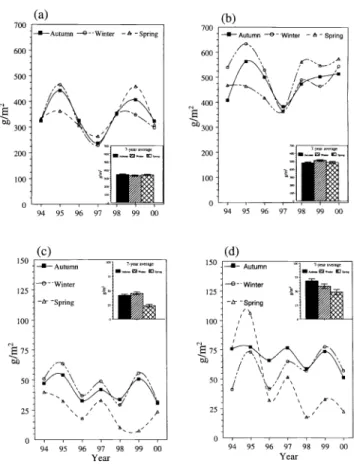
Aboveground biomass production was measured at the end of each growing sea- son by clipping 5 randomly selected quadrats (0.1 m2) adjacent to each plant composition transect (n = 20 plots per topographic position). Vegetation in the plots was clipped at ground level, separat- ed into graminoid, forb, and woody com- ponents, oven-dried at 60°C, and weighed.
Data Analysis
A total of 148 species were encountered in this study, but only those species with >
2% mean canopy cover in any year or treatment were analyzed individually.
Canopy cover of individual species and the summed cover of species in similar taxonomic and life-form groups (e.g.,
186 JOURNAL OF RANGE MANAGEMENT 56(2) March 2003
sedges, legumes, annual forbs, and woody species) were aresine square-root trans- formed and analyzed as a split-split plot over time. The full model contained terms for burn season, topographic position, year, and their interactions. To evaluate patterns of change through time from sea- sonal burning, we used the annual devia- tion from the mean year value for the 8- year study period as a linear covariate and the deviation squared as a quadratic
covariate. We initially fit a full covariance model to each independent variable and the nonsignificant (P > 0.05) effects were then deleted systematically. Inferences regarding trends through time were based on the respective regression coefficients.
If a species response to season of fire dif- fered between topographic positions, the regression slopes were tested for each site using appropriate contrasts. Otherwise, the response was combined across topograph- ic positions and the slopes for each burn season compared. Linear and quadratic response curves were fitted using least square regression.
Aboveground biomass was analyzed as a split-split plot with burn season as the whole plot factor, topographic position as the subplot factor, and year as the sub-sub- plot factor. The effect of burn season was tested using the variation between repli- cate watersheds (nested within burn sea- sons) as the whole plot error term; topo- graphic effects were tested using the topo- graphic position x watershed (nested with- in burn season) mean square as the subplot error term; and year effects were tested with the residual mean square.
Species richness (the cumulative num- ber of plant species detected in the 20 plots for each topographic position) and the Shannon diversity index (H' = x In pi, where pi is the canopy cover of each species) were square-root transformed and analyzed using the split-split plot over time covariance model. Frequency values were aresine square-root transformed and analyzed using the split-split plot model, with burn season as the whole-plot factor and topographic position and year as the split factors. We used SAS procedures (SAS Institute 1999) to analyze the data, with 0.05 as the probability level to estab- lish statistical significance.
Results and Discussion
Topoedaphic factors influenced the response patterns of some species to repeated seasonal burning, although differ- ences were primarily from variation in the
50 45 40 35
30
j 25
00 20
15 10 5
(a)
Big bluestem--uplands Autumn 0 Winter A Spring
-*=' . $--
94 95 96 97 98 99 00 01 Year (c)
Indiangrass--uplands Autumn a Winter a Spring
e
0 .tea
a
94 95 96 97 98 99 00 01
(e)
Year
94 95 96 97 98 99 00 01
Year
r
94 95 96 97 98 99 00 01 Year
5 0
Indiangrass--lowlands Autumn 0 Wine, 0 Spring
e /d
/ /
94 95 96 97 98 99 00 01 Year
(t)
94 95 96 97 98 99 00 01
Year
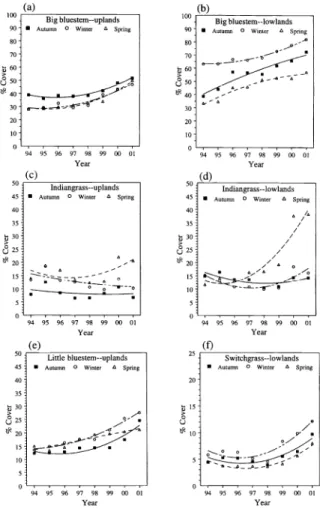
Fig. 2. Canopy cover changes through time in response to annual autumn, winter, and spring burning: (a, b) big bluestem on upland and lowland topographic locations, (c, d) indian- grass on upland and lowland topographic locations, (e) little bluestem on upland sites, and (d) switchgrass on lowland sites.
rate of change. In general, most species that responded to time of burning followed gradual curvilinear shifts through time.
The quadratic downward trend exhibited by some species indicated sensitivity to fire, after which the population maintained its presence in the community at a lower level. In contrast, the concave temporal trend of some species indicated a negative short-term impact to fire, followed by a period where the species recovered to pre- existing levels. The canopy cover of most species, however, remained stable through time, suggesting tolerance to annual burn- ing in any season.
Warm-season Grasses
Burning in autumn and winter produced similar response patterns through time in all warm-season grass species. Big bluestem cover increased in response to annual burning in any season, although the changes through time were smaller on upland topographic positions (Fig. 2a)
than on lowland positions (Fig. 2b).
Indiangrass increased only with spring burning, and exhibited the largest response of any warm-season grass to fire.
However, it required 7 consecutive burns before the upturn, with the greatest
increase occurring on lowland topographic sites (Fig. 2c, 2d). Little bluestem cover increased on upland locations with autumn and winter burning, but did not change (P
= 0.13) in response to spring burning (Fig.
2e). On lowland sites, little bluestem cover remained stable through time with all burn treatments (Table 1). Switchgrass (Panicum virgatum L.) increased in response to fire in any season on lowland sites (Fig. 2f); but on upland sites, switchgrass cover did not change significantly through time with any burn treatment (Table 1).
The collective canopy cover of all warm-season grasses increased from burn- ing in any season, although the rate of change differed between topographic posi-
tions. On upland sites, the increases
through time were similar for all burn sea-
JOURNAL OF RANGE MANAGEMENT 56(2) March 2003 187
Table 1. Average percent cover of graminoid species after S years of annual burning in different seasons on upland and lowland topographic positions. A positive superscript indicates cover increased (P < 0.05) from 1994. A negative superscript indicates cover declined significantly from 1994.
Uplands Lowlands
Species Autumn Winter
Andropogon gerardii 51.7+ 46.9+
Bouteloua curtipendula 3.5 2.6
Panicum virgatum 1.8 2.3
Schizachyrium scoparium 24.6+ 27.5+
Sorghastrum nutans 6.7 10.2
Sporobolus composites 0.8- 2.0- Sporobolus heterolepis 3.7+ 1.7+
All warm-season grasses 93.1+ 93.7+
Carex spp. 17.5+ 17.1+
Dichanthelium oligosanthes 2.9 8.3
Koeleria macrantha 9.3+ 2.7 0.1
Poa pratensis 0.1- 0.1-
All cool-season graminoids 30.2+ 28.3+
sons (Fig. 3a); but on lowland sites, spring burning produced the greatest increase in
(a) (b)
warm-season grass cover (Fig. 3b). Not all warm-season grass species, however, tol-
150 100 140
150 140
130 130
120 120
110 110
100 100
a 90 90
p 80 0 80
U 70 U 70
0 60 6` 60
50 50
40 40
30 30
20 20
10 10
_- -_ T
O T T T
94 95 96 97 98 99
25 l
20
as 15
U 0 40 10
5
0
(c) Year
00 01
Prairie junegrass--uplands Autumn Winter A Spring
0 - C , r
0
94 95 96 97 98 99 00 01
Year (e)
94 95 96 97 98 99 00 01
Year
90 80 70
94 95 96 97 98 99 00 01
25 (d)
Scribner's panicum--uplands Autumn ° Winter a Spring
Year
y 15 U 0
0
5
0
\
/a
0
\ a'
e
94 95 96 97 98 99 00 01
Year
94 95 96 97 98 99 00 01
Year
Fig. 3. Canopy cover changes through time in response to annual autumn, winter, and spring burning: (a, b) total cover of all warm- season grass species on upland and lowland topographic locations, (c) prairie junegrass on upland sites, (d) Scribner's panicum on upland sites, (e) sedges for both topographic sites combined, and (f) total cover of all cool-season graminoids on upland sites.
188
0
(a)
erated or benefitted from annual burning.
Tall dropseed [Sporobolus composites (Poir.) Men.] decreased in response to fire in any season (Table 1). Cover of side-oats grama [Bouteloua curtipendula (Michx.) Ton.] also was reduced with spring burn- ing, but not from autumn or winter burn- ing (Table 1).
Cool-season Graminoids
Prairie junegrass [Koeleria macrantha (Ledeb.) Schult.], a species predominant on upland sites, increased linearly in response to autumn burning, but remained stable through time with winter and spring burning (Fig. 3c). All other cool-season graminoids declined significantly with repeated spring burning, whereas Kentucky bluegrass (Poa pratensis L.) was the only cool-season species that declined in response to autumn and winter
burning (Table 1). On upland sites, Scribner's panicum [Dichanthelium
All perennial (orbs Autumn o Winter Spring
2
e
94 95 96 97 98 99 00 01
Year
94 95 96 97 98 99 00 01
Year (e)
94 95 96 97 98 99 00 01
Year
50 j
(b)
45 40 35
y 30 (525
0 20 15 10 ,
5 0
5 0
Tall goldenrod--lowlands Autumn o Winter n Spring
94 95 96 97 98 99 00 01
Year
94 95 96 97 98 99 00 Year
Fig. 4. Canopy cover changes through time in response to annual autumn, winter, and spring burning for various perennial forbs on different topographic positions: (a) total cover of all perennial forbs for both topographic sites combined, (b) heath aster for both topographic sites combined, (c) aromatic aster on upland sites, (d) tall goldenrod on lowland sites, (d) total cover of all legume species on lowland sites, and (f) prairie lespedeza on lowland sites.
JOURNAL OF RANGE MANAGEMENT 56(2) March 2003
Table 2. Average percent cover of various forb species after 8 years of annual burning in different seasons on upland and lowland topographic positions. A positive superscript indicates cover increased (P < 0.05) from 1994. A negative superscript indicates cover declined significantly from 1994.
Uplands Lowlands
Species Autumn Winter
Ambrosia psilostachya 2.0 1.3
Artemisia ludoviciana 0.2- 0.7- 0.1-
Brickellia eupatorioides 0.8 1.0
Physalis pumila 0.5 0.4-
Ruellia humilis 0.3- 0.4-
Salvia azurea 5.8+ 4.0 0.1 0
Solidago canadensis 0 0 0
Solidago missouriensis 0.3 0.4- Symphyotrichum ericoides 17.9+ 23.1+
Symphyotrichum oblongifolium 16.0+ 12.8+ 0 0 0
All perennial forbs 51.9+ 51.8+
Amorpha canescens 2.8 0.4
Dalea canadia 0.2 0.7
Lespedeza capitata 0.2 0.7
Lespedeza violaceae < 0.1 < 0.1 0.1
All legume species 7.3 5.4
All annual forbs 0.2 0.1
All woody species 0.2 0.2
oligosanthes (Nash) Gould], the most time with spring burning (Fig. 4a). Species common cool-season grass on Konza that were primarily responsible for the Prairie, declined and then recovered to increase in forb cover from repeated beginning levels in response to winter autumn and winter burning were heath burning (Fig. 3d); but on lowland sites, the
temporal patterns remained stable with both winter and autumn burning (Table 1).
Sedges [primarily Carex mops Bailey, C.
meadii Dewey, C. brevior (Dewey) Mack., and Cyperus lupulinus (Spreng.) Marcks]
also declined initially in response to both autumn and winter burning before diverg- ing upward and attaining the highest cover values after 8 years of fire (Fig. 3e). The
collective cover of all cool-season graminoids followed concave patterns through time with autumn and winter burning. Although the trends were similar on both topographic positions, cool-season graminoid cover eventually surpassed ini- tial values on upland sites (Fig. 30, but only recovered to the original levels on lowland sites (Table 1). The transitory decline of most cool-season graminoid species in response to autumn and winter burning coincided with 3 consecutive years of below normal precipitation during the growing season, suggesting that mois- ture availability may be crucial in mediat- ing their response patterns to seasonal fire.
Perennial Forbs
The combined cover of all perennial forbs responded with similar curvilinear upward trends in response to autumn and winter burning, but did not change through
aster [Symphyotrichum ericoides (L.) Nesom], aromatic aster [S. oblongifolium
(Nutt.) Nesom], and tall goldenrod (Solidago canadensis L.) (Figs. 4b-4d).
Western ragweed (Ambrosia psilostachya DC), a dominant forb in tallgrass prairie, was not affected (P > 0.10) by time of burning on either topographic position (Table 2). However, dynamic interannual fluctuations in western ragweed cover sug- gest that factors other than season of burn influenced temporal patterns. Although burning in autumn or early-spring will putatively increase forbs or "weedy"
species (Anderson 1961, Anderson et al.
1970, Schwegman and McClain 1985), it required repeated burning in autumn or winter before forb canopy cover eventual- ly increased.
Total legume cover increased on low- land sites in response to burning in any season, but the greatest changes through time occurred with autumn and winter burning (Fig. 4e). Prairie lespedeza
[Lespedeza violaceae (L.) Pers.], a species occurring predominantly on lowland sites, exhibited the most prominent increase of all legumes to annual burning, and was the only forb species that increased with spring burning (Fig. 4f). Cover of lead- plant (Amorpha canescens Pursh), the
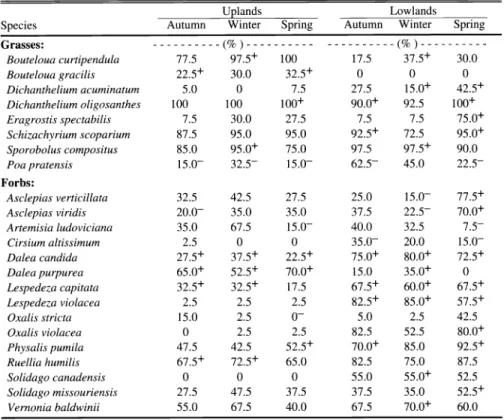
Table 3. Average percent frequency of species that changed significantly after 8 years of annual burning in different seasons on upland and lowland topographic positions (10-m2 plots; n = 40).
A positive superscript indicates the frequency of occurrence increased (P < 0.05) from 1994. A negative superscript indicates the frequency declined significantly from 1994.
Uplands Lowlands
Species Autumn Winter
Grasses: ---(%)--- ---(%)---
Bouteloua curtipendula 77.5 97.5+
Bouteloua gracilis 22.5+ 30.0 0 0 0
Dichanthelium acuminatum 5.0 0 7.5
Dichanthelium oligosanthes 100 100
Eragrostis spectabilis 7.5 30.0 7.5
Schizachyrium scoparium 87.5 95.0 Sporobolus compositus 85.0 95.0+
Poa pratensis 15.0- 32.5-
Forbs:
Asclepias verticillata 32.5
Asclepias viridis 20.0- 35.0
Artemisia ludoviciana 35.0 67.5
2.5 0 0
Dalea candida 27.5+ 37.5+
Dalea purpurea 65.0+ 52.5+ 0
Lespedeza capitata 32.5+ 32.5+
Lespedeza violacea 2.5 2.5 2.5
Oxalis stricta 15.0 2.5
0 2.5 2.5
Physalis pumila 47.5 42.5
Ruellia humilis 67.5+ 72.5+
Solidago canadensis 0 0 0
Solidago missouriensis 27.5 47.5
Vernonia baldwinii 55.0 67.5
JOURNAL OF RANGE MANAGEMENT 56(2) March 2003 189
most common legume species on Konza Prairie, did not change significantly on either topographic position after 8 years of burning in any season (Table 2). Densities of many legume species are higher in tall- grass prairie burned annually in the spring than in prairie that is not burned (Towne and Knapp 1996). Trends in canopy cover, however, suggest that most legume species tolerate annual spring fire rather than benefit directly from it.
Annual Species
Annual forb species were too sparse to analyze individually, but the combined canopy cover of all annual forbs did not change through time with any burn treat- ment (Table 2). Collectively, annual forbs averaged 0.6% cover the first 2 years of burning, after which levels dropped and stabilized in all burn treatments. In con- trast, extremely low levels of 2 annual grass species [common witchgrass (Panicum capillare L.) and little barley (Hordeum pusillum Nutt.)] were detected in the first 2 years of the study, but subse- quently disappeared and never reappeared in any bum treatment.
Annual plants are potentially susceptible to fire, but some forb species [e.g., daisy fleabane (Erigeron strigosus Muhl. ex Willd.) and grooved flax (Linum sulcatum Riddell)] persisted under all burn regimes.
A few annual species [e.g., annual ragweed (Ambrosia artemisiifolia L.), snow-on-the- mountain (Euphorbia marginata Pursh), common pepperweed (Lepidium densiflo- rum Schrad.), and smooth-seed wildbean (Strophostyles leiosperma (Tory. & A.
Gray) Piper)] appeared sporadically in some years. However, most other annual forb species [e.g., rough false-penny-royal (Hedeoma hispida Pursh), prickly lettuce (Lactuca serriola L.), red-seed plantain (Plantago rhodosperma Decne.), clasping Venus'-looking-glass [Triodanis perfoliata (L.) Nieuwl.], and field pansy (Viola bicol- or Pursh)] disappeared after the second burn and never reappeared, indicating intolerance to fire in any season.
Woody Species
Woody shrubs [e.g., rough-leaf dogwood (Corpus drummondii Mey.), smooth sumac (Rhus glabra L.), New Jersey tea (Ceanothus herbaceous Raf.), buckbrush (Symphoricarpos orbiculatus Moench), and Arkansas rose (Rosa arkansana Porter)]
also occurred too sporadically to analyze individually. Average canopy cover of all woody species (excluding leadplant) did not change significantly through time in any bum treatment (Table 2). In ungrazed tall-
(a)
Tr
-
94 95 96 97 98 99 00 01
Year
(c)
Year
Year
0.4
0.0
94 95 96 97 98 99 00 01
Year
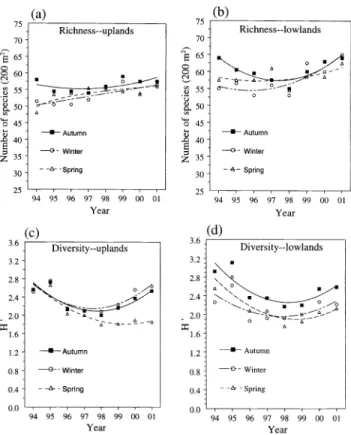
Fig 5. Changes in diversity indices through time in response to annual autumn, winter, and spring burning on different topographic positions: (a, b) species richness for upland and lowland topographic positions, (c, d) the Shannon diversity index for upland and lowland topographic positions.
grass prairie, woody species are controlled with fire (Adams et al. 1982, Hulbert 1986), and the lack of a significant change of woody cover in this study is likely due to low initial levels. Although annual fire suppresses canopy cover of woody species by removing accumulated top growth, 8
years of burning in autumn, winter, or spring did not eliminate any shrub species.
Frequency of Occurrence
Depending upon topographic position, burning in any season increased the fre- quencies of 4 species [prairie lespedeza, round-head lespedeza (Lespedeza capitata Michx.), white prairie-clover (Dalea can- dida Willd.), and purple prairie-clover (Dalea purpurea Vent.)] (Table 3). Eight years of spring burning increased the fre- quency of occurrence in 15 species, com- pared with 10 species increasing from winter burning and 9 species increasing in response to autumn burning.
Changes in the frequency of occurrence were not always associated with concomi- tant changes in canopy cover. For exam- ple, the frequency of some species [white
prairie-clover, purple prairie-clover, round-head lespedeza, and fringe-leaf
ruellia (Ruellia humilis)] increased signifi- cantly in response to different burning regimes without an accompanying change in canopy cover. This suggests that bum- ing may be important in the colonization of these species, but their density or stature is sufficiently low that changes in canopy cover are not detectable.
Diversity Indices
Species richness increased in response to spring and winter burning, but declined and then recovered to initial levels with autumn burning on both topographic posi- tions (Fig. 5a, 5b). After 8 years of annual fire, however, the number of species on either topographic position was similar for all burn seasons. In tallgrass prairie,
species richness declines as fire frequency increases (Collins et al. 1995). The trends in species richness observed in this study, however, indicated the eventual downturn requires more than 8 consecutive burns.
The effect of seasonal burning on the Shannon diversity index varied with topo- graphic position. On upland sites, diversity declined progressively in response to annual spring burning, and declined but then recovered with both autumn and win-
190 JOURNAL OF RANGE MANAGEMENT 56(2) March 2003