Charting the Potential of Description Logic
for the Generation of Referring Expressions
Yuan Ren and Kees van Deemter and Jeff Z. Pan Department of Computing Science
University of Aberdeen Aberdeen, UK
Abstract
The generation of referring expressions (GRE), an important subtask of Natural Language Generation (NLG) is to gener-ate phrases that uniquely identify domain entities. Until recently, many GRE algo-rithms were developed using only simple formalisms, which were taylor made for the task. Following the fast development of ontology-based systems, reinterpreta-tions of GRE in terms of description logic (DL) have recently started to be studied. However, the expressive power of these DL-based algorithms is still limited, not exceeding that of older GRE approaches. In this paper, we propose a DL-based ap-proach to GRE that exploits the full power of OWL2. Unlike existing approaches, the potential of reasoning in GRE is explored.
1 GRE and KR: the story so far
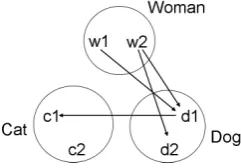
Generation of Referring Expressions (GRE) is the subtask of Natural Language Generation (NLG) that focuses on identifying objects in natural lan-guage. For example, Fig.1 depicts the relations between several women, dogs and cats. In such a scenario, a GRE algorithm might identifyd1as “the dog that loves a cat”, singling out d1 from the five other objects in the domain. Reference has long been a key issue in theoretical linguis-tics and psycholinguislinguis-tics, and GRE is a crucial component of almost every practical NLG sys-tem. In the years following seminal publications such as (Dale and Reiter, 1995), GRE has be-come one of the most intensively studied areas of NLG, with links to many other areas of Cogni-tive Science. After plan-based contributions (e.g., (Appelt, 1985)), recent work increasingly stresses the human-likeness of the expressions generated in simple situations, culminating in two
[image:1.595.346.467.263.347.2]evalua-tion campaigns in which dozens of GRE algo-rithms were compared to human-generated ex-pressions (Belz and Gatt, 2008; Gatt et al., 2009).
Figure 1: An example in which edges from women to dogs denote f eedrelations, from dogs to cats denoteloverelations.
A few proposals have started to combine GRE with KR. Following on from work based on la-belled directed graphs (cf. (Krahmer et al., 2003)) – a well-understood mathematical formalism that offers no reasoning support – (Croitoru and van Deemter, 2007) analysed GRE as a projection problem in Conceptual Graphs. More recently, (Areces et al., 2008) analysed GRE as a problem in Description Logic (DL), a formalism which, like Conceptual Graphs, is specifically designed for representing and reasoning with potentially com-plex information. The idea is to produce a for-mula such as Dogu ∃love.Cat (the set of dogs intersected with the set of objects that love at least one cat); this is, of course, a successful reference if there existsexactly one dog who loves at least one cat. This approach forms the starting point for the present paper, which aims to show that when a principled, logic based approach is chosen, it be-comes possible to refer to objects which no exist-ing approach to GRE (includexist-ing that of Areces et al.) has been able to refer to. To do this, we de-viate substantially from these earlier approaches. For example, while Areces et al. use one finite in-terpretation for model checking, we consider arbi-trary (possibly infinite) interpretations, hence rea-soning support becomes necessary.
We shall follow many researchers in focussing on the semantic core of the GRE problem: we shall generate descriptions of semantic content, leaving the decision of what words to use for ex-pressing this content (e.g., ‘the ancient dog’, or ‘the dog which is old’) to later stages in the NLG pipeline. Furthermore, we assume that all domain objects are equally salient (Krahmer and Theune, 2002). As explained above, we do not consider here the important matter of the naturalness or ef-ficacy of the descriptions generated. We shall be content producing uniquely referring expressions whenever such expressions are possible, leaving the choice of the optimal referring expression in each given situation for later.
In what follows, we start by explaining how DL has been applied in GRE before (Sec. 2) , point-ing out the limitations of existpoint-ing work. In Sec.3 we discuss which kinds of additional expressivity are required and how they can be achieved through modern DL. In Sec.4 we present a generic algo-rithm to compute these expressive REs. Sec.5 concludes the paper by comparing its aims and achievements with current practise in GRE.
2 DL for GRE
2.1 Description Logics
Description Logic (DLs) come in different flavours, based on decidable fragments of first-order logic. A DL-based KB represents the domain with descriptions of concepts, relations, and their instances. DLs underpin the Web On-tology Language (OWL), whose latest version, OWL2 (Motik et al., 2008), is based on DL SROIQ(Horrocks et al., 2006).
An SROIQontology Σ usually consists of a TBoxT and an ABoxA.T contains a set of con-cept inclusion axioms of the formCvD, relation inclusion axioms such asRvS(the relationRis contained in the relationS),R1 ◦. . .◦Rn v S,
and possibly more complex information, such as the fact that a particular relation is functional, or symmetric;Acontains axioms about individuals, e.g.a:C(ais an instance ofC),(a, b) :R(ahas anRrelation withb).
Given a set of atomic concepts, the entire set of concepts expressible bySROIQis defined re-cursively. First, all atomic concepts are concepts. Furthermore, if C and D are concepts, then so are > | ⊥ | ¬C |CuD|CtD| ∃R.C | ∀R.C| ≤ nR.C | ≥ nR.C | ∃R.Self | {a1, . . . , an},
where > is the top concept, ⊥ the bottom con-cept, na non-negative integer number, ∃R.Self the self-restriction ((i.e., the set of those x such that(x, x) : R holds)), ai individual names and
R a relation which can either be an atomic rela-tion or the inverse of another relarela-tion (R−). We call a set of individual names{a1, . . . , an}a
nom-inal, and useCN, RN andIN to denote the set of atomic concept names, relation names and indi-vidual names, respectively.
AninterpretationIis a pairh∆I,Iiwhere∆I is a non-empty set andI is a function that maps atomic conceptA toAI ⊆ ∆I, atomic roler to rI ⊆ ∆I ×∆I and individual a to aI ∈ ∆I. The interpretation of complex concepts and ax-ioms can be defined inductively based on their se-mantics, e.g.(CuD)I =CI∩DI, etc.
Iis amodelofΣ, writtenI |= Σ,iff all the ax-ioms in Σare satisfied in I. It should be noted that one Σ can have multiple models. For ex-ample when T = ∅,A = {a : A tB}, there can be a model I1 s.t. ∆I1 = {a}, aI1 =
a, AI1 = {a}, BI1 = ∅, and another modelI
2 s.t. ∆I2 = {a},aI2 = a, BI2 = {a}, AI2 = ∅.
(Horrocks et al., 2006).
The possibly multiple models indicate that an ontology is describing an open world. In GRE, researchers usually impose a closed world. From the DL point of view, people can (partially) close the ontology with a DBoxD(Seylan et al., 2009), which is syntactically similar to the ABox, except that D contains only atomic formulas. Further-more, every concept or relation appearing in D is closed. Its extension is exactly defined by the contents of D, i.e. ifD 6|= a : A then a : ¬A, thus is the same in all the models. The concepts and relations not appearing inD can still remain open. DL reasoning can be exploited to infer implicit information from ontologies. For exam-ple, givenT = {Dog v ∃f eed−.W oman} (ev-ery dog is fed by some woman) and A = {d1 : Dog, w1 :W oman}, we know that there must be someW oman who feeds d1. When the domain is closed asD = Awe can further infer that this W oman isw1although there is no explicit rela-tion betweenw1andd1. Note that the domain∆I in an interpretation ofDis not fixed, but it includes all the DBox individuals.
However, closing ontologies by means of the DBox can restrict the usage of implicit knowledge (from T). More precisely, the interpretations of the concepts and relations appearing inDare fixed therefore no implicit knowledge can be inferred. To address this issue, we introduce the notion of NBox to support Negation as Failure (NAF): Un-der NAF, an ontology is a tripleO = (T,A,N), whereT is a TBox,Aan ABox andN is a subset ofCN orRN. We callN an NBox. NAF requires thatOsatisfy the following conditions:
1. Letx∈INandA∈ N uCN. Then (T,A)6|=x:AimpliesO |=x:¬A. 2. Let x, y ∈ IN and r ∈ N uRN. Then(T,A) 6|= (x, y) : r impliesO |= (x, y) :¬r.
Like the DBox approach, the NBox N defines conditions in which “unknown” should be treated as “failure”. But, instead of hard-coding this, it specifies a vocabulary on which such treatment should be applied. Different from the DBox ap-proach, inferences on this NAF vocabulary is still possible. An example of inferring implicit knowl-edge with NAF will be shown in later sections.
2.2 Background Assumptions
When applying DL to GRE, people usually im-pose the following assumptions.
• Individual names are not used in REs. For example, “the Woman who feedsd1” would be invalid, becaused1is a name. Names are typically outlawed in GRE because, in many applications, many objects do not have names that readers/hearers would be familiar with.
• Closed World Assumption (CWA): GRE re-searchers usually assume a closed world, without defining what this means. As ex-plained above, DL allows different interpre-tations of the CWA. Our solution does not de-pend on a specific definition of CWA. In what follows, however, we use NAF to illustrate our idea. Furthermore, the domain is usually considered to be finite and consists of only individuals appearing inA.
• Unique Name Assumption (UNA): Different names denote different individuals. If, for example, w1andw2 may potentially be the same woman, then we can not distinguish one from the other.
We follow these assumptions when discussing ex-isting works and presenting our approach. In ad-dition, we consider the entire KB, including A, T and N. It is also worth mentioning that, in the syntax of SROIQ, negation of relations are not allowed in concept expressions, e.g. you can-not compose a concept ∃¬f eed.Dog. However, iff eed ∈ N, then we can interpret(¬f eed)I = ∆I×∆I\f eedI. In the rest of the paper, we use this as syntactic sugar.
2.3 Motivation: DL Reasoning and GRE
Every DL concept can be interpreted as a set. If the KB allows one to prove that this set is a sin-gleton then the concept is a referring expression. It is this idea (Gardent and Striegnitz, 2007) that (Areces et al., 2008) explored. In doing so, they say little about the TBox, appearing to consider only the ABox, which contains only axioms about instances of atomic concepts and relations. For ex-ample, the domain in Fig.1 can be described as
(w2, d1) : f eed, (w2, d2) : f eed, (d1, c1) :love}
Assuming that this represents a Closed World, Areces et al. propose an algorithm that is able to generate descriptions by partitioning the do-main.1 More precisely, the algorithm first finds out which objects are describable through increas-ingly large conjunctions of (possibly negated) atomic concepts, then tries to extend these con-junctions with complex concepts of the form (¬)∃R1.Concept, then with concepts of the form (¬)∃R2.(Concept u(¬)∃R1.Concept), and so on. At each stage, only those concepts that have been acceptable through earlier stages are used. Consider, for instance, KB1 above. Regardless of what the intended referent is, the algorithm starts partitioning the domain stage by stage as follows. Each stage makes use of all previous stages. Dur-ing stage (3), e.g., the object w2 could only be identified becaused2was identified in stage (2):
1. Dog={d1, d2},
¬DoguW oman={w1, w2}, ¬Dogu ¬W oman={c1, c2}.
2. Dogu ∃love.(¬Dogu ¬W oman) ={d1}, Dogu ¬∃love.(¬Dogu ¬W oman) ={d2}. 3. (¬Dog u W oman) u ∃f eed.(Dog u
¬∃love.(¬Dogu ¬W oman)) ={w2}, (¬Dog u W oman) u ¬∃f eed.(Dog u ¬∃love.(¬Dogu ¬W oman)) ={w1}. As before, we disregard the important question of the quality of the descriptions generated, other than whether they do or do not identify a given referent uniquely. Other aspects of quality depend in part on details, such as the question in which order atomic concepts are combined during phase (1), and analogously during later phases.
However this approach does not extend the ex-pressive power of GRE. This is not because of some specific lapse on the part of the authors: it seems to have escaped the GRE community as a whole that relations can enter REs in a variety of alternative ways.
Furthermore, the above algorithm considers only the ABox, therefore background information
1
Areces et al. (Areces et al., 2008) consider several DL fragments (e.g.,ALCandEL). Which referring expressions are expressible, in their framework, depends on which DL fragment is chosen. Existential quantification, however, is the only quantifier that was used, and inverse relations are not considered.
will not be used. It follows that the domain al-ways has a fixed single interpretation/model. Con-sequently the algorithm essentially uses model-checking, rather than full reasoning. We will show that when background information is in-volved, reasoning has to be taken into account. For example, suppose we extend Fig.1 with back-ground (i.e., TBox) knowledge saying that one should always feed any animal loved by an ani-mal whom one is feeding, while also adding a love edge (Fig.2) betweend2andc2:
Figure 2: An extended example of Fig.1. Edges from women to cats denote f eed relations. Dashed edges denote implicit relations.
If we close the domain with NAF, the ontology can be described as follows:
KB2: T2 = {f eed◦ love v f eed},
A2 = A1 ∪ {(d2, c2) : love}, N2 = {Dog, W oman, f eed, love}
The TBox axiom enables the inference of implicit facts: the facts(w1, c2) : f eed,(w2, c1) : f eed, and(w2, c2) :f eedcan be inferred using DL rea-soning under the above NBoxN2. Axioms of this kind allow a much more natural, insightful and concise representation of information than would otherwise be possible.
Continuing to focus on the materialised KB2, we note another limitation of existing works: if only existential quantifiers are used then some ob-jects are unidentifiable (i.e., it is not possible to distinguish them uniquely). These objects would become identifiable if other quantifiers and inverse relations were allowed. For example,
• The cat which is fed byat least 2women= Catu ≥2f eed−.W oman={c1},
• The woman feeding only those fed by at least 2 women = W oman u ∀f eed. ≥ 2.f eed−.W oman={w1},
3 Beyond Existential Descriptions
In this section, we show how more expressive DLs can make objects referable that were previously unreferable. This will amount to a substantial re-formulation which allows the approach based on DL reasoning to move well beyond other GRE al-gorithms in its expressive power.
3.1 Expressing Quantifiers in OWL2
Because the proposal in (Areces et al., 2008) uses only existential quantification, it fails to identify any individual in Fig.2. Before filling this gap, we pause to ask what level of expressivity ought to be achieved. In doing so, we make use of a conceptual apparatus developed in an area of formal semantics and mathematical logic known as the theory of Generalized Quantifiers (GQ), where quantifiers other thanallandsomeare stud-ied (Mostowski, 1957). The most general format for REs that involves a relation R is, informally,
the N1 who R Q N2’s, where N1 and N2
denote sets,R denotes a relation, and Qa gener-alized quantifier. (Thus for examplethe women who feed SOME dogs.) An expression of this form is a unique identifying expression if it corre-sponds to exactly one domain element. Using a set-theoretic notation, this means that the follow-ing set has a cardinality of1:
{y∈N1 :Qx∈N2|Ryx}
whereQis a generalized quantifier. For example, ifQis the existential quantifier, whileN1denotes the set of women, N2the set of dogs, and Rthe relation of feeding, then this says that the number of women who feed SOME dog is one. IfQis the quantifierat least two, then it says that the num-ber of women who feed at least two dogs is one. It will be convenient to write the formula above in the standard GQ format where quantifiers are cast as relations between sets of domain objects A, B. Using the universal quantifier as an exam-ple, instead of writing∀x∈ A|x ∈B, we write ∀(AB). Thus, the formula above is written
{y∈N1 :Q(N2{z:Ryz)}}.
Instantiating this as before, we get{y∈W oman: ∃(Dog{z : F eed yz)}}, or “women who feed a dog”, where Q is ∃, A = Dog and B = {z : F eed yz}for somey.
Mathematically characterising the class of all quantifiers that can be expressed in referring
expressions is a complex research programme to which we do not intend to contribute here, partly because this class includes quantifiers that are computationally problematic; for example, a quantifiers such asmost(in the sense of more than 50%), which is not first-order expressible, as is well known.
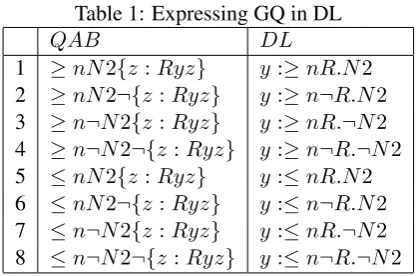
[image:5.595.312.521.301.439.2]To make transparent which quantifiers are ex-pressible in the logic that we are using, let us think of quantifiers in terms of simple quantitative con-straints on the sizes of the setsA∩B,A−B, and B−A, as is often done in GQ theory, asking what types of constraints can be expressed in referring expressions based onSROIQ. The findings are summarised in Tab.1. OWL2 can express any of the following types of descriptions, plus disjunc-tions and conjuncdisjunc-tions of anything it can express.
Table 1: Expressing GQ in DL
QAB DL
1 ≥nN2{z:Ryz} y:≥nR.N2 2 ≥nN2¬{z:Ryz} y:≥n¬R.N2 3 ≥n¬N2{z:Ryz} y:≥nR.¬N2 4 ≥n¬N2¬{z:Ryz} y:≥n¬R.¬N2 5 ≤nN2{z:Ryz} y:≤nR.N2 6 ≤nN2¬{z:Ryz} y:≤n¬R.N2 7 ≤n¬N2{z:Ryz} y:≤nR.¬N2 8 ≤n¬N2¬{z:Ryz} y:≤n¬R.¬N2
When n = 1, for example, type 1 becomes ∃R.N2, i.e. theexistentialquantifier. Whenn= 0 type 7 becomes ∀R.N2, i.e. the quantifier only. Whenn = 0type 6 becomes ∀¬R.¬N2, i.e. the quantifierall. In types 2, 4, 6 and 8, negation of a relation is used. This is not directly supported in SROIQ but, as we indicated earlier, given R∈ N,¬Rcan be used in concepts.
Together, this allows the expression of a de-scription such as “women who feed at least one but at most 7 dogs”, by conjoining type 1 (with n = 1) with type 5 (with n = 7). Using nega-tion, it can say “women who do not feed all dogs and who feed at least one non-dog” (W omanu ¬∀¬F eed.¬Dog u ∃F eed.¬Dog). In addition to Tab.1, SROIQ can even represent reflexive relation such as “the dog who loves itself” by Dogu ∃love.Self, which was regarded infeasible in (Gardent and Striegnitz, 2007).
include quantifiers expressible in the binary tree of numbers, e.g. (van Benthem, 1986) – which is generally regarded as highly general – but much else besides. Even wider classes of referring ex-pressions can certainly be conceived, but these are not likely to have overwhelming practical utility in today’s NLG applications.
4 GeneratingSROIQ-enabled REs
In this section, we present an algorithm that com-putes the descriptions discussed in sect.3. A GRE algorithm should have the following behaviour: if an entity is distinguishable from all the others, the algorithm should find a unique description; oth-erwise, the algorithm should say there exists no unique description. In this paper, we follow Are-ces et al.’s strategy of generating REs for all ob-jects simultaneously, but we apply it to a much larger search space, because many more constructs are taken into account.
4.1 GROWL: an algorithm for Generating Referring expressions using OWL-2.
In this section we show how the ideas of pre-vious sections can be implemented. To do this, we sketch an algorithm scheme called GROWL. GROWL applies a generate-and-test strategy that composes increasingly complicated descriptions and uses DL reasoning to test whether a de-scription denotes a singleton w.r.t. the KB. To avoid considering unnecessarily complicated de-scriptions, the algorithm makes use of the (syntac-tic) depth of a description, defined as follows:
Definition 1 (Depth) Given a description d, its depth|d|is calculated as follows:
1. |d| = 1 for d := >|⊥|A|¬A, where A is atomic.
2. |dud0|=|dtd0|=max(|d|,|d0|) + 1. 3. |∃r.d| =|∀r.d|= | ≤ nr.d|= | ≥nr.d| =
|=nr.d|=|d|+ 1.
Different descriptions can mean the same of course, e.g. ¬∀R.A ≡ ∃R.¬A. We do not know which syntactic variant should be used but focus, for simplicity, on generating their uniquenegated normal form (NNF). The NNF of a formula φ can be obtained by pushing all the¬ inward un-til only before atomic concepts (including >and ⊥), atomic relations, nominals or self restrictions
(e.g.∃r.Self). Without loss of generality, in what follows we assume all the formulas are in their NNF. To avoid confusion, the NNF of negation of a formula φ is denoted by ~φ instead of ¬φ. For example ~(AtB) = ¬Au ¬B ifAandB are atomic. Obviously, ~(~A) = A, ~(~R) = R, (R−)−=R, and(~R)− =~R−. The use of NNF substantially reduces the redundancies generated by the algorithm. For example, we won’t generate both¬∀R.Aand∃R.¬Abut only the later.
Given an ontology Σ, we initialise GROWL with the following sets:
1. The relation name setRN is the minimal set satisfying:
• ifRis an atomic relation inΣ, thenR∈ RN;
• ifR ∈RN, then ~R∈RN; • ifR ∈RN, thenR− ∈RN;
2. The concept name setCN is the minimal set satisfying:
• > ∈CN;
• ifAis an atomic concept inΣ, thenA∈ CN;
• ifR ∈RN, then∃R.Self ∈CN; • ifA∈CN, then ~A∈CN;
3. The natural number set N contains 1,2, . . . , n where n is the number of individuals inΣ.
4. The construct set S contains all the con-structs supported by a particular language. ForSROIQ,S = {¬,u,t,∃,∀,≤,≥,=}. We assume here that nominals are disallowed (cf. sect.2).
Algorithm GROWL:
Construct−description(Σ, CN, RN, N, S)
INPUT:Σ, CN, RN, N, S
OUTPUT: Description QueueD 1: D:=∅
2: fore∈CN do
3: D:=Add(D, e) 4: ford=f etch(D)do
5: foreachs∈Sdo
6: ifs=uors=tthen
7: foreachd0 ∈Ddo
10: foreachr∈RN do
11: D:=Add(D, s r.d) 12: ifs=≤ors=≥ors is =then
13: foreachr∈RN, eachk∈N do
14: D:=Add(D, s k r.d) 15: return D
Algorithm ADD:Add(D, e)
INPUT:D, e
OUTPUT: (Extended) Description QueueD 1: ford∈Ddo
2: if|d|<|e|anddvΣethen
3: return D
4: else if|d| =|e|andd vΣ eandeu ¬dis satisfiablethen
5: return D
6: ifeis satisfiable inΣthen
7: D:=D∪ {e} 8: return D
GROWL takes an ontology Σas its input and output a queue D of descriptions by adding in-creasingly complex concepts e to D, using the functionAdd(D, e), which is implemented as the algorithm ADD. Because of the centrality of ADD we start by explaining how this function works.
In the simple algorithm we are proposing in this paper – which represents only one amongst many possibilities – addition is governed by the heuris-tic that more complex descriptions should have smaller extensions. To this end, a candidate de-scriptioneis compared with each existing descrip-tion d ∈ D. Step 2 ensures that if there exists a simpler descriptiond(|d|< |e|) whose extension is no larger than e(d vΣ e), theneis not added intoD(because the role ofecan be taken by the simpler descriptiond). Similarly, step 4 ensures that if there existsdwith same depth (|d| = |e|) but smaller extension (dvΣeandeu ¬dis satis-fiable), then e should not be added into D. The subsumption checking in Step 2 and 4, and the instance retrieval in Step 6, must be realised by DL reasoning, in which TBox, ABox and NBox must all be taken into account. ADD guaran-tees that when the complexity of descriptions in-creases, their extensions are getting smaller.
We now turn to the main algorithm, GROWL. In Step 1 of this algorithm,Dis initialised to∅. Steps 2 to 3 add all satisfiable elements of CN to D. From Steps 4 to 14, we recursively “process”
ele-ments ofDone by one, by which we mean that the constructors inS are employed to combine these elements with other elements of D (e.g., an ele-ment is intersected with all other eleele-ments, and so on). We usef etch(D)to retrieve the first unpro-cessed element ofD. New elements are added to the end ofD. ThusDis a first-come-first-served queue (note that processed elements are not re-moved fromD).
To see in more detail how elements of D are processed, consider Steps 5-14 once again. For each elementdofD, Step 5 uses a constructsto extend it:
1. Ifsisuort, in Step 7 and 8, we extendd with each element ofDand add new descrip-tions toD.
2. Ifsis∃ or∀, in Step 10 and 11, we extend dwith all relations ofRN and add new de-scriptions toD. In Areces et el.’s work,∀is also available when using¬ and∃together, however due to their algorithm they can never generates descriptions like∀r.A.
3. Ifsis≤,≥or=, in Step 13 and 14, we ex-tenddwith all relations inRN and all num-bers inN, and add new descriptions toD. Because the=construct can be equivalently substituted by the combination of≤,≥andu constructs (=kr.dis semantically equivalent to≥kr.du ≤kr.d), it is a modelling choice to use either≤,≥, or only=, or all of them. In this algorithm we use them all.
Because we compute only the NNF and we disallow the use of individual identifiers, nega-tion ¬ appears only in front of atomic concept names. For this reason, processing does not con-sider s = ¬. Note that GROWL leaves some important issues open. In particular, the or-der in which constructs, relations, integers and conjuncts/disjuncts are chosen is left unspecified. Note that D, RN, N, S are all assumed to be fi-nite, hence Steps 5 to 14 terminate for a given d ∈ D. Because Steps 5 to 14 generate descrip-tions whose depth increases with one constructor at a time, there are finitely manyd∈ Dsuch that |d|=n(for a givenn).
fact, some objects that are not referable for them are referable by GROWL. For example, if we ap-ply the algorithm to the KB in Fig.2, a possible solution is as follows:
1. {w1}=W omanu∃¬f eed.Cat, the woman that does not feed all cats.
2. {w2} =≤ 0¬f eed.Cat , the woman that feeds all cats.
3. {d1} = Dogu ≤ 0¬f eed−.W oman, the dog that is fed by all women.
4. {d2} = Dogu ∃¬f eed−.W oman, the dog that is not fed by all women.
5. {c1} =Catu ≤0¬f eed−.W oman, the cat that is fed by all women.
6. {c2} = Catu ∃¬f eed−.W oman, the cat that is not fed by all women.
It is worth reiterating here that our algorithm fo-cusses on finding uniquely referring expressions, leaving aside which of all the possible ways in which an object can be referred to is “best”. For this reason, empirical validation of our algorithm – a very sizable enterprise in itself, which should probably be based on descriptions elicited by hu-man speakers – is not yet in order.
4.2 Discussion
Let us revisit the basic assumptions of Sec.2.2, to see what can be achieved if they are abandoned.
1. In natural language, people do using names, e.g. “the husband of Marie Curie”. To allow REs of this kind, we can extend our Algo-rithm A-1 by including singleton classes such as{M aria Curie}inCN.
2. Traditional GRE approaches have always as-sumed a single model with complete knowl-edge. Without this assumption, our approach can still find interesting REs. For example, if a man’s nationality is unknown, but he is known to be the Chinese or Japanese, we can refer to him/her as Chineset J apanese. However, models should be finite to guaran-tee thatN is finite.
3. Individuals with multiple names. DL im-poses the UNA by explicitly asserting the
inequality of each two individuals. With-out UNA, reasoning can still infer some re-sults, e.g. {W omanuM an v ⊥, David : M an, M ay :W oman} |=David 6=M ay. Thus we can refer to David as “the man” if the domain is closed.
5 Widening the remit of GRE
This paper has shown some of the benefits that arise when the power of KR is brought to bear on an important problem in NLG, namely the gen-eration of referring expressions (GRE). We have done this by using DL as a representation and reasoning formalism, extending previous work in GRE in two ways. First, we have extended GRE by allowing the generation of REs that involve quantifiers other than ∃. By relating our algo-rithm to the theory of Generalised Quantifiers, we were able to formally characterise the set of quan-tifiers supported by our algorithm, making exact how much expressive power we have gained. Sec-ondly, we have demonstrated the benefits of im-plicit knowledge through inferences that exploit TBox-information, thereby allowing facts to be represented more efficiently and elegantly, and al-lowing GRE to tap into kinds of generic (as op-posed to atomic) knowledge that it had so far left aside, except for hints in (Gardent and Striegnitz, 2007) and in (Croitoru and van Deemter, 2007). Thirdly, we have allowed GRE to utilise incom-plete knowledge, as when we refer to someone as “the man of Japanese or Chinese nationality”.
References
Douglas Appelt. 1985. Planning English Sentences.
Cambridge University Press, Cambridge, UK.
Carlos Areces, Alexander Koller, and Kristina Strieg-nitz. 2008. Referring expressions as formulas of description logic. InProceedings of the 5th INLG, Salt Fork, Ohio.
Anja Belz and Albert Gatt. 2008. Intrinsic vs. extrinsic evaluation measures for referring expression
gener-ation. InHLT ’08: Proceedings of the 46th Annual
Meeting of the Association for Computational Lin-guistics on Human Language Technologies, pages 197–200.
Madalina Croitoru and Kees van Deemter. 2007. A conceptual graph approach to the generation of re-ferring expressions. InProceedings of the 20th IJ-CAI.
Robert Dale and Ehud Reiter. 1995. Computational in-terpretations of the gricean maxims in the generation
of referring expressions. CoRR, cmp-lg/9504020.
Claire Gardent and Kristina Striegnitz. 2007.
Gen-erating bridging definite descriptions. Computing
Meaning, 3:369–396.
Albert Gatt, Anja Belz, and Eric Kow. 2009. The
TUNA-REG Challenge 2009: Overview and
eval-uation results. In Proceedings of the 12th ENLG
(ENLG 2009), pages 174–182, Athens, Greece, March. Association for Computational Linguistics.
Ian Horrocks, Oliver Kutz, and Ulrike Sattler. 2006.
The Even More Irresistible SROIQ. InKR 2006.
Emiel Krahmer and Mariet Theune. 2002. Efficient context-sensitive generation of descriptions in
con-text. Information Sharing: Givenness and Newness
in Language, pages 223–264.
Emiel Krahmer, Sebastiaan van Erk, and Andr Verleg. 2003. Graph-based generation of referring expres-sions. Computational Linguistics, 29(1):53–72.
A Mostowski. 1957. On a generalization of quanti-fiers. Fund. Math., 44:235–273.
Boris Motik, Bernardo Cuenca Grau, Ian Horrocks, Zhe Wu, Achille Fokoue, and Carsten Lutz. 2008. Owl 2 web ontology language: Profiles. W3c work-ing draft, W3C, October.
Inanc¸ Seylan, Enrico Franconi, and Jos de Bruijn. 2009. Effective query rewriting with ontologies over dboxes. InIJCAI 2009.