Dependency Structure for Incremental Parsing of Japanese and Its Application
Tomohiro Ohno
Information Technology Center,
Nagoya University
Nagoya, Japan
[email protected]
Shigeki Matsubara
Graduate Schoool of Information Science,
Nagoya University
Nagoya, Japan
[email protected]
Abstract
Previous researches on incremental dependency parsing have not discussed how a parser should output the information about dependency rela-tion where the modified word has not been in-putted yet. This paper proposes a dependency structure which a Japanese incremental depen-dency parser should produce in the middle of an input sentence. The dependency structure also expresses the fact that a word depends on a word which the parser would receive later. In addi-tion, we present a method for incremental pendency parsing to produce our proposed de-pendency structure. As the result of an experi-ment on increexperi-mental parsing, we confirmed the feasibility of our incremental dependency pars-ing. Furthermore, this paper shows its applica-tion in the simultaneous linefeed inserapplica-tion for real-time generation of more readable captions, and then describes the effectiveness of our pro-posed dependency structure.
1 Introduction
In applications such as simultaneous machine inter-pretation, spoken dialogue and real-time captioning, it is necessary to execute processing simultaneously with speech input, and thus, the questions of what syntactic information is acquirable and when the in-formation can be acquired become issues. However, previous researches on incremental dependency pars-ing (Kato et al., 2005; Johansson and Nugues, 2007; Nivre, 2008) have not discussed how a parser should output the information about dependency relation where the modified word has not been inputted.
This paper proposes a dependency structure which a Japanese incremental dependency parser should pro-duce in the middle of an input sentence. Our proposed
dependency structure makes a parser clarify the fact that the modifiedbunsetsu1 of a bunsetsu will be in-putted later. This enables a higher layer application to use the information that the bunsetsu does not de-pend on any bunsetsus which have been already in-putted. Especially, in the case of Japanese, since the modified bunsetsu is always inputted after the mod-ifier bunsetsu, our proposal is effective for the appli-cations which execute processing simultaneously with speech input.
In addition, this paper describes a method for incre-mental dependency parsing to produce our proposed dependency structure whenever receiving a bunsetsu. We conducted an experiment on incremental parsing and confirmed the feasibility of our method. Further-more, this paper shows its application to the simul-taneous linefeed insertion for real-time generation of more readable captions. As the result of an experi-ment on linefeed insertion, we confirmed the effec-tiveness of our proposed dependency structure.
2 Dependency structure for incremental
parsing
Since applications such as simultaneous machine in-terpretation and real-time captioning need to execute the process simultaneously with speech input, it is de-sirable for them to be able to acquire the dependency information at any time. In our research, incremen-tal dependency parsing shall output the parsing result whenever receiving a bunsetsu.
nihon-ni kaet-te-kite sugu
watashi-mo ie-no terebi-de warudokappu-wo mita-wake-desu
“nihon-ni(to Japan)”
“kaet-te-kite(had come back)”
“sugu(soon after)”
“watashi-mo(I also)”
“ie-no(at home)”
dependency structure:
“non-inputted bunsetsu”
“non-inputted bunsetsu” “non-inputted bunsetsu”
“terebi-de (on TV)”
(to Japan) (had come back)
(soon after)
(I also) (at
home) (on TV) (the world cup) (watched)
<
“kaet-te-kite(had come back)”
<
<
<
<
>,
>,
>,
>,
>
(I also watched the world cup on TV at home soon after I had come back to Japan.)
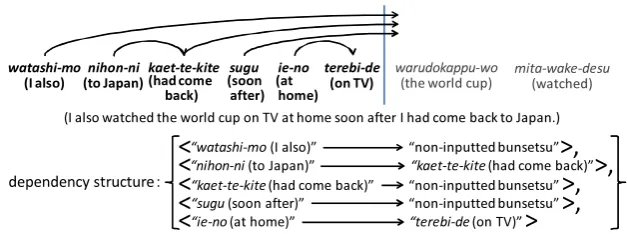
Figure 1: Example of a dependency structure outputted in the middle of an input sentence
Next, we discuss the output contents of incre-mental dependency parsing. When applications use incremental dependency parsing, the information about whether or not the dependency structure of a sequence of busnetsus is closed, that is, the information about a syntactically sufficient unit is also useful. In fact, when identifying the timing of the start of interpreting in the simultaneous machine interpretation (Ryu et al., 2006; F¨ugen et al., 2007; Paulik and Waibel, 2010), the timing of insert-ing back-channel feedbacks (Fujie et al., 2004; Kamiya et al., 2010), and the appropriate position of a linefeed in captioning (Ohno et al., 2009), the information about a syntactically sufficient unit is used as an important clue.
In our research, an incremental dependency parsing shall clearly output the fact that a bunsetsu depends on a bunsetsu which will be later inputted. If it be-comes clear that the modified bunsetsu of a bunsetsu has not been inputted yet, the higher layer applications can identify the syntactically sufficient units in the in-putted sequence of bunsetsus and use the information effectively.
In what follows, we describe the dependency struc-ture which incremental dependency parsing in our re-search outputs in the middle of an input sentence. When a sentenceS composed of a sequence of
bun-setsusb1· · ·bnis parsed2, we define the dependency structureDxwhich is outputted at the time that a bun-setsubx(1≤x≤n)is inputted as follows:
Dx={⟨b1→dep(b1)⟩,· · ·,⟨bx−1→dep(bx−1)⟩}
Here,dep(by)∈
{
{by+1,· · ·, bx, bover}(ifbx̸=bn) {by+1,· · ·, bx} (otherwise)
}
(1≤y≤x−1)
2In this research, we assume that sentence boundaries are de-tected as its preprocessing.
where⟨by → dep(by)⟩ means the dependency rela-tion where the modifier bunsetsu isby and where the modified bunsetsu isdep(by). dep(by) is a member of a set which contains not onlyby+1,· · ·, bx, which are inputted after the bunsetsu by, but also bover.
dep(by) =bovermeans that the modified bunsetsu of
by is not any of by+1,· · ·, bx but a bunsetsu which will be inputted later. In addition, we assume the following three Japanese syntactic constraints:
• No dependency is directed from right to left. • Dependencies don’t cross each other.
• Each bunsetsu, except the final one in a sentence, depends on only one bunsetsu.
Figure1shows an example of a dependency struc-ture outputted in the middle of an input sentence. This example shows the dependency structure which is outputted right after the bunsetsu “terebi-de (on TV)” was inputted when a parser parses the sentence “watashi-mo nihon-ni kaet-te-kite sugu ie-no terebi-de warudokappu-wo mita-wake-terebi-desu(I also watched the world cup on TV at home soon after I had come back to Japan.)”
3 Incremental dependency parsing
This section describes a method to produce the de-pendency structure proposed in Section 2 whenever receiving a bunsetsu. This method is implemented by improving the dependency parsing method proposed by Uchimoto et al. (2000).
Generally, stochastic dependency parsing methods identify the dependency structure which maximizes the conditional probabilityP(D|S), which means the
probability that the dependency structure for a sen-tenceS is D. In usual methods, a relationship
[image:2.595.133.447.103.220.2]hand, in the Uchimoto et al.’s method, a relationship between two bunsetsus is tagged with a “between,” “depend,” or “beyond” to indicate the following three cases, respectively. The anterior bunsetsu can depend on (1) a bunsetsu between the two, (2) the posterior bunsetsu, or (3) a bunsetsu beyond the posterior one. Then, the dependency probability of two bunsetsus is estimated by using the product of the probabilities of the relationship between the left bunsetsu and those to its right in a sentence.
In our research, we thought that by adapting the ba-sic idea in the Uchimoto et al.’s method, we might be able to calculate the probability that a bunsetsu does not depend on any bunsetsus which have been already inputted, that is, the probability that a bun-setsu depends on a non-inputted bunbun-setsu (bover). As a difference from the Uchimoto et al.’s method, our method identifies the dependency structureDxwhich should be outputted when the sequence of bunsetsus
Bx = b1,· · ·, bx(1 ≤ x ≤ n), which is a subse-quence of a sentenceS = b1· · ·bn, is inputted. Our method outputs the dependency structure which max-imizes the probabilityP(Dx|Bx)as the most appro-priate dependency structure for the sequence of bun-setsusBx.
Here, Dx is described as an ordered set {d1,· · ·, dx−1} of dependency relations di (1 ≤ i ≤ x − 1), where the modifier bun-setsu is a bunbun-setsubi. In addition, di is described as
di={di,i+1,· · ·, di,x, di,x+1}(1≤i≤x−1).di,i+j is a flag which indicates the relationship between bunsetsusbiandbi+j, and takes the following value:
di,i+j =
0 (1≤j < dist(i)) 1 (j=dist(i))
2 (dist(i)< j≤n−i)
wheredist(i)is defined asdist(i) =l−iwhen a
bun-setsubidepends on a bunsetsubl(i < l ≤x+ 1≤n). Note that our method adds a flagdi,x+1, which
indi-cates the relationship betweenbi and a non-inputted bunsetsubx+1, to the elements ofdias a dummy.
Using the above-mentioned notation, our method calculatesP(Dx|Bx)as follows3:
P(Dx|Bx)2= x∏−1
i=1
P(di|Bx)
3Uchimoto et al. (2000a) discussed the rationale and assump-tions behind the form of this model.
1 2 3
dpnd 0.4
btwn 0.1
dpnd 0.3 bynd
0.6
bynd 0.6 bynd
0.6
btwn 1/2
dpnd 1/2
4 btwn
1/2
1 2 3 4
1 2 3 4
× × = 0.141
× × = 0.300
× × = 0.424 inputted
= → | ) (b1 b2 B3
P
non-inputted
= → | ) (b1 b3 B3
P
= →
=
→ | ) ( | )
(b1 b4 B3 P b1 b B3
[image:3.595.303.525.109.228.2]P over
Figure 2: Calculation of dependency probability
=
x∏−1
i=1
P(di,i+1,· · ·, di,x+1|Bx)
=
x∏−1
i=1
(dist∏(i)−1
j=1
P(di,i+j = 0|Bx)
×P(di,i+dist(i)= 1|Bx)
×
x−∏i+1
j=dist(i)+1
P(di,i+j = 2|Bx)
)
where the value ofdist(i)is decided based on theDx. Here, we use the following value as P(di,i+j|Bx), which means the probability of the relationship (“be-yond,” “depend,” or “between”) between two bunset-sus.
• When1≤j≤ x−i:P(di,i+j|Bx) =the value which is estimated using the maximum entropy method in the same way4as the Uchimoto et al.’s method.
• When j = x −i + 1: P(di,i+j = 0|Bx) = 0,
P(di,i+j = 1|Bx) =P(di,i+j = 2|Bx) = 1/2 The reasons that we decided the second itemization are as follows: The relationship di,x+1 between a
bunsetsu bi and a non-inputted bunsetsu bx+1 does
not become the relationship “beyond,” but becomes either “depend” or “between.” Moreover, we as-sume that the probability that the relationship be-comes “depend” is equal to that of “between” because the probabilities are unknown. This assumption en-ablesargmaxDxP(Dx|Bx)to be calculated with no
relation to the probabilities betweenbiandbx+1.
Finally, if there exists a ⟨bi → bx+1⟩ in the
our method outputs the dependency structure which is made by replacing every⟨bi →bx+1⟩in theDxwith ⟨bi→bover⟩.
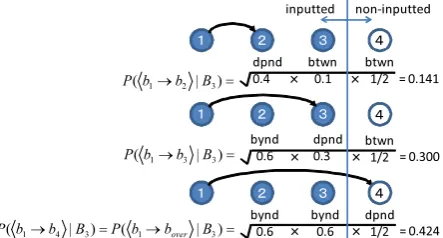
Figure 2 shows how to calculate the dependency probability P(d1|B3) when a bunsetsu b3 in a
sen-tence composed ofb1,· · ·, b5is inputted. Note that we
considerP(⟨b1→b4⟩|B3) =P(⟨b1→bover⟩|B3).
4 Experiment
To evaluate the feasibility of incrementally producing the dependency structure proposed in Section2, we conducted an experiment on dependency parsing.
4.1 Outline of experiment
As the experimental data, we used the transcribed data of Japanese discourse speech in the Simultane-ous Interpretation Database (Matsubara et al., 2002). All the data had been manually annotated with infor-mation on morphological analysis, bunsetsu boundary detection, clause boundary detection and dependency analysis (Ohno et al., 2009).
We performed a cross-validation experiment by us-ing 16 discourses. That is, we repeated the experi-ment, in which we used one discourse from among 16 discourses as the test data and the others as the learn-ing data, 16 times. However, since we used 2 dis-courses among 16 disdis-courses as the preliminary anal-ysis data, we evaluated the experimental results for the remaining 14 discourses (1,714 sentences, 20,707 bunsetsus). Here, as the morphological information, bunsetsu boundary information, and clause boundary information in the input of dependency parsing, we used one which had been manually annotated. In ad-dition, we used the maximum entropy method tool (Zhang, 2013) with the default options except “-i (it-eration) 2000.”
4.2 Evaluation index
Our method is designed to output the dependency structure defined in Section2whenever a bunsetsu is inputted. Therefore, we introduced the following new evaluation index to evaluate the accuracy of incremen-tal dependency parsing:
acc.=
∑N
i
∑ni
j=1DepN um(M atch(Dji, Gij))
∑N
i
∑ni
j=1DepN um(Dji)
where Dij and Gij indicate the dependency
struc-ture which a parser outputs and the correct one which
1 2 3 4 5
(0/0) 1
1 2 (0/1)
1 2 3 (1/2)
1 2 3 4 (3/3)
1 2 3 4 5 (4/4)
DepNum(Match(D, G))/ DepNum(D)
Acc. =(8/10) =
i
G5
•correct data
•results of parsing
When is inputted: D1i=
=
i
D2
=
i
D3
=
i
D4
=
i
D5 1
b
When is inputtedb2 :
When is inputtedb3 :
When is inputtedb4 :
[image:4.595.305.525.110.244.2]When is inputtedb5 :
Figure 3: Calculation of accuracy
recall precision f-measure
non- 70.4% 75.0% 72.6%
inputted (22,811/ (22,811/
32,389) 30,413)
inputted 74.8% 73.8% 74.3%
(102,778/ (102,778/
[image:4.595.314.508.279.364.2]137,376) 139,352)
Table 1: Recalls and precisions of our method
a parser should output respectively when a bunsetsu
bj(1 ≤ j ≤ ni)in a sentenceSi(1 ≤ i ≤ N)is in-putted. In addition,DepN um() is a function which
returns the number of elements of the input set of de-pendency relations, andM atch()is a function which
returns an intersection between the two input sets of dependency relations.
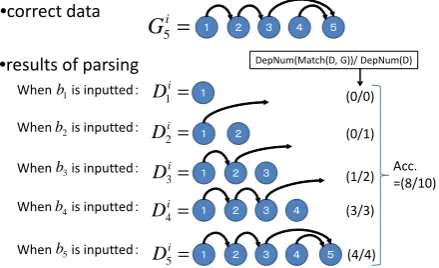
Figure 3 shows an example of the calculation of our defined accuracy in case of parsing a sentence
Si composed of 5 bunsetsus. Here, we explain how to calculate the DepN um(M atch(Di
3, Gi3)) when
the 3rd bunsetsu is inputted. From the correct data of the dependency structure of a whole sentence
Si, Gi3 = {⟨b1 → b2⟩,⟨b2 → b3⟩} is derived.
On the other hand, the result of parsing is Di
3 =
{⟨b1 → b2⟩,⟨b2 → bover⟩}. From the Gi3 and D3i, DepN um(M atch(D3i, Gi3)) = 1is derived.
Furthermore, we obtained the recalls and preci-sions, separately for the case that the modified bun-setsu has not been inputted and the case that the mod-ified bunsetsu has been inputted. The recall and pre-cision for the former case are respectively defined as follows:
rec.=
∑N
i
∑ni
j=1DepN um(Over(M atch(Dij, Gij)))
∑N
i
∑ni
prec. =
∑N
i
∑ni
j=1DepN um(Over(M atch(Dij, Gij)))
∑N
i
∑ni
j=1DepN um(Over(Dji))
where Over() is a function which returns a set of de-pendency relations where the modified bunsetsu has not been inputted yet from among the input set of dependency relations. The recall and precision for the latter case are defined by replacing the Over() in the above-mentioned definition with the NonOver(). NonOver() is a function which returns a set of depen-dency relations where the modified bunsetsu has been inputted from among the input set of dependency re-lations.
4.3 Experimental results
The accuracy obtained using our method was 74.0% (125,589/169,765). Only as a guide, we conducted a parsing experiment by using the Uchimoto et al.’s method5 and CaboCha(Kudo and Matsumoto, 2002), which identify the dependency structure after the whole sentence is inputted. As the result of mea-suring the conventional dependency accuracy (=
∑N
iDepN um(M atch(Dnii,G
i ni))/
∑N
i DepN um(Dini)),
the dependency accuracy of the Uchimoto et al.’s method and CaboCha were 75.8% (14.391/18,993) and 78.0% (14,814/18,993) respectively.
Table 1 shows the recalls and precisions of our method, separately for the case that the modified bun-setsu has not been inputted and the case that the mod-ified bunsetsu has been inputted. The f-measure for the case that the modified bunsetsu has not been in-putted was not as high as that for the non-inin-putted case. However, the precision for the inputted case was higher than that for the non-inputted case. We con-firmed the feasibility of outputting our proposed de-pendency structure whenever a bunsetsu is inputted.
5 Application to sequential linefeed insertion
In this section, we describe application of our incre-mental dependency parsing described in Section3to sequential linefeed insertion.5.1 Sequential linefeed insertion
Whenever a bunsetu is inputted, our method deci-sively judges whether or not a linefeed should be in-serted between the inputted bunsetsu and the adjacent 5We used the same features in Section3when estimating the probability of the relationship between two bunsetsus.
Clause boundary analysis (CBAP)
Incremental dependency parsing (Section 3)
Judgment of linefeed insertion
Bunsetsus in a sentence on which morphological analysis and bunsetsu boundary analysis have been performed are inputted one by one.
[image:5.595.315.502.119.213.2]Whether or not a linefeed should be inserted between the inputted bunsetsu and the adjacent bunsetsu is outputted.
Figure 4: Flow of sequential linefeed insertion
bunsetsu. Here, morphological analysis and bunsetsu boundary analysis have been already performed for the input sequence of bunsetsus in a sentence.
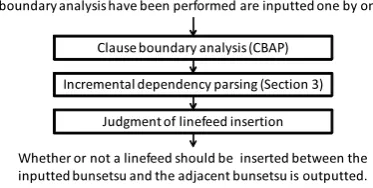
Figure4shows the flow of our sequential linefeed insertion. First, our method decides whether there exists a clause boundary between the inputted bun-setsu bx and the adjacent bunsetsu bx−1 or not by
using Clause Boundary Annotation Program (CBAP) (Kashioka and Maruyama, 2004). Next, our method parses the dependency structureDxproposed in Sec-tion2 by using the incremental dependency parsing method proposed in Section3.
Finally, in judgment of linefeed insertion, our method decisively judges whether a linefeed should be inserted between the inputted bunsetsubx and the adjacent bunsetsu bx−1 by using the maximum
en-tropy method. The maximum enen-tropy method esti-mates the probability that a linefeed should be in-serted at a point by considering such information as morphological analysis results, bunsetsu boundaries, clause boundaries, and dependency structures. When the probability is larger than 0.5, our method decides to insert a linefeed at the point.
The features used in the ME method, which esti-mates the probability that a linefeed is inserted be-tween a bunsetsu bx−1 and bx, are as roughly the same as those for the conventional sentence-based method (Ohno et al., 2009)6. The difference is that our method does not use the following three features among those for the sentence-based method:
• whether or not bx−1 depends on the final
bun-setsu of a clause
• whether or not bx−1 depends on a bunsetsu to
recall precision f-measure
our method 79.6% 70.2% 74.6%
(4,375/5,497) (4,375/6,228)
conv. method 73.7% 74.4% 74.0%
(4,052/5,497) (4,052/5,447)
Table 2: Experimental results of linefeed insertion
which the number of characters from the start of the line is less than or equal to the maximum number of characters (20 characters)
• whether or not there exists a bunsetsu which de-pends on the modified bunsetsu ofbx−1, among
bunsetsus which are located after bx−1 and to
which the number of characters from the start of the line is less than or equal to the maximum number of characters
The values of these features can not be decided until the modified bunsetsu ofbx−1is inputted ifbx−1does
not depend onbx. Since our sequential linefeed in-sertion method needs to identify the linefeed inin-sertion points simultaneously with speech input, our method does not use these features.
5.2 Experiment on linefeed insertion
To evaluate the application potency of the dependency structure proposed in Section2, we conducted an ex-periment on linefeed insertion using the sequential linefeed insertion method described in the previous section.
5.2.1 Experimental outline
We used the same experimental data and performed a cross-validation experiment in the same way as Sec-tion4.1. However, when inputting the test data, we eliminated the information on clause boundaries, de-pendency, and linefeeds. In the evaluation, we ob-tained the recall, precision and f-measure on the line-feed insertion performance.
For comparison, we also performed linefeed inser-tion using the conveninser-tional sentence-based method (Ohno et al., 2009). Here, when performing the con-ventional method, clause boundary information and dependency information were beforehand provided using Clause Boundary Annotation Program (CBAP) and Uchimoto et al.’s dependency parsing method (Uchimoto et al., 2000b), respectively.
5.2.2 Experimental results on linefeed insertion
Table2shows the recalls, precisions and f-measures of our method and conventional method. The f-measure for our method was 74.6%, which was slightly larger than that for the conventional method. We confirmed that our method can output linefeed insertion points simultaneously with speech input, maintaining the approximately-same f-measure of linefeed insertion as that for the conventional method. However, we measured the sentence accuracy, which is the ratio of sentences of which all linefeed insertion points were correctly detected. The sentence accuracies of our method and the conventional method were 35.8% (614/1,714) and 46.2% (792/1,714) re-spectively. The conventional method decides the most appropriate linefeed insertion points by considering the whole sentence while our method judges whether a linefeed should be inserted or not whenever a bun-setsu is inputted. This difference is thought to have caused the result. We will confirm that the readabil-ity of captions generated by our method does not de-crease, by conducting not only objective evaluation based on comparing the linefeed insertion result with the correct data but also subjective evaluation.
6 Conclusion
This paper proposed the dependency structure which an incremental dependency parser outputs for an in-putted bunsetsu sequence. Our proposed dependency structure makes a parser clarify the fact that the mod-ified bunsetsu is a bunsetsu which will be inputted later. In addition, we proposed a method for incre-mental dependency parsing to output our proposed de-pendency structure. As the result of an experiment on incremental parsing, we confirmed the feasibility of our method. Furthermore, we applied our proposed incremental dependency parsing to the simultaneous linefeed insertion, and then we confirmed the applica-tion potency of our proposed dependency structure.
Acknowledgments
References
Christian F¨ugen, Alex Waibel, and Muntsin Kolss. 2007. Simultaneous translation of lectures and speeches. Ma-chine Translation, 21:209–252. 10.1007/s10590-008-9047-0.
Shinya Fujie, Kenta Fukushima, and Tetsunori Kobayashi. 2004. A conversation robot with back-channel feedback function based on linguistic and nonlinguistic informa-tion. InProcedings of the 2nd International Conference on Autonomous Robots and Agents (ICARA2004), pages 379–384.
Richard Johansson and Pierre Nugues. 2007. Incre-mental dependency parsing using online learning. In Proceedings of the 2007 Joint Conference on Em-pirical Methods in Natural Language Processing and Computational Natural Language Learning (EMNLP-CoNLL2007), pages 1134–1138.
Yuki Kamiya, Tomohiro Ohno, and Shigeki Matsubara. 2010. Coherent back-channel feedback tagging of in-car spoken dialogue corpus. InProceedings of the 11th An-nual SIGdial Meeting on Discourse and Dialogue (SIG-DIAL2010), pages 205–208.
Hideki Kashioka and Takehiko Maruyama. 2004. Seg-mentation of semantic units in Japanese monologues. InProceedings of International Conference on Speech and Language Technology and Oriental COCOSDA (ICSLT/O-COCOSDA2004), pages 87–92.
Yoshihide Kato, Shigeki Matsubara, Katsuhiko Toyama, and Yasuyoshi Inagaki. 2005. Incremental dependency parsing based on headed context-free grammar.Systems and Computers in Japan, 36:63–77.
Taku Kudo and Yuji Matsumoto. 2002. Japanese depen-dency analysis using cascaded chunking. In Proceed-ings of the 6th Conference on Natural Language Learn-ing 2002 (CoNLL 2002), pages 63–69.
Shigeki Matsubara, Akira Takagi, Nobuo Kawaguchi, and Yasuyoshi Inagaki. 2002. Bilingual spoken mono-logue corpus for simultaneous machine interpretation research. In Proceedings of the 3rd International Conference on Language Resources and Evaluation (LREC2002), pages 153–159.
Joakim Nivre. 2008. Algorithms for deterministic incre-mental dependency parsing.Computational Linguistics, 34:513–553.
Tomohiro Ohno, Masaki Murata, and Shigeki Matsubara. 2009. Linefeed insertion into Japanese spoken mono-logue for captioning. In Proceedings of Joint Con-ference of the 47th Annual Meeting of the Associa-tion for ComputaAssocia-tional Linguistics and the 4th
Interna-tional Joint Conference on Natural Language Process-ing (ACL-IJCNLP2009), pages 531–539.
Matthias Paulik and Alex Waibel. 2010. Spoken lan-guage translation from parallel speech audio: simultane-ous interpretation as SLT training data. InProceedings of the 2010 IEEE International Conference on Acous-tics Speech and Signal Processing (ICASSP2010), pages 5210–5213.
Koichiro Ryu, Shigeki Matsubara, and Yasuyoshi Inagaki. 2006. Simultaneous English-Japanese spoken language translation based on incremental dependency parsing and transfer. InProceedings of the 21st International Conference on Computational Linguistics and 44th An-nual Meeting of the Association for Computational Lin-guistics (COLING/ACL-2006), pages 683–690.
Kiyotaka Uchimoto, Masaki Murata, Satoshi Sekine, and Hitoshi Isahara. 2000a. Dependency model using pos-terior context. Journal of Natural Language Processing, 7(5):3–18. (In Japanese).
Kiyotaka Uchimoto, Masaki Murata, Satoshi Sekine, and Hitoshi Isahara. 2000b. Dependency model using pos-terior context. In Proceedings of the 6th International Workshop on Parsing Technologies (IWPT2000).
Le Zhang. 2013. Maximum entropy