Proceedings of the 7th Workshop on Statistical Machine Translation, pages 109–113, Montr´eal, Canada, June 7-8, 2012. c2012 Association for Computational Linguistics
Tree Kernels for Machine Translation Quality Estimation
Christian Hardmeier and Joakim Nivre and J¨org Tiedemann Uppsala University
Department of Linguistics and Philology Box 635, 751 26 Uppsala, Sweden
Abstract
This paper describes Uppsala University’s submissions to the Quality Estimation (QE) shared task at WMT 2012. We present a QE system based on Support Vector Machine re-gression, using a number of explicitly defined features extracted from the Machine Transla-tion input, output and models in combinaTransla-tion with tree kernels over constituency and de-pendency parse trees for the input and output sentences. We confirm earlier results suggest-ing that tree kernels can be a useful tool for QE system construction especially in the early stages of system design.
1 Introduction
The goal of the WMT 2012 Quality Estimation (QE) shared task (Callison-Burch et al., 2012) was to create automatic systems to judge the quality of the translations produced by a Statistical Ma-chine Translation (SMT) system given the input text, the proposed translations and information about the models used by the SMT system. The shared task organisers provided a training set of 1832 sen-tences drawn from earlier WMT Machine Transla-tion test sets, translated from English to Spanish with a phrase-based SMT system, along with the models used and diagnostic output produced by the SMT system as well as manual translation quality annotations on a 1–5 scale for each sentence. Ad-ditionally, a set of 17 baseline features was made available to the participants. Systems were evalu-ated on a test set of 422 sentences annotevalu-ated in the same way.
Uppsala University submitted two systems to this shared task. Our systems were fairly successful and achieved results that were outperformed by only one competing group. They improve over the baseline performance in two ways, building on and extend-ing earlier work by Hardmeier (2011), on which the system description in the following sections is partly based: On the one hand, we enhance the set of 17 baseline features provided by the organisers with another 82 explicitly defined features. On the other hand, we use syntactic tree kernels to extract implicit features from constituency and dependency parse trees over the input sentences and the Machine Translation (MT) output. The experimental results confirm the findings of our earlier work, showing tree kernels to be a valuable tool for rapid prototyp-ing of QE systems.
2 Features
Our QE systems used two types of features: On
the one hand, we used a set ofexplicit featuresthat
were extracted from the data before running the Ma-chine Learning (ML) component. On the other hand, syntactic parse trees of the MT input and output
sentences providedimplicit featuresthat were
com-puted directly by the ML component using tree ker-nels.
2.1 Explicit features
Both of the QE systems we submitted to the shared task used the complete set of 17 baseline features provided by the workshop organisers. Additionally, theUU best system also contained all the features presented by Hardmeier (2011) with the exception
of a few features specific to the film subtitle genre and inapplicable to the text type of the shared task, as well as a small number of features not included in that work. Many of these features were modelled on QE features described by Specia et al. (2009). In particular, the following features were included in addition to the baseline feature set:
• number of words, length ratio (4 features)
• source and target type-token ratios (2 features)
• number of tokens matching particular patterns
(3 features each):
– numbers
– opening and closing parentheses
– strong punctuation signs
– weak punctuation signs
– ellipsis signs
– hyphens
– single and double quotes
– apostrophe-s tokens
– short alphabetic tokens (≤3 letters)
– long alphabetic tokens (≥4 letters)
• source and target language model (LM) and
log-LM scores (4 features)
• LM and log-LM scores normalised by sentence
length (4 features)
• number and percentage of out-of-vocabulary
words (2 features)
• percentage of source 1-, 2-, 3- and 4-grams
oc-curring in the source part of the training corpus (4 features)
• percentage of source 1-, 2-, 3- and 4-grams in
each frequency quartile of the training corpus (16 features)
• a binary feature indicating that the output
con-tains more than three times as many alphabetic tokens as the input (1 feature)
• percentage of unaligned words and words with
1 : 1, 1 :n,n: 1 andm:nalignments (10
fea-tures)
• average number of translations per word,
un-weighted and un-weighted by word frequency and reciprocal word frequency (3 features)
• translation model entropy for the input words,
cumulatively per sentence and averaged per word, computed based on the SMT lexical weight model (2 features).
Whenever applicable, features were computed for both the source and the target language, and addi-tional features were added to represent the squared difference of the source and target language feature values. All feature values were scaled so that their values ranged between 0 and 1 over the training set.
The total number of features of theUU best
sys-tem amounted to 99. It should be noted, however, that there is considerable redundancy in the feature set and that the 82 features of Hardmeier (2011) overlap with the 17 baseline features to some extent. We did not make any attempt to reduce feature over-lap and relied on the learning algorithm for feature selection.
2.2 Parse trees
Both the English input text and the Spanish Machine Translations were annotated with syntactic parse trees from which to derive implicit features. In En-glish, we were able to produce both constituency and dependency parses. In Spanish, we were limited to dependency parses because of the better availability of parsing models. English constituency parses were produced with the Stanford parser (Klein and Man-ning, 2003) using the model bundled with the parser. For dependency parsing, we used MaltParser (Nivre et al., 2006). POS tagging was done with HunPOS (Hal´acsy et al., 2007) for English and SVMTool (Gim´enez and M´arquez, 2004) for Spanish, with the models provided by the OPUS project (Tiedemann, 2009). As in previous work (Hardmeier, 2011), we treated the parser as a black box and made no at-tempt to handle the fact that parsing accuracy may be decreased over malformed SMT output.
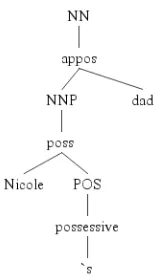
To be used with tree kernels, the output of the de-pendency parser had to be transformed into a sin-gle tree structure with a unique label per node and unlabelled edges, similar to a constituency parse tree. We followed Johansson and Moschitti (2010) in using a tree representation which encodes part-of-speech tags, dependency relations and words as sequences of child nodes (see fig. 1).
Figure 1: Representation of the dependency tree fragment
for the wordsNicole ’s dad
A tree and some of its Subset Tree Fragments
S N
NP D N VP V Mary
brought
a cat
NP D N a cat N cat D a V brought N Mary NP D N VP V brought
[image:3.612.80.290.252.314.2]a cat
Fig. 1.
A syntactic parse tree with its
sub-trees (STs).
NP D N a cat NP D N
NP D N a
NP D N NP
D N VP V brought
a cat
cat NP
D N VP V
a cat NP D N
VP V N cat D a V brought N Mary …
Fig. 2.
A tree with some of its subset trees
(SSTs).
NP D N
VP
V
brought a cat
NP D N
VP
V
a cat NP D N
VP
a cat NP D N
VP a NP D VP a NP D VP NP N VP NP N NP NP
D N D NP
… VP
Fig. 3.
A tree with some of its partial trees
(PTs).
is What offer
an plan direct stock purchase
Fig. 4.
A dependency tree of a question.
constraint over the SSTs, we obtain a more general form of substructures that we
call
partial trees
(PTs). These can be generated by the application of partial
production rules of the grammar, consequently
[VP [V]]
and
[VP [NP]]
are
valid PTs. Figure 3 shows that the number of PTs derived from the same tree as
before is still higher (i.e. 30 PTs). These different substructure numbers provide
an intuitive quantification of the different information levels among the
tree-based representations.
3
Fast Tree Kernel Functions
The main idea of tree kernels is to compute the number of common substructures
between two trees
T1
and
T2
without explicitly considering the whole fragment
space. We have designed a general function to compute the ST, SST and PT
kernels. Our fast evaluation of the PT kernel is inspired by the efficient evaluation
of non-continuous subsequences (described in [13]). To increase the computation
speed of the above tree kernels, we also apply the pre-selection of node pairs
which have non-null kernel.
3.1
The Partial Tree Kernel
The evaluation of the common PTs rooted in nodes
n1
and
n2
requires the
selection of the shared child subsets of the two nodes, e.g.
[S [DT JJ N]]
and
[S [DT N N]]
have
[S [N]]
(2 times) and
[S [DT N]]
in common. As the order
of the children is important, we can use subsequence kernels for their generation.
More in detail, let
F
=
{
f1, f2
, .., f
|F|}
be a tree fragment space of type PTs and
let the indicator function
Ii(n) be equal to 1 if the target
fi
is rooted at node
n
A tree and some of its Partial Tree Fragments
Figure 2: Tree fragments extracted by the Subset Tree Kernel and by the Partial Tree Kernel. Illustrations by Moschitti (2006a).
3 Machine Learning component
3.1 Overview
The QE shared task asked both for an estimate of a 1–5 quality score for each segment in the test set and for a ranking of the sentences according to qual-ity. We decided to treat score estimation as primary and address the task as a regression problem. For the ranking task, we simply submitted the ranking induced by the regression output, breaking ties ran-domly.
Our system was based on SVM regression as implemented by the SVMlight software (Joachims, 1999) with tree kernel extensions (Moschitti,
2006b). Predicted scores less than 1 were set to 1 and predicted scores greater than 5 were set to 5 as this was known to be the range of valid scores. Our learning algorithm had some free hyperparam-eters. Three of them were optimised by joint grid search with 5-fold cross-validation over the training
set: the SVM training error/margin trade-off (C
pa-rameter), one free parameter of the explicit feature kernel and the ratio between explicit feature and tree kernels (see below). All other parameters were left at their default values. Before running it over the test set, the system was retrained on the complete training set using the parameters found with cross-validation.
3.2 Kernels for explicit features
To select a good kernel for our explicit features, we initially followed the advice given by Hsu et al. (2010), using a Gaussian RBF kernel and
optimis-ing the SVMCparameter and theγparameter of the
RBF with grid search. While this gave reasonable results, it turned out that slightly better prediction could be achieved by using a polynomial kernel, so we chose to use this kernel for our final submission and used grid search to tune the degree of the poly-nomial instead. The improvement over the Gaussian kernel was, however, marginal.
3.3 Tree kernels
To exploit parse tree information in our Machine Learning (ML) component, we used tree kernel functions. Tree kernels (Collins and Duffy, 2001) are kernel functions defined over pairs of tree struc-tures. They measure the similarity between two trees by counting the number of common substructures. Implicitly, they define an infinite-dimensional fea-ture space whose dimensions correspond to all pos-sible tree fragments. Features are thus available to cover different kinds of abstract node configurations that can occur in a tree. The important feature di-mensions are effectively selected by the SVM train-ing algorithm through the selection and weighttrain-ing
of the support vectors. The intuition behind our
use of tree kernels is that they may help us iden-tify constructions that are difficult to translate in the source language, and doubtful syntactic structures in the output language. Note that we do not currently compare parse trees across languages; tree kernels
[image:3.612.74.295.358.423.2]Cross-validation Test set
Features T C d ∆ ρ MAE RMS ∆ ρ MAE RMS
UU best 99 explicit + TK 0.05 4 2 0.506 0.566 0.550 0.692 0.56 0.62 0.64 0.79
(a) 99 explicit + TK 0.03 8 3 0.502 0.564 0.552 0.700 0.56 0.61 0.63 0.78
(b) 17 explicit + TK 0.05 4 2 0.462 0.530 0.568 0.714 0.57 0.61 0.65 0.79
UU bltk 17 explicit + TK 0.03 8 3 0.466 0.534 0.566 0.712 0.58 0.61 0.64 0.79
(c) 99 explicit 0 8 2 0.492 0.560 0.554 0.700 0.56 0.59 0.65 0.80
(d) 17 explicit 0 8 2 0.422 0.466 0.598 0.748 0.52 0.55 0.70 0.83
(e) TK only – 4 – 0.364 0.392 0.632 0.782 0.51 0.51 0.70 0.85
T: Tree kernel weight C: Training error/margin trade-off d: Degree of polynomial kernel
∆: DeltaAvg score ρ: Spearman rank correlation MAE: Mean Average Error
[image:4.612.79.532.57.208.2]RMS: Root Mean Square Error TK: Tree kernels
Table 1: Experimental results
are applied to trees of the same type in the same lan-guage only.
We used two different types of tree kernels for the different types of parse trees (see fig. 2). The Sub-set Tree Kernel (Collins and Duffy, 2001) consid-ers tree fragments consisting of more than one node with the restriction that if one child of a node is in-cluded, then all its siblings must be included as well so that the underlying production rule is completely represented. This kind of kernel is well suited for constituency parse trees and was used for the source language constituency parses. For the dependency trees, we used the Partial Tree Kernel (Moschitti, 2006a) instead. It extends the Subset Tree Kernel by permitting also the extraction of tree fragments com-prising only part of the children of any given node. Lifting this restriction makes sense for dependency trees since a node and its children do not correspond to a grammatical production in a dependency tree in the same way as they do in a constituency tree (Mos-chitti, 2006a). It was used for the dependency trees in the source and in the target language.
The explicit feature kernel and the three tree ker-nels were combined additively, with a single weight parameter to balance the sum of the tree kernels against the explicit feature kernel. This coefficient was optimised together with the other two hyperpa-rameters mentioned above. It turned out that best re-sults could be obtained with a fairly low weight for the tree kernels, but in the cross-validation experi-ments adding tree kernels did give an improvement over not having them at all.
4 Experimental Results
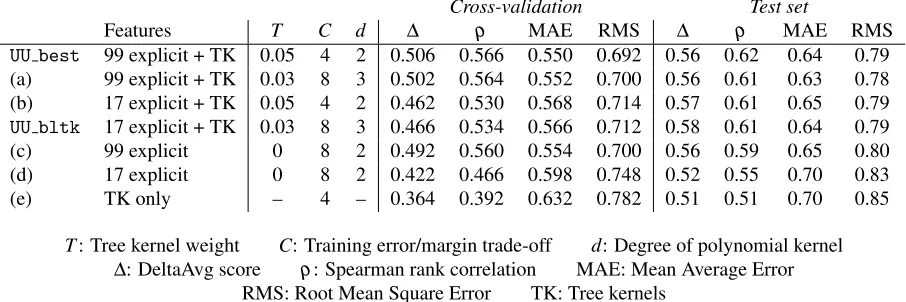
Results for some of our experiments are shown in table 1. The two systems we submitted to the shared task are marked with their system identifiers. A few other systems are included for comparison and are numbered (a) to (e) for easier reference.
Our system using only the baseline features (d) performs a bit worse than the reference system of the shared task organisers. We use the same learn-ing algorithm, so this seems to indicate that the ker-nel and the hyperparameters they selected worked slightly better than our choices. Using only tree kernels with no explicit features at all (e) creates a system that works considerably worse under cross-validation, however we note that its performance on the test set is very close to that of system (d).
Adding the 82 additional features of Hardmeier (2011) to the system without tree kernels slightly im-proves the performance both under cross-validation and on the test set (c). Adding tree kernels has a similar effect, which is a bit less pronounced for the cross-validation setting, but quite comparable on
the test set (UU bltk, b). Finally, combining the
full feature set with tree kernels results in an addi-tional gain under cross-validation, but unfortunately the improvement does not carry over to the test set (UU best, a).
5 Conclusions
In sum, the results confirm the findings made in our earlier work (Hardmeier, 2011). They show that tree kernels can be a valuable tool to boost the initial
performance of a Quality Estimation system without spending much effort on feature engineering. Unfor-tunately, it seems that the gains achieved by tree ker-nels over simple parse trees and by the additional ex-plicit features used in our systems do not necessarily add up. Nevertheless, comparison with other partici-pating systems shows that either of them is sufficient for state-of-the-art performance.
References
Chris Callison-Burch, Philipp Koehn, Christof Monz,
Matt Post, Radu Soricut, and Lucia Specia. 2012.
Findings of the 2012 Workshop on Statistical Machine
Translation. InProceedings of the Seventh Workshop
on Statistical Machine Translation, Montreal, Canada, June. Association for Computational Linguistics. Michael Collins and Nigel Duffy. 2001. Convolution
kernels for natural language. InProceedings of NIPS
2001, pages 625–632.
Jes´us Gim´enez and Llu´ıs M´arquez. 2004. SVMTool: A general POS tagger generator based on Support
Vec-tor Machines. In Proceedings of the 4th Conference
on International Language Resources and Evaluation (LREC-2004), Lisbon.
P´eter Hal´acsy, Andr´as Kornai, and Csaba Oravecz. 2007.
HunPos – an open source trigram tagger. In
Proceed-ings of the 45th Annual Meeting of the Association for Computational Linguistics. Companion Volume: Pro-ceedings of the Demo and Poster Sessions, pages 209– 212, Prague, Czech Republic, June. Association for Computational Linguistics.
Christian Hardmeier. 2011. Improving machine transla-tion quality predictransla-tion with syntactic tree kernels. In Mikel L. Forcada, Heidi Depraetere, and Vincent
Van-deghinste, editors,Proceedings of the 15th conference
of the European Association for Machine Translation (EAMT 2011), pages 233–240, Leuven, Belgium. Chih-Wei Hsu, Chih-Chung Chang, and Chih-Jen Lin.
2010. A practical guide to support vector classifica-tion. Technical report, Department of Computer Sci-ence, National Taiwan University.
Thorsten Joachims. 1999. Making large-scale SVM
learning practical. In B. Sch¨olkopf, C. Burges, and
A. Smola, editors,Advances in Kernel Methods –
Sup-port Vector Learning. MIT Press.
Richard Johansson and Alessandro Moschitti. 2010.
Syntactic and semantic structure for opinion
expres-sion detection. InProceedings of the Fourteenth
Con-ference on Computational Natural Language
Learn-ing, pages 67–76, Uppsala, Sweden, July. Association
for Computational Linguistics.
Dan Klein and Christopher D. Manning. 2003.
Accu-rate unlexicalized parsing. InProceedings of the 41st
Annual Meeting of the Association for Computational Linguistics, pages 423–430, Sapporo, Japan, July. As-sociation for Computational Linguistics.
Alessandro Moschitti. 2006a. Efficient convolution ker-nels for dependency and constituent syntactic trees. In
Proceedings of the 17th European Conference on Ma-chine Learning, Berlin.
Alessandro Moschitti. 2006b. Making tree kernels
prac-tical for natural language learning. InProceedings of
the Eleventh International Conference of the European Association for Computational Linguistics, Trento.
Joakim Nivre, Johan Hall, and Jens Nilsson. 2006.
MaltParser: A language-independent system for
data-driven dependency parsing. InProceedings of the 5th
Conference on International Language Resources and Evaluation (LREC-2006), pages 2216–2219, Genoa. Lucia Specia, Craig Saunders, Marco Turchi, Zhuoran
Wang, and John Shawe-Taylor. 2009. Improving the confidence of Machine Translation quality estimates. InProceedings of MT Summit XII, Ottawa.
J¨org Tiedemann. 2009. News from OPUS – a collection of multilingual parallel corpora with tools and inter-face. In N. Nicolov, K. Bontcheva, G. Angelova, and
R. Mitkov, editors,Recent Advances in Natural
Lan-guage Processing, pages 237–248. John Benjamins, Amsterdam.