Detecting Visually Relevant Sentences for Fine-Grained Classification
Olivia Winn∗, Madhavan Kavanur Kidambi∗and Smaranda Muresan† ∗Computer Science Department, Columbia University
†Center for Computational Learning Systems, Columbia University
[email protected], [email protected], [email protected]
Abstract
Detecting discriminative semantic at-tributes from text which correlate with im-age features is one of the main challenges of zero-shot learning for fine-grained image classification. Particularly, using full-length encyclopedic articles as textual descriptions has had limited success, one reason being that such documents contain many non-visual or unrelated sentences. We propose a method to automatically extract visually relevant sentences from Wikipedia documents. Our model, based on a convolutional neural network, is robustly tested through ground truth labeling obtained via Amazon Mechanical Turk, achieving 81.73% F1 measure.
1 Introduction
Current research in multimodal fusion and cross-modal mapping relies primarily on pre-aligned datasets of images and their short captions or tags, where the text is known to contain visually de-scriptive content directly related to its image (Ba-roni, 2016). These texts are usually manually col-lected, and restricted in length to words, phrases, and sentences. Using full-length documents such as Wikipedia articles would potentially allow au-tomated access to already available rich descrip-tive content and would greatly aid the task of fine-grained classification across numerous domains, many of which have rich image datasets (such as birds (Welinder et al., 2010), flowers (Nilsback and Zisserman, 2008), aircraft (Maji et al., 2013), and dogs (Khosla et al., 2011).)
Unfortunately, most full-length documents con-tain predominantly non-visual text, making them noisy with respect to visual information and lim-iting the success of zero-shot learning techniques
Figure 1: Example Sentences from Wikipedia ar-ticle on the Fish Crow.
for fine-grained classification (Elhoseiny et al., 2013; Elhoseiny et al., 2015; Lei Ba et al., 2015). Furthermore, the visual portion of the text often describes objects outside the classifier’s interest, such as the color of a bird’s eggs when the task is identifying bird species (see Figure 1).
Thus, the question we address in this paper is as follows: can weautomatically identify visually descriptive sentences relevant to a particular ob-ject from documents that may contain predomi-nantly non-visual text? We refer to this type of sentence as ‘visually relevant’. Answering this question would allow us to automatically build aligned datasets of images with rich sentence-level descriptions, removing the necessity of manually creating aligned image-text datasets.
In this work, we focus on bird species, as this is one of the most well-studied and challenging fine-grained classification domains, using Wikipedia articles as our text (Section 2). To build our com-putational models, we must first define the notion of ‘visually relevant’ sentences. We use the
tion of Visually Descriptive Language (VDL) in-troduced by Gaizauskas et al. (2015), with some restrictions. Like VDL, we aim to identify ‘vi-sually confirmed’ rather than ‘vi‘vi-sually concrete’ segments of text as our descriptions correspond to a class (the bird species) rather than a partic-ular image. For example, a sentence describing a bird’s feet can be a ‘visually relevant’ sentence for a bird, though it would not be ‘visually concrete’ for an image of the bird flying with its feet hid-den. Unlike VDL, for the scope of this paper we are interested only in the sentences which are visu-ally descriptive with respect to the object (i.e., bird species). We define such sentences as containing
visually relevant language(VRL).
To build our training data, we make a simpli-fying assumption: a sentence is only considered to contain visually relevant language if it is in the ‘Description’ section of the article. While other sections may contain visually descriptive language, we assume they describe other objects such as the eggs. This simplifying assumption al-lows us to approach our problem as a sentence classification task (is a sentence VRL or non-VRL), and provides an automatic, though noisy, approach for labeling the training data. We collect a dataset of 1150 Wikipedia articles about birds to train the non-linear, non-consecutive convolu-tion neural network architecture proposed by Lei et al. (2015). The architecture of this particular CNN is well suited to model sentences in our cor-pus such as“Adults have upperparts streaked with brown, grey, black and white”as it captures non-consecutive grams such as “upperparts brown”,
“upperparts gray”,“streaked white”, etc. To test our model in a robust manner, we use crowdsourcing to manually annotate all sen-tences as either VRL or non-VRL from an un-seen set of 200 Wikipedia articles (for a total of 6342 sentences) (Section 2), corresponding to the bird classes in the Caltech-UCSD Birds-200-2011 dataset (Welinder et al., 2010).
Our experiments show that the CNN model trained on the noisy VRL dataset performs very well when tested on a human-labeled VRL dataset: 83.4% Precision, 80.13% Recall, 81.73% F1 mea-sure (Section 4). Our analysis highlights several findings: 1) VRL sentences outside of the descrip-tion secdescrip-tion, or in documents with no Descripdescrip-tion section, are properly labeled by the model as VRL; 2) non-VRL sentences within the Description
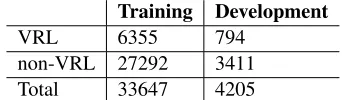
sec-Training Development
VRL 6355 794
[image:2.612.330.501.60.110.2]non-VRL 27292 3411 Total 33647 4205
Table 1: Statistics of the Training and Dev. Sets
tion (many documents included descriptions of birdsong in these sections) are correctly labeled by the model as non-VRL (Section 4). The datasets, including the crowdsourcing annotations for the 200 documents are released to the research com-munity (http://github.com/oh-livia/ VRL_Wiki_Dataset). This dataset will be use-ful to advance research on fine-grained classifi-cation, given that the Caltech-UCSD Birds-200-2011 is one of the most highly used datasets for this task.
2 Datasets
To train our models we collected a set of 1150 Wikipedia articles of bird species. As a future goal of this work is to correlate the extracted tex-tual information with image data, the training doc-uments were specifically chosen not to correspond to the 200 birds species in the Caltech-UCSD Birds-200-11 dataset, which were set aside as test data. Of these 1150 documents, 690 of them con-tained sections labeled “Description” or related headings such as “Appearance”, which allowed us to build our training and development sets. All sentences in the sections labeled “Description”, “Appearance” and “Identification” were consid-ered instances of the VRL class and everything else as instances of the non-VRL class; this label-ing scheme we refer to as ‘noisy’. Table 1 shows the statistics of the number of training and devel-opment instances used to build the computational models. The dataset is highly unbalanced: VRL sentences comprise 19% of both training and de-velopment. This skew is typical of many descrip-tive documents, and as such provides an appropri-ate model to train on.
To test our modelswe use the Wikipedia arti-cles of the 200 birds in the Caltech-UCSD Birds-200-11 previously collected by Elhoseiny et al. (2013), consisting of 6342 sentences, which we call 200V RL. To see whether our computational
2.1 Crowdsourcing to Annotate Sentences as Visually Relevant
We define a sentence-level annotation task, where each sentence in a document is assigned one of the following labels: 1— the sentence contains visu-ally relevant language (VRL), i.e. it is visuvisu-ally de-scriptive with respect to the object under consid-eration (birds species) (see examples (1) and (2)); and 0 — the sentence does not contain visually relevant language (see examples (3), (4), (5)).
Label 1(VRL sentence) is assigned when the entire sentence is visually relevant (ex (1)) or when it is partially visually relevant (e.g., in example (2) only the underlined part is visually relevant):
(1) It has a black cap and a chestnut lower belly
(2) Males give increasingly vocal displays and show off the white markings of the wings in flight and of the tail [...] Label0(non-VRL sentence) is assigned when the sentence describes the object of interest (bird species) but it is not visually descriptive (ex (3)), when it is visually descriptive but not relevant to the object (ex (4)), or when it is neither visually descriptive nor associated with the bird species.
(3) Males have 2 distinct types of songs -classified as short and long songs. (4) The egg coloring is a brown spotted
greenish-white.
(5) Finally volcanic eruptions on Tor-ishima continues to be a threat. In addition to the above labeling, for cases where a Turker chose the label1they were asked to provide information about the particular visu-ally relevant text segments by specifying thebird, the body part and the description. While these phrase-level annotations are not used for our cur-rent task, they could be used in future work when joint-learning from text and images, especially to align information related to each body part of the bird. In addition, they could be used to build a graph-based representation of image descriptions similar to scene graphs (Schuster et al., 2015).
The annotation task was done at the sentence level and each sentence was annotated by three Turkers on Amazon Mechanical Turk. Besides the two labels1and0, the Turkers could also se-lect “I don’t know” and provide an explanation for why they could not determine whether or not the
sentence contains VRL. We used highly skilled Turkers (≥500 completed HITS and≥95% ap-proval rate) and we paid 5 cents per HIT (each HIT contained only one sentence). The inter-annotator agreement was very high, with a Fleiss K score of 0.8273. Only 8.64% of the sentences did not have a unanimous vote. Less than 2% of the sen-tences had at least one Turker vote ‘I don’t know’; of these, less than 0.05% garnered one vote each of1,0and ‘I don’t know’.
To build the test set for the computational mod-els we use majority voting (at least two annotators selected the label). For the few cases where we did not have majority voting (0.05% of data) we selected the 0label, as only one Turker voted1 while the other two said0and ‘I don’t know’. This test set, which we call200HumV RL, contains 1248
sentences of class1(VRL) and 5094 sentences of class0(non-VRL).
3 Detecting Visually Relevant Sentences
As mentioned earlier, our task can be framed as a binary sentence classification problem, where each sentence is labeled either as VRL or non-VRL. Deep learning methods, and in particular convolutional neural networks (CNNs), have be-come some of the top performing methods on various NLP tasks that can be modeled as sen-tence classification (e.g, sentiment analysis, ques-tion type classificaques-tion) (Kim, 2014; Kalchbrenner et al., 2014; Lei et al., 2015).
We use the non-linear, non-consecutive con-volution neural network architecture proposed by Lei et al. (2015), which we refer to as CNNLei.
This CNN uses tensor products to combine non-consecutive n-grams of each sentence to create an embedding per sentence. The non-consecutive aspect of the n-gram allows it to capture co-occurrence of words spread across sentences:
Hyperparameters and Word Vectors. The word vectors are pre-trained on the entire set of 1150 Wikipedia articles about birds using the word2vec model of Mikolov et al. (2013) with a window context of 20 words and vectors of 150 dimensions. Notice that we do not use the docu-ments in the test set200V RLfor training the word
vectors. We chose to use domain specific text to pre-train the word vectors in order to make sure we are capturing domain specific semantics such as proper word senses. Words such as “crown”, when trained on a different corpus, would typically have an embedding very close to words such as “roy-alty”, “tiara”, etc; in the domain of bird descrip-tions, “crown” maps most closely to “feathers” and “head”. The hyperparameters for the CNN model are: L2 regularization weight is 0.0001, n-gram order is 3 and hidden feature dimension is 50.
4 Experimental Setup and Results Test Datasets. We first evaluate the CNNLei
model on the 200HumV RL dataset described in
Section 2, which contains the 6342 sentences la-beled by Turkers (class distribution: 1248 sen-tences in class 1and 5094 sentences in class0). Since our computational model was trained on the noisy visually relevant sentences (where the labels were determined by the ‘Description’ section of the documents), we wanted to evaluate how the model performed on a similarly constructed test set. Thus, instead of considering the human labels for the 6342 sentences, a sentence was assigned to class1if it belonged to the Description, Appear-ance or Identification sections and to class0 oth-erwise. We call this dataset200NoisyV RL (class
distribution: 1258 sentences in class 1and 5084 sentences in class0). Note that while it seems as if only 10 sentences changed, many of the sen-tences in the ‘Description’ sections were labeled by humans as class 0, and many sentences outside these sections labeled as class 1. However, one possible issue with the200NoisyV RLdataset is that
some documents do not contain any description-type sections and thus all sentences are labeled0, which might affect measuring the performance of the model. Thus, we considered additional test sets containing only the documents that had sec-tions labeled with ‘Description’, ‘Appearance’ or ‘Identification’ (142 documents out of the origi-nal 200 documents). Using these documents, we
constructed a dataset 142NoisyV RL, where class
1contained sentences that were part of the three description-type sections, and class 0 contained all other sentences (class distribution: 1156 class 1 and 3836 class 0). In addition, we also used the Turkers’ labels (majority voting) for the corre-sponding sentences in these 142 documents. We call this dataset 142HumV RL (class distribution:
992 class 1 and 4000 class 0). Since the CNN model was trained on the noisy labeling, a rea-sonable assumption is that the classification re-sults would be better on the 200NoisyV RL and
142NoisyV RL datasets than on the 200HumV RL
and142HumV RLdatasets.
Baseline. As baseline, we used the same neural bag-of-words model (nBoW) as Lei et al. (2015). We use the same training and development sets as for the CNN model (Table 1), along with the same word embeddings.
Results and Discussion. Table 2 shows the re-sults of theCNNLeimodel and thenBoWmodel
on the four datasets. The CNN model performs slightly better than the baseline on all datasets in terms of F1 measure, with a much better Recall but worse Precision. Given that the end goal is to use the extracted visually relevant sentences to-gether with images for fine-grained classification, and that the amount of visually relevant sentences in a document is small with respect to the docu-ment length, having high Recall is important.
One of the most interesting findings of this study is that both of the computational models perform much better on the human-labeled visu-ally relevant datasets (200HumV RL,142HumV RL)
than on the noisy visually relevant datasets (200NoisyV RL, 142NoisyV RL). In particular, the
recall increases significantly (e.g., from 63.24% on142NoisyV RLto 80.15% on142HumV RLusing
theCNNLeimodel).
Models 200HumV RL 200NoisyV RL 142HumV RL 142NoisyV RL
P(%) R(%) F(%) P(%) R(%) F(%) P(%) R(%) F(%) P(%) R(%) F(%)
[image:5.612.102.512.59.100.2]CNNLei 83.40 80.13 81.73 66.06 62.96 64.47 82.94 80.15 81.52 82.04 63.24 71.42 nBoW 88.61 73.56 80.39 67.31 55.33 60.73 88.48 73.32 80.19 84.11 55.88 67.15
Table 2: Classification results on the four datasets
song descriptions outside of the description-type sections, so the words pertaining to sound were not correlated as strongly with the VRL class. It is also possible that the abundance of appearance descriptions in each description section would en-courage the visual words to have a much stronger effect on the ‘visualness’ of a sentence. One such example is the sentence “The song is a series of musical notes which sound like: wheeta wheeta whee-tee-oh, for which a common pneumonic is ‘The red, the red T-shirt’”. Even the repetition of the word‘red’is not enough to make the classifier label the sentence as VRL.
Another type of example that explains these re-sults are sentences that describe the weight of the birds, such as“Recorded weights range from 0.69 to 2 kg,[...]”These sentences were part of the De-scription section, but were not marked as VRL by either the Turkers or the computational models.
We also analyzed some of the false positives of the CNNLei model on the 142HumV RL and
200HumV RL datasets. One type of error comes
from sentences that are visually descriptive, but not visually relevant, such as sentences that de-scribe other objects like eggs. For example, the sentence “The egg shells are of various shades of light or bluish grey with irregular, dark brown spots or greyish-brown splotches” was labeled as VRL by the model but not by the Turkers. More interesting are the false positives that con-tain comparison words such as“clapping or click-ing has been observed more often in females than in males”, and words having to do with appear-ance that do not specifically describe how the bird looks such as “this bird is more often seen than heard”.
5 Related Work
There are two lines of work most closely related to ours. First, Gaizauskas et al. (2015) propose a definition and typology of Visually Descriptive Language (VDL). They show that humans are able to reliably annotate text segments as containing ‘visually descriptive’ language or not, providing evidence that standalone text can be classified by
the visualness of its contents. In our work, mo-tivated by the end task of fine-grained classifica-tion, we restrict the definition to ‘visually rele-vant’. As Gaizauskas et al. (2015) do, we show that humans can reliably annotate text as visually relevant or not. Unlike Gaizauskas et al. (2015), we propose a method to automatically detect visu-ally relevant sentences from full-text documents. Second, Dodge et al. (2012) propose a method to separate visual text from non-visual text in image captions. However, their method focuses just on noun-phrases, while our approach finds visually relevant sentences in full-length documents.
While our end result is a set of visually relevant text descriptions, our approach is complementary to the rich body of work on generating text de-scriptions from images (see (Bernardi et al., 2016) for a survey), since our methodextracts such de-scriptions from existing text.
6 Conclusion
Our work shows that it is possible to take domain-specific full-length documents—such as Wikipedia articles for birds species—and classify their sentences by visual relevancy using a CNN model trained on a noisy dataset. As many doc-uments generally have a small proportion of vi-sually relevant sentences, this approach automati-cally generates high quality visually relevant tex-tual descriptions for images to be used by zero-shot learning approaches for fine-grained image classification tasks (e.g., (Wang et al., 2009)). While our study has focused on bird species, we believe that this method is generally applica-ble for other domains used in fine-grained clas-sification research such as flowers and dogs (all have associated Wikipedia articles and Descrip-tion/Appearance sections). In future work, we plan to use the outcomes of this work for joint learning from text and images.
Acknowledgments
References
M. Baroni. 2016. Grounding distributional semantics in the visual world. Language and Linguistics Com-pass, 10(1):3–13.
Raffaella Bernardi, Ruket Cakici, Desmond Elliott, Aykut Erdem, Erkut Erdem, Nazli Ikizler-Cinbis, Frank Keller, Adrian Muscat, and Barbara Plank. 2016. Automatic description generation from im-ages: A survey of models, datasets, and evalua-tion measures. Journal of Artificial Intelligence Re-search, 55.
Jesse Dodge, Amit Goyal, Xufeng Han, Alyssa Men-sch, Margaret Mitchell, Karl Stratos, Kota Yam-aguchi, Yejin Choi, Hal Daum´e III, Alexander C Berg, et al. 2012. Detecting visual text. In Pro-ceedings of the 2012 Conference of the North Amer-ican Chapter of the Association for Computational Linguistics: Human Language Technologies, pages 762–772. Association for Computational Linguis-tics.
Mohamed Elhoseiny, Babak Saleh, and Ahmed Elgam-mal. 2013. Write a classifier: Zero-shot learning using purely textual descriptions. InProceedings of the IEEE International Conference on Computer Vi-sion, pages 2584–2591.
Mohamed Elhoseiny, Ahmed Elgammal, and Babak Saleh. 2015. Tell and predict: Kernel classifier pre-diction for unseen visual classes from unstructured text descriptions. IEEE Conference on Computer Vi-sion and Pattern Recognition Workshops (CVPR). Robert Gaizauskas, Josiah Wang, and Arnau Ramisa.
2015. Defining visually descriptive language. In Proceedings of the 2015 Workshop on Vision and Language (VL15): Vision and Language Integration Meets Cognitive Systems.
Nal Kalchbrenner, Edward Grefenstette, and Phil Blun-som. 2014. A convolutional neural network for modelling sentences. In Proceedings of the 52nd Annual Meeting of the Association for Computa-tional Linguistics, ACL 2014, June 22-27, 2014, Baltimore, MD, USA, Volume 1: Long Papers, pages 655–665.
Aditya Khosla, Nityananda Jayadevaprakash, Bang-peng Yao, and Li Fei-Fei. 2011. Novel dataset for fine-grained image categorization. In First Work-shop on Fine-Grained Visual Categorization, IEEE Conference on Computer Vision and Pattern Recog-nition, Colorado Springs, CO, June.
Yoon Kim. 2014. Convolutional neural networks for sentence classification. Proceedings of the 2014 Conference on Empirical Methods in Natural Lan-guage Processing (EMNLP), pages 1746–1751. Jimmy Lei Ba, Kevin Swersky, Sanja Fidler, et al.
2015. Predicting deep zero-shot convolutional neu-ral networks using textual descriptions. In Proceed-ings of the IEEE International Conference on Com-puter Vision, pages 4247–4255.
Tao Lei, Regina Barzilay, and Tommi Jaakkola. 2015. Molding cnns for text: Non-linear, non-consecutive convolutions. InProceedings of the 2015 Confer-ence on Empirical Methods in Natural Language Processing (EMNLP).
S. Maji, J. Kannala, E. Rahtu, M. Blaschko, and A. Vedaldi. 2013. Fine-grained visual classification of aircraft. Technical report.
Tomas Mikolov, Ilya Sutskever, Kai Chen, Greg Cor-rado, and Jeffrey Dean. 2013. Distributed represen-tations of words and phrases and their composition-ality. Advances in Neural infgormation Processing Systems, pages 3111–3119.
M-E. Nilsback and A. Zisserman. 2008. Automated flower classification over a large number of classes. InProceedings of the Indian Conference on Com-puter Vision, Graphics and Image Processing, Dec. Sebastian Schuster, Ranjay Krishna, Angel Chang,
Li Fei-Fei, and Christopher D Manning. 2015. Gen-erating semantically precise scene graphs from tex-tual descriptions for improved image retrieval. In Proceedings of the Fourth Workshop on Vision and Language, pages 70–80.
Josiah Wang, Katja Markert, and Mark Everingham. 2009. Learning models for object recognition from natural language descriptions. InBritish Machine Vision Conference (BMVC), volume 1, page 2. P. Welinder, S. Branson, T. Mita, C. Wah, F. Schroff,