Dutch Resolution: Separation of Enantiomers with Families of Resolving
Agents. A Status Report
Dutch Resolution: Separation of Enantiomers with Families of Resolving Agents.
Richard M. Kellogg,*a José W. Nieuwenhuijzen,a K. Pouwer,a Ton R. Vries,a Quirinus B. Broxterman,b Reinier F.P. Grimbergen, Bernard Kaptein,b René M. La Crois,a Ellen de Wever,a Karen Zwaagstra,a Alexander C. van der Laana a Syncom B.V., Kadijk 3, 9747 AT Groningen, The Netherlands
Fax +31(50)5757399; E-mail: [email protected]
b DSM Research, Advanced Synthesis and Catalysis, PO Box 18, 6160 MD Geleen, The Netherlands
Received 25 February 2003
Synthesis 2003, No. 10, Print: 21 07 2003.
Art Id.1437-210X,E;2003,0,10,1626,1638,ftx,en;E08903SS.pdf. © Georg Thieme Verlag Stuttgart · New York
Abstract: Dutch Resolution is the term given to the use of mixtures
(families) of resolving agents in classical resolutions. In this status report an overview is given of the latest results and new (possible) families of resolving agents are introduced. The concept of families is discussed as well as the factors that come into play on use of fam-ilies. Practical aspects of Dutch Resolution in particular and resolu-tions in general are discussed.
Key words: amino alcohols, asymmetric synthesis, chiral
auxil-iaries, chiral resolution, chirality, camphor, chalcones, sulfonic ac-ids
Introduction
The market for pharmaceuticals vividly illustrates the need for reliable methods for obtaining enantiomerically pure compounds. A recent estimate of the position of sin-gle enantiomer drugs in the roughly $410 billion world-wide sale of pharmaceuticals in 2001 was 36% ($147 billion) of total sales. This was up from 34% in 2000 and 32% in 19991 and takes no account of the increasing mar-ket for applications of single enantiomers in areas such as materials.
If the chiral pool is not, or cannot, be employed, resolution is thought to be the most frequently used alternative in-dustrial method for obtaining single enantiomers2 al-though it is difficult to estimate exactly what the balance is between use of chiral pool, asymmetric synthesis, and resolution. Our rough impression based on current busi-ness trends is that some 30–50% of the single enantiomers required are obtained by classical resolution procedures. In our view the various approaches to obtaining single enantiomers should be seen as complementary tools in the arsenal of organic synthesis rather than as competitors for preeminence. Improvements in the trustworthiness, speed and predictability of all methods are highly desirable. In this article we will deal with some new developments with regard to resolutions by diastereomeric salt formation.
Improvements in optical resolution strategies are impor-tant not only for industrial applications but also for rea-sons of pure science; understanding the intricacies of
transition from solution to solid phase with involvement of the most intricate stereochemical considerations forms a magnificent scientific challenge.
In 1998, an article ‘The Family Approach to the Resolu-tion of Racemates’ was published.3 This unusual title re-fers to the use of mixtures of resolving agents. The use of mixtures that were families was most effective. A family was defined as follows: ‘The members of a family in gen-eral bear strong structural similarity and are stereochemi-cally homogeneous (homochirality among family members and enantiomeric purity of the components)’. In general three (sometimes two) family members are used in a resolution. Such resolutions, chiefly of acids and bases, proceed rapidly and diastereomeric excesses in the precipitated salts are usually high. These salts almost al-ways contain a mixture of the family of resolving agents. The ratios reflect to some extent the solubilities of the dia-stereomeric salts of the resolving agents used, although obvious relationships are absent. Success rates, defined for the moment as the chance of obtaining solid salts with significant diastereomeric excesses, were significantly higher, 90–95%, than the 20–30% estimated for classical resolutions.4
Although the method was first referred to as the ‘Family Approach’ this term has been more or less supplanted by the name ‘Dutch Resolution’, later introduced for market-ing purposes. Although chemically less graphic, this name seems to have captured the imagination even more.
The idea of using mixtures runs contrary to chemical intu-ition and certainly makes the tradintu-itionalists among us un-easy. However, the deliberate use of mixtures is nowadays more palatable in view of both of the approaches used in combinatorial chemistry as well as the extensive work on non-linear effects in enantioselective reactions wherein enantiomerically non-pure compounds are deliberately employed.5
camphor sulfonic acid and bromocamphor sulfonic acid tend to be one of a kind. Although small structural modi-fications might be introduced into such structures the dif-ficulty thereof and attendant costs do not encourage this although there are exceptions (see later). Our own entry into the concept of families was via the cyclic phosphoric acids 1 developed by ten Hoeve and Wynberg.7 Various substituted derivatives of 1 (Scheme 1) were available in the laboratory. The step to use of a mixture was therefore technically easy.
‘P mix’ in the nomenclature of reference 3 is a mixture of 1a–c. A wide variety of substituted aldehydes can readily be used in the Cannizzaro reaction leading to the 1,3-diol precursors and then the phosphoric acids. The original P
mix did not include the 2-nitro derivative 1d shown in Scheme 1. This compound (see later) has subsequently been shown to be quite important. Many other derivatives obviously can be prepared. Resolution procedures for the cyclic phosphoric acids have been described.7
In this article we will go deeper into the concept of fami-lies. The definitions are in general heuristic although the-oretical insight is increasing gradually. Attention will be paid to the new families of resolving agents. We will also go into practical aspects of Dutch Resolution. Finally we will discuss briefly a ‘reverse’ approach to Dutch Resolu-tion, in which a ‘family’ of racemates is resolved. This phenomenon might have rather broad implications.
Prof. Kellogg, who for many years was employed at the Uni-versity of Groningen, is Chief Fi-nancial Officer of Syncom BV. He is an American citizen. He has been active in many different re-search areas including bio-organ-ic chemistry and supramolecular chemistry.
Dr. Nieuwenhuijzen recently ob-tained her PhD under direction of Prof. Kellogg. She has contributed fundamentally to the practice and theory of Dutch Resolution.
Dr. Pouwer obtained his PhD de-gree with Prof. Wynberg at the University of Groningen and is a section leader at Syncom BV.
Dr. Vries is General Director of Syncom BV and is the discoverer of Dutch Resolution. He obtained his PhD degree at the University of Groningen under the direction of Prof. Wynberg.
Dr. Broxterman is Senior Scien-tist at DSM Research and obtained his PhD degree with Prof. Hogev-een at the University of Gronin-gen.
Dr. Grimbergen is associated with the Centre for Particle Technology at DSM Research and obtained his PhD degree with Prof. Bennema in Nijmegen.
Dr. Kaptein is a scientist at DSM Research and obtained his PhD de-gree at the University of Groningen with Prof. Kellogg
Dr. La Crois obtained his PhD degree with Prof. B. L. Feringa at the University of Groningen and Dr. van der Laan obtained his PhD with Prof. J. H. van Boom at the University of Leiden. Both are research chemists at Syncom BV.
The methods leading to family 1a–d are characteristic of what one desires, namely that the synthetic approach is not overly difficult and amenable to the preparation of de-rivatives, that starting materials are not exceptionally ex-pensive and available and that the reactions can readily be run on a reasonable scale. We have carried out several of
the syntheses described here on a kilogram scale. One should note, however, that in this procedure racemates are prepared and that each racemate must be resolved. A res-olution procedure that works for one compound need not necessarily work for another of seemingly closely related structure, despite suggestions to the contrary.8 In our ex-perience, however, resolution is a fairly routine operation although each resolution has to be optimized.
Other families that have been used on a regular basis are, to use the abbreviations given in ref 3, M mix (2a–c), T mix (3a–c), PE-I mix (4a–c), PE-II mix (5a–c), PE-III mix (6a–c), PG mix (7a–c) and PGA mix (8a–c) as shown in Figure 1. In most cases the enantiomeric forms of the structures illustrated are also available.
The structural similarities of the members of the families are obvious. ‘Cross mixing’, for example a member of T-mix with M-T-mix, has not been successful in our experi-ence. Except for PE-III in which alkyl groups are varied, family differences have been achieved by substitution on aromatic rings. The substituents chosen were based ini-tially simply on what was available or could be readily synthesized. Recent insights (see later) suggest that, as luck would have it, more difficultly accessible substitu-ents may be even more effective.9
Scheme 1 Synthesis of cyclic phosphoric acids
OH OH O
+ H
O
H
O O P O OH
base
1) phosphorylation 2) resolution
H X
X
X
1a X = H 1b X = 2-Cl 1c X = 2-OCH3 1d X = 2-NO2
[image:3.595.53.278.52.209.2]P-mix (1a-c)
There are essentially two approaches to the synthesis of families of resolving agents: either prepare each member of a family as the racemate and then resolve as described above for the cyclic phosphoric acids. It will be necessary to do this on the fairly large scale required for practical ap-plication. The other approach is to prepare each family member as a pure enantiomer by enantioselective synthe-sis. Combinations of these approaches might in certain cases be possible; certain members might be readily avail-able via enantioselective synthesis and others not.
It is easy to underestimate the amount of effort involved. In general the choice falls on fairly simple structures. On paper synthetic schemes often appear straightforward and not excessively challenging. One reason to desire simplic-ity is that in general reasonably large amounts are required if a resolving agent could ever be considered for an indus-trial application. Consideration of costs and labor, certain-ly in an industrial setting, is necessary. We do not claim that the approaches we describe in the following para-graphs are unique; the choices have usually been dictated by our own evaluation of practical considerations.
An example of the enantioselective approach is the con-densation of camphor sulfonic acid 9, a popular commer-cial resolving agent, with (substituted) benzaldehydes (Scheme 2). These condensation products 10 have been described in the patent literature10 and are used as sun-screens. We are unaware of descriptions of the use of these materials as resolving agents.
The reader will immediately recognize a limitation, name-ly that in principle onname-ly a single enantiomer is available. The configuration around the benzylidene double bond is
E as established by 2D-NMR. The pure materials are
highly crystalline. Resolutions of amines can be carried out with these materials although the high crystallinity sometimes complicates obtaining the salts.
Hydrogenation of the double bonds in 10 leads to benzyl substituted camphor sulfonates. These in our experience unfortunately do not readily provide crystalline salts with amines.
Bromocamphor-10-sulfonic acid 11 is also used commer-cially but lends itself less readily to functionalization. The
[image:4.595.305.520.409.685.2]prototype chiral sulfonic acid is probably 1-phenylethane-sulfonic acid 12 and derivatives thereof (Figure 2).
Figure 2 Bromo camphor sulfonic acid 11 and 1-phenylethane sul-fonic acid 12
The synthesis of the racemic sodium salt of 1-phenyle-thanesulfonic acid 12a from the reaction of sodium sulfite with 1-phenylethyl chloride was described more than 100 years ago.11 In our hands this reaction is not readily repro-ducible although others11b–d describe the successful use of the procedure. An enantioselective synthesis of 12a has been described.12 Although this approach is elegant we did not consider it for the preparation of a family because of the costs of the procedure as well as doubts about whether it would be reliable for the preparation of deriva-tives (we have not examined whether this is so) or could be used on a larger scale.
The simple cost-effective alternative we use for the prep-aration of racemic 12 and derivatives thereof is shown in Scheme 3.
Scheme 2 Condensation of benzaldehydes with camphor sulfonic acid 9
H O
X O SO3H
O SO3H
X NaOMe
9
10a X = H 10b X = CH3 10c X = OCH3
SO3H
O
Br SO3H
11 12
Overall yields starting from the appropriate acetophe-none, which is reduced with NaBH4 to the alcohol 13, on a 0.1 mol scale are 56–85%. The alcohol 13 is subsequent-ly converted to the thiourea salt 14, which is hydrosubsequent-lyzed with NaOH to the corresponding thiol 15. Although the oxidations with H2O2 need to be done with care, in our ex-perience this procedure for the conversion of thiol 15 to sulfonic acid 12 is trustworthy and better than oxidation with heavy metals. The preparation of 12a has been car-ried out in 61% yield on an 8.6 mol scale. Resolutions of 12a–c can be carried out with L-4-hydroxyphenyl glycine 16 as described for 12a itself.13 This resolution provides the (S)-enantiomer of 12a.
The addition products 18 of NaHSO3 to a,b-unsaturated ketones 17 represent another, extremely easy to obtain, class of racemic sulfonic acids (Scheme 4). These sulfon-ic acids were first described by Knoevenagel14 and later in detail by Pfoertner15,16 although there have been to our knowledge no reports of the resolution of these materials.
The procedure as described by Pfoertner15 allows use of substituted benzaldehydes and substituted acetophenones for the syntheses of the required chalcones 17. The reac-tions are performed in general at high concentration (roughly 1.4 M) and the products (17a–e) crystallize from the reaction mixture. Several other substituents were used (not shown here) and the reaction proceeds equally well. For cases where ortho- or meta-substituents are present the products do not crystallize from the reaction mixture, but can be obtained via normal extraction procedures. These chalcones react smoothly with NaHSO3 at reflux temperatures in EtOH–H2O. Again the products (18a–e) crystallize from the reaction mixture as sodium salts ex-cept for cases where ortho- or meta-substituents are present in which case the solutions must be concentrated to induce crystallization. These reactions have been car-ried out without problems on a 1 kg scale.
Resolution of sulfonic acid 18a was first investigated. Frustration grew rapidly as we found that the use of re-solving agents and families of rere-solving agents were not effective and that ephedrine, dehydroabiethylamine,
[image:5.595.303.547.217.410.2]qui-nidine, quinine, D-4-hydroxyphenylglycine 16, and L -cys-teine were also ineffective as resolving agents. Salts were readily formed but these in all cases had virtually no dias-tereomeric excess (although the yields were <50%). We discovered, however, that (R)-4-methylphenylglycinol 19 (Figure 3), derived from reduction of (R)-4-methylphe-nylglycine, was an effective resolving agent for 18b and 18c. An interesting observation is that 18a–c can be re-solved simultaneously as a mixture. After recrystalliza-tion the enantiomeric excesses are, respectively 90%, 98%, and 96% in a 1:10:4 mixture obtained on resolution with 19 as is shown in Table 1.
Figure 3 (R)-4-methylphenylglycinol 19 and D-phenylglycinamide
20
Resolutions are best carried out in a 1:1 mixture of i-pro-panol and 10% HCl. The resolution of mixtures of race-mates is an obvious extension of Dutch Resolution itself.
Compound 18a under basic conditions undergoes a retro-Michael reaction with concomitant decomposition/racem-ization. However, 18a and other sulfonic acids are entirely stable under neutral or acidic conditions. The salts formed with amines under resolution conditions are also stable and we have never observed racemization of 18a or other sulfonic acids.
Crystals of 18a and 18b with 19 were suitable for X-ray crystallography. In the unit cell three components are present: the sulfonate (18a or 18b), compound 19 and one molecule of water. A crystal structure is shown (Figure 4) which contains 17% 18a and 83% 18b. A layered struc-ture is formed (Figure 5), in which the phenyl rings of 18 and 19 are nicely stacked. Several hydrogen bonds are formed; some of them with a water crystal.
Sulfonic acids 18d and 18e substituted at the Y position in our experience can be resolved with a somewhat unusual resolving agent, D-phenylglycinamide 20, which recently became available in large quantities (Figure 3). Simulta-neous resolution of a mixture of sulfonic acids was often
Table 1 Resolution of Mixtures of Sulfonates 18
En-try
Racemate ee H/Me/ OMe
Ratio H/Me/ OMe
ee H/Me/ OMe after rec.
Ratio H/ Me/OMe after rec.
1 18b 67 – 99 –
2 18a:18b,
1:1
79/86 1:1.3 99+/99+ 1:2.7
3 18a:18b:18c,
1:1:1
19/79/27 1:5:5 90/98/96 1:10:4
OH
H3C
NH2
19 20
NH2
NH2
O
[image:5.595.51.256.293.448.2]very effective whereas resolution of the racemates sepa-rately proceeded poorly. In a Dutch Resolution approach mixtures of resolving agents are used hence a separation of the individual enantiomers is not necessary.
A number of derivatives of 18 were prepared in which
tert-butyl, cyclohexyl of naphthyl groups replaced the
ar-omatic rings. It was observed that for the aliphatic groups, no salts could be formed with a number of resolving agents that were tested including 19 and 20. Only the compounds with one naphthyl group were able to form salts. This supports the idea that p-stacking is important, as was also shown in the crystal structures.
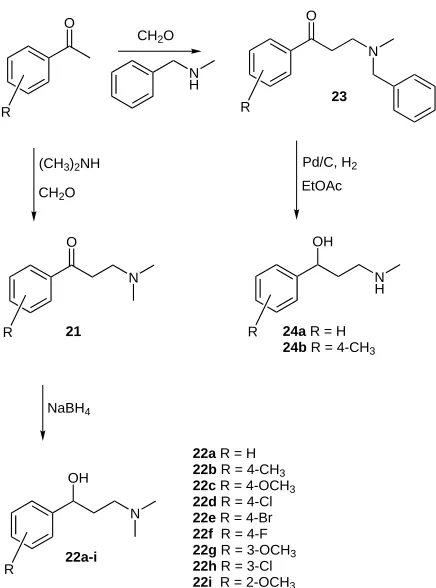
The Mannich reaction is well suited for the preparation of racemic families of amino alcohols as shown in Scheme 5.
Scheme 5 Mannich approach to amino alcohols 22 and 24
Reaction of (substituted) acetophenones with dimethy-lamine and formaldehyde furnishes ketoamines 21, which can be reduced to the dimethylamino alcohols 22 with so-dium borohydride. Alternatively, the Mannich reaction can be performed with methylbenzylamine, followed by a reduction giving in one step the monomethyl alcohols 24. Individual members of family 22 can be readily resolved with mandelic acid. Compound 24a and 24b can be re-solved with phosphoric acid 1a in high resolution efficien-cies. Asymmetric (transfer) hydrogenation might be used to prepare some of these derivatives.17
[image:6.595.305.523.84.378.2]Another very simple approach to new racemic amines is shown in Scheme 6. Condensation of malonic acid with substituted benzaldehydes in the presence of an ammonia source gives b-amino acids, which are converted to the es-ters 25. These eses-ters are readily resolved with, for exam-ple, 1c or tartaric acid. As example the first crystals of 25b and 1c are obtained in 89% diastereomeric excess (S = 0.88) on use of isopropanol as solvent. Reduction de-livers 1,3-amino alcohols 26. One can resolve the racemic alcohols; for example 26d can be resolved with M-mix (Figure 1) and the first salt is obtained in a diastereomeric excess of 92% (S = 0.40) in isopropanol. The ability of 25 and 26 to act as families remains to be examined. A highly promising diastereoselective route to chiral amines is shown in Scheme 7.
Figure 4 Crystal structure of 18a+18b/19 with 18a:18b, 17:83
NaBH4
O
N O CH2O
R
R CH2O
N OH
EtOAc (CH3)2NH
R
R
R
N H
N O
N H OH Pd/C, H2
22a R = H 22b R = 4-CH3 22c R = 4-OCH3 22d R = 4-Cl 22e R = 4-Br 22f R = 4-F 22g R = 3-OCH3 22h R = 3-Cl 22i R = 2-OCH3
24a R = H 24b R = 4-CH3 21
22a-i
[image:6.595.52.290.199.540.2]23
Scheme 7 Diastereoselective allylzinc additions to imines of (R)-phenylglycinamide 27
The route shown in Scheme 7 begins with the highly dias-tereoselective addition of allylzinc bromide to imines 27 of (R)-phenylglycine amide 20.18 Removal of the chiral auxiliary from addition product 28 to provide enantiomer-ically pure amines 29 may be performed without compli-cations on a multigram scale. Resolutions of acids with these materials are under investigation and initial results are promising.19
What Constitutes a Family?
The families that have been used so far differ in general only in the nature of substituent on an aryl ring. All com-ponents of families that we use are enantiomerically pure. Little success has been achieved with the use of enantio-merically enriched materials although this point has not been investigated in exhaustive detail.
On the use of a family – normally three family members are used in a 1:1:1 molar ratio – the first salt obtained nearly always contains a mixture of resolving agents. The ratio is usually skewed in non-stoichiometric fashion in favor of one of the resolving agents. In a number of cases one of the three resolving agents was not, or only barely, incorporated although it was clear to us that the resolu-tions proceeded better in the presence of this non (or poor-ly) incorporated material. Nitro substituents seem to be particularly effective although not unique in their effects: halo and alkyl substituents can also be active. However, the number of examples is limited and at this stage general conclusions are risky.
Further investigation has led to the discovery that the poorly incorporated resolving agents can be effective nu-cleation inhibitors.9 The case studied in most detail so far is the resolution of mandelic acid 30 with phenylethy-lamine 31a. A 1:1 mixture 31b of the 2- and 4-nitro deriv-atives (this easy to prepare mixture is also used for commercial purposes) was used as an additive (Scheme 8).
Scheme 8 Resolution of 30 with 31a in the presence of 31b
With the aid of turbidity measurements it was established that this mixture of nitro derivatives functioned as an ef-fective nucleation inhibitor. For both diastereomers nucle-ation inhibition is observed, whereas the dissolution temperatures remain more or less identical.
In passing we note that in order to compare resolution ef-ficiencies, resolutions need to be carried out under compa-rable conditions. In practice this requires identical starting concentrations and resolution under temperature-con-trolled conditions. For small scale and scouting work this is achieved in a programmable bath fitted with a thermo-stat. Our procedure is as follows: once a clear solution is obtained in a Kimble test tube with a diameter of 25 mm and height of 150 mm this is covered and placed in the programmable bath. The stirring speed is 900 rpm using a 1 cm magnetic stirring bar. The temperature program is started at, for example, 65 °C with a cooling rate of 0.1 °C per min to 20 °C. These details are given as an example of
Scheme 6 Synthesis of amino esters 25 and amino alcohols 26
H
O HO OH
O O
R OH
NH2
R
R
OH NH2
1) NH4OAc, EtOH, ∆ 2) MeOH/SOCl2
R
O NH2 O
resolution
NaBH4, THF
26a-e
25a R = H 25b R = 4-Br 25c R = 4-Cl 25d R = 4-OCH3 25e R = 4-CH3
rac-26
ZnBr N
O NH2
R R
H2, Pd/C
R
HN O
NH2
H
NH2
H
27 28
29a-i 29a R = H
29b R = 4-CH3 29c R = 4-OCH3 29d R = 4-Br 29e R = 4-Cl 29f R = 2-CH3 29g R = 2-OCH3 29h R = 2-Br 29i R = 2-Cl
OH O OH
+ CH3
NH2
30
i-propanol
(S)-31a R = H (S)-31b R = 2-NO2/
R = 4-NO2
R
the care that must be taken, in our experience, to achieve reproducibility.
At 0.25M in isopropanol, compound 30 with an equiva-lent amount of 31a provides salt with a diastereomeric ex-cess (de) of 14% and S factor 0.19, where S = 2 × ee × yield.20 The S factor for a perfect resolution (50% yield based on racemate, 100% enantiomeric excess) is thus 1. When the resolution is carried out at the same concentra-tion and under the same temperature condiconcentra-tions with 0.9 equivalents of 31a and 0.1 equivalents of 31b the first salt is obtained with a de of 55% and an S factor of 0.41. No detectable amount of 31b, which is visible to the naked eye owing to its yellow color, is incorporated into the salt.9
This improvement may seem marginal. Numerous cases have been studied, however, and effects are sometimes spectacular. For example, in an experiment carried out un-der controlled conditions as described above, resolution of 1-(2-chlorophenyl)ethyl amine (not shown) with 1a gave salt with 22% de (S factor 0.26). Addition of 1d as nucle-ation inhibitor to 1a led to 86% de (S factor 0.62). In some cases, particularly with 2-nitro substituted resolving agents, the nucleation inhibitor is not even incorporated in detectable amounts in the first salt. An ideal resolution would be based on two resolving agents, one in great ex-cess, and the other only present in small amounts. If the minor component acts as nucleation inhibitor and is not incorporated one obtains a pure salt, which on neutraliza-tion affords only a single resolving agent. This is particu-larly attractive when recycling is desired.
Practical Aspects of Dutch Resolution in Particular and Resolutions in General
We will concentrate here only on those aspects that in our experience have been essential for practical success.
Since the initial discovery of Dutch Resolution in 1996 around 1000 resolutions of racemic acids and bases have been carried out for clients. Obviously most of these 1000 different structures fall under client confidentiality. Dutch Resolution has been used on a regular basis in the screen-ing of these resolutions. The overall success rate for achieving resolution is greater than 95%. The technique of Dutch Resolution has obviously played a large role in this success. In addition, however, another factor deserves to be mentioned, namely the human component, ‘Finger-spitzengefühl’, to express it in German, is important.
From the technical side chiral HPLC facilities are essen-tial to aid in the rapid determination of enantiomeric ex-cesses of new racemates submitted for resolution. To work effectively one must be able to evaluate quickly the effectiveness of a resolving agent. Each compound re-quires its own HPLC conditions and this continual chal-lenge must be taken seriously. HPLC is for us by far the most general and accurate method with which to deter-mine enantiomeric excesses. Chiral GC is, of course,
en-tirely suitable for compounds of sufficient volatility. Salts are in general better handled by chiral HPLC. Further backup is given by differential scanning calorimetry (DSC), which is indispensable for analysis of melting be-havior.
Although it may seem a trivial aspect, the presence in the laboratory of all common resolving agents as well as the common mixes for Dutch Resolution together with famil-iarity with their solubility and crystallization behavior are indispensable for the achievement of speedy and secure resolutions.
In our experience, for the first screening of a new resolu-tion, a stoichiometry of 1:1 is convenient, in other words 1 molar equivalent of resolving agent, which is a mixture in the case of Dutch Resolution, and 1 molar equivalent of racemate. We prefer in general to use reasonably polar solvents, which can be readily removed by a rotary evap-orator. Acetone, methyl ethyl ketone, isopropanol, etha-nol, and methaetha-nol, sometimes as mixtures with H2O, are popular solvents. Toluene is used on occasion. If quanti-tative or semi-quantiquanti-tative comparisons are required, we find it convenient to carry out the resolutions in tubes, which are placed in a temperature programmable bath. The temperature is then lowered at a set rate. The temper-ature at which crystallization occurs can be carefully mon-itored. This technique has been very useful for determination of the effectiveness of new families of re-solving agents.
For the optimization of resolutions in principle 0.5 equiv-alents of resolving agent should suffice if only the less sol-uble combination of resolving agent and enantiomer of the racemate crystallize A concomitant advantage of the use of less than one molar equivalent of resolving agent is the fact that also the more soluble diastereomer is less super-saturated, and thus less likely to crystallize. Resolutions including Dutch Resolution can be optimized with respect to the amount of resolving agent used. The resolution ef-ficiency is readily followed by calculation of the S-fac-tor.20
In the Peachey and Pope variant, 0.5 equivalent of the re-solving agent is supplemented with an achiral acid or base (depending on whether the resolving agent is acidic or ba-sic).21 In this way, a neutral system is obtained.
The effects of nucleation inhibition have already been dis-cussed. We anticipate that the discovery and use of ‘de-signer nucleation inhibitors’ will in the future lead in many cases to improved resolutions. A rough strategy for the discovery of such inhibitors based on extrapolation of the principles of Dutch Resolution has been presented.
Reverse Resolution
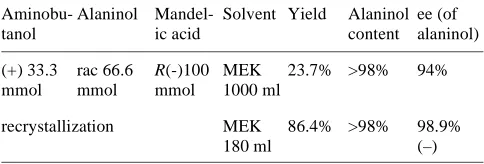
In addition to the resolution of a racemate with a family of resolving agents also a family of racemates might be re-solved with a (family of) resolving agent(s). An illustra-tive example is the resolution of alaninol in methyl ethyl ketone (MEK) as solvent. This resolution is very difficult with mandelic acid (or any other resolving agent). Ami-nobutanol on the other hand is resolved very effectively with mandelic acid. We were pleased to observe that a
mixture of both amino alcohols is readily resolved with
mandelic acid. Amino butanol as well as alaninol is ob-tained in high ee. In this case, however, a mixture of both amino alcohols is obtained.
Pure alaninol can be obtained when using optically pure aminobutanol (forming the more-soluble salt with man-delic acid) as additive, instead of racemic aminobutanol or optically pure aminobutanol forming the less-soluble mandelic acid salt (normal Dutch Resolution addition strategy).
[image:9.595.49.291.537.619.2]From a clear mixture of (+)-2-amino-1-butanol (1 equiv), racemic alaninol (2 equiv) and R(–)-mandelic acid in 2-butanone, (–)-alaninol/(R)-(–)-mandelic acid crystals with an ee of 99% and an aminobutanol content <2% in a re-covery yield of 73% is obtained (after 1 recrystallization) (Table 2).
We refer to this approach as reverse Dutch Resolution. Most likely nucleation inhibition also plays a role here. More details of this system will be described in a separate publication.22
Starting materials were commercially available and were used with-out further purification. Melting points were determined on a Met-tler Toledo DSC-822e apparatus with a heating rate of 10 °C/min in standard aluminum crucibles. 1H NMR spectra were recorded on a Varian Gemini-200 spectrometer (at 200 MHz) at ambient temper-ature. 13C NMR spectra were recorded on a varian Gemini-200 (at 50.3 MHz). Chemical shifts are denoted in d (ppm) referenced to the residual protic solvent peaks. Coupling constants J, are denoted in Hz. High resolution mass spectra were recorded on an AEI-MS-902
mass spectrometer. To ensure accurate ee determination, racemic mixtures were always measured first. Optical rotations were record-ed on a Perkin Elmer 241 polarimeter.
Phosphoric Acids 1a–d
The synthesis of these cyclic phosphoric acids is fully described in the literature.7a
Synthesis of Benzylidene Camphorsulfonates 10a–c10a–c A mixture of camphor sulfonic acid (9) (0.08 mol) and NaOMe (0.8 mol, 10 equiv) was refluxed in toluene (400 mL) for 1 h. After cool-ing somewhat, benzaldehyde was added (0.08 mol) and the reaction mixture was heated to reflux for 3 h. The mixture was allowed to cool to r.t overnight. H2O (100 mL) was added and after stirring for 30 min the precipitate, which formed, was removed by filtration. The crude product was recrystallized from H2O.
Sodium 3-Benzylidene Camphorsulfonate (10a)
Yield: 35% after recrystallization from H2O; mp 173.3–176.9°C. 1H NMR (DMSO-d
6): d = 0.72 (s, 3 H), 1.12 (s, 3 H), 1.43 (m, 2 H), 2.17 (m, 1 H), 2.51 (m, 1 H), 2.80 (m, 1 H), 3.00 (m, 2 H), 3.35 (s, 3 H), 7.00 (s, 1 H), 7.39 (m, 3 H), 7.55 (d, 2 H).
13C NMR (DMSO-d
6): d = 21.5 (q), 22.7 (q), 27.6 (t), 33.0 (s), 49.2 (t), 50.8 (d), 52.5 (s), 60.0 (t), 129.2 (d), 130.8 (d), 131.4 (d), 131.5 (d), 132.2 (d), 137.5 (s), 144.2 (s), 208.2 (s).
Sodium 3-(4-Methylbenzylidene) Camphorsulfonate (10b)
Yield: 73% after recrystallization from water; mp 171.2–173.3 °C. 1H NMR (DMSO-d
6): d = 0.67 (s, 3 H), 1.08 (s, 3 H), 1.36 (m, 2 H), 2.18 (m, 2 H), 2.30 (s, 3 H), 2.97 (m, 1 H), 3.11 (m, 2 H), 7.03 (s, 1 H), 7.21 (d, 2 H), 7.40 (d, 2 H).
13C NMR (DMSO-d
6): d = 19.6 (q), 20.9 (q), 21.6 (q), 25.8 (t), 26.1 (t), 47.5 (s), 47.8 (t), 49.1 (s), 58.2 (d), 127.8 (s), 132.8 (d), 139.5 (d), 141.3 (s), 206.5 (s).
Sodium 3-(4-Methoxybenzylidene) Camphorsulfonate (10c)
Yield: 12% after recrystallization from water; mp 176.9–180.9 °C. 1H NMR (DMSO-d
6): d = 0.16 (s, 3 H), 0.52 (s, 3 H), 0.99 (m, 1 H), 1.14 (m, 1 H), 1.68 (m, 1 H), 2.02 (m, 1 H), 2.47 (d, 1 H), 2.88 (d, 1 H), 3.28 (s, 3 H), 6.38 (d, 2 H), 6.60 (s, 1 H), 6.88 (d, 2 H). 13C NMR (DMSO-d
6): d = 19.5 (q), 20.5 (q), 25.4 (t), 47.1 (t), 48.7 (q), 55.5 (d), 57.8 (s), 114.7 (d), 126.8 (d), 131.7 (d), 139.7 (s), 160.2 (s), 206.0 (s).
Reduction of Acetophenones to Alcohols 13a–c; General Proce-dure
To a suspension of NaBH4 (5.8 g; 0.16 mol) in EtOH (120 mL) was added at 0 ºC the acetophenone (0.32 mol) (in case of the p-Br ace-tophenone this was a solution in EtOH) dropwise, while maintain-ing the temperature below 10 ºC. After addition is complete, the reaction mixture was stirred overnight at r.t. After addition of water (100 mL), the mixture was stirred at r.t. for 15 min. The reaction mixture was extracted with Et2O (3 × 100 mL). The combined ether layers were washed with brine, dried over Na2SO4, and concentrat-ed to give a colorless liquid.
1-Phenylethanol (13a)
Yield: 98%. 1H NMR (CDCl
3): d = 1.54 (d, 3 H), 2.98 (br s, 1 H), 4.91 (q, 1 H), 7.32–7.45 (m, 5 H).
13C NMR: d = 25.1 (q), 70.2 (d), 125.5 (d), 127.4 (d), 128.5 (d),
145.9 (s).
Table 2 Reverse Resolution
Aminobu-tanol
Alaninol Mandel-ic acid
Solvent Yield Alaninol content
ee (of alaninol)
(+) 33.3 mmol
rac 66.6 mmol
R(-)100
mmol
MEK 1000 ml
23.7% >98% 94%
recrystallization MEK 180 ml
1-p-Tolylethanol (13b)
Yield: 98%.
1H NMR: d = 1.14 (d, 3 H), 1.60 (br s, 1 H), 2.02 (s, 3 H), 4.54 (q,
1 H), 6.83 (d, 2 H), 6.93 (d, 2 H).
13C NMR: d = 20.8 (q), 24.8 (q), 70.0 (d), 125.2 (d), 129.0 (d), 137.0 (s), 142.8 (s).
1-(4-Bromophenyl)ethanol (13c)26
1H NMR: d = 1.40 (d, 3 H), 4.80 (q, 1 H), 7.20 (d, 2 H), 7.42 (d, 2 H).
13C NMR: d = 25.0 (q), 69.6 (d), 121.0 (s), 127.0 (d), 131.4 (d), 144.7 (s).
Formation of Thiourea Salts 14a–c; General Procedure
A mixture of the alcohol 12 (0.10 mol), thiourea (0.10 mol), 48% HBr (40 mL) and EtOH (50 mL) was refluxed overnight. After cool-ing to r.t., the reaction mixture was concentrated in vacuo, yieldcool-ing a white solid or a syrup, depending on the substituent. This crude salt was used without further purification.
Hydrolysis of the Thiourea Salts 14 to the Thiols 15a–c; General Procedure
The thiourea salt 14 (0.10 mol) was dissolved or suspended in water (50 mL) and heated to 50 ºC. To this mixture was added dropwise 33% NaOH solution until no more cloudiness developed upon addi-tion and the pH had risen to 10. The reacaddi-tion mixture was stirred overnight at 50 ºC. After cooling to r.t., 30% HCl was added until pH 6. The reaction mixture was extracted with Et2O (3 × 100 mL). The combined organic layers were washed with brine, dried over Na2SO4 and concentrated to a liquid. NOTE: the thiols have a dis-tinct odor!
1-Phenylethanethiol (15a)
Yield: 75%.
1H NMR: d = 1.67 (d, 3 H), 4.23 (q, 1 H), 7.35 (m, 5 H).
13C NMR: d = 25.9 (q), 38.5 (d), 126.2 (d), 127.0 (d), 128.5 (d),
144.8 (s).
1-p-Tolylethanethiol (15b)
Yield: 87%.
1H NMR: d = 1.64 (d, 3 H), 2.32 (s, 4 H), 4.19 (q, 1 H), 7.11 (d, 2
H), 7.24 (d, 2 H).
13C NMR: d = 20.8 (q), 25.9 (q), 38.2 (d), 126.1 (d), 129.2 (d), 136.7 (s), 142.8 (s).
1-(4-Bromophenyl)ethanethiol (15c)
Yield: 64%.
1H NMR: d = 1.80 (d, 3 H), 4.12 (q, 1 H), 7.19 (d, 2 H), 7.38 (d, 2 H).
13C NMR: d = 25.7 (q), 37.9 (d), 120.6 (s), 128.0 (d), 131.6 (d),
144.8 (s).
Oxidation of Thiols 15a–c to 12a–c General procedure
The thiol 15 (36 mmol) was dissolved in HOAc (120 mL). H2O2 (110 mL, 30%, 2 equiv) was added dropwise, at such a rate that the temperature remained below 32 ºC. Beware of the induction time of the reaction; the temperature rise does not follow the addition im-mediately. After addition was complete and the thiol has reacted (according to TLC), Me2S was added at 0 ºC until no more perox-ides were present, as shown by a peroxide test. The reaction mixture was concentrated in vacuo (during evaporation the peroxide test was also applied), yielding an oil. This residue was suspended in H2O (ca. 80 mL) and 33% NaOH was added until pH 7. The water-layer was washed with Et2O (3 × 75 mL) and concentrated in vacuo to yield the sodium sulfonate, which was dried in vacuo at 60 ºC.
1-Phenylethanesulfonic Acid (12a)
Yield 77%.
1H NMR (DMSO): d = 1.51 (d, 3 H), 3.83 (q, 1 H), 7.27 (m, 5 H),
11.5 (br s, 1 H).
13C NMR (DMSO): d = 17.5 (q), 59.9 (d), 126.6 (d), 127.6 (d), 128.9 (d), 139.9 (s).
1-p-Tolylethanesulfonic Acid (12b)
Yield was not determined, since traces of DMSO remained. 1H NMR (D
2O): d = 1.74 (d, 3 H), 4.24 (q, 1 H), 7.34 (d, 2 H), 7.44 (d, 2 H).
1-(4-Bromophenyl)ethanesulfonic Acid 12c
Yield: 87%. 1H NMR (D
2O): d = 1.75, 4.00 (q, 1 H), 7.23 (d, 2 H), 7.39 (d, 2 H), (d, 3 H).
13C NMR (D
2O): d = 15.5 (q), 60.0 (d), 121.2 (s), 130.4 (d), 131.2 (d), 136.3 (s).
Resolution of 12a13a
Sulfonate (50 g; 0.24 mol) was dissolved in 10% HCl (150 mL). L-4-Hydroxyphenylglycine (40.1 g, 0.24 mol) was added together with 10% HCl (450 mL) and the mixture was heated until a clear so-lution was obtained. The mixture was allowed to crystallize at r.t. overnight. The resulting crystals were removed by filtration under suction, washed with ice water, furnishing 30.3 g (36%) of a white solid; [a]D–83.9 (c 1, MeOH); HPLC (Ultron ES OVM, 20 mM KH2PO4–CH3CN, 95:5): 87% ee. The salt was recrystallized from 10% HCl and a little MeOH to afford 22.8 g (27%) of a white solid. HPLC: 98% ee. The salt was suspended in H2O (25 mL) and heated to 60 °C until a clear solution was obtained. NH3 (6 N) was added until pH 7. The mixture was stirred at 0 °C for 2 h. The resulting sol-id was removed by filtration and the filtrate was passed over Am-berlite IR-120. The column was eluted with H2O. The eluent was concentrated in vacuo and stripped with toluene to obtain 14.5 g of the free sulfonic acid. HPLC: 98% ee.
Resolution of 12b
Sulfonate 12b (140.7 g, 0.63 mol) was suspended in 10% HCl (200 mL). L-4-Hydroxyphenylglycine (105.2 g, 0.63 mol) was added and heated until a clear solution was obtained. The mixture was allowed to crystallize at r.t. overnight. The resulting crystals were removed by filtration under suction, washed with ice water, furnishing 39.3 g (17%) of a white solid. HPLC showed unfortunately no base line separation. The salt was recrystallized from 10% HCl–MeOH to af-ford 15.1 g (6.5%) with 85% ee; [a]D–74.2 (c = 0.5, MeOH). Due to low yield this salt was suspended in water (20 mL) and heated to 60 °C. NH3 (6 N) was added until pH 7. The mixture was stirred at 0 °C for 2 h. The resulting solid was removed by filtration and the filtrate was passed over Amberlite IR-120. The column was eluted with H2O. The eluent was concentrated in vacuo and stripped with toluene to obtain 14.5 g of free sulfonic acid, which still contained some H2O.
Resolution of 12c
fil-trate was passed over Amberlite IR-120. The column was eluted with H2O. The eluent was concentrated in vacuo and stripped with toluene to obtain 50 mg of free sulfonic acid, which still contained some H2O.
Synthesis of Chalcones 17a–e; General Procedure
Acetophenone (4.2 g, 0.43 mol) was dissolved in 96% EtOH (100 mL) and H2O (200 mL). NaOH (21.8 g) was added. The reaction mixture was cooled in ice and benzaldehyde (4.1 g, 0.43 mol) was added dropwise within 5 min. The reaction mixture was stirred at r.t. overnight. The solid formed was removed by filtration under suc-tion. If precipitation did not occur, the reaction mixture was extract-ed with Et2O (3×100 mL). The combined ether layers were washed with brine, dried over Na2SO4, and concentrated in vacuo to yield the desired products.
Chalcone 17a
Yield: 94%; yellow solid; mp 56.7–58.2 ºC (lit.23 55–57 ºC). 1H NMR (CDCl
3): d = 7.35–7.62 (m, 9 H), 7.76 (d, J = 15.7 Hz, 1 H), 7.97 (d, J = 7.3 Hz, 2 H).
13C NMR (CDCl
3): d = 119.6 (d), 125.6 (d), 125.9 (d), 126.0 (d), 126.1 (d), 126.5 (d), 128.1 (d), 130.3 (d), 132.4 (s), 135.7 (s), 142.3 (d), 188.2 (s).
HRMS: m/z calcd for C15H12O, 208.089; found, 208.089.
p-Methylchalcone 17b
Yield: 99%; yellow solid, mp 93.2 ºC (decomp.) (lit.24 84–86 ºC). 1H NMR (CDCl
3): d = 2.35 (s, 3 H), 7.17 (d, J = 8.1 Hz, 2 H), 7.42– 7.56 (m, 6 H), 7.75 (d, J = 15.8 Hz, 1 H), 7.97 (d, J = 7.0 Hz, 2 H). 13C NMR (CDCl
3): d = 21.3 (q), 121.0 (d), 128.3 (d), 128.5 (d), 129.6 (d), 132.0 (d), 132.5 (d), 138.2 (s), 141.0 (s), 144.8 (d), 190.6 (s).
HRMS: m/z calcd for C16H14O, 222.104; found, 222.106.
p-Methoxychalcone 17c
Yield: 98%; yellow solid; mp 73.1–75.3 ºC (lit.25 73–74 ºC). 1H NMR (CDCl
3): d = 3.78 (s, 3 H), 6.87 (d, J = 8.8 Hz, 2 H), 7.34– 7.56 (m, 6 H), 7.74 (d, J = 15.4 Hz, 1 H), 7.95 (d, J = 7.0 Hz, 2 H). 13C NMR (CDCl
3): d = 55.2 (q), 114.3 (d), 119.6 (d), 127.5 (s), 128.3 (d), 128.2 (d), 130.1 (d), 132.4 (d), 138.4 (s), 144.6 (d), 190.4 (s).
HRMS: m/z calcd for C16H14O2, 238.099; found, 238.100.
p¢-Methylchalcone 17d
Yield: 89%; yellow solid; mp 69.5–75.9 ºC (lit.25 96–97 °C) 1H NMR (CDCl
3): d = 2.52 (s, 3 H), 7.34–8.04 (m, 11 H). 13C NMR (CDCl
3): d = 21.7 (q), 122.1 (d), 128.4 (d), 128.7 (d), 129.0 (d), 129.4 (d), 130.5 (d), 135.0 (s), 135.6 (s), 143.7 (s), 144.5 (d), 190.1 (s).
HRMS: m/z calcd for C16H14O, 222.104; found, 222.105.
p¢-Methoxychalcone 17e
Yield: 77%; yellow solid; mp 96.1 ºC (decomp.) (lit.25 106-107 °C). 1H NMR (CDCl
3): d = 3.97 (s, 3 H), 7.06 (d, 2 H), 7.48–8.15 (m, 9 H).
13C NMR (CDCl
3): d = 55.5 (q), 113.9 (d), 121.9 (d), 128.4 (d), 129.0 (d), 130.3 (d), 130.8 (d), 131.1 (d), 135.1 (s), 144.0 (s), 163.5 (s), 188.7 (s).
HRMS: m/z calcd for C16H14O2, 238.099; found, 238.100.
Synthesis of Sulfonates 18; General procedure
The chalcone 17 (90 mmol) was dissolved in 96% EtOH (150 mL). NaHSO3 (90 mmol) was dissolved in H2O (100 mL) and added to the chalcone solution. The reaction mixture was heated to reflux. The reaction was usually complete within 3.5 h, but can convenient-ly be refluxed overnight. After cooling to r.t., the reaction mixture was concentrated in vacuo to give the end product 18. If precipita-tion occurred after cooling, the product 18 was removed by filtra-tion under sucfiltra-tion.
Sodium 1,3-Diphenyl-3-oxo-propanesulfonate (18a)
Yield: 71%; white solid; mp 119.9–132.5 °C (lit.15 135 ºC). 1H NMR (DMSO-d
6): d = 3.61 (dd, J = 17.2, 9.9 Hz, 1 H), 3.83 (dd, J = 4.0, 17.2 Hz, 1 H), 4.20 (dd, J = 9.9, 4.0 Hz, 1 H), 7.12–7.24 (m,
3 H), 7.35 (d, J = 7.0 Hz, 2 H), 7.50–7.91 (m, 3 H), 7.92 (d, J = 7.3 Hz, 2 H).
13C NMR (DMSO-d
6): d = 40.2 (t), 60.2 (d), 125.2 (d), 126.3 (d), 126.8 (d), 127.6 (d), 128.2 (d), 132.0 (d), 135.7 (s), 137.9 (s), 196.9 (s).
Sodium 1-(p-Methylphenyl)-3-phenyl-3-oxo-propanesulfonate (18b)
Yield: 87%; white solid; mp 94.6–97.5 °C. 1H NMR (DMSO-d
6): d = 2.20 (s, 3 H), 3.53 (dd, J = 21.6, 9.8 Hz, 1 H), 3.76 (dd, J = 21.6, 4.2 Hz, 1 H), 4.12 (dd, J = 9.8, 4.2 Hz, 1 H), 6.96 (d, J = 8.1 Hz, 2 H), 7.18 (d, J = 8.1 Hz, 2 H), 7.43–7.59 (m, 3 H), 7.87 (d, J = 6.8 Hz, 2 H).
13C NMR (DMSO-d
6): d = 20.8 (q), 41.4 (t), 61.1 (d), 128.2 (d), 128.3 (d), 129.0 (d), 129.4 (d), 133.4 (d), 135.5 (s), 136.1 (s), 137.0 (s), 198.3 (s).
Sodium 1-(p-Methoxyphenyl)-3-phenyl-3-oxo-propane-sulfonate (18c)
Yield: 99%; white solid. 1H NMR (DMSO-d
6): d = 3.54 (dd, J = 17.2, 9.9 Hz, 1 H), 3.70 (s, 3 H), 3.79 (dd, J =16.8, 4.0 Hz, 1 H), 4.13 (dd, J = 9.3, 3.7 Hz, 1 H), 6.76 (d, J = 8.8 Hz, 2 H), 7.24 (d, J = 8.8 Hz, 2 H), 7.48–7.89 (m, 3 H), 7.91 (d, J = 7.0 Hz, 2 H).
13C NMR (DMSO-d
6): d = 41.6 (t), 55.1 (q), 60.7 (d), 113.1 (d), 128.2 (d), 129.0 (d), 130.4 (d), 131.4 (s), 133.3 (d), 137.1 (s), 158.2 (s), 195.6 (s).
Sodium 1-Phenyl-3-(p-methylphenyl)-3-oxo-propanesulfonate (18d)
Yield: 87%; white solid; mp 88.9–95.7 °C. 1H NMR (DMSO-d
6): d = 2.42 (s, 3 H), 3.64 (dd, J = 9.5, 17.2 Hz, 1 H), 3.84 (dd, J = 4.0, 16.8 Hz, 1 H), 4.24 (dd, J = 4.0, 9.9 Hz, 1 H), 7.19–7.42 (m, 7 H), 7.87 (d, 2 H).
13C NMR (DMSO-d
6): d = 21.8 (q), 41.4 (t), 62.1 (d), 126.9 (d), 128.0 (d), 128.6 (d), 129.9 (d), 134.9 (s), 139.6 (s), 144.1 (s), 191.0 (s).
Sodium 1-Phenyl-3-(p-methoxyphenyl)-3-oxo-propane-sulfonate (18e)
Yield: 80%; white solid; mp 122.5–124.5 °C. 1H NMR (DMSO-d
6): d = 3.46–3.40 (dd, J = 9.9, 17.0 Hz, 1 H), 3.68–3.78 (2 dd, J = 4.0, 16.9 Hz, 2 H), 3.89 (s, 3 H), 4.26 (dd, J = 3.7, 9.5 Hz, 1 H), 7.05–7.42 (m, 7 H), 7.95 (d, 2 H).
13C NMR (DMSO-d
3-Dimethylamino-1-phenyl-propan-1-ol (22a)
In a 1 L round-bottomed flask attached to a reflux condenser were placed acetophenone (100 g, 0.83 mol), dimethylamine hydrochlo-ride (88.3g, 1.08 mol), and paraformaldehyde (32.6 g, 1.16 mol). After the addition of concentrated HCl (1.5 mL) in 95% EtOH (135 mL), the mixture was refluxed for 2 h. While still warm, it was di-luted with acetone (300 mL), allowed to cool to r.t., and then chilled overnight in the refrigerator. The large crystals were filtered and washed with acetone and dried overnight at 45 °C to give 147.9 g (83%) of 21a. To a well stirred solution of 21 (190.6 g, 0.89 mol) in H2O (1.5 L) at 0 °C was added NaBH4 (42.9 g, 1.13 mol) in small portions over several hours. The solution was stirred overnight and allowed to warm to r.t. The solution was treated sequentially with acetone, concentrated HCl and 5 N NaOH. The aq solution was ex-tracted several times with CH2Cl2. The combined organic layers were dried and concentrated.
Yield: 144.9 g (91%). 1H NMR (CDCl
3): d = 1.71–1.91 (m, 2 H), 2.29 (s, 6 H), 2.38–2.54 (m, 1 H), 2.56–2.74 (m, 1 H), 4.92 (dd, J = 4.8, 7.0 Hz, 1 H), 7.18– 7.41 (m, 5 H).
13C NMR (CDCl
3): d = 34.9 (t), 45.3 (q), 58.1 (t), 75.2 (d), 125.6 (d), 126.9 (d), 128.2 (d), 145.2 (s).
API-ES-MS: m/z = 180.1 (M + H+).
3-Methylamino-1-phenylpropan-1-ol (24a)
In a 2 L round-bottomed flask attached to a reflux condenser were placed acetophenone (88.8 g, 0.74 mol), benzylmethylamine hydro-chloride (110 g, 0.7 mol), and paraformaldehyde (44.4 g, 2.5 mol) in EtOH (500 mL). After the addition of concd HCl (1 mL), the mix-ture was refluxed for 2 h and allowed to cool to r.t. overnight. The large crystals were filtered and dried overnight at 45 °C to give 126.84 g (63%) of 23a. The free amine 23a can be obtained by ex-traction of a solution of the salt in H2O/dil. Na2CO3 with EtOAc. A mixture of 23a (56.6 g; 0.22 mol), EtOAc (300 mL) and 10% Pd/C (5.5 g) was stirred at 5 bar H2-pressure for 6 days. The reaction was monitored by 1H NMR. The reaction mixture was filtered over celite and concentrated in vacuo.
Yield: 35.42 g (96%). 1H NMR (CDCl
3): d = 1.66–1.74 (m, 2 H), 2.31 (s, 3 H), 2.68–2.77 (m, 2 H), 3.85 (br, 2 H), 4.76–4.83 (m, 1 H), 7.12–7.25 (m, 5 H). 13C NMR (CDCl
3): d = 36.0 (q), 37.3 (t), 49.9 (t), 74.5 (d), 125.7 (d), 126.9 (d), 128.2 (d), 145.4 (s).
API-ES-MS: m/z = 166.3 (M + H+).
3-Amino-3-phenylpropionic Acid Methylester (25a)
Benzaldehyde (212 g; 2.0 mol) and NH4OAc (308 g; 4.0 mol) were dissolved in EtOH (2 L). The solution was stirred at 45 °C. A solu-tion of malonic acid (208 g, 2.0 mol) in EtOH (1 L) was added. The mixture was stirred overnight at 60 °C and then at reflux for 6 h. The reaction mixture was cooled to 5 °C. The resulting precipitate was collected by filtration and washed with ice-cold EtOH. The white solid was dried in vacuo, to give 188.4 g (57%) of 3-amino-3-phe-nylpropionic acid. The acid was dissolved in MeOH (3 L) and cooled to 5 °C. To this mixture was added dropwise SOCl2 (108 mL) and the mixture was stirred overnight at r.t. The solution was refluxed for 2 h and subsequently concentrated to dryness. To the white residue was added 2 M Na2CO3 (1 L) and the mixture was ex-tracted with EtOAc (3×2 L). The combined organic layers were dried over Na2SO4 and concentrated in vacuo.
Yield: 168 g (83%); yellow oil. 1H NMR (CDCl
3): d = 2.07 (s, 2 H), 2.75 (d, 2 H), 3.76 (s, 3 H), 4.50 (t, 1 H), 7.41 (m, 5 H).
13C NMR (CDCl
3): d = 43.7 (t), 51.0 (d), 52.4 (q), 126.0 (d), 126.9 (d), 128.2 (d), 145.0 (s), 171.9 (s).
3-Amino-3-phenylpropan-1-ol (26a)
To a cooled solution (5 °C) of NaBH4 (85.5 g, 2.26 mol) in THF (930 mL) was added 25a (50 g, 0.28 mol). H2SO4 (62 mL) was add-ed dropwise. The reaction mixture was stirradd-ed overnight at r.t. The mixture was recooled to 5 °C and MeOH (93 mL) and NaOH (2 L, 5 M) were added dropwise, respectively. The mixture was heated at reflux for 2 h. The solution was cooled to r.t. and the organic layer was removed. The aqueous layer was extracted with CH2Cl2 (3×500 mL). The combined organic layers were dried over Na2SO4 and concentrated to dryness. The residue was purified by heating at reflux temperature in concentrated NaOH (300 mL). H2O (300 mL) was added and the mixture was extracted with CH2Cl2 (3×600 mL). The organic layer was dried over Na2SO4 and concentrated to dryness.
Yield: 27.4 g (65%); pale brown solid. 1H NMR (CDCl
3): d = 1.96 (m, 2 H), 3.90 (m, 2 H), 4.20 (m, 1 H), 7.38 (m, 5 H).
13C NMR (CDCl
3): d = 39.6 (t), 55.7 (d), 61.4 (t), 125.6 (d) 126.8 (d), 128.4 (d), 146.2 (s).
References
(1) Rouhi, M. Chem. Eng. News 2002, 80(23), 43. (2) (a) Sheldon, R. A. Chirotechnology, Chap. 6; Marcel
Dekker: New York, 1993. (b) Chirality in Industry II; Collins, N. A.; Sheldrake, G. N.; Crosby, J., Eds.; Wiley: Chichester, 1997.
(3) (a) Vries, T.; Wynberg, H.; van Echten, E.; Koek, J.; ten Hoeve, W.; Kellogg, R. M.; Broxterman, Q. B.; Minnaard, A.; Kaptein, B.; van der Sluis, S.; Hulshof, L. A.; Kooistra, J. Angew. Chem. Int. Ed. 1998, 37, 2349. (b) See also: Broxterman, Q. B.; van Echten, E.; Hulshof, L. A.; Kaptein, B.; Kellogg, R. M.; Minnaard, A. J.; Vries, T. R.; Wynberg, H. Chem. Today 1998, 129, 4278.
(4) Jacques, J. Collet, A. Wilen, S. H. Enantiomers, Racemates
and Resolutions; Wiley: New York, 1981.
(5) For a broad overview see: Noyori, R. Angew. Chem. Int. Ed.
2002, 41, 2008.
(6) Excellent books and chapters on resolution phenomena are: (a) Kozma, D. Handbook of Optical Resolutions via
Diastereomeric Salt Formation; CRC Press: Boca Raton, 2002. (b) Eliel, E. L.; Wilen, S. H. Stereochemistry of Organic Compounds, Chap. 7; Wiley-Interscience: New
York, 1994. (c) See also 2a (d) Wilen, S. H. Resolving
Agents and Resolutions in Organic Chemistry In Topics in Stereochemistry; Wiley-Interscience: New York, 1971, Vol.
6. (e) Wilen, S. H. Tables of Resolving Agents and Optical ; Eliel, E. L., Ed.; University of Notre Dame Press: London,
1972. (f) Newman, P. Optical Resolutions Procedures for Chemical Compounds; Optical Resolution Information
Centre: New York, 1971.
(7) (a) ten Hoeve, W.; Wynberg, H. J. Org. Chem. 1985, 50, 4508. (b) ten Hoeve, W.; Wynberg, H. Eur. Pat. 180,276 1989; US Pat. 4,814,477, 1989.
(8) Gizur, T.; Péteri, I.; Harsányi, K.; Fogassy, E. Tetrahedron:
Asymmetry 1996, 7, 1589.
(9) Nieuwenhuijzen, J. W.; Grimbergen, R. F. P.; Koopman, C.; Kellogg, R. M.; Vries, T. R.; Pouwer, K.; van Echten, E.; Kaptein, B.; Hulshof, L. A.; Broxterman, Q. B. Angew.
Chem. Int. Ed. 2002, 41, 4281.
Richard F. US Patent 4,323,549, 1982; and further patents cited; for some other sulfonic acid derivatives see:. (d) Boesten, W. H. J. US Patent 4,111,980, 1978;. (e) Bruggink, A.; Roos, E. C.; De Vroom, E. Org. Process
Res. Dev. 1998, 2, 128.
(11) (a) Evans, E. B.; Mabbott, E. E.; Turner, E. E. J. Chem. Soc.
1927, 1159. (b) Anderson, A. R.; Short, W. F. J. Chem. Soc. 1933, 485. (c) Agami, C.; Prince, B.; Puchot, C. Synth. Commun. 1990, 20, 3289. (d) Ashworth, F.; Burkhardt, G.
N. J. Chem. Soc. 1928, 1791. (e) for a review on sulfonations see: Gilbert, E. E. Synthesis 1969, 1, 3. (12) (a) Corey, E. J.; Cimprich, K. A. Tetrahedron Lett. 1992, 33,
4099. (b) Corey, E. J.; Bakshi, R. K.; Shibata, S. J. Am.
Chem. Soc. 1987, 109, 5551. (c) Corey, E. J.; Shibata, S.;
Bakshi, R. K. J. Org. Chem. 1988, 53, 2861. (d) Corey, E. J.; Bakshi, R. K. Tetrahedron Lett. 1990, 31, 611. (13) (a) Yoshioka, R.; Tohyama, M.; Ohtsuki, O.; Yamada, S.;
Chibata, I. Bull. Chem. Soc. Jpn. 1987, 60, 649.
(b) Yoshioka, R.; Ohtsuki, O.; Senuma, M.; Tosa, T. Chem.
Pharm. Bull. 1989, 37, 883. (c) Yoshioka, R.; Ohtsuki, O.;
Da-Te, T.; Okamura, K.; Senuma, M. Bull. Chem. Soc. Jpn.
1994, 67, 3012. (d) Yoshioka, R.; Okamura, K.; Yamada, S.;
Aoe, K.; Da-Te, T. Bull. Chem. Soc. Jpn. 1998, 71, 1109. (14) Knoevenagel, E. Berichte 1904, 31, 4038.
(15) Pfoertner, K. H. Helv. Chim. Acta 1980, 63, 664.
(16) (a) Dahlman, O.; Månson, K. J. Wood Chem. Technol. 1996,
16, 47. (b) Richtzenhain, H.; Alfredsson, B. Berichte 1956, 89, 378. (c) Richtzenhain, H. Berichte 1939, 72, 2152.
(d) Kratzl, K.; Däubner, H. Monatsh. Chem. 1948, 78, 376. (e) Browne, M. F.; Shriner, R. L. J. Org. Chem. 1957, 22, 1320. (f) Kratzl, D.; Däubner, H. Berichte 1944/1946, 77/79, 519.
(17) (a) Chirality in Industry II; Collins, N. A.; Sheldrake, G. N.; Crosby, J., Eds.; Wiley: Chichester, 1997, 101.
(b) Watanabe, M.; Murata, K.; Ikariya, T. J. Org. Chem.
2002, 67, 1712.
(18) Van der Sluis, M.; Dalmolen, J.; de Lange, B.; Kaptein, B.; Kellogg, R. M.; Broxterman, Q. B. Org. Lett. 2001, 3, 3943. (19) Dalmolen, J. Eur. J. Org. Chem. to be submitted .
(20) Fogassy, E.; Lopata, A.; Faigl, F.; Darvas, F.; Ács, M.; Toke, L. Tetrahedron Lett. 1980, 21, 647.
(21) Pope, W. J.; Peachy, S. J. J. Chem. Soc. 1899, 5, 1066. (22) Kaptein, B. et al. manuscript in preparation.
(23) Kohler, E. P.; Chadwell, H. M. Org. Synth., Coll. Vol. I; Wiley: New York, 1941, 78.
(24) López, S. N.; Castelli, M. V.; Azcchino, S. A.; Domínguez, J. N.; Lobo, G.; Charris-Charris, J.; Cortés, J. C. G.; Ribas, J. C.; Devia, C.; Rodríguez, A. M.; Enriz, R. D. Bioorg. Med.
Chem. 2001, 9, 1999.