Proceedings of SSST-5, Fifth Workshop on Syntax, Semantics and Structure in Statistical Translation, pages 1–9,
Automatic Projection of Semantic Structures:
an Application to Pairwise Translation Ranking
Daniele Pighin Llu´ıs M`arquez TALP Research Center Universitat Polit`ecnica de Catalunya
{pighin,lluism}@lsi.upc.edu
Abstract
We present a model for the inclusion of se-mantic role annotations in the framework of confidence estimation for machine translation. The model has several interesting properties, most notably: 1) it only requires a linguis-tic processor on the (generally well-formed) source side of the translation; 2) it does not directly rely on properties of the transla-tion model (hence, it can be applied beyond phrase-based systems). These features make it potentially appealing for system ranking, translation re-ranking and user feedback eval-uation. Preliminary experiments in pairwise hypothesis ranking on five confidence estima-tion benchmarks show that the model has the potential to capture salient aspects of transla-tion quality.
1 Introduction
The ability to automatically assess the quality of translation hypotheses is a key requirement to-wards the development of accurate and depend-able translation models. While it is largely agreed that proper transfer of predicate-argument structures from source to target is a very strong indicator of translation quality, especially in relation to ade-quacy (Lo and Wu, 2010a; 2010b), the incorpora-tion of this kind of informaincorpora-tion in the Statistical Ma-chine Translation (SMT) evaluation pipeline is still limited to few and isolated cases, e.g., (Gim´enez and M`arquez, 2010).
In this paper, we propose a general model for the incorporation of predicate-level semantic anno-tations in the framework of Confidence Estimation
(CE) for machine translation, with a specific focus on the sub-problem of pairwise hypothesis ranking. The model is based on the following underlying as-sumption: by observing how automatic alignments project semantic annotations from source to target in a parallel corpus, it is possible to isolate features that are characteristic of good translations, such as movements of specific arguments for some classes of predicates. The presence (or absence) of these features in automatic translations can then be used as an indicator of their quality. It is important to stress that we are not claiming that the projections pre-serve the meaning of the original annotation. Still, it should be possible to observe regularities that can be helpful to rank alternative translation hypotheses.
References Source Source Hypothesis
Align Annotate Annotate Align
Project Project
Learn Compare Score
Alignments
Parallel Annotations
Model
Alignments Annotations
[image:2.612.77.297.75.240.2]Training Test
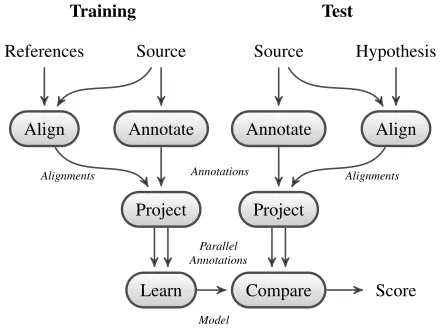
Figure 1: Architectural overview.
to compare the observed projection against the ex-pectedprojection given the source annotation. The distance between the two projections (observed and expected) can then be used as a measure of the qual-ity of the hypothesis.
As it only considers one-sided annotations, our framework does not require the availability of com-parable linguistic processors and linguistic annota-tions, tagsets, etc., on both sides of the translation process. In this way, it overcomes one of the main obstacles to the adoption of linguistic analysis for MT confidence estimation. Furthermore, the fact that source data is generally well-formed lowers the requirements on the linguistic processor in terms of robustness to noisy data, making it possible to em-ploy a wider range of linguistic processors.
Within this framework, in this paper we describe our attempt to bridge Semantic Role Labeling (SRL) and CE by modeling proposition-level semantics for pairwise translation ranking. The extent to which this kind of annotations are transferred from source to target has indeed a very high correlation with re-spect to human quality assessments (Lo and Wu, 2010a; 2010b). The measure that we propose is then an ideal addition to already established CE mea-sures, e.g., (Specia et al., 2009; Blatz et al., 2004), as it attempts to explicitly model the adequacy of translation hypotheses as a function of predicate-argument structure coverage. While we are aware of the fact that the current definition of the model can be improved in many different ways, our preliminary investigation, on five English to Spanish translation
benchmarks, shows promising accuracy on the dif-ficult task of pairwise translation ranking, even for translations with very few distinguishing features.
To capture different aspects of the projection of SRL annotations we employ two instances of the abstract architecture shown in Figure 1. The first works at theproposition level, and models the cor-rect movement of arguments from source to target. The second works at theargument level, and models the fluency and adequacy of individual arguments within each predicate-argument structure. The mod-elsthat we learn during training are simple phrase-based translation models working on different kinds of sequences, i.e., role labels in the former case and words in the latter. To evaluate the adequacy of an automatically projected proposition or argument, we force the corresponding translation model to gener-ate it (via constrained decoding). The reachability and confidence of each translation are features that we exploit to compare alternative translations, by combining them in a simple voting scheme.
To score systems which are not under our direct control (the typical scenario in CE benchmarks), we introduce a component that generates source-target alignments for any pair of aligned test sentences. This addition has the nice property of allowing us to handle the translation as a black-box, decoupling the evaluation from a specific system and, in theory, allowing the model to cope with phrase-based, rule-based or hierarchical systems alike, as well as with human-generated translations.
The rest of the paper is structured as follows: in Section 2 we will review a selection of related work; in Section 3 we will detail our approach; in Section 4 we will present the results of our evaluation; finally, in Section 5 we will draw our conclusions.
2 Related work
that the most relevant features are those based on source/target pairs and on characteristics of the translation model.
Specia et al. (2009) build on top these results by designing a feature-selection framework for confi-dence estimation. Translations are considered as black-boxs (i.e., no system or model-dependent fea-tures are employed), and novel feafea-tures based on the number of content words, a POS language model on the target side, punctuation and number matchers in source and target translations and the percentage of uni-grams are introduced. Features are selected via Partial Least Squares (PLS) regression (Wold et al., 1984). Inductive Confidence Machines (Papadopou-los et al., 2002) are used to estimate an optimal threshold to distinguish between “good” and “bad” translations. Even though the authors show that a small set of shallow features and some supervision can produce good results on a specific benchmark, we are convinced that more linguistic features are needed for these methods to perform better across a wider spectrum of domains and applications.
Concerning the usage of SRL for SMT, Wu and Fung (2009) reported a first successful application of semantic role labels to improve translation quality. They note that improvements in translation quality are not reflected by traditional MT evaluation met-rics (Doddington, 2002; Papineni et al., 2002) based onn-gram overlaps. To further investigate the topic, Lo and Wu (2010a; 2010b) involved human annota-tors to demonstrate that the quality of semantic role projection on translated sentences is very highly cor-related with human assessments.
Gim´enez and M`arquez (2010) describe a frame-work for MT evaluation and meta-evaluation com-bining a rich set ofn-gram-based and linguistic met-rics, including several variants of a metric based on SRL. Automatic and reference translations are anno-tated independently, and the lexical overlap between corresponding arguments is employed as an indica-tor of translation quality. The authors show that syn-tactic and semantic information can achieve higher reliability in system ranking than purely lexical mea-sures.
Our original contribution lies in the attempt to ex-ploit SRL for assessing translation quality in a CE scenario, i.e., in the absence of reference transla-tions. By accounting for whole predicate-argument
sequences as well as individual arguments, our model has the potential to capture aspects which relate both to the adequacy and to the fluency of a translation. Furthermore, we outline a general framework for the inclusion of linguistic processors in CE that has the advantage of requiring resources and software tools only on the source side of the translation, where well-formed input can reasonably be expected.
3 Model
The task of semantic role labeling (SRL) consists in recognizing and automatically annotating seman-tic relations between a predicate word (not nec-essarily a verb) and its arguments in natural lan-guage texts. The resulting predicate-argument struc-tures are commonly referred to aspropositions, even though we will also use the more general term anno-tations.
In PropBank (Palmer et al., 2005) style anno-tations, which our model is based on, predicates are generally verbs and roles are divided into two classes: core roles (labeled A0, A1, . . . A5), whose semantic value is defined by the predicate syntactic frame, and adjunct roles (labeled *, e.g., AM-TMP or AM-LOC)1which are a closed set of verb-independent semantic labels accounting for predi-cate aspects such as temporal, locative, manner or purpose. For instance, in the sentence “The com-mission met to discuss the problem” we can iden-tify two predicates, met and discuss. The corre-sponding annotations are “[A0The commission] [pred
met] [AM-PRPto discuss the problem]” and “[A0The
commission] met to [preddiscuss] [A1the problem]”.
Here, A0 and A1 play the role of prototypical sub-ject and obsub-ject, respectively, and AM-PRP is an ad-junct modifier expressing a notion of purpose.
Sentence annotations are inherently non-sequential, as shown by the previous example in which the predicate and one of the arguments of the second proposition (i.e., discuss and A1) are completely embedded within an argument of the first proposition (i.e., AM-PRP). Following a widely adopted simplification, the annotations in a sentence are modeled independently. Furthermore we
scribe each annotation at two levels: aproposition level, where we model the movement of arguments from source to target; and an argument level, were we model the adequacy and fluency of individual argument translations. The comparison of two alternative translations takes into account all these factors but it models each of them independently, i.e., we consider how properly each propositions is rendered in each hypothesis, and how properly each argument is translated within each proposition.
3.1 Annotation and argument projection
At the proposition level, we simply represent the se-quence of role-label in each proposition, ignoring their lexical content with the exception of the pred-icate word. Considering the previous example, the sentence would then be represented by the two se-quences “A0 met AM-PRP” and “A0 * discuss A1”. In the latter case, the special character “*” marks a “gap” between A0 and the predicate word. The annotation is projected onto the translation via di-rect word alignments obtained through a constrained machine translation process (i.e., we force the de-coder to generate the desired translation). Eventual discontinuities in the projection of an argument are modeled as gaps. If two arguments insist on a shared subset of words, then their labels are combined. If the projection of an argument is a subset of the pro-jection of the predicate word, then the argument is discarded. If the overlap is partial, then the non-overlapping part of the projection is represented.
If a word insertion occurs next to an argument or the predicate, then we include it in the final se-quence. This decision is motivated by the consider-ation that insertions at the boundary of an argument may be a clue of different syntactic realizations of the same predicate across the two languages (Levin, 1993). For example, the English construct “A0 give A2 A1” could be rendered as “doy A1 a A2” in Span-ish. Here, the insertion of the preposition “a” at de-coding can be an important indicator of translation quality.
This level of detail is insufficient to model some important features of predicate-argument structures, such as inter-argument semantic or syntactic depen-dencies, but it is sufficient to capture a variety of interesting linguistic phenomena. For instance, A0-predicate inversion translating SVO into VSO
lan-guages, or the convergence of multiple source argu-ments into a single target argument when translating into a morphologically richer language. We should also stress again that we are not claiming that the structures that we observe on the target side are lin-guistically motivated, but only that they contain rel-evant clues to assess quality aspects of translation.
As for the representation of individual arguments, we simply represent their surface form, i.e., the sequence of words spanning each argument. So, for example, the argument representations extracted from “[A0 The commission] [pred met] [AM-PRP to
discuss the problem]” would be “The commission”, “met”, “to discuss the problem”. To project each ar-gument we align all its words with the target side. The leftmost and the rightmost aligned words de-fine the boundaries of the argument in the target sen-tence. All the words in between (including eventual gaps) are considered as part of the projection of the argument. This approach is consistent with Prop-Bank style annotations, in which arguments are con-tiguous word sequences, and it allows us to employ a standard translation model to evaluate the fluency of the argument projection. The rationale here is that we rely on proposition level annotations to convey the semantic structure of the sentence, while at the argument level we are more interested in evaluating the lexical appropriateness of their realization.
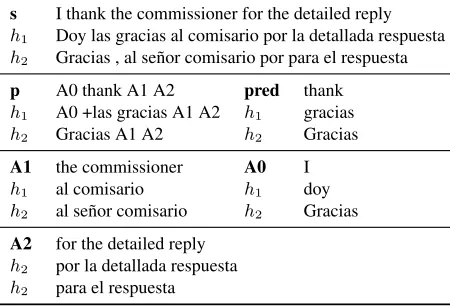
The projection of a proposition and its arguments for an example sentence is shown in Figure 2. Here,
s is the original sentence and h1 and h2 are two
translation hypotheses. The figure shows how the whole proposition (p) and the predicate word (pred) along with its arguments (A0,A1andA2) are repre-sented after projection on the two hypotheses. As we can observe, in both casesthank(the predicate word) gets aligned with the wordgracias. Forh1, the
de-coder alignsI(A0) todoy, leaving a gap between A0 and the predicate word. The gap gets filled by gen-erating the wordlas. Since the gap is adjacent to at least one argument,lasis included in the representa-tion ofpforh1. Inh2, the projection of A0 exactly
overlaps the projection of the predicate (“Gracias”), and therefore A0 is not included innforh2.
3.2 Comparing hypotheses
reli-s I thank the commissioner for the detailed reply
h1 Doy las gracias al comisario por la detallada respuesta
h2 Gracias , al se˜nor comisario por para el respuesta
p A0 thank A1 A2 pred thank
h1 A0 +las gracias A1 A2 h1 gracias
h2 Gracias A1 A2 h2 Gracias
A1 the commissioner A0 I
h1 al comisario h1 doy
h2 al se˜nor comisario h2 Gracias
A2 for the detailed reply
h2 por la detallada respuesta
[image:5.612.73.298.74.227.2]h2 para el respuesta
Figure 2: Comparison between two alternative transla-tionsh1andh2for the source sentences.
able. Lets be the source sentence, andh1 and h2
be two translation hypotheses. For each proposition
pins, we assign a confidence value to its represen-tation inh1 and h2, i.e., p1 andp2, by forcing the
proposition-level translation system to generate the projection observed in the corresponding hypothe-sis. The reachability ofp1(respectively,p2) and the
decoder confidence in translatingpasp1are used as
features to estimatep1(p2) accuracy. Similarly, for
each argument ain each propositionp we generate its automatic projection on h1 and h2, i.e., a1 and
a2. We force the argument-level decoder to translate
aintoa1 anda2, and use the respective reachability
and translation confidence as features accounting for their appropriateness.
The best translation hypothesis (h1 orh2) is then
selected according to the following decision func-tion:
h∗ = arg max i∈{0,1}
X
k
fk(hi, hj6=i, s) (1)
where each feature functionfk(·,·,·)defines a
com-parison measure between its first two arguments, and returns 1 if the first argument is greater (better) than the second, and 0 otherwise. In short, the decision function selects the hypothesis that wins the highest number of comparisons.
The feature functions that we defined account for the following factors, the last three being eval-uated once for each proposition in s: (1) Num-ber of successfully translated propositions; (2) Av-erage translation confidence for projected proposi-tions; (3) Number of times that a proposition in hi
has higher confidence than the corresponding propo-sition inhi6=j; (4) Number of successfully translated
arguments; (5) Average translation confidence for projected arguments; (6) Number of times that an argument inhihas higher confidence than the
corre-sponding argument inhi6=j.
With reference to Figure 2, the two translation hy-potheses have been scored 4 (very good) and 2 (bad) by human annotators. The score assigned by the proposition decoder top1 is higher thanp2, hence
comparisons (2) and (3) are won by h1.
Accord-ing to the arguments decoder, h1 does a better job
at representing A0 and A2;h2 is better at rendering
A1, and pred is a tie. Therefore, h1 also prevails
according to (6). Given the very high confidence as-signed to the translation of A2 inh1, the hypothesis
also prevails in (5). In this case, (1) and (4) do not contribute to the decision as the two projections have the same coverage.
4 Evaluation
In this section, we present the results obtained by applying the proposed method to the task of rank-ing consistency, or pairwise rankrank-ing of alternative translations: that is, given a source sentences, and two candidate translationsh1 andh2, decide which
one is a better translation for s. Pairwise ranking is a simplified setting for CE that is general enough to model the selection of the best translation among a finite set of alternatives. Even though it cannot measure translation quality in isolation, a reliable pairwise ranking model would be sufficient to solve many common practical CE problems, such as sys-tem ranking, user feedback filtering or hypotheses re-ranking.
4.1 Datasets
We ran our experiments on the human assessments released as part of the ACL Workshops on Machine Translations in 2007 (Callison-Burch et al., 2007), 2008 Burch et al., 2008), 2009 (Callison-Burch et al., 2009) and 2010 (Callison-(Callison-Burch et al., 2010). These datasets will be referred to as wm-tYY(t)in the remainder,YY being the last two digits of the year of the workshop andt=nfor newswire data ort = efor Europarl data. So, for example,
of the workshop. As our system is trained on Eu-roparl data, newswire test sets are to be considered out-of-domain. All the experiments are relative to English to Spanish translations.
The wmt08, wmt09 andwmt10 datasets provide a ranking among systems within the range [1,5] (1 being the worst system, and 5 the best). The dif-ferent datasets contain assessments for a difdif-ferent number of systems, namely: 11 forwmt08(e), 10 for
wmt08(n), 9 forwmt09and 16 forwmt10n. Gener-ally, multiple annotations are available for each an-notated sentence. In all cases in which multiple as-sessments are available, we used the average of the assessments.
Thewmt07dataset would be the most interesting of all, in that it provides separate assessments for the two main dimensions of translation quality, ade-quacy and fluency, as well as system rankings. Un-luckily, the number of annotations in this dataset is very small, and after eliminating the ties the bers are even smaller. As results on such small num-bers would not be very representative, we decided not to include them in our evaluation.
We also evaluated on the dataset described in (Specia et al., 2010), which we will refer to as
specia. As the system is based on Europarl data, it is to be considered an in-domain benchmark. The dataset includes results produced by four different systems, each translation being annotated by only one judge. Given the size of the corpus (the output of each system has been annotated on the same set of 4,000 sentences), this dataset is the most repre-sentative among those that we considered. It is also especially interesting for two other reasons: 1) sys-tems are assigned a score ranging from 1 (bad) to 4 (good as it is) based on the number of edits required to produce a publication-ready translation. There-fore, here we have an absolute measure of transla-tion accuracy, as opposed to relative rankings; 2) each system involved in the evaluation has very pe-culiar characteristics, hence they are very likely to generate quite different translations for the same in-put sentences.
4.2 Setup
Our model consists of four main components: an automatic semantic role labeler (to annotate source sentences); a lexical translation model (to
gener-ate the alignments required to map the annotations onto a translation hypothesis); a translation model for predicate-argument structures, to assign a score to projected annotations; and a translation model for role fillers, to assign a score to the projection of each argument.
To automatically label our training data with se-mantic roles we used the Swirl system2 (Surdeanu and Turmo, 2005) with the bundled English mod-els for syntactic and semantic parsing. On the CoNLL-2005 benchmark (Carreras and M`arquez, 2005), Swirl sports an F1-measure of 76.46. This figure drops to 75 for mixed data, and to 65.42 on out-of-domain data, which we can regard as a con-servative estimate of the accuracy of the labeler on
wmtbenchmarks.
For all the translation tasks we employed the Moses phrase-based decoder3in a single-factor con-figuration. The -constraint command line pa-rameter is used to force Moses to output the desired translation. For the English to Spanish lexical trans-lation model, we used an already available model learned using all availablewmt10edata.
To build theproposition leveltranslation system, we first annotated all the English sentences from the
wmt10e (en→es) training set with Swirl; then, we forced the lexical translation model to generate the alignments for the reference translations and pro-jected the annotations on the target side. The process resulted in 2,493,476 parallel annotations. 5,000 an-notations were held-out for model tuning. The train-ing data was used to estimate a 5-gram language model and the translation model, which we later op-timized on held-out data.
As for the argument level translator, we trained it on parallel word sequences spanning the same role in an annotation and its projection. Each such pair constitutes a training example for the argu-ment translator, each arguargu-ment representation being modeled independently from the others. With the same setup used for the proposition translator, we collected 4,578,480 parallel argument fillers from
wmt10e en→es training data, holding out 20,000 pairs for model tuning.
2
http://www.surdeanu.name/mihai/swirl/
3
4.3 A note on recall
The main limitation of the model in its current im-plementation is its low recall. The translation model that we use to generate the alignments is mostly re-sponsible for it. In fact, in approximately 35% of the cases the constrained translation model is not able to generate the required hypothesis. An obvious im-provement would consist in using just an alignment model for this task, instead of resorting to transla-tion, for instance following the approach adopted in (Espl`a et al., 2011). It should also be noted that, while this component adds the interesting property of decoupling the measure from the system that pro-duced the hypothesis, it is not strictly necessary in all those cases in which translation alignments are already available, e.g., for N-best re-ranking.
The second component that suffers from recall problems is the semantic role labeler, which fails in annotating sentences in approximately 6% of the re-maining cases. These failures are by and large due to the lack of proper verbal predicates in the target sentence, and as such expose a limiting factor of the underlying model. In another 3% of the cases, an annotation is produced but it cannot be projected on the hypothesis, since the predicate word on the target side gets deleted during translation.
Another important consideration is that no mea-sure for CE is conceived to be used in isolation, and our measure is no exception. In combination with others, the measure should only trigger when ap-propriate, i.e., when it is able to capture interesting patterns that are significant to discriminate transla-tion quality. If it abstains, the other measures would compensate for the missing values. In this respect, we should also consider that not being able to pro-duce a translation may be inherently considered an indicator of translation quality.
4.4 Results
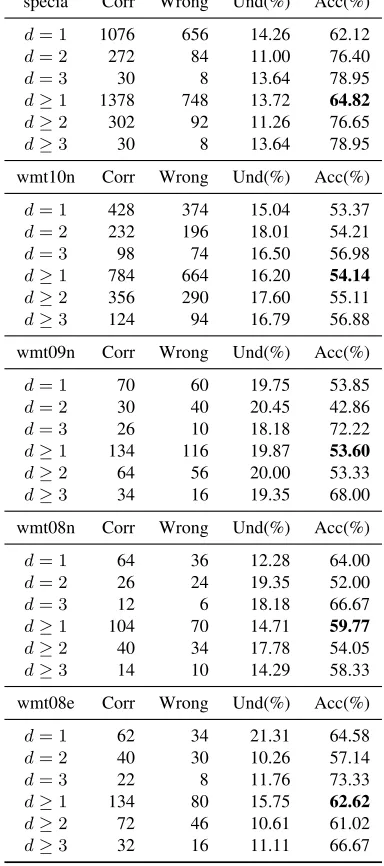
Table 1 lists, in each block of rows, pairwise classifi-cation accuracy results obtained on a specific bench-mark. The benchmarks are sorted in order of re-verse relevance, the largest benchmark (specia) be-ing listed first. In each row, we show results obtained for different configurations in which the variable is the distancedbetween two assessment scores. So, for example, the row d = 1 accounts for all the
specia Corr Wrong Und(%) Acc(%)
d= 1 1076 656 14.26 62.12
d= 2 272 84 11.00 76.40
d= 3 30 8 13.64 78.95
d≥1 1378 748 13.72 64.82
d≥2 302 92 11.26 76.65
d≥3 30 8 13.64 78.95
wmt10n Corr Wrong Und(%) Acc(%)
d= 1 428 374 15.04 53.37
d= 2 232 196 18.01 54.21
d= 3 98 74 16.50 56.98
d≥1 784 664 16.20 54.14
d≥2 356 290 17.60 55.11
d≥3 124 94 16.79 56.88
wmt09n Corr Wrong Und(%) Acc(%)
d= 1 70 60 19.75 53.85
d= 2 30 40 20.45 42.86
d= 3 26 10 18.18 72.22
d≥1 134 116 19.87 53.60
d≥2 64 56 20.00 53.33
d≥3 34 16 19.35 68.00
wmt08n Corr Wrong Und(%) Acc(%)
d= 1 64 36 12.28 64.00
d= 2 26 24 19.35 52.00
d= 3 12 6 18.18 66.67
d≥1 104 70 14.71 59.77
d≥2 40 34 17.78 54.05
d≥3 14 10 14.29 58.33
wmt08e Corr Wrong Und(%) Acc(%)
d= 1 62 34 21.31 64.58
d= 2 40 30 10.26 57.14
d= 3 22 8 11.76 73.33
d≥1 134 80 15.75 62.62
d≥2 72 46 10.61 61.02
[image:7.612.330.522.80.513.2]d≥3 32 16 11.11 66.67
Table 1: Results on five confidence estimation bench-marks. Annnext to the task name (e.g. wmt08n) stands for a news (i.e. out of domain) corpus, whereas ane(e.g. wmt08e) stands for a Europarl (i.e. in domain) corpus. Thespeciacorpus is in-domain.
The accuracy for d ≥ 1, i.e., on all the available annotations, is shown in bold.
First, we can observe that the results are above the baseline (an accuracy of 50% for evenly distributed binary classification) on all the benchmarks and for all configurations. The only outlier is wmt09n for
d = 2, with an accuracy of 42.86%. Across the different datasets, results vary from promising ( spe-ciaandwmt08e, where accuracy is generally above 60%) to mildly good (wmt10n), but across all the board the method seems to be able to provide useful clues for confidence estimation.
As expected, the accuracy of classification tends to increase as the difference between hypotheses be-comes more manifest. In four cases out of six, the accuracy ford = 3is above 60%, with the notable peaks onspecia,wmt09nandwmt08ewhere it goes over 70% (on the first, it arrives almost at 80%). Unluckily, very few translations have very different quality (a measure of the difficulty of the task). Nev-ertheless, the general trend seems to support the re-liability of the approach.
When we consider the results on the whole datasets (i.e., d ≥ 1), pairwise classification accu-racy ranges from 54% (for wmt09n and wmt10n, both out-of-domain), to 63-64% (for specia and
wmt08e, both in-domain). Interestingly, the perfor-mance on wmt08n, which is also out-of-domain, is closer to in-domain benchmarks, i.e., 60%. These figures suggest that the method is consistently reli-able on in-domain data, but also out-of-domain eval-uation can benefit from its application. The differ-ence in performance betweenwmt08nand the other out-of-domain benchmarks will be reason of further investigation as future work, as well as the drop in performance ford= 2on three of the benchmarks.
5 Conclusions
We have presented a model to exploit the rich in-formation encoded by predicate-argument structures for confidence estimation in machine translation. The model is based on a battery of translation sys-tems, which we use to study the movement and the internal representation of propositions and ar-guments projected from source to target via auto-matic alignments. Our preliminary results, obtained on five different benchmarks, suggest that the
ap-proach is well grounded and that semantic annota-tions have the potential to be successfully employed for this task.
The model can be improved in many ways, its ma-jor weakness being its low recall as discussed in Sec-tion 4.3. Another area in which there is margin for improvement is the representation of predicate ar-gument structures. It is reasonable to assume that different representations could yield very different results. Introducing more clues about the seman-tic content of the whole predicate argument struc-ture, e.g., by including argument head words in the representation of the proposition, or considering a more fine-grained representation at the proposition level, could make it possible to assess the quality of a translation reducing the need to back-off to indi-vidual arguments. As for the representation of ar-guments, a first and straightforward improvement would be to train a separate model for each argument class, or to move to a factored model that would al-low us to model explicitly the insertion of words or the overlap of argument words due to the projection. Another important research direction involves the combination of this measure with already assessed metric sets for CE, e.g., (Specia et al., 2010), to un-derstand to what extent it can contribute to improve the overall performance. In this respect, we would also like to move from a heuristic scoring function to a statistical model.
Finally, we would like to test the generality of the approach by designing other features based on the same “annotate, project, measure” framework, as we strongly believe that it is an effective yet simple way to combine several linguistic features for machine translation evaluation. For example, we would like to apply a similar framework to model the movement of chunks or POS sequences.
Acknowledgments
We would like to thank the anonymous reviewers for their valuable comments. This research has been partially funded
by the Spanish Ministry of Education and Science (OpenMT-2, TIN2009-14675-C03) and the European Community’s Sev-enth Framework Programme (FP7/2007-2013) under grant
References
John Blatz, Erin Fitzgerald, George Foster, Simona Gan-drabur, Cyril Goutte, Alex Kulesza, Alberto Sanchis, and Nicola Ueffing. 2004. Confidence estimation for machine translation. In Proceedings of the 20th in-ternational conference on Computational Linguistics, COLING ’04, Stroudsburg, PA, USA. ACL.
Chris Callison-Burch, Philipp Koehn, Cameron Shaw Fordyce, and Christof Monz, editors. 2007. Proceed-ings of the Second Workshop on Statistical Machine Translation. ACL, Prague, Czech Republic.
Chris Callison-Burch, Philipp Koehn, Christof Monz, Josh Schroeder, and Cameron Shaw Fordyce, editors. 2008. Proceedings of the Third Workshop on Statisti-cal Machine Translation. ACL, Columbus, Ohio. Chris Callison-Burch, Philipp Koehn, Christof Monz,
and Josh Schroeder, editors. 2009. Proceedings of the Fourth Workshop on Statistical Machine Translation. ACL, Athens, Greece.
Chris Callison-Burch, Philipp Koehn, Christof Monz, Kay Peterson, and Omar Zaidan, editors. 2010. Pro-ceedings of the Joint Fifth Workshop on Statistical Ma-chine Translation and MetricsMATR. ACL, Uppsala, Sweden.
Xavier Carreras and Llu´ıs M`arquez. 2005. Introduc-tion to the CoNLL-2005 shared task: Semantic role labeling. InProceedings of the Ninth Conference on Computational Natural Language Learning (CoNLL-2005), pages 152–164, Ann Arbor, Michigan, June. Association for Computational Linguistics.
George Doddington. 2002. Automatic evaluation of ma-chine translation quality using n-gram co-occurrence statistics. In Proceedings of the second interna-tional conference on Human Language Technology Research, HLT ’02, pages 138–145, San Francisco, CA, USA. Morgan Kaufmann Publishers Inc.
Miquel Espl`a, Felipe S´anchez-Mart´ınez, and Mikel L. Forcada. 2011. Using word alignments to assist computer-aided translation users by marking which target-side words to change or keep unedited. In Pro-ceedings of the 15th Annual Conference of the Euro-pean Associtation for Machine Translation.
Jes´us Gim´enez and Llu´ıs M`arquez. 2010. Lin-guistic measures for automatic machine transla-tion evaluatransla-tion. Machine Translation, 24:209–240. 10.1007/s10590-011-9088-7.
Beth Levin. 1993. English Verb Classes and Alterna-tions. The University of Chicago Press.
Chi-kiu Lo and Dekai Wu. 2010a. Evaluating machine translation utility via semantic role labels. In Pro-ceedings of the Seventh conference on International Language Resources and Evaluation (LREC’10), Val-letta, Malta. European Language Resources Associa-tion (ELRA).
Chi-kiu Lo and Dekai Wu. 2010b. Semantic vs. syntac-tic vs. n-gram structure for machine translation evalu-ation. InProceedings of the 4th Workshop on Syntax and Structure in Statistical Translation, pages 52–60, Beijing, China.
Martha Palmer, Daniel Gildea, and Paul Kingsbury. 2005. The Proposition Bank: An Annotated Corpus of Semantic Roles. Comput. Linguist., 31(1):71–106. Harris Papadopoulos, Kostas Proedrou, Volodya Vovk,
and Alexander Gammerman. 2002. Inductive confi-dence machines for regression. InAMAI’02.
Kishore Papineni, Salim Roukos, Todd Ward, and Wei-Jing Zhu. 2002. BLEU: a method for automatic evaluation of machine translation. InProceedings of the 40th Annual Meeting on Association for Computa-tional Linguistics, ACL ’02, pages 311–318, Strouds-burg, PA, USA. ACL.
Lucia Specia, Marco Turchi, Zhuoran Wang, John Shawe-Taylor, and Craig Saunders. 2009. Improv-ing the confidence of machine translation quality es-timates. InMachine Translation Summit XII, Ottawa, Canada.
Lucia Specia, Nicola Cancedda, and Marc Dymetman. 2010. A dataset for assessing machine translation evaluation metrics. In Proceedings of the Seventh conference on International Language Resources and Evaluation (LREC’10), Valletta, Malta. European Lan-guage Resources Association (ELRA).
Mihai Surdeanu and Jordi Turmo. 2005. Seman-tic role labeling using complete syntacSeman-tic analysis. In Proceedings of the Ninth Conference on Compu-tational Natural Language Learning (CoNLL-2005), pages 221–224, Ann Arbor, Michigan, June. Associ-ation for ComputAssoci-ational Linguistics.
S. Wold, A. Ruhe, H Wold, and W.J. Dunn. 1984. The collinearity problem in linear regression. the partial least squares (pls) approach to generalized inverses. 5:735–743.