Proceedings of the Workshop on Distributional Semantics and Compositionality (DiSCo’2011), pages 54–60,
Exemplar-based Word-Space Model for Compositionality Detection: Shared
task system description
Siva Reddy University of York, UK
Suresh Manandhar University of York, UK [email protected]
Diana McCarthy Lexical Computing Ltd, UK [email protected]
Spandana Gella University of York, UK [email protected]
Abstract
In this paper, we highlight the problems of polysemy in word space models of compo-sitionality detection. Most models represent each word as a single prototype-based vec-tor without addressing polysemy. We propose an exemplar-based model which is designed to handle polysemy. This model is tested for compositionality detection and it is found to outperform existing prototype-based models. We have participated in the shared task (Bie-mann and Giesbrecht, 2011) and our best per-forming exemplar-model is ranked first in two types of evaluations and second in two other evaluations.
1 Introduction
In the field of computational semantics, to represent the meaning of a compound word, two mechanisms are commonly used. One is based onthe distribu-tional hypothesis(Harris, 1954) and the other is on
the principle of semantic compositionality (Partee, 1995, p. 313).
The distributional hypothesis (DH) states that
words that occur in similar contexts tend to have similar meanings. Using this hypothesis, distribu-tional models like the Word-space model (WSM, Sahlgren, 2006) represent a target word’s meaning as a context vector (location in space). The simi-larity between two meanings is thecloseness (prox-imity) between the vectors. The context vector of a target word is built from its distributional behaviour observed in a corpus. Similarly, the context vector of a compound word can be built by treating the
com-pound as a single word. We refer to such a vector as aDH-based vector.
The other mechanism is based on the principle of semantic compositionality (PSC) which states that
the meaning of a compound word is a function of, and only of, the meaning of its parts and the way in which the parts are combined. If the meaning of a part is represented in a WSM using the distribu-tional hypothesis, then the principle can be applied to compose the distributional behaviour of a com-pound word from its parts without actually using the corpus instances of the compound. We refer to this as aPSC-based vector. So aPSC-based is composed of componentDH-based vectors.
Both of these two mechanisms are capable of de-termining the meaning vector of a compound word. For a given compound, if a DH-based vector and a PSC-based vector of the compound are projected into an identical space, one would expect the vec-tors to occupy the same location i.e. both the vecvec-tors should be nearly the same. However the principle of semantic compositionality does not hold for non-compositional compounds, which is actually what the existingWSMs of compositionality detection ex-ploit (Giesbrecht, 2009; Katz and Giesbrecht, 2006; Schone and Jurafsky, 2001). The DH-based and
PSC-based vectors are expected to have high simi-larity when a compound is compositional and low similarity for non-compositional compounds.
Most methods inWSM(Turney and Pantel, 2010) represent a word as a single context vector built from merging all its corpus instances. Such a representa-tion is called theprototype-based modelling (Mur-phy, 2002). These prototype-based vectors do not
distinguish the instances according to the senses of a target word. Since most compounds are less am-biguous than single words, there is less need for dis-tinguishing instances in a DH-based prototype vec-tor of a compound and we do not address that here but leave ambiguity of compounds for future work. However the constituent words of the compound are more ambiguous. When DH-based vectors of the
constituent words are used for composing thePSC -based vector of the compound, the resulting vec-tor may contain instances, and therefore contexts, that are not relevant for the given compound. These noisy contexts effect the similarity between thePSC -based vector and the DH-based vector of the com-pound. Basing compositionality judgements on a such a noisy similarity value is no longer reliable.
In this paper, we address this problem of pol-ysemy of constituent words of a compound using an exemplar-based modelling (Smith and Medin, 1981). In exemplar-based modelling of WSM (Erk and Pad´o, 2010), each word is represented by all its corpus instances (exemplars) without merging them into a single vector. Depending upon the purpose, only relevant exemplars of the target word are acti-vated and then these are merged to form a refined prototype-vector which is less-noisy compared to the original prototype-vector. Exemplar-based mod-els are more powerful than prototype-based ones be-cause they retain specific instance information.
We have evaluated our models on the validation data released in the shared task (Biemann and Gies-brecht, 2011). Based on the validation results, we have chosen three systems for public evaluation and participated in the shared task (Biemann and Gies-brecht, 2011).
2 Word Space Model
In this section, construction ofWSMfor all our ex-periments is described. We use Sketch Engine1 (Kil-garriff et al., 2004) to retrieve all the exemplars for a target word or a pattern using corpus query lan-guage. Letw1 w2 be a compound word with con-stituent words w1 and w2. Ew denotes the set of exemplars ofw. Vw is the prototype vector of the wordw, which is built by merging all the exemplars inEw
1
Sketch Enginehttp://www.sketchengine.co.uk
For the purposes of producing aPSC-based vector for a compound, a vector of a constituent word is built using only the exemplars whichdo notcontain the compound. Note that the vectors are sensitive to a compound’s word-order since the exemplars of w1 w2are not the same asw2 w1.
We use other WSM settings following Mitchell and Lapata (2008). The dimensions of the WSM
are the top 2000 content words in the given corpus (along with their coarse-grained part-of-speech in-formation). Cosine similarity(sim) is used to mea-sure the similarity between two vectors. Values at the specific positions in the vector representing con-text words are set to the ratio of the probability of the context word given the target word to the overall probability of the context word. The context window of a target word’s exemplar is the whole sentence of the target word excluding the target word. Our lan-guage of interest is English. We use the ukWaC cor-pus (Ferraresi et al., 2008) for producing outWSMs.
3 Related Work
As described in Section 1, most WSM models for compositionality detection measure the similarity between the true distributional vectorVw1w2 of the compound and the composed vectorVw1⊕w2, where
⊕denotes a compositionality function. If the simi-larity is high, the compound is treated as composi-tional or else non-composicomposi-tional.
Giesbrecht (2009); Katz and Giesbrecht (2006); Schone and Jurafsky (2001) obtained the compo-sitionality vector of w1 w2 using vector addition
Vw1⊕w2 = aVw1 + bVw2. In this approach, if
sim(Vw1⊕w2, Vw1w2) > γ, the compound is
clas-sified as compositional, whereγ is a threshold for deciding compositionality. Global values ofaandb were chosen by optimizing the performance on the development set. It was found that no single thresh-old valueγ held for all compounds. Changing the threshold alters performance arbitrarily. This might be due to the polysemous nature of the constituent words which makes the composed vector Vw1⊕w2
filled with noisy contexts and thus making the judge-ment unpredictable.
thresh-oldγ. We try to address this problem by addressing the polysemy inWSMs using exemplar-based mod-elling.
The above models use a simple addition based compositionality function. Mitchell and Lapata (2008) observed that a simple multiplication func-tion modelled composifunc-tionality better than addi-tion. Contrary to that, Guevara (2011) observed additive models worked well for building composi-tional vectors. In our work, we try using evidence from both compositionality functions, simple addi-tion and simple multiplicaaddi-tion.
Bannard et al. (2003); McCarthy et al. (2003) ob-served that methods based on distributional similar-ities between a phrase and its constituent words help when determining the compositionality behaviour of phrases. We therefore also use evidence from the similarities between each constituent word and the compound.
4 Our Approach: Exemplar-based Model
Our approach works as follows. Firstly, given a compound w1 w2, we build its DH-based
proto-type vector Vw1w2 from all its exemplars Ew1w2. Secondly, we remove irrelevant exemplars inEw1 andEw2 of constituent words and build the refined prototype vectors Vwr
1 and Vwr2 of the constituent
words w1 and w2 respectively. These refined
vec-tors are used to compose thePSC-based vectors2of the compound. Related work to ours is (Reisinger and Mooney, 2010) where exemplars of a word are first clustered and then prototype vectors are built. This work does not relate to compositionality but to measuring semantic similarity of single words. As such, their clusters are not influenced by other words whereas in our approach for detecting composition-ality, the other constituent word plays a major role.
We use the compositionality functions, sim-ple addition and simsim-ple multiplication to build Vwr
1+w2r and Vwr1×wr2 respectively. Based on
the similaritiessim(Vw1w2, Vwr
1),sim(Vw1w2, Vwr2),
sim(Vw1w2, Vwr
1+wr2)andsim(Vw1w2, Vw1r×w2r), we
decide if the compound is compositional or non-compositional. These steps are described in a little more detail below.
2Note that we use twoPSC-based vectors for representing a
compound.
4.1 Building Refined Prototype Vectors
We aim to remove irrelevant exemplars of one con-stituent word with the help of the other concon-stituent word’s distributional behaviour. For example, let us take the compound traffic light. Light occurs in many contexts such as quantum theory, optics, lamps and spiritual theory. In ukWaC, light has 316,126 instances. Not all these exemplars are rel-evant to compose the PSC-based vector of traffic light. These irrelevant exemplars increases the se-mantic differences betweentraffic lightandlightand thus increase the differences between Vtraffic⊕light
andVtraffic light. sim(Vlight, Vtraffic light)is found to be 0.27.
Our intuition and motivation for exemplar re-moval is that it is beneficiary to choose only the exemplars of light which share similar contexts of
traffic since traffic light should have contexts sim-ilar to both traffic and light if it is compositional. We rank each exemplar oflight based on common co-occurrences oftraffic and also words which are distributionally similar totraffic. Co-occurrences of
trafficare the context words which frequently occur withtraffic, e.g. car, road etc. Using these, the exemplar from a sentence such as “Cameras capture
cars running red lights . . .” will be ranked higher than one which does not have contexts related to
traffic. The distributionally similar words totraffic
are the words (like synonyms, antonyms) which are similar totraffic in that they occur in similar con-texts, e.g. transport, flow etc. Using these distri-butionally similar words helps reduce the impact of data sparseness and helps prioritise contexts of traf-ficwhich are semantically related. We use Sketch Engine to compute the scores of a word observed in a given corpus. Sketch Engine scores the co-occurrences (collocations) using logDice motivated by (Curran, 2003) and distributionally related words using (Rychl´y and Kilgarriff, 2007; Lexical Com-puting Ltd., 2007). For a given word, both of these scores are normalised in the range (0,1)
All the exemplars of light are ranked based on the co-occurrences of these collocations and distri-butionally related words oftrafficusing
strafficE∈E light =
X
c∈E
xEc ×ytrafficc (1)
wherestrafficE∈E
exemplarE w.r.t. traffic, cfor context word in the exemplarE,xEc is the coordinate value (contextual score) of the context wordcin the exemplarE and yctrafficis the score of the context wordcw.r.t.traffic. A refined prototype vector oflightis then built by merging the topnexemplars oflight
Vlightr =
n X
ei∈Elighttraffic;i=0
ei (2)
where Etraffic
light are the set of exemplars of light
ranked using co-occurrence information from the other constituent wordtraffic. nis chosen such that sim(Vlightr, Vtraffic light) is maximised. This similar-ity is observed to be greatest using just 2286 (less than 1%) of the total exemplars oflight. After ex-emplar removal,sim(Vlightr, Vtraffic light)increased to 0.47 from the initial value of 0.27. Thoughnis cho-sen by maximising similarity, which is not desirable for non-compositional compounds, the lack of simi-larity will give the strongest possible indication that a compound is not compositional.
4.2 Building Compositional Vectors
We use the compositionality functions, simple ad-dition and simple multiplication to build composi-tional vectorsVwr
1+w2randVwr1×wr2. These are as
de-scribed in (Mitchell and Lapata, 2008). In model ad-dition,Vw1⊕w2 =aVw1+bVw2, all the previous
ap-proaches use static values ofaandb. Instead, we use dynamic weights computed from the participating vectors using a = sim(Vw1w2,Vw1)
sim(Vw1w2,Vw1)+sim(Vw1w2,Vw2)
andb= 1−a. These weights differ from compound to compound.
4.3 Compositionality Judgement
To judge if a compound is compositional or non-compositional, previous approaches (see Section 3) base their judgement on a single similarity value. As discussed, we base our judgement based on the col-lective evidences from all the similarity values using a linear equation of the form
α(Vwr
1, Vwr2) =a0+a1.sim(Vw1w2, Vw1r)
+a2.sim(Vw1w2, Vw2r) (3)
+a3.sim(Vw1w2, Vw1r+wr2)
+a4.sim(Vw1w2, Vwr
1×wr2)
[image:4.612.373.476.57.113.2]Model APD Acc. Exm-Best 13.09 88.0 Pro-Addn 15.42 76.0 Pro-Mult 17.52 80.0 Pro-Best 15.12 80.0
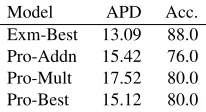
Table 1: Average Point Difference (APD) and Av-erage Accuracy (Acc.) of Compositionality Judge-ments
where the value ofα denotes the compositionality score. The range ofαis in between 0-100. Ifα ≤
34, the compound is treated as non-compositional,
34 < α < 67as medium compositional and α ≥
67 as highly compositional. The parameters ai’s are estimated using ordinary least square regression by training over the training data released in the shared task (Biemann and Giesbrecht, 2011). For the three categories – adjective-noun, verb-object and subject-verb – the parameters are estimated sep-arately.
Note that ifa1 =a2 =a4 = 0, the model bases
its judgement only on addition. Similarly if a1 =
a2 =a3 = 0, the model bases its judgement only on
multiplication.
We also experimented with combinations such as α(Vwr
1, Vw2)andα(Vw1, Vwr2)i.e. using refined
vec-tor for one of the constituent word and the unrefined prototype vector for the other constituent word.
4.4 Selecting the best model
To participate in the shared task, we have selected the best performing model by evaluating the mod-els on the validation data released in the shared task (Biemann and Giesbrecht, 2011). Table 1 displays the results on the validation data. The average point difference is calculated by taking the average of the difference in a model’s scoreα and the gold score annotated by humans, over all compounds. Table 1 also displays the overall accuracy of coarse grained labels – low, medium and high.
TotPrd Spearmanρ Kendallsτ
Rand-Base 174 0.02 0.02
Exm-Best 169 0.35 0.24
Pro-Best 169 0.33 0.23
Exm 169 0.26 0.18
[image:5.612.315.537.58.135.2]SharedTaskNextBest 174 0.33 0.23
Table 2: Correlation Scores
the actual compounds in those categories. We leave analysis of this for future work. We combined the outputs of these category-specific models to build the best modelExm-Best.
For comparison, results of standard mod-els prototype addition (Pro-Addn) and prototype-multiplication(Pro-Mult)are also displayed in Table 1.Pro-Addncan be represented asα(Vw1, Vw2)with a1 =a2 =a4 = 0. Pro-Multcan be represented as α(Vw1, Vw2) witha1 = a2 = a3 = 0. Pro-Best is
the best performing model in prototype-based mod-elling. It is found to be α(Vw1, Vw2). (Note:
De-pending upon the compound type, some of theai’s
inPro-Bestmay be 0).
Overall, exemplar-based modelling excelled in both the evaluations, average point difference and coarse-grained label accuracies. The systems Exm-Best, Pro-Best and Exmα(Vwr
1, Vwr2) were
submit-ted for the public evaluation in the shared task. All the model parameters were estimated by regression on the task’s training data separately for the 3 com-pound types as described in Section 4.3. We perform the regression separately for these classes to max-imise performance. In the future, we will investigate whether these settings gave us better results on the test data compared to setting the values the same re-gardless of the category of compound.
5 Shared Task Results
Table 2 displays Spearmanρ and Kendallsτ corre-lation scores of all the models. TotPrd stands for the total number of predictions. Rand-Base is the baseline system which randomly assigns a compo-sitionality score for a compound. Our model Exm-Best was the best performing system compared to all other systems in this evaluation criteria. Shared-TaskNextBest is the next best performing system apart from our models. Due to lemmatization er-rors in the test data, our models could only predict judgements for 169 out of 174 compounds.
All ADJ-NN V-SUBJ V-OBJ Rand-Base 32.82 34.57 29.83 32.34 Zero-Base 23.42 24.67 17.03 25.47 Exm-Best 16.51 15.19 15.72 18.6 Pro-Best 16.79 14.62 18.89 18.31
Exm 17.28 15.82 18.18 18.6
[image:5.612.78.301.58.125.2]SharedTaskBest 16.19 14.93 21.64 14.66
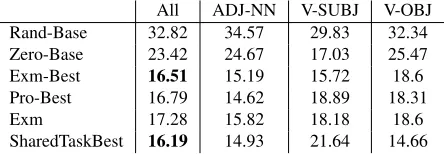
Table 3: Average Point Difference Scores
All ADJ-NN V-SUBJ V-OBJ Rand-Base 0.297 0.288 0.308 0.30 Zero-Base 0.356 0.288 0.654 0.25 Most-Freq-Base 0.593 0.673 0.346 0.65 Exm-Best 0.576 0.692 0.5 0.475 Pro-Best 0.567 0.731 0.346 0.5
Exm 0.542 0.692 0.346 0.475
SharedTaskBest 0.585 0.654 0.385 0.625
Table 4: Coarse Grained Accuracy
Table 3 displays average point difference scores. Zero-Base is a baseline system which assigns a score of 50 to all compounds. SharedTaskBest is the over-all best performing system. Exm-Best was ranked second best among all the systems. For ADJ-NN and V-SUBJ compounds, the best performing sys-tems in the shared task are Pro-Best and Exm-Best respectively. Our models did less well on V-OBJ compounds and we will explore the reasons for this in future work.
Table 4 displays coarse grained scores. As above, similar behaviour is observed for coarse grained ac-curacies. Most-Freq-Base is the baseline system which assigns the most frequent coarse-grained la-bel for a compound based on its type (ADJ-NN, V-SUBJ, V-OBJ) as observed in training data. Most-Freq-Base outperforms all other systems.
6 Conclusions
References
Baldwin, T., Bannard, C., Tanaka, T., and Widdows, D. (2003). An empirical model of multiword ex-pression decomposability. InProceedings of the ACL 2003 workshop on Multiword expressions: analysis, acquisition and treatment - Volume 18, MWE ’03, pages 89–96, Stroudsburg, PA, USA. Association for Computational Linguistics.
Bannard, C., Baldwin, T., and Lascarides, A. (2003). A statistical approach to the semantics of verb-particles. InProceedings of the ACL 2003 work-shop on Multiword expressions: analysis, ac-quisition and treatment - Volume 18, MWE ’03, pages 65–72, Stroudsburg, PA, USA. Association for Computational Linguistics.
Biemann, C. and Giesbrecht, E. (2011). Distri-butional semantics and compositionality 2011: Shared task description and results. In Pro-ceedings of DISCo-2011 in conjunction with ACL 2011.
Curran, J. R. (2003). From distributional to semantic similarity. Technical report, PhD Thesis, Univer-sity of Edinburgh.
Erk, K. and Pad´o, S. (2010). Exemplar-based mod-els for word meaning in context. In Proceed-ings of the ACL 2010 Conference Short Papers, ACLShort ’10, pages 92–97, Stroudsburg, PA, USA. Association for Computational Linguistics.
Ferraresi, A., Zanchetta, E., Baroni, M., and Bernar-dini, S. (2008). Introducing and evaluating ukwac, a very large web-derived corpus of en-glish. InProceedings of the WAC4 Workshop at LREC 2008, Marrakesh, Morocco.
Giesbrecht, E. (2009). In search of semantic com-positionality in vector spaces. In Proceedings of the 17th International Conference on Concep-tual Structures: ConcepConcep-tual Structures: Leverag-ing Semantic Technologies, ICCS ’09, pages 173– 184, Berlin, Heidelberg. Springer-Verlag.
Guevara, E. R. (2011). Computing semantic com-positionality in distributional semantics. In Pro-ceedings of the Ninth International Conference on Computational Semantics, IWCS ’2011.
Harris, Z. S. (1954). Distributional structure. Word, 10:146–162.
Katz, G. and Giesbrecht, E. (2006). Automatic identification of non-compositional multi-word expressions using latent semantic analysis. In
Proceedings of the Workshop on Multiword Ex-pressions: Identifying and Exploiting Underly-ing Properties, MWE ’06, pages 12–19, Strouds-burg, PA, USA. Association for Computational Linguistics.
Kilgarriff, A., Rychly, P., Smrz, P., and Tugwell, D. (2004). The sketch engine. InProceedings of EU-RALEX.
Lexical Computing Ltd. (2007). Statistics used in the sketch engine.
McCarthy, D., Keller, B., and Carroll, J. (2003). Detecting a continuum of compositionality in phrasal verbs. In Proceedings of the ACL 2003 workshop on Multiword expressions: analysis, acquisition and treatment - Volume 18, MWE ’03, pages 73–80, Stroudsburg, PA, USA. Association for Computational Linguistics.
Mitchell, J. and Lapata, M. (2008). Vector-based Models of Semantic Composition. In Proceed-ings of ACL-08: HLT, pages 236–244, Columbus, Ohio. Association for Computational Linguistics.
Murphy, G. L. (2002). The Big Book of Concepts. The MIT Press.
Partee, B. (1995). Lexical semantics and compo-sitionality. L. Gleitman and M. Liberman (eds.) Language, which is Volume 1 of D. Osherson (ed.) An Invitation to Cognitive Science (2nd Edition), pages 311–360.
Reisinger, J. and Mooney, R. J. (2010). Multi-prototype vector-space models of word mean-ing. InProceedings of the 11th Annual Confer-ence of the North American Chapter of the As-sociation for Computational Linguistics (NAACL-2010), pages 109–117.
Rychl´y, P. and Kilgarriff, A. (2007). An efficient algorithm for building a distributional thesaurus (and other sketch engine developments). In Pro-ceedings of the 45th Annual Meeting of the ACL on Interactive Poster and Demonstration Ses-sions, ACL ’07, pages 41–44, Stroudsburg, PA, USA. Association for Computational Linguistics.
syntag-matic and paradigsyntag-matic relations between words in high-dimensional vector spaces. PhD thesis, Stockholm University.
Schone, P. and Jurafsky, D. (2001). Is knowledge-free induction of multiword unit dictionary head-words a solved problem? In Proceedings of the Conference on Empirical Methods in Natural Language Processing, EMNLP ’01.
Smith, E. E. and Medin, D. L. (1981). Categories and concepts / Edward E. Smith and Douglas L. Medin. Harvard University Press, Cambridge, Mass. :.