Factored Translation with Unsupervised Word Clusters
Christian Rishøj
Center for Language Technology
University of Copenhagen
[email protected]
Anders Søgaard
Center for Language Technology
University of Copenhagen
[email protected]
Abstract
Unsupervised word clustering algorithms — which form word clusters based on a measure of distributional similarity — have proven to be useful in providing beneficial features for var-ious natural language processing tasks involv-ing supervised learninvolv-ing. This work explores the utility of such word clusters as factors in sta-tistical machine translation.
Although some of the language pairs in this work clearly benefit from the factor augmen-tation, there is no consistent improvement in translation accuracy across the board. For all language pairs, the word clusters clearly im-prove translation for some proportion of the sentences in the test set, but has a weak or even detrimental effect on the rest.
It is shown that if one could determine whether or not to use a factor when translating a given sentence, rather substantial improvements in precision could be achieved for all of the lan-guage pairs evaluated. While such an “oracle” method is not identified, evaluations indicate that unsupervised word cluster are most bene-ficial in sentenceswithoutunknown words.
1
Factored translation
One can go far in terms of translation quality with plenty of bilingual text and a translation model that maps small chunks of tokens as they appear in the surface form, that is, the usual phrase-based sta-tistical machine translation model. Yet even with a large parallel corpus, data sparsity is still an is-sue. Factored translation models are an extension of phrase-based models which allow integration of addi-tional word-level annotation into the model. Operat-ing on more general representations, such as lemmas or some kind of stems, translation model can draw on richer statistics and to some degree offset the data sparsity problem.
4.1.1
The Brown algorithm
In this thesis, we use the bottom-up agglomerative word clustering algorithm of
(Brown et al., 1992) to derive a hierarchical clustering of words. The input to the
algorithm is a text, which is a sequence of words w1, . . . , wn. The output from the clustering algorithm is a binary tree, in which the leaves of the tree are the words.
We interpret each internal node as a cluster containing the words in that subtree.
Initially, the algorithm starts with each word in its own cluster. As long as there
are at least two clusters left, the algorithm merges the two clusters that maximizes
the quality of the resulting clustering (quality will be defined later).1 Note that the
algorithm generates a hard clustering—each word belongs to exactly one cluster.
To define the quality of a clustering, we view the clustering in the context of a class-based bigram language model. Given a clusteringCthat maps each word to a cluster, the class-based language model assigns a probability to the input text w1, . . . , wn,
where the maximum-likelihood estimate of the model parameters (estimated with
empirical counts) are used. We define the quality of the clustering C to be the logarithm of this probability (see Figure 4-1 and Equation 4.1) normalized by the
length of the text.
...
...
c
1 c
2 c3 ci cn
w
1 w
2 w3 wi w
n
P(ci|ci−1)
P(wi|ci) ci=C(wi)
Figure 4-1: The class-based bigram language model, which defines the quality of a clustering, represented as a Bayesian network.
1We use the termclusteringto refer to a set of clusters.
44
Figure 1: Bayesian network illustrating the class-based language model that is used to define the qual-ity of a clustering in the Brown algorithm [Liang, 2005]
2 Unsupervised word clusters
Unsupervised word clusters owe their appeal perhaps mostly to the relative ease of obtaining them. Ob-taining regular morphological, syntactic or seman-tic analyses for tokens in a text relies on some sort of tagger, either based on manually crafted rules or trainable on an annotated corpus. Both rule-crafting and corpus annotation are time-consuming and ex-pensive processes, and might not be feasible for a small or resource-scarce language.
For unsupervised word clusters, on the other hand, one merely needs a large amount of raw (unanno-tated) text and some processing power. Such cluster-ing is thus particularly interestcluster-ing for resource-scarce languages, and especially so if the clusters enable the training of more generalized translation models with-out more bilingual text.
The independence of annotated corpora or hand-crafted rules make unsupervised clusters interesting for languages rich in NLP resources too. They of-fer a way to exploit vast amounts of raw, unanno-tated, monolingual text, in a manner akin to the way language models profitably may be trained on vast amounts of raw monolingual text.
With the broad coverage achievable from vast amounts of monolingual text, word clusters might help alleviate the problem of unknown words in translation. It is imaginable that a word form oth-erwise unknown to the translation model belongs to
a known cluster. Appropriate use of word clusters, coupled with a broad-coverage language model, could make it be possible for the translation model to ar-rive at the intended translation.
In this work we use two unsupervised clustering gorithms: Brown and Unsupos. Other clustering al-gorithms were on the drawing board as well, namely embeddings from the Neural Language Model of Col-lobert and Weston [2008] and word representations from random indexing (RI)1. These, however, were
abandoned due to time constraints.
2.1 The Brown algorithm
The bottom-up agglomerative algorithm of Brown et al. [1992] processes a sequence of tokens and pro-duces a binary tree with tokens as leaf nodes. Each internal node in the tree can be interpreted as a clus-ter containing the tokens on the leaf nodes of that subtree. The clustering produced is thus a hierarchi-calclustering.
Very briefly, the algorithm proceeds by first as-signing every token to its own cluster, and then iter-atively merges the two clusters that maximises the quality of the resulting clustering, where thequality
of a clustering is defined in terms of a class-based
language model (figure 1).
Note that this algorithm produces a hard
clus-tering, in the sense that it assigns each token to a
single cluster. From a semantic perspective, there are homographic words whose underlying senses are conceptually and possibly syntactically distinct, and whose cluster-tag intuitively should depend on their use in running text. The clustering obtained from the Brown algorithm does not accommodate this wish.
We use the implementation2 of Liang [2005].
2.2 jUnsupos
Contrary to the hard clustering of the Brown algo-rithm, the jUnsupos algorithm of Biemann [2006] emits a Viterbi tagger which is sensitive to the con-text of a token in running con-text. Thus, word forms can belong to more than a single cluster, and such word forms — which are considered ambiguous by the al-gorithm — will be assigned to a cluster depending on their context.
In a coarse outline, the algorithm works by first inducing a distributional clustering for unambiguous high-frequency tokens, as well as a co-occurrence-based clustering for less common tokens. The two partly overlapping clusterings are then combined to
1
https://github.com/turian/random-indexing-wordrepresentations
2Available at http://www.cs.berkeley.edu/~pliang/software/
100001001 immediate urgent ongoing absolute ex-traordinary exceptional ideological un-precedented appalling overwhelming al-leged automatic [...]
11111100111111110 worried concerned skeptical unhappy uneasy reticent unsure per-plexed excited apprehensive legion un-concerned [...]
111111100010001 cover include involve exclude confuse encompass designate preclude transcend duplicate defy precede [...]
1111111000000 encourage promote protect defend safeguard restore assist preserve coordi-nate convince destroy integrate [...]
0111000 china russia iran israel turkey ukraine in-dia japan pakistan georgia serbia europol [...]
1000110010 waste water drugs land fish material meat profit alcohol forest blood chemi-cals [...]
Figure 2: Exemplars of word clusters obtained using the Brown algorithm (C=1000), showing the 12 most frequent tokens per cluster
produce a lexicon with derived syntactic categories and word forms.
2.3 Cluster count and complexion
A reasonable question when faced with the task of inducing word clusters in an unsupervised manner is: How many clusters to produce? This question is presumably closely intertwined with the question of what sort of beast a cluster obtained in this man-ner can be expected to be. Would a clustering with around 30-90 clusters correspond somewhat closely to an ordinary part-of-speech tag-set for the given language?
Looking at the handful of exemplar clusters shown in figure 2, which were obtained with the Brown algo-rithm (using a cluster count of 1000), we cautiously note some apparent patterns.
• The clusters appear to be subsets of the cluster-ing implied by conventional part-of-speech tags: The first two consist of adjectives (including the rather ambiguous form legion), the next two (transitive) verbs and the final two nouns.
clusters seem to consist of verbs in their infini-tive (or plurally inflected) form.
• From a quasi-semantic perspective, the last clus-ter appears to consist of nouns for corporeal goods (as apposed to immaterial things).
• While most exemplars from the second-last clus-ter are countries, all of the shown forms can be said to be proper nouns.
Note that only the 12 most frequent forms from each cluster are displayed, the apparent patterns should be taken with a pinch of salt. Although the qualities suggested can be expected to relate to distributional properties that the clusters reflect, exceptional mem-bers are perhaps to be expected.
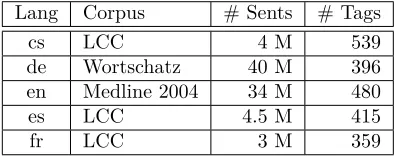
In the present work, we went with the pre-trained models for jUnsupos3, which have the following
characteristics4:
Lang Corpus # Sents # Tags
cs LCC 4 M 539
de Wortschatz 40 M 396 en Medline 2004 34 M 480
es LCC 4.5 M 415
fr LCC 3 M 359
For the Brown algorithm, we are contrasting clus-ter count choices of 320 and 1000, based on reports of other successful applications [Turian et al., 2010]5,
with clustering models trained on monolingual data from the Europarl corpus and the News Commentary corpus.
3
Experimental setup
The baseline systems were set up in accordance with the guidelines on the shared task website. That is, they were trained withgrow-diag-final-andword alignment heuristics andmsd-bidirectional-fe re-ordering.
Translation models were trained on a concatena-tion of the Europarl and News Commentary corpora, which were first tokenized, then filtered to sentence lengths of up to 40 tokens, and finally lowercased.
5-gram language models were built using
ngram-count on a concatenation of the
Eu-roparl corpora and the News Commentary corpora.
3As available at
http://wortschatz.uni-leipzig.de/~cbiemann/software/unsupos.html
4LCC refers to the Leipzig Corpora, available at
http://corpora.uni-leipzig.de/. Wortschatz refers to http://www.wortschatz.uni-leipzig.de/. Medline is avail-able at http://www.nlm.nih.gov/mesh/filelist.html.
5A planned evaluation of a cluster count of 3200 was
aban-doned due to time constraints
For the unsupervised word clusters, 5-gram language models were used as well, built from tagged versions of the same corpora. All language models were binarised and loaded using KenLM [Heafield, 2011]. Minimum error rate training (MERT) was used to optimise parameters on both baseline and factored models against the 2008 news test set, as suggested on the shared task website6.
All phrase tables were filtered and binarised for the development and testing corpora during tuning and testing, respectively.
Seeing that the preparation of the raw corpora, word clustering models, factored corpora, language models, as well as training, optimization and eval-uation of the various models was a rather involved, yet repetitive process, we took a stab at making a GNU Makefile-based approach for automated han-dling (and parallelisation) of the whole dependency graph of subtasks. The ongoing effort, which shares some aspirations and abilities with the recently an-nounced Experiment Management System (EMS), is publicly available7.
[image:3.612.81.278.297.376.2]4 Results
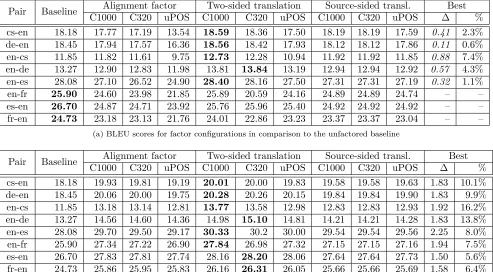
Table 1a lists BLEU scores for adding jUnsupos tags (uPOS), Brown clusters with 320 clusters (C320) or Brown clusters with 1000 clusters (C1000) as either an alignment factor, a two-sided translation factor or a source-sided translation factor.
Although using Brown clusters (C1000) as a two-sided translation factor improves BLEU scores for some language pairs, most notablyen-cs,en-de and
cs-en, no clear across-the-board benefit is seen.
4.1 Oracle scores
Based on the hypothesis that the factorisations are beneficial when translation some sentences, and not when translating others, we completed an oracle-based evaluation, in which we assume to knowa pri-oriwhether to use the factored model for translating a given sentence, or just go with the baseline, unfac-tored model. In reality, we don’t have such an or-acle method for arbitrary sentences, but when deal-ing with the shared task test set (or other corpora for which we have reference translations), it was easy enough to check per-sentence BLEU scores for each model and make the decision based on a comparison. Table 1b lists BLEU scores obtainable with each factor configuration given such an oracle method. In this scenario, most factored models beat the baseline, indicating that the factorisations are beneficial for certain sentences, and detrimental for others.
Pair Baseline Alignment factor Two-sided translation Source-sided transl. Best C1000 C320 uPOS C1000 C320 uPOS C1000 C320 uPOS Δ % cs-en 18.18 17.77 17.19 13.54 18.59 18.36 17.50 18.19 18.19 17.59 0.41 2.3% de-en 18.45 17.94 17.57 16.36 18.56 18.42 17.93 18.12 18.12 17.86 0.11 0.6% en-cs 11.85 11.82 11.61 9.75 12.73 12.28 10.94 11.92 11.92 11.85 0.88 7.4% en-de 13.27 12.90 12.83 11.98 13.81 13.84 13.19 12.94 12.94 12.92 0.57 4.3% en-es 28.08 27.10 26.52 24.90 28.40 28.16 27.50 27.31 27.31 27.19 0.32 1.1% en-fr 25.90 24.60 23.98 21.85 25.89 20.59 24.16 24.89 24.89 24.74 – – es-en 26.70 24.87 24.71 23.92 25.76 25.96 25.40 24.92 24.92 24.92 – – fr-en 24.73 23.18 23.13 21.76 24.01 22.86 23.23 23.37 23.37 23.04 – –
(a) BLEU scores for factor configurations in comparison to the unfactored baseline
Pair Baseline Alignment factor Two-sided translation Source-sided transl. Best C1000 C320 uPOS C1000 C320 uPOS C1000 C320 uPOS Δ % cs-en 18.18 19.93 19.81 19.19 20.01 20.00 19.83 19.58 19.58 19.63 1.83 10.1% de-en 18.45 20.06 20.00 19.75 20.28 20.26 20.15 19.84 19.84 19.90 1.83 9.9% en-cs 11.85 13.18 13.14 12.81 13.77 13.58 12.98 12.83 12.83 12.93 1.92 16.2% en-de 13.27 14.56 14.60 14.36 14.98 15.10 14.81 14.21 14.21 14.28 1.83 13.8% en-es 28.08 29.70 29.50 29.17 30.33 30.2 30.00 29.54 29.54 29.56 2.25 8.0% en-fr 25.90 27.34 27.22 26.90 27.84 26.98 27.32 27.15 27.15 27.16 1.94 7.5% es-en 26.70 27.83 27.81 27.74 28.16 28.20 28.06 27.64 27.64 27.73 1.50 5.6% fr-en 24.73 25.86 25.95 25.83 26.16 26.31 26.05 25.66 25.66 25.69 1.58 6.4%
(b) BLEU scores with anoracle-directed, per-sentence selective usage of either the baseline or the factored model
Table 1: BLEU scores when using Brown Clusters with granularity 1000 (C1000), granularity 320 (C320) and unsupervised part-of-speech tags (uPOS) as either an added alignment factor, a two-sided translation factor or a source-sided translation factor
[image:4.612.76.569.58.330.2]Pair Baseline Oracle Abs. Δ Rel. % cs-en 18.18 22.60 4.42 24.3% de-en 18.45 22.42 3.97 21.5% en-cs 11.85 15.89 4.04 34.1% en-de 13.27 17.16 3.89 29.3% en-es 28.08 32.52 4.44 15.8% en-fr 25.90 30.07 4.17 16.1% es-en 26.70 30.22 3.52 13.2% fr-en 24.73 28.67 3.94 15.9%
Table 2: BLEU scores under the assumption of an oracle function indicating the optimal factor config-uration for each sentence
4.2 Combined oracle scores
Imagine another oracle function, which would not simply determine whether to prefer a given factored model over the baseline for a given sentence, but instead indicate which of several possible factored models to use when translating a given sentence.
BLEU scores obtainable under the assumption of such a combined oracle function are listed in table 2. As was the case for the individual factored models (table 1a),en-cs,en-deandcs-ensee the largest ben-efits over the baselines.
These oracle scores are obviously an idealised case. They indicate an upper bound that one could seek to approximate by constructing an appropriate oracle function.
4.3 Unknown words
In section 2 it was hypothesised that word clus-ters are potentially beneficial in translating sentences with unknown words — that is, word forms which were not seen in any aligned sentences (but which may belong to a word cluster known by the transla-tion model).
Pair Sentences Baseline C1000 Rel. % cs-en 1955 65% 17.63 17.70 0.4% de-en 1925 64% 17.84 17.56 -1.6% en-cs 1583 53% 11.85 12.63 6.6% en-de 1395 46% 13.65 13.47 -1.3% en-es 1327 44% 27.77 27.97 0.7% en-fr 1369 46% 25.43 25.11 -1.3% es-en 1316 44% 26.43 25.41 -3.9% fr-en 1423 47% 24.20 23.56 -2.6%
Avg. 1537 51% 20.60 20.43 -0.4%
(a) BLEU scores for sentenceswithunknown words
Pair Sentences Baseline C1000 Rel. % cs-en 1048 35% 19.63 20.77 5.8% de-en 1078 36% 20.03 21.24 6.0% en-cs 1420 47% 11.85 12.90 8.9% en-de 1608 54% 12.97 14.22 9.6% en-es 1676 56% 28.41 28.88 1.7% en-fr 1634 54% 26.46 26.81 1.3% es-en 1687 56% 27.01 26.15 -3.2% fr-en 1580 53% 25.40 24.58 -3.2%
Avg. 1466 49% 21.47 21.94 3.4%
[image:5.612.75.306.62.219.2](b) BLEU scores for sentences withnounknown words
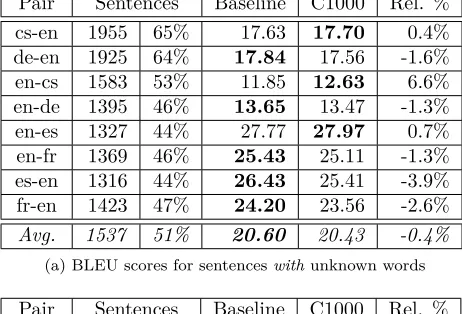
Table 3: BLEU scores for the best overall factorisa-tion, Brown clusters (C=1000) as a two-sided trans-lation factor, on sentenceswith (table 3a) and with-out(table 3b) unknown words
see how the factored models fare in comparison to the unfactored baselines, specifically for those sen-tences containing unknown words, and for the rest (sentences without unknown words). This targeted evaluation was done using the best overall factor con-figuration: Brown clusters (C=1000) as a two-sided translation factor.
The results are shown in tables 3a and 3b. On average (across language paris), 51% test set sen-tences contain at least 1 unknown word. Contrary to what might be expected, the factorisation seems to be most beneficial for sentences with all known
words (3.4% improvement in BLEU score on aver-age). For sentences with unknown words, the effect is weak or detrimental (except foren-cs), averaging a slight decrease (-0.4%) in BLEU score across the language pairs.
The lack of benefit for sentences with unknown words is likely due to the fact that no additional monolingual data was used to make the Brown clus-ters for this experiment. In other words, there is no chance of knowing the Brown cluster for an un-known word. Furthermore, we assume that gains for
sentences with unknown words are more likely with a factorisation that includes an alternative decoding path for word clusters8.
5 Conclusions and future work
In this work we have explored the utility of three un-supervised word clusterings as either an alignment factor, a two-sided translation factor or a source-sided translation factor.
Although no across-the-board benefit was seen, it was evident that the factorisations help in translating some proportion of the test set sentences. Being able to determine for which sentences to use a factored model is clearly desirable.
Overall, the single most beneficial of the factor configurations explored was Brown clusters with a granularity of 1000, as a two-sided translation factor. A more detailed evaluation of the effects of different cluster sizes, as well as using clusters induced from more text, would be interesting in a follow-up study. Using clusters in some more interesting factor configurations, particularly in alternative decoding paths, is still pending.
References
C. Biemann. Unsupervised part-of-speech tagging em-ploying efficient graph clustering. In Proceedings of the 21st International Conference on computational Linguistics and 44th Annual Meeting of the Associa-tion for ComputaAssocia-tional Linguistics: Student Research Workshop, pages 7–12, 2006.
P. F Brown, V. J.D Pietra, P. V deSouza, J. C Lai, and R. L Mercer. Class-based n-gram models of natural language. Computational linguistics, 18(4):467–479, 1992.
R. Collobert and J. Weston. A unified architecture for natural language processing: Deep neural networks with multitask learning. In Proceedings of the 25th international conference on Machine learning, page 160–167, 2008.
K. Heafield. KenLM: faster and smaller language model queries. In Proceedings of the Sixth Workshop on Statistical Machine Translation, Edinburgh, UK, July 2011. Association for Computational Linguistics. P. Liang. Semi-supervised learning for natural language.
PhD thesis, Massachusetts Institute of Technology, 2005.
J. Turian, L. Ratinov, and Y. Bengio. Word repre-sentations: A simple and general method for semi-supervised learning. InProceedings of the 48th Annual Meeting of the Association for Computational Linguis-tics, page 384–394, 2010.
8Evaluation of factor configurations with alternative