Response Generation in Dialogue using a Tailored PCFG Parser
Caixia Yuan Xiaojie Wang Qianhui He
School of Computer Science
Beijing University of Posts and Telecommunications
{yuancx, xjwang}@bupt.edu.cn [email protected]
Abstract
This paper presents a parsing paradigm for natural language generation task, which learns a tailored probabilistic context-free grammar for encoding meaning represen-tation (MR) and its corresponding natural language (NL) expression, then decodes and yields natural language sentences at the leaves of the optimal parsing tree for a target meaning representation. The ma-jor advantage of our method is that it does not require any prior knowledge of the M-R syntax for training. We deployed our method in response generation for a Chi-nese spoken dialogue system, obtaining results comparable to a strong baseline both in terms of BLEU scores and human evaluation.
1 Introduction
Grammar based natural language generation (NL-G) have received considerable attention over the past decade. Prior work has mainly focused on hand-crafted generation grammar (Reiter et al., 2005; Belz, 2008), which is extensive, but also ex-pensive. Recent work automatically learns a prob-abilistic regular grammar describing Markov de-pendency among fields and word strings (Konstas and Lapata, 2012a, Konstas and Lapata, 2013), or extracts a tree adjoining grammar provided an alignment lexicon is available which projects the input semantic variables up the syntactic tree of their natural language expression (Gyawali and Gardent, 2014). Although it is a consensus that at a rather abstract level natural language generation can benefit a lot from its counterpart natural lan-guage understanding (NLU), the problem of lever-aging NLU resources for NLG still leaves much room for investigation.
In this paper, we propose a purely data-driven natural language generation model which exploits
a probabilistic context-free grammar (PCFG) pars-er to assist natural language genpars-eration. The ba-sic idea underlying our method is that the generat-ed sentence is licensgenerat-ed by a context-free-grammar, and thus can be deduced from a parsing tree which encodes hidden structural associations between meaning representation and its sentence expres-sion. A tailored PCFG, i.e., a PCFG easily tailored to application-specific concepts, is learned from pairs of structured meaning representation and its natural language sentence and then used to guide generation processes for other previously unseen meaning representations. Table 1 exemplifies a record from the application under consideration.
where-Table 1: Examples of meaning representation input as a structured database and its corresponding natural language expression. Each meaning representation has several fields, each field has a value.
Meaning action1 object1 value11 value12 action2 object2 value21 value22 representation confirm person 100 120 request date null null
Text †pants is between 100 and 200. When is the meeting scheduled?)¬<ê3100< 200<ƒm§ž¯s3=Um¬º(The number of
partici-as they train different CFG grammar and depen-dency grammar respectively.
The major advantage of our approach is that it learns a tailored PCFGs directly from MR and NL pairs, without the need to manually define CFG derivations, which is one of the most im-portant prerequisites in (Belz and Kow, 2009) and (Konstas and Lapata, 2013), and thus porting our method to another applications is relatively easy. We demonstrate the versatility and effectiveness of our method on response generation for a Chinese spoken dialogue system (SDS)1.
2 Problem Formulation 2.1 The grammar
Following most previous works in this area (Liang, et al., 2009; Konstas and Lapata, 2013), we use the term record r to refer to a (m, w) pair. Each meaning representationm is described as several fieldsf, each field has a valuef.v. As exemplified in Table 1, eachmin the referred SDS system has eight fields (e.g., action, object1, value11), each field has a specific value. The value can be a string (e.g., confirm, person), or a numeric quantity (e.g., 100, 120), or null. The text is simply a sequence of wordsw= (w1, ..., w|w|).
Our goal is to learn a PCFG for interpreting a MR using NL expression. In order to gener-ate more coherent sentence, the established gram-mar should capture recursive structure of phrases. Meanwhile, in order to generate sentence express-ing target meanexpress-ings, the grammar should also cap-ture concept embeddings corresponding to desired meaning fields. Under this framework, a tailored PCFG grammar we used for generation can be de-scribed as a 6-tuple:
G=hNp, Nc, T, S, L, λi (1) whereNp is a finite set of non-terminal symbols produced by a common parser,Ncis a finite set of
1A demo can be found at
http://www.aidc.org.cn:8008/WebContent/
concept symbols related to specific record fields, T is a finite set of NL terminal symbols (words), S ∈ Np is a distinguished start symbol, L is a lexicon which consists of a finite set of production rules, andλ is a set of parameters that defines a probability distribution over derivations underG.
2.2 Grammar Induction
In this section, we present a learning procedure for the grammar described above. The input to the learning algorithm is a set of training sen-tences paired with their correct meaning represen-tations (as illustrated in Table 1). The output from the learning algorithm is a PCFG describing both phrase and concept embeddings. The learning al-gorithm assumes that a common phrase structure parser is available, but it does not require any pri-or knowledge of the MR syntax.
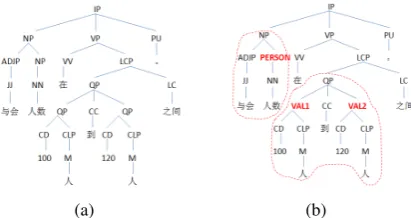
As a concrete example, consider the record in Table 1. We first analyze its sentence expres-sion using the Stanford parser (Chen and Man-ning, 2014) whose nonterminals are syntactic cat-egories (e.g., NP, VP, JJ, NN). Figure 1(a) out-lines the partial parser tree of sentence in Table 1. The meaning of the sentence is then integrated by adding conceptual symbols of its subparts into the parser tree. Figure 1(b) shows a hybrid parse tree of Figure 1(a). Here the nonterminal symbol-s in bold, PERSON, VAL1 and VAL2, represent domain-specific concepts corresponding to fields person, value1 and value2.
cen-(a) (b)
Figure 1: Example of (a) a syntactic tree and (b) its corresponding hybrid tree from which the tailored PCFG defined in Formula (1) is constructed. The subtree circled by dotted line contains conceptual node and its terminal derivations.
tral characteristic of a tree structured representa-tion is that component concept appears as a node in a tree, with its word realizations as terminal n-odes derived by it. For example, the concept PER-SON has a terminal node “<ê”, and VALUE1 “100<”, these could then form part of the rep-resentation for the sentence “†¬<ê3100<
200 <ƒm"(The number of participants is between 100 and 200.)” The use of a recursive hy-brid syntactic and conceptual structure is one char-acteristic that distinguishes the proposed grammar from earlier work in which meaning is represented by logical forms or regular grammars (Lu and Ng, 2011; and Konstas and Lapata, 2013).
Given hybrid trees, Np, Nc, T, S and the set of derivations that are possible are fixed, we only need to learn a probabilistic model parameterized byλ. Since the “correct” correspondence between NL words and MR fields is fully accessible, i.e., there is a single deterministic derivation associat-ed with each training instance, model parameter λcan be directly estimated from the training cor-pus by counting. Because the derived trees output by parser can be noisy, we need to process them to obtain cleaner PCFG rules. We compare the 3-best trees produced by the Stanford Parser, and prune off the inconsistent components voted by majori-ties when extracting and counting rules.
2.3 Decoding
Our goal in decoding is to find the most probable sentencesˆfor a given meaning expressionm:
ˆ
s=g( argmax
D s.t. m(D)=m
P(D|G)·ln(|D|+ 1)) (2)
wheregis a function that takes as input a deriva-tion tree D and returns s,ˆ m(D) refers to the
meaning representation of a derivation D, and P(D|G) is product of weights of the PCFG rules
used in a derivation D, the factor ln(|D|+ 1),
offers a way to compensate the output sentence length |D|. We use a decoding paradigm intro-duced in (Konstas and Lapata, 2013) which is essentially a bottom-up chart-parsing algorithm without forcing the input to exhibit linear struc-ture. It first fills the diagonal cell of the chart with terminal words with the top scoring words emitted by the unary rules of the typeA→α, whereAis a non-terminal symbol, andαis a terminal word.
In order to search among exponentially many possible tree structures for a given MR, a k-best decoder is achieved by adding to the chart a list of the top k words and production rules, then an ex-ternal language model is used to rerank the derived partial trees in a timely manner with cube pruning (Huang and Chiang, 2005).
3 Empirical Evaluation
We conducted experiments on a Chinese spoken dialogue system (SDS) for booking meeting room. Our NLG module receives structured input from dialogue management (DM) module and gener-ates natural language response to user. The struc-tured input includes dialogue actions (e.g., greet, request, confirm), objects (e.g., date, budget, loca-tion) and object values which can be a null. The SDS corpus consists of 1,406 formal meaning rep-resentations, along with their Chinese NL expres-sions written by 3 Chinese native speakers. The average sentence length for the example data is 15.7 Chinese words. We randomly select 1,000 record pairs as training data, and the remaining 406 is used as testing data.
To evaluate the quality of the generated sen-tences, the BLEU score (Papineni et al., 2002) is computed by comparing system-generated sen-tences with human-written sensen-tences. In addition, we evaluated the generated text via a human judg-ment as designed in (Angeli et al., 2010). The sub-jects were presented with a MR and were asked to rate its corresponding NL expression along t-wo dimensions: grammatical fluency and seman-tic correctness. A five point rating scale is de-signed where a higher number indicates better per-formance. The averaged score of three human e-valuators was computed.
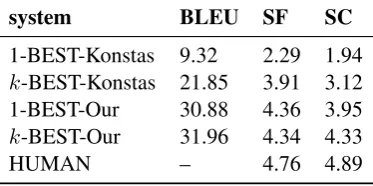
Table 2: BLEU scores, and human ratings for syn-tactic fluency (SF) and semantic correctness (SC) of different systems.
system BLEU SF SC 1-BEST-Konstas 9.32 2.29 1.94 k-BEST-Konstas 21.85 3.91 3.12 1-BEST-Our 30.88 4.36 3.95 k-BEST-Our 31.96 4.34 4.33 HUMAN – 4.76 4.89
using the proposed tailored PCFGs with that us-ing the grammar described in (Konstas and La-pata, 2013). 1-BEST signifies results obtained from the basic decoder described in Section 2.3, and k-BEST is results of the k-best decoder r-eranked with a bigram language model. Here we setk= 20without more fine-tuning work.
To make intensive comparisons, the length of the generated sentence is not restricted as a fixed number, while varying from 1 to a length of the longest sentence in the training data. The sen-tences with different length are overall sorted to obtain the 1-BEST and thek-BEST.
From Table 2, we find that differences in BLEU scores between 1-BEST-Konstas and 1-BEST-Our are statistically significant (9.32 vs. 30.88). S-ince the only difference between these two result-s iresult-s the grammar uresult-sed, we have rearesult-son to juresult-stify that the tailored grammar learnt from the hybrid phrase-concept trees is superior for modeling NL and MR correspondence to that used in (Konstas and Lapata, 2013). It is interesting to notice that k-BEST-Konstas observes substantial increase in performance compared to 1-BEST-Konstas, while k-BEST-Our only achieves a slight increase com-pared to 1-BEST-Our. Statistical language model offers potentially significant advantages for the se-quential Markov grammar as reported in (Konstas and Lapata, 2013), but it contributes little to the tailored PCFGs. This also verifies the robustness of the proposed method.
[image:4.595.88.275.112.205.2]Table 2 also summarizes the human ratings for each system and the gold-standard human-authored sentences. From Table 2 we can observe that our method consistently produce good Chi-nese sentences in terms of both grammatical co-herence and semantic soundness, which is consis-tent with the results of automatic evaluation. An-other major advantage of our method over method
Figure 2: An example of generations produced by each of the four models.
of (Konstas and Lapata, 2013) is that it does not require any prior knowledge of the MR syntax for training. Therefore, transplanting our method to other NLG application is relatively easy.
Figure 2 shows the generations of the four mod-els on an example. 1-BEST-Konstas is only able to form Markov but not grammatical associations. k-BEST-Konstas improves it by accounting for more possible associations, but errors are still made due to the lack of syntactic structure. 1-BEST-Our andk-BEST-Our remedies this. However, unex-pected sentences are still produced in the cases of long rang correlation. For example,k-BEST-Our produced a sentence “¬ÆFÏŸožÿÞ1 Qº(When is the meeting date held?)” which is a
grammatically well-formed sentence but has poor fluency and meaning. As perceived in the work of syntactic parsing, PCFG is very difficult to capture long range dependency of word strings.
4 Conclusions
We have presented a PCFG-based natural lan-guage generation method. In particular, the method learns tailored PCFG rules from hy-brid phrase-concept trees automatically augment-ed from the output of a common syntactic parser. A compelling advantage of the proposed method is that it does not rely on prior knowledge of the MR syntax for training. We have shown the com-petitive results in a Chinese spoken dialogue sys-tem. Future extensions include deploying more ef-ficient decoding algorithms, and richer structural features to rerank the derivations.
Acknowledgments
References
Gabor Angeli, Percy Liang, and Dan Klein. 2010. A Simple Domain-Independent Probabilistic Ap-proach to Generation. In Proceedings of the Con-ference on Empirical Methods in Natural Language Processing, pp. 502-512, Cambridge, MA.
Ioannis Konstas and Mirella Lapata. 2013. A Global Model for Concept-to-Text Generation. Journal of Artificial Intelligence Research, 48(2013): 305-346.
Ioannis Konstas and Mirella Lapata. 2012a. Concept-to-Text Generation via Discriminative Reranking. In Proceedings of the 50th Annual Meeting of the Asso-ciation for Computational Linguistics: Human Lan-guage Technologies, pp. 369-378, Jeju, South Korea.
Ioannis Konstas and Mirella Lapata. 2012b. Unsuper-vised Concept-to-text Generation with Hypergraph-s. InProceedings of 2012 Conference of the North American Chapter of the of the ACL: Human Lan-guage Technologies, pp.752-761, Montreal, Canada.
Liang Huang and David Chiang. 2005. Better K-best Parsing. In Proceedings of the 9th Interna-tional Workshop on Parsing Technology, pp. 53-64, Van-couver, British Columbia.
David Chiang. 2007. Hierarchical Phrase-Based Translation. Computational Linguistics, 33(2): 201-228.
Percy Liang, Michael I. Jordan, and Dan Klein. 2009. Learning Semantic Correspondences with Less Su-pervision. InProceedings of the Joint Conference of the 47th Annual Meeting of the ACL and the 4th In-ternational Joint Conference on Natural Language Processing of the AFNLP, pp. 91-99, Suntec, Singa-pore.
Wei Lu and Hwee Tou Ng. 2011. A Probabilis-tic Forest-to-String Model for Language Genera-tion from Typed Lambda Calculus Expressions. In Proceedings of the 2011 Conference on Empirical Methods in Natural Language Processing, pp. 1611-1622, Edinburgh, Scotland, UK.
Anja Belz. 2008. Automatic Generation of Weather Forecast Texts Using Comprehensive Probabilistic Generation-space Models. Natural Language Engi-neering, 14(4):431-455.
Anja Belz and Eric Kow. 2009. System Building Cost vs. Output Quality in Data-to-text Generation. In Proceedings of the 12th European Workshop on Natural Language Generation, pp. 16-24, Athens, Greece.
Danqi Chen and Christopher D. Manning. 2014. A Fast and Accurate Dependency Parser using Neural Networks. InProceedings of the 2014 Conference on Empirical Methods in Natural Language Pro-cessing, pp. 740-750, Doha, Qatar.
Nathan McKinley and Soumya Ray. 2014. A Decision-Theoretic Approach to Natural Language Generation. In Proceedings of the 52nd Annual Meeting of the Association for Computational Lin-guistics, pp. 552-561, Baltimore, Maryland, USA. Kishore Papineni, Salim Roukos, Todd Ward, and
Wei-Jing Zhu 2002. BLEU: a Method for Automatic Evaluation of Machine Translation InProceedings of the 40th Annual Meeting of the Association for Computational Linguistics, pp. 311-318. Philadel-phia, PA.
Bikash Gyawali and Claire Gardent 2014. Surface Realisation from Knowledge-base. InProceedings of the 52nd Annual Meeting of the Association for Computational Linguistics, pp. 424-434. Baltimore, Maryland.
Miguel Ballesteros, Bernd Bohnet, Simon Mille, and Leo Wanner. 2015. Data-driven Sentence Genera-tion with Non-isomorphic Trees. InProceedings of the 2015 Annual Conference of the North American Chapter of the ACL, pp. 387-397, Denver, Colorado.
Verena Rieser and Oliver Lemon. 2009. Natural Lan-guage Generation as Planning Under Uncertainty for Spoken Dialogue Systems. In Proceedings of the 12th Conference of the European Chapter of the A-CL, pp. 683-691, Athens, Greece
Yuk Wah Wong and Raymond J. Mooney. 2007. Gen-eration by Inverting a Semantic Parser That Uses S-tatistical Machine Translation. InProceedings of the Human Language Technology and the Conference of the North American Chapter of the Association for Computational Linguis-tics, pp. 172-179, Rochester, NY.
Ondrej Dusek and Filip Jurcicek. 2015. Training a Natural Language Generator from Unaligned Data. In Proceedings of the 53rd Annual Meeting of the Association for Computational Linguistics and the 7th International Joint Conference on Natural Lan-guage Processing, pp.410-419, Beijing, China.