Dynamic Terminology Integration Methods
in Statistical Machine Translation
M¯arcis Pinnis
Tilde, Vienibas gatve 75a, Riga, Latvia University of Latvia, 19 Raina Blvd., Riga, Latvia
Abstract
In this paper the author presents meth-ods for dynamic terminology integration in statistical machine translation systems using a source text pre-processing work-flow. The workflow consists of exchange-able components for term identification, inflected form generation for terms, and term translation candidate ranking. Auto-matic evaluation for three language pairs shows a translation quality improvement from 0.9 to 3.41 BLEU points over the baseline. Manual evaluation for seven lan-guage pairs confirms the positive results; the proportion of correctly translated terms increases from 1.6% to 52.6% over the baseline.
1 Introduction
In professional translation services, correct and consistent handling of terminology is an important indicator of translation quality. However, pure sta-tistical machine translation (SMT) systems, such as, Moses (Koehn et al., 2007) in a general sce-nario cannot ensure correct and consistent han-dling of terminology, because statistics of large amounts of data are difficult to control if not con-strained by means of, e.g., bilingual term collec-tions or translation model or language model adap-tation techniques. In cases where the context is too ambiguous (e.g., if an SMT system receives just a short translation segment or the SMT system’s models are limited in the possibilities to analyse larger context) or when external knowledge is
re-c
�2015 The authors. This article is licensed under a Creative Commons 3.0 licence, no derivative works, attribution, CC-BY-ND.
quired, it can be impossible for an SMT system to guess the correct translation.
In the localisation industry customers often pro-vide their own term collections that have to be strictly used during translation to ensure correct and consistent usage of terminology. Obviously, such collections may contain term translations that are rated as unlikely (in certain contexts) by an SMT system’s models or they may even be miss-ing in the models at all if custom adaptation of the models using the customers’ provided data is not performed. If such SMT systems would be inte-grated in localisation service workflows, it would not be possible to ensure high terminology transla-tion quality in the SMT suggestransla-tions. Therefore, ef-fective methods that can benefit from custom term collections are necessary.
termi-nology identifying feature in the translation model can significantly improve translation quality of an out-of-domain system (up to +2.13 BLEU points). Their method specifically addressed morphologi-cally rich languages by identifying terms in dif-ferent inflected forms using stemming tools. Sim-ilar work that shows significant quality improve-ments has been recently performed by Arcan et al. (2014a) for the English-Italian language pair. They use a term collection to create a ”fill-up” transla-tion model that consists of a pre-trained SMT sys-tem’s phrase table merged with a phrase table cre-ated from the bilingual terminology. However, all these methods require to re-train the whole SMT system (or at least re-tune the SMT system) if new in-domain data becomes available. For many translation tasks such a scenario is not economi-cally justifiable. Furthermore, if we have already trained a relatively good SMT system (let it be a general domain system or a close-domain system to the domain that is needed), we should be able to tailor it to the required domain with the help of just the right bilingual terminology.
Consequently, considerable research efforts have been focussed also on dynamic integration methods for term collections in SMT that do not require re-training of SMT systems. For instance, the Moses SMT system supports input data (in the Moses XML format) that is enriched with ex-ternally generated translation candidates. Using this methodology, Carl & Langlais (2002) used term dictionaries to pre-process source text and achieved an increase in translation quality for the English-French language pair. Similarly, Arcan et al. (2014a) identify exactly matched terms and provide translation equivalents from the Wiki Ma-chine1 by performing context-based disambigua-tion if there are multiple transladisambigua-tion equivalents for a single term for English-Italian. Babych & Hart-ley (2003) showed that inclusion of certain named entities in “do-not-translate” lists allowed to in-crease translation quality for the English-Russian language pair. Recently dynamic translation and language models (Bertoldi, 2014) have been in-vestigated for integration of terminology into SMT (Arcan et al., 2014b) for English-Italian. It is evi-dent that most of the related research has, however, mostly focused on languages with simple mor-phology or translation of phrases that are rarely
1The Wiki Machine is available online at: https://bitbucket.org/fbk/thewikimachine
translated or even left untranslated. A study in the FP7 project TTC (2013) showed that for English-Latvian such simplified methods do not yield pos-itive results. H´alek et al. (2011) came to the same conclusion in their work on English-Czech named entity translation. This means that for morphologi-cally rich languages more linguistimorphologi-cally rich meth-ods are necessary.
In this paper, the author proposes a workflow for dynamic terminology integration in SMT systems that allows to: 1) identify terms in source text (i.e., translation segments or even large documents with Moses XML tags) that is sent to the SMT system for translation, 2) generate inflected forms of terms using corpus-based and morphological synthesis-based methods, and 3) rank term translation can-didates. The methods proposed have been eval-uated in two different scenarios using automated SMT quality metrics for three language pairs and by performing manual comparative evaluation for seven language pairs (from English into Estonian, French, German, Italian, Latvian, Lithuanian, and Spanish). The results will show that the proposed methods are able to improve terminology trans-lation quality and the overall sentence transtrans-lation quality for morphologically rich languages. For evaluation purposes, the author uses the LetsMT SMT platform (Vasil¸jevs et al., 2012), which is based on the Moses SMT system.
The paper is further structured as follows: sec-tion 2 describes the dynamic terminology integra-tion workflow and the different modules for source text pre-processing, section 3 describes our auto-matic and manual evaluation efforts, and section 4 concludes the paper.
2 Dynamic Terminology Integration Workflow
Figure 1: The conceptual design of dynamic ter-minology integration in SMT systems
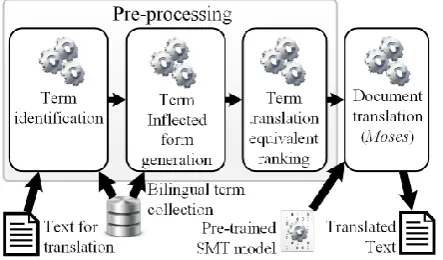
decoding the content with the Moses decoder. The workflow (depicted in Figure 2) consists of three exchangeable modules that 1) use a bilingual term collection provided by the user to identify terms in the source text using term identification meth-ods (see section 2.1), 2) generate inflected forms of the translations of the identified terms (see section 2.2), and 3) assign translation confidence scores to translation candidates and enrich the source text with the generated translation candidates (see sec-tion 2.3). After pre-processing the terminology en-riched content is translated with the Moses decoder by explicitly using the provided translation candi-dates.
Figure 2: Source text pre-processing workflow
When using SMT capabilities in on-line scenar-ios, let it be translation of full Web pages, on-line pre-translation of following translation segments in CAT tools (e.g., the MateCat platform by Fed-erico et al. (2014)), or any other scenario that re-quires quick SMT response, an important factor to be considered for dynamic integration methods is their impact on the overall speed of translation.
For successful SMT integration in localisation sce-narios, it is crucial that SMT systems can provide translations quickly as translator performance will decrease if the translators will have to wait for SMT suggestions (Skadin¸ˇs et al., 2014). To ensure that the effect on the overall translation speed is minimal, compromises between how linguistically rich term identification and ranking has to be or whether or not to perform the inflected form gen-eration for terms in an off-line mode (i.e., when uploading a term collection to the SMT platform) have to be met. The proposed workflow allows to decide whether processing speed or linguistic rich-ness is of greater importance.
2.1 Term Identification
The first task that has to be performed when pre-processing source text using a bilingual term col-lection is to identify terms. For this purpose, three methods were investigated:
• Thefirst method (TWSC) performs term iden-tification using the linguistically and statis-tically motivated term extraction tool TWSC
(Pinnis et al., 2012). TWSC 1) morpho-syntactically tags and lemmatises the source text, 2) extracts term phrases that match morpho-syntactic term phrase patterns (most commonly, noun phrases), 3) performs statis-tic ranking using co-occurrence measures and reference corpora statistics, and 4) tags terms in a document by prioritising longer phrases. Then, the extracted term phrases are looked-up in the term collection by comparing their lemma and part of speech sequences. If the terms in the term collection do not contain morpho-syntactic information, terms are mor-phologically analysed and lemmatised, after which all matching term phrase patterns from TWSC are identified and used for look-up purposes.
[image:3.595.72.294.493.623.2]• The first two methods rely heavily on lin-guistic tools that can significantly affect the translation speed. Therefore, the third method (Fast Term IdentificationorFast) performs a left-to-right search in the source text using minimal linguistic support from language-specific stemming tools to identify terms in different inflected forms.
2.2 Inflected Form Generation
The next pre-processing step after term identifica-tion is the generaidentifica-tion of translaidentifica-tion candidates for the identified terms. Previous research (Nikoulina et al., 2012; Carl & Langlais, 2002; Babych & Hartley, 2003) on source text pre-processing has not given special attention to this question, because the bilingual term collections already “provide” translation equivalents. However, the issue is that the terms that are provided in the bilingual term collections are usually in their canonical forms. For morphologically rich languages the canonical forms in many contexts are not the required in-flected forms. Because of the focus on language pairs that do not require (or require very limited) morphological generation (e.g., English-French, English-German, etc.), previous research has not seen the need to address these issues. Therefore, the author investigated three different methods for acquisition of inflected forms of terms:
• The first method (Synthesis) uses a morpho-logical analyser and synthesiser and inflected form generation rules to generate inflected forms of a term from its canonical form. E.g., the Latvian term ‘datu tips’ (in English: ‘data type’) corresponds to the term phrase pattern ‘ˆN...g.* ˆN.*’ consisting of two nouns (the first word is in a genitive case). The term phrase pattern corresponds to the inflec-tion rule ‘***** ***00’. The rule speci-fies that thefirst word has to be kept as is (the ‘*’), however the second word is allowed to be in any inflected form of a noun (‘0’ indi-cates that any value for a morphological cat-egory is acceptable; in the positional tagset used for Latvian the fourth andfifth positions correspond to case and number). The rules allow defining also morpho-syntactic agree-ments between different morphological cate-gories (e.g., in Latvian adjectives in a noun phrase have to have the same gender, number, and case as the head noun). For Latvian there
are in total 18 inflection rules specified for 99 term phrase patterns from TWSC.
• The second method (Corpus) is language in-dependent and relies on the SMT system’s monolingual corpus (e.g., the corpus that is used for language modelling) to identify in-flected forms of terms using a similar method to theFast Term Identification.
• Both previous methods may not be able to generate inflected forms for all terms. For instance, the first method may lack a term phrase pattern necessary for a specific term, whereas, when applying the second method, some inflected forms may be missing in the corpus or the stemming tool may not be able to identify all forms. Therefore, the third method (Combined) is a combination (using union) of both previous methods.
2.3 Term Translation Equivalent Ranking As the last pre-processing step, the generated translation candidates have to be ranked by assign-ing translation confidence scores. For this purpose two methods were investigated:
• Thefirst method (Equal) assigns equal trans-lation likelihood scores to all transtrans-lation can-didates of a term. This method is used as a baseline method for translation candidate ranking. When assigning equal weights to all translation candidates, we rely on the lan-guage model to select the most likely transla-tion.
• The second method (Simple) uses a large monolingual corpus and calculates for each translation candidate of a term its relative frequency among all translation candidates of the term. This method allows assigning higher scores for more common translations.
3 Evaluation
To evaluate the dynamic terminology integration methods, two evaluation tasks were carried out: 1) automatic evaluation that identifies the combina-tion of the different methods that allows achiev-ing the highest results, and 2) manual evaluation that focusses on term translation qualitative analy-sis using production SMT systems and an author-itative term collection. The following subsections describe both evaluation efforts.
3.1 Automatic Evaluation
The automatic evaluation was performed for three language pairs (English-German, Latvian, and Lithuanian) using general domain SMT systems that were trained in the LetsMT platform using the DGT-TM parallel corpus (Steinberger et al., 2012) (the releases of 2007, 2011, and 2012). For eval-uation, the author uses a proprietary parallel cor-pus of 872 sentence pairs in the automotive do-main (technical documentation from car service manuals). The original data set was available for English-Latvian, therefore, the remaining two data sets for German and Lithuanian were prepared by professional translators. For English-Latvian an in-domain tuning set of 1,745 sentence pairs was available; for the remaining systems held-out sets of 2,000 sentence pairs from the training data were used for SMT system tuning. The results of the baseline systems are given in Table 1. It is
evi-Lang. pair EN-DE EN-LT EN-LV BLEU (a) 8.27 6.94 12.68 BLEU (g) 54.03 48.12
-Table 1: Baseline system performance (“(a)” - au-tomotive domain evaluation sets; “(g)” - SMT sys-tem in-domain evaluation sets from the DGT-TM corpus)
dent that the results for English-Latvian are signif-icantly higher (although still relatively low) than for the other language pairs. This is mainly due to the fact that an automotive domain tuning set was available for the English-Latvian experiments. As the results for the other language pairs are very low, Table 1 includes also automatic evaluation re-sults using 1000 held-out sentence pairs from the DGT-TM corpus to show that the systems on in-domain data perform relatively well. This shows just how different the writing styles and the lan-guage complexity between different domains can be.
Next, the author analysed, which pre-processing configuration allows achieving better results (see Figure 3). This analysis was performed for English-Latvian using a term collection that was created by a professional translator from the tuning-data. The term collection consists of 644 term pairs (terms were included only in their canonical forms). The results show that all
combi-Figure 3: Automatic evaluation results using three different term collections for English-Latvian (BLEU scores)
nations performed better than the baseline system. It is evident that theFast Term Identificationallows achieving better results than the other term identi-fication methods. The method also allows to iden-tify more terms in the source text (1,404; compared to 1,261 forPhrase and 620 for TWSC). We see also that theSynthesis method for inflected form generation achieves lower results than theCorpus
method for which there are two possible reasons: 1) data ambiguity for the SMT system by provid-ing significantly more inflected forms is increased, and 2) the implemented ranking methods do not al-low effectively estimating, which inflected form is more or less likely due to not taking the language transfer characteristics into account.
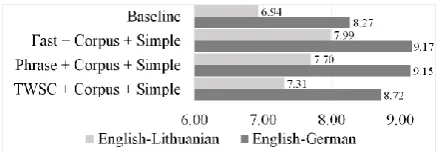
Next, professional translators were asked to pre-pare professional term collections for English-German (692 term pairs) and English-Lithuanian (662 term pairs) and performed automatic evalua-tion experiments. The results in Figure 4 are lim-ited to the configurations with ‘Corpus+Simple’ that showed to achieve the best results for English-Latvian.
3.2 Manual Evaluation
[image:5.595.307.526.192.317.2]fo-Figure 4: Automatic evaluation results using dif-ferent term identification methods and corpus-based inflected form generation and ranking
cussed to a narrow domain). Therefore, the man-ual evaluation was performed for seven language pairs using production level in-domain SMT sys-tems (contrary to out-of-domain syssys-tems before) in the information technology domain. For termi-nology integration, the freely available Microsoft Terminology Collection2was used.
As the term collection contains many ambigu-ous terms that can be confused with general lan-guage words and phrases (e.g., ‘AND’, ‘about’, ‘name’, ‘form’, ‘order’, etc.), it is important to fil-ter such candidates out as the dynamic integration workflow (contrary to methods that perform SMT system model adaptation) is sensitive to the level of ambiguity of the included terms. The collec-tions for the different language pairs werefiltered using a term pair specificity estimation method that is based on inverse document frequency (IDF) scores (Sp¨arck Jones, 1972) from a broad domain corpus. The formula is given in (1); it was first introduced by Pinnis & Skadin¸ˇs (2012).
R(ps, pt) =
min��|ps|
i=1IDFs(ps(i)), �|pt|
j=1IDFt(pt(j))
� (1)
The baseline system performance and the term col-lection statistics are given in Table 2.
[image:6.595.72.291.70.147.2]Lang. pair BLEU Terms (filtered) Terms (initial) EN-ES 74.61 18,871 23,094 EN-FR 68.76 19,665 24,160 EN-ET 55.23 10,175 12,648 EN-LT 60.42 10,352 12,726 EN-LV 66.98 10,497 12,926 EN-RU 60.79 18,416 22,669 EN-DE 61.35 20,308 24,997
Table 2: Baseline system performance (on 1,000 held-out sentence pairs) and statistics of the term collections before and afterfiltering
2The Microsoft Terminology Collection can be down-loaded from: http://www.microsoft.com/Language/en-US/Terminology.aspx
The manual evaluation is performed by com-paring the SMT system performance with-out (the baseline scenario) and with (the im-proved scenario) integrated terminology. The ‘Fast+Corpus+Simple’ configuration was used in this experiment. The evaluation data for each lan-guage pair consists of 100 in-domain sentences for which the outputs of the SMT systems in the two scenarios differed (different translations were pro-duced in average for 56% of sentences). For each language pair two professional translators were in-volved in the evaluation.
For the evaluation, translators were asked to per-form three ratings:
• For each sentence, translators had to decide which scenario produced a better translation. If both scenarios produced translations of equal quality, the translators had to decide whether both scenarios produced acceptable or not acceptable translations.
• Similarly to the sentence level, for each term that was identified in the source text using the ‘Fast’ method, translators had to decide which scenario produced a better translation.
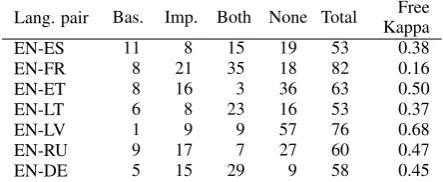
• The first two are quantitative analysis mea-sures, therefore as a third rating translators were asked to rate the term translation quality in both scenarios separately. The translators had to decide whether the term is translated correctly, whether a wrong inflectional form is used, whether it is not translated, whether it is split up or its words are in a wrong or-der, whether a wrong lexical choice is made, whether the marked phrase is actually not a term and has been wrongly identified as a term, or whether there is another issue. The sentence level evaluation summary in Table 3 shows that the translations of the improved sce-nario were preferred more for six language pairs. Because of spatial restrictions, the paper features only results from the analysis where evaluators were in full agreement. It is evident that the task of comparing sentence level quality is a very challenging task for evaluators, because the Free Kappa (Randolph, 2005) agreement scores are mainly in the levels of fair to moderate.
[image:6.595.72.291.598.684.2]Lang. pair Bas. Imp. Both None Total KappaFree EN-ES 11 8 15 19 53 0.38 EN-FR 8 21 35 18 82 0.16 EN-ET 8 16 3 36 63 0.50 EN-LT 6 8 23 16 53 0.37
EN-LV 1 9 9 57 76 0.68
[image:7.595.71.293.73.164.2]EN-RU 9 17 7 27 60 0.47 EN-DE 5 15 29 9 58 0.45
Table 3: Evaluation summary for sentence level ratings where evaluators were in agreement
Lang. pair Bas. Imp. Both None Total KappaFree EN-ES 4 34 77 0 115 0.64 EN-FR 4 71 141 4 220 0.44 EN-ET 21 51 53 0 125 0.70 EN-LT 1 40 54 3 98 0.49 EN-LV 6 46 67 4 123 0.75 EN-RU 1 49 93 0 143 0.82 EN-DE 2 30 87 0 119 0.70
Table 4: Evaluation summary for term level ratings where evaluators were in agreement
scores for evaluators show that the task of compar-ing in which system terms were translated better was fairly easy and in general well understood.
The summary of the term translation quality evaluation for the individual scenarios is given in Table 5. The results show that the proportion of correct term translations has improved for all language pairs from +1.6% for English-Estonian to +52.6% for English-Lithuanian. The minimal improvement for English-Estonian is mainly due to selection of wrong inflected forms (which is a lesser quality issue, but an issue nonetheless) rather than wrong term lexical choices (which is a greater quality issue). The author believes that the relatively low performance for English-Estonian is caused by the under-performance of the word stemming component for Estonian that is used for inflectional form acquisition for terms (however, deeper investigation is necessary). It is evident that in terms of using the correct lexical choice, the quality has improved from +26.4% for English-German to +65.2% for English-Lithuanian. This means that the method allows ensuring terminol-ogy translation consistency better than in the base-line scenario.
4 Conclusions
The paper presented a source text pre-processing workflow for dynamic terminology integration in SMT systems. To evaluate the methods, the
au-thor performed automatic evaluation in the auto-motive domain. The results show that the best combination of pre-processing methods achieved a translation quality improvement from 0.9 to 3.41 BLEU points (depending on the language pair) over the baseline scenario. Manual evaluation for seven language pairs indicates that the proportion of correctly translated terms increased from 1.6% to 52.6% over the baseline scenario.
Although the results are positive, the best re-sults were achieved using lightly linguistic meth-ods (i.e., stemming tools). The linguistically more advanced methods could either identify less terms or produced too many inflected forms of terms, thus making it more difficult for the SMT decoder to select the correct form. The author believes that a language transfer based term ranking method and a method that combines the different term identifi-cation methods could improve the results even fur-ther. However, this is an area for future work.
5 Acknowledgements
This work has been supported by the European Social Fund within the project “Support for Doc-toral Studies at University of Latvia”. The research has been supported by the ICT Competence Cen-tre (www.itkc.lv) within the project “2.6. Multilin-gual Machine Translation” of EU Structural funds, contract nr. L-KC-11-0003. The author would like thank ValtersSics for training SMT systems thatˇ were used in the manual evaluation task.
References
Arcan, M., Giuliano, C., Turchi, M., and Buite-laar, P. 2014a. Identification of Bilingual Terms from Monolingual Documents for Statistical Ma-chine Translation. In Proceedings of CompuTerm 2014.
Arcan, M., Turchi, M., Tonelli, S., and Buitelaar, P. 2014b. Enhancing Statistical Machine Translation with Bilingual Terminology in a CAT Environment. InProceedings of AMTA 2014(pp. 54–68).
Babych, B., and Hartley, A. 2003. Improving Machine Translation Quality With Automatic Named Entity Recognition. In Proceedings of the 7th
Interna-tional EAMT workshop on MT and other Language Technology Tools, Improving MT through other Lan-guage Technology Tools: Resources and Tools for Building MT.
% of terms EN-ESB I EN-FRB I EN-ETB I EN-LTB I EN-LVB I EN-RUB I EN-DEB I Term correct 71.3 85.4 55.9 75.0 39.8 40.4 42.1 64.2 51.3 67.9 60.2 89.2 70.3 85.6 Wrong inflection 1.9 11.5 1.6 5.8 19.4 50.3 7.9 18.4 11.3 27.5 6.0 8.7 1.6 5.2 Not translated 8.6 0.6 19.2 14.3 9.9 1.2 0.6 0.0 4.6 0.0 16.3 0.9 7.8 0.3 Term split up or
re-ordered 2.2 0.3 6.7 0.9 2.2 0.3 1.9 2.2 2.6 0.0 6.6 0.6 0.7 1.0 Wrong lexical choice 7.3 1.3 13.3 1.6 18.8 4.6 30.4 2.8 20.9 0.0 10.8 0.6 5.9 5.6 Not a term 6.4 0.6 1.7 1.7 0.6 0.6 10.8 10.8 1.7 1.7 0.0 0.0 0.7 1.0 Other 2.2 0.3 1.6 0.7 9.3 2.5 6.3 1.6 7.6 3.0 0.0 0.0 13.1 1.3 Rel. impr. of correct
term translations (%) 19.6 34.1 1.6 52.6 32.3 48.0 21.9 Rel. impr. of correct
lexical choice (%) 32.2 40.5 53.1 65.2 52.4 47.7 26.4 Rel. red. of errors
(%) 48.9 43.3 1.0 38.3 34.0 72.7 51.6
Table 5: Evaluation summary for term translation quality
Bertoldi, N., and Federico, M. 2009. Domain Adaptation for Statistical Machine Translation with Monolingual Resources. In Proceedings of the 4th
Workshop on Statistical Machine Translation (pp. 182189).
Bouamor, D., Semmar, N., and Zweigenbaum, P. 2012. Identifying bilingual Multi-Word Expressions for Statistical Machine Translation. InProceedings of LREC 2012(pp. 674–679).
Carl, M., and Langlais, P. 2002. An Intelligent Ter-minology Database as a Pre-processor for Statistical Machine Translation. InCOLING-02 on COMPUT-ERM 2002: 2ndinternational workshop on
computa-tional terminology. (Vol. 14, pp. 1–7).
Cattelan, A., Farina, A., Lupinetti, D., Martines, A., Massidda, A., Schwenk, H., Barrault, L., Blain, F., Koehn, P., Buck, C., and Germann, U. 2014. The MateCat Tool. InProceedings of COLING 2014(pp. 129–132).
H´alek, O., Rosa, R., Tamchyna, A., and Bojar, O. 2011. Named Entities from Wikipedia for Machine Trans-lation. InProceedings of ITAT 2011(pp. 23–30).
Hildebrand, A. S., Eck, M., Vogel, S., and Waibel, A. 2005. Adaptation of the Translation Model for Sta-tistical Machine Translation Based on Information Retrieval. InProceedings of EAMT(pp. 133–142). Koehn, P., Hoang, H., Birch, A., Callison-Burch, C.,
Federico, M., Bertoldi, N., Cowan, B., Shen, W., Moran, C., Zens, R., Dyer, C., Bojar, O., Constantin, A., and Herbst, E. 2007. Moses: Open Source Toolkit for Statistical Machine Translation. In Pro-ceedings of the ACL 2007 Interactive Poster and Demonstration Sessions(pp. 177–180).
Koehn, P., and Schroeder, J. 2007. Experiments in Do-main Adaptation for Statistical Machine Translation. In Proceedings of the 2nd Workshop on Statistical
Machine Translation(pp. 224–227).
Nikoulina, V., Sandor, A., and Dymetman, M. 2012. Hybrid Adaptation of Named Entity Recognition for
Statistical Machine Translation. InProceedings of ML4HMT-12(pp. 116).
Papineni, K., Roukos, S., Ward, T., and Zhu, W.-J. 2002. BLEU: a Method for Automatic Evaluation of Machine Translation. InProceedings of ACL 2002
(pp. 311–318).
Pinnis, M., Ljubeˇsi´c, N., S¸tefanescu, D., Skadin¸a, I.,˘ Tadi´c, M., and Gornostay, T. 2012. Term Extraction, Tagging, and Mapping Tools for Under-Resourced Languages. InProceedings of TKE 2012(pp. 193– 208).
Pinnis, M., and Skadin¸s, R. 2012. MT Adaptation forˇ Under-Resourced Domains What Works and What Not. InProceedings of Baltic HLT 2012(pp. 177– 180).
Randolph, J. J.. 2005. Free-Marginal Multirater Kappa (multirater K[free]): An Alternative to Fleiss’ Fixed-Marginal Multirater Kappa. In Joensuu Learning and Instruction Symposium.
Skadin¸s, R., Skadin¸a, I., Pinnis, M., Vasil¸jevs, A., andˇ Hud´ık, T. 2014. Application of Machine Translation in Localization into Low-resourced Languages. In
Proceedings of EAMT 2014(pp. 209–216).
Sp¨arck Jones, K. 1972. A Statistical Interpretation of Term Specificity and Its Application in Retrieval. In
Journal of Documentation28, 11–21.
Steinberger, R., Eisele, A., Klocek, S., Pilos, S., and Schlter, P. 2012. DGT-TM: A Freely Available Translation Memory in 22 Languages. In Proceed-ings of LREC 2012(pp. 454–459).
TTC. 2013. Public Deliverable D7.3: Evaluation of the Impact of TTC on Statistical MT (p. 38). TTC Project: Terminology Extraction, Translation Tools and Comparable Corpora.