Using Explicit Semantic Analysis for Cross-Lingual Link Discovery
Petr Knoth
KMi, The Open University [email protected]
Lukas Zilka
KMi, The Open University [email protected]
Zdenek Zdrahal
KMi, The Open University [email protected]
Abstract
This paper explores how to automati-cally generate cross-language links be-tween resources in large document col-lections. The paper presents new meth-ods for Cross-Lingual Link Discovery (CLLD) based on Explicit Semantic Anal-ysis (ESA). The methods are applicable to any multilingual document collection. In this report, we present their comparative study on the Wikipedia corpus and provide new insights into the evaluation of link dis-covery systems. In particular, we mea-sure the agreement of human annotators in linking articles in different language ver-sions of Wikipedia, and compare it to the results achieved by the presented methods.
1 Introduction
Cross-referencing documents is an essential part of organising textual information. However, keep-ing links in large, quickly growkeep-ing, document col-lections up-to-date, is problematic due to the num-ber of possible connections. In multilingual doc-ument collections, interlinking semantically re-lated information in a timely manner becomes even more challenging. Suitable software tools that could facilitate the link discovery process by automatically analysing the multilingual content are currently lacking. In this paper, we present new methods for Cross-Lingual Link Discovery (CLLD) applicable across different types of mul-tilingual textual collections.
Our methods are based on Explicit Semantic Analysis (ESA) introduced by Gabrilovich and Markovitch (2007). ESA is a method that calcu-lates semantic relatedness of two texts by map-ping their term vectors to a high dimensional space (typically, but not necessarily, the space of Wikipedia concepts) and by calculating the
sim-ilarity between these vectors (instead of compar-ing them directly). The method has received much attention in the recent years and it has also been extended to a multilingual version called Cross-Lingual Explicit Semantic Analysis (CL-ESA) (Sorg and Cimiano, 2008). To the best of our knowledge, this method has not yet been applied in the context of automatic link discovery systems. Since the CLLD field is relatively young, it is also important to establish a constructive means for evaluating these systems. Our paper pro-vides insight into this problem by investigating the agreement/reliability of man-made links and by presenting a possible approach for the definition of ground truth, i.e. gold standard.
The paper brings the following contributions:
(a) It applies Explicit Semantic Analysis to the link discovery and CLLD tasks.
(b) It provides new insights into the evaluation of CLLD systems and into the way people link information in different languages, as mea-sured by their agreement.
2 Related Work
CLLD Methods
Current approaches to link detection can be di-vided into three groups:
(1) link-basedapproaches discover new links by exploiting an existing link graph (Itakura and Clarke, 2008; Jenkinson et al., 2008; Lu et al., 2008).
(2) semi-structured approaches try to discover new links using semi-structured information, such as the anchor texts or document titles (Geva, 2007; Dopichaj et al., 2008; Granitzer et al., 2008; Milne and Witten, 2008; Mihal-cea and Csomai, 2007).
(3) purely content-based approaches use as an input plain text only. They typically dis-cover related resources by calculating se-mantic similarity based on document vectors (Allan, 1997; Green, 1998; Zeng and Blo-niarz, 2004; Zhang and Kamps, 2008; He, 2008). Some of the mentioned approaches, such as (Lu et al., 2008), combine multiple approaches. To the best of our knowledge, no approach has so far been reported to use Ex-plicit Semantic Analysis to address this task.
The main disadvantage of the link-based and semi-structured approaches is probably the ficulty associated with porting them across dif-ferent types of document collections. The two well-known solutions to monolingual link detec-tion, the Geva’s and Itakura’s algorithms (Trotman et al., 2009), fit in these two categories. While these algorithms have been demonstrated to be ef-fective on a specific Wikipedia set, their perfor-mance has significantly decreased when they were applied to a slightly different task of interlink-ing two encyclopedia collections. Purely content-based methods have been mostly found to produce slightly worse results than the two previous classes of methods, however their advantage is that their performance should remain stable across different document collections. As a result, they can al-ways be used as part of any link discovery sys-tem and can even be combined with domain spe-cific methods that make use of the link graph or semi-structured information. In practice, domain-specific link discovery systems can achieve high
precision and recall. For example,Wikify!
(Mihal-cea and Csomai, 2007) and the link detector pre-sented by Milne and Witten (2008) can be used to identify suitable anchors in text and enrich it with links to Wikipedia by combining multiple ap-proaches with domain knowledge.
In this paper, we present four methods (three purely content-based and one combining the link-based and content-link-based approach) for CLLD based on CL-ESA. Measuring semantic similar-ity using ESA has been previously shown to pro-duce better results than calculating it directly on document vectors using cosine and other similar-ity measures and it has also been found to outper-form the results that can be obtained by measuring similarity on vectors produced by Latent Seman-tic Analysis (LSA) (Gabrilovich and Markovitch, 2007). Therefore, the cross-lingual extension of
ESA seems a plausible choice.
Evaluation of link discovery systems
The evaluation of link discovery systems is cur-rently problematic as there is no widely accepted gold standard. Manual development of such a standard would be costly, because: (a) the num-ber of possible links is very high even for small collections, (b) the link generation task is subjec-tive (Ellis et al., 1994) and (c) it is not entirely clear how the link generation task should be de-fined in terms of link granularity (for example, document-to-document links, anchor-to-document links, anchor-to-passage links etc.). Developing such a CLLD corpora manually would be even more complicated.
As a result, Wikipedia links were extracted and taken as the gold standard (ground truth) in a com-parative evaluation in (Huang et al., 2008). The authors admit that Wikipedia links are not perfect (validity of existing links is sometimes question-able and useful links may be missing) the compar-ative evaluation of methods and systems should be considered informative only. For example, it
would be na¨ıve to expect that measuring
preci-sion/recallcharacteristics would be accurate. In this paper we discuss the issues in automati-cally defining the ground truth for CLLD systems. We take into account the differences in the way people link content in different languages to as-sess the agreement between the different language versions with the goal to find out how well our sys-tem performs. Our experiments are conducted on the Wikipedia dataset, however we use the articles only as a set of documents abstracting from the Wikipedia encyclopedic nature.
3 The CLLD methods
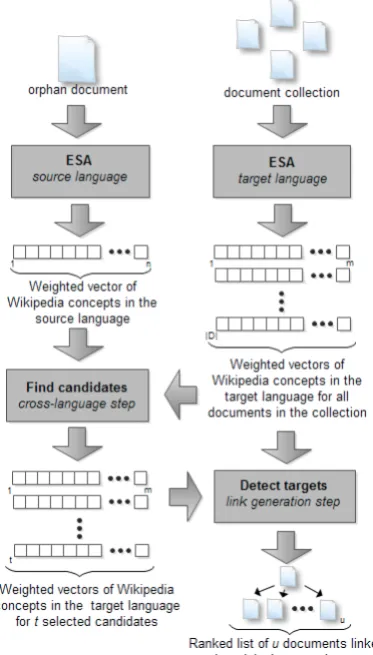
This section describes the methods used in our ex-periments. The whole process of cross-language link detection is shown in Figure 1. The method takes as an input a new “orphan” document (i.e. a document that is not linked to other documents) written in the source language and automatically generates a ranked list of documents written in the target language (the suitable link targets from the source document). The task involves two steps: the cross-language step and the link generation
step. We have experimented with four different
CLLD methods: CL-ESA2Links, CL-ESADirect,
Figure 1: Cross-language link discovery process
are derived from the approach applied in the first and the second step. These methods have differ-ent characteristics and would be useful in differdiffer-ent scenarios.
In the first step, an ESA vector is calculated
for each document in the document collection. This results in obtaining a weighted vector of Wikipedia concepts for each document in the tar-get language. The cardinality of the vector is given by the number of concepts (pages) in the target language version of Wikipedia (i.e. it is about 3.8 million for English, 764,000 for Spanish, etc.). A similar procedure is applied on the orphan doc-ument, however, the source language version of ESA is used. The resulting ESA vector is then compared to the ESA vectors that represent docu-ments in the target language collection (CL-ESA approach). A set of candidate vectors representing documents in the target language is acquired as an output of the cross-language step, see Section 3.1.
In the second step, the candidate vectors are
taken as a seed and are used to discover documents that are suitable link targets. The four different
Figure 2: CLLD candidates
approaches used in this step distinguish the above-mentioned methods, see Section 3.2.
3.1 The cross-language step
The main rationale for the cross-language step is
to findtsuitable candidates in the target language
that can later be exploited to identify link targets. Semantically similar target language documents to the source language document are considered by our methods as suitable candidates. To identify such documents, the ESA vector of the source doc-ument is compared to the ESA vectors of docu-ments in the target document collection.
Each dimension in an ESA vector expresses the similarity of a document to the given language ver-sion of a Wikipedia concept/article. Therefore, the cardinality of the source document vector is differ-ent from the cardinality of the vectors represdiffer-ent- represent-ing the documents in the target language collec-tion (Figure 2). In order to calculate the similarity of two vectors, we map the dimensions that corre-spond to the same Wikipedia concepts in different language versions. In most cases, if a Wikipedia concept is mapped to another language version, there is a one-to-one correspondence between the articles in those two languages. However, there are cases when one page in the source language is mapped to more than one page in the target
lan-guage and vice versa.1 For the purpose of
simi-larity calculation, we use100dimensions with the
highest weight that are mappable from the source to the target language. The number of candidates
to be extracted is controlled by parametert. We
have experimentally found that its selection has a significant impact on the performance of our meth-ods.
1These multiple mappings appear quite rarely, e.g. in
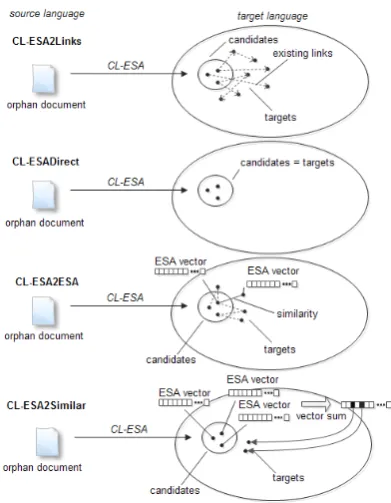
[image:3.595.312.520.69.158.2]Figure 3: Schematic illustration of the four ap-proaches used by the CLLD methods.
3.2 The link generation step
In the link generation step, the candidate docu-ments are taken and used to produce a ranked list of targets for the original source document. The following approaches, schematically illustrated in Figure 3, are taken by our four methods:
• CL-ESA2Links - This method requires
ac-cess to the link structure in the target collec-tion. More precisely, the method takes the original orphan document in the source lan-guage and tries to link it to an already inter-linked target language collection. After ap-plying CL-ESA in the first step, existing links are extracted from the candidate documents. The link targets are then ranked according to their similarity to the source document, i.e. documents that are more similar are ranked higher. This list is then used as a collection of link targets.
• CL-ESADirect - This method applies
CL-ESA on the source document and takes the list of candidates directly as link targets.
• CL-ESA2ESA- In this method, the
applica-tion of CL-ESA is followed by another appli-cation of monolingual ESA, which measures the semantic similarity of the candidates with
all documents in the document collection, to identify link targets.
• CL-ESA2Similar- Instead of generating the
ranked list of link targets using monolin-gual ESA as in the previous method, which is computationally expensive, we calculate a vector sum from the candidate list of ESA document vectors. We then select strong Wiki concepts representing these dimensions as the set of targets. This is equivalent to
cal-culating cosine similarity usingtfidf vectors.
Though much quicker, the main disadvantage is that if we wanted to use this method on an-other set than Wikipedia, ESA would have to be used with a different background collec-tion.
All of the methods have different properties. CL-ESA2Links requires the knowledge of the link graph in the target document collection. CL-ESA2ESA and ESADirect are two methods that are universal, i.e. can be easily applied in any doc-ument collection. The difference between them is that the former one requires significantly less doc-ument vector comparisons than the later method. ESA2Similar works almost as fast as CL-ESADirect, but it has the disadvantage that ESA has to be used with the specific document collec-tion as a background.
4 The underlying data
Wikipedia has been used as a corpus for the meth-ods evaluation. This decision has the following advantages that make it possible for us to test and analyse the methods on a real use case:
• A very large multilingual text collection.
• The articles are well-interlinked and the
in-terlinking has been approved by a large com-munity of users.
• A large proportion of articles contain
ex-plicit mapping between different language versions.
language version is more likely to contain relevant information not available in the source language. The language selection has been motivated by the aim to test the methods in two very different envi-ronments. The Spanish version is relatively well resourced containing 764,095 pages (about four times fewer than English), the Czech language is much less resourced containing 196,494 pages (about four times fewer than Spanish).
5 Evaluation methodology
One of the main obstacles in systematically im-proving link discovery systems is the difficulty to evaluate the results. The issue that makes reliable evaluation problematic is due to both technical and cognitive aspects. The difficulty in obtaining the “ground truth” for a sufficiently large dataset is caused both by the lack of human resources to manually annotate a very large number of docu-ment combinations, and the inherent subjectivity of the task. As a result, we find it essential to es-timate the agreement between annotators and see to what extent the precision and recall character-istics can be measured with respect to interlinked document collections.
We claim that the reasons for linking two pieces of information is made at the level of seman-tics, i.e. the annotator has to understand the con-cepts/ideas described in two papers to decide if they should be connected by a link. We claim that this process should be language independent. Thus, an article about London will be related to an article about the United Kingdom regardless of the language the articles are written in.
Therefore, let us define the link generation task
in the following way: Given a document2 in the
source language, find documents in the target lan-guage that are suitable link targets for the source document, i.e. there is a semantic relationship be-tween the source document and the linked target documents.
Based on the definition, the ground truth for
a topic document d is the set of documents that
can be considered (semantically) suitable link tar-gets. Though this set is typically unknown to us, we can in our experiment approximate it by taking the existing Wikipedia links as ground truth. Be-cause the Wikipedia link structure has been agreed by a large number of contributing authors, it is
2The termtopicis also sometimes used to refer to the
doc-ument.
likely to have a relatively consistent link struc-ture in comparison to content that would be linked just by a single person. To establish the ground truth for the original source document, we can ex-tract all links originating in the source document and pointing to other documents. Since the pro-cess of linking information is performed at the se-mantic level, and is thus language independent, we can enrich our ground truth with link graphs from different language versions of Wikipedia. This causes the ground truth to get larger which has two consequences: (1) It increases the reliability of the evaluation as many relevant links are often omit-ted (Knoth et al., 2010) (2) It is more difficult to achieve higher recall.
6 Results
6.1 Experimental setup
The experiment was carried out for two language pairs: Spanish to English and Czech to English.
We will denote the source language Lsource and
the target languageLtarget. The input for the
dif-ferent CLLD methods are two document sets:
• Let SOU RCELsource be the set of topic
documents selected as pages that contain a Wikipedia link between different language versions. In our case, 100 pages were se-lected.
• Let T ARGETLtarget be the collection of
documents in the target language from which the link targets are selected. In our case, this collection contains all (3.8 million) Wikipedia pages in English.
The output of the method is a set (ranked list)
LISTresult = hT ARGETLtarget, scorei. To
es-tablish the ground truth we define:
• Letρbe the mapping from documents in the
source language to their target language ver-sionsρ:DLsource →DLtarget.
• Let SOU RCELtarget be the set of topic
documents mapped to the target language
SOU RCELtarget =ρSOU RCELsource.
• Let α, β be the mappings from documents
to the other documents they link to in the
source and target language respectively α :
then we define the ground truth (GT) as the union of ground truths for different language ver-sions, in this experiment we define it as the union of ground truth for the source and target language.
GT =α(SOU RCELsource)∪β(SOU RCELtarget)
A given generated item hd, scorei ∈
LISTresult is evaluated as a hit if and only
ifd∈GT.
6.2 Methods evaluation
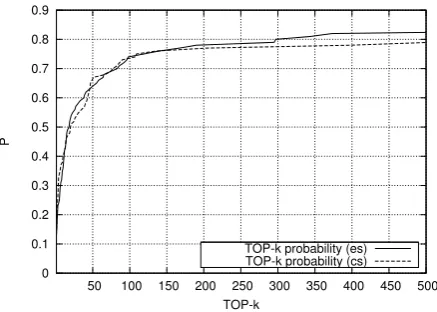
To investigate the performance of the first part of CLLD - the cross-language step carried out by CL-ESA, we have analysed how well the system finds for a given topic document in the source guage the duplicate document in the target lan-guage. In this step, the system takes a docu-ment in the source language, and selects from the 3.8 million large document set in the target lan-guage the documents with the highest similarity.
We then check, if a duplicate document (d =
ρdsource) appears among the topk retrieved
doc-uments. The experiment is repeated for all
exam-ples inSOU RCELsource and the results are then
averaged (Figure 4). The graph suggests that the method performs well, as the document often
ap-pears among the first few results. In about 65%
of cases, the document is found among the first50
retrieved items. We believe that if the set of
candi-dates (controlled by thetparameter) contains this
document, the CLLD method is likely to produce better results, this is especially true for the CL-ESA2Links method.
The overall results for all the methods are pre-sented in Figure 5. We have experimentally set
t= 10for Spanish to English andt= 3for Czech
to English CLLD. CL-ESA2Links performed in
the experiments the best achieving 0.2 precision
at0.3recall. CL-ESA2Similar performed the best
out of the purely content-based methods.
Though the precision/recall might seem quite low, a number of things should be taken into ac-count:
• A significant number of potentially useful
links is still missing in our ground truth, be-cause people typically do not intend to link all relevant information. As a result, many potentially useful connections are not explic-itly present in Wikipedia (Knoth et al., 2010).
0 0.1 0.2 0.3 0.4 0.5 0.6 0.7 0.8 0.9
50 100 150 200 250 300 350 400 450 500
P
TOP-k
[image:6.595.310.529.66.222.2]TOP-k probability (es) TOP-k probability (cs)
Figure 4: The probability (y-axis) of finding the
target language version of a given source language
document using CL-ESA in the top k retrieved
documents (x-axis). Drawn as a cumulative
dis-tribution function.
The problem can be partly mitigated by com-bining the ground truth from more language versions. Another approach is to measure the agreement instead of precision/recall charac-teristics (see Section 6.3).
• A significant number of links in Wikipedia
are conceptual links. These links do not ex-press a particularly strong relationship at the article level. This makes it very difficult for the pure-content based methods to find them, which results in low recall. It seems that CL-ESA2Links is the only method that does not suffer from this issue.
• The experiment settings make it hard for the
methods to achieve high precision/recall
per-formance. TheT ARGETLtarget set contains
3.8 million articles, out of which, the
meth-ods are supposed to identify on average just a small subset of target documents. More precisely, in Spanish to English CLLD, our
ground truth contains on average 341
tar-get documents with standard deviation 293,
in Czech to English, it contains on average
382target documents with standard deviation
292.
6.3 Measuring the agreement
0 0.05 0.1 0.15 0.2 0.25 0.3 0.35 0.4
0 0.05 0.1 0.15 0.2 0.25 0.3 0.35 0.4
Precision
Recall
CL-ESA2Links CL-ESA2Similar CL-ESA2ESA CL-ESADirect
0 0.05 0.1 0.15 0.2 0.25 0.3 0.35 0.4 0.45
0 0.05 0.1 0.15 0.2 0.25 0.3 0.35
Precision
Recall
[image:7.595.74.290.265.409.2]CL-ESA2Links CL-ESA2Similar CL-ESA2ESA CL-ESADirect
Figure 5: The precision (y−axis)/recall (x-axis) graphs for Spanish to English (left) and Czech to
English (right) CLLD methods.
Spanish vs English
Yen Nen N/Aen
Yes 5,563 10,201 3,934
Nes 15,715 539,299,641 99,191,766
N/Aes 5781 321,326,145 0
Czech vs English
Yen Nen N/Aen
Ycz 4,308 8,738 2,194
Ncz 12,961 392,411,445 7,501,806
N/Acz 9,790 356,532,740 0
Table 1: The agreement of Spanish and English Wikipedia and Czech and English Wikipedia on their link structures calculated and summed for all
pages inSOU RCEes. Y - indicates yes,N - no,
N/A- not available/no decision
Wikipedia. We have iterated over the set of
top-ics fromSOU RCELsource and recorded for each
document inT ARGETLtarget in each step if it is
a valid link target (yes -Y) or if it is not a valid
link target (no -N) for the given source document
in each language, thus measuring the agreement between the link structures in different languages. The results are presented in Table 1.
As demonstrated in Figure 6, a subset of Wikipedia pages cannot be mapped to other lan-guage versions. Either the semantically equiva-lent page does not exist or the cross-language link is missing. These links were classified as no
de-cision/not available (N/A). The mappable
docu-ments were classified in a standard way according to their appearance in the link graphs of the lan-guage versions. Only these links are taken into account while measuring the agreement.
A common way to assess inter-annotator
agree-Figure 6: Individual cases of
agree-ment/disagreement/no decision (not available) for two language versions of Wikipedia link graphs.
ment between two raters in Information Retrieval is using the Cohen’s Kappa calculated as:
κ= P r(a)−P r(e) 1−P r(e) ,
whereP r(a)is the relative observed frequency of
agreement andP r(e)is the hypothetical
probabil-ity of chance agreement. P r(a) is typically
cal-culated as |Y,Y|+|N,N|
|Y,Y|+|Y,N|+|N,Y|+|N,N|. Since there is a strong agreement on the negative decisions, the
probability will be close to 1. If we ignore the
|N, N|cases, which do not carry any useful
infor-mation, the formula looks as follows:
P r(a) = |Y, Y|
|Y, Y|+|Y, N|+|N, Y|.
[image:7.595.308.534.268.410.2]0 0.05 0.1 0.15 0.2
0 10 20 30 40 50 60 70 80 90 100
agreement
% truth
CL-ESA2Links CL-ESA2Similar CL-ESA2ESA CL-ESADirect
0 0.05 0.1 0.15 0.2
0 10 20 30 40 50 60 70 80 90 100
agreement
% truth
[image:8.595.100.495.66.201.2]CL-ESA2Links CL-ESA2Similar CL-ESA2ESA CL-ESADirect
Figure 7: The agreements of the Spanish to English (left) and Czech to English (right) CLLD methods with GTes,en and GTcz,en respectively. The y-axis shows the agreement strength and the x-axis the
number of generated examples as a fraction of the number of examples in ground truth.
connecting any two pages is approximately:3
plink = |
links| |pages|2 =
78.3M
3.2M2 = 0.000007648.
Thus, the hypothetical number of items appear-ing in theY, Y class by chance isp2link.(|Y, Y|+ |Y, N|+|N, Y|+|N, N|). This formula estimates the number of agreements achieved by chance. In
our case the value is much smaller than1, hence
P(e)is close to0. Therefore, we can calculate the agreement for English and Spanish as:
κen,es=
5,563
31,479 = 0.177.
The agreement for Czech and English is:
κen,cz=
4,308
26,007 = 0.166.
The value indicates a relatively low inter-annotator agreement. We believe that the fact that such a low agreement has been measured is very inter-esting, particularly because the link structure in Wikipedia is a result of a collaborative effort of many contributors. Therefore, we would expect that even lower agreement might be experienced in other types of text collections.
Motivated by the previous findings, we have calculated the agreement between the output of our method and the link graphs present in dif-ferent language versions of Wikipedia. We were especially interested to find out if the agree-ment is significantly different from the agreeagree-ment
3Following the official Wikipedia statistics. Though
dif-ferent language versions have difdif-ferentplink, the differences
do not effect the results.
measured between different language versions of Wikipedia. We have generated by our CLLD
methods100%of|GT|links for every orphan
doc-ument in SOU RCELsource, i.e. if a particular
document is linked in Wikipedia to57documents,
we generate57links. We have then measured the
agreement for each topic document and averaged the agreement values. The results of the exper-iment for Spanish to English and Czech to En-glish CLLD are shown in Figure 7. They suggest that CL-ESA2Links achieved a level of agreement comparable to that of human annotators. A very reasonable level of agreement has also been mea-sured for CL-ESA2Similar, especially for the first
10% of the generated links. CL-ESADirect and
CL-ESA2ESA exhibit a lower level of agreement.
7 Conclusion
References
James Allan. 1997. Building hypertext using
informa-tion retrieval. Inf. Process. Manage., 33:145–159,
March.
Philipp Dopichaj, Andre Skusa, and Andreas Heß. 2008. Stealing anchors to link the wiki. In Geva et al. (Geva et al., 2009), pages 343–353.
David Ellis, Jonathan Furner-Hines, and Peter Wil-lett. 1994. On the measurement of inter-linker consistency and retrieval effectiveness in hypertext
databases. In SIGIR ’94: Proceedings of the 17th
annual international ACM SIGIR conference on Re-search and development in information retrieval, pages 51–60, New York, NY, USA. Springer-Verlag New York, Inc.
Evgeniy Gabrilovich and Shaul Markovitch. 2007. Computing semantic relatedness using
wikipedia-based explicit semantic analysis. InIn Proceedings
of the 20th International Joint Conference on Artifi-cial Intelligence, pages 1606–1611.
Shlomo Geva, Jaap Kamps, and Andrew Trotman,
ed-itors. 2009. Advances in Focused Retrieval, 7th
In-ternational Workshop of the Initiative for the Evalu-ation of XML Retrieval, INEX 2008, Dagstuhl Cas-tle, Germany, December 15-18, 2008. Revised and Selected Papers, Lecture Notes in Computer Sci-ence. Springer.
Shlomo Geva. 2007. Gpx: Ad-hoc queries and auto-mated link discovery in the wikipedia. In Norbert Fuhr, Jaap Kamps, Mounia Lalmas, and Andrew
Trotman, editors,INEX, Lecture Notes in Computer
Science. Springer.
Michael Granitzer, Christin Seifert, and Mario Zech-ner. 2008. Context based wikipedia linking. In Geva et al. (Geva et al., 2009), pages 354–365.
Stephen J. Green. 1998. Automated link generation:
can we do better than term repetition? Comput.
Netw. ISDN Syst., 30(1-7):75–84.
Jiyin He. 2008. Link detection with wikipedia. In Geva et al. (Geva et al., 2009), pages 366–373.
Wei Che Huang, Andrew Trotman, and Shlomo Geva. 2008. Experiments and evaluation of link discovery in the wikipedia.
Kelly Y. Itakura and Charles L. A. Clarke. 2008. Uni-versity of waterloo at inex 2008: Adhoc, book, and link-the-wiki tracks. In Geva et al. (Geva et al., 2009), pages 132–139.
Dylan Jenkinson, Kai-Cheung Leung, and Andrew Trotman. 2008. Wikisearching and wikilinking. In Geva et al. (Geva et al., 2009), pages 374–388.
Petr Knoth, Jakub Novotny, and Zdenek Zdrahal. 2010. Automatic generation of inter-passage links
based on semantic similarity. InProceedings of the
23rd International Conference on Computational Linguistics (Coling 2010), pages 590–598, Beijing, China, August.
Wei Lu, Dan Liu, and Zhenzhen Fu. 2008. Csir at inex 2008 link-the-wiki track. In Geva et al. (Geva et al., 2009), pages 389–394.
Rada Mihalcea and Andras Csomai. 2007. Wikify!: linking documents to encyclopedic knowledge. In
Proceedings of the sixteenth ACM conference on Conference on information and knowledge
manage-ment, CIKM ’07, pages 233–242, New York, NY,
USA. ACM.
David Milne and Ian H. Witten. 2008. Learning to link with wikipedia. In James G. Shanahan, Sihem Amer-Yahia, Ioana Manolescu, Yi Zhang, David A. Evans, Aleksander Kolcz, Key-Sun Choi, and Abdur
Chowdhury, editors,CIKM, pages 509–518. ACM.
Philipp Sorg and Philipp Cimiano. 2008. Cross-lingual information retrieval with explicit
seman-tic analysis. In Working Notes for the CLEF 2008
Workshop.
Andrew Trotman, David Alexander, and Shlomo Geva. 2009. Overview of the inex 2010 link the wiki track.
Jihong Zeng and Peter A. Bloniarz. 2004. From
key-words to links: an automatic approach. Information
Technology: Coding and Computing, International Conference on, 1:283.