Classification-based Contextual Preferences
Shachar Mirkin, Ido Dagan, Lili Kotlerman
Bar-Ilan University Ramat Gan, Israel
{mirkins,dagan,davidol}@cs.biu.ac.il
Idan Szpektor
Yahoo! Research Haifa, Israel
Abstract
This paper addresses context matching in tex-tual inference. We formulate the task under theContextual Preferencesframework which broadly captures contextual aspects of infer-ence. We propose a generic classification-based scheme under this framework which co-herently attends to context matching in infer-ence and may be employed in any inferinfer-ence- inference-based task. As a test bed for our scheme we use the Name-based Text Categorization (TC) task. We define an integration of Contextual Prefer-ences into the TC setting and present a concrete self-supervised model which instantiates the generic scheme and is applied to address con-text matching in the TC task. Experiments on standard TC datasets show that our approach outperforms the state of the art in context mod-eling for Name-based TC.
1 Introduction
Textual inference is prevalent in text understanding applications. For example, in Question Answering (QA) the expected answer should be inferred from retrieved passages, and in Information Extraction (IE) the meaning of the target event is inferred from its mention in the text.
Lexical inferences make a substantial part of the inference process. In such cases, a target term is inferred from text expressions based on either one of two types of lexical matches: (i) adirect matchof the target term in the text. For instance, the IE event
injuremay be detected by finding the wordinjurein the text; (ii) anindirect match, through a term that implies the meaning of the target term, e.g. inferring
injurefromhurt.
In either case, due to word ambiguity, it is nec-essary to validate that the context of the match con-forms with the intended meaning of the target term before carrying out an inference operation based on this match. For example, “You hurt my feelings” con-stitutes an invalid context for theinjureevent ashurt
in this text does not refer to a physical injury. Simi-larly, inferring the protest-related eventdemonstrate
based ondemois deemed invalid althoughdemo im-plies the meaning of the worddemonstratein other contexts, e.g., concerningsoftware demonstration.
Although seemingly equivalent, a closer look re-veals that the above two examples correspond to two distinct contextual mismatch situations. While the match ofhurtis invalid for injurein the particular given context, an inference based ondemois invalid for the protestdemonstrateevent in any context.
Thus, several types of context matching are in-volved in textual inference. While most prior work addressed only specific context matching scenarios, Szpektor et al. (2008) presented a broader view, proposing a generic framework for context match-ing in inference, termed Contextual Preferences (CP). CP specifies the types of context matching that need to be considered in inference, allowing a model of choice to be applied for validating each type of match. Szpektor et al. applied CP to an IE task using differ-ent models to validate each type of context match.
In this work we adopt CP as our context matching framework and propose a novel classification-based scheme which provides unified modeling for CP. We represent typical contexts of the textual objects that participate in inference using classifiers; at inference time, each match is assessed by the respective classi-fiers which determine its contextual validity.
As a test bed we applied our scheme to the task
of Name-based Text Categorization. This is an unsu-pervised setting of TC where the only input given is the category name, and in which context validation is of high importance. We instantiate the scheme with a novel self-supervised model and apply it to the TC task. We suggest a method for integrating any CP-based context matching model into TC and use it to combine the context matching scores generated by our model. Results on two standard TC datasets show that our approach outperforms the state of the art con-text model for this task and suggest applying this scheme to additional inference-based applications.
2 Background
2.1 Context matching in inference
Word ambiguity has been traditionally addressed through Word Sense Disambiguation (WSD) (Nav-igli, 2009). The WSD task requires selecting the meaning of a target term from amongst a predefined set of senses, based on sense-inventories such as WordNet (Fellbaum, 1998).
An alternative approach eliminates the reliance on such inventories. Instead of explicit sense identifi-cation, a direct sense-match between terms is pur-sued (Dagan et al., 2006).Lexical substitution (Mc-Carthy and Navigli, 2009) is probably the most com-monly known task that follows this approach. Con-text matchingis a generalization of lexical substitu-tion, which seeks a match between terms in context, not necessarily for the purpose of substitution. For in-stance, the wordplayedin “U2 played their first-ever concert in Russia” contextually matchesmusic, al-thoughmusiccannot substituteplayedin this context. The context matching task, therefore, is to determine (by quantifying or giving a binary decision) the va-lidity of a match between two terms in context.
In Section 1 we informally presented two cases of contextual mismatches. A comprehensive view of context matching types is provided by the Contextual Preferences framework (Szpektor et al., 2008). CP is phrased in terms of the Textual Entailment (TE) paradigm (Dagan et al., 2009). In TE, atexttentails
a textual hypothesis h if the meaning of h can be inferred fromt. Formulating the IE example from Section 1 within TE,hmay be the name of the target event,injure, andtis a text segment from whichh
can be inferred. A direct match occurs when a term
inhis identical to a term int. An inference based on an indirect match is viewed as the application of alexical entailment rule,r, such as ‘hurt⇒injure’, where the entailing left-hand side (LHS) of the rule (hurt) is matched in the text, while the entailed right-hand side (RHS),injure, is matched in the hypothesis. Hence, threeinference objectstake part in infer-ence operations: t, h and r. Most prior work ad-dressed only specific contextual matches between these objects. For example, Harabagiu et al. (2003) matched the contexts oftandhfor QA (answer and question, respectively); Barak et al. (2009) matched
tandh(document and category) in TC, while other works, including those applying lexical substitution, typically validated the context match betweentandr
(Kauchak and Barzilay, 2006; Dagan et al., 2006; Pantel et al., 2007; Connor and Roth, 2007).
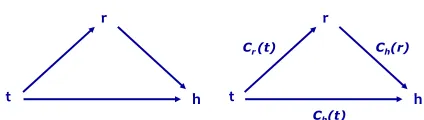
In comparison, in the CP framework, all possible contextual matches amongt,handrare considered:
t−h,t−randr−h. The three context matches are depicted in Figure 1 (left). In CP, the representation of each inference object is enriched with contextual information which is used to characterize its valid contexts. Such information may be the words of the event description in IE, corpus instances based on which a rule was learned, or an annotation of relevant WordNet senses in Name-based TC. For example, a category namehockeymay be assigned with the sense number corresponding toice hockey, but not tofield hockey, in order to designate information that limits the valid contexts of the category to the former among the two meanings of the name.
Before an inference operation is performed, the context representations of each pair among the partic-ipating objects should bematchedby a context model in order to assess the contextual validity of the opera-tion. Along with the context representation and the specific context matching models, the way context model decisions are combined needs to be specified in a concrete implementation of the CP framework.
2.2 Context matching models
Pantel et al. (2007) and Szpektor et al. (2008) rep-resented the context of such rules as the intersection of preferences of the rule’sLHSandRHS, namely the observed argument instantiations or their semantic classes. A rule is deemed applicable to a given text if the argument instantiations in the text are similar to the selectional preferences of the rule. To overcome sparseness, other works represented context in latent space. Pennacchiotti et al. (2007) and Szpektor et al. (2008) measured the similarity between the Latent Semantic Analysis (LSA) (Deerwester et al., 1990) representations of matched contexts. Dinu and La-pata (2010) used Latent Dirichlet Allocation (LDA) (Blei et al., 2003) to model templates’ latent senses, determining rule applicability based on the similarity between the two sides of the rule when instantiated by the context, while Ritter et al. (2010) used LDA to model argument classes, considering a rule valid for a given argument instantiation if its instantiated templates are drawn from the same hidden topic.
A different approach is provided by classification-based models which learn classifiers for inference objects. A classifier is trained based on positive and negative examples which represent valid or invalid contexts of the object; from those, features charac-terizing the context are extracted, e.g. words in a window around the target term or syntactic links with it. Given a new context, the classifier assesses its va-lidity with respect to the learned classification model. Classifiers in prior work were applied to determine rule applicability in a given context (t−r). Train-ing a classifier for word paraphrasTrain-ing, Kauchak and Barzilay (2006) used occurrences of the rule’sRHSas positive context examples, and randomly picked neg-ative examples. A similar approach was applied by Dagan et al. (2006), which used a single-class SVM to avoid selecting negative examples. In both works, a resulting classifier represents a word with all its senses intermixed. Clearly, this poses no problem for monosemous words, but is biased towards the more common senses of polysemous words. Indeed, Dagan et al. (2006) report a negative correlation between the degree of polysemy of a word and the performance of its classifier. Connor and Roth (2007) used per-rule classifiers to produce a noisy training set for learning a global classifier for verb substitution.
In this work we follow the classification-based ap-proach which seems appealing for several reasons.
t
r
t
Ch(r)
h
Cr(t)
Ch(t) r
[image:3.612.321.533.56.116.2]h
Figure 1: Left: An illustration of the CP relationships as in (Szpektor et al., 2008), with arrows indicting the context matching direction; Right: The application of classifiers to the tested contexts under our scheme.
First, it allows seamlessly integrating various types of information via classifiers’ features; unlike some of the above models, it is not inherently dependent on the type of rules that are utilized and easily accom-modates to both lexical and lexical-syntactic rules through the choice of features. In addition, it does not rely on a predefined similarity measure and pro-vides flexibility in terms of model’s parameters. Fi-nally, this approach captures the notion of direction-ality which is fundamental in textual inference, and is therefore better suited to applied inference than previously proposed symmetric context models.
In comparison to prior classification-based models, our approach addresses all three context matches specified by CP, rather than only the rule-text match. It is not limited to substitutable terms or even to terms with the same part of speech. In addition, we avoid learning a classifier for all senses combined, but rather learn it for the specific intended meaning.
2.3 Name-based Text Categorization
Name-based TC (Gliozzo et al., 2009) is an unsu-pervised setting of Text Categorization in which the only input provided is the category name, e.g.trade,
‘mergers and acquisitions’orguns. When category names are ambiguous, e.g.space, categories are not well defined; thus, auxiliary information is expected to accompany the name for disambiguation, such as a list of relevant senses or a category description.
In this work we focus on the above unsupervised step. Gliozzo et al. (2009) addressed this task by rep-resenting both documents and categories by LSA vec-tors which implicitly capture contextual similarities between terms. Each document was then assigned to the most similar category based on cosine simi-larity between the LSA vectors. Barak et al. (2009) required an occurrence of a term entailing the cat-egory name (or the catcat-egory name itself) in order to regard the category as a candidate for the docu-ment. To assess the contextual validity of the match, they used LSA document-category similarity as in (Gliozzo et al., 2009). For example, to classify a doc-ument into the categorymedicine, at least one lexical entailment rule, e.g. ‘drug⇒medicine’, should be matched in the document. Then, the validity ofdrug
formedicinein the matched document is assessed by the LSA context model. In this work we adopt Barak et al.’s requirement for a match for the category in the document, but address context matching in an entirely different way.
Name-based TC provides a convenient setting for evaluating context matching approaches for two main reasons. First, all types of context matchings are real-ized in this application (see Section 3); second, as the hypothesis consists of a single term or a few terms, the TC gold standard annotation corresponds quite directly to the context matching task for lexical infer-ences; in other applications where longer hypotheses are involved, context matching performance may be masked by other factors.
3 Contextual Matches in TC
Within Name-based TC, the Textual Entailment ter-minology is mapped as follows:his a term denoting the category name (e.g.mergeroracquisition);tis a matched term in the document to be categorized from whichh may be inferred; and a match refers to an occurrence in the document of eitherh(direct match) or theLHSof an entailment rulerwhoseRHS
is a category name (indirect match).1
Under the CP view, a context model needs to ad-dress the following three context matching cases within a TC setting.
t−h: Assessing the validity of a match in the docu-ment with respect to the category’s intended meaning.
1Note thattandhboth refer here to individual terms.
For example, the occurrence of the category name
space(in the sense ofouter space) in “the server ran out of disk space” does not indicate aspace-related text, and should be dismissed by the context model.
t−r: This case refers to a rule match in the docu-ment. A context model should ensure that the mean-ing of a match is compatible with that of the rule. For example, ‘alien⇒space’ is a valid rule for the
spacecategory. Yet, it should not be applied to “The US welcomes a large number of aliens every year”, sincealienin this sentence has a different meaning than the intended meaning of the rule.
r−h: The match between the intended meanings of the category name and theRHSof the rule. For instance, the rule ‘room⇒space’ is not suitable at all for the(outer) spacecategory.
4 A Classification-based Scheme for CP
Szpektor et al. (2008) introduced a vector-space model to implement CP, in which the textt, the rule
r and the hypothesish share the same contextual representation. However, in CP,r,handthave non-symmetric roles: the context oftshould be tested as valid forrandhand not vice versa, and the context ofrshould be validated forhand not the other way around. This stems from the need to consider direc-tionality in context matching. For instance, a text aboutfootball typically constitutes a valid context for the more general sports context, but not vice versa. Indeed, directionality may be captured in vector-space models by using a directional similarity measure (Kotlerman et al., 2010), but only symmetric measures were used in context matching work so far.
Based on this distinction between the inference objects’ roles, we present a novel scheme that uses two types of classifiers to represent context:
Ch: A classifier that identifies valid contexts forh. It tests contexts oft(fort−hmatching) orr(for
r−hmatching), assigning them scoresCh(t) andCh(r), respectively.
Cr: A classifier that identifies valid contexts for ap-plying the ruler. It tests the context oft, assign-ing it a scoreCr(t).
Hence,halways acts as theclassifying object,tis always theclassified object, whileracts as both. Con-text matching is quantified by the degree by which the classified object represents a valid context for the classifying object in a given inference scenario.
In comparison to the CP implementation in (Szpek-tor et al., 2008), our approach uses a unified model which captures directionality in context matching.
To instantiate the scheme, one needs to define the way training examples are obtained and processed. This may be done within supervised classification, where labeled examples are provided, or – as we do in this work – using self-supervised classifiers which obtain training examples automatically. We present such an instantiation in Section 5, where a classifier is trained for each category and each rule. When more complex hypotheses are involved,Chclassifiers can be trained separately for each relevant part of the hypothesis, using the rest for disambiguation.
A combination of the three model scores provides a final context matching score. In Section 6 we sug-gest a way to combine the actual classification scores as part of the integration of CP into TC, but other combinations are plausible. In particular, binary clas-sifications (valid vs. invalid) may be used as filters. That is, the context is classified as valid only if all relevant models classify it as such.
5 A Self-supervised Context Model
We now turn to demonstrate how our classification-based scheme may be implemented. The model be-low is exemplified on Name-based TC, but may be applicable to other tasks, with few changes.
5.1 Training-set generation
Our implementation is self-supervised as we want to integrate it within the unsupervised TC setting. That is, the classifiers automatically obtain training examples for the classifying object (a category or a rule) without relying on labeled documents.
We obtain examples by querying the TC training corpus with automatically-generated search queries. The difficulty lies in correctly constructing queries that will retrieve documents representing either valid or invalid contexts for the classifying object. To this end, we retrieve examples through a gradual process in which the most accurate (least ambiguous) query
is used first and less accurate queries follow, until the designated number of examples is acquired.
5.1.1 Obtaining positive examples
To acquire positive training examples, we con-struct queries which are comprised of two main clauses. The first contains the seeds, terms which characterize the classifying object. Primarily, these are the category name or theLHSof the rule. The sec-ond consists ofcontext wordswhich are used when the seeds are polysemous, and are intended to assist disambiguation. When context words are used, at least one seed and at least one context word must be matched to retrieve a document. For example, given the highly ambiguous category namespace, we first construct the query using only the monose-mous termouter space; if the number of retrieved documents does not meet the requirement, a second query may be constructed:(“outer space”ORspace)
AND(infiniteORscienceOR. . . ).
To generate a rule classifierCr, we retrieve posi-tive examples as follows. If theLHSterm is monose-mous according to WordNet2, we first query using this term alone (e.g. decrypt), and add its monose-mous synonyms and hyponyms if more examples are required (e.g. decrypt OR decode). If the LHS is polysemous, we carry out Procedure 1. Intuitively, this procedure tries to minimize ambiguity by using monosemous terms as much as possible; when poly-semous terms must be used, it tries to ensure there are monosemous terms to disambiguate them. Note that entailment directionality is maintained throughout the process, as seeds are only expanded with more specific (entailing) terms, while context words are only expanded with more general (entailed) terms.
Procedure 1: Retrieval ofCrpositive examples
Apply sequentially until sufficient examples are obtained:
1: Set the LHS as seed and the RHS’s monosemous syn-onyms, hypernyms and derivations as context words. 2: Add monosemous synonyms and hyponyms of the
LHS to the seeds.
3: As in 2, but use polysemous terms as well. 4: Add polysemous context words.
Positive examples for category classifiers (Ch) are obtained through a similar procedure as for rule
sifiers. If the category is part of a hierarchy, we also use the name of the parent category (e.g. sportfor
rec.sport.hockey) as a context word.
5.1.2 Obtaining negative examples
Negative examples are even more challenging to acquire. In prior work negative examples were se-lected randomly (Kauchak and Barzilay, 2006; Con-nor and Roth, 2007). We follow this method, but also attempt to identify negative examples that are semantically similar to the positive ones in order to improve the discriminative power of the classifier (Smith and Eisner, 2005). We do that by applying a similar procedure which uses cohyponyms of the seeds, e.g.baseballforhockeyorislamfor christian-ity. Cohyponymy is a non-entailing relation; hence, by using it we expect to obtain semantically-related, yet invalid contexts. If not enough negative exam-ples are retrieved using cohyponyms, we select the remaining required examples randomly.
As the distribution of positive and negative ex-amples in the data is unknown, we set the ratio of negative to positive examples as a parameter of the model, as in (Bergsma et al., 2008).
5.1.3 Insufficient examples
When the number of training examples for a rule or a category is below a certain minimum, the re-sulting classifier is expected to be of poor quality. This usually happens for positive examples in any of the following two cases: (i) the seed is rare in the training set; (ii) the desired sense of the seed is rarely found in the training set, and unwanted senses were filtered by our retrieval query. For instance,nazarene
does not occur at all in the training set, and the classi-fier corresponding to the rule ‘nazarene⇒christian’ cannot be generated. On the other hand,conedoes appear in the corpus but not in the astrophysical sense the rule ‘cone⇒space’ refers to. In such cases we refrain from generating the classifier and use instead a default score of0for each classified object. The idea is that rare terms will also occur infrequently in the test set, while cases where the term is found in the corpus, but in a different sense than the desired one, will be blocked.
5.1.4 Feature extraction
We extract global and local lexical features that are standard in WSD work. Global features include all
the terms in the document or in the sentence in which a match was found. Local features are extracted around matches of seeds which comprised the query that retrieved the document. These features include the terms in a window around the match, and the noun, verb, adjective and adverb nearest to the match in either direction. For randomly sampled negative examples, where no matched query terms exist, we randomly select terms in the document as “matches” for local feature extraction. If more than one match of the same term is found in a document, we assume one-sense-per-discourse (Gale et al., 1992) and jointly extract features for all matches of the term.
5.2 Applying the classifiers
During inference, for each direct match in a docu-ment, the correspondingChis applied. For an indi-rect match, the respectiveCris also applied.
In addition, Ch is applied to the matched rules. Unliket, a rule is not represented by a single text. Therefore, to test a rule’s match with the category, we randomly sample from the training set documents containing the rule’sLHS. We applyChto each sam-pled example and compute the ratio of positive classi-fications. The result is a score indicating the domain-specific probability of the rule to be applicable to the category, and may be interpreted as an in-domain
prior. For instance, the rule ‘check ⇒ hockey’ is assigned a score of0.05, since the sense of check
as a hockey defense technique is rare in the corpus. On the other hand, non ambiguous rules, e.g. ‘ war-ship⇒ship’ are assigned a high probability (1.0), and so are rules whoseLHSis ambiguous but its dom-inant sense in the training corpus is the same one the rule refers to, e.g. ‘margin⇒earnings’(0.85).
We do not assign negative classifier scores to in-valid matches but rather set them to zero instead. The reason is that an invalid context only indicates that the term cannot be used for entailing the category name, but not that the document itself is irrelevant.
6 CP for Text Categorization
As in (Barak et al., 2009) (Barak09 below), we represent documents and categories by term-vectors in the following way: a document vector contains the document terms; a category vector contains two sets of terms: C, the terms denoting the category name, andE, their entailing terms. For example,oil
is added to the vector of the categorycrudeby the rule ‘oil⇒crude’ (i.e.crude∈ C andoil∈ E).
Barak09assigned equal values of1to all vector entries. We suggest integrating a CP-based context model into TC by re-weighting the terms in the vec-tors, prior to determining the final document-category categorization score through vector similarity. Given a categoryc, with term vectorC, and a documentd
with term vectorD, the model re-weights vector en-tries of matching terms (i.e., terms inC∩D), based on the validity of the context match. Valid matches should be assigned with higher scores than invalid ones, leading to higher overall vector similarity for documents with valid matches for the given category. Non-matching terms are ignored as their weights are canceled out in the subsequent vector product.
Specifically, the model assigns a new weight
wD(u) to a matching termuin the document vec-torDbased on the model’s assessment of: (a)t−h, the context match between the (match in the) doc-ument and the category; and (if an indirect match) (b)t−r, the context match between the document and the rule ‘u⇒ci’, whereci ∈ C. The model also sets a new weightwC(v)to a termvin the category vectorCbased on the context match forr−h, be-tween the rule ‘v⇒ cj’ (cj ∈ C) and the category. For instance, using our context matching scheme in TC,wD(u)is set toCh(u)or Ch(u)+Cr(u)2 for direct and indirect matches, respectively;wC(v)is left as1 ifv∈ Cand set toCh(v)whenv∈ E.
Barak09assigned a single global context score to a document-category pair using the LSA representa-tions of their vectors. In our approach, however, we consider the actual matches from the three different views, hence the re-weighting of the vector entries using three model scores.
7 Experimental Setting
7.1 Datasets and knowledge resources
Following (Gliozzo et al., 2009) and (Barak et al., 2009), we evaluated our method on two standard TC
datasets:Reuters-10and20-Newsgroups.
The Reuters-10(R10, for short) is a sub-corpus of the Reuters-21578 collection3, constructed from the ten most frequent categories in the Reuters tax-onomy. We used the Apte split of the Reuters-21578 collection, often used in TC tasks. The top 10 cate-gories include about 9,000 documents, split into train-ing (70%) and test (30%) sets. The20-Newsgroups
(20NG) corpus is a collection of newsgroup postings gathered from twenty different categories from the Usenet Newsgroups hierarchy4. We used the “by-date” version of the corpus, which contains approxi-mately 20,000 documents partitioned (nearly) evenly across the categories and divided in advance to train-ing (60%) and test (40%) sets.
As in (Gliozzo et al., 2009; Barak et al., 2009), we adjusted non-standard category names (e.g. forsale
was renamed tosale) and manually specified for each category its relevant WordNet senses. The sense tag-ging properly defines the categories, and is expected to accompany such hypotheses. Other types of in-formation may be used for this purpose, e.g. words from category descriptions, if such exist.
We applied standard preprocessing (sentence split-ting, tokenization, lemmatization and part of speech tagging) to all documents in the datasets. All terms, including those denoting category names and rules, are represented by their lemma and part of speech.
As sources for lexical entailment rules we used WordNet 3.0 (synonyms, hyponyms, derivations and meronyms) and a Wikipedia-derived rule-base (Shnarch et al., 2009). UnlikeBarak09we did not limit the rules extracted from WordNet to the most frequent senses and used all rule types from the Wikipedia-based resource.
7.2 Self-supervised model tuning
Tuning of the self-supervised context model’s pa-rameters (number of training examples, negative to positive ratio, feature set and the way negative exam-ples are obtained) was performed over development sets sampled from the training sets. Based on this tun-ing, some parameters varied between the datasets and between classifier types (Ch vs. Cr). For example,
3http://kdd.ics.uci.edu/databases/
reuters21578/reuters21578.html 4
selection of negative examples based on cohyponyms was found useful forCrclassifiers inR10, while ran-dom examples were used in the rest of the cases.
We usedSVMperf(Joachims, 2006) with a linear kernel and binary feature weighting.
For querying the corpus we used the Lucene search engine5 in its default setting. Up to 150 positive examples were retrieved for each classifier, with5 examples set as the required minimum. This resulted in generating 100% of the hypothesis classifiers for both datasets and 95% and 70% of the rule classifiers forR10and20NG, respectively.
We computedCh(r)scores based on up to20 sam-pled instances. If less than2examples were found in the training set, we assigned an “unknown” context match probability of0.5, since a rareLHSoccurrence does not indicate anything about its meaning in the corpus. Such cases constituted 2% (R10) and 11% (20NG) of the utilized rules.
7.3 Baseline models
To provide a more meaningful comparison with prior work, we focus on the first unsupervised step in the typical Name-based TC flow, without the subsequent supervised training. Our goal is to improve the accu-racy of this first step, and we therefore compare our context model’s performance to two unsupervised methods used byBarak09.
The first baseline, denotedBarakno-cxt, is the
co-sine similarity score between the document and cate-gory vectors where all terms are equally weighted to a score of1.6 This baseline shows the performance when no context model is employed.
The second baseline, denotedBarakfull, is a
repli-cation of the state of the art context model for Name-based TC. In this method, LSA vectors are con-structed for a document by averaging the LSA vectors of its individual terms, and for a category by averag-ing the LSA vectors of the terms denotaverag-ing its name. The categorization score of a document-category pair is set to be the product between the cosine similarity score of the LSA vectors and the score given by the aboveBarakno-cxtmethod. We note that LSA-based
context models performed best also in (Gliozzo et al., 2009) and (Szpektor et al., 2008).
5
http://lucene.apache.org 6
Other attempted weighting schemes, such as tf-idf, did not yield better performance.
Model Reuters-10
Accuracy P R F1
Barakno-cxt 73.2 63.6 77.0 69.7
Barakfull 76.3 68.0 79.2 73.2
Class.-based 79.3 71.8 83.6 77.2
Model 20-Newsgroups Accuracy P R F1
Barakno-cxt 63.7 44.5 74.6 55.8
Barakfull 69.4 50.1 82.8 62.4
[image:8.612.324.530.53.181.2]Class.-based 73.4 54.7 76.4 63.7
Table 1: Evaluation results.
All models were constructed based on the TC train-ing sets, ustrain-ing no external corpora. The vocabulary consists of terms that appear more than once in the training set. The terms we consider include nouns, verbs, adjectives and adverbs, as well as nominal multi-word expressions.
8 Results and Analysis
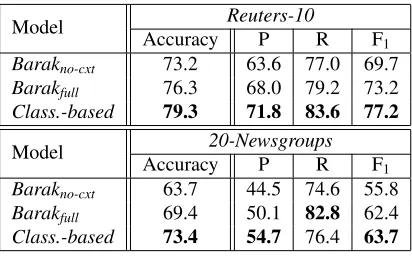
Given a document, all categories for which a lexical match was found in the document are considered, and the document is classified to the highest scoring category. If all categories are assigned non-positive scores, the document is not assigned to any of them. Based on this requirement that a document con-tains at least one match for the category, 4862 document-category pairs were considered for clas-sification inR10and 9955pairs in 20NG. We eval-uated our context model, as well as the baselines, based on theaccuracy of these classifications, i.e. the percentage of correct decisions among the candi-date document-category pairs. We also measured the models’ performance in terms of micro-averaged pre-cision(P),relative recall(R) and F1. LikeBarak09, recall is computed relative to the potential recall of the rule-set which provides the entailing terms.
Table 1 presents the evaluation results. As in
Removed Reuters-10 20-Newsgroups Accuracy F1 Accuracy F1
- 79.3 77.2 73.4 63.7
Ch(t) 76.2 72.3 71.9 61.0
Cr(t) 80.5 77.6 74.3 64.5
[image:9.612.72.288.53.129.2]Ch(r) 78.4 75.7 73.1 63.4
Table 2: Ablation tests results.
state of the art LSA-based method.
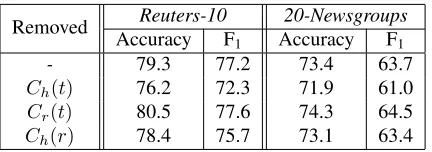
Table 2 presents ablation tests of our model. In each test we measured the classification performance when one of the three classification scores is ignored. Clearly,Ch(t)is the most beneficial component, and in general the category classifiers help improving overall performance. The limited performance ofCr may be related to higher ambiguity in rules relative to category names, resulting in noisier training data. In addition, the small size of the training set limits the number of training examples for rule classifiers. This problem affectsCr more thanCh since, by nature, the corpus includes more occurrences of category names. Still,Crcontributes to improved recall (this fact is not visible in Table 2).
The coverage of the utilized rule-set determines the maximal (absolute) recall that can be achieved by any model. With the rule-set we used in this ex-periment, the recall upper bound was 59.1% for R10 and 40.6% for 20NG. However, rule coverage af-fects precision as well: In many cases documents are assigned to incorrect categories because the correct category is not even a candidate as no entailing term was matched for it in the document. For instance, a document with the sentence “For sale or trade!!! BMW R60US. . .” was classified by our method to the categoryforsale, while its gold-standard category ismotorcycles. Yet, none of the rules in our rule-set triggeredmotorcyclesas a candidate category for this document. Ideally, a context model would rule out all incorrect candidate categories; in practice even a single low score for one of the competing categories results in a false positive error in such cases (in addi-tion to the recall loss). To reduce these problems we intend to employ additional knowledge resources in future work.
Our algorithm for retrieving training examples turned out to be not sufficiently accurate, particularly for negative examples. This is a challenging task that
requires further research. Although useful for some classifier types, the use of cohyponyms may retrieve potentially positive examples as negative ones, since terms that are considered cohyponyms in WordNet are often perceived as near synonyms in common usage, e.g. buyout and purchasein the context of acquisitions. Likewise, using WordNet senses to de-termine ambiguity is also inaccurate. Rare or too fine-grained senses, common in WordNet, cause a term to be considered ambiguous, which in turn trig-gers the use of less accurate retrieval methods. For example,auctionhas a bridge-related WordNet sense which is irrelevant for our dataset, but made the term be considered ambiguous. This calls for develop-ment of other methods for determining word ambigu-ity, which consider the actual usage of terms in the domain rather than relying solely on WordNet.
9 Conclusions
In this paper we presented a generic classification-based scheme for comprehensively addressing con-text matching in con-textual inference scenarios. We presented a concrete implementation of the proposed scheme for Name-based TC, and showed how CP decisions can be integrated within the TC setting.
Utilizing classifiers for context matching offers several advantages. They naturally incorporate di-rectionality and allow integrating various types of information, including ones not used in this work such as syntactic features. Our results indeed support this approach. Still, further research is required re-garding issues raised by the use of multiple classifiers, scalability in particular.
Hypotheses in TC are available in advance. While also the case in other applications, it constitutes a practical challenge when hypotheses are given “on-line”, like Information Retrieval queries, since classi-fiers will have to be generated on the fly. We intend to address this issue in future work.
Lastly, we plan to apply the generic classification-based approach to address context matching in other inference-based applications.
Acknowledgments
References
Libby Barak, Ido Dagan, and Eyal Shnarch. 2009. Text Categorization from Category Name via Lexical Refer-ence. InHLT-NAACL (Short Papers).
Shane Bergsma, Dekang Lin, and Randy Goebel. 2008. Discriminative Learning of Selectional Preference from Unlabeled Text. InIn Proceedings of EMNLP. David M. Blei, Andrew Y. Ng, and Michael I. Jordan.
2003. Latent Dirichlet Allocation. Journal of Machine Learning Research, 3:993–1022, March.
Michael Connor and Dan Roth. 2007. Context Sensitive Paraphrasing with a Global Unsupervised Classifier. In
Proceedings of ECML.
Ido Dagan, Oren Glickman, Alfio Gliozzo, Efrat Mar-morshtein, and Carlo Strapparava. 2006. Direct Word Sense Matching for Lexical Substitution. In Proceed-ings of COLING-ACL.
Ido Dagan, Bill Dolan, Bernardo Magnini, and Dan Roth. 2009. Recognizing Textual Entailment: Rational, Eval-uation and Approaches. Natural Language Engineer-ing, pages 15(4):1–17.
Scott Deerwester, Scott Deerwester, Susan T. Dumais, George W. Furnas, Thomas K. Landauer, and Richard Harshman. 1990. Indexing by Latent Semantic Anal-ysis. Journal of the American Society for Information Science, 41:391–407.
Georgiana Dinu and Mirella Lapata. 2010. Topic Models for Meaning Similarity in Context. InProceedings of Coling 2010: Posters.
Doug Downey and Oren Etzioni. 2009. Look Ma, No Hands: Analyzing the Monotonic Feature Abstraction for Text Classification. InProceedings of NIPS. Christiane Fellbaum, editor. 1998. WordNet: An
Elec-tronic Lexical Database (Language, Speech, and Com-munication). The MIT Press.
William A. Gale, Kenneth W. Church, and David Yarowsky. 1992. One Sense per Discourse. In Proceed-ings of the workshop on Speech and Natural Language. Alfio Gliozzo, Carlo Strapparava, and Ido Dagan. 2009. Improving Text Categorization Bootstrapping via Unsu-pervised Learning. ACM Trans. Speech Lang. Process., 6:1:1–1:24, October.
Sanda M. Harabagiu, Steven J. Maiorano, and Marius A. Pas¸ca. 2003. Open-domain Textual Question Answer-ing Techniques. Natural Language Engineering, 9:231– 267, September.
Thorsten Joachims. 2006. Training Linear SVMs in Linear Time. InProceedings of the ACM Conference on Knowledge Discovery and Data Mining (KDD). David Kauchak and Regina Barzilay. 2006.
Paraphras-ing for Automatic Evaluation. InProceedings of HLT-NAACL.
Lili Kotlerman, Ido Dagan, Idan Szpektor, and Maayan Zhitomirsky-Geffet. 2010. Directional Distributional Similarity for Lexical Inference. Natural Language Engineering, 16(4):359–389.
Diana McCarthy and Roberto Navigli. 2009. The English Lexical Substitution Task. Language Resources and Evaluation, 43(2):139–159.
Quinn McNemar. 1947. Note on the Sampling Error of the Difference between Correlated Proportions or Percentages. Psychometrika, 12(2):153–157, June. Roberto Navigli. 2009. Word Sense Disambiguation: A
Survey.ACM Computing Surveys, 41(2):1–69. Patrick Pantel, Rahul Bhagat, Bonaventura Coppola,
Timo-thy Chklovski, and Eduard Hovy. 2007. ISP: Learning Inferential Selectional Preferences. InProceedings of NAACL-HLT.
Marco Pennacchiotti, Roberto Basili, Diego De Cao, and Paolo Marocco. 2007. Learning Selectional Prefer-ences for Entailment or Paraphrasing Rules. In Pro-ceedings of RANLP.
Alan Ritter, Mausam, and Oren Etzioni. 2010. A La-tent Dirichlet Allocation Method for Selectional Prefer-ences. InProceedings of ACL.
Eyal Shnarch, Libby Barak, and Ido Dagan. 2009. Ex-tracting Lexical Reference Rules from Wikipedia. In
Proceedings of IJCNLP-ACL.
Noah A. Smith and Jason Eisner. 2005. Contrastive Estimation: Training Log-linear Models on Unlabeled Data. InProceedings of ACL.