Sentence-Level Instance-Weighting for Graph-Based
and Transition-Based Dependency Parsing
Anders Søgaard
Center for Language Technology University of Copenhagen [email protected]
Martin Haulrich
ISV Computational Linguistics Group Copenhagen Business School
Abstract
Instance-weighting has been shown to be effective in statistical machine translation (Foster et al., 2010), as well as cross-language adaptation of dependency parsers (Søgaard, 2011). This paper presents new methods to do instance-weighting in state-of-the-art dependency parsers. The meth-ods are evaluated on Danish and English data with consistent improvements over un-adapted baselines.
1 Introduction
The default assumption in theoretical machine learning is that training and test data are indepen-dently and identically (iid) drawn from the same distribution. If the distributions differ, we face what is referred to as sample selection bias in the statistical literature. Sample selection bias is typ-ically ignored in machine learning, but it occurs often in practice.
In natural language processing, the problem shows up in almost any real-world application. Machine translation systems are trained on large amounts of parallel text, but typically this text comes from a small set of sources or institutions, e.g. the Europarl corpora of transcribed debates from the European Parliament (Koehn, 2005). Machine translation systems are used to translate many different kinds of texts, however. In ma-chine translation, which can be seen as a struc-tured learning problem of predicting target sen-tence y given a source sentence x, we typically see a bias in P(y) and P(x), but not inP(y|x). Statistical parsers for English are typically trained on annotated text from the Wall Street Journal cor-pus of newspaper articles (Marcus et al., 1993), but are used to process many different kinds of text. Since the problem of sample selection bias in natural language processing is typically related to differences in textual domains, computational
linguists typically refer to the problem as domain adaptation.
Domain adaptation is one of the most funda-mental yet-to-be-solved problems in natural lan-guage processing. While statistical parsers have accuracies of 90-92% parsing newspaper articles, accuracy on transcribed telephone conversations or child-directed speech often drop to 60-70% (Nivre et al., 2007a). Domain adaptation is there-fore also receiving more and more attention, and it has recently been studied in the context of named entity recognition (Daume III, 2007), sentiment analysis (Blitzer et al., 2007), dependency pars-ing (Sagae and Tsujii, 2007; Kawahara and Uchi-moto, 2009), text classification (Chen et al., 2009), context-free parsing (McClosky et al., 2010) and machine translation (Foster et al., 2010).
Domain adaptation is the problem of learning a target distribution from a labeled sample of source data with a similar, but different distribution. The problem comes in two variants; one where we also have a small amount of labeled target domain data, and one in which we only have labeled source do-main data and must rely on unlabeled source and target domain data to do the actual adaptation of the model that can be learned from source domain data. Much work in natural language processing has assumed a small amount of labeled target do-main data (Daume III, 2007; Foster et al., 2010), but we consider the more difficult case where none is available. This is sometimes referred to as un-supervised domain adaptation.
How domain adaptation is tackled depends much on the assumptions we may have about the similarities and differences between the two distri-butions. One line of approaches to domain adapta-tion is to change the feature representaadapta-tion of the source domain data, typically focusing on the fea-tures that are also predictive in the target domain (Ben-David et al., 2007). Such approaches assume a bias inP(x), but may also try to deal with
narios where there is a bias inP(y|x). Others have proposed using priors to encode knowledge about one domain in a model induced from data in an-other domain, or they have promoted frequent tar-get domain classes if they were less frequent in the source domain. Such approaches assume a bias in
P(y)and have become popular in word sense dis-ambiguation (Zhu and Hovy, 2007), for example, where a particular reading of bank may be much more frequent in some domains rather than others. Classes can be promoted using instance weight-ing, but instance weighting can also be used to change the marginal distribution of data. The first case is typically referred to as solving class im-balance, while the second case is called covari-ate shift (Shimodaira, 2000). We will, assuming a bias in P(x), consider the covariate shift sce-nario. A fourth line of research in domain adapta-tion applies semi-supervised or transductive learn-ing algorithms to domain adaptation problems, us-ing unlabeled data from the target domain.
In dependency parsing, domain adaptation re-ceived attention in the CoNLL 2007 Shared Task. While semi-supervised learning and structural cor-respondence learning were used by participants in the CoNLL 2007 Shared Task, none of the par-ticipants used instance-weighting techniques. In this paper, we follow suggestions in the related literature on learning under sample selection bias to transform the density ratio estimation problem in co-variate shift into a problem of predicting whether an instance is from the source domain or from the target domain (Zadrozny, 2004; Bickel and Scheffer, 2007). We show how to do this in the context of graph-based and transition-based dependency parsing.
Related work includes Søgaard (2011) who uses perplexity per word to select the source data most similar to the target data, so a form of in-stance weighting with weights 0 and 1, but ap-plies the technique to cross-language adaptation of dependency parsers; but also Plank and van No-ord (2011) who in a similar fashion use topic sim-ilarity measures to select articles rather than sen-tences.
Our instance-weighted parsers are evaluated primarily on a new data set, namely a partition-ing of the Danish treebank (Buch-Kromann, 2003) into four different textual domains. We do ex-periments with all pair-wise combinations of the four domain-specific treebanks. Our results are
supplemented by a subset of the CoNLL 2007 Shared Task data. It has been noted in several places that there were annotation differences be-tween the source and target data in the original data which makes domain adaptation almost im-possible (Dredze et al., 2007). Consequently, we only use the three small target domain evalua-tion datasets, which were annotated more consis-tently, and do experiments with all pair-wise com-binations of these datasets. Our experiments can also be seen as transductive learning experiments, since no target data other than the data used for evaluation is used.
2 Sentence-Based Instance-Weighting in Dependency Parsing
2.1 Using Text Classification for Instance-Weighting
The source and target plain text corpora are first extracted, and each sentence is assigned a label saying whether the sentence was sampled from source or target data. The idea is then to train a text classifier on the data and use the probability that a sentence comes from the target domain to weight the source instances. This is also the approach to learning under sample selection bias suggested by Zadrozny (2004).
Our text classifier was a logistic regression clas-sifier implemented in Mallet. It represents each sentence by a vector representing occurrences of
n-grams in the sentence (n ≤ 3). No stop word lists were used. The text classifier was used to approximate the probability that each source sentence was sampled from the target domain. The weights are obtained using ten-fold cross-validation. We store one weight for each sentence in the labeled source data.
2.2 Graph-Based Dependency Parsing
Graph-based dependency parsing is a heteroge-neous family of approaches to the dependency parsing algorithms, each of which couples a learn-ing algorithm and a parslearn-ing algorithm. Some of these algorithms assume dependency trees are projective (Eisner, 1996), while others allow for non-projective dependency trees (McDonald et al., 2005).
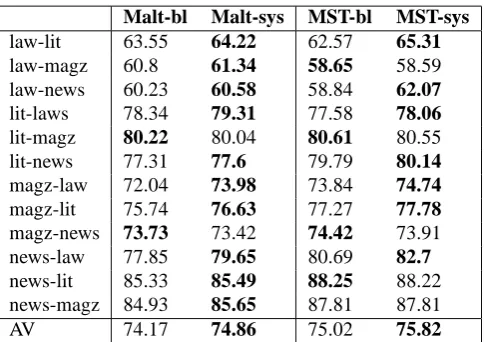
al-Malt-bl Malt-sys MST-bl MST-sys law-lit 63.55 64.22 62.57 65.31 law-magz 60.8 61.34 58.65 58.59 law-news 60.23 60.58 58.84 62.07 lit-laws 78.34 79.31 77.58 78.06 lit-magz 80.22 80.04 80.61 80.55 lit-news 77.31 77.6 79.79 80.14 magz-law 72.04 73.98 73.84 74.74 magz-lit 75.74 76.63 77.27 77.78 magz-news 73.73 73.42 74.42 73.91 news-law 77.85 79.65 80.69 82.7 news-lit 85.33 85.49 88.25 88.22 news-magz 84.93 85.65 87.81 87.81 AV 74.17 74.86 75.02 75.82
Table 1: Unlabeled attachment scores for Danish.
gorithm used in McDonald et al. (2005) and the publicly available MSTParser1 to learn candidate
weights is MIRA (Crammer and Singer, 2003). The MIRA algorithm considers one sentence at each update of the weight vector, and the succes-sive values of the vector are accumulated to later produce an averaged weight vector in a way simi-lar to using averaged perceptron. Unlike using av-eraged perceptron, MIRA aggressively maximizes the margin between the correct dependency struc-ture and the parser’s prediction enforcing it to be larger than the loss of that prediction.
In our experiments we weight the margin such that a large margin between the correct and pre-dicted structures is less aggressively enforced when learning from distant data points. This is achieved by weighting the loss of incorrect classi-fications by the probability that the sentence was sampled from the target domain.
2.3 Transition-Based Dependency Parsing
Transition-based parsing reduces the problem of finding the most likely dependency tree for a sen-tence to a series of classification problems by see-ing parssee-ing as transitions between configurations. Parsing is incremental and left-to-right. A con-figuration typically consists of the next couple of words to be read, the first couple words on a stack storing previously read words, and part of the de-pendency structure already build. Each configura-tion is a feature vector used to predict the parser’s next transition. The guiding classifier is trained on canonical derivations of the dependency trees in the labeled training data.
1http://sourceforge.net/projects/mstparser/
The most widely used transition-based depen-dency parser is the MaltParser (Nivre et al., 2007b).2 The parser comes with several parsing algorithms, but uses a projective and very efficient algorithm by default. MaltParser is bundled with LibSVM 2.91, implementing a wide range of sup-port vector machine algorithms that are used to learn classifiers to guide parsing. LibSVM 2.91 does not allow for instance weighting. However, LibSVM 3.0 does. In our experiments with the MaltParser, we use LibSVM 3.0 in conjunction with the MaltParser providing it with sentence-level instance weights from our Mallet text classi-fier. This means that configuration-transition pairs in the canonical derivations of a sentence with weight w will have weight w when training the support vector machine used by our parser.
3 Data
We evaluate our instance-weighted parsers on two domain adaptation data sets from English and Danish annotated corpora, one of which (Dan-ish) has not previously been used in the literature. The Danish corpus is a balanced corpus, annotated building the Danish Dependency Treebank (DD (Buch-Kromann, 2003) and used in the CoNLL-X Shared Task (Buchholz and Marsi, 2006). The DDT comes with metadata revealing the original source of each sentence. This metadata was used to split the DDT into four domains: law (77 sent.), literature (lit; 984 sent.), magazines (magz; 190 sent.) and newspapers (news; 5052 sent.).
The second dataset was also used for the CoNLL 2007 Shared Task on domain adaptation
Malt-bl Malt-sys MST-bl MST-sys childes-pbiotb 43.11 43.91 46.03 48.86 childes-pchemtb 38.01 39.69 44.89 44.41 pbiotb-childes 50.35 49.91 59.07 61.37 pbiotb-pchemtb 75.64 75.26 77.26 77.16 pchemtb-childes 49.63 50.69 60.89 60.91 pchemtb-pbiotb 75.28 75.06 76.39 76.73
[image:4.595.168.433.60.161.2]AV 55.34 55.75 60.76 61.57
Table 2: Unlabeled attachment scores for English.
for dependency parsers (Nivre et al., 2007a). In the shared task, the Penn-III treebank (Marcus et al., 1993) was used as source domain, and test do-mains were chemical and biomedical research ar-ticles and transcribed child-directed speech. The quality of the shared task data was questioned by participants (Dredze et al., 2007), and there is some consensus today that annotation styles were too different for evaluation results to be useful. We therefore use data from the target domains only: biomedical literature (160 sent.), chemical litera-ture (195 sent.) and child-directed speech (666 sent.). We consider all pairwise combinations of datasets within the two languages.
4 Results
Our results for both Danish and English (see Table 1 and 2), reporting unlabeled attachment scores including punctuation, show rather consis-tent improvements across all pairwise combina-tions of datasets. Error reduccombina-tions vary greatly from dataset to dataset, however. The average er-ror reduction on the Danish data is≥ 3%for the instance-weighted MSTParser, and≥2.5%for the instance-weighted MaltParser.
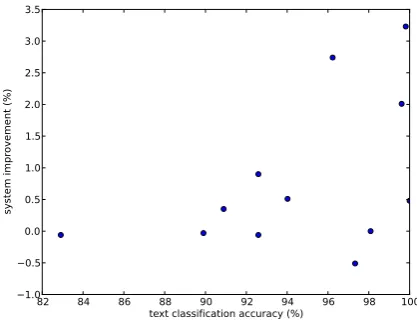
It is interesting to note that there were no signif-icant improvements when English input data was weighted by a text classifier trained on biomedical and chemical literature. These two text types are of course more similar to each other than to child-directed speech. This is reflected in the text clas-sification accuracy, which is as high as 98–99% when comparing sentences sampled from techni-cal literature and sentences sampled from child-directed speech, but considerably lower (∼93.5%) when trying to differentiate biomedical sentences from chemical ones. Table 1 plots the correlation between system improvements and text classifica-tion accuracy for the Danish data. It is easy to see that high text classification accuracy is nec-essary for substantial improvements over the
non-82 84 86 88 90 92 94 96 98 100
text classification accuracy (%) −1.0
−0.5 0.0 0.5 1.0 1.5 2.0 2.5 3.0 3.5
sy
ste
m
im
pro
ve
me
nt
(%
)
Figure 1: Correlation between text classification accu-racy and system improvement (Danish).
weighted baseline system.
Finally we note that we did similar experiments on the Penn-III treebank using the metadata also used by Webber (2009), with less robust results and smaller average improvements. The distri-bution of text types is very skewed in the Wall Street Journal, however, making text classification on this data alone a difficult job.
5 Conclusion
We have presented ways of implementing instance-weighting in transition-based and graph-based dependency parsing based on text classification and showed that this leads to con-sistent improvements over non-adapted baselines in domain adaptation scenarios, especially across very different domains.
References
[image:4.595.316.525.218.378.2]Steffen Bickel and Tobias Scheffer. 2007. Dirichlet-enhanced spam filtering based on biased samples. Advances in Neural Information Processing Systems, 19:161–168.
John Blitzer, Mark Dredze, and Fernando Pereira. 2007. Bi-ographies, bollywood, boom-boxes and blenders: Domain adaptation for sentiment classification. In ACL.
Matthias Buch-Kromann. 2003. The Danish Dependency Treebank and the DTAG Treebank Tool. In TLT.
Sabine Buchholz and Erwin Marsi. 2006. CoNLL-X shared task on multilingual dependency parsing. In CoNLL.
Bo Chen, Wai Lam, Ivor Tsang, and Tak-Lam Wong. 2009. Extracting discriminative concepts for domain adaptation in text mining. In KDD.
Koby Crammer and Yoram Singer. 2003. Ultraconservative algorithms for multiclass problems. In JMLR.
Hal Daume III. 2007. Frustratingly easy domain adaptation. In ACL.
Mark Dredze, John Blitzer, Partha Pratim Talukdar, Kuzman Ganchev, Jo˜ao Graca, and Fernando Pereira. 2007. Frus-tratingly hard domain adaptation for dependency parsing. In EMNLP-CoNLL.
Jason Eisner. 1996. Three new probabilistic models for de-pendency parsing. In COLING.
George Foster, Cyril Goutte, and Roland Kuhn. 2010. Dis-criminative instance weighting for domain adaptation in statistical machine translation. In EMNLP.
Daisuke Kawahara and Kiyotaka Uchimoto. 2009. Learning reliability of parses for domain adaptation of dependency parsing. In IJCNLP.
Philipp Koehn. 2005. Europarl: a parallel corpus for statisti-cal machine translation. In MT-Summit.
Mitchell Marcus, Mary Marcinkiewicz, and Beatrice San-torini. 1993. Building a large annotated corpus of En-glish: the Penn Treebank. Computational Linguistics, 19(2):313–330.
David McClosky, Eugene Charniak, and Mark Johnson. 2010. Automatic domain adaptation for parsing. In NAACL-HLT.
Ryan McDonald, Fernando Pereira, Kiril Ribarov, and Jan Hajiˇc. 2005. Non-projective dependency parsing using spanning tree algorithms. In HLT-EMNLP.
Joakim Nivre, Johan Hall, Sandra K¨ubler, Ryan McDonald, Jens Nilsson, Sebastian Riedel, and Deniz Yuret. 2007a. The CoNLL 2007 shared task on dependency parsing. In EMNLP-CoNLL.
Joakim Nivre, Johan Hall, Jens Nilsson, Atanas Chanev, G¨ulsen Eryigit, Sandra K¨ubler, Svetoslav Marinov, and Erwin Marsi. 2007b. MaltParser: a language-independent system for data-driven dependency parsing. Natural Lan-guage Engineering, 13(2):95–135.
Barbara Plank and Gertjan van Noord. 2011. Effective mea-sures of domain similarity for parsing. In ACL.
Kenji Sagae and Jun’ichi Tsujii. 2007. Dependency parsing and domain adaptation with lr models and parser ensem-bles. In EMNLP-CoNLL.
Hidetoshi Shimodaira. 2000. Improving predictive infer-ence under covariate shift by weighting the log-likelihood function. Journal of Statistical Planning and Inference, 90:227–244.
Anders Søgaard. 2011. Data point selection for cross-language adaptation of dependency parsers. In ACL.
Bonnie Webber. 2009. Genre distinctions for discourse in the Penn Treebank. In ACL-IJCNLP.
Bianca Zadrozny. 2004. Learning and evaluating classifiers under sample selection bias. In ICML.