D S Sharma, R Sangal and A K Singh. Proc. of the 13th Intl. Conference on Natural Language Processing, pages 299–304, Varanasi, India. December 2016. c2016 NLP Association of India (NLPAI)
Verbframator: Semi-Automatic Verb Frame Annotator Tool with Special
Reference to Marathi
Hanumant Redkar
,
Sandhya Singh, Nandini Ghag, Jai Paranjape, Nilesh Joshi,Malhar Kulkarni, Pushpak Bhattacharyya
Center for Indian Language Technology, IIT Bombay, Mumbai, India
{hanumantredkar,sandhya.singh,samskritkanya,jai.para20,joshinilesh60}@gmail.com,
[email protected], [email protected]
Abstract
The sentence is incomplete without a verb in a language. A verb is majorly responsible for giving the meaning to a sentence. Any sen-tence can be represented in the form of a verb frame. Verb frames are mainly developed as a knowledge resource which can be used in var-ious semantic level Natural Language Pro-cessing (NLP) activities. This paper presents the Verbframator – a verb frame annotator tool which automatically extracts and gener-ates verb frames of example sentences from Marathi wordnet. It also helps in generating Shakti Standard Format (SSF) files of the giv-en example sgiv-entgiv-ences. The ggiv-enerated verb frames and SSF files can be used in the de-pendency tree banking and other NLP applica-tions like machine translation, paraphrasing, natural language generation, etc.
1 Introduction
Verb is one of the most important part-of-speech (POS) category in any language. It plays a major role in understanding or defining a sentence. Sen-tences in any language can be represented in the form of verb frames. Verb frame is made of verbal propositions and arguments of words around a giv-en verb. It is required for creating depgiv-endgiv-ency rela-tions which leads to the development of a knowledge resource. These kinds of resources are always required for semantics related Natural Lan-guage Processing (NLP) applications like machine translation, natural language generation, paraphras-ing, etc. Development and analysis of verb frames
for Indian languages is an emerging research topic in the field of NLP and computational linguistics.
This paper presents a verb frame generator tool to semi-automatically annotate and generate verb frames using example sentences from wordnet. Marathi wordnet is used as a reference wordnet for this purpose. Marathi1 is an Indo-Aryan language spoken prominently in Maharashtra, India.
Mara-thi wordnet2 comes under the umbrella of
IndoWordNet3 which currently has around 32183 synsets and 43834 words, of which 3047 are verbs. The objective is to generate verb frames for these verbs using examples from Marathi wordnet.
The paper covers explanation of the con-cept, working of verb-frame tool, advantages and disadvantages of the tool and its applications. The immediate application of the output of this tool is to study Marathi sentences and their structures with the help of its generated verb-frames. This study will lead to development of rules and guide-lines for verb-frame annotation process.
In computational linguistics and natural lan-guage processing, only few efforts have been taken to create this kind of resource for Indian languages. And in spite of Marathi being a morphologically rich, with sufficient resource availability, no re-markable work has been found.
In this paper, section 2 briefs the related work. Section 3 defines the verb frame. Section 4 dis-cusses the work flow of verb frame annotator tool. Section 5 lists features and limitations of the tool. Section 6 concludes the paper with scope for im-provement in the tool, followed by references.
1 https://en.wikipedia.org/wiki/Marathi_language 2
http://www.cfilt.iitb.ac.in/wordnet/webmwn/
3
http://www.cfilt.iitb.ac.in/indowordnet/
2 Related Work
Verb POS easily represents the activity, state or action in a text which can lead to its semantic in-terpretation. This property of verb is useful in cre-ating the necessary knowledge base required for NLP applications. Though, for English language, there is a substantial amount of work which has been done regarding the development and analysis using verb frames, but only limited work can be seen for Indian languages. This can be seen in the following research work.
Begum et al. (2008) discussed their experience with the creation of verb frames for Hindi lan-guage. These frames are further classified based on Paninian grammar framework using 6 karaka rela-tions. The method followed by the authors consid-ers the morphology, syntactic variations and semantics of the verb to divide it into different classes. This resource focuses on NLP related ac-tivities for Hindi language.
Based on similar approach, Ghosh (2014) creat-ed a resource for verb frames for compound verbs in Bengali language. The objective of the paper was to investigate if the vector verb from the com-pound verb is able to retain its case marking prop-erties and argument structure or not. And also the knowledge and syntax associated with verb frames can be utilized for categorizing and analyzing the verb words for various NLP applications.
Soni et al. (2013) explored the application of verb frames and the conjuncts in sentence simplifi-cation for Hindi language. The method proposed by the authors includes usage of conjuncts as a first level of sentence simplification. This is followed by using verb frames enhanced with tense, aspect and modality features. It is a rule based system and its output was evaluated manually and automatical-ly using BLEU score for the ease of readability and simplification.
Other related work by Schulte (2009), Theakston et al. (2015) has also explored verb frames for English language.
After reviewing these papers, the need for such kind of resource for Indian languages and a tool which can assist in the creation of this type of re-sources became more apparent. Also, apart from English, language specific verb-frame analysis has been done for few Indian languages such as Hindi and Bengali. However, no attempt has been made for Marathi language in the domain of verb-frame
creation and analysis. This paper aims to fill the gap in the literature by providing verb-frame tool for the study of verb frames.
3 What is a Verb Frame?
In any language, verb is a major part-of-speech category. Verbs are used to define actions, activi-ties and states. The potential of verbs to choose their complements (arguments/adjuncts) is referred to as 'verb sub-categorization' or 'verb valency' and a combination of functional components that are evoked by a verb is called as verb frames.
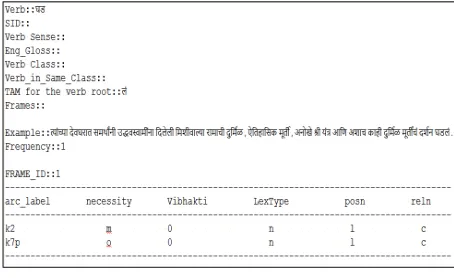
[image:2.612.313.540.376.515.2]Verb frame typically is made of verbal proposi-tions and arguments of words around a verb in a given sentence. Each of the propositional word in a verb frame has arguments such as an arc-label or semantic role label, its necessity in a frame, vibhakti (i.e. case marker), lexical type, relation with head verb, position with respect to head verb, etc. These verb frames are developed to generate dependency tree structures in a given language. Figure 1 shows a typical verb frame for a Marathi word घड (ghaDa, to happen).
Figure 1: Typical verb frame for a word घड
4 Verb Frame Annotator : Verbframator
Verb frame annotator interface or Verbframator is an online tool developed to extract the verb frames of example sentences from wordnet. It also generates the Shakti Standard Format (SSF) (Bharati et al., 2007) files for these example sen-tences.
The Verbframator is a semi-automatic tool which is developed in PHP and data is stored and maintained in MySQL verbframe database. The user input interface of Verbframator can be seen in figure 2.
Figure 2: A Verbframator user input i
4.1 Work Flow of Verbframator
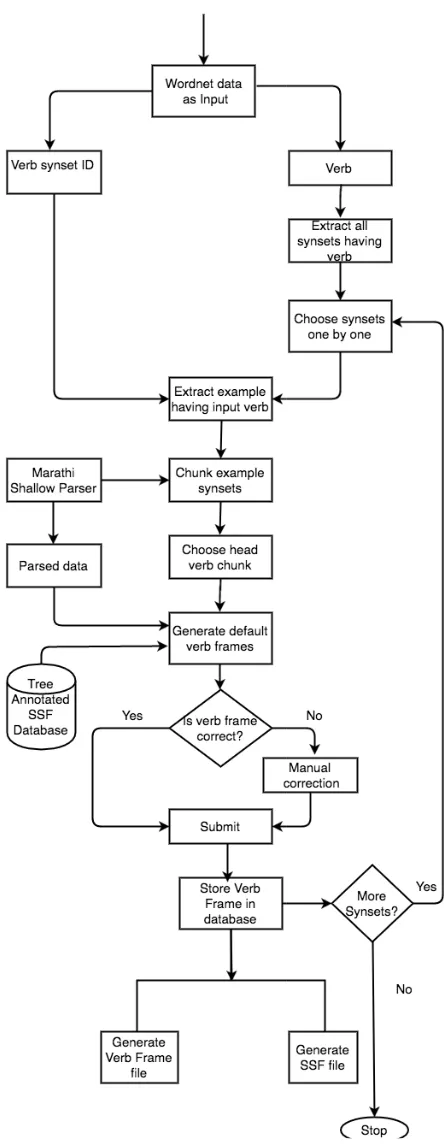
The Verbframator is designed to
frames of the example sentences from wordnet. this study we have used Marathi wordnet work flow of this tool is shown in fi
ing are the steps used by Verbframator verb frames:
(1) Take wordnet data as an input id or verb:
The Verbframator starts with the user i put in the form of either verb’s
a verb itself. The system is sentences from wordnet for
annotation process. As shown in figure above, search can be done
synset id or a verb in Marathi
(2) Extract example sentence(s):
(a) If the user enters verb synset id then system checks if the verb is present in the context of the example sentence and extract the corresponding
sentence.
(b) If the user enters verb it
two possibilities: (i) if there is o one synset for the input
system extracts exam
synset and (ii) if there are more than one synset then the sys
the synsets of the input verb selects synsets one by one synset is processed at a time
In both the cases (a) and (b) a
amples are extracted only if verb is present in the example sentence, else it will show corresponding error message. Also, if synsets have more than one example se
user input interface
Verbframator
is designed to generate verb the example sentences from wordnet. In this study we have used Marathi wordnet. The work flow of this tool is shown in figure 3.
Follow-Verbframator to generate
an input - synset
starts with the user in-verb’s synset id or The system is uses example sentences from wordnet for the verb frame As shown in figure 2 earch can be done by entering
in Marathi language.
Extract example sentence(s):
If the user enters verb synset id then tem checks if the verb is present in example sentence corresponding example
If the user enters verb itself there are if there is only the input verb then the mples of that if there are more than stem extracts all put verb. Here user s synsets one by one and each
cessed at a time.
In both the cases (a) and (b) above, the ex-amples are extracted only if verb is present in the example sentence, else it will show corresponding error message. Also, if synsets have more than one example
sen-tence then the system extracts only those examples in which the input verb appea
Figure 3: Work flow diagram of
tence then the system extracts only those examples in which the input verb appears.
Work flow diagram of Verbframator
[image:3.612.314.536.106.680.2](3) Chunk example sentence(s):
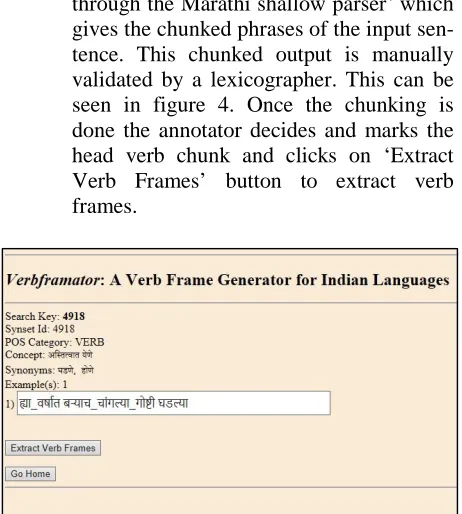
[image:4.612.72.303.102.359.2]The input example sentence processed through the Marathi shallow parser4 which gives the chunked phrases of the input sen-tence. This chunked output is manually validated by a lexicographer. This can be seen in figure 4. Once the chunking is done the annotator decides and marks the head verb chunk and clicks on ‘Extract Verb Frames’ button to extract verb frames.
Figure 4: Verbframator sentence chunked output
(4) Generate default verb frame(s):
[image:4.612.344.540.431.570.2]Once the chunking is done, the system au-tomatically generates the default verb frame for an input example.
Figure 5: Verbframator - default frame generator
4
http://ltrc.iiit.ac.in/showfile.php?filename=downloads/shallo w_parser.php
The method to automatically generate the default verb frames is explained in detail in the next section. The default verb frame generated for a verb घडणे (ghaDaNe, to happen, to occur) can be seen in figure 5.
(5) Validate extracted verb frame(s):
The annotator manually validates the gen-erated verb frame. Here, user has to do minimal validation as most of the fields in the verb frame are already entered by the system automatically. Once the validation is done by an annotator, user can store the verb frame, generate the verb frame or/and generate the SSF file.
(6) Store the verb frame(s) data:
Verb frames are stored in the verbframe database by using button ‘Store Verb Frames’.
(7) Generate verb frame(s):
We can generate the verb frames using button ‘Generate Verb Frames’. The verb frame(s) of the processed verb frame is generated in the standard verb frame for-mat. The extracted verb frame can be seen in figure 6.
Figure 6: Extracted verb frame for a verb घडघडघडघड
(8) Generate SSF file:
We can also generate SSF file of the pro-cessed example sentence by clicking on ‘Generate SSF File’.
The process is repeated if there are more synsets for an input verb.
[image:4.612.72.300.497.641.2]4.2 Method to Generate Default Verb Frames
The default verb frames are automatically generat-ed using (i) the tree annotatgenerat-ed data and (ii) Marathi shallow parser output. While extracting verb frame features the Verbframator first checks if chunks are already present in the SSF tree annotated data-base. If chunks are present then the corresponding arc label is extracted from the database else the arc label is extracted from the shallow parser output data.
In extract features using tree annotated data ap-proach, we automatically extract verb frame argu-ments from the tree annotated files. These files are already annotated by the human experts and are available in SSF format. Currently, the system has used about 92 tree annotated SSF files having 5536 sentences, 74476 words and 50813 chunks. This data continuously changes and new annotated data is appended to the existing data. Our offline system preprocesses this tree annotated data and features like arc labels, lex type and other necessary infor-mation are extracted from this annotated data. The SSF tree annotated data and extracted features are stored in the verbframe database. This is an ongo-ing process where the feature extraction is done on tree annotated data as and when new tree annotated data is added to the offline preprocessing system.
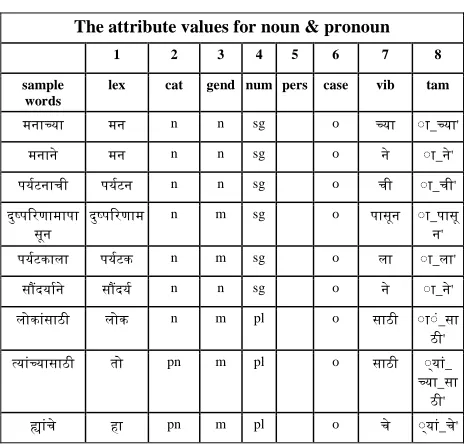
[image:5.612.310.544.71.190.2]In extract features using Marathi shallow parser approach, if the required features are not available in verbframe database then the Marathi shallow parser tool is used to extract these features. The verb frame features such as vibhakti’s and lexical type can be extracted using the output of the shal-low parser tool. The extracted output can be mapped to get the vibhakti’s. This can be seen in table 1, 2, and 3.
Marathi Vibhakti Table
Sanskrit English Sanskrit English Singular Suffixes Plural Suf-fixes Ordinal Number Ordinal Number Case De-scription Case De-scription
(एकवचनएकवचनएकवचनएकवचन) (अनेकवचनअनेकवचनअनेकवचनअनेकवचन)
prathamā (थमा)
First kartā (कता) Nominative case
– -ā (आ)
dwitīyā (ि तीया)
Second karma (कम) Accusative case
-sa (-स), -lā (-ला), -te
(-ते)
-sa (-स), -lā (-ला), -nā (ना),
-te (-ते) trutīyā
(तृतीय)
Third karaṇa(करण) Instrumental case
-nī (नी), e (ए), shī
(शी)
-nī (नी), -hī (ही), e (ए), shī
(शी) caturthī
(चतुथ)
Fourth sampradāna( सदान)
Dative case -sa (-स), -lā (-ला), -te
(-ते)
-sa (-स), -lā (-ला), -nā (ना),
-te (-ते)
pancamī (पमी)
Fifth apādāna(अपा दान)
Ablative case
-ūna (-ऊन), -hūna
(-न)
-ūna (-ऊन), -hūna (-न)
shhashhthī (षी)
Sixth sambandh (संबंध)
Genitive case
-chā (-चा), -chī (-ची), -che (-चे)
-ce (-चे), -cyā (-या), -cī
(-ची) saptamī
(समी)
Seventh adhikaran (अिधकरण)
Locative case
-ta (-त), -i (-इ), -ā
(-आ)
-ta (-त), -ī (-ई), -ā (-आ)
sambhoda n (संबोधन)
Vocative case
– Vocative case
– -no (-नो)
Table 1: Vibhakti's in Marathi
The attribute values for noun & pronoun
1 2 3 4 5 6 7 8
sample words
lex cat gend num pers case vib tam
मनाया मन n n sg o या ◌ा_या'
मनाने मन n n sg o ने ◌ा_ने'
पयटनाची पयटन n n sg o ची ◌ा_ची'
दुपरणामापा
सून दुपरणाम
n m sg o पासून ◌ा_पासू न'
पयटकाला पयटक n m sg o ला ◌ा_ला'
स दयाने स दय n n sg o ने ◌ा_ने'
लोकांसाठी लोक n m pl o साठी ◌ा◌ं_सा
ठी'
"यांयासाठी तो pn m pl o साठी ◌्यां_
या_सा ठी'
[image:5.612.311.545.225.449.2]%ांचे हा pn m pl o चे ◌्यां_चे'
Table 2: The attribute values for Noun & Pronoun
Vibhakti to Number Conversion
Vibhakti’s (7) Numerical Form
Singular Suf-fixes
Plural Suffixes
(एकवचनएकवचनएकवचनएकवचन) (अनेकवचनअनेकवचनअनेकवचनअनेकवचन)
– आ 1
सलाते सलानाते 2
नीएशी नीहीएशी 3
सलातेसाठी
करता सलानातेसाठीकरता
4
ऊननमुळे
पासून ऊननमुळेपासून
5
चाचीचे चेयाची 6
तइआ तईआ 7
– नो 8
Table 3: Vibh[akti to Number Conversion
[image:5.612.317.535.490.691.2]5 Verbframator: Features and Limitations
Salient features of Verbframator:
• Verbframator reduces the manual effort of creating verb frames.
• Verb frames are automatically extracted which requires minimal validation.
• It also generates SSF files of the input verb sentences.
• Helps in analyzing the generated verb
frames and constructing similar patterns for a given verb.
• verbframe database stores verb frame and trained data in a systematic and classified manner.
Limitations of Verbframator
• Although Verbframator generates verb
frames and SSF files automatically, it still requires manual intervention to complete some tasks.
• In wordnet, not all verbs in a synset are explained using an example sentence. Only first frequently used verb appears in the example sentence. The example sentence is not available for rest of the verbs in a given synsets. Hence, verb frame for such sentences cannot be developed.
• The Verbframator extracts examples hav-ing input verbs only.
• Quality of verb frames depends upon an-notators understanding in annotating verb frames. Hence, inter-annotator-agreement should be of high value which can lead to better quality resource.
• Quality of verb frames also depends upon the quality of trained data or gold data.
• Currently Verbframator can be applicable only for wordnet sentences. It cannot be used for general corpus.
6 Conclusion and Future Scope
Verb is an important POS category for any lan-guage. Verb frames are created to generate de-pendency tree structures in a given language. This paper introduces an online tool Verbframator which semi-automatically extracts and generates verb frames using example sentences from Marathi wordnet. Verbframator also generates SSF format-ted files of the given example sentences. These resources can be used in the dependency tree bank-ing. In future, this verb frame annotator tool is to be made fully automatic. Also, this tool is to be expanded for other Indian languages under the umbrella of IndoWordNet. Sentences from other corpus are also to be included in the Verbframator.
References
Bharati, Akshar, Rajeev Sangal, and Dipti M. Sharma. 2007. "Ssf: Shakti standard format guide." Language Technologies Research Centre, International Institute of Information Technology, Hyderabad, India (2007): 1-25.
Begum, Rafiya, Samar Husain, Lakshmi Bai, and Dipti Misra Sharma. 2008 "Developing Verb Frames for
Hindi." In LREC. LREC 2008.
Ghosh, Sanjukta. 2014. "Making Verb Frames for Bangla Vector Verbs" ICON 2014.
Ghosh, Sanjukta. 2014. "Noun Classification from the
Verb Frames of Conjunct Verbs." Forthcoming in
Journal of Advanced Linguistic Studies. Bahri Publi-cations, New Delhi.
Schulte im Walde, Sabine. 2009. "The induction of verb
frames and verb classes from corpora." Corpus
lin-guistics. an international handbook. Berlin: Mouton de Gruyter (2009): 952-972.
Soni, Ankush, Sambhav Jain, and Dipti Misra Sharma. 2013. "Exploring Verb Frames for Sentence
Simplifi-cation in Hindi." In IJCNLP, pp. 1082-1086.
Theakston, Anna L., et al. 2015. "Productivity of noun
slots in verb frames."Cognitive science 39.6 (2015):
1369-1395.