Optimizing Rule-Based Morphosyntactic Analysis
of Richly Inflected Languages — a Polish Example
Dominika Pawlik University of Warsaw Institute of Mathematics
Aleksander Zabłocki University of Warsaw Institute of Informatics
{dominika, olekz}@mimuw.edu.pl, [email protected] Bartosz Zaborowski Polish Academy of Sciences Institute of Computer Science
Abstract
We consider finite-state optimization of morphosyntactic analysis of richly and ambiguously annotated corpora. We pro-pose a general algorithm which, despite being surprisingly simple, proved to be ef-fective in several applications for rulesets which do not match frequently.
1 Introduction
Morphosyntactic analysis of natural language texts is commonly performed as an iterative pro-cess of applying pre-defined syntactical rules to a previously tokenised and morphologically anno-tated input (Aït-Mokhtar and Chanod, 1997). We consider two of its sub-tasks: shallow parsing and disambiguation.
As stated in (Mohri, 1997), such tasks can often be efficiently realized with finite-state transducers (FST), which allow time savings by the classical operations of determinization, minimization and composition (Roche and Schabes, 1995). How-ever, the applicability of the FST model may de-pend on the richness of annotation and on the ex-pressive power of the rules. These both tend to complicate in richly inflected languages, including Baltic and most of Slavic.
Motivated by the needs which arose during the development of the National Corpus of Pol-ish (NCP, (Przepiórkowski et al., 2012)), we aim at a high-efficiency rule-based morphosyntactic analysis framework suitable for such languages. Despite the existence of many formal methods and tools for this task, we are not aware of any pre-vious result meeting all our needs, listed in Sec-tion 2. We discuss the state of the art in SecSec-tion 3. Our solution to the problem, though surpris-ingly single, performs well under the assumption that the rules matchrarely, i.e. the average number of matches per rule per sentence is significantly
below1. In the case of rules designed for analyz-ing the Polish corpora (Przepiórkowski, 2008a), this was about0.05–0.1, depending on the partic-ular corpus and ruleset.
2 Problem statement
Richly inflected languages often require com-plex annotation as in the Constraint Grammar model (Karlsson, 1990): each token is assigned a list of potentially correctreadings, each of which specifies the lemmatized form and a tag consist-ing of the values of syntactic attributes (PoS, case, gender etc.). For example, the English wordfound could have the following readings:1
found:VB (The king wouldfounda new city.)
find:VBD (Hefoundno money for that.)
find:VBN (The robber has not beenfound.)
while the Polish worddrogithe following ones:
drogi:adj:m3:sg:nom /It is anexpensivehouse./
drogi:adj:m3:sg:acc /I see anexpensivehouse./
drogi:adj:m2:sg:nom /It is anexpensivedog./
droga:noun:f:sg:gen /I do not see thatroad./
droga:noun:f:pl:acc /I see theseroads./
x. . . (6 other readings2)
In this setting, unification becomes a key tool in morphosyntactic analysis. For example, since a noun must agree with its modifying adjectives upon case, number and gender, unifying the values of these attributes can be used to remove all but the first two readings ofdrogiin
drogi
drogi:adj:m3:sg:nom
drogi:adj:m3:sg:acc
drogi:adj:m2:sg:nom
gdomg
dom:noun:m3:sg:nom
dom:noun:m3:sg:acc
1In the examples for English language, we use the PoS tags of the Brown corpus. Tagging for Polish roughly follows the National Corpus of Polish, though has been simplified.
2
x. . . (8 other readings)
xxxxxxxx/an expensive house/
Hence, we desire at least the following features:
1. Functionality. Our rules should support dis-ambiguation by unifying selected attributes in (se-lected of) the tokens matched by a regexp, e.g.
[pos~vb] A:([pos~adj]*) B:[pos~noun]
⇒unify(case number gender, A B)
should look for a sequence consisting of a verb3, a number of adjectives and a noun, and unify three attributes of the two latter. As for shallow pars-ing, we should allow creating syntactic structures depending on whether such unification has been successful (e.g. a noun and an adjective can be marked as a nominal group if they agree).
2. (Practical) determinism. By this we mean that single rules should run in an (almost) linear time in the input size. This clearly holds in mod-els relying on FST determinization4, but we would equally appreciate e.g. deterministic pushdown automata or other not purely finite-state tools.
3. (Practical) composition. By this we mean obtaining the ability to execute a cascade of rules significantly faster than it would take to execute them separately.
Clearly, a trade-off between time and memory efficiency is involved in both conditions 2 and 3.
3 Related work
Building FSTs for given replace rules, their de-terminization and minimization have been exten-sively described in theory (see (Roche and Sch-abes, 1995) and (Mohri, 1997)) and efficiently im-plemented, e.g. in the XFST toolkit (Beesley and Karttunen, 2003). However, as many authors no-tice, these methods turn out to be inapplicable in some situations. In our case, this happens for more than one reason.
First, a FST may be not determinizable; as dis-cussed in (Roche and Schabes, 1996, Sec. 3.8) and (Noord and Gerdemann, 2001), this tends to happen for replace rules acting over unbounded ranges of tokens, including both rule types dis-cussed in Section 2. Trying to by-pass this prob-lem — by assuming that a rule will not have
3To be more precise, apotentialverb, i.e. a token having some verbal reading. The same applies in the sequel.
4As in (Roche and Schabes, 1995), by FST
determiniza-tionwe mean building an equivalent subsequential form, i.e. a form not which does not backtrack during the execution.
a match longer than n tokens — typically leads to an exponential number of states wrt. n, which practically makes composing the results impos-sible. As explained in (Noord and Gerdemann, 2001, Sec. 3.6), the explosion of states can be avoided by equipping FSTs with a queue; how-ever, such devices no longer admit the standard composition (and no other composition method is given).
Apparently, the most commonly chosen solu-tion of the problem is to abandon determinism for the rules which turn out to be too complex. This is the case in FASTUS (Hobbs et al., 1997), JAPE (Cunningham et al., 2000) (at least, in its full expressive power) and most probably also in SProUT (Becker et al., 2002), as its authors do not at all discuss the issue, while they refer to the stan-dard methods which we discussed above.
In our situation, the second obstruction to using FSTs is a (yet another) explosion of states caused by unification rules for rich inflection. In order to compute the result of a unification, a determinized FST must remember its temporary result (in the current state) while processing consecutive tokens. This means increasing a part of the state space by a factor of N, where N is the number of possi-ble unification results; in the case of Polish case-number-gender agreement, this is about100.5
The scale of this problem depends on the representation of the input. Choosing a naive string encoding of the form
found/found:VB/find:VBD/find:VBN# (∗)
will increase N hopelessly since the result of unification will be asetof tags rather than a single value. This is not the case in the more common model for ambiguous annotation, Finite-State In-tersection Grammar (FSIG) (Koskenniemi, 1990). In this approach, the input is represented as a finite-state automaton (FSA) so that alternative readings give rise to parallel paths, e.g. he found thatwill be represented as
VB
'' DT
''
he // PPS //
found
77
find // find ''
VBD //
that
77
that // that ''
WPO // VBN
77
WPS
77
The rules are applied by intersecting the above automaton with FSTs representing them. This means that the FSTs operate on thepaths of the
input FSA, each of which contains exactly one reading of each token, e.g.
hePPSfindVBNthatWPO
In this setting, unification leads to at most N -fold increase of the state space even in com-pound FSTs, which allows hoping for composi-tion. However, the FSIG model has the disadvan-tage that the execution time is not linear in terms of the input size, particularly for high ambiguity (cf. (Tapanainen, 1999)). Hence, the model does not ensure our efficiency requirements.
Efficient unification seems to be achievable by equipping the FST with additional memory for the temporary result, even though this means leaving the pure finite-state formalism. Note also that this is analogous to introducing a queue in (Noord and Gerdemann, 2001). These observations have mo-tivated the solution proposed below.
4 The solution
Basic model. We follow the idea present in the old Spejd as well as in JAPE: each rule is split into a simple match pattern and a list of more com-plex actions performed outside of the finite-state formalism. In our case, match patterns are regular expressions6, while the actions can be virtually ar-bitrary, provided that they operate within a given match. The match patterns are compiled into de-terministic automata (DFA). Rather than follow-ing the FSIG approach, we traditionally run these DFAs on single strings encoding the input, as in the example (∗) on page 2, which enables finding matches without backtracking.
Whenever a match is found, we stop the DFA which found it and apply the pre-defined routines corresponding to the actions. For the example in-putdrogi domdiscussed in Section 2, the routine
for unify would scan and store all the readings
of drogi, do the same for dom, intersect the two sets of readings and save the result.7
Single-pattern DFAs. Even though our pat-terns are regular expressions, compiling them to DFAs is not straightforward since the actions may refer tosub-matches(e.g. A,Bin the example in
6
A match pattern is a regular expression over token spec-ifications. These are built of attribute requirements, com-bined by logical connectives and quantifiers over readings, e.g. “there is a reading in which bothposequalsnounand
caseequalsnom”. For the input encoding of the form (∗), such patterns clearly translate to character-level regular ex-pressions.
7This might be non-linear in terms of the match size but will happen rarely due to the rareness of the matches.
Section 2). In general, a single run of a classi-cal DFA cannot unambiguously determine the po-sitions of all such sub-matches (Friedl, 2002). For this purpose, we use the enhanced tagged DFAs (TDFAs) from (Laurikari, 2000) which use ad-ditional integer registers (which Laurikari calls tags) to store the references to potential sub-match boundaries.
TDFAs are asymptotically fast as they do not backtrack, but several times slower than the clas-sical DFAs. Hence we adopt thedouble pass tech-nique of (Cox, 2010): we process the input first with a classical DFA deciding solely whether it contains a match for a given rule; only when it does, we execute a more complex TDFA localiz-ing the match and the desired sub-matches, and finally apply the rule actions. In this way, every sentence containing a match is processed twice; however, our assumption that the matches are (av-eragely) rare guarantees that in total this variant is faster than using only TDFAs.
Practical composition. We have already met the first two requirements from Section 2. It re-mains to provide means for practical composi-tion. At this point, the (average) rareness of the matches becomes crucial. Intuitively, it means that many rules do not change the input, and it should be advantageous to composetheserules together. Among several possible realizations of this idea, we have chosen the following simple algorithm.
Let M1, . . . , Mn denote the match
specifica-tions of the rules to be applied. We build:
• for eachi, a TDFATirecognizingMi;
• a DFADrecognizingM1|M2|. . .|Mn.
Then, we slightly modifyDin Laurikari’s spirit by equipping it with two integer registers, L andR, used as follows: whenever a match for someMi
is found, D shall setR := i provided that L < i≤R. Hence, runningDon the whole input with initialR =∞results in settingRto the leasti > Lsuch thatMihas some match.
The main algorithm proceeds as follows:
1. SetL:= 0. (Start with all rules.)
2. SetR:=∞and runDon the whole input. 3. IfR=∞(noMiwithi > Lmatched), halt.
4. RunTRon the whole input. For every match
found, apply to it the actions of theR-th rule. 5. SetL:=Rand jump to step 2.
Avoiding explosion. Even though the num-ber of constructed states is clearly smaller than in the FST models (as we have avoided states aris-ing from sophisticated rule actions), it is still very high. We reduced it significantly8 by a simple technique oflazy construction: the transitions and their target states are built only during the execu-tion, just before their first use.
In practice, for a large number of rules, we fix a composition widthkand apply the above algo-rithm to groups ofkconsecutive rules. To achieve best performance, k should be chosen possibly large but so that the states still fit into memory. This makes the running time asymptotically linear in the number of rules; nevertheless, the third re-quirement from Section 2 has been met.
5 Evaluation
Our approach has been applied to optimize Spejd, a syntactic parser of broad functionality which has been used for corpus development, valence extrac-tion (Przepiórkowski, 2008b), and also sentiment analysis (Buczy´nski and Wawer, 2008).
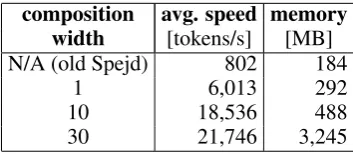
composition avg. speed memory width [tokens/s] [MB]
N/A (old Spejd) 802 184
1 6,013 292
10 18,536 488
[image:4.595.92.269.390.467.2]30 21,746 3,245
Table 1: The speed and memory usage of Spejd in terms of the composition width.
Table 1 presents the overall efficiency of the system. In the tests, performed on a computer with 3.1 GHz AMD FX processor, 467 handwrit-ten rules of (Przepiórkowski, 2008a) were applied to a 15 million token sample from the IPI Cor-pus (Przepiórkowski, 2004).
Notably, the use of lazy construction increased the achievable width from about3–4to about30.9
Conclusion
We have described a variation of the finite-state approach which, although it may seem strange in
8In some TDFAs in our applications, less than 5% of states are reachable in practice, even for megabytes of input.
9
Further state space reduction techniques, which are out of scope of this paper, have allowed us to work with widths exceeding 1000. Due to the overhead involved in them, this resulted “only” in about 10-fold acceleration in comparison withk= 30.
comparison with the classical solutions, seems to be a good choice for infrequently matching com-plex morphosyntactic rules, particularly for highly ambiguous rich annotation. In practice, it has al-lowed over 25-fold acceleration of the Spejd sys-tem while preserving its rich functionality.
Acknowledgement
The project was partially funded by the National Science Centre allocated on the basis of a decision DEC-2011/03/D/ST6/00914.
References
Salah Aït-Mokhtar and Jean-Pierre Chanod. 1997. In-cremental finite-state parsing. InANLP, pages 72– 79.
Markus Becker, Witold Dro˙zd˙zy´nski, Hans-Ulrich Krieger, Jakub Piskorski, Ulrich Schäfer, and Feiyu Xu. 2002. SProUT — shallow processing with typed feature structures and unification. In Proceed-ings of the International Conference on NLP (ICON 2002), Mumbai, India.
Kenneth R. Beesley and Lauri Karttunen. 2003.Finite State Morphology. CSLI Studies in Computational Linguistics. CSLI Publications.
Aleksander Buczy´nski and Aleksander Wawer. 2008. Shallow parsing in sentiment analysis of product reviews. In Sandra Kübler, Jakub Piskorski, and Adam Przepiórkowski, editors, Proceedings of the LREC 2008 Workshop on Partial Parsing: Between Chunking and Deep Parsing, pages 14–18, Mar-rakech. ELRA.
Russ Cox. 2010. Regular expression matching in the wild, March.
H. Cunningham, D. Maynard, and V. Tablan. 2000. JAPE: a java annotation patterns engine (second edi-tion). Technical Report Technical Report CS–00– 10, of Sheffield, Department of Computer Science.
Jeffrey E. F. Friedl. 2002. Mastering Regular Expres-sions. O’Reilly & Associates, Inc., Sebastopol, CA, USA, 2 edition.
Jerry R. Hobbs, Douglas E. Appelt, John Bear, David J. Israel, Megumi Kameyama, Mark E. Stickel, and Mabry Tyson. 1997. FASTUS: A cascaded finite-state transducer for extracting information from natural-language text. CoRR, cmp-lg/9705013.
Kimmo Koskenniemi. 1990. Finite-state parsing and disambiguation. InProceedings of the 13th confer-ence on Computational linguistics - Volume 2, COL-ING ’90, pages 229–232, Stroudsburg, PA, USA. Association for Computational Linguistics.
Ville Laurikari. 2000. NFAs with tagged transitions, their conversion to deterministic automata and ap-plication to regular expressions. InIn Proceedings of the 7th International Symposium on String Pro-cessing and Information Retrieval, pages 181–187. IEEE.
Mehryar Mohri. 1997. Finite-state transducers in lan-guage and speech processing. Computational Lin-guistics, 23(2):269–311.
Gertjan van Noord and Dale Gerdemann. 2001. Fi-nite state transducers with predicates and identities. Grammars, 4(3):263–286.
Adam Przepiórkowski, Mirosław Ba´nko, Rafał L. Górski, and Barbara Lewandowska-Tomaszczyk, editors. 2012. Narodowy Korpus J˛ezyka Polskiego [Eng.: National Corpus of Polish]. Wydawnictwo Naukowe PWN, Warsaw.
Adam Przepiórkowski. 2004. The IPI PAN Corpus: Preliminary version. Institute of Computer Science, Polish Academy of Sciences, Warsaw.
Adam Przepiórkowski. 2008a. Powierzchniowe przetwarzanie j˛ezyka polskiego. Akademicka Ofi-cyna Wydawnicza EXIT, Warsaw.
Adam Przepiórkowski. 2008b. Towards a partial grammar of Polish for valence extraction. In Gram-mar & Corpora 2007: Selected contributions from the conference Grammar and Corpora, Sept. 25–27, 2007, Liblice, pages 127–133. Academia, Prague.
Emmanuel Roche and Yves Schabes. 1995. Determin-istic part-of-speech tagging with finite-state trans-ducers.Comput. Linguist., 21:227–253, June.
Emmanuel Roche and Yves Schabes. 1996. Introduc-tion to finite-state devices in natural language pro-cessing. Technical report, Mitsubishi Electric Re-search Laboratories.