Sentence Simplification as Tree Transduction
Dan Feblowitz
Computer Science Department Pomona College
Claremont, CA
David Kauchak Computer Science Department
Middlebury College Middlebury, VT
Abstract
In this paper, we introduce a syntax-based sentence simplifier that models simplifi-cation using a probabilistic synchronous tree substitution grammar (STSG). To im-prove the STSG model specificity we uti-lize a multi-level backoff model with addi-tional syntactic annotations that allow for better discrimination over previous STSG formulations. We compare our approach to T3 (Cohn and Lapata, 2009), a re-cent STSG implementation, as well as two state-of-the-art phrase-based sentence simplifiers on a corpus of aligned sen-tences from English and Simple English Wikipedia. Our new approach performs significantly better than T3, similarly to human simplifications for both simplicity and fluency, and better than the phrase-based simplifiers for most of the evalua-tion metrics.
1 Introduction
Text simplification is aimed at reducing the read-ing and grammatical complexity of text while re-taining the meaning. Text simplification has ap-plications for children, language learners, people with disabilities (Carroll et al., 1998; Feng, 2008) and in technical domains such as medicine (El-hadad, 2006), and can be beneficial as a prepro-cessing step for other NLP applications (Vickrey and Koller, 2008; Miwa et al., 2010). In this paper we introduce a new probabilistic model for sen-tence simplification using synchronous tree sub-stitution grammars (STSG).
Synchronous grammars can be viewed as simul-taneously generating a pair of recursively related strings or trees (Chiang, 2006). STSG grammar rules contain pairs of tree fragments called ele-mentary trees (Eisner, 2003; Cohn and Lapata,
2009; Yamangil and Shieber, 2010). The leaves of an elementary tree can be either terminal, lex-ical nodes or alignednonterminals (also referred to as variables or frontier nodes). Because ele-mentary trees may have any number of internal nodes structured in any way STSGs allow for more complicated derivations not expressible with other synchronous grammars.
To simplify an existing tree, an STSG gram-mar is used as a tree transducer. Figure 1 shows some example simplification STSG rules written in transductive form. As a transducer the gram-mar rules take an elementary tree and rewrite it as the tree on the right-hand side of the rule. For ex-ample, the first rule in Figure 1 would make the transformation
S
VP1 VP
ADVP
RB
occasionally MD
may NP0
S
VP1 NP0 ,
, ADVP
RB
sometimes
changing “may occasionally” to “sometimes ,” and moving the noun phrase from the beginning of the sentence to after the comma. The indices on the nonterminals indicate alignment and transduction continues recursively on these aligned nontermi-nals until no nonterminontermi-nals remain. In the example above, transduction would continue down the tree on the NP and VP subtrees. A probabilistic STSG has a probability associated with each rule.
One of the key challenges in learning an STSG from an aligned corpus is determining the right level of specificity for the rules: too general and they can be applied in inappropriate contexts; too specific, and the rules do not apply in enough con-texts. Previous work on STSG learning has regu-lated the rule specificity based on elementary tree depth (Cohn and Lapata, 2009), however, this ap-proach has not worked well for text
S(NP0VP(MD(may) ADVP(RB(occasionally))) VP1) → S(ADVP(RB(sometimes)) ,(,) NP0VP1) NP(NNS0) → NP(NNS0)
NP(JJ0NNS1) → NP(JJ0NNS1) VP(VB0PP(IN(in) NP1)) → VP(VB0NP1)
VB(assemble), → VB(join) JJ(small) → JJ(small) NNS(packs) → NNS(packs) NNS(jackals) → NNS(jackals)
Figure 1: Example STSG rules representing the maximally general set for the aligned trees in Figure 2. The rules are written in transductive form. Aligned nonterminals are indicated by indices.
tion (Coster and Kauchak, 2011a). In this pa-per, we take a different approach and augment the grammar with additional information to increase the specificity of the rules (Galley and McKeown, 2007). We combine varying levels of grammar augmentation into a single probabilistic backoff model (Yamangil and Nelken, 2008). This ap-proach creates a model that uses specific rules when the context has been previously seen in the training data and more general rules when the con-text has not been seen.
2 Related Work
Our formulation is most closely related to the T3 model (Cohn and Lapata, 2009), which is also based on the STSG formalism. T3 was devel-oped for the related problem of text compression, though it supports the full range of transforma-tion operatransforma-tions required for simplificatransforma-tion. We use a modified version of their constituent alignment and rule extraction algorithms to extract the ba-sic STSG rules with three key changes. First, T3 modulates the rule specificity based on elemen-tary tree depth, while we use additional grammar annotations combined via a backoff model allow-ing for a broader range of context discrimination. Second, we learn a probabilistic model while T3 learns the rule scores discriminatively. T3’s dis-criminative training is computationally prohibitive for even modest sized training sets and a bilistic model can be combined with other proba-bilities in a meaningful way. Third, our implemen-tation outputs ann-best list which we then rerank based on a trained log-linear model to select the final candidate.
Zhu et al. (2010) suggest a probabilistic, syntax-based approach to text simplification. Unlike the STSG formalism, which handles all of the trans-formation operations required for sentence simpli-fication in a unified framework, their model uses a combination of hand-crafted components, each
designed to handle a different transformation op-eration. Because of this model rigidity, their sys-tem performed poorly on evaluation metrics that take into account the content and relative to other simplification systems (Wubben et al., 2012).
Woodsend and Lapata (2011) introduce a quasi-synchronous grammar formulation and pose the simplification problem as an integer linear pro-gram. Their model has similar representational ca-pacity to an STSG, though the learned models tend to be much more constrained, consisting of<1000 rules. With this limited rule set, it is impossible to model all of the possible lexical substitutions or to handle simplifications that are strongly con-text dependent. This quasi-synchronous grammar approach performed better than Zhu et al. (2010) in a recent comparison, but still performed worse than recent phrase-based approaches (Wubben et al., 2012).
A number of other approaches exist that use Simple English Wikipedia to learn a simplifica-tion model. Yatskar et al. (2010) and Biran et al. (2011) learn lexical simplifications, but do not tackle the more general simplification problem. Coster and Kauchak (2011a) and Wubben et al. (2012) use a modified phrase-based model based on a machine translation framework. We compare against both of these systems. Qualitatively, we find that phrasal models do not have the represen-tative power of syntax-based approaches and tend to only make small changes when simplifying.
Finally, there are a few early rule-based sim-plification systems (Chandrasekar and Srinivas, 1997; Carroll et al., 1998) that provide motivation for recent syntactic approaches. Feng (2008) pro-vides a good overview of these.
3 Probabilistic Tree-to-Tree Transduction
S1
VP
VP4
PP6
NP6
NNS8
packs JJ7
small IN
in VB5
assemble ADVP
RB
occasionally MD
may NP2
NNS3
jackals
S1
VP4
NP6
NNS8
packs JJ7
small VB5
join NP2
NNS3
jackals ,
, ADVP
RB
[image:3.595.114.449.63.195.2]sometimes
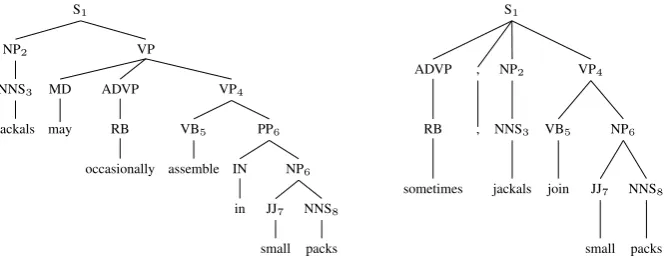
Figure 2: An example pair of constituent aligned trees generated by the constituent alignment algorithm. Aligned constituents are indicated with a shared index number (e.g. NP2is aligned to NP2).
a parsed, sentence-aligned corpus between normal and simplified sentences. To learn the grammar, we first align tree constituents based on an in-duced word alignment then extract grammar rules that are consistent with the constituent alignment. To improve the specificity of the grammar we augment the original rules with additional lexi-cal and positional information. To simplify a sen-tence based on the learned grammar, we generate a finite-state transducer (May and Knight, 2006) and use the transducer to generate an n-best list of simplifications. We then rerank then-best list of simplifications using a trained log-linear model and output the highest scoring simplification. The subsections below look at each of these steps in more detail. Throughout the rest of this paper, we will refer to the unsimplified text/trees asnormal and the simplified variants assimple.
3.1 Rule Extraction
Given a corpus of pairs of trees representing nor-mal and simplified sentences, the first step is to extract a set of basic STSG production rules from each tree pair. We used a modified version of the algorithm presented by Cohn and Lapata (2009). Due to space constraints, we only present here a brief summary of the algorithm along with our modifications to the original algorithm. See Cohn and Lapata (2009) for more details.
Word-level alignments are learned using Giza++ (Och and Ney, 2000) then tree nodes (i.e. constituents) are aligned if: there exists at least one pair of nodes below them that is alignedand all nodes below them are either aligned to a node under the other constituent or unaligned. Given the constituent alignment, we then extract the STSG production rules. Because STSG rules can
have arbitrary depth, there are often many possible sets of rules that could be extracted from a pair of trees.1 Following Cohn and Lapata (2009) we extract the maximally general rule set from an aligned pair of input trees that is consistent with the alignment: the set of rules capable of synchronously deriving the original aligned tree pair consisting of rules with the smallest depth. Figure 2 shows an example tree pair that has been constituent aligned and Figure 1 shows the extracted STSG rules.
We modify the constituent alignment algorithm from Cohn and Lapata (2009) by adding the re-quirement that if node b with parent a are both aligned to nodez and its parent y, we only align the pairs (a, y) and(b, z), i.e. align the children and align the parents. This eliminates a common occurrence where too many associations are made between a pair of preterminal nodes and their chil-dren. For example, for the sentences shown in Fig-ure 2 the word alignment contains “assemble” aligned to “join”. Under the original definition four aligned pairs would be generated:
VB
assemble
VB
join
but only two under our revised definition:
VB
assemble
VB
join
This revised algorithm reduces the size of the alignment, decreasing the number of cases which must be checked during grammar extraction while preserving the intuitive correspondence.
1There is always at least one set of rules that can generate
3.2 Grammar Generation
During the production rule extraction process, we select the production rules that are most general. More general rules allow the resulting transducer to handle more potential inputs, but can also re-sult in unwanted transformations. When generat-ing the grammar, this problem can be mitigated by also adding more specific rules.
Previous approaches have modulated rule speci-ficity by incorporating rules of varying depth in addition to the maximally general rule set (Cohn and Lapata, 2009), though this approach can be problematic. Consider the aligned subtrees rooted at nodes (VP4, VP4) in Figure 2. An STSG learn-ing algorithm that controls rule specificity based on depth must choose between generating the rule:
VP(VB0PP(IN(in) NP1))→VP(VB0NP1)
which drops the preposition, or a deeper rule that includes the lexical leaves such as:
VP(VB(assemble) PP(IN(in) NP1))→VP(VB(join) NP1)
or
VP(VB(assemble) PP(IN(in) NP(JJ0NNS1)))→ VP(VB(join) NP(JJ0NNS1))
If either of the latter rule forms is chosen, the applicability is strongly restricted because of the specificity and lexical requirement. If the former rule is chosen and we apply this rule we could make the following inappropriate transformation:
VP
PP
NP
NN
cafeteria DT
the IN
in VB
eat
VP
NP
NN
cafeteria DT
the VB
eat
simplifying“eat in the cafeteria”to“eat the cafe-teria”.
We adopt a different approach to increase the rule specificity. We augment the production rules and resulting grammar with several parse tree an-notations shown previously to improve SCFG-based sentence compression (Galley and McKe-own, 2007) as well as parsing (Collins, 1999): par-ent annotation, head-lexicalization, and annotation with the part of speech of the head word.
Following Yamangil and Nelken (2008), we learn four different models and combine them into a single backoff model. Each model level in-creases specificity by adding additional rule anno-tations. Model 1 contains only the original pro-duction rules. Model 2 adds parent annotation,
Model 3 adds the head child part of speech and Model 4 adds head child lexicalization. The head child was determined using the set of rules from Collins (1999). Figure 3 shows the four different model representations for the VP rule above.
3.3 Probability Estimation
We train each of the four models individually us-ing maximum likelihood estimation over the train-ing corpus, specifically:
p(s|n) = count(s∧n)
count(n)
wheresandnare tree fragments with that level’s annotation representing the right and left sides of the rule respectively.
During simplification, we start with the most specific rules, i.e. Model 4. If a tree fragment was not observed in the training data at that model level, we repeatedly try a model level simpler until a model is found with the tree fragment (Yamangil and Nelken, 2008). We then use the probability distribution given by that model. A tree fragment only matches at a particular level if all of the anno-tation attributes match for all constituents. If none of the models contain a given tree fragment we in-troduce a rule that copies the tree fragment with probability one.
Two types of out-of-vocabulary problems can occur and the strategy of adding copy rules pro-vides robustness against both. In the first, an input contains a tree fragment whose structure has never been seen in training. In this case, copy rules allow the structure to be reproduced, leaving the system to make more informed changes lower down in the tree. In the second, the input contains an unknown word. This only affects transduction at the leaves of the tree since at the lower backoff levels nodes are not annotated with words. Adding copy rules allows the program to retain, replace, or delete un-seen words based only on the probabilities of rules higher up for which it does have estimates. In both cases, the added copy rules make sure that any in-put tree will have an outin-put.
3.4 Decoding and Reranking
Model 1: VP(VB0PP(IN(in)NP1))→VP(VB0NP1)
Model 2: VPˆVP(VBˆVP0PPˆVP(INˆPP(in)NPˆPP1))→VPˆS(VBˆVP0NPˆVP1)
Model 3: VP[VB]ˆVP(VBˆVP0PP[NNS]ˆVP(INˆPP(in)NP[NNS]ˆPP1))→ VP[VB]ˆS(VBˆVP0NP[NNS]ˆVP1)
Model 4: VP[VB-assemble]ˆVP(VB[assemble]ˆVP0PP[NNS-packs]ˆVP(IN[in]ˆPP(in)NP[NNS-packs]ˆPP1))→ VP[VB-join]ˆS(VB[join]ˆVP0NP[NNS-packs]ˆVP1)
Figure 3: The four levels of rule augmentation for an example rule ranging from Model 1 with no additional annotations to Model 4 with all annotations. The head child and head child part of speech are shown in square brackets and the parent constituent is annotated with ˆ.
grammar rule represents a state transition and is weighted with the grammar rule’s probability. We then use the Tiburon tree automata package (May and Knight, 2006) to apply the transducer to the parsed sentence. This yields a weighted regular tree grammar that generates every output tree that can result from rewriting the input tree using the transducer. The probability of each output tree in this grammar is equal to the product of the proba-bilities of all rewrite rules used to produce it.
Using this output regular tree grammar and Tiburon, we generate the 10,000 most probable output trees for the input parsed sentence. We then rerank this candidate list based on a log-linear combination of features:
- The simplification probability based on the STSG backoff model.
- The probability of the output tree’s yield, as given by ann-gram language model trained on the simple side of the training corpus using the IRSTLM Toolkit (Federico et al., 2008).
- The probability of the sequence of the part of speech tags in the output tree, as given by ann -gram model trained on the part of speech tags of the simple side of the training corpus.
- A two-sided length penalty decreasing the score of output sentences whose length, normalized by the length of the input, deviates from the training corpus mean, found empirically to be 0.85.
The first feature represents the simplification like-lihood based on the STSG grammar described above. The next two features ensure that outputs are well-formed according to the language used in Simple English Wikipedia. Finally, the length penalty is used to prevent both over-deletion and over-insertion of out-of-source phrases. In addi-tion, the length feature mean could be reduced or increased to encourage shorter or longer simplifi-cations if desired.
The weights of the log-linear model are opti-mized using random-restart hill-climbing search (Russell and Norvig, 2003) to maximize BLEU (Papineni et al., 2002) on a development set.2
4 Experiment Setup
To train and evaluate the systems we used the data set from Coster and Kauchak (2011b) consisting of 137K aligned sentence pairs between Simple English Wikipedia and English Wikipedia. The sentences were parsed using the Berkeley Parser (Petrov and Klein, 2007) and the word alignments determined using Giza++ (Och and Ney, 2000). We used 123K sentence pairs for training, 12K for development and 1,358 for testing.
We compared our system (SimpleTT– simple tree transducer) to three other simplification ap-proaches:
T3: Another STSG-based approach (Cohn and La-pata, 2009). Our approach shares similar con-stituent alignment and rule extraction algorithms, but our approach differs in that it is generative instead of discriminative, and T3 increases rule specificity by increasing rule depth, while we em-ploy a backoff model based on grammar augmen-tation. In addition, we employ n-best reranking based on a log-linear model that incorporates a number of additional features.
The code for T3 was obtained from the au-thors.3 Due to performance limitations, T3 was only trained on 30K sentence pairs. T3 was run on the full training data for two weeks, but it never terminated and required over 100GB of memory. The slow algorithmic step is the discriminative training, which cannot be easily parallelized. T3 was tested for increasing amounts of data up to
2BLEU was chosen since it has been used successfully in
the related field of machine translation, though this approach is agnostic to evaluation measure.
3http://staffwww.dcs.shef.ac.uk/
30K training pairs and the results on the automatic evaluation measures did not improve.
Moses-Diff: A phrase-based approach based on the Moses machine translation system (Koehn et al., 2007) that selects the simplification from the 10-best output list that is most differentfrom the input sentence (Wubben et al., 2012). Moses-Diff has been shown to perform better than a number of recent syntactic systems including Zhu et al. (2010) and Woodsend and Lapata (2011).
Moses-Del: A phrase-based approach also based on Moses which incorporates phrasal deletion (Coster and Kauchak, 2011b). The code was ob-tained from the authors.
For an additional data point to understand the benefit of the grammar augmentation, we also evaluated a deletion-only system previously used for text compression and a variant of that sys-tem that included the grammar augmentation de-scribed above. K&M is a synchronous context free grammar-based approach (Knight and Marcu, 2002) and augm-K&M adds the grammar aug-mentation along with the four backoff levels.
There are currently no standard evaluation met-rics for text simplification. Following previous work (Zhu et al., 2010; Coster and Kauchak, 2011b; Woodsend and Lapata, 2011; Wubben et al., 2012) we evaluated the systems using automatic metrics to analyze different system characteristics and human evaluations to judge the system quality.
Automatic Evaluation
- BLEU (Papineni et al., 2002): BLEU measures the similarity between the system output and a human reference and has been used successfully in machine translation. Higher BLEU scores are better, indicating an output that is more similar to the human reference simplification.
- Oracle BLEU: For each test sentence we gener-ate the 1000-best output list and greedily select the entry with the highest sentence-level BLEU score. We then calculate the BLEU score over the entire test set for all such greedily selected sentences. The oracle score provides an analy-sis of the generation capacity of the model and gives an estimate of the upper bound on the BLEU score attainable through reranking.
- Length ratio: The ratio of the length of the orig-inal, unsimplified sentence and the system sim-plified sentence.
Human Evaluation
Following previous work (Woodsend and Lapata, 2011; Wubben et al., 2012) we had humans judge the three simplification systems and the human simplifications from Simple English Wikipedia (denoted SimpleWiki)4 based on three metrics: simplicity, fluency and adequacy. Simplicity mea-sures how simple the output is, fluency meamea-sures the quality of the language and grammatical cor-rectness of the output, and adequacy measures how well the content is preserved. For the flu-ency experiments, the human evaluators were just shown the system output. For simplicity and ade-quacy, in addition to the system output, the orig-inal, unsimplified sentence was also shown. All metrics were scored on a 5-point Likert scale with higher indicating better.
We used Amazon’s Mechanical Turk (MTurk)5 to collect the human judgements. MTurk has been used by many NLP researchers, has been shown to provide results similar to other human annota-tors and allows for a large population of annotaannota-tors to be utilized (Callison-Burch and Dredze, 2010; Gelas et al., 2011; Zaidan and Callison-Burch, 2011).
We randomly selected 100 sentences from the test set where all three systems made some change to the input sentence. We chose sentences where all three systems made a change to focus on the qualityof the simplifications made by the systems. For each sentence we collected scores from 10 judges, for each of the systems, for each of the three evaluation metrics (a total of 100*10*3*3 = 9000 annotations). The scores from the 10 judges were averaged to give a single score for each sen-tence and metric. Judges were required to be within the U.S. and have a prior acceptance rate of 95% or higher.
5 Results
Automatic evaluation
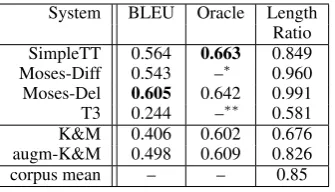
Table 1 shows the results of the automatic eval-uation metrics. SimpleTT performs significantly better than T3, the other STSG-based model, and obtains the second highest BLEU score behind only Moses-Del. SimpleTT has the highest oracle BLEU score, indicating that the syntactic model of SimpleTT allows for more diverse simplifications
4
T3 was not included in the human evaluation due to the very poor quality of the output based on both the automatic measures and based on a manual review of the output.
System BLEU Oracle Length Ratio SimpleTT 0.564 0.663 0.849 Moses-Diff 0.543 –∗ 0.960 Moses-Del 0.605 0.642 0.991 T3 0.244 –∗∗ 0.581 K&M 0.406 0.602 0.676 augm-K&M 0.498 0.609 0.826
[image:7.595.99.267.61.157.2]corpus mean – – 0.85
Table 1: Automatic evaluation scores for all sys-tems tested and the mean values from the training corpus.∗Moses-Diff uses then-best list to choose candidates and therefore is not amenable to oracle scoring. ∗∗T3 only outputs the single best simpli-fication.
than the phrase-based models and may be more amenable to future reranking techniques. Sim-pleTT also closely matches the in-corpus mean of the length ratio seen by human simplifications, though this can be partially explained by the length penalty in the log-linear model.
Moses-Del obtains the highest BLEU score, but accomplishes this with only small changes to the input sentence: the length of the simplified sen-tences are only slightly different from the original (a length ratio of 0.99). Moses-Diff has the low-est BLEU score of the three simplification systems and while it makes larger changes than Moses-Del it still makes much smaller changes than Sim-pleTT and the human simplifications.
T3 had significant problems with over-deleting content as indicated by the low length ratio which resulted in a very low BLEU score. This issue has been previously noted by others when using T3 for text compression (Nomoto, 2009; Marsi et al., 2010).
The two deletion-only systems performed worse than the three simplification systems. Com-paring the two systems shows the benefit of the grammar augmentation: augm-K&M has a signif-icantly higher BLEU score than K&M and also avoided the over-deletion that occurred in the orig-inal K&M system. The additional specificity of the rules allowed the model to make better deci-sions for which content to delete.
Human evaluation
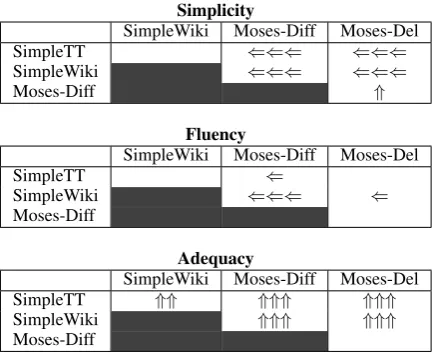
Table 2 shows the human judgement scores for the simplification approaches for the three differ-ent metrics averaged over the 100 sdiffer-entences and Table 3 shows the pairwise statistical significance calculations between each system based on a
two-simplicity fluency adequacy SimpleWiki 3.45 3.93 3.42
SimpleTT 3.55 3.80 3.09
Moses-Diff 3.07 3.64 3.91
[image:7.595.320.514.62.113.2]Moses-Del 3.19 3.74 3.86
Table 2: Human evaluation scores on a 5-point Likert scale averaged over 100 sentences.
tailed pairedt-test. Overall, SimpleTT performed well with simplicity and fluency scores that were comparable to the human simplifications. Sim-pleTT was too aggressive at removing content, re-sulting in lower adequacy scores. This phenom-ena was also seen in the human simplifications and may be able to be corrected in future variations by adjusting the sentence length target.
The human evaluations highlight the trade-off between the simplicity of the output and the amount of content preserved. For simplicity, Sim-pleTT and the human simplifications performed significantly better than both the phrase-based sys-tems. However, simplicity does come with a cost; both SimpleTT and the human simplifications re-duced the length of the sentences by 15% on aver-age. This content reduction resulted in lower ad-equacy than the phrase-based systems. A similar trade-off has been previously shown for text com-pression, balancing content versus the amount of compression (Napoles et al., 2011).
For fluency, SimpleTT again scored similarly to the human simplifications. SimpleTT performed significantly better than Moses-Diff and slightly better than Moses-Del, though the difference was not statistically significant.
As an aside, Moses-Del performs slightly bet-ter than Moses-Diff overall. They perform simi-larly on adequacy and Moses-Del performs better on simplicity and Moses-Diff performs worse rel-ative to the other systems on fluency.
Qualitative observations
SimpleTT tended to simplify by deleting prepo-sitional, adjective, and adverbial phrases, and by truncating conjunctive phrases to one of their con-juncts. This often resulted in outputs that were syntactically well-formed with only minor infor-mation loss, for example, it converts
“The Haiti national football team is the na-tional team of Haiti and is controlled by the F´ed´eration Hat¨ıenne de Football.”
Simplicity
SimpleWiki Moses-Diff Moses-Del
SimpleTT ⇐⇐⇐ ⇐⇐⇐
SimpleWiki ⇐⇐⇐ ⇐⇐⇐
Moses-Diff ⇑
Fluency
SimpleWiki Moses-Diff Moses-Del
SimpleTT ⇐
SimpleWiki ⇐⇐⇐ ⇐
Moses-Diff
Adequacy
SimpleWiki Moses-Diff Moses-Del
SimpleTT ⇑⇑ ⇑⇑⇑ ⇑⇑⇑
SimpleWiki ⇑⇑⇑ ⇑⇑⇑
[image:8.595.73.292.61.238.2]Moses-Diff
Table 3: Pairwise statistical significance test re-sults between systems for the human evaluations based on a pairedt-test. The number of arrows de-notes significance with one, two and three arrows indicating p < 0.05, p < 0.01 and p < 0.001
respectively. The direction of the arrow points to-wards the system that performed better.
“The Haiti national football team is the na-tional football team of Haiti.”
which only differs from the human reference by one word.
SimpleTT also produces a number of interesting lexical and phrasal substitutions, including:
football striker → football player football defender → football player in order to → to
known as → called
member → part
T3, on the other hand, tended to over-delete con-tent, for example simplifying:
“In earlier times, they frequently lived on the outskirts of communities, generally in squalor.”
to just
“A lived”.
As we saw in the automatic evaluation results, the phrase-based systems tended to make fewer changes to the input and those changes it did make tended to be more minor. Moses-Diff was more aggressive about making changes, though it was more prone to errors since the simplifications cho-sen were more distant from the input cho-sentence than other options in then-best list.
6 Conclusions and Future work
In this paper, we have introduced a new prob-abilistic STSG approach for sentence simplifica-tion, SimpleTT. We improve upon previous STSG approaches by: 1) making the model probabilistic instead of discriminative, allowing for an efficient, unified framework that can be easily interpreted and combined with other information sources, 2) increasing the model specificity using four levels of grammar annotations combined into a single model, and 3) incorporatingn-best list reranking combining the model score, language model prob-abilities and additional features to choose the fi-nal output. SimpleTT performs significantly better than previous STSG formulations for text simpli-fication. In addition, our approach was rated by human judges similarly to human simplifications in both simplicity and fluency and it scored bet-ter than two state-of-the-art phrase-based sentence simplification systems along many automatic and human evaluation metrics.
There are a number of possible directions for extending the capabilities of SimpleTT and related systems. First, while some sentence splitting can occur in SimpleTT due to sentence split and merge examples in the training data, SimpleTT does not explicitly model this. Sentence splitting could be incorporated as another probabilistic component in the model (Zhu et al., 2010). Second, in this work, like many previous researchers, we assume Simple English Wikipedia as our target simplic-ity level. However, the difficulty of Simple En-glish Wikipedia varies across articles and there are many domains where the desired simplicity varies depending on the target consumer. In the future, we plan to explore how varying algorithm param-eters (for example the length target) affects the simplicity level of the output. Third, one of the benefits of SimpleTT and other probabilistic sys-tems is they can generate an n-best list of can-didate simplifications. Better reranking of output sentences could close this gap across all these sys-tems, without requiring deep changes to the under-lying model.
References
Or Biran, Samuel Brody, and Noe ´mie Elhadad. 2011. Putting it simply: A context-aware approach to lexi-cal simplification. InProceedings of ACL.
Creat-ing speech and language data with Amazon’s Me-chanical Turk. In Proceedings of NAACL-HLT Workshop on Creating Speech and Language Data with Amazon’s Mechanical Turk.
John Carroll, Gido Minnen, Yvonne Canning, Siobhan Devlin, and John Tait. 1998. Practical simplifica-tion of English newspaper text to assist aphasic read-ers. InProceedings of AAAI Workshop on Integrat-ing AI and Assistive Technology.
Raman Chandrasekar and Bangalore Srinivas. 1997. Automatic induction of rules for text simplification. InKnowledge Based Systems.
David Chiang. 2006. An introduction to synchronous grammars. Part of a tutorial given at ACL.
Trevor Cohn and Mirella Lapata. 2009. Sentence com-pression as tree transduction. Journal of Artificial Intelligence Review.
Michael Collins. 1999. Head-Driven Statistical Mod-els for Natural Language Parsing. Ph.D. thesis, University of Pennsylvania.
William Coster and David Kauchak. 2011a. Learning to simplify sentences using Wikipedia. In Proceed-ings of the Workshop on Monolingual Text-To-Text Generation.
William Coster and David Kauchak. 2011b. Simple English Wikipedia: A new text simplification task. InProceedings of ACL.
Jason Eisner. 2003. Learning non-isomorphic tree mappings for machine translation. InProceedings of ACL.
Noemie Elhadad. 2006. Comprehending technical texts: predicting and defining unfamiliar terms. In
Proceedings of AMIA.
Marcello Federico, Nicola Bertoldi, and Mauro Cet-tolo. 2008. IRSTLM: An open source toolkit for handling large scale language models. In Proceed-ings of Interspeech, Brisbane, Australia.
Lijun Feng. 2008. Text simplification: A survey. CUNY Technical Report.
Michel Galley and Kathleen McKeown. 2007. Lex-icalized Markov grammars for sentence compres-sion. InProceedings of HLT-NAACL.
Hadrien Gelas, Solomon Teferra Abate, Laurent Be-sacier, and Francois Pellegrino. 2011. Evaluation of crowdsourcing transcriptions for African languages. InInterspeech.
Kevin Knight and Daniel Marcu. 2002. Summariza-tion beyond sentence extracSummariza-tion: a probabilistic ap-proach to sentence compression. Artificial Intelli-gence.
Philipp Koehn, Hieu Hoang, Alexandra Birch, Chris Callison-Burch, Marcello Federico, Nicola Bertoldi, Brooke Cowan, Wade Shen, Christine Moran, Richard Zens, Chris Dyer, Ondrej Bojar, Alexandra Constantin, and Evan Herbst. 2007. Moses: Open source toolkit for statistical machine translation. In
Proceedings of ACL.
Erwin Marsi, Emiel Krahmer, Iris Hendrickx, and Wal-ter Daelemans. 2010. On the limits of sentence compression by deletion. InEmpirical Methods in NLG.
Jonathan May and Kevin Knight. 2006. Tiburon: A weighted tree automata toolkit. In Proceedings of CIAA.
Makoto Miwa, Rune Saetre, Yusuke Miyao, and Jun’ichi Tsujii. 2010. Entity-focused sentence sim-plification for relation extraction. InProceedings of COLING.
Courtney Napoles, Benjamin Van Durme, and Chris Callison-Burch. 2011. Evaluating sentence com-pression: pitfalls and suggested remedies. In Pro-ceedings of the Workshop on Monolingual Text-To-Text Generation.
Tadashi Nomoto. 2009. A comparison of model free versus model intensive approaches to sentence com-pression. InProceedings of EMNLP.
Franz Och and Hermann Ney. 2000. Improved statisti-cal alignment models. InProceedings of ACL.
Kishore Papineni, Kishore Papineni, Salim Roukos, Salim Roukos, Todd Ward, Todd Ward, Wei jing Zhu, and Wei jing Zhu. 2002. BLEU: A method for automatic evaluation of machine translation. In
Proceedings of ACL.
Slav Petrov and Dan Klein. 2007. Improved inference for unlexicalized parsing. In Proceedings of HTL-NAACL.
Stuart Russell and Peter Norvig. 2003. Artificial intel-ligence: A modern approach.
David Vickrey and Daphne Koller. 2008. Sentence simplification for semantic role labeling. In Pro-ceedings of ACL.
Kristian Woodsend and Mirella Lapata. 2011. Learn-ing to simplify sentences with quasi-synchronous grammar and integer programming. InProceedings of EMNLP.
Sander Wubben, Antal van den Bosch, and Emiel Krahmer. 2012. Sentence simplification by mono-lingual machine translation. InProceedings of ACL.
Elif Yamangil and Stuart Shieber. 2010. Bayesian syn-chronous tree-substitution grammar induction and its application to sentence compression. In Proceed-ings of ACL.
Mark Yatskar, Bo Pang, Cristian Danescu-Niculescu-Mizil, and Lillian Lee. 2010. For the sake of sim-plicity: Unsupervised extraction of lexical simpli-fications from Wikipedia. InProceedings of HLT-NAACL.
Omar F. Zaidan and Chris Callison-Burch. 2011. Crowdsourcing translation: Professional quality from non-professionals. InProceedings of ACL.