Learning from errors: Using vector-based compositional semantics for
parse reranking
Phong Le, Willem Zuidema, Remko Scha Institute for Logic, Language, and Computation
University of Amsterdam, the Netherlands {p.le,zuidema,scha}@uva.nl
Abstract
In this paper, we address the problem of how to use semantics to improve syntac-tic parsing, by using a hybrid reranking method: a k-best list generated by a sym-bolic parser is reranked based on parse-correctness scores given by a composi-tional, connectionist classifier. This classi-fier uses a recursive neural network to con-struct vector representations for phrases in a candidate parse tree in order to classify it as syntactically correct or not. Tested on the WSJ23, our method achieved a statisti-cally significant improvement of 0.20% on F-score (2% error reduction) and 0.95% on exact match, compared with the state-of-the-art Berkeley parser. This result shows that vector-based compositional semantics can be usefully applied in syntactic pars-ing, and demonstrates the benefits of com-bining the symbolic and connectionist ap-proaches.
1 Introduction
Following the idea of compositionality in formal semantics, compositionality in vector-based se-mantics is also based on theprinciple of composi-tionality, which says that “The meaning of a whole is a function of the meanings of the parts and of the way they are syntactically combined” (Partee, 1995). According to this principle, composing the meaning of a phrase or sentence requires a syntac-tic parse tree, which is, in most current systems, given by a statistical parser. This parser, in turn, is trained on syntactically annotated corpora.
However, there are good reasons to also con-sider information flowing in the opposite direc-tion: from semantics to syntactic parsing. Per-formance of parsers trained and evaluated on the Penn WSJ treebank has reached a plateau, as many
ambiguities cannot be resolved by syntactic infor-mation alone. Further improvements in parsing may depend on the use of additional sources of in-formation, including semantics. In this paper, we study the use of semantics for syntactic parsing.
The currently dominant approach to syntactic parsing is based on extracting symbolic grammars from a treebank and defining appropriate proba-bility distributions over the parse trees that they license (Charniak, 2000; Collins, 2003; Klein and Manning, 2003; Petrov et al., 2006; Bod et al., 2003; Sangati and Zuidema, 2011; van Cra-nenburgh et al., 2011). An alternative approach, with promising recent developments (Socher et al., 2010; Collobert, 2011), is based on us-ing neural networks. In the present paper, we combine the ‘symbolic’ and ‘connectionist’ ap-proaches through reranking: a symbolic parser is used to generate a k-best list which is then reranked based on parse-correctness scores given by a connectionist compositional-semantics-based classifier.
The idea of reranking is motivated by anal-yses of the results of state-of-the-art symbolic parsers such as the Brown and Berkeley parsers, which have shown that there is still considerable room for improvement: oracle results on 50-best lists display a dramatic improvement in accuracy (96.08% vs. 90.12% on F-score and 65.56% vs. 37.22% on exact match with the Berkeley parser). This suggests that parsers that rely on syntactic corpus-statistics, though not sufficient by them-selves, may very well serve as a basis for sys-tems that integrate other sources of information by means of reranking.
One important complementary source of infor-mation is the semantic plausibility of the con-stituents of the syntactically viable parses. The ex-ploitation of that kind of information is the topic of the research we report here. In this work, we follow up on a proposal by Mark Steedman
(1999), who suggested that the realm of seman-tics lacks the clearcut hierarchical structures that characterise syntax, and that semantic information may therefore be profitably treated by the clas-sificatory mechanisms of neural nets—while the treatment of syntactic structures is best left to sym-bolic parsers. We thus developed a hybrid system, which parses its input sentences on the basis of a symbolic probabilistic grammar, and reranks the candidate parses based on scores given by a neural network.
Our work is inspired by the work of Socher and colleagues (2010; 2011). They proposed a parser using a recursive neural network (RNN) for en-coding parse trees, representing phrases in a vec-tor space, and scoring them. Their experimental result (only 1.92% lower than the Stanford parser on unlabelled bracket F-score for sentences up to a length of 15 words) shows that an RNN is expres-sive enough for syntactic parsing. Additionally, their qualitative analysis indicates that the learnt phrase features capture some aspects of phrasal se-mantics, which could be useful to resolve semantic ambiguity that syntactical information alone can not. Our work in this paper differs from their work in that we replace the parsing task by a reranking task, and thus reduce the object space significantly to a set of parses generated by a symbolic parser rather than the space of all parse trees. As a result, we can apply our method to sentences which are much longer than 15 words.
Reranking a k-best list is not a new idea. Collins (2000), Charniak and Johnson (2005), and Johnson and Ural (2010) have built reranking sys-tems with performances that are state-of-the-art. In order to achieve such high F-scores, those rerankers rely on a very large number of features selected on the basis of expert knowledge. Unlike them, our feature set is selected automatically, yet the reranker achieved a statistically significant im-provement on both F-score and exact match.
Closest to our work is Menchetti et al. (2005) and Socher et al. (2013): both also rely on sym-bolic parsers to reduce the search space and use RNNs to score candidate parses. However, our work differs in the way the feature set for rerank-ing is selected. In their methods, only the score at the tree root is considered whereas in our method the scores at all internal nodes are taken into ac-count. Selecting the feature set like that gives us a flexible way to deal with errors accumulated from
the leaves to the root.
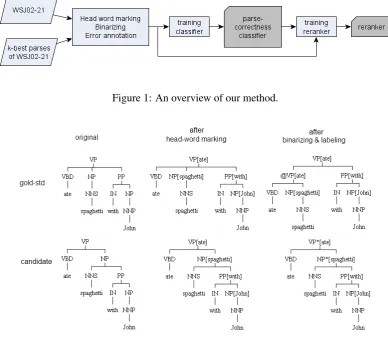
Figure 1 shows a diagram of our method. First, a parser (in this paper: the Berkeley parser) is used to generate k-best lists of the Wall Street Jour-nal (WSJ) sections 02-21. Then, all parse trees in these lists and the WSJ02-21 are preprocessed by marking head words, binarising, and performing error-annotation (Section 2). After that, we use the annotated trees to train our parse-correctness classifier (Section 3). Finally, those trees and the classifier are used to train the reranker (Section 4).
2 Experimental Setup
The experiments presented in this paper have the following setting. We use the WSJ corpus with the standard splits: sections 2-21 for training, sec-tion 22 for development, and secsec-tion 23 for test-ing. The latest implementation (version 1.7) of the Berkeley parser1 (Petrov et al., 2006) is used for generating 50-best lists. We mark head words and binarise all trees in the WSJ and the 50-best lists as in Subsection 2.1, and annotate them as in Sub-section 2.2 (see Figure 2).
2.1 Preprocessing Trees
We preprocess trees by marking head words and binarising the trees. For head word marking, we used the head finding rules of Collins (1999) which are implemented in the Stanford parser. To binarise a k-ary branching, e.g. P →
C1 ... H ... Ck whereH is the top label of the
head constituent, we use the following method. If
His not the left-most child, then
P →C1 @P ; @P →C2 ... H ... Ck
otherwise,
P →@P Ck ; @P →H ... Ck−1
where @P, which is called extra-P, now is the head of P. We then apply this transformation again on the children until we reach terminal nodes. In this way, we ensure that every internal node has one head word.
2.2 Error Annotation
We annotate nodes (ascorrectorincorrect) as fol-lows. Given a parse tree T in a 50-best list and a corresponding gold-standard treeGin the WSJ,
Figure 1: An overview of our method.
Figure 2: Example for preprocessing trees. Nodes marked with (*) are labelled incorrect whereas the other nodes are labelledcorrect.
we first attempt to align their terminal nodes ac-cording to the following criterion: a terminal node
t is aligned to a terminal node g if they are at the same position counting from-left-to-right and they have the same label. Then, a non-terminal nodeP[wh]with childrenC1, ..., Ckis aligned to
a gold-standard non-terminal node P∗[w∗h] with children C1∗, ..., Cl∗ (1 ≤ k, l ≤ 2 in our case) if they have the same word head, the same syn-tactical category, and their children are all aligned in the right order. In other words, the following conditions have to be satisfied
P =P∗; wh =w∗h; k=l
Ciis aligned toCi∗, for alli= 1..k
Aligned nodes are annotated as correct whereas the other nodes are annotated asincorrect.
3 Parse-Correctness Classification
This section describes how a neural network is used to construct vector representations for
phrases given parse trees and to identify if those trees are syntactically correct or not. In order to encode tree structures, we use an RNN2(see Fig-ure 3 and FigFig-ure 4) which is similar to the one proposed by Socher and colleagues (2010). How-ever, unlike their RNN, our RNN can handle unary branchings, and also takes head words and syntac-tic tags as input. It is worth noting that, although we can use some transformation to remove unary branchings, handling them is helpful in our case because the system avoids dealing with so many syntactic tags that would result from the
transfor-2
mation. In addition, using a new set of weight ma-trices for unary branchings makes our RNN more expressive without facing the problem of sparsity thanks to a large number of unary branchings in the treebank.
Figure 3: An RNN attached to the parse tree shown in the top-right of Figure 2. All unary branchings share a set of weight matrices, and all binary branchings share another set of weight ma-trices (see Figure 4).
An RNN processes a tree structure by repeat-edly applying itself at each internal node. Thus, walking bottom-up from the leaves of the tree to the root, we compute for every node a vector based on the vectors of its children. Because of this process, those vectors have to have the same di-mension. It is worth noting that, because informa-tion at leaves, i.e. lexical semantics, is composed according to a given syntactic parse, what a vec-tor at each internal node captures is some aspects of compositional semantics of the corresponding phrase. In the remainder of this subsection, we describe in more detail how to construct composi-tional vector-based semantics geared towards the parse-correctness classification task.
Similar to Socher et al. (2010), and Col-lobert (2011), given a string of words(w1, ..., wl),
we first compute a string of vectors (x1, ..., xl)
representing those words by using a look-up table (i.e., word embeddings)L∈Rn×|V|, where|V|is
the size of the vocabulary andnis the dimension-ality of the vectors. This look-up table L could be seen as a storage of lexical semantics where each column is a vector representation of a word. Hence, letbi be the binary representation of word
wi(i.e., all of the entries ofbi are zero except the
one corresponding to the index of the word in the dictionary), then
xi =Lbi ∈Rn (1)
[image:4.595.324.493.135.311.2]We also encode syntactic tags by binary vectors but put an extra bit at the end of each vector to mark if the corresponding tag is extra or not (i.e., @P orP).
Figure 4: Details about our RNN for a unary branching (top) and a binary branching (bottom). The bias is not shown for the simplicity.
Then, given a unary branchingP[wh]→C, we
can compute the vector at the nodeP by (see Fig-ure 4-top)
p = f Wuc+Whxh+W−1x−1+
W+1x+1+Wttp+bu
where c, xh are vectors representing the childC
and the head word,x−1, x+1 are the left and right neighbouring words of P, tp encodes the
syn-tactic tag of P, Wu, Wh, W−1, W+1 ∈ Rn×n,
Wt ∈ Rn×(|T|+1), |T| is the size of the set of
syntactic tags, bu ∈ Rn, and f can be any
acti-vation function (tanhis used in this case). With a binary branchingP[wh] → C1 C2, we simply change the way the children’s vectors added (see Figure 4-bottom)
p = f Wb1c1+Wb2c2+Whxh+W−1x−1+
W+1x+1+Wttp+bb
Finally, we put a sigmoid neural unit on the top of each internal node (except pre-terminal nodes because we are not concerned with POS-tagging) to detect the correctness of the subparse tree rooted at that node
y=sigmoid(Wcatp+bcat) (2)
[image:4.595.75.292.146.255.2]3.1 Learning
The error on a parse tree is computed as the sum of classification errors of all subparses. Hence, the learning is to minimise the objective
J(θ) = 1
N
X
T
X
(y(θ),t)∈T
1
2(t−y(θ))
2+λkθk2
(3) whereθare the model parameters,N is the num-ber of trees,λis a regularisation hyperparameter,
T is a parse tree,y(θ)is given by Equation 2, and
tis the class of the corresponding subparse (t= 1 meanscorrect). The gradient ∂J∂θ is computed ef-ficiently thanks to backpropagation through the structure (Goller and Kuchler, 1996). L-BFGS (Liu and Nocedal, 1989) is used to minimise the objective function.
3.2 Experiments
We implemented our classifier in Torch73 (Col-lobert et al., 2011a), which is a powerful Matlab-like environment for machine learning. In order to save time, we only trained the classifier on 10-best parses of WSJ02-21. The training phase took six days on a computer with 16 800MHz CPU-cores and 256GB RAM. The word embeddings given by Collobert et al. (2011b)4were used asLin Equa-tion 1. Note that these embeddings, which are the result of training a language model neural network on the English Wikipedia and Reuters, have been shown to capture many interesting semantic simi-larities between words.
We tested the classifier on the development set WSJ22, which contains1,700sentences, and measured the performance in positive rate and negative rate
pos-rate = #true pos #true pos+ #false neg
neg-rate = #true neg #true neg+ #false pos
The positive/negative rate tells us the rate at which positive/negative examples are correctly labelled
positive/negative. In order to achieve high per-formance in the reranking task, the classifier must have a high positive rate as well as a high nega-tive rate. In addition, percentage of posinega-tive exam-ples is also interesting because it shows the unbal-ancedness of the data. Because the accuracy is not
3
http://www.torch.ch/
4http://ronan.collobert.com/senna/
a reliable measurement when the dataset is highly unbalanced, we do not show it here. Table 1, Fig-ure 5, and FigFig-ure 6 show the classification results.
pos-rate (%) neg-rate (%) %-Pos
gold-std 75.31 - 1
1-best 90.58 64.05 71.61
10-best 93.68 71.24 61.32
[image:5.595.306.528.118.190.2]50-best 95.00 73.76 56.43
Table 1: Classification results on the WSJ22 and the k-best lists.
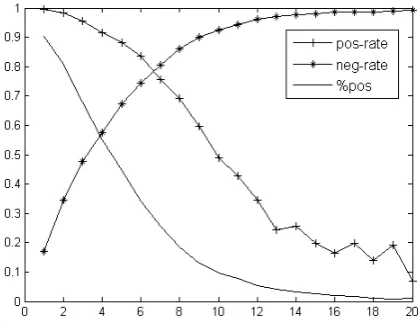
Figure 5: Positive rate, negative rate, and percent-age of positive examples w.r.t. subtree depth.
3.3 Discussion
Table 1 shows the classification results on the gold-standard, 1-best, 10-best, and 50-best lists. The positive rate on the gold-standard parses, 75.31%, gives us the upper bound of %-pos when this classifier is used to yield best lists. On the 1-best data, the classifier missed less than one tenth positive subtrees and correctly found nearly two third of the negative ones. That is, our classi-fier might be useful for avoiding many of the mis-takes made by the Berkeley parser, whilst not in-troducing too many new mistakes of its own. This fact gave us hope to improve parsing performance when using this classifier for reranking.
[image:5.595.315.525.262.425.2]Figure 6: Positive rate, negative rate, and percentage of positive samples w.r.t. syntactic categories (excluding POS tags).
deeper a subtree is, the lower the a priori likeli-hood that the subtree is positive (we can see this in the percentage-of-positive-example curve). In addition, deep subtrees are difficult to classify be-cause uncertainty is accumulated when propagat-ing from bottom to top.
4 Reranking
In this section, we describe how we use the above classifier for the reranking task. First, we need to represent trees in one vector space, i.e., µ(T) =
µ1(T), ..., µv(T)
for an arbitrary parse tree T. Collins (2000), Charniak and Johnson (2005), and Johnson and Ural (2010) set the first entry to the model score and the other entries to the number of occurrences of specific discrete hand-chosen prop-erties (e.g., how many times the wordpizzacomes after the wordeat) of trees. We here do the same with a trick to discretize results from the classifier: we use a 2D histogram to store predicted scores w.r.t. subtree depth. This gives us a flexible way to penalise low score subtrees and reward high score subtrees w.r.t. the performance of the classifier at different depths (see Subsection 3.3). However, unlike the approaches just mentioned, we do not use any expert knowledge for feature selection; in-stead, this process is fully automatic.
Formally speaking, a vector feature µ(T) is computed as following. µ1(T)is the model score
(i.e., max-rule-sum score) given by the parser,
µ2(T), ..., µv(T)
is the histogram of a set of (y, h)whereyis given by Equation 2 andhis the depth of the corresponding subtree. The domain ofy(i.e.,[0,1]) is split intoγy equal bins whereas
the domain ofh(i.e.,{1,2,3, ...}) is split intoγh
bins such that thei-th (i < γh) bin corresponds to
subtrees of depthiand theγh-th bin corresponds
to subtrees of depth equal or greater thanγh. The
parametersγyandγhare then estimated on the
de-velopment set.
After extracting feature vectors for parse trees, we then find a linear ranking function
f(T) =w>µ(T)
such that
f(T1)> f(T2) iff fscore(T1)>fscore(T2)
wherefscore(.)is the function giving F-score, and
w ∈ Rv is a weight vector, which is efficiently
SVM-Rank5 (Joachims, 2006), which runs extremely fast (less than two minutes with about38,000 10-best lists).
4.1 Experiments
Using the classifier in Section 3, we implemented the reranker in Torch7, trained it on WSJ02-21. We used WSJ22 to estimate the parametersγyand
γh by the grid search and found thatγy = 9 and
[image:7.595.318.516.61.175.2]γh = 4yielded the best F-score.
Table 2 shows the results of our reranker on 50-best WSJ23 given by the Berkeley parser, us-ing the standard evalb. Our method improves 0.20% on F-score for sentences with all length, and 0.22% for sentences with ≤ 40 words. These differences are statistically significant6with
p-value < 0.003. Our method also improves ex-act match (0.95% for all sentences as well as for sentences with≤40words).
Parser LR LP LF EX
all
Berkeley parser 89.98 90.25 90.12 37.22 This paper 90.10 90.54 90.32 38.17 Oracle 95.94 96.21 96.08 65.56
≤40words
[image:7.595.71.300.347.479.2]Berkeley parser 90.43 90.70 90.56 39.65 This paper 90.57 91.01 90.78 40.50 Oracle 96.47 96.73 96.60 68.51
Table 2: Reranking results on 50-best lists on WSJ23 (LR is labelled recall, LP is labelled pre-cision, LF is labelled F-score, and EX is exact match.)
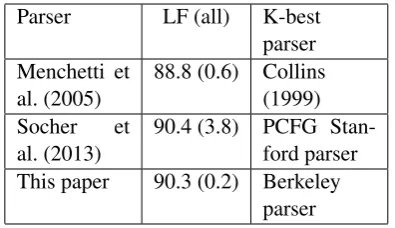
Table 3 shows the comparison of the three parsers that use the same hybrid reranking ap-proach. On F-score, our method performed0.1% lower than Socher et al. (2013), and 1.5%better than Menchetti et al. (2005). However, our method achieved the least improvement on F-score over its corresponding baseline. That could be because our baseline parser (i.e., the Berkeley parser) performs much better than the other two baseline parsers; and hence, detecting errors it makes on candidate parse trees is more difficult.
5
www.cs.cornell.edu/people/tj/svm light/svm rank.html
6We used the “Significance testing for
evalua-tion statistics” software (http://www.nlpado.de/ sebas-tian/software/sigf.shtml) given by Pad´o (2006).
Parser LF (all) K-best parser Menchetti et
al. (2005)
88.8 (0.6) Collins (1999) Socher et
al. (2013)
90.4 (3.8) PCFG Stan-ford parser This paper 90.3 (0.2) Berkeley
parser
Table 3: Comparison of parsers using the same hy-brid reranking approach. The numbers in the blan-kets indicate the improvements on F-score over the corresponding baselines (i.e., the k-best parsers).
5 Conclusions
This paper described a new reranking method which uses semantics in syntactic parsing: a sym-bolic parser is used to generate a k-best list which is later reranked thanks to parse-correctness scores given by a connectionist compositional-semantics-based classifier. Our classifier uses a recursive neural network, like Socher et al., (2010; 2011), to not only represent phrases in a vector space given parse trees, but also identify if these parse trees are grammatically correct or not.
Tested on WSJ23, our method achieved a statistically significant improvement on F-score (0.20%) as well as on exact match (0.95%). This result, although not comparable to the re-sults reported by Collins (2000), Charniak and Johnson (2005), and Johnson and Ural (2010), shows an advantage of using vector-based com-positional semantics to support available state-of-the-art parsers.
One of the limitations of the current paper is the lack of a qualitative analysis of how learnt vector-based semantics has affected the reranking results. Therefore, the need for “compositional seman-tics” in syntactical parsing may still be doubted. In future work, we will use vector-based seman-tics together with non-semantic features (e.g., the ones of Charniak and Johnson (2005)) to find out whether the semantic features are truly helpful or they just resemble non-semantic features.
Acknowledgments
References
Rens Bod, Remko Scha, and Khalil Sima’an. 2003. Data-Oriented Parsing. CSLI Publications, Stan-ford, CA.
Eugene Charniak and Mark Johnson. 2005. Coarse-to-fine n-best parsing and MaxEnt discriminative reranking. InProceedings of the 43rd Annual Meet-ing on Association for Computational LMeet-inguistics, pages 173–180. Association for Computational Lin-guistics.
Eugene Charniak. 2000. A maximum-entropy-inspired parser. In Proceedings of the 1st North American chapter of the Association for Computa-tional Linguistics, pages 132–139. Association for Computational Linguistics.
Michael Collins. 1999. Head-Driven Statistical Mod-els for Natural Language Parsing. Ph.D. thesis, University of Pennsylvania.
Michael Collins. 2000. Discriminative reranking for natural language parsing. InProceedings of the In-ternational Workshop on Machine Learning (then Conference), pages 175–182.
Michael Collins. 2003. Head-driven statistical mod-els for natural language parsing.Computational lin-guistics, 29(4):589–637.
Ronan Collobert, Koray Kavukcuoglu, and Cl´ement Farabet. 2011a. Torch7: A matlab-like environment for machine learning. InBigLearn, NIPS Workshop.
Ronan Collobert, Jason Weston, L´eon Bottou, Michael Karlen, Koray Kavukcuoglu, and Pavel Kuksa. 2011b. Natural language processing (almost) from scratch. The Journal of Machine Learning Re-search, 12:2493–2537.
Ronan Collobert. 2011. Deep learning for efficient discriminative parsing. InInternational Conference on Artificial Intelligence and Statistics (AISTATS).
Christoph Goller and Andreas Kuchler. 1996. Learn-ing task-dependent distributed representations by backpropagation through structure. InIEEE Inter-national Conference on Neural Networks, volume 1, pages 347–352. IEEE.
Thorsten Joachims. 2006. Training linear SVMs in lin-ear time. InProceedings of the 12th ACM SIGKDD international conference on Knowledge discovery and data mining, pages 217–226. ACM.
Mark Johnson and Ahmet Engin Ural. 2010. Rerank-ing the Berkeley and Brown parsers. InHuman Lan-guage Technologies: The 2010 Annual Conference of the North American Chapter of the Association for Computational Linguistics, pages 665–668. As-sociation for Computational Linguistics.
Dan Klein and Christopher D Manning. 2003. Ac-curate unlexicalized parsing. InProceedings of the 41st Annual Meeting on Association for Computa-tional Linguistics, Volume 1, pages 423–430. Asso-ciation for Computational Linguistics.
Dong C Liu and Jorge Nocedal. 1989. On the limited memory BFGS method for large scale optimization. Mathematical programming, 45(1-3):503–528.
Sauro Menchetti, Fabrizio Costa, Paolo Frasconi, and Massimiliano Pontil. 2005. Wide coverage natu-ral language processing using kernel methods and neural networks for structured data. Pattern Recogn. Lett., 26(12):1896–1906, September.
Sebastian Pad´o, 2006. User’s guide tosigf: Signifi-cance testing by approximate randomisation.
Barbara Partee. 1995. Lexical semantics and compo-sitionality. In L. R. Gleitman and M. Liberman, ed-itors,Language. An Invitation to Cognitive Science, volume 1, pages 311–360. MIT Press, Cambridge, MA.
Slav Petrov, Leon Barrett, Romain Thibaux, and Dan Klein. 2006. Learning accurate, compact, and interpretable tree annotation. In Proceedings of the 21st International Conference on Computational Linguistics and the 44th annual meeting of the Asso-ciation for Computational Linguistics, pages 433– 440. Association for Computational Linguistics.
Jordan B Pollack. 1988. Recursive auto-associative memory.Neural Networks, 1:122.
Federico Sangati and Willem Zuidema. 2011. Ac-curate parsing with compact tree-substitution gram-mars: Double-DOP. In Proceedings of the Con-ference on Empirical Methods in Natural Language Processing, pages 84–95. Association for Computa-tional Linguistics.
Libin Shen and Aravind K Joshi. 2003. An SVM based voting algorithm with application to parse reranking. InProceedings of the seventh conference on Natural language learning at HLT-NAACL 2003-Volume 4, pages 9–16. Association for Computational Linguis-tics.
Richard Socher, Christopher D Manning, and An-drew Y Ng. 2010. Learning continuous phrase representations and syntactic parsing with recursive neural networks. InProceedings of the NIPS-2010 Deep Learning and Unsupervised Feature Learning Workshop.
Richard Socher, John Bauer, Christopher D. Manning, and Andrew Y. Ng. 2013. Parsing With Composi-tional Vector Grammars. InProceedings of the ACL conference (to appear).
Mark Steedman. 1999. Connectionist sentence processing in perspective. Cognitive Science, 23(4):615–634.
Ivan Titov and James Henderson. 2006. Loss mini-mization in parse reranking. InProceedings of the 2006 Conference on Empirical Methods in Natural Language Processing, pages 560–567. Association for Computational Linguistics.
Andreas van Cranenburgh, Remko Scha, and Federico Sangati. 2011. Discontinuous Data-Oriented Pars-ing: A mildly context-sensitive all-fragments gram-mar. InProceedings of the Second Workshop on Sta-tistical Parsing of Morphologically Rich Languages, pages 34–44. Association for Computational Lin-guistics.