Automatic classification of patterns
from the Pattern Dictionary of English Verbs
Isma¨ıl El Maarouf University of Wolverhampton [email protected]
V´ıt Baisa Masaryk University Lexical Computing Ltd [email protected]
Abstract
The paper presents a supervised approach to semantic parsing, based on a new se-mantic resource, the Pattern Dictionary of English Verbs (PDEV). PDEV lists the most frequent patterns of English verbs identified in corpus. Each argument in a pattern is semantically categorized with semantic types from the PDEV ontology. Each pattern is linked to a set of sentences from the British National Corpus.
The article describes PDEV in details and presents the task of pattern classification. The system described is based on a dis-tributional approach, and achieves 66% in Micro-average F1 across a sample of 25 of the most frequent verbs.
1 Introduction
This paper reports the results of Natural Language Processing (NLP) experiments in semantic pars-ing, based on a new semantic resource, the Pat-tern Dictionary of English Verbs (PDEV) (Hanks, 2013). This resource is the output of Corpus Pat-tern Analysis (CPA; (Hanks, 2004)), a corpus lex-icography technique for mapping meaning onto words in text. CPA analyses the prototypical syn-tagmatic patterns with which words in use are as-sociated. The patterns emerge from the analysis of corpus concordance lines and careful attention to linguistic context clues is applied to characterize pattern elements and to distinguish between pat-terns. Only in a second step is an “implicature” (i.e. a meaning) mapped onto a pattern. In other words, CPA is driven by syntagmatic patterns, not meaning.
Given these two features (pattern-driven and corpus-driven), this resource is unique in its kind, across languages. However, while CPA has made contributions to lexicography and to linguistics, no
experiments have yet been made in NLP to use PDEV in applications such as Information Extrac-tion or Statistical Machine TranslaExtrac-tion.
The present paper proposes to make use of PDEV as a resource for the semantic processing of text. It describes its structure in detail (section 2) and proposes the task of Pattern classification as a first step in semantic parsing (section 3). Contri-butions are summarized in section 4.
2 Background
2.1 Corpus Pattern Analysis
PDEV is built using the CPA methodology, which draws on Corpus Linguistics (Sinclair, 1991), and is inspired by semantic theories such as the Gen-erative Lexicon (Pustejovsky, 1995), Frame Se-mantics (Fillmore, 1985) and Preference Seman-tics (Wilks, 1975). As a methodology for build-ing lexical resources, CPA takes the position that words are only meaningful in context: words in isolation tend to be ambiguous while word pat-terns are rarely so. While this may seem self-evident, it has important implications for lexical semantics, which are developed in the Theory of Norms and Exploitations (TNE) (Hanks, 2013). According to TNE, it is a fallacy to attempt the definition of words independently and outside of context. Words should be described according to, and along with, the patterns in which they are found in real language use.
CPA builds typical phraseological patterns from corpora, by clustering corpus tokens (labelling them) according to the similarity of their context. The similarity is evaluated in different steps.
nb % Pattern & primary implicature 1 7% [[Plant]] blossom [NOOBJ]
[[Plant]] produces flowers or masses of flowers
2 87% [[Eventuality|Psych]] blossom [NOOBJ] (into [[Anything = Good]])
[[Eventuality|Psych]] develops in a promising way or into something that is expected or desired
[[Psych]] refers to Psychological Entities and includes Emotions, Attitude and Goal.
Figure 1: Patterns for the verbblossom
• Semantic analysis involves the use of
seman-tic features shared by collocates in each argu-ment position. For example, Semantic Types (ST; e.g. [[Human]], [[Building]], [[Event]]) are used to represent the prototypical proper-ties shared by the collocates found in a spe-cific pattern position.
Since PDEV patterns represent abstractly several features of tokens from a large sample, they are rarely fully instantiated in an example: actual ex-amples most often instantiate part of a pattern (e.g. subject ellipsis).
2.2 The structure of patterns
PDEV is created using three main tools: a cor-pus interface, i.e. The SketchEngine1(Kilgarriff et al., 2004), an ontology of semantic types2, and the pattern dictionary3. PDEV lexicographers use the British National Corpus4(BNC), a large reference corpus containing various text types in British En-glish (100 million words).
A verb pattern includes arguments such as Sub-ject and ObSub-ject. Each argument can be described according to determiners, semantic types, contex-tual roles, and lexical sets:
• Determiners account for distinctions between “take place” and “takehisplace”.
• Semantic types account for distinctions such
as “building [[Machine]]” and “building [[Relationship]]”.
• Contextual roles account for distinctions such
as “[[Human=Film Director]] shoot” and “[[Human=Sports Player]] shoot”.
• Lexical sets account for distinctions such as “reap the whirlwind” and “reap the har-vest”.
1https://the.sketchengine.co.uk 2http://nlp.fi.muni.cz/projekty/cpa/ public_onto.html
3http://deb.fi.muni.cz/pdev 4http://www.natcorp.ox.ac.uk/
Figure 1 shows an example of the PDEV entry of the verb to blossom. Both patterns are intransitive; the first has the semantic type [[Plant]] as subject and may be classified as the literal meaning even though it is comparatively rare. The criterion that distinguishes the second pattern, which may be classified as a conventional metaphor, is the semantic type ([[Eventuality]] or [[Psych]]). Pattern 2 also includes an optional prepositional phrase as additional context clue.
(1) The Times notedfruit treeswhich had begun toblossom...
(2) Thesilk tradeblossomedin Blockley...
Pattern 2 (example 2) illustrates an alternation of semantic types. It means that in the whole set of lines tagged as “blossom 2”, subjects are either [[Eventuality]] or [[Psych]]. A semantic type pro-vides the relevant semantic value of all words in context. They are, in practice, controlled general-izations of corpus observations.
Each pattern is described with (i) a primary im-plicature which elaborates the meaning of the pat-tern and (ii) percentages. Percentages are obtained by dividing the number of tagged lines over a ran-dom sample (the size of the sample depends on the frequency of a verb, usually 250 corpus lines).
3 Pattern classification
3.1 Description of the experiment
An important task performed by semantic parsers is Word Sense Disambiguation (WSD), in which systems predict the senses of words in text. WSD experiments (Navigli, 2009) have used WordNet5 as a sense repository but we decided to explore how PDEV patterns could be used in this context. As each pattern is linked to a set of lines, the present task ofpattern classificationrequires sys-tems to identify the correct pattern for each verb token. Our experiment was carried out on 25 verbs
Macro-F1= 1 |C|·
|C|
!
k=1
(1 +β)·P recisionk·Recallk β·(P recisionk+Recallk)
withβ= 1 (1)
with comparatively high frequency in the BNC, on a range of patterns. The dataset contains 20418 verb tokens and was split using the following strat-ified sampling method: tokens were randomly se-lected from each verb pattern separately, using a 0.8:0.2 ratio, making sure that in extreme cases, where the set included less than 4 instances, the training set would always contain at least as many examples as in the test set.
Two evaluation metrics were used: Micro-average (Micro-F1) and Macro-Micro-average F-score (Macro-F1). Micro-F1 can be computed by count-ing False and True positives and negatives across classes. Micro-F1 can be complemented with Mac-F1 which gives an estimate of the perfor-mance of systems in discriminating patterns (by giving equal weight to classes rather than to in-stances; see equation (1)).
The baseline was generated by applying the ma-jority class (most frequent) found in the training set, to the test set. Since the dataset is highly biased in terms of label frequency, the baseline Micro-F1 is quite high (0.62 across verbs). How-ever, the baseline reaches 0.12 in Macro-F1.
3.2 Bootstrapping system
The system used for this task is a solution avail-able in the Sketch Engine (Kilgarriff and Rychly, 2010), a corpus query system allowing users to explore corpus concordances. This system bootstraps from an existing automatic thesaurus (Grefenstette, 1994; Lin, 1998) to assign a label to a given verb token. The thesaurus is based on a regular grammar which identifies collocates linked to a verb through a syntactic relation (such as sub-ject). The system applies the grammar to extract dependency triples of the form||w, r, w!||, where
wis a lemma linked to another lemmaw!by a
re-lationr. Each triple is weighted with an
associa-tion score based on the set of extracted triples, as described in equation (2). A distance measure de-scribed in equation (3) is then applied to words sharing similar contexts (Rychl´y and Kilgarriff, 2007).
The bootstrapping algorithm uses the thesaurus scores to predict a label for each token. For each verb tokenvof the test set, it compares its contexts
(r, w!) to the contexts (r, w) labelled ask in the training set (of frequency over 1). The score for each token, results from the sum of the contexts having the best score as described in equation (4). This method relies on the hypothesis that to-kens sharing identical context should be labelled identically. It therefore does not normally dis-criminates cases where the same context is tagged with two different labels. This occurs only rarely. Two thresholds have been tested, minscore, the minimal score returned by the algorithm, and
mindiff, the minimal difference between the best score and the second best score.
3.3 Results
The bootstrapping system was tested on sev-eral combinations of parameters mindiff
and minscore. The best combination was
mindiff = 0.1, thus a low difference between the first two scores returned by the algorithm, and
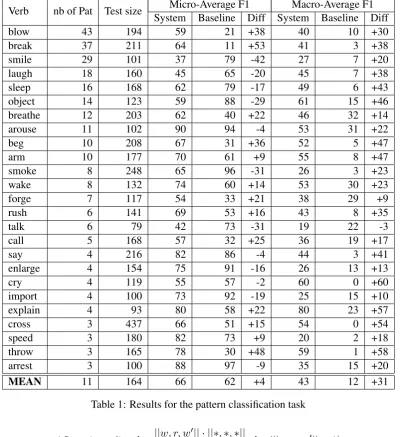
minscore= 0.9, thus a high score threshold. Table 1 shows that, on average, the system beats the baseline on both Micro-F1 and Macro-F1. While the difference (diff) between the sys-tem and the baseline in Micro-F1 is low, it is much higher for Macro-F1, which shows that the boot-strapping system is not biased towards the major-ity class.
Detailed analysis revealed that the bootstrap-ping generally suffers from fairly low recall, but has a very satisfying precision on average (Micro-Prec/Micro-Rec = 0.86/0.56; Macro-Prec/Macro-Rec = 0.56/0.41).
Conclusion
This article has presented new results for the clas-sification of verb patterns from the Pattern Dictio-nary of English Verbs (PDEV). The latter is an interesting resource for semantic parsing as it is a corpus-based meaning repository with links to patterns of use. The tagged corpus of the PDEV has been used on a task of pattern classification similar to Word Sense Disambiguation, which is potentially beneficial to many Natural Language Processing applications.
Verb nb of Pat Test size System Baseline Diff System Baseline DiffMicro-Average F1 Macro-Average F1
blow 43 194 59 21 +38 40 10 +30
break 37 211 64 11 +53 41 3 +38
smile 29 101 37 79 -42 27 7 +20
laugh 18 160 45 65 -20 45 7 +38
sleep 16 168 62 79 -17 49 6 +43
object 14 123 59 88 -29 61 15 +46
breathe 12 203 62 40 +22 46 32 +14
arouse 11 102 90 94 -4 53 31 +22
beg 10 208 67 31 +36 52 5 +47
arm 10 177 70 61 +9 55 8 +47
smoke 8 248 65 96 -31 26 3 +23
wake 8 132 74 60 +14 53 30 +23
forge 7 117 54 33 +21 38 29 +9
rush 6 141 69 53 +16 43 8 +35
talk 6 79 42 73 -31 19 22 -3
call 5 168 57 32 +25 36 19 +17
say 4 216 82 86 -4 44 3 +41
enlarge 4 154 75 91 -16 26 13 +13
cry 4 119 55 57 -2 60 0 +60
import 4 100 73 92 -19 25 15 +10
explain 4 93 80 58 +22 80 23 +57
cross 3 437 66 51 +15 54 0 +54
speed 3 180 82 73 +9 20 2 +18
throw 3 165 78 30 +48 59 1 +58
arrest 3 100 88 97 -9 35 15 +20
[image:4.595.100.501.65.503.2]MEAN 11 164 66 62 +4 43 12 +31
Table 1: Results for the pattern classification task
AScore(w,r,w’)= log||w, r, w!|| · ||∗,∗,∗||
||w, r,∗|| · ||∗,∗, w!|| ·log(||w, r, w!||+ 1) (2)
Dist(w,w’)= !
(tuplei,tuplej)∈{tuplew∩tuplew!}ASi+ASj−(ASi−ASj)
2/50 !
tuplei∈{tuplei∪tuplej}ASi
(3)
scorev,k= "
(w,r) "
(w!,r)
max #
Distw,w!·
! (w,r,k) !
(w,r) $
(4)
SketchEngine. Results showed that the system beats the baseline on average and has a high pre-cision, which makes it a potentially interesting tool for NLP applications. Various grammars or methods to generate thesaurus contexts need to be tested in order to improve the system’s recall with-out sacrificing precision. In the future, the system will also be analysed on a larger set of verbs.
Acknowledgements
References
Charles J. Fillmore. 1985. Frames and the semantics of understanding. Quaderni di Semantica, 6(2):222– 254.
Gregory Grefenstette. 1994. Explorations in Auto-matic Thesaurus Discovery (The Springer Interna-tional Series in Engineering and Computer Science). Springer.
Patrick Hanks. 2004. Corpus pattern analysis. In Eu-ralex Proceedings, volume 1, pages 87–98.
Patrick Hanks. 2013. Lexical Analysis: Norms and Exploitations. MIT Press.
Adam Kilgarriff and Pavel Rychly. 2010. Semi-automatic dictionary drafting. In Gilles-Maurice de Schryver, editor,Oxford Handbook of Innovation. Menha Publichers, Kampala.
Adam Kilgarriff, Pavel Rychly, Pavel Smrz, and David Tugwell. 2004. Itri-04-08 the sketch engine. Infor-mation Technology, 105:116.
Dekang Lin. 1998. Automatic retrieval and clustering of similar words. InProceedings of the 17th inter-national conference on Computational linguistics-Volume 2. Association for Computational Linguis-tics.
Roberto Navigli. 2009. Word sense disambiguation: A survey. ACM Comput. Surv., 41(2):10:1–10:69.
James Pustejovsky. 1995. The Generative Lexicon. MIT Press.
Pavel Rychl´y and Adam Kilgarriff. 2007. An ef-ficient algorithm for building a distributional the-saurus (and other sketch engine developments). In Proceedings of the 45th Annual Meeting of the As-sociation for Computational Linguistics Companion Volume Proceedings of the Demo and Poster Ses-sions, pages 41–44, Prague, Czech Republic. Asso-ciation for Computational Linguistics.
John Sinclair. 1991. Corpus, concordance, colloca-tion. Oxford University Press.