Cross-lingual variation of light verb constructions: using parallel corpora
and automatic alignment for linguistic research
Tanja Samardˇzi´c
Linguistics Department University of Geneva
Paola Merlo
Linguistics Department University of Geneva
Abstract
Cross-lingual parallelism and small-scale language variation have recently become subject of research in both computational and theoretical linguistics. In this arti-cle, we use a parallel corpus and an auto-matic aligner to study English light verb constructions and their German transla-tions. We show that parallel corpus data can provide new empirical evidence for better understanding the properties of light verbs. We also study the influence that the identified properties of light verb construc-tions have on the quality of their automatic alignment in a parallel corpus. We show that, even though characterised by limited compositionality, these constructions can be aligned better than fully compositional phrases, due to an interaction between the type of light verb construction and its fre-quency.
1 Introduction
Fine-grained contrastive studies traditionally be-long to the field of applied linguistics, notably to translation and second language acquisition stud-ies. Recently, however, interest for contrastive studies has been renewed due to developments in the general theory of language (the notion of micro-parameters (Kayne, 2000)) on the one hand, and due to advances in natural language process-ing based on the exploitation of parallel corpora, on the other hand.
Parallel corpora are collections of translations with explicit alignment of sentences. They are im-portant resources for the automatic acquisition of the cross-linguistic translation equivalents that are needed for machine translation. There is also in-terest in using parallel corpora to automatically de-velop new annotated linguistic resources by pro-jecting the annotation that already exists in one
language (usually English) (Pad´o, 2007; Basili et al., 2009). Such resources can be used for train-ing systems for automatic parstrain-ing for different lan-guages. Recently, parallel multilingual corpora have also been used to improve performance in mono-lingual tasks (Snyder et al., 2009).
For most of these applications, the aligned sen-tences in the parallel corpora need to be analysed into smaller units (phrases and words), which, in turn, need to be aligned. Although crucial for suc-cessful use of parallel corpora, word (and phrase) alignment is still a challenging task (Och and Ney, 2003; Collins et al., 2005; Pad´o, 2007).
Our research concentrates on one type of con-struction that needs a special treatment in the task of aligning corpora and projecting linguistic an-notation from one language to another, namely light verb constructions. These constructions, usu-ally identified as paraphrases of verbs (e.g. have a laugh means laugh, give a talk means talk), are frequent, cross-lingually productive forms, where simple-minded parallelism often breaks down. Their meaning is partially uncomposi-tional, formed in a conventional way, which means that they cannot be analysed as regular construc-tions and that they cannot be translated to another language directly word by word. Unlike colloca-tions and idioms, however, these construccolloca-tions are formed according to the same “semi-productive” pattern in different languages. Due to their cross-lingual analysability, they can be expected to be aligned at the word level in a parallel corpus, even if their components are not direct word-to-word translations of each other. This means that word alignment of these constructions, needed for au-tomatic translation and transferring annotations, is possible, but it is not straight-forward.
An in-depth study of these constructions in the specific context of parallel corpora and alignment can cast new light on the correlation of their lin-guistic and statistical properties. On the one hand,
the statistical large-scale analysis of the behaviour of these constructions as the output of an align-ment process provides novel linguistic informa-tion, which enlarges the empirical base for the analysis of these constructions, and complements the traditional grammaticality judgements. On the other hand, the linguistically fine-grained analysis of the statistical behaviour of these constructions provides linguistically-informed performance and error analyses that can be used to improve align-ers.
2 Two Types of Light Verb Constructions and their Alignment
Light verb constructions have already been iden-tified as one of the major sources of problems in transferring semantic annotation between lan-guages as close as English and German (Burchardt et al., 2009). Light verb constructions introduce two kinds of divergences that can pose a problem for automatic word alignment. In the case oftrue light verb constructions (Kearns, 2002), English phrases such ashave a laugh, give [stg.] a wipe, and take a look typically correspond to German single words,lachen, wischen, andblicken respec-tively. Such correspondences can be expected to result in actual parallel sentences where English verbshave, give, andtakewould be either aligned with the verbs lachen, wischen, and blicken re-spectively or would have no alignment at all. Such alignments are not common cases and can be ex-pected to pose a problem to an automatic aligner.
Another type of divergence concerns construc-tions with vague action verbs (Kearns, 2002). In this case, English phrases such asmake an agree-ment, make a decision, andgive a talkcorrespond to German phraseseinen Vertrag schliessen, eine Entscheidung treffen, and einen Vortrag halten, respectively. Parallel sentences containing these constructions should be aligned so that English nouns agreement, decision, and talk are aligned with German nouns Vertrag, Entscheidung, and
Vortrag. At the same time, English verb make
should be aligned with Germanschliessen in the first example, withtreffenin the second, andgive
should be aligned withhaltenin the third example. Aligning the nouns should not pose any problem, since these alignments are direct lexical transla-tions (c.f. (LEO, 2006 9) online dictionary, for ex-ample) and they can be expected to be aligned in many different sentences. However, aligning the
verbs is necessarily more complicated, since they are not direct translations of each other and cannot be expected to be aligned in other contexts.1
However, the difference between the two types of light verb constructions is not clear cut. They are better seen as two ends of a continuum of verb usages with different degrees of verbs’ lightness and different degrees of compositionality of the meaning of constructions. (Stevenson et al., 2004; Butt and Geuder, 2001; Grimshaw and Mester, 1988). Even though several English verbs have been identified as having light usages (e.g. take, make, have, give, pay), there has been little re-search on the influence that the properties of the heading light verb can have on the degree of se-mantic compositionality of the construction.
The purpose of the present research is to exam-ine the German translation equivalents of the range of different English light verb constructions occur-ring in a parallel corpus and study the differential performance of a standard aligner on this language pair for these constructions.
3 Experiments
Our study is based on the assumption that the qual-ity and bijectivqual-ity of the alignment are propor-tional to the corpus frequency and linguistic com-positionality of the construction. Therefore, we identify two aspects of the alignment of these con-structions as the relevant objects of study.
First, we quantify the amount and nature of cor-rect word alignments for light verb constructions compared to regular verbs, as determined by hu-man inspection. Given the described divergences between English and German, it can be expected that light verb constructions will be aligned with a single word more often than constructions headed by a regular verb. Assuming that the properties of the heading light verbs do influence semantic compositionality of the constructions, it can also be expected that light verb constructions headed by different verbs will be differently aligned to the German translations, constituting different types of constructions.
1Direct word-to-word English translations ofschliessen
listed in the LEO dictionary, for example, are: infer, com-prise, imply, close, close down, conclude, consummate, draw up, lock, shut, shutdown, sign off, quit, whilemakeis only listed within the phrase that is translation for this particular collocation. Similarly, English word translations fortreffen
Second, we evaluate the quality of automatic word alignments of light verb constructions.
Current word alignment models are based on the assumption that the best word alignments are composed of the best word-to-word translations (as an effect of using Expectation-Maximisation for training). Factors in the translations that de-viate from one-to-one alignments are often lex-ically specific (fertility) and require sufficient statistics. Because of the interaction of these properties of the alignment model and the semi-compositionality of light verb constructions, these constructions can be expected to pose a problem for automatic word alignment. Specifically, we ex-pect lower overall quality of word alignment in the sentences containing light verb constructions than in the sentences that contain corresponding regular constructions.
As indicated, however, we also expect that the quality of automatic word alignment will be influ-enced by different distributional phenomena that are not necessarily related to the linguistic prop-erties of parallel texts, in particular related to fre-quency of some of the components of the construc-tion.
These predictions about the alignment of light verb constructions in English and German and their realisations in a corpus are examined in an experiment.
3.1 Materials and Methods
A random sample of instances of each of the de-fined types of construction was extracted from a large word-aligned parallel corpus and manually examined.
3.1.1 Corpus
The instances of the phrases were taken from the English-German portion of the Europarl corpus (Koehn, 2005) that contains the proceedings of the sessions held in 1999, irrespective of the source language and of the direction of translation. Be-fore sampling, the corpus was word-aligned using GIZA++ (Och and Ney, 2003). Alignments were performed in both directions, with German as the target language and with English as the target lan-guage.
3.1.2 Word alignment using GIZA++
The program for automatic word alignment, GIZA++, has been developed within a system for automatic translation. It implements a series of
statistical word-based translation models. In these models, word alignment is represented as a single-valued function, mapping each word in the tar-get sentence to one word in the source sentence. To account for the fact that some target language words cannot be aligned with any source language word, a special empty word (“NULL”) is intro-duced in the source sentence.
The definition of word alignment does not al-low many-to-many mappings between the words of two languages, needed for representing align-ment of non-compositional multi-word expres-sions. However, it allows aligning multiple words in one language to a single word in the other lan-guage, which is needed for successful alignment of English light verb constructions.
3.1.3 Sampling phrase instances
To study light verb constructions in a parallel cor-pus systematically, we group the instances of the constructions into two types: light verb construc-tions headed by the verb take, as an example of true light verb constructions, and those headed by the verbmake, as an example of vague action verbs. We compare both types of light verb con-structions to regular concon-structions headed by the verbs which are WordNet synonyms of the verb
make (create, produce, draw, fix, (re)construct, (re)build, establish) with the same subcategoriza-tion frame.
We analyse three samples of the constructions, one for each of the types defined by the heading verb. Each sample contains 100 instances ran-domly selected from the word-aligned parallel cor-pus. The constructions are represented as ordered pairs of words, where the first word is the verb that heads the construction and the second is the noun that heads the verb’s complement. Only the constructions where the complement is the direct object were included in the analysis.2
3.1.4 Data collection
The following data were collected for each occur-rence of the English word pairs.
form included auxiliary verbs or modals, these were not considered. Only the lexical part of the forms were regarded as word translations.
We then determine the type of mapping be-tween the translations. If the German transla-tion of an English word pair includes two words too (e.g. take+decision↔Beschluss+fassen), this was marked as the “2-2” type. If German trans-lation is a single word, the mapping was marked with “2-1”. This type of alignment is further dis-tinguished into “2-1N” and “2-1V”. In the first subtype, the English construction corresponds to a German noun (e.g. initiative+taken ↔ Initia-tive). In the second subtype, the English construc-tion corresponds to a German verb (e.g. take+look
↔ anschauen). In the cases where a translation shift occurs so that no translation can be found, the mapping is marked with “2-0”.
We also collect the information on automatic alignment for each element of the English word pair for both alignment directions. These data were collected for the elements of English word pairs (verbs and nouns) separately. The alignment was assessed as “good” if the word was aligned with its actual translation, as “bad” if the word was aligned with some other word, and as “no align” if no alignment was found. Note that the “no align” label could only occur in the setting were English was the source language, since all the words in the sentence had to be aligned in the case where it was the target language.
For example, a record of an occurrence of the English construction “make+proposal” extracted from the bi-sentence in (1)3would contain the
in-formation given in (2).
(1) Target language German EN:He made a proposal.
DE: Er(1) hat(1) einen(3) Vorschlag(4) gemacht(3).
Target language English
DE:Er hat einen Vorschlag gemacht.
EN:He(1) made(5) a(3) proposal(4).
(2) English instance: made + proposal German alignment: Vorschlag + gemacht Type of mapping: 2-2
3Glosses:
Er hat einen Vorschlag gemacht. he has a proposal made
The numbers in the brackets in the target sentences indicate the position of the automatically aligned source word.
English LVC
take
LVC make
Regular
German translation
2→2 57 50 94
2→1N 8 18 2
2→1V 30 28 2
2→0 5 4 2
[image:4.595.307.522.62.174.2]Total 100 100 100
Table 1: Types of mapping between English con-structions and their translation equivalents in Ger-man.
Automatic alignment, target German, noun: good, verb: no align
Automatic alignment, target English, noun: good, verb: good
4 Results
In this section, we present the results of the analy-ses of both correct (manual) and automatic align-ment of the three types of constructions, pointing out the relevant asymmetries.
4.1 Results of Manual Alignment
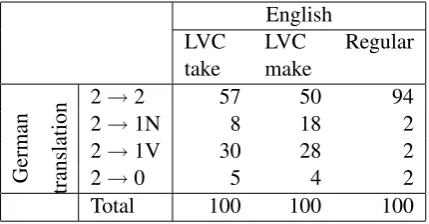
Table 1 shows how many times each of the four types of mapping (2-2; 2-1N; 2-1V; 2-0) between English constructions and their German transla-tion equivalents occurs in the sample.
We can see that the three types of construc-tions tend to be mapped to their German equiva-lents in different ways. First, both types of light verb constructions are mapped to a single Ger-man word much more often than the regular con-structions (38 instances of light verb concon-structions withtakeand 46 instances of light verb construc-tions with make vs. only 4 instances of regular constructions.). Confirming our initial hypothe-sis, this result suggests that the difference between fully compositional phrases and light verb con-structions in English can be described in terms of the degree of the “2-1” mapping to German trans-lation equivalents.
DE EN LVCs with
take
Both EN words 5 57 EN noun 63 79
EN verb 6 57
LVCs with
make
Both EN words 5 40 EN noun 58 58
EN verb 6 52
Regular construction
[image:5.595.79.283.61.200.2]Both EN words 26 42 EN noun 68 81 EN verb 32 47
Table 2: Well-aligned instances of LVCs withtake, withmake, and with regular constructions (out of 100), produced by an automatic alignment, in both alignment directions (target is indicated).
In the case where the German translation equiv-alent for an English construction is a verb, both components of the English construction are in-cluded in the corresponding German verb, the ver-bal category of the light verb and the lexical con-tent of the nominal complement. These instances are less compositional, more specific and id-iomatic (e.g. take+care↔k¨ummern, take+notice ↔ber¨ucksichtigen).
On the other hand, English constructions that correspond to a German noun are more compo-sitional, less idiomatic and closer to the regular verb usages (e.g. make+proposal ↔ Vorschlag, make+changes ↔ Korrekturen). The noun that
is regarded as their German translation equivalent is, in fact, the equivalent of the nominal part of the construction, while the verbal part is simply omitted. This result suggests that English light verb constructions with take are less composi-tional than the light verb constructions withmake.
4.2 Results on Automatic Alignment
We evaluate the quality of automatic alignment of light verb constructions in comparison with reg-ular phrases taking into account two factors, the alignment direction and the frequency of the ele-ments of the constructions. The results are pre-sented in the next two sections.
4.2.1 Direction of Alignment
Table 2 shows how the quality of automatic ment varies depending on the direction of align-ment, as well as on the type of construction. Re-call that more than one target word can be aligned to the same source word and all words of the target have to be aligned.
It can be noted that all the three types of con-structions are better aligned if the target language is English. However, the difference in the quality is bigger in light verb constructions than in regular constructions, clearly because in this direction the multi-word property of the English light verb con-structions can be represented. Both words are well aligned in light verb constructions withtakein 57 cases and withmakein 40 cases if the target lan-guages is English, which is comparable with regu-lar constructions (42 cases). However, if the target language is German, both types of light verb con-structions are aligned well (both words) in only 5 cases, while regular constructions are well aligned in 26 cases.
Looking into the alignment of the elements of the constructions (verbs and nouns) separately, we can notice that nouns are generally better aligned than verbs for all the three types of constructions, and in both directions. However, this difference is not the same in all cases. The difference in the quality of alignment of nouns and verbs is the same in both alignment directions for regular constructions, but it is more pronounced in light verb constructions if German is the target. On the other hand, if English is the target, the difference is smaller in light verb construction than in regular phrases. These results suggest that the direction of alignment influences more the alignment of verbs than the alignment of nouns in general. This influ-ence is much stronger in light verb constructions than in regular constructions.
Finally, our initial hypothesis that the quality of alignment of light verb constructions is lower than the quality of alignment of regular constructions has only been confirmed in the case where German is the target language (both words well aligned in 26 cases, compared to only 5 cases in both types of light verb constructions). Regular verbs are es-pecially better aligned than light verbs in this case (32 : 6). However, if the target is English, the qual-ity of alignment of regular constructions is simi-lar to that of light verb constructions with make
Frequency takeLVC makeLVC Regular
Low 12 25 62
High 76 35 8
Table 3: The three types of constructions parti-tioned by the frequency of the complements in the sample.
Well aligned
Freq takeLVC makeLVC Regular
Low Both 4 33 8 32 21 34
Freq N 8 66 8 32 47 75
V 4 33 12 48 53 85
High Both 47 62 18 51 4 50
Freq N 64 84 27 77 8 100
[image:6.595.75.287.62.106.2]V 58 76 18 51 4 50
Table 4: Counts and percentages of well-aligned instances of the three types of constructions in re-lation with the frequency of the complements in the sample. The percentages represent the number of well-aligned instances out of the overall number of instances within one frequency range. English is the target language.
4.2.2 Frequency
Since the quality of alignment of the three types of constructions proved different from what was expected in the case where English was the target language, we examine further the automatic align-ment in this direction. In particular, we study its interaction with frequency.
The frequency of the nouns is defined as the number of occurrences in the sample. It ranges from 1 to 20 occurrences in the sample of 100 in-stances. The instances of the constructions were divided into three frequency ranges: instances containing nouns with 1 occurrence were con-sidered as low frequency items; those contain-ing nouns that occurred 5 and more times in the sample were considered as high frequency items; nouns occurring 2, 3, and 4 times were considered as medium frequency items. Only low and high frequency items were considered in this analysis.
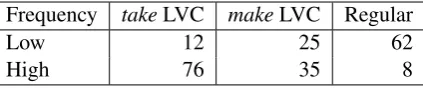
Table 3 reports the number of instances belong-ing to different frequency ranges. It can be noted that light verb constructions with take exhibit a small number of low frequency nouns. The num-ber of low frequency nouns increases in the con-structions withmake(25/100), and it is much big-ger in regular constructions (62/100). The op-posite is true for high frequency nouns (LVCs
with take: 76/100, with make: 35/100, regular: 8/100). Such distribution of low/high frequency items reflects different collocational properties of the constructions. In the most idiomatic construc-tions (withtake), lexical selection is rather limited which results in little variation. Verbs in regular constructions select for a wide range of different complements with little reoccurrence. Construc-tions withmakecan be placed between these two types.
[image:6.595.71.297.164.278.2]Different trends in the quality of automatic alignment can be identified for the three types of constructions depending on the frequency range of the complement in the constructions, as shown in Table 4. The quality of alignment of both com-ponents of the constructions is comparable for all the three types of constructions in low frequency items (in 33% of instances of light verb construc-tions with take, 32% of light verb constructions withmake, and 34% of regular constructions both the verb and the noun were well aligned). It is also improved in high frequency items in all the three types, compared to low frequency. However, the improvement is bigger in light verb construc-tions with take(62% well aligned cases) than in LVCs with make (51%) and in regular construc-tions (50%).4
Looking into the components of the construc-tions separately, we can notice interesting differ-ences in the quality of automatic alignment of verbs. The proportion of well-aligned verbs in-creases with the frequency of their complements in light verb constructions withtake(33% of low fre-quency items compared to 76% of high frefre-quency items.) It stays almost the same in light verb con-structions withmake(48% of low frequency items and 51% of high frequency items), and it even de-creases in regular items (85% of low frequency items compared to only 50% of high frequency items).
5 Discussion
The results reported in the previous section con-firm both components of our first hypothesis (on the expected differences in cross-lingual mapping) and refine the conditions under which the sec-ond hypothesis (on the expected differences in the quality of automatic alignment) is true. We discuss
4Note that the high frequency regular items are
these conclusions in detail here.
5.1 Manual Alignment
Recall that the first component of our first hypoth-esis indicated that it is expected that light verb constructions will be aligned with a single word more often than constructions headed by a regular verb.
The analysis of corpus data has shown that there is a clear difference between English regu-lar phrases and light verb constructions in the way they are mapped to their translation equivalents in German. Regular constructions are mapped word-by-word, with the English verb being mapped to the German verb, and the English noun to the Ger-man noun. A closer look into the only 4 exam-ples where regular constructions were mapped as “2-1” shows that this mapping is not due to the “lightness” of the verb. In two of these cases, it is the content of the verb that is translated, not that of the noun (produce+goods↔Produktion;
estab-lishes+rights↔legt). This never happens in light verb constructions.
On the other hand, light verb constructions are much more often translated with a single Ger-man word. In both subtypes of the “2-1” map-ping of light verb constructions, it is the con-tent of the nominal complement that is translated, not that of the verb. The noun is either trans-formed into a verb (take+look ↔ anschauen) or
it is translated directly with the verb being omitted (take+initiative↔Initiative).
This difference provides empirical grounds for distinguishing between semantically full and se-mantically impoverished verbs, a task that is often difficult on the basis of syntactic tests, since they often exhibit the same syntactic properties.
The second component of the first hypothesis indicated that it was expected that the two types of light verb constructions be differently aligned.
The finding that English light verb construc-tions withtaketend to be aligned more often with a single German verb and less often to a single Ger-man noun than the constructions withmake justi-fies classifying the instances into the types based on the heading verb, which is not a common prac-tice in the linguistic literature. It suggests that some semantic or lexical properties of these verbs can determine the type of the construction. More precisely, the meaning of the constructions with
takecan be regarded as less compositional than the
meaning of the constructions withmake. This dif-ference is also supported by the findings of a pre-liminary study of Serbian translation equivalents of these constructions (Samardˇzi´c, 2008). English constructions withtaketend to be translated with a single verb in Serbian, while the constructions withmakeare usually translated word-by-word.5
5.2 Automatic alignment
The second hypothesis conjectured that we would find lower overall quality of word alignment in the sentences containing light verb constructions than in the sentences that contain corresponding regular constructions. The findings of this re-search show that the interactions between align-ment and types of constructions is actually more complicated than this simple hypothesis, in some expected and some unexpected ways. To sum-marise, we found, first, better alignment of regu-lar constructions compared to light verb construc-tions only if the target language is German; sec-ond, overall, alignment if English is target is bet-ter than if German is target; and thirdly, we found a clear frequency by construction interaction in the quality of alignment.
The quality of automatic alignment of both reg-ular constructions and light verb constructions in-teracts with the direction of alignment. First, the alignment is considerably better if the target language is English than if it is German, which confirms the findings of (Och and Ney, 2003). Second, the expected difference in the quality of alignment between regular constructions and light verb constructions has only been found in the di-rection of alignment with German as the target language, that is where the “2-1” mapping is ex-cluded. However, the overall quality of alignment in this direction is lower than in the other.
This result could be expected, given the general morphological properties of the two languages, as well as the formalisation of the notion of word alignment used in the system for automatic align-ment. According to this definition, multiple words in the target language sentence can be aligned with a single word in the source language sentence, but not the other way around. Since English is 5The difference in the level of semantic compositionality
a morphologically more analytical language than German, multiple English words often need to be aligned with a single German word (a situation al-lowed if English is the target but not if German is the target).
The phrases in (3) illustrate the two most com-mon cases of such alignments. First, English tends to use functional words (the preposition of
in (3a)), where German applies inflection (geni-tive suffixes on the articledesand on the noun Ba-nanensektorsin (3b). Second, compounds are re-garded as multiple words in English (banana sec-tor), while they are single words in German ( Ba-nanensektors). This asymmetry explains both the fact that automatic alignment of all the three types of constructions is better when the target language is English and that the alignment of light verb con-structions is worse than the alignment of regular phrases when it is forced to be expressed as one-to-one mapping, which occurs when German is the alignment target.
(3) a. the infrastructure of the banana sector b. die Infrastruktur des Bananensektors Practically, all these factors need to be taken into consideration in deciding which version of alignment should be taken, be it for evaluation or for application in other tasks such as automatic translation or annotation projection. The inter-section of the two directions has been proved to provide most reliable automatic alignment (Pad´o, 2007; Och and Ney, 2003). However, it excludes, by definition, all the cases of potentially useful good alignments that are only possible in one di-rection of alignment.
Linguistically, the fact that the expected differ-ence in the quality of alignment between regular constructions and light verb constructions has only been found in the direction where English con-structions could not be aligned with single German words can be seen as another empirical indication of semantic impoverishment of light verbs in com-parison with full lexical verbs.
Finally, we found an unexpected frequency by construction interaction (Table 4), which explains the finding that regular phrases are not better aligned than light verb constructions if English is the target language (opposite to our second hy-pothesis). This interaction, well known in lan-guage processing and acquisition, occurs in those cases where marked constructions are very fre-quent. In our case, the marked construction is the
semi-compositional light verb construction with
take, which has frequent noun complements. In this case, despite the non-regularity of the con-struction, alignment is performed well if the di-rection of alignment allows its mapping to a sin-gle word. Also, with respect to this phenomenon, the constructions withtakebehave more markedly than those withmake.
What is especially interesting about these data is the fact that the alignment is different not just between light verb constructions and regular con-structions, but also between the two types of light verb constructions. The constructions with
takeexhibit more consistent properties of irregu-lar items, while the constructions withmakecan be positioned somewhere between irregular and regu-lar items. This additionally confirms the claim that these two types of constructions differ in the level of semantic compositionality, providing a basis for an improvement in their linguistic account.
6 Conclusions and Future Work
In this paper we have proposed a contrastive study of light verb constructions based on data collected through alignments of parallel corpora. We have shown how a linguistically refined analysis can shed light on particularly difficult cases for an alignment program, a useful result for improving current statistical machine translation systems. We have also shown how properties and behaviours of these constructions that can be found only in large parallel corpora and through sophisticated compu-tational tools can shed light on the linguistic nature of the constructions under study.
References
Roberto Basili, Diego De Cao, Danilo Croce,
Bonaven-tura Coppola, and Alessandro Moschitti. 2009.
Cross-language frame semantics transfer in
bilin-gual corpora. In Alexander F. Gelbukh, editor,
Proceedengs of the 10th International Conference on Intelligent Text Processing and Computational Linguistics, pages 332–345, Mexico City, Mexico. Springer.
Aljoscha Burchardt, Katrin Erk, Anette Frank, An-drea Kowalski, Sebastian Pad´o, and Manfred Pinkal. 2009. FrameNet for the semantic analysis of Ger-man: Annotation, representation and automation.
In Hans Boas, editor, Multilingual FrameNets in
Computational Lexicography: Methods and appli-cations, pages 209–244. Mouton de Gruyter.
Miriam Butt and Wilhelm Geuder. 2001. On the (semi)lexical status of light verbs. In Norbert Corver
and Henk van Riemsdijk, editors,Semilexical
Cate-gories: On the content of function words and the function of content words, pages 323–370, Berlin. Mouton de Gruyter.
Michael Collins, Philipp Koehn, and Ivona Kuˇcerov´a. 2005. Clause restructuring for statistical machine
translation. In Proceedings of the Annual
Meet-ing of the Association for Computational LMeet-inguistics (ACL), pages 531–540, Ann Arbor. Association for Computational Linguistics.
Jane Grimshaw and Armin Mester. 1988. Light verbs and theta-marking. Linguistic Inquiry, 19:205–232.
Richard Kayne. 2000. Parameters and Universals.
Oxford University Press, New York.
Kate Kearns. 2002. Light verbs in English.
Manuscript.
Philipp Koehn. 2005. Europarl: A parallel corpus for statistical machine translation. In Proceedings of MT Summit 2005, Phuket, Thailand.
LEO. 2006-9. LEO Online Dictionary. LEO
Dictio-naryTeam, http://dict.leo.org.
Franz Josef Och and Hermann Ney. 2003. A sys-tematic comparison of various statistical alignment
models. Computational Linguistics, 29(1):19–52.
Sebastian Pad´o. 2007. Cross-Lingual Annotation
Projection Models for Role-Semantic Information. Ph.D. thesis, Saarland University.
Tanja Samardˇzi´c. 2008. Light verb constructions in
English and Serbian. InEnglish Language and
Lit-erature Studies — Structures across Cultures, pages 59–73, Belgrade. Faculty of Philology.
Benjamin Snyder, Tahira Naseem, Jacob Eisenstein, and Regina Barzilay. 2009. Adding more languages improves unsupervised multilingual part-of-speech tagging: a Bayesian non-parametric approach. In
Proceedings of Human Language Technologies: The 2009 Annual Conference of the North American Chapter of the Association for Computational Lin-guistics, pages 83–91, Boulder, Colorado, June. As-sociation for Computational Linguistics.
Suzanne Stevenson, Afsaneh Fazly, and Ryan North. 2004. Statistical measures of the
semiproductiv-ity of light verb constructions. In Proceedings of