A Character-Based Intersection Graph Approach to Linguistic Phylogeny
Jessica Enright University of Alberta Edmonton, Alberta, Canada [email protected]
Abstract
Linguists use phylogenetic methods to build evolutionary trees of languages given lexical, phonological, and morpho-logical data. Perfect phylogeny is too re-strictive to explain most data sets. Con-servative Dollo phylogeny is more permis-sive, and has been used in biological ap-plications. We propose the use of conser-vative Dollo phylogeny as an alternative or complementary approach for linguistic phylogenetics. We test this approach on an Indo-European dataset.
1 Introduction
1.1 Language Phylogeny
A linguistic phylogenetic tree is a tree describing the evolution of some set of languages. Usually, we build such a tree using information given by a set of characters associated with those languages.
We say that a character back-mutated if after evolving from 0 state to 1 state, it subsequently is lost and switches back on the tree from1state to 0 state. We say that a character has parallel evolutionif it evolves twice on the tree from state
0to state1 independently. We say that a charac-ter isborrowedif, on the true evolutionary tree, it has been transfered from one branch to another by contact between linguistic groups. Loanwords are an example of this.
1.2 Perfect phylogeny
Given a set of binary characters C = {c1...cj},
we say that a rooted tree T = (r, VT, ET) with
languages L = l1...lk as the leaf nodes of T is
a perfect phylogeny if there is a binary labeling of each character at each node such that the root node is labeled with a zero for each character, and for each character both the subtree induced by the nodes labeled1 at that character, and the subtree
induced by the nodes labeled 0 at that character are connected.
This means that each character evolves exactly once, and that there is no back-mutation or bor-rowing.
We can recognize whether a set of characters admits a perfect phylogeny in polynomial time (Felsenstein, 2004). Unfortunately, often charac-ter data does not admit a perfect phylogeny.
Usually the question given character data is: How far away is this data from admitting a perfect phylogeny? What is the minimum level of bor-rowing, back mutation or parallel evolution that we must allow to produce a tree that describes this data? Answering this question is NP-Hard (Day et al., 1986).
Many approaches describe and formalize this question. Nakhleh et al. (2005b) provide an ex-cellent survey of linguistic phylogenetic methods. Nakhleh et al. (2005a) proposed perfect logeny networks as a way of considering the phy-logeny problem. A perfect phyphy-logeny network is a graph that is not required to be a tree such that every character exhibits a perfect phylogeny on at least one of the subtrees of that graph.
Unfortunately, even given a phylogenetic tree and character data, determining the minimum number of edges one must add to produce a per-fect phylogeny network is NP-Hard (Day et al., 1986). Nakhleh et al. (2005a) mention that ap-plying the perfect phylogeny network approach to their Indo-European language dataset is tractable only because one need only add very few edges to their tree to produce a perfect phylogeny network.
1.3 Dollo Phylogenies
In contrast to a perfect phylogeny, a Dollo phy-logeny allows an arbitrary number of back muta-tions.
Given a set of binary charactersC ={c1...cj},
we say that a rooted tree T = (r, VT, ET) with
{1, 1, 0 } {0, 1, 0 } {0, 0, 1 } {1, 0, 1 } {1, 1, 0 }
{1, 1, 0 } {0, 0, 0 }
[image:2.595.72.292.63.218.2]{1, 0, 1 }
Figure 1: A tree that is a conservative Dollo phy-logeny, but not a perfect phyphy-logeny, as charac-ters one and two back-mutate. The lists at each node contain the state of characters one, two, and three in that order.
languages L = l1...lk as the leaf nodes of T is
aDollo phylogeny if there is a binary labeling of each character at each node such that the root node is labeled with a zero for each character, and for each character the subtree induced by the nodes labeled1is connected.
This means that each character evolves exactly once but an arbitrary number of back-mutations are allowed. Unfortunately, every set of charac-ter data admits a Dollo phylogeny. Clearly Dollo phylogeny is too permissive to be a useful notion in linguistic phylogenetics.
Przytycka et al. (2006) discussed the idea of a conservative Dollo phylogeny.
Given a set of binary characters C ={c1...cj},
we say that a rooted tree T = (r, VT, ET) with languages L = l1...lk as the leaf nodes ofT is a
conservative Dollo phylogeny (CDP) if there is a binary labeling of each character at each node such that the root node is labeled with a zero for each character, for each character the subtree induced by the nodes labeled 1 is connected, and if two characters appear together in their 1states in the tree at an internal node, they also occur together in their1states in the tree at a leaf node. Recall that the leaves in this tree are the languages for which we have data. For an example, see Figure 1.
If two characters existed together in some an-cestral language, they must also exist together in at least one leaf language. That is, if they have ever existed together in the same language, we have ev-idence of it in the form of a known language that possessed both of those characters. Is this a rea-sonable assumption? We have no evidence that
it is. However, it’s certainly a more reasonable assumption than that required for a perfect phy-logeny. We expect that often, data sets will not admit a CDP, and that, like for perfect phylogeny, the question will be: How far away are the data from admitting a CDP?
Przytycka et al. (2006) prove that a set of char-acters admit a CDP if and only if their intersection graph is chordal. Chordal graphs are graphs with no induced cycles longer than three vertices. Rose et al. (1976) provide a linear-time recognition al-gorithm for chordal graphs.
GraphG= (V, E)is an intersection graph of a family of setsSif there is a bijectionFbetweenV
andS such that for every two setss, t ∈ S F(s)
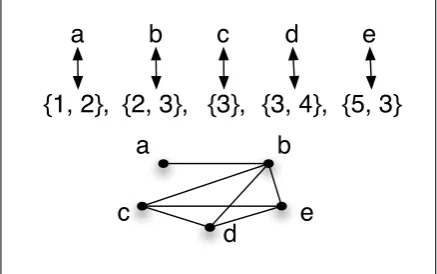
is adjacent to F(t) if and only if s intersects t. Setsintersects settif they share at least one ele-ment. Given sets, we can compute their intersec-tion graph in linear time. For an example of an intersection graph derived from a family of sets, see Figure 2.
{1, 2}, {2, 3}, {3}, {3, 4}, {5, 3}
a
b
c
d
e
a
b
c
e
d
Figure 2: An example of a family of sets labeled a, b, c, d, e on the top and the intersection graph of those sets on the bottom.
We can then determine if a set of characters ad-mits a CDP in linear time. This approach to phy-logeny was used by Przytycka et al. (2006) in a biological phylogenetic application. Here, we use it for linguistic phylogeny.
2 Methodology
[image:2.595.307.526.360.497.2]We ran our program on the Indo-European character dataset used by Nakhleh et al. (2005a), and available online at http://www.cs.rice.edu/ nakhleh/CPHL/.
2.1 Language Family Grouping
Nakhleh et al. (2005a) combined established lan-guage groups into a single lanlan-guage during com-putation to decrease comcom-putation time. We use the same families as they do, and do the same in two of our experiments.
For example, we consider the Tocharian lan-guage family, consisting of Tocharian A and Tocharian B to be a single language when building our intersection graph. This language grouping is done as a preprocessing step to the construction of the intersection graph of the characters.
We expect this transformation to be particularly useful in the CDP setting, beyond just decreasing computation time. We expect it will make our data closer to admitting a CDP in a way consistent with true evolutionary history.
Consider the difference between the intersec-tion graph of a set of characters with family group-ing and without. Letsandtbe two characters that, are considered to intersect with family grouping, but not without. Then sandt are not present in any of the same languages, but there are two lan-guages li, lj such thatli has charactersbut nott
and languagelj has charactert but not s, andli
andljare in the same familyL.
We use the language family definitions given by Nakhleh et al. (2005a), where these language fam-ilies are identified as consistent with all characters, and it is argued that it is very unlikely there is any borrowing between a portion of the tree inside the family, and a portion of the tree outside the family. Therefore, if s and t are both present within leaves in the language familyL, and neither is bor-rowed from outside the family, then each ofs, tis either present only within language family L, or is present in at least one internal node ancestral to language family L. Ifsandtare only present within the language family, they are not informa-tive when language family grouping is used.
However, if both s andt are present at an in-ternal node ancestral to language family L, then this is important information that we have derived by applying family language grouping, and will make the data closer to admitting a CDP in terms of number of borrowings required.
2.2 Binary Data
We made the data binary by separating states of a given character as best indicated by notes pro-vided by Nakhleh et al. (2005a) on their coding of the characters. In making the data binary, we have likely lost some constraining information. When a language (or language family, when that group-ing was used) has a unique state at a character, we coded this as having all possible non-ancestral states. The basis for this is that some of these codes indicate that there is no data for that char-acter at that language, or that if that language ac-tually does have a unique state at that character, it is uninformative, but could have evolved from any other state. Data processing by someone more highly trained in linguistics would either confirm this decision or provide an alternative approach. We have tried to remain as close as possible to how the data is used in Nakhleh et al. (2005a).
3 Experiments
We ran four experiments to investigate the use-fulness of the conservative Dollo parsimony ap-proach. We ran our implementation on:
1. All characters without language family grouping
2. All characters with language family grouping 3. Phonological and morphological characters
only without language family grouping 4. Phonological and morphological characters
only with language family grouping
4 Results
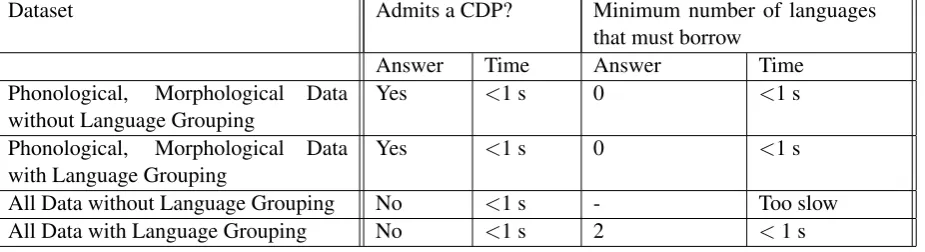
We give our results in Table 4
For the morphological and phonological dataset, both grouped and ungrouped, we ex-tracted a phylogenetic tree from our program’s output. These trees were consistent with Tree A in (Nakhleh et al., 2005a). The fact that we man-aged to build a tree consistent with expectations without any input tree is very encouraging.
Table 1: The results of conservative Dollo phylogeny checking algorithm on modified versions of the Indo-European character dataset as used in (Nakhleh et al., 2005a). We ran each program for at most 1 hour. Entries of ”Too slow” indicate that we did not allow the program to halt.
Dataset Admits a CDP? Minimum number of languages
that must borrow
Answer Time Answer Time
Phonological, Morphological Data without Language Grouping
Yes <1 s 0 <1 s
Phonological, Morphological Data with Language Grouping
Yes <1 s 0 <1 s
All Data without Language Grouping No <1 s - Too slow
All Data with Language Grouping No <1 s 2 <1 s
In our experiments without language grouping, we do not combine languages in this way, and in-stead consider all 24 languages separately.
5 Discussion
When is the CDP approach useful for linguistic phylogenetics?
Because a CDP allows back-mutation, it is likely most useful for datasets that exhibit a lot of back mutation, and not a lot of borrowing. Phono-logical and morphoPhono-logical characters are more likely to fit this requirement than lexical data. This is reflected in our positive results on the phonolog-ical and morphologphonolog-ical characters alone.
In contrast, when we included the lexical data, the dataset did not admit a conservative Dollo par-simony, whether or not we used language family grouping. We expect this is due to borrowing of lexical characters.
The full dataset with language family group-ing was much closer to admittgroup-ing a conserva-tive Dollo parsimony than the full dataset with-out language family grouping. As explained in our Methodology section, this was expected and rein-forces our position that language family grouping is extremely useful when computing conservative Dollo phylogenies.
Our experiments ran in either negligible time, or were not allowed to halt. The speed of the fast experiments suggests that computing conservative Dollo phylogenies might be useful in construct-ing a tree when no tree is known, and the amount of character data causes computing other types of phylogenies to be intractable.
6 Future Work
We are currently pursuing several extensions to this work.
First, we are developing an improved heuristic search for the minimum number of edges that need to be removed from or added to a graph to make the resulting graph chordal. This will enable us to use the Dollo phylogeny approach outlined here on character data sets that require more borrowing to fully explain them.
Using this improved search, we will run experi-ments on other sets of character data.
Nakhleh et al. (2005a) started with several pro-posed trees in their work on perfect phylogenetic networks. We plan to implement a version of our CDP approach that takes as input a proposed tree. This version will calculate the minimum number of edges that must be added to create a Dollo phylogeny network, as analogous to Nakhleh et al.’s perfect phylogenetic network. This minimum number of edges would be useful as a lower bound for the required number of edges one must add to produce a perfect phylogeny network.
7 Conclusion
We have presented an alternative phylogeny that may be of use in linguistic phylogenetics, par-ticularly on phonological or morphological data. We have proposed a number of future extensions based on our experiments that we hope will im-prove the performance of this approach.
Acknowledgments
References
William Day, David Johnson, and David Sankoff. 1986. The computational complexity of inferring rooted phylogenies by parsimony. Mathematical Biosciences, 81:33–42.
Joseph Felsenstein. 2004. Inferring Phyloge-nies. Number 1. Sinauer Associates, Massachusetts, USA.
Luay Nakhleh, Don Ringe, and Tandy Warnow. 2005a. Perfect phylogenetic networks: A new methodology for reconstructing the evolutionary history of natu-ral languages. Language (Journal of the Linguistic Society of America), 81(2):382–420.
Luay Nakhleh, Tandy Warnow, Don Ringe, and Steven N. Evans. 2005b. A comparison of phyloge-netic reconstruction methods on an ie dataset. The Transactions of the Philological Society, 3(2):171 – 192.
Teresa Przytycka, George Davis, Nan Song, and Dan-nie Durand. 2006. Graph theoretical insights into evolution of multidomain proteins. Journal of com-putational biology : a journal of comcom-putational molecular cell biology, 13(2):351–363.