Proceedings of the NAACL HLT 2010 Workshop on Semantic Search, pages 19–26,
Query-based Text Normalization Selection Models for Enhanced Retrieval
Accuracy
Si-Chi Chin Rhonda DeCook W. Nick Street David Eichmann
The University of Iowa Iowa City, USA.
{si-chi-chin, rhonda-decook, nick-street, david-eichmann}@uiowa.edu
Abstract
Text normalization transforms words into a base form so that terms from common equiv-alent classes match. Traditionally, informa-tion retrieval systems employ stemming tech-niques to remove derivational affixes. Deplu-ralization, the transformation of plurals into singular forms, is also used as a low-level text normalization technique to preserve more pre-cise lexical semantics of text.
Experiment results suggest that the choice of text normalization technique should be made individually on each topic to enhance informa-tion retrieval accuracy. This paper proposes a hybrid approach, constructing a query-based selection model to select the appropriate text normalization technique (stemming, deplural-ization, or not doing any text normalization). The selection model utilized ambiguity prop-erties extracted from queries to train a com-posite of Support Vector Regression (SVR) models to predict a text normalization tech-nique that yields the highest Mean Average Precision (MAP). Based on our study, such a selection model holds promise in improving retrieval accuracy.
1 Introduction
Stemming removes derivational affixes of terms therefore allowing terms from common equivalence classes to be clustered. However, stemming also in-troduces noise by mapping words of different con-cepts or meanings into one base form, thus impeding word-sense disambiguation. Depluralization, the conversion of plural word forms to singular form, preserves more precise semantics of text than stem-ming (Krovetz, 2000).
Empirical research has demonstrated the ambiva-lent effect of stemming on text retrieval perfor-mance. Hull (1996) conducted a comprehensive case study on the effects of four stemmer tech-niques and the removal of plural “s” 1 on retrieval performance. Hull suggested that the adoption of stemming is beneficial but plural removal is as well competitive when the size of documents is small. Prior research (Manning and Schtze, 1999; Mc-Namee et al., 2008) indicated that traditional stem-ming, though still benefiting some queries, would not necessarily enhance the average retrieval perfor-mance. In addition, stemming was considered one of the technique failures undermining retrieval perfor-mance in the TREC 2004 Robust Track (Voorhees, 2006). Prior research also noted the semantic differ-ences between plurals and singulars. Riloff (1995) indicated that plural and singular nouns are distinct because plural nouns usually pertain to the “general types of incidents,” while singular nouns often per-tain to “a specific incident.”
Nevertheless, prior research has not closely ex-amined the effect of the change of the semantics caused by different level of text normalization tech-niques. In our work, we conducted extensive exper-iments on the TREC 2004 Robust track collection to evaluate the effect of stemming and depluralization on information retrieval. In addition, we quantify the ambiguity of a query, extracting five ambiguity properties from queries. The extracted ambiguity properties are used to construct query-based selec-tion model, a composite of multiple Support Vector
1In our work, we not only removed the plural “s” or “es”
but also changed irregular plural forms such as “children” to its singular form “child”.
Regression models, to determine the most appropri-ate text normalization technique for a given query. To our knowledge, our work is the first study to con-struct a query-based selection model, using ambigu-ity properties extracted from provided queries to se-lect an optimal text normalization technique for each query.
The remainder of this paper is organized as fol-lows. In section 2 we describe our experimental setups and dataset. Section 3 describes and ana-lyzes experiment results of different text normaliza-tion techniques on the dataset. We discuss five am-biguity properties and validate each property in sec-tion 4. In secsec-tion 5 we describe the framework and the prediction results of the proposed query-based selection model. Finally, we summarize our findings and discuss future work in section 6.
2 Experiment Setup
The experiment utilizes the queries and relevance judgment results from the TREC 2004 Robust Track to evaluate the effect of three text normal-ization techniques – raw text, depluralized text, and stemmed text. The TREC 2004 Robust Track used a document set of approximately 528,000 documents comprising 1,904 MB of text. In total, 249 query topics were used in TREC Robust 2004.
Figure 1 illustrates the setup of the experiment. The collection is parsed with a SAX parser and stored in a Postgres database. Lucene is then used to generate three indices: indices of raw text, deplural-ized text, and stemmed text. The Postgres database stores each document of the collection, the query topics of the TREC 2004 Robust Track, and results of experiments. The ambiguity properties for each query is also computed in the Postgres system. We query Lucene indices to obtain the top 1,000 relevant results and compute Mean Average Precision (MAP) with the trec eval program to evaluate performance. We use R to analyze performance scores, generate descriptive charts, conduct non-parametric statisti-cal tests, and perform a paired t-test. We use Weka (Hall et al., 2009) to construct query-based selection model that incorporates multiple Support Vector Re-gression (SVR) models.
2.1 Query Models
The TREC 2004 Robust Track provides 249 query topics; each includes a title, a short description,
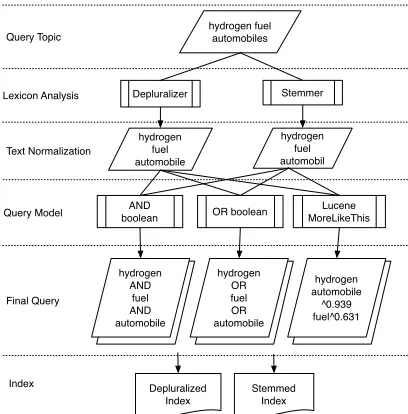
and a narrative (usually one-paragraph). We se-lected three basic query models as a modest base-line to demonstrate the effect of different text nor-malization techniques. Our future work will exploit other ranking models such as BM25 and LMIR. The three query models used in the experiment are: (1) boolean search with the title words of topics con-catenated with logical AND (e.g. hydrogen AND fuel AND automobiles); (2) boolean search with the title words of topics concatenated with logical OR (e.g. hydrogen OR fuel OR automobiles); (3) co-sine similarity with the title words of topics. Lucene MoreLikeThis (MLT) class supports both boolean and cosine similarity query methods for the exper-iment. Figure 2 shows how query topics are pro-cessed before interrogating the indices. Original queries are first depluralized or stemmed, further processed according to each query model, and fi-nally run against the depluralized and stemmed in-dices. The experiment runs unprocessed raw queries against the index of raw text, depluralized queries against the index of depluralized text, and stemmed queries against the index of stemmed text.
3 Experiment Results
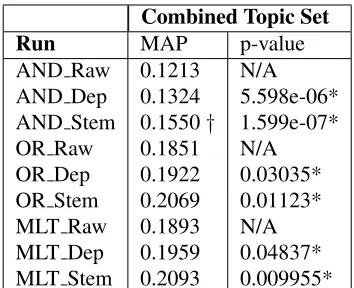
Table 3 and Figure 3 summarize the results for the full set of topics. Each row in Table 3 represents a query model combined with a given text normaliza-tion technique as described in secnormaliza-tion 2.1.
XMLParser
Postgres
DBMS Lucene
R
Lexicon Analysis
Lexicon Analysis
Lucene
Index Files Index Files
Index Files XML
Documents TREC Robust Track 2004
Ambiguity Calculator
Trec Eval Document
Process
DBMS Legend
Data
Query Topics
Search Results
Performance Score
Graphs Graphs
Graphs
Wilcoxon Tests
Paired T-test Weka
SVM Regression
Ambiguity Measures
[image:3.612.154.466.75.326.2]Text
Figure 1: Flow chart of experiment setup
Final Query Text Normalization Query Topic
Lexicon Analysis
Query Model AND OR boolean MoreLikeThisLucene
boolean hydrogen
fuel automobile
hydrogen fuel automobil hydrogen fuel
automobiles
Stemmer Depluralizer
Depluralized Index
Stemmed Index hydrogen
AND fuel AND automobile
Index
hydrogen OR fuel OR automobile
hydrogen automobile
^0.939 fuel^0.631
Figure 2: Using the query “hydrogen fuel automobiles” as an example, the depluralized query becomes “hydro-gen fuel automobile” and the stemmed query becomes “hydrogen fuel automobil.” Final boolean queries for de-pluralized topic become “hydrogen AND fuel AND au-tomobile” and “hydrogen OR fuel OR automobil.” More-LikeThis (MLT) is the Lucene class used for cosine sim-ilarity retrieval. A term vector score appends each word in the topic.
techniques are within 2%.
To visualize the relative performances among three text normalization techniques, we standardized the three MAP values for a single topic (one from each text normalization technique) to have mean 0 and standard deviation of 1. The result provides a 3-value pattern emphasizing the ordering of the MAPs across the text normalization techniques, rather than the raw MAP values themselves. We then used the K-medoids algorithm (Kaufman and Rousseeuw, 1990) to cluster the transformed data, applying Eu-clidean distance as the distance measure. Figure 4 is an example of 9 constructed clusters based on the MAP scores of the MLT query model. In a clus-ter, a line represents the standardized MAP value of a topic on each text normalization technique. Given the small differences in aggregate MAP per-formance, it is interesting to note that the clusters demonstrate variable patterns, indicating that some topics performed better as a depluralized query than a stemmed query.
[image:3.612.83.287.385.592.2]Query Model
Average Precision
and or mlt
0.0
0.2
0.4
0.6
0.8
1.0
1.2
Mean Average Precision vs. Query Model
0.0
0.2
0.4
0.6
0.8
1.0
1.2
0.0
0.2
0.4
0.6
0.8
1.0
1.2
0.0
0.2
0.4
0.6
0.8
1.0
1.2
0.0
0.2
0.4
0.6
0.8
1.0
1.2
0.0
0.2
0.4
0.6
0.8
1.0
1.2
0.0
0.2
0.4
0.6
0.8
1.0
1.2
0.0
0.2
0.4
0.6
0.8
1.0
1.2
0.0
0.2
0.4
0.6
0.8
1.0
1.2
0.0
0.2
0.4
0.6
0.8
1.0
1.2
raw
deplural
[image:4.612.75.294.91.279.2]stem
Figure 3: Profile plot of MAP
the next section, we address the issue of inconsis-tent performance by constructing regression models to predict the mean average precision of each query from the ambiguity measures, and choose an appro-priate normalization method based on these predic-tions.
4 Ambiguity Properties
Research has affirmed the negative impact of query ambiguity on an information retrieval system. As stemming clusters terms of different concepts, it should increase query ambiguity. To quantify the query ambiguity potentially caused by stemming, we compute five ambiguity properties for each query: 1) the product of the number of senses, re-ferred as the sense product; 2) the product of the number of words mapped to one base form (e.g. a stem), referred as the word product; 3) the ratio of the sense product of depluralized query to which of stemmed query, referred as the deplural-stem ratio; 4) the sum of the inverse document frequency for each word in a query, referred as the idf-sum; 5) the length of a query.
4.1 Sense Product
Sense product measures the extent of query ambigu-ity after stemming. We first find all words mapped to a given stem and, for each word, we then count the number of senses found in WordNet. To compute
Figure 4: Example of relative performance similarities among text normalization techniques. The cluster analy-sis uses the MAP scores of the MLT query model
Combined Topic Set
Run MAP p-value
[image:4.612.316.544.110.340.2]AND Raw 0.1213 N/A AND Dep 0.1324 5.598e-06* AND Stem 0.1550† 1.599e-07* OR Raw 0.1851 N/A OR Dep 0.1922 0.03035* OR Stem 0.2069 0.01123* MLT Raw 0.1893 N/A MLT Dep 0.1959 0.04837* MLT Stem 0.2093 0.009955*
[image:4.612.338.515.459.603.2]the number of senses for a given stem, we accumu-late the number of senses of each word mapped to the stem. The sense product is then the multiply-ing of the number of senses for each stemmed query term, computed as:
sense product=
n
Y
i=1 m
X
j=1
Sj (1)
Sj denotes the number of senses for each word
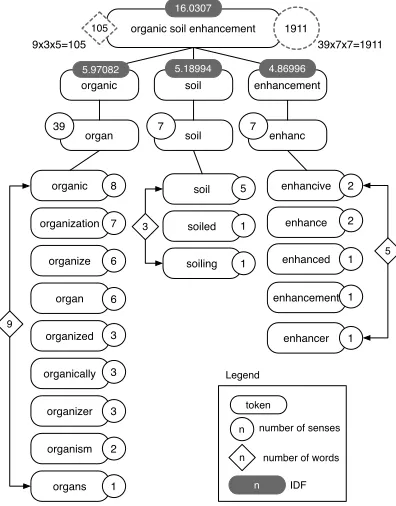
mapped to a stemi. We have m words mapped to a stem iand have n stems in a query. As the sense product increases, the query ambiguity increases. Figure 5 illustrates the computation of the sense product for the query “organic soil enhancement.” The term “organic” has the stem organ, which is a stem for 9 different words. The accumulated num-ber of senses for “organ” is 39. With the same ap-proach, we obtain 7 senses for 1 “soil” and 7 senses for “enhanc.” Therefore, multiplication 39, 7, and 7 gives us the sense product value 1911.
4.2 Word Product
Word product is an alternative measure of query am-biguity after stemming. To compute the word prod-uct, we multiply the number of words mapped to each stem of a given query, which is formulated as:
word product=
n
Y
i=1
Wi (2)
Wi denotes the number of words mapped to a
stem i, and n is the number of stems in a query. We assume that the query ambiguity increases as the word product increases. Consider the query “organic soil enhancement” in Figure 5. We find 9 words mapped to the stem “organ”; 3 words mapped to the stem “soil”; 5 words mapped to the stem “enhance-ment”. Therefore the word product for the query is 105, the product of 9, 3, and 5.
4.3 Deplural-Stem Ratio
Deplural-stem ratio is a variation of sense product. It takes the ratio of the sense product of a depluralized query to the stemmed query. As the deplural-stem ratio increases, the query ambiguity after stemming increases. In the example illustrated in Figure 5, the deplural-stem ratio is the sense product of the deplu-ralized query “organic soil enhancement” divided by
the sense product of the stemmed query “organ soil enhanc”. The deplural-stem ratio is computed as:
deplural-stem ratio=
Qn
i=1
Pm
j=1Smj
Qn
i=1
Pm
j=1Dj
(3)
4.4 Idf-sum
The idf-sum is the sum of the inverse document fre-quency (IDF) of each word in the query. The IDF of a given word measures the importance of the word in the document collection. Queries with high values of IDF are more likely to return relevant documents from the collection. For example, the term “ZX-Turbo,” describing a series of racing cars, has a high IDF and occurs only once in the entire TREC 2004 Robust Track collection. Therefore, searching the collection with the term “ZX-Turb” will return the only relevant document in the collection and achieve high precision and recall. The idf-sum is computed as:
idf sum=
n
X
i=1
IDFi (4)
IDFi denotes the idf of each query term i and
n is the number of words in a query. We assume that the query ambiguity decreases as the idf-sum in-creases. For the query “organic soil enhancement”, the IDF for each term is 5.97082 (organic), 5.18994 (soil), and 4.86996 (enhancement). The idf-sum of the query is 16.0307.
4.5 Query Length
The length of the query is the number of words in a query.
4.6 Feature Validation
organic soil enhancement
organic soil enhancement
organ soil enhanc
organic
organism organizer organization
organize
organ
organized
organically
soil
soiled
soiling
organs 8
7
6
6
3
3
3
2
1
5
1
1
enhancive
enhance
enhanced
enhancement
enhancer 2
2
1
1
1
39 7 7
39x7x7=1911 1911
5.97082 5.18994 4.86996
16.0307
token
n number of senses
n IDF
Legend
5 3
9
n number of words 105
[image:6.612.86.284.77.330.2]9x3x5=105
Figure 5: Example of ambiguity indicators on the query “organic soil enhancement”
Figure 6 demonstrates the distribution of ambigu-ity properties against the actual best text normaliza-tion technique. It is noted that stemming is the actual best method when a query has lower sense product, or lower word product, or a higher idf-sum. It im-plies that stemming is less likely to be the actual best method as a query is ambiguous. The results demon-strate the potential of utilizing ambiguity measures to select the actual best text normalization technique.
5 Query-based Selection Model
The cluster analysis in Section 3 suggests that the choice of text normalization technique should be made individually on each topic. The retrieval per-formance would be enhanced as we choose an ap-propriate text normalization technique for a given topic. Given the five ambiguity properties described in Section 4, we constructed Support Vector Regres-sion (SVR) (Smola and Schlkopf, 2004) models to choose between stemming, depluralization, and not doing any text normalization for different queries. Regression models aim to discover the relationship between two random variablesxandy. In our work, independent variable xis a vector of the five prop-erties described in section 4: x = (sense product,
word product, deplural-stem ratio, Idf-sum, length),
and dependent variable y is the MAP score of a given topic. SVR has been successfully applied for many time series and function estimation prob-lems. We utilized training data to construct multiple SVR models for each of nine combinations of query models (AND, OR, and MLT) and text normaliza-tion techniques (raw, depluralized, and stemmed queries). For example, the regression model for an MLT query model using stemmed queries is:
M ap M LT stem= 0.0853
−0.0849∗length
+ 0.6286∗sense prod
+ 0.0171∗word prod
−0.0774∗gap ds
+ 0.4189∗idf sum
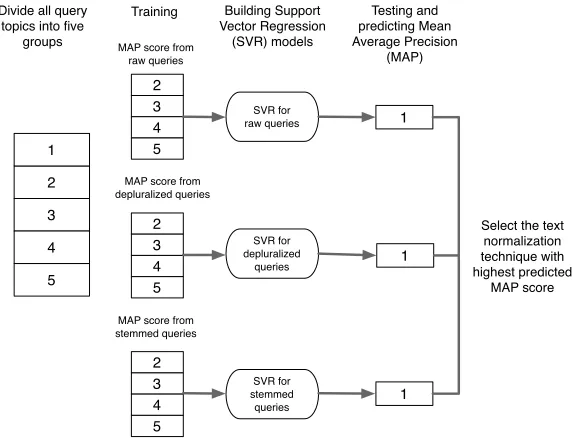
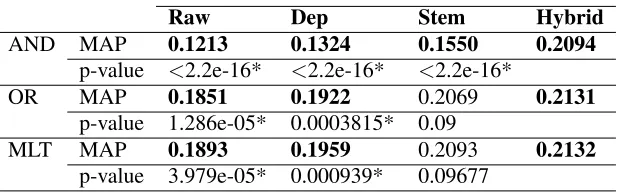
For a given query model, MLT, for example, we utilized training data to construct three SVR models each to predict the MAP scores of raw queries, de-pluralized queries, and stemmed queries in the test set. We then compared the predicted MAP score of a query and selected the text normalization technique with the highest predicted score. Figure 5 illustrates our experiment framework on the query-based se-lection model. We used five-fold cross-validation to evaluate the performance of the selection model. For each iteration (fold) we used the 4 out of the 5 parti-tions as training data, constructing SVR models and using the remaining fifth partition for testing. We ac-cumulated all testing results and computed one over-all MAP score for evaluation. Table 3 shows the re-sults of the five-fold cross-validation performed on 249 query topics provided by the TREC 2004 Ro-bust Track. We utilized a paired t-test to determine the performance difference between the query-based selection model (hybrid model) and other three text normalization techniques. The results in Table 3 shows that the query-based selection model attained the highest MAP score and achieved significant im-provement.
6 Conclusion and Future work
Feature Coefficient R-square P-value length -0.06811 0.07864 5.768e-05* log(sense prod) -0.034692 0.1482 1.819e-08* log(word prod) -0.04557 0.09426 9.78e-06* sqrt(ds ratio) -0.021657 0.03738 0.006088* idf sum 0.008498 0.04165 0.003747*
Table 2: Results of simple linear regression on the MAP of stemmed queries in MLT query model.
dep raw stem
0
2
4
6
8
10
Sense Product(log) vs. Actual Best Method
Actual Best Lexical Analysis
log(sense_prod)
dep raw stem
0
1
2
3
4
5
Word Product(log) vs. Actual Best Method
Actual Best Lexical Analysis
log(word_prod)
dep raw stem
5
10
15
20
25
30
35
IDF-sum vs. Actual Best Method
Actual Best Lexical Analysis
[image:7.612.86.517.230.393.2]idf_sum
Figure 6: Boxplots of the distribution of three ambiguity properties in each actual best text normalization technique
2
3
4 1
5
Divide all query topics into five
groups
Training
MAP score from raw queries
MAP score from depluralized queries
MAP score from stemmed queries
2 3 4 5
SVR for raw queries
2 3 4 5
SVR for depluralized
queries
2 3 4 5
SVR for stemmed
queries
Building Support Vector Regression
(SVR) models
Testing and predicting Mean Average Precision
(MAP)
1
1
1
Select the text normalization technique with highest predicted
MAP score
[image:7.612.162.450.459.678.2]Raw Dep Stem Hybrid
AND MAP 0.1213 0.1324 0.1550 0.2094
p-value <2.2e-16* <2.2e-16* <2.2e-16*
OR MAP 0.1851 0.1922 0.2069 0.2131
p-value 1.286e-05* 0.0003815* 0.09
MLT MAP 0.1893 0.1959 0.2093 0.2132
[image:8.612.153.462.69.166.2]p-value 3.979e-05* 0.000939* 0.09677
Table 3: Paired T-test was performed to examine the differences of each text normalization techniques (raw, deplu-ralizer, and stemmer) and query-based selection model (hybrid model). Significant differences between models are labeled with *.
a low-level text-normalization technique, introduces less ambiguity than stemming and preserves more precise semantics of text. The experimental re-sults demonstrate variable patterns, indicating that some topics performed better as a depluralized query than as a stemmed query. From Figure 4 in Sec-tion 3, we conclude that the choice of text nor-malization technique should be made individually on each topic. An effective query-based selection model would enhance information retrieval perfor-mance. The query-based selection model utilizes Support Vector Regression (SVR) models to predict the mean average precision (MAP) of each query from the ambiguity measures, and to choose an ap-propriate normalization technique based on these predictions. The selection is lightweight, requiring only analysis of the topic title itself against infor-mation readily available regarding the corpus (e.g, term idf values). We extracted 5 measures to quan-tify the ambiguity of a query: 1) sense product; 2) word product; 3) deplural-stem ratio; 4) idf-sum; 5) length of a query. The constructed query-based selection model demonstrate positive results on en-hanced performance. The experiments reported here show that, even when the improvement is modest (1%), the selection model competes well with tra-ditional approaches. To improve the model, future work may first explore and introduce more powerful features to the models, considering properties such as part of speech of text. Second, future work may explore the effect of noise and outliers in the data to improve the accuracy of the model. Finally, ad-ditional data mining techniques may be adopted in future work to further improve the prediction.
References
M. Hall, E. Frank, G. Holmes, B. Pfahringer, P. Reute-mann, and I.H. Witten. 2009. The WEKA Data
Min-ing Software: An Update. SIGKDD Explorations,
1:10–18.
David A. Hull. 1996. Stemming algorithms: A case study for detailed evaluation. Journal of the American Society for Information Science, 47(1):70–84. L. Kaufman and P.J. Rousseeuw. 1990. Finding groups
in data. An introduction to cluster analysis. Wiley, New York.
Robert Krovetz. 2000. Viewing morphology as an in-ference process. Artificial Intelligence, 118(1-2):277– 294, April.
Christopher D Manning and Hinrich Schtze. 1999. Foun-dations of Statistical Natural Language Processing. MIT Press, Cambridge, Mass.
Paul McNamee, Charles Nicholas, and James Mayfield.
2008. Don’t have a stemmer?: be un+concern+ed.
In Proceedings of the 31st International ACM SIGIR Conference on Research and Development in Informa-tion retrieval, pages 813–814, Singapore, Singapore. ACM.
Ellen Riloff. 1995. Little words can make a big differ-ence for text classification. InProceedings of the 18th International ACM SIGIR Conference on Research and Development in Information Retrieval, pages 130– 136, Seattle, Washington, United States. ACM. Alex J. Smola and Bernhard Schlkopf. 2004. A tutorial
on support vector regression. Statistics and Comput-ing, 14(3):199–222.