A Frame-Based Semantics of Locative Alternation in LTAG
Yulia Zinova
Heinrich Heine University D¨usseldorf Germany
Laura Kallmeyer
Heinrich Heine University D¨usseldorf Germany
Abstract
In this paper we present an analysis of locative alternation phenomena in Russian and English within a frame-based LTAG syntax-semantics interface. The combina-tion of a syntactic theory with an extended domain of locality and frames provides a powerful mechanism for argument linking. Furthermore, the concept of tree families and unanchored trees in LTAG allows for a decomposition of meaning into lexical and constructional components.
1 Introduction
There is a number of formalisms that capture the idea that the meaning of a verb-based construction depends both on the lexical meaning of the verb and on the construction in which the verb is used (Goldberg, 1995; Van Valin and LaPolla, 1997). The question is how exactly the meaning compo-nents are distributed and how they combine.
In (Kallmeyer and Osswald, 2012a) a combi-nation of Lexicalized Tree Adjoining Grammars (Joshi and Schabes, 1997) and Frame Semantics is introduced. Since LTAG displays an extended domain of locality and, related to this, elementary trees contain slots for all arguments of their lex-ical anchor, LTAG is particularly well-suited for combining it with a frame-based compositional semantics. When coupling an elementary tree with a semantic frame, as proposed in (Kallmeyer and Osswald, 2012a), syntactic arguments can be directly linked to their counterpart in the seman-tics. Semantic composition is then modeled by unification which is a result of performing adjunc-tions and substituadjunc-tions. Figure 1 provides a sim-ple illustration of syntactic and semantic compo-sition.
.... NP[I= 3 ]...
.. John
....S. ....
.. VP. ....
.. NP[I= 2 ]
. ..
.. V...
.. loves .
..
.. NP[I= 1 ]
.... NP[I= 4 ]...
.. Mary
3 [
person
NAME John ]
loving
EXPERIENCER 1 THEME 2 4
[
person
NAME Mary ]
Figure 1: Derivation forJohn loves Mary
Linguistic generalizations in LTAG are cap-tured a) by the distinction between lexical an-chor and unanan-chored elementary tree, b) by the concept of tree families (representing subcatego-rization frames) and c) by the factosubcatego-rization in the metagrammar. Parallel to this syntactic factor-ization, a factorization of meaning is possible as well. The resulting framework is very flexible with respect to the decomposition and composi-tion of lexical and construccomposi-tional units on the syn-tax and semantics level.
In the following, we present an analysis of loca-tive alternation that benefits from the flexibility of this framework. The structure of the paper is as follows. The next section presents the English and Russian data we are dealing with in this pa-per. Then, in section 3, we briefly introduce the framework of frame semantics in LTAG that we are using. Section 4 proposes an analysis of the locative alternation in English and Russian within this framework. In section 5, we further decom-pose the meaning of some Russian verbs, analyz-ing the semantics of certain prefixes that change the verb meaning such that a locative alternation becomes possible. Finally, section 6 concludes.
2 The Data
(1) - (4) show basic examples of locative alterna-tion in English and Russian. As there is no stan-dard name for this constructions in the literature, let us call the first variant ((1), (3))prepositional phrase construction,orPPC, and the second vari-ant ((2), (4)) -instrumental case construction, or
ICC, for convenience of referring to them.
(1) John1 loaded the hay2 into the wagon3.
(2) John1 loaded the wagon3 with hay2.
(3) Ivan1 Ivan
zagruzil loadedperf
seno2 hayacc
v
invagonwagon3gen. .
Ivan loaded the hay into a/the wagon. (4) Ivan1
Ivan
zagruzil loadedperf
vagon3 wagonacc
senom2. hayinstr.
Ivan loaded the wagon with hay.
PPCs are traditionally analyzed as having a change of location meaning and ICCs as having a change of state meaning (Kageyama, 1997; Levin and Rappaport Hovav, 1998; Goldberg, 1995). An analysis for (1) and (2) following (Kageyama, 1997) is provided in (5). It demonstrates that there is a difference between the two constructions, but only the difference in the perspective is shown.
(5) a. X CAUSE[BECOME[hay
BE ON truck]]
b. X CAUSE[BECOME[truckz
BE[WITH[hay BE ON z]]]]
(6) a. [[x ACT]CAUSE[y
BECOME Plocz] [LOAD]MAN N ER]
b. [[x ACT]CAUSE[z BECOME []ST AT E WITH-RESPECT-TO y] [LOAD]MAN N ER]
The analysis proposed in (Levin and Rappaport Hovav, 1998), which can be found under (6), pro-vides more detailed information about the differ-ence between PPCs and ICCs. (6-a) tells us that the hay changes its location as a result of the load-ing event, while (6-b) describes that the result is a change in the state of the wagon. One can notice that in (5) there is no explicit reference to the verb itself and the only component that is taken from the verb meaning is that the result of the loading is that theTHEMEis on theLOCATIONin the end.
The question that arises if one looks carefully at what the sentences in (1) - (4) mean is whether
it is really the case that there is no change of state in PPC examples? In fact, any loading activity leads to both a change of location of the content and some change of state of the container (if it is specified), just different components of the effect become more salient. As there is actually only one action, we propose the following formaliza-tion: the verb describes a change of location and the result state depends on the end amount ofPA -TIENT at the GOAL. If this amount is equal to
the capacity of the container, we get the change of state effect. If it is equal to the total amount of content, we have a holistic change of location effect.
Although at first Russian examples look sim-ilar to the English ones, there are a number of differences. While (4) has the same meaning as (2), (3) means that all the hay was loaded. On the other hand, if we consider imperfective examples (7) and (8), we find no holistic effect in either ICC and PPC case. Verbsgruzit’’to load’ andmazat’
’to spread’, ’to cover’ (examples (9) and (10)) are the only non-prefixed verbs that allow locative al-ternation in written language1. Other verbs allow
only one construction in their non-prefixed variant (see (11) and (12)) and both constructions, when a prefixza-is added (see (13) and (14)). A prefix
na-makes the verb perfective but does not change the set of constructions it can participate in, like in (15) and (16).
(7) Ivan1 Ivan
gruzil loadedimp
seno2 hayacc
v in
vagon3. wagongen.
Ivan was loading the hay into a/the wagon. (8) Ivan1
Ivan
gruzil loadedimp
vagon3 wacc
senom2. hayinstr.
Ivan was loading the wagon with hay. (9) On
Henamazaldistributedperf
maslo butteracc
na
onhleb.breadacc
He distributed butter over a piece of bread. (10) On
Henamazalcoveredperf
hleb breadacc
maslom. butterinstr
He covered a piece of bread with butter. (11) On
Hesypalputimp
sahar suggaracc
v
inbanku.canacc
He was putting sugar in a/the tin. (12) *On
He sypalcovered/filledimp
banku tinacc
saharom. sugarinstr
He covered/filled the tin with sugar. (13) On
Hezasypalputperf
sahar suggaracc
v
inbanku.canacc
He put sugar in a/the tin. (14) On
Hezasypalcovered/filledperf
banku tinacc
saharom. sugarinstr
He covered/filled the tin with sugar. (15) On
He
nasypal putperf
sahar suggaracc
v in
banku. canacc
He put sugar in a/the tin. (16) *On
He nasypalcovered/filledperf
banku tinacc
saharom. sugarinstr
He covered/filled the tin with sugar.
The aim of this work is to provide an analysis that correctly models the following: a) holistic fects for English ICC constructions, b) holistic ef-fects for Russian PPC and ICC constructions with perfective verb, and c) no holistic effect in other cases. We also aim at providing an explanation of why some verbs allow locative alternation and some do not and how the addition of a prefix to a Russian verb changes the set of constructions it can participate in.
3 LTAG and Frame Semantics
Following (Kallmeyer and Osswald, 2012a), we adopt a syntax-semantics interface that links a sin-gle semantic representation (in our case, a se-mantic frame) to an entire elementary tree and that models semantic composition by unifications triggered by substitution and adjunction. In this we partly follow (Gardent and Kallmeyer, 2003; Kallmeyer and Romero, 2008), except that our fo-cus is on event semantics and the decomposition of lexical meaning and we therefore use frames.
Formally, frames are taken to be typed feature structures. Each elementary tree is linked to a fea-ture strucfea-ture and unification is triggerd via the feature unifications in the syntax. For this pur-pose, some of the nodes in the elementary trees have semantic features such asI (for inidividual)
andE (for event). Their unifications cause
[image:3.595.78.279.71.263.2]equa-tions between metavariables. As a result, the cor-responding semantic feature structures are uni-fied as well. A simpliuni-fied example was given in Fig. 1 where the substitutions trigger unifications between 1 and 3 and between 2 and 4, which
leads to an insertion of the corresponding argu-ment frames into the frame ofloves.
....S. ....
.. VP[E= 4 ]...
.. V[E= 4 ]...
.. walked .
..
.. NP[I= 5 ]
.... VP[E= 8 ]. ....
.. PP[I= 7 ]. ....
.. NP[I= 7 ]
. ..
..P...
.. along .
..
.. VP∗[E= 8 ]
4
directed-motion-activity
EFFECTOR 5
PATH
path
STARTP 2 ENDP 3
MANNER WALKING
8
directed-motion
PATH [
path
REGION 10 ]
7 [
AT-REGION 9 ]
10 ⊆ 9
Figure 2: Path modification
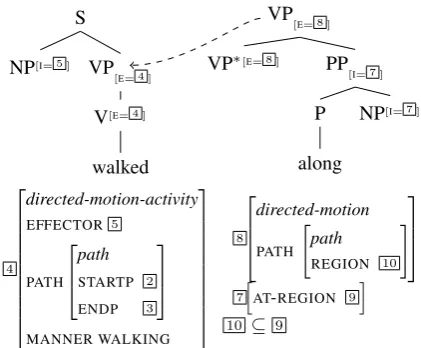
[image:3.595.301.512.72.246.2]An example taken from (Kallmeyer and Oss-wald, 2012a) involving an adjunction is given in Fig. 2 where the path of a walking activity is fur-ther restricted by an along ... PP modifier. The frames express that theAT-REGIONof the NP
em-bedded under the PP (for instance the brook in
John walked along the brook) contains the RE -GIONof the path. This containment is expressed
as an additional relation between feature values. Note that the feature structures used for seman-tics are more complex than the syntactic feature structures used in LTAG. However, this complex-ity is limited to the semantic part, the complexcomplex-ity of syntactic parsing remains unchanged.
As detailed in (Kallmeyer and Osswald, 2012a), LTAG’s decomposition of elementary trees into a) unanchored trees and lexical anchor and b) tree fragments of unanchored trees in the metagrammar can be paired with a correspond-ing decomposition of meancorrespond-ing, in particular into contributions of constructions and of lexical ele-ments. In this paper, we will exploit this for a dis-tinction of the meaning contributions of ICC and PPC constructions and of their lexical anchors.
4 Locative Alternation: The Analysis
In this section, we will examine the possible unan-chored trees involved in our examples of loca-tive alternations, relating the elementary tree tem-plates to the semantics of the construction. Fur-thermore, we will detail the semantics contributed by lexical anchors and we will show how syntactic composition triggers semantic frame unification.
scalar change of location
GOAL object PATIENT object
SCALE [
scale
MAX value
]
INIT [
state
VALUE value
]
RESULT [
state
VALUE value ]
[image:4.595.129.231.71.201.2]
Figure 3: Signature forscalar change of location
derived from the semantics of the verb and its ar-guments, while in the case of the ICC there is a part of the meaning, that comes from the construc-tion itself. The goal now is to provide the meaning of the ICC and of the verbs allowing locative al-ternation such that in combination they form the desired frame representation of the semantics of a sentence.
4.1 Feature Geometry
Following ideas in (Osswald and Van Valin, Jr., 2012) where one can find a discussion of the rep-resentation of events and results using Fillmores Frame Semantics (Fillmore, 1982) we introduce attributes of initial and result states and a scale which is determined by its type, maximum and minumum value. The change of state is either a decrease or an increase of a value on an ordered scale (a discussion of an analysis of scalar change can be found in (Kennedy and Levin, 2008)). The type of change of state determines the way the change happens. For example, change of loca-tion requires a patient and a goal and the patient is then moved to the goal according to the scale (for example, covered area or amount). Inside the scale attribute the maximum value (featureMAX)
is specified, the minimum value is assumed to be
0. Some of the verbs specify a concrete initial or result state (INIT and RESULT respectively), but loaddoes not have any initial or result state spec-ified within its semantics, so it just determines the scale with its maximum. Summarizing the ideas, one obtains the following for our analysis of loca-tive alternation:
• change of location and change of state are just
different interpretations of the result state of the scalar change of location;
• a scalar change of location is described by
S
NP[I=1]
VP
V⋄[S=0]
NP[I=2]
PP[I=3]
S
NP[I=1]
VP
V⋄[S=0]
NP[I=2] Figure 4: Unanchored trees for the PPC
S
NP[I=1]
VP
V⋄[S=0]
NP[I=3]
NPI N ST R[I=
2] S
NP[I=1]
VP
V⋄[S=0]
[image:4.595.343.469.77.204.2]NP[I=3] Figure 5: Unanchored trees for the ICC
PATIENT, GOAL, SCALE and initial and
re-sult values on it, which means that there is a change of location of PATIENT to GOAL,
such that the amount ofPATIENTat theGOAL
changes from the initial to the end value (cf. Fig. 3);
• the value ofSCALEis of typescalewith
pos-sible subtypes such asvolume, orarea, which can also have subtypes such ascapacity and
amountforvolumeorcoverageforarea.
4.2 The Construction
So far, we were looking only at examples where both container and content are realized. However, the constructions that are being discussed can also be used when only the direct object of the verb is present; in this case, they will have the same dif-ference in semantics. Therefore, for the PPC and ICC construction, we obtain the unanchored ele-mentary trees shown in Fig. 4 and Fig. 5.2 In the
ICC trees, the second NPIN ST R stands for both
NP in instrumental case in Russian and PP with
[image:4.595.341.481.244.365.2]0 causation effect
scalar change of location
[image:5.595.85.479.63.415.2]goal 3 object scale 4 [ scale max 7 ] patient 2 scale 4 init [ state value 0 ] result [ state value 7 ] 1
Figure 6: Frame for the ICC (English)
0 causation effect
scalar change of location
[image:5.595.307.487.211.400.2]goal 3 [ object scale 4 ] patient 2 scale 4 init [ state value 5 ] result [ state value 6 ] 1
Figure 7: Frame for the ICC (Russian)
prepositionwithin English.3
Let us present our analysis by going through the decomposition of the verbal trees for (1) - (4). Figures 6 and 7 show the frames for the unan-chored trees for the ICC in English and Russian respectively. The frame for the PPC is common for both languages and represented in Fig. 8. In all three frames, the scalar change of location is em-bedded under the EFFECT attribute of the causa-tionevent that describes the meaning of the verbal construction. The ICC frame in Fig. 6 expresses that in the initial state there is nothing at theGOAL
and in the result state the amount of PATIENTat
the GOAL is equal to the maximum value
speci-fied in theSCALEinside the GOAL. This gives us
the meaning that if the GOAL is a container and
thus has acapacity scale, it’s result state will be
full. As already mentioned, in Russian this is not necessarily so. Therefore, in Fig. 7, the effect of the causation is less specified. The part which is
3Note that, in order to adjoin VP modifiers, a more binary structure is actually needed. In this respect, our trees are slightly simplified for the sake of this paper.
0 causation EFFECTOR 1 PATIENT 2 [ SCALE 4 ] GOAL 3 EFFECT
scalar change of location
PATIENT 2 SCALE 4
Figure 8: PPC frame (English, Russian)
0 causation effector 1 patient 2 goal 3 cause [ activity effector 1 ] effect
scalar change of location
goal 3 patient 2 scale 14 init [ state value 15 ] result [ state value 16 ] 1
Figure 9: Frame for load (English, imperfective in Russian)
more specified in the English ICC construction, compared to the Russian one, comes with the per-fectivizing prefixes, like na- and za-. The PPC frame (Fig. 8) expresses that the relevant scale for the change of location is provided by the patient.
4.3 Semantic Frame Composition
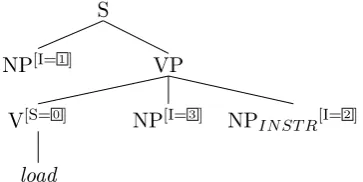
[image:5.595.322.504.641.732.2]Let us first go through the full composition of (2). Fig. 9 gives the lexical semantics ofload. When anchoring the ICC construction withload, yield-ing the tree in Fig. 10, the frames from Fig. 6 and Fig. 9 unify. The result is given in Fig. 11.
S
NP[I=1]
VP
V[S=0]
NP[I=3]
NPI N ST R[I= 2]
load
0 causation effector 1 patient 2 goal 3 cause [ activity effector 1 ] effect
scalar change of location
[image:6.595.74.498.66.335.2]goal 3 object scale 4 [ scale max 7 ] patient 2 scale 4 init [ state value 0 ] result [ state value 7 ] 1
Figure 11: Frame for theloadICC tree (English)
object TYPE wagon SCALE 21 [ capacity MAX 22 ] object TYPE hay SCALE 31 [ amount MAX 32 ]
Figure 12: Frames forwagonandhay
We assume that frames for nouns such as
wagon or haycome with a SCALE attribute that
can be for instance of typecapacityas forwagon
oramountas in the case ofhay, see Fig. 12. When substituting thewagoninto the direct object posi-tion, because of the linking I features, the value
3 of theGOAL feature in the frame in Fig. 11 is
unified with the wagon frame. As a result, the maximal value on thecapacityscale of thewagon
provides the value of the result state, yielding the frame in 13. At the next step, hayis substituted into the instrumental object slot in the tree (see Fig. 14), causing a unification of its frame with the value 2 ofPATIENT. The resulting frame (Fig. 15)
represents that in the result state the amount of hay in the wagon is equal to the maximal capacity of the wagon, in other words the wagon is full. As we have seen, the construction determines which scale is relevant for the result state; in an ICC con-struction it is the scale of the goal, i.e., the capac-ity of the wagon.
In contrast to this, in the PPC construction, the scale of the PATIENTis the relevant scale for the
scalar change of location. In the case ofhay, the
0 causation effector 1 patient 2 goal 3 object type wagon scale 4 [ capacity max 7 ] cause [ activity effector 1 ] effect
scalar change of location
goal 3 object type wagon scale 4 [ capacity max 7 ] patient 2 scale 4 init [ state value 0 ] result [ state value 7 ] 1
Figure 13: Frame forload wagon(ICC)
S
NP[I=1]
VP
V[S=0]
NP[I=3]
NPI N ST R[I= 2]
[image:6.595.307.485.377.469.2]load wagon with hay
Figure 14: Tree forload wagon with hay
change can be up to the total amount of hay. How-ever, as expressed in the PPC frame, theRESULT
value is not necessarily equal to theMAXvalue of
the relevant scale. Consequently, no holistic effect arises in this case.
5 Morphological Decomposition
Let us now turn to the Russian examples (11) -(16). There are two questions we aim to answer:
• How does holistic meaning arise?
• Why does adding the prefix za- make some verbs eligible for both ICC and PPC?
The idea is that most verbs, for examplesypat’
0
causation
effector 1
patient 2
type hay
scale 31
[
amount
max 32
]
goal 3
object
type wagon
scale 4
[
capacity
max 7
]
cause [
activity
effector 1
]
effect
scalar change of location
goal 3
patient 2
scale 4
init
[
state
value 0 ]
result [
state
value 7
]
1
Figure 15: Resulting frame for the ICC and load wagon with hay
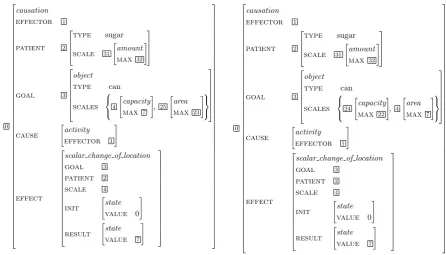
shown in Fig. 17. Note that, in contrast to the previous section, we now allow multivalued (i.e., set-valued) scale values for cases where several scales are possible. Can for instance has both a surface (area) that can be covered and a volume (capacity) that can be filled. When unifying with such a multivalued attribute, unification with one of the values must be successfull. When adding the noun in direct object position, the SCALE
in-side the change of location must unify with the
SCALEof the noun. In the case ofsypat’the
uni-fication fails since the typeamountcannot unify with any of the two scale types ofcan.
What happens when a prefix is added? First, the perfective meaning is added (the part of the meaning that comes together with the ICC in En-glish), see frames for bothna- (Fig. 19) and
za-(Fig. 18). Second, if the prefix za-is added, the scale restriction is removed (20). If the prefix
na-is added, the restriction remains. As a prelim-inary analysis of this, let us introduce attributes that can overwrite something instead of unifying with it. This operation is allowed only on the mor-phological level and thus does not affect the com-positionality of semantic derivation. The
under-0
causation
effector 1 patient 2
goal 3
cause
[ activity
effector 1 ]
effect
scalar change of location
goal 3
patient 2
scale 14 [
amount]
init
[ state
value 15 ]
result
[ state
value 16 ]
[image:7.595.74.271.72.366.2]1
Figure 16: Frame for Russian verbsypat’
object
type
can
scales
[
capacity
max
22]
,
[
area
max
23]
[image:7.595.305.500.73.288.2]1
Figure 17: Frame forbanka(can)
linedSCALE attribute in the frame forza-prefix
(Fig. 18) replaces theSCALEattribute in the verb
frame and we obtain the resulting frame in 20 for the verbzasypat’’to cover’, ’to fill’.4
This analysis is in line with ideas from (Filip, 2000; Filip, 2003), where the meaning of Slavic prefixes is discussed. Both prefixes presented here derive a perfective verb from an imperfective one, but with different meanings: while zasypat’is a quantized verb, nasypat’ (as well as sypat’) is a cummulative one and this leads to the restrictions on the direct object type (which is here expressed via the type of scales).
After the morphological step is computed, only standard unification is used. However, now the verb can participate in both the PPC and ICC con-structions because it is now unifiable (after com-bination with the construction frames) with ob-jects of container type (likecan), as well as with objects of a content type (likehayorsugar).
[image:7.595.315.505.323.412.2]
causation
effect
scalar change
scale 11
[ scale
max 12
]
init
[ state
value 0
]
result
[ state
value 12
]
[image:8.595.301.500.69.299.2]1 Figure 18: Frame for the prefixza
causation
effect
scalar change
scale
[
scale
max 12
]
init
[
state
value 0
]
result
[
state
value 12
]
[image:8.595.72.267.72.217.2]1 Figure 19: Frame for the prefixna
As mentioned above, at the moment we assume multiple values for theSCALEattribute of objects
like banka ’can’. An alternative solution might be to store the object frame in the lexicon with characteristic attributes of this object, such as a
CAPACITYattribute with a value of maximum
ca-pacity of the object, and then allow for such at-tributes to be transformed in theSCALEattribute.
We leave this issue for future research.
Let us illustrate the multivalue approach that we currently assume by performing the substitu-tion of the nounbanka’can’, Fig. 17 into the tree for the verb gruzit’ ’to load’ in the ICC. There are two different scale types inside the object of
canavailable for the unification while substituting
canin a direct object position in the ICC, capac-ityandarea. As there is no restriction on the type of the scale inside the verb, both unifications are possibe and lead to different interpretations of ex-ample (14): in case the capacity scale is selected, the result state of the can isfull(Fig. 21) and in case the area scale is selected, the can iscovered
(Fig. 22).
0
causation
effector 1
patient 2
goal 3
cause [
activity
effector 1
]
effect
scalar change of location
goal 3
patient 2
scale 14
[ scale
max 12
]
init
[ state
value 0 ]
result [
state
value 12
]
[image:8.595.71.258.246.399.2]1
Figure 20: Frame for Russian verbzasypat’
6 Conclusion
In this paper we present an analysis of locative alternation phenomena in Russian and English using the combination of an LTAG and Frame Semantics. This analysis uses LTAG’s mecha-nism of separation between unanchored elemen-tary trees and lexical anchors to separate the con-tribution of the lexical meaning from the contri-bution of construction and follows the ideas ex-pressed in (Kallmeyer and Osswald, 2012b). An advantage of combining LTAG with Frame Se-mantics is that LTAG’s extended domain of lo-cality allows direct linking of thematic roles of the arguments with corresponding syntactic slots. From the other side, Frame Semantics allows a reach meaning factorization, as is illustrated in the provided analysis of locative alternation.
Additionally, some ideas for morphological de-composition are presented, which is especially useful for languages with a rich morphology, such as Russian.
Acknowledgments
0 causation effector 1 patient 2 type sugar scale 31 [ amount max 32 ] goal 3 object type can scales 4 [ capacity max 7 ] , 25 [ area max 23 ] cause [ activity effector 1 ] effect
scalar change of location
[image:9.595.69.516.68.323.2]goal 3 patient 2 scale 4 init [ state value 0 ] result [ state value 7 ] 1
Figure 21: Frame for (14), ’fill’ variant
References
Hana Filip. 2000. The quantization puzzle. InEvents as Grammatical Objects, pages 3–60. CSLI Press, Stanford.
Hana Filip. 2003. Prefixes and the delimitation of events. Journal of Slavic Linguistics, 1(11):55–101. Charles J. Fillmore. 1982. Frame semantics. In The Linguistic Society of Korea, editor, Linguistics in the Morning Calm, pages 111–137. Hanshin Pub-lishing Co., Seoul.
Claire Gardent and Laura Kallmeyer. 2003. Semantic Construction in FTAG. In Proceedings of EACL 2003, pages 123–130, Budapest.
Adele E. Goldberg. 1995. Constructions. A Con-struction Grammar Approach to Argument Struc-ture. Cognitive Theory of Language and Culture. The University of Chicago Press, Chicago and Lon-don.
Aravind K. Joshi and Yves Schabes. 1997. Tree-Adjoning Grammars. In G. Rozenberg and A. Sa-lomaa, editors, Handbook of Formal Languages, pages 69–123. Springer, Berlin.
Taro Kageyama. 1997. Denominal verbs and rel-ative salience in lexical conceptual structure. In T. Kageyama, editor,Verb semantics and syntactic structure, pages 45–96. Kurioso Publishers, Tokyo. Laura Kallmeyer and Rainer Osswald. 2012a. An Analysis of Directed Motion Expressions with Lex-icalized Tree Adjoining Grammars and Frame Se-mantics. In Luke Ong, editor,Proceedings of WoL-LIC, Lecture Notes in Computer Science LNCS, September. To appear.
0 causation effector 1 patient 2 type sugar scale 31 [ amount max 32 ] goal 3 object type can scales 24 [ capacity max 22 ] , 4 [ area max 7 ] cause [ activity effector 1 ] effect
scalar change of location
goal 3 patient 2 scale 4 init [ state value 0 ] result [ state value 7 ] 1
Figure 22: Frame for (14), ’cover’ variant
Laura Kallmeyer and Rainer Osswald. 2012b. A frame-based semantics of the dative alternation in lexicalized tree adjoining grammars. Submitted to Empirical Issues in Syntax and Semantics 9. Laura Kallmeyer and Maribel Romero. 2008. Scope
and situation binding in LTAG using semantic uni-fication. Research on Language and Computation, 6(1):3–52.
Christopher Kennedy and Beth Levin. 2008. Measure of change: The adjectival core of degree achieve-ments. In L. McNally and C. Kennedy, editors, Adjectives and adverbs. syntax, semantics, and dis-course. Oxford University Press, Oxford.
Beth Levin and Malka Rappaport Hovav. 1998. Mor-phology and lexical semantics. In A. Spencer and A. M. Zwicky, editors, Handbook of morphology, pages 248–271. Blackwell Publishers, Oxford. Rainer Osswald and Robert D. Van Valin, Jr.
2012. Framenet, frame structure, and the syntax-semantics interface. Manuskript Heinrich-Heine Universit¨at.