Optimizing Generative Dialog State Tracker
via Cascading Gradient Descent
Byung-Jun Lee1, Woosang Lim1, Daejoong Kim2, Kee-Eung Kim1 1Department of Computer Science, KAIST 2 LG Electronics
Abstract
For robust spoken dialog management, various dialog state tracking methods have been proposed. Although discriminative models are gaining popularity due to their superior performance, generative models based on the Partially Observable Markov Decision Process model still remain at-tractive since they provide an integrated framework for dialog state tracking and dialog policy optimization. Although a straightforward way to fit a generative model is to independently train the com-ponent probability models, we present a gradient descent algorithm that simultane-ously train all the component models. We show that the resulting tracker performs competitively with other top-performing trackers that participated in DSTC2.
1 Introduction
Spoken dialog systems, a field rapidly growing with the spread of smart mobile devices, has to deal with challenges to become a primary user in-terface for natural interaction using conversations. One of the challenges is to maintain the state of the dialog in the conversational process, which is calleddialog state tracking. The dialog state en-capsulates the information needed to successfully finish the dialog, such as users’ goal or requests, and thus it is an essential entity in spoken dia-log systems. However, the error incurred by Au-tomatic Speech Recognition (ASR) and Spoken Language Understanding (SLU) makes the true user utterance not directly observable, and this makes it difficult to figure out the true dialog state. Various methods have been used to construct dialog state trackers. The traditional methods used in most commercial systems use hand-crafted rules that typically rely on the most likely result
from SLU. However, these rule-based systems are prone to frequent errors as the most likely result is not always correct. Hence, these systems of-ten drive the users to respond using simple key-words and to explicitly confirm everything they say, which is far from a natural conversational in-teraction. An accurate tracking of the dialog state is crucial for natural and efficient dialogs. On the other hand, modern methods take a statistical ap-proach to calculate the posterior distribution over the dialog states using multiple results from SLU in order to overcome the error in the most likely SLU result.
Statistical dialog state trackers can be catego-rized into two approaches depending on how the posterior calculation is modeled. The generative approachuses the generative model that describes how the SLU results are generated from the hidden dialog state and uses the Bayes’ rule to calculate the posterior. It has been a popular approach for statistical dialog state tracking, since it naturally fits into the Partially Observable Markov Decision Process (POMDP) (Williams and Young, 2007), an integrated model for dialog state tracking and dialog strategy optimization. In the POMDP point of view, the dialog state tracking is essentially be-lief monitoring, which is the task of calculating posterior distribution over the hidden state given the history of observations. Examples of the dia-log state trackers that take the generative approach include (Young et al., 2010; Thomson and Young, 2010; Raux and Ma, 2011)
On the other hand, thediscriminative approach directly models the posterior distribution. Since it avoids modeling of unnecessary aspects of the task, it typically achieves a better tracking accu-racy compared to the generative approach. Ex-amples of discriminative dialog state trackers in-clude (Lee, 2013; Metallinou et al., 2013). How-ever, their feature functions often refer to past ob-servations, and it remains yet to be seen whether
the discriminative approach can be successfully incorporated into POMDP or reinforcement learn-ing (RL) for dialog strategy optimization.
This paper is concerned with the generative ap-proach to dialog state tracking. In our earlier work (Kim et al., 2013), the optimization of the tracker was carried out independently for each component model (observation model, user action model, and belief refinement model) that com-prised our tracker. This was not exactly a proper way to train the tracker for overall performance optimization. In this paper, we present an opti-mization method, which we call “cascading gra-dient descent”, that trains component models si-multaneously. We show that this approach yields a dialog state tracker that performs on par with the best ones that participated in the second Dialog State Tracking Challenge (DSTC2).
The rest of the paper is organized as follows: We briefly review the background of our work in section 2, and present our method in section 3. We then explain the DSTC2 dialog domain and the ex-perimental settings in section 4, and discuss the re-sults in section 5. Finally, we conclude the paper with the summary and the suggestion for future work in section 6.
2 Background and Related Work
The dialog state tracking is formalized as fol-lows: In each turn of the dialog, the spoken dia-log system executes system actiona, and the user with goalgresponds to the system with utterance
u. The dialog state in each turn is defined s = (u, g, h), wherehis the dialog history encapsulat-ing additional information needed for trackencapsulat-ing the dialog state (Williams et al., 2005). The SLU pro-cesses the user utterance and generates the results as an N-best list o = [hu˜1, f1i, . . . ,hu˜N, fNi],
where ui˜ is the hypothesized user utterance and
fi is its confidence score1. Without loss of
gener-ality, we assume that the last item in the N-best list is the null itemh∅,1−PNi=1−1fii, representing the set of unrecognized user utterances. The statis-tical dialog state tracker maintains the probability distribution over states, called thebelief.
2.1 Discriminative Dialog State Tracking
Dialog state trackers taking the discriminative ap-proach calculates the belief via trained conditional
1Here we assume thatPN−1
i=1 fi≤1, acting as a posterior ofN-best list.
models that represent the belief directly. Maxi-mum Entropyis widely used for the discriminative approach, which formulates the belief as follows:
b0(g) =P(g|x) =η·exp(wTφ(x)) (1)
where η is the normalizing constant, x = (u1, a1, g1, . . . , ut, at, gt)is the history of user
ac-tions, system acac-tions, and user goals up to the cur-rent dialog turn t, φ(·) is the vector of feature functions onx, and finally,wis the set of model parameters to be learned from dialog data.
According to the formulation, the posterior computation has to be carried out forall possible user goals in order to obtain the normalizing con-stantη. This is not feasible for real dialog domains that have a large number of user goals (the DSTC2 dialog domain used on this paper has 371070 user goals).
Consequently, it is important for the discrimina-tive approach to reduce the size of the state space. (Metallinou et al., 2013) adopts the idea behind the HIS model and confines the set of possible goals to those appeared in SLU results. (Lee, 2013) as-sumed conditional independence between dialog state components to address scalability, and used conditional random field.
2.2 Generative Dialog State Tracking
In contrast, the generative approach to the dialog state tracking calculates the belief using Bayes’ rule, with the belief from the last turn b as a prior and the likelihood given the user utter-ance hypothesesPr(o|a, g, h). In the prior work (Williams et al., 2005), the likelihood is factored and some independence assumptions are made:
b0(g0, h0) =ηX
u
Pr(o|u) Pr(u|g0, a)· X
h
Pr(h0|g0, u, h, a)X
g
Pr(g0|g, a)b(g, h)
(2) where η is the normalizing constant and u is marginalized out in the belief.
hypothesis from SLU. This confines the possible goal state to the values that have been appeared as SLU hypotheses, and provides scalability without a loss of accuracy when the coverage of N-best list is large enough to include the true utterance. Us-ing the HIS model with an additional assumption that the user goal does not change (goal transition from one to another is 0), the belief update equa-tion (2) is reformulated as follows:
b0(ψ0, h0) =ηX u
Pr(o|u) Pr(u|ψ0, a)·
X
h
Pr(h0|ψ0, u, h, a) Pr(ψ0|ψ)b(ψ, h) (3)
whereψis a set of user goals that share the same belief. Each probability model in the above equa-tion has a name:Pr(o|u)is called theobservation model,Pr(u|ψ0, a)is called theuser action model, Pr(ψ0|ψ)is called thebelief refinement model, and Pr(h0|ψ0, u, h, a)is called thehistory model.
In this paper, we used the last turn’s belief of di-alog states as history state and preserved its depen-dence in the observation model to improve perfor-mance. With the changes, observation model can distinguish user actions without their value. For example,request alternativeuser action may have the power of diminishing dominant partitions, and it can only be learnt by the dependence with par-tition confidence. The belief update formula used in this paper becomes:
b0(ψ0) =ηX u
Pr(o|u, a, h)·
Pr(u|ψ0, a) Pr(ψ0|ψ)b(ψ) (4)
Other approaches to cope with the scalabil-ity problem in dialog state tracking is to adopt factorized dynamic Bayesian network by making conditional independence assumptions among di-alog state components, and use approximate in-ference algorithms such as loopy belief propa-gation (Thomson and Young, 2010) or blocked Gibbs sampling (Raux and Ma, 2011).
3 Cascading Gradient Descent
Although equation (4) is an elegant formulation of the dialog state tracking via Bayes rule, there has not been an integrated learning algorithm that simultaneously optimizes component probability models, i.e. the observation, the user action, and the belief refinement models. Our prior work (Kim
et al., 2013) relied on independently training each component probability model, and then simply plugging them into (4). Since the independent op-timization of component probability models does not lend itself to the optimization of overall dia-log state tracking performance, we added an ex-tra post-processing step called “belief ex- transforma-tion” in order to fine tune the results obtained from equation (4). Unfortunately, this effort gen-erally resulted in overfitting to the training data. In this paper, we present an integrated learning al-gorithm that simultaneously optimizes the compo-nent probability models of the HIS model.
We start with defining an objective function which measures the error of the dialog state track-ing:
E =XT
t=1 X
i
1
2(b(ψit)−rti)2 (5) wheretis the dialog turn,iis the partition index,
rt
i is the binary label with value 1 if and only if
the partitionψt
i contains the true user goal. Note
that our objective function coincides with the `2 performance metrics used in DSTC.
We then express component probability models as functions of features, which are parameterized by sets of weights, and rewrite equation (4):
b(ψit) =ηt X
(ut,ft)∈ot
PrwO(ut, ft, at, b(ψit−1))·
PrwU(ut|ψit, at) PrwR(ψti|ψti−1)b(ψit−1)
(6) where wO, wU, and wR represent the set of
pa-rameters for the observation, the user action, and the belief refinement models, respectively.
Our learning method is basically a gradient de-scent. The gradient of E with respect to wO is
derived as follows:
∂E ∂wO =
T
X
t=1 X
i
(b(ψt
i)−rti)∂b(ψ t i) ∂wO
By convenience, we define:
δti = X
(ut,ft)∈ot
PrwO(ut, ft, at, b(ψti−1))·
PrwU(ut|ψit, at) PrwR(ψti|ψti−1)b(ψit−1)
= X
(ut,ft)∈ot
pt
OptUptRb(ψti−1)
ηt= (X
i
and then obtain:
∂b(ψt i)
∂wO =
∂δt i ∂wO ·η
t+ ∂ηt ∂wO ·δ
t i
= ∂∂δwti
O ·η
t−b(ψt i)
X
i0
∂δt i0
∂wO ·η
t,
where
∂δt i ∂wO =
b(ψt−1
i )
X
(ut,ft)∈ot
∂pt
O
∂wOp
t
UptR
+∂b(ψti−1) ∂wO
X
(ut,ft)∈ot
pt
OptUptR
.
Gradients for the parameters of other com-ponent probability models are derived similarly. We call our algorithm cascading gradient descent since the gradient ∂b(ψit)
∂w requires computation of
the gradient in the previous dialog turn ∂b(ψti−1)
∂w ,
hence reflecting the temporal impact of the param-eter change in throughout the dialog turns.
Once we obtain the gradients, we update the pa-rameters using the gradient descent
w0O=wO−α
∂E ∂wO
,
w0
U=wU−α
∂E ∂wU
,
w0
R=wR−α
∂E ∂wR
whereαis the stepsize parameter.αis initially set to0.5and decreased by multiplying 1
10 whenever the overall cost function increases.
4 Dialog State Tracking in the Restaurant Information Domain
This section describes the dialog domain used for the evaluation of our dialog tracker and the com-ponent probability models used for the domain. An instruction on how to obtain the dataset and a more detailed description on the dialog domain can be found in the DSTC2 summary paper (Hen-derson et al., 2014).
4.1 Task Description
We used the DSTC2 dialog domain in which the user queries the database of local restaurants. The dataset for the restaurant information domain were originally collected using Amazon Mechani-cal Turk. A usual dialog proceeds as follows: the
user specifies the constraints (e.g. type of food, location, etc) or the name of restaurant he wants, and the system offers the name of a restaurant that qualifies the constraints. User then accepts the of-fer, and requests for additional information about accepted restaurant. The dialog ends when all the information requested by the user is provided.
The dialog state tracker should thereby clar-ify three types of information inside the state: goal, method, and requested. The goal state is composed of name, pricerange, area, and food slots, which is the information of the constraints that the user has. The method state represents what method user is using to accomplish his goal, whose value is one of thenone, by constraints, by alternatives, by name, or finished. Lastly, the re-quested state represents the information currently requested by the user, such as the address, phone number, postal code, etc. In this paper, we restrict ourselves to tracking the goal states only, but our tracker can be easily extended to track others as well.
The dialog state tracker updates the belief turn by turn, receiving SLU N-best hypotheses each with an SLU confidence score in every turn. De-spite the large number of states a dialog can have, in the most cases, the coverage of N-best hypothe-ses is enough to limit the consideration of possible goal state to values that has been observed in SLU hypotheses. Consequently, the task of the dialog state tracker is to generate a set of observed val-ues and their confidence scores for each slot, with the confidence score corresponding to the poste-rior probability of the goal state being the true goal state. The dialog state tracker also maintains a spe-cial goal state, calledNone, which represents that the true goal state has not been observed. Its poste-rior probability is also computed together with the observed goal states as a part of the belief update. For the rest of this section, we describe the models chosen for each component probabilities.
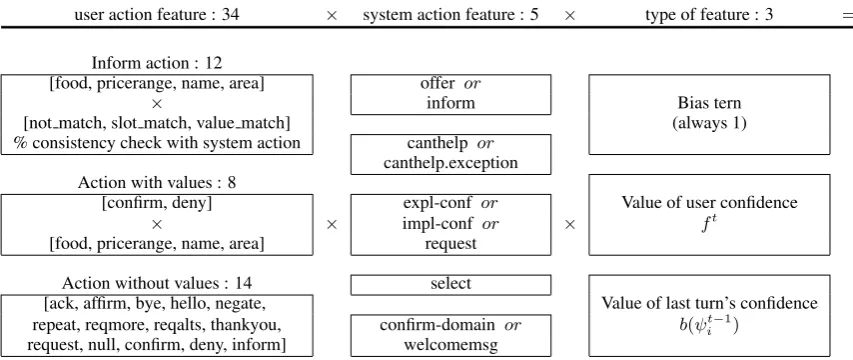
4.2 Observation Model
The observation model that describes the genera-tion of SLU result for the user utterance is defined as
Pr(o=hut, fti|u, a, h) =
ηoPrwO(ut, ft, at, b(ψit−1))
=ηo 1
1 + exp(−wT
user action feature : 34 × system action feature : 5 × type of feature : 3 = 510
Inform action : 12
[food, pricerange, name, area] offer or
× inform Bias tern
[not match, slot match, value match] (always 1)
% consistency check with system action canthelp or canthelp.exception Action with values : 8
[confirm, deny] expl-conf or Value of user confidence
× × impl-conf or × ft
[food, pricerange, name, area] request
Action without values : 14 select
[ack, affirm, bye, hello, negate, Value of last turn’s confidence repeat, reqmore, reqalts, thankyou, confirm-domain or b(ψt−1
i )
[image:5.595.73.500.67.247.2]request, null, confirm, deny, inform] welcomemsg
Table 1: 510 features used in observation model are specified.
whereφO(ut, ft, at, b(ψt−1
i ))is the vector of
fea-tures taken from the hypothesized user action ut,
its confidence scoreft generated from SLU,
sys-tem action at, and the belief of partition we are
dealing withb(ψti−1)from history state. Normal-ization constanteηocan be ignored since it is
sub-sumed by overall normalization constant η. Fea-ture details are specified in table 1.
4.3 User Action Model
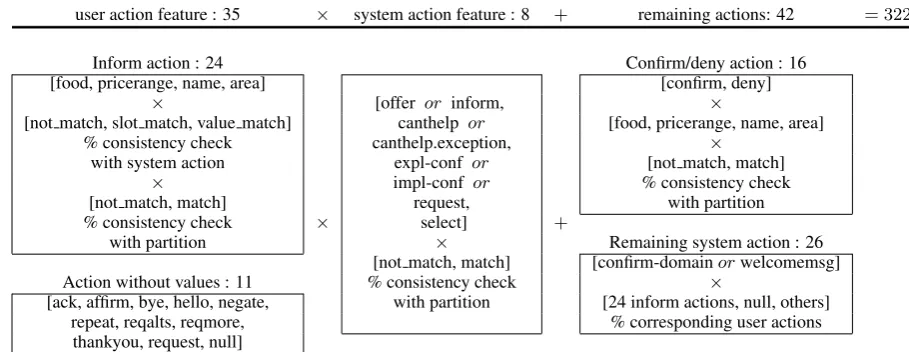
Similar to the observation model, the user action model that predicts the user action given the pre-vious system action and user goal is defined as
Pr(ut|ψti, at) = PrwU(ut|ψit, at)
= Pexp(wTUφU(ut, ψit, at)) uexp(wTUφU(u, ψti, at))
whereφU(ut, ψt
i, at) ∈ {0,1}322 is the vector of
features taken from the (hypothesized) user action
ut, system actionat, and the partition being
up-dated ψt
i. Softmax function is used to
normal-ize over possible user actions. Feature details are specified in table 2.
4.4 Belief Refinement Model
The belief refinement model predicts how the par-tition of the user goal will evolve at the next dialog turn. We defined it as a mixture of the empirical distribution and the uniform distribution obtained
from the training data:
PrwR(ψit|ψit−1)
= 1 + exp(1−w
R)
occurrence(ψt i, ψti−1) occurrence(ψti−1)
+
1−1 + exp(1−w
R)
|ψt i| |ψit−1|
where occurrence(ψt
i, ψti−1) is the number of
consecutive dialog turns in the training data with user goals being consistent with ψt−1
i in the
previous turn and ψt
i in the current turn, and occurrence(ψit−1)is defined similarly for a single turn only. The ratio of the two, which corresponds to the partition split probability used in (Young et al., 2010), is the first term in the mixture. On the other hand, if we use this empirical distribution only, we cannot deal with novel user goals that do not appear in the training data. Assuming that user goals are generated from the uniform distribution, the probability that the user goal is in a partition
ψis |Nψ| where|ψ|is the number of user goals in the partitionψ, andN is the total number of user goals. The probability thatψt
i gets split fromψit−1
is then |ψti|
|ψti−1|. Hence, we mix the two probabilities
for the resulting model.
user action feature : 35 × system action feature : 8 + remaining actions: 42 = 322
Inform action : 24 Confirm/deny action : 16
[food, pricerange, name, area] [confirm, deny]
× [offer or inform, ×
[not match, slot match, value match] canthelp or [food, pricerange, name, area]
% consistency check canthelp.exception, ×
with system action expl-conf or [not match, match]
× impl-conf or % consistency check
[not match, match] request, with partition
% consistency check × select] +
with partition × Remaining system action : 26
[not match, match] [confirm-domainorwelcomemsg]
Action without values : 11 % consistency check ×
[ack, affirm, bye, hello, negate, with partition [24 inform actions, null, others]
repeat, reqalts, reqmore, % corresponding user actions
[image:6.595.66.521.67.243.2]thankyou, request, null]
Table 2: 322 features used in user action model are specified.
5 Experimental Details
5.1 Datasets
The restaurant information domain used in DSTC2 is arranged into three datasets: train, dev, test. The first two datasets are labeled with the true user goals and user actions to optimize the dialog state tracker before submission. The half of the di-alogs are created with artificially degraded speech recognizers, intended to better distinguish the per-formances of trackers. Details of each dataset are as below:
• dstc2 train: Composed of 1612 dialogs of 11405 turns, produced from two different dialog managers with a hand-crafted dialog policy.
• dstc2 dev: Composed of 506 dialogs of 3836 turns, produced from the dialog man-agers used in dstc2 train set. Most of dialog state trackers show lower performance on this dataset than others.
• dstc2 test: Composed of 1117 dialogs of 9689 turns, produced from the dialog policy trained by reinforcement learning, which is not used for the train and dev datasets. We used both train and dev sets as the training data, as if they were one big dataset. Although the true labels for the test dataset were made pub-lic after the challenge, we did not use these labels in any way for optimizing our tracker.
5.2 Pre-training
One of the drawbacks in using gradient descent is convergence to a local optimum. We also
ob-served this phenomena during the training of our dialog state tracker via cascading gradient descent. Randomized initialization of parameters is a com-mon practice for gradient descent, but given the high-dimensionality of the parameter space, the randomized initialization had a limited effect in converging to a sufficiently good local optimum.
We adopted a pre-training phase where the pa-rameters of each component model are optimized individually. Once the pre-training is done for each component model, we gathered the param-eter values and took them as the initial paramparam-eter value for the cascading gradient descent. This pre-training phase helped tremendously converging to a good local optimum, and reduced the number of iterations as well. We pre-trained the parameters of each component model as follows:
• Observation Model: True user action labels in the training set are used as targets for the observation model. For every user action hy-pothesis in theN-best list, set the target value to 1 if the user action hypothesis is the true user action, and 0 otherwise. A simple gradi-ent descgradi-ent was used for pre-training.
oth-(a) Evaluation on accuracy metric (higher is better)
[image:7.595.195.407.69.172.2](b) Evaluation on L2 metric (lower is better) (c) Evaluation onROCV2,ca05metric (higher is better)
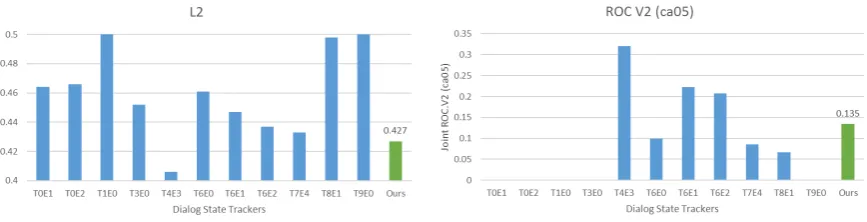
Figure 1: The overall results of proposed method. Each figure shows the evaluations over dstc2 test dataset by featured metrics (joint accuracy, joint l2, joint roc.v2) in DSTC2.
erwise. A simple gradient descent was also used for pre-training.
• Belief Refinement Model: Since there is only a single parameter for this model, we did not perform pre-training.
5.3 Results and Discussion
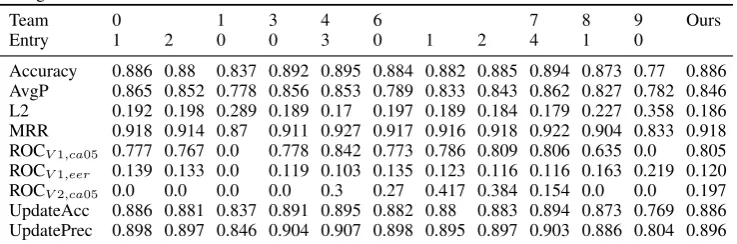
Table 3 shows the test set score of tracker im-plemented based on proposed algorithm, with the score of other trackers submitted to DSTC2. We tried 200 random initialised weights to train model with proposed algorithm, and learned model with the lowest training L2 error is picked to show the result on the test set. Because we only used live SLU and past data to track dialog state, other tracker results with the same condition are selected to compare with our tracker.
The implementation of our algorithm was not ready until the DSTC2 deadline. We participated as Team 8 using the old optimization method in (Kim et al., 2013). As shown in the table 3, the new algorithm shows a substantial improve-ment, achieving almost 15% decrease in the L2 error. Since both trackers are fine-tuned, this im-provement seems to be originated from the new optimization algorithm.
For all three featured metrics used to evalu-ate, tracker constructed with our proposed method shows competitive performance. The key to excel baseline tracker was to discover the relation be-tween user action and system action. For exam-ple, user actions that tell about the same slot sys-tem was talking about but giving different value are usually correcting wrong recognitions so far, which should significantly reduce the belief over state the system was tracking.
Due to the objective function that is designed to optimize L2 error, our tracker shows better perfor-mance at L2 error than the other metrics. For both all goal metric and joint goal metric, our tracker shows low L2 error when compared to other track-ers while the rank of accuracy metric is not so high. When the fact that our method as a genera-tive state tracker benefits from the ability to be eas-ily incorporated into POMDP framework is con-sidered, only similar performance to other trackers is satisfactory.
6 Conclusion
[image:7.595.87.521.219.330.2]al-All goal
Team 0 1 3 4 6 7 8 9 Ours
Entry 1 2 0 0 3 0 1 2 4 1 0
Accuracy 0.886 0.88 0.837 0.892 0.895 0.884 0.882 0.885 0.894 0.873 0.77 0.886 AvgP 0.865 0.852 0.778 0.856 0.853 0.789 0.833 0.843 0.862 0.827 0.782 0.846 L2 0.192 0.198 0.289 0.189 0.17 0.197 0.189 0.184 0.179 0.227 0.358 0.186 MRR 0.918 0.914 0.87 0.911 0.927 0.917 0.916 0.918 0.922 0.904 0.833 0.918 ROCV1,ca05 0.777 0.767 0.0 0.778 0.842 0.773 0.786 0.809 0.806 0.635 0.0 0.805 ROCV1,eer 0.139 0.133 0.0 0.119 0.103 0.135 0.123 0.116 0.116 0.163 0.219 0.120
ROCV2,ca05 0.0 0.0 0.0 0.0 0.3 0.27 0.417 0.384 0.154 0.0 0.0 0.197 UpdateAcc 0.886 0.881 0.837 0.891 0.895 0.882 0.88 0.883 0.894 0.873 0.769 0.886 UpdatePrec 0.898 0.897 0.846 0.904 0.907 0.898 0.895 0.897 0.903 0.886 0.804 0.896
Table 3: Test set scores averaged over all goal slots of our proposed algorithm and other trackers are presented. The goal slots are composed of food, pricerange, name and area.
Joint goal
Team 0 1 3 4 6 7 8 9 Ours
Entry 1 2 0 0 3 0 1 2 4 1 0
Accuracy 0.719 0.711 0.601 0.729 0.737 0.713 0.707 0.718 0.735 0.699 0.499 0.726 AvgP 0.678 0.66 0.503 0.659 0.636 0.54 0.619 0.638 0.673 0.583 0.522 0.658 L2 0.464 0.466 0.649 0.452 0.406 0.461 0.447 0.437 0.433 0.498 0.76 0.427 MRR 0.779 0.757 0.661 0.763 0.804 0.767 0.765 0.772 0.787 0.749 0.608 0.775 ROCV1,ca05 0.332 0.316 0.096 0.32 0.461 0.324 0.395 0.432 0.349 0.22 0.0 0.438 ROCV1,eer 0.256 0.254 0.382 0.249 0.208 0.281 0.241 0.226 0.243 0.299 0.313 0.218
[image:8.595.116.485.78.200.2]ROCV2,ca05 0.0 0.0 0.064 0.0 0.321 0.1 0.223 0.207 0.086 0.067 0.0 0.135 UpdateAcc 0.489 0.487 0.37 0.495 0.507 0.473 0.466 0.476 0.514 0.459 0.325 0.488 UpdatePrec 0.729 0.694 0.677 0.759 0.726 0.748 0.743 0.743 0.703 0.692 0.54 0.71
Table 4: Test set scores of joint goal slot of our proposed algorithm and other trackers are presented. The joint goal slot is a slot that is treated as correct when every goal slot is correct.
gorithm. Using proposed method on Hidden In-formation State model, we construct a tracker that performs competitively with DSTC2 par-ticipants, who mostly adopt discriminative ap-proaches. Since generative approach has much more potential to be extended to more com-plex models or toward different domains such as DSTC3, our tracker has the advantage over the other trackers.
Hidden Information State (HIS) model with cascading gradient descent has far more steps of improvement remaining. Although history state in current paper only includes previous partition belief due to implementation convenience, utiliz-ing additional history state is the key to improve performance even more. History state can in-clude any information depending on how we de-fine the state. The reason why the discriminative state tracking methods generally show good per-formance in terms of accuracy is rich set of poten-tially informative features, which can be employed by the history state.
In addition to the future improvements with
his-tory state, we can consider improving each prob-ability models. In this paper, probprob-ability mod-els are modeled with sigmoid function or soft-max function over weighted features, which is in other words a neural network with no hidden layer. The model used in this paper can naturally devel-oped by adding hidden layers, and ultimately deep learning techniques could be applicable. Apply-ing deep learnApply-ing techniques could help the his-tory state to find out influential hidden features to employ.
Acknowledgments
This work was supported by the IT R&D program of MKE/KEIT. [10041678, The Original Technol-ogy Development of Interactive Intelligent Per-sonal Assistant Software for the Information Ser-vice on multiple domains]
References
challenge. InProceedings of the SIGdial 2014 Con-ference, Baltimore, U.S.A., June.
Daejoong Kim, Jaedeug Choi, Kee-Eung Kim, Jungsu Lee, and Jinho Sohn. 2013. A specific analysis of a dialog state tracker in a challenge. InProceedings of the SIGDIAL 2013 Conference, pages 462–466. Sungjin Lee. 2013. Structured discriminative model
for dialog state tracking. Proceedings of the SIG-DIAL 2013 Conference, pages 442–451.
Angeliki Metallinou, Dan Bohus, and Jason D Williams. 2013. Discriminative state tracking for spoken dialog systems. In Proceedings of the 51st Annual Meeting of the Association for Computa-tional Linguastics, pages 466–475.
Antoine Raux and Yi Ma. 2011. Efficient probabilistic tracking of user goal and dialog history for spoken dialog systems. InINTERSPEECH, pages 801–804. Blaise Thomson and Steve Young. 2010. Bayesian update of dialogue state: A pomdp framework for spoken dialogue systems. Computer Speech & Lan-guage, 24(4):562–588.
Jason D Williams and Steve Young. 2007. Partially observable markov decision processes for spoken dialog systems. Computer Speech & Language, 21(2):393–422.
Jason D Williams, Pascal Poupart, and Steve Young. 2005. Factored partially observable markov deci-sion processes for dialogue management. In 4th Workshop on Knowledge and Reasoning in Practi-cal Dialog Systems, International Joint Conference on Artificial Intelligence (IJCAI), pages 76–82. Steve Young, Milica Gaˇsi´c, Simon Keizer, Franc¸ois