DCU-UVT: Word-Level Language Classification with Code-Mixed Data
Utsab Barman, Joachim Wagner, Grzegorz Chrupała†and Jennifer Foster CNGL Centre for Global Intelligent Content, National Centre for Language Technology
School of Computing, Dublin City University, Dublin, Ireland
†Tilburg School of Humanities, Department of Communication and Information Sciences Tilburg University, Tilburg, The Netherlands
{ubarman,jwagner,jfoster}@computing.dcu.ie [email protected]
Abstract
This paper describes the DCU-UVT team’s participation in theLanguage Iden-tification in Code-Switched Data shared task in the Workshop on Computational Approaches to Code Switching. Word-level classification experiments were car-ried out using a simple dictionary-based method, linear kernel support vector ma-chines (SVMs) with and without con-textual clues, and a k-nearest neighbour approach. Based on these experiments, we select our SVM-based system with contextual clues as our final system and present results for the Nepali-English and Spanish-English datasets.
1 Introduction
This paper describes DCU-UVT’s participation in the shared task Language Identification in Code-Switched Data (Solorio et al., 2014) at the Workshop on Computational Approaches to Code Switching, EMNLP, 2014. The task is to make word-level predictions (six labels: lang1, lang2, ne, mixed, ambiguousandother) for mixed-language user generated content. We submit pre-dictions for Nepali-English and Spanish-English
data and perform experiments using dictionaries, a
k-nearest neighbour (k-NN) classifier and a linear-kernel SVM classifier.
In our dictionary-based approach, we investi-gate the use of different English dictionaries as well as the training data. In the k-NN based approach, we use string edit distance,
character-n-gram overlap and context similarity to make predictions. For the SVM approach, we experi-ment with context-independent (word,
character-n-grams, length of a word and capitalisation in-formation) and context-sensitive (adding the
pre-vious and next word as bigrams) features in differ-ent combinations. We also experimdiffer-ent with adding features from thek-NN approach and another set of features from a neural network. Based on per-formance in cross-validation, we select the SVM classifier with basic features (word, character-n -grams, length of a word, capitalisation information and context) as our final system.
2 Background
While the problem of automatically identify-ing and analysidentify-ing code-mixidentify-ing has been iden-tified over 30 years ago (Joshi, 1982), it has only recently drawn wider attention. Specific problems addressed include language identifica-tion in multilingual documents, identificaidentifica-tion of code-switching points and POS tagging (Solorio and Liu, 2008b) of code-mixing data. Ap-proaches taken to the problem of identifying code-mixing include the use of dictionaries (Nguyen and Do˘gru¨oz, 2013; Barman et al., 2014; El-fardy et al., 2013; Solorio and Liu, 2008b), lan-guage models (Alex, 2008; Nguyen and Do˘gru¨oz, 2013; Elfardy et al., 2013), morphological and phonological analysis (Elfardy et al., 2013; El-fardy and Diab, 2012) and various machine learn-ing algorithms such as sequence labelllearn-ing with Hidden Markov Models (Farrugia, 2004; Ros-ner and Farrugia, 2007) and Conditional Random Fields (Nguyen and Do˘gru¨oz, 2013; King and Abney, 2013), as well as word-level classifica-tion using Naive Bayes (Solorio and Liu, 2008a), logistic regression (Nguyen and Do˘gru¨oz, 2013) and SVMs (Barman et al., 2014), using features such as word, POS, lemma and character-n-grams. Language pairs that have been explored include English-Maltese (Farrugia, 2004; Rosner and Far-rugia, 2007), English-Spanish (Solorio and Liu, 2008b), Turkish-Dutch (Nguyen and Do˘gru¨oz,
2013), modern standard Arabic-Egyptian di-alect (Elfardy et al., 2013), Mandarin-English (Li et al., 2012; Lyu et al., 2010), and English-Hindi-Bengali (Barman et al., 2014).
3 Data Statistics
The training data provided for this task consists of tweets. Unfortunately, because of deleted tweets, the full training set could not be downloaded. Out of 9,993 Nepali-English training tweets, we were able to download 9,668 and out of 11,400 Spanish-English training tweets, we were able to download 11,353. Table 1 shows the token-level statistics of the two datasets.
Label Nepali-English Spanish-English
lang1(en) 43,185 76,204
lang2(ne/es) 59,579 32,477
ne 3,821 2,814
ambiguous 125 341
mixed 112 51
[image:2.595.329.506.60.117.2]other 34,566 21,813
Table 1: Number of tokens in the Nepali-English and Spanish-English training data for each label
Nepali (lang2) is the dominant language in the Nepali-English training data but for Spanish-English, English (lang1) is dominant. The third largest group contains tokens with the labelother. These are mentions (@username), punctuation symbols, emoticons, numbers (except numbers that represent words such as2forto), words in a language other thanlang1andlang2and unintel-ligible words. Named entities (ne) are much less frequent and mixed language words (e.g. ramri-ness) and words for which there is not enough con-text to disambiguate them are rare. Hash tags are annotated as if the hash symbol was not there, e.g.
#truestoryis labelledlang1.
4 Experiments
All experiments are carried out for Nepali-English data. Later we apply the best approach to Spanish-English. We train our systems in a five-fold cross-validation and obtain best parameters based on average cross-validation results. Cross-validation splits are made based on users, i.e. we avoid the occurrence of a user’s tweets both in training and test splits for each cross-validation run. We ad-dress the task with the following approaches:
1. a simple dictionary-based classifier,
Resource Accuracy
BNC 43.61
LexNorm 54.60
TrainingData 89.53
TrainingData+BNC+LexNorm 90.71
Table 2: Average cross-validation accuracy of dictionary-based prediction for Nepali-English
2. classification using supervised machine learning withk-nearest neighbour, and 3. classification using supervised machine
learning with SVMs.
4.1 Dictionary-Based Detection
We start with a simple dictionary-based approach using as dictionaries(a)the British National Cor-pus (BNC) (Aston and Burnard, 1998), (b) Han et al.’s lexical normalisation dictionary (LexNorm) (Han et al., 2012) and (c) the training data. The BNC and LexNorm dictionaries are built by recording all words occurring in the respective corpus or word list as English. For the BNC, we also collect word frequency information. For the training data, we obtain dictionaries for each of the six labels and each of the five cross-validation runs (using the relevant 4/5 of training data).
To make a prediction, we consult all dictionar-ies. If there are more than one candidate label, we choose the label for which the frequency for the query token is highest. To account for the fact that the BNC is much larger than the training data, we normalise all frequencies before comparison. LexNorm has no frequency information, hence it is added to our system as a simple word list (we consider the language of a word to be English if it appears in LexNorm). If a word appears in multi-ple dictionaries with the same frequency or if the word does not appear in any dictionary or list, the predicted language is chosen based on the domi-nant language(s)/label(s) of the corpus.
We experiment with the individual dictionar-ies and the combination of all three dictionardictionar-ies, among which the combination achieves the high-est cross-validation accuracy (90.71%). Table 2 shows the results of dictionary-based detection ob-tained in five-fold cross-validation.
4.2 Classification with k-NN
[image:2.595.82.283.270.346.2]and choose the majority label of the subset as our prediction. For efficiency, we first selectk1 items
that share an n-gram with the token to be classi-fied.1 The set of k
1 items is then re-ranked
ac-cording to string edit distance to the test item and the bestk2matches are used to make a prediction.
Apart from varying k1 andk2, we experiment
with(a)lowercasing strings,(b)including context by concatenating the previous, current and next token, and (c) weighting context by first calcu-lating edit distances for the previous, current and next token separately and using a weighted aver-age. The best configuration we found in cross-validation uses lowercasing with k1 = 800 and
k2 = 16but no context information. It achieves
an accuracy of 94.97%.
4.3 SVM Classification
We experiment with linear kernel SVM classifiers using Liblinear (Fan et al., 2008). Parameter opti-misation2is performed for each feature set combi-nation to obtain best cross-validation accuracy.
4.3.1 Basic Features
Following Barman et al. (2014), our basic features are:
Char-N-Grams (G): We start with a charac-ter n-gram-based approach (Cavnar and Trenkle, 1994). Following King and Abney (2013), we se-lect lowercased charactern-grams (n=1 to 5) and the word as the features in our experiments.
Dictionary-Based Labels (D): We use presence in the dictionary of the 5,000 most frequent words in the BNC and presence in the LexNorm dictio-nary as bidictio-nary features.3
Length of words (L): We create multiple fea-tures for token length using a decision tree (J48). We use length as the only feature to train a deci-sion tree for each fold and use the nodes obtained from the tree to create boolean features (Rubino et al., 2013; Wagner et al., 2014).
1Starting withn = 5, we decreasen until there are at leastk1items and then we randomly remove items added in the last augmentation step to arrive at exactlyk1items. (For
n= 0, we randomly sample from the full training data.) 2C= 2iwithi=−15,−14, ...,10
3We chose these parameters based on experiments with each dictionary, combinations of dictionaries and various fre-quency thresholds. We apply a frefre-quency threshold to the BNC to increase precision. We rank the words according to frequency and used the rank as a threshold (e.g. 5K, top-10K etc.). With the top 5,000 ranked words andC = 0.25, we obtained best accuracy (96.40%).
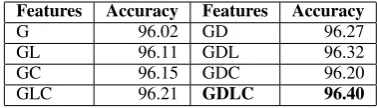
Features Accuracy Features Accuracy
G 96.02 GD 96.27
GL 96.11 GDL 96.32
GC 96.15 GDC 96.20
[image:3.595.321.510.62.116.2]GLC 96.21 GDLC 96.40
Table 3: Average cross-validation accuracy of 6-way SVMs on the Nepali-English data set; G = char-n-gram, L = binary length features, D = dict.-based labels and C = capitalisation features
Context Accuracy(%)
GDLC + P1 96.41
GDLC + P2 96.38
GDLC + N1 96.41
GDLC + N2 96.41
GDLC + P1+ N1 96.42
GDLC + P2+ N2 96.41
Table 4: Average cross-validation accuracy of 6-way SVMs using contextual features for Nepali-English
Capitalisation (C): We choose 3 boolean features to encode capitalisation information: whether any letter in the word is capitalised, whether all letters in the word are capitalised and whether the first letter is capitalised.
Context (Pi and Nj): We consider the previous iand nextjtoken to be combined with the current token, forming an (i+1)-gram and a (j+1)-gram, which we add as features. Six settings are tested. Table 4 shows that using the bigrams formed with the previous and next word are the best combina-tion for the task (among those tested).
Among the eight combinations of the first four feature sets that contain the first set (G), Table 3 shows that the 6-way SVM classifier4performs best with all features sets (GDLC), achieving 96.40% accuracy. Adding contextual information PiNj to GDLC, Table 4 shows best results for i=j=1, achieving 96.42% accuracy, only slightly ahead of the context-independent system.
4.3.2 Neural Network (Elman) and k-NN Features
We experiment with two additional features sets not covered by Barman et al. (2014):
Neural Network (Elman): We extract features from the hidden layer of a recurrent neural net-4We also test 3-way SVM classification (lang1,lang2and
[image:3.595.346.489.193.270.2]Systems Accuracy
GDLC 96.40
k-NN 95.10
Elman 89.96
GDLC+k-NN 96.31
GDLC+Elman 96.46
GDLC+k-NN+Elman 96.40
GDLC+P1N1 96.42
k-NN+P1N1 95.11
Elman+P1N1 91.53
GDLC+P1N1+k-NN 96.33
GDLC+P1N1+Elman 96.45
GDLC+P1N1+k-NN+Elman 96.40
Table 5: Average cross-validation accuracy of 6-way SVMs of combinations of GDLC,k-NN, El-man and P1N1features for Nepali-English
work that has been trained to predict the next char-acter in a string (Chrupała, 2014). The 10 most ac-tive units of the hidden layer for each of the initial 4 bytes and final 4 bytes of each token are bina-rised by using a threshold of 0.5.
k-Nearest Neighbour (kNN): We obtain fea-tures from our basic k-NN approach (Section 4.2), encoding the prediction of the k-NN model with six binary features (one for each label) and a nu-meric feature for each label stating the relative number of votes for the label, e.g. if k2 = 16
and 12 votes are for lang1 the value of the fea-ture votes4lang1 will be 0.75. Furthermore, we add two features stating the minimum and maxi-mum edit distance between the test token and the
k2selected training tokens.
Table 5 shows cross-validation results for these new feature sets with and without the P1N1
con-text features. Excluding the GDLC features, we can see that best accuracy is withk-NN and P1N1
features (95.11%). For Elman features, the accu-racy is lower (91.53% with context). In combina-tion with the GDLC features, however, the Elman features can achieve a small improvement over the GDLC+P1N1 combination (+0.04 percentage
points): 96.46% accuracy for the GDLC+Elman setting (without P1N1features). Furthermore, the
k-NN features do not combine well.5
4.3.3 Final System and Test Results
At the time of submission of predictions, we had an error in our GDLC+Elman feature combiner re-5A possible explanation may be that thek-NN features are based on only 3 of 5 folds for the training data (3 folds are used to make predictions for the 4th set) but 4 of 5 folds are used for test data predictions in each cross-validation run.
Tweets
Token-Level Tweet-Level
Nepali-English 96.3 95.8
Spanish-English 84.4 80.4
Surprise Genre
Token-Level Post-Level
Nepali-English 85.6 77.5
[image:4.595.324.509.60.147.2]Spanish-English 94.4 80.0
Table 6: Test set results (overall accuracy) for Nepali-English and Spanish-English tweet data and surprise genre
sulting in slightly lower performance. Therefore, we selected SVM-GDLC-P1N1 as our final
ap-proach and trained the final two systems using the full training data for Nepali-English and Spanish-English respectively. While we knew that C = 0.125is best for Nepali-English from our experi-ments, we had to re-tune parameter C for Spanish-English using cross-validation on the training data. We found best accuracy of 94.16% for Spanish-English with C = 128. Final predictions for the test sets are made using these systems.
Table 6 shows the test set results. The test set for this task is divided into tweets and a sur-prise genre. For the tweets, we achieve 96.3% and 84.4% accuracy (overall token-level accuracy) in Nepali-English and in Spanish-English respec-tively. For this surprise genre (a collection of posts from Facebook and blogs), we achieve 85.6% for Nepali-English and 94.4% for Spanish-English.
5 Conclusion
To summarise, we achieved reasonable accuracy with a 6-way SVM classifier by employing basic features only. We found that using dictionaries is helpful, as are contextual features. The perfor-mance of thek-NN classifier is also notable: it is only 1.45 percentage points behind the final SVM-based system (in terms of cross-validation accu-racy). Adding neural network features can further increase the accuracy of systems.
Briefly opening the test files to check for for-matting issues, we notice that the surprise genre data contains language-specific scripts that could easily be addressed in an English vs. non-English scenario.
Acknowledgments
[image:4.595.99.266.61.197.2]References
Beatrice Alex. 2008. Automatic detection of English inclusions in mixed-lingual data with an application to parsing. Ph.D. thesis, School of Informatics, The University of Edinburgh, Edinburgh, UK.
Guy Aston and Lou Burnard. 1998. The BNC hand-book: exploring the British National Corpus with SARA. Capstone.
Utsab Barman, Amitava Das, Joachim Wagner, and Jennifer Foster. 2014. Code-mixing: A challenge for language identification in the language of so-cial media. In Proceedings of the First Workshop on Computational Approaches to Code-Switching. EMNLP 2014, Conference on Empirical Methods in
Natural Language Processing, Doha, Qatar,
Octo-ber. Association for Computational Linguistics.
William B. Cavnar and John M. Trenkle. 1994. N-gram-based text categorization. In Theo Pavlidis, editor, Proceedings of SDAIR-94, Third Annual Symposium on Document Analysis and Information Retrieval, pages 161–175.
Grzegorz Chrupała. 2014. Normalizing tweets with edit scripts and recurrent neural embeddings. In
Proceedings of the 52nd Annual Meeting of the As-sociation for Computational Linguistics (Volume 2:
Short Papers), pages 680–686, Baltimore,
Mary-land, June. Association for Computational Linguis-tics.
Heba Elfardy and Mona Diab. 2012. Token level identification of linguistic code switching. In Pro-ceedings of ProPro-ceedings of COLING 2012: Posters (the 24th International Conference on Computa-tional Linguistics), pages 287–296, Mumbai, India.
Heba Elfardy, Mohamed Al-Badrashiny, and Mona Diab. 2013. Code switch point detection in Ara-bic. InNatural Language Processing and Informa-tion Systems, pages 412–416. Springer.
Rong-En Fan, Kai-Wei Chang, Cho-Jui Hsieh, Xiang-Rui Wang, and Chih-Jen Lin. 2008. LIBLINEAR: A library for large linear classification. Journal of
Machine Learning Research, 9:1871–1874.
Paulseph-John Farrugia. 2004. TTS pre-processing is-sues for mixed language support. In Proceedings of CSAW’04, the second Computer Science Annual
Workshop, pages 36–41. Department of Computer
Science & A.I., University of Malta.
Bo Han, Paul Cook, and Timothy Baldwin. 2012. Automatically constructing a normalisation dictio-nary for microblogs. In Proceedings of the 2012 Joint Conference on Empirical Methods in ral Language Processing and Computational
Natu-ral Language Learning, pages 421–432. Association
for Computational Linguistics.
Aravind K. Joshi. 1982. Processing of sentences with intra-sentential code-switching. In J. Horeck´y, ed-itor, Proceedings of the 9th conference on Compu-tational linguistics - Volume 1 (COLING’82), pages 145–150. Academia Praha, North-Holland Publish-ing Company.
Ben King and Steven Abney. 2013. Labeling the lan-guages of words in mixed-language documents us-ing weakly supervised methods. InProceedings of the 2013 Conference of the North American Chap-ter of the Association for Computational
Linguis-tics: Human Language Technologies, pages 1110–
1119, Atlanta, Georgia, June. Association for Com-putational Linguistics.
Ying Li, Yue Yu, and Pascale Fung. 2012. A mandarin-english code-switching corpus. In Nico-letta Calzolari (Conference Chair), Khalid Choukri, Thierry Declerck, Mehmet Uur Doan, Bente Mae-gaard, Joseph Mariani, Asuncion Moreno, Jan Odijk, and Stelios Piperidis, editors, Proceedings of the Eight International Conference on Language
Resources and Evaluation (LREC’12), Istanbul,
Turkey, may. European Language Resources Asso-ciation (ELRA).
Dau-Cheng Lyu, Tien Ping Tan, Engsiong Chng, and Haizhou Li. 2010. SEAME: A Mandarin-English code-switching speech corpus in South-East Asia.
In INTERSPEECH 2010, 11th Annual Conference
of the International Speech Communication
Asso-ciation, volume 10, pages 1986–1989, Makuhari,
Chiba, Japan. ISCA Archive.
Dong Nguyen and A. Seza Do˘gru¨oz. 2013. Word level language identification in online multilingual communication. In Proceedings of the 2013 Con-ference on Empirical Methods in Natural Language
Processing (EMNLP 2013), pages 857–862, Seattle,
Washington, USA, October. Association for Com-putational Linguistics.
Mike Rosner and Paulseph-John Farrugia. 2007. A tagging algorithm for mixed language identifica-tion in a noisy domain. In INTERSPEECH-2007, 8th Annual Conference of the International Speech
Communication Association, pages 190–193. ISCA
Archive.
Raphael Rubino, Joachim Wagner, Jennifer Foster, Jo-hann Roturier, Rasoul Samad Zadeh Kaljahi, and Fred Hollowood. 2013. DCU-Symantec at the WMT 2013 quality estimation shared task. In Pro-ceedings of the Eighth Workshop on Statistical Ma-chine Translation, pages 392–397, Sofia, Bulgaria. Association for Computational Linguistics.
Thamar Solorio and Yang Liu. 2008a. Learning to pre-dict code-switching points. In Proceedings of the Conference on Empirical Methods in Natural
Lan-guage Processing, pages 973–981. Association for
Computational Linguistics.
Proceedings of the Conference on Empirical
Meth-ods in Natural Language Processing, pages 1051–
1060. Association for Computational Linguistics. Thamar Solorio, Elizabeth Blair, Suraj Maharjan, Steve
Bethard, Mona Diab, Mahmoud Gonheim, Abdelati Hawwari, Fahad AlGhamdi, Julia Hirshberg, Alison Chang, and Pascale Fung. 2014. Overview for the first shared task on language identification in code-switched data. InProceedings of the First Workshop on Computational Approaches to Code-Switching. EMNLP 2014, Conference on Empirical Methods in
Natural Language Processing, Doha, Qatar,
Octo-ber. Association for Computational Linguistics. Joachim Wagner, Piyush Arora, Santiago Cortes, Utsab
Barman, Dasha Bogdanova, Jennifer Foster, and Lamia Tounsi. 2014. DCU: Aspect-based polarity classification for SemEval task 4. InProceedings of the International Workshop on Semantic Evaluation
(SemEval-2014), pages 392–397, Dublin, Ireland,